The Social Self
George Herbert Mead
Norman L. Santos
Discussant
OBJECTIVES
1. Recognize George Herbert Mead and his
significant contribution to social psychology.
2. Explain the Social Self Theory
3. Differentiate between the concepts of ‘me’
and ‘I’
4. Describe the looking-glass self
MOTIVATION
George Herbert Mead
George Herbert Mead:
The Social Self
The Self: the part of an individual’s personality
composed of self-awareness and self-image
Social Self Theory is based on the perspective that the
self emerges from social interactions
The self is not there from birth, but it is developed
over time from social experiences and activities.
Mead’s Development of Self
 Language develops self by allowing individuals to
respond to each other through symbols, gestures,
words, and sounds.
 Play develops self by allowing individuals to take
on different roles, pretend, and express expectation
of others.
 Games develop self by allowing individuals to
understand and adhere to the rules of the activity.
Mead’s I and Me
The 'me' is considered the socialized
aspect of the individual. The 'me'
represents learned behaviors, attitudes,
and expectations of others and of
society.
generalized other, a phase of the self that
is in the past
Mead’s I and Me
The 'I', therefore, can be considered the
present and future phase of the self.
The 'I' represents the individual's identity
based on response to the 'me.‘
The 'I' says, 'Okay.Society says I should
behave and socially interact one way, and I
think I should act the same (or perhaps
different),' and that notion becomes self.
Charles Horton Cooley
The Looking-Glass Self
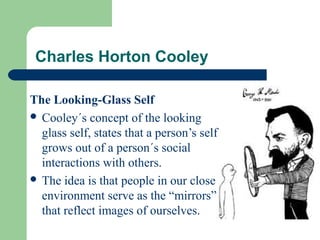
 Cooley´s concept of the looking
glass self, states that a person’s self
grows out of a person´s social
interactions with others.
 The idea is that people in our close
environment serve as the “mirrors”
that reflect images of ourselves.

Social Self

  • 1.
    The Social Self GeorgeHerbert Mead Norman L. Santos Discussant
  • 2.
    OBJECTIVES 1. Recognize GeorgeHerbert Mead and his significant contribution to social psychology. 2. Explain the Social Self Theory 3. Differentiate between the concepts of ‘me’ and ‘I’ 4. Describe the looking-glass self
  • 3.
  • 5.
  • 6.
    George Herbert Mead: TheSocial Self The Self: the part of an individual’s personality composed of self-awareness and self-image Social Self Theory is based on the perspective that the self emerges from social interactions The self is not there from birth, but it is developed over time from social experiences and activities.
  • 7.
    Mead’s Development ofSelf  Language develops self by allowing individuals to respond to each other through symbols, gestures, words, and sounds.  Play develops self by allowing individuals to take on different roles, pretend, and express expectation of others.  Games develop self by allowing individuals to understand and adhere to the rules of the activity.
  • 8.
    Mead’s I andMe The 'me' is considered the socialized aspect of the individual. The 'me' represents learned behaviors, attitudes, and expectations of others and of society. generalized other, a phase of the self that is in the past
  • 9.
    Mead’s I andMe The 'I', therefore, can be considered the present and future phase of the self. The 'I' represents the individual's identity based on response to the 'me.‘ The 'I' says, 'Okay.Society says I should behave and socially interact one way, and I think I should act the same (or perhaps different),' and that notion becomes self.
  • 10.
    Charles Horton Cooley TheLooking-Glass Self  Cooley´s concept of the looking glass self, states that a person’s self grows out of a person´s social interactions with others.  The idea is that people in our close environment serve as the “mirrors” that reflect images of ourselves.