CHAPTER - 10
LIGHT : REFLECTION AND
REFRACTION
1) Light :-
1. Light is a form of energy which gives us sensation of vision.
2. When light falls on objects, it reflects the light and when the reflected
light reaches our eyes then we see the objects.
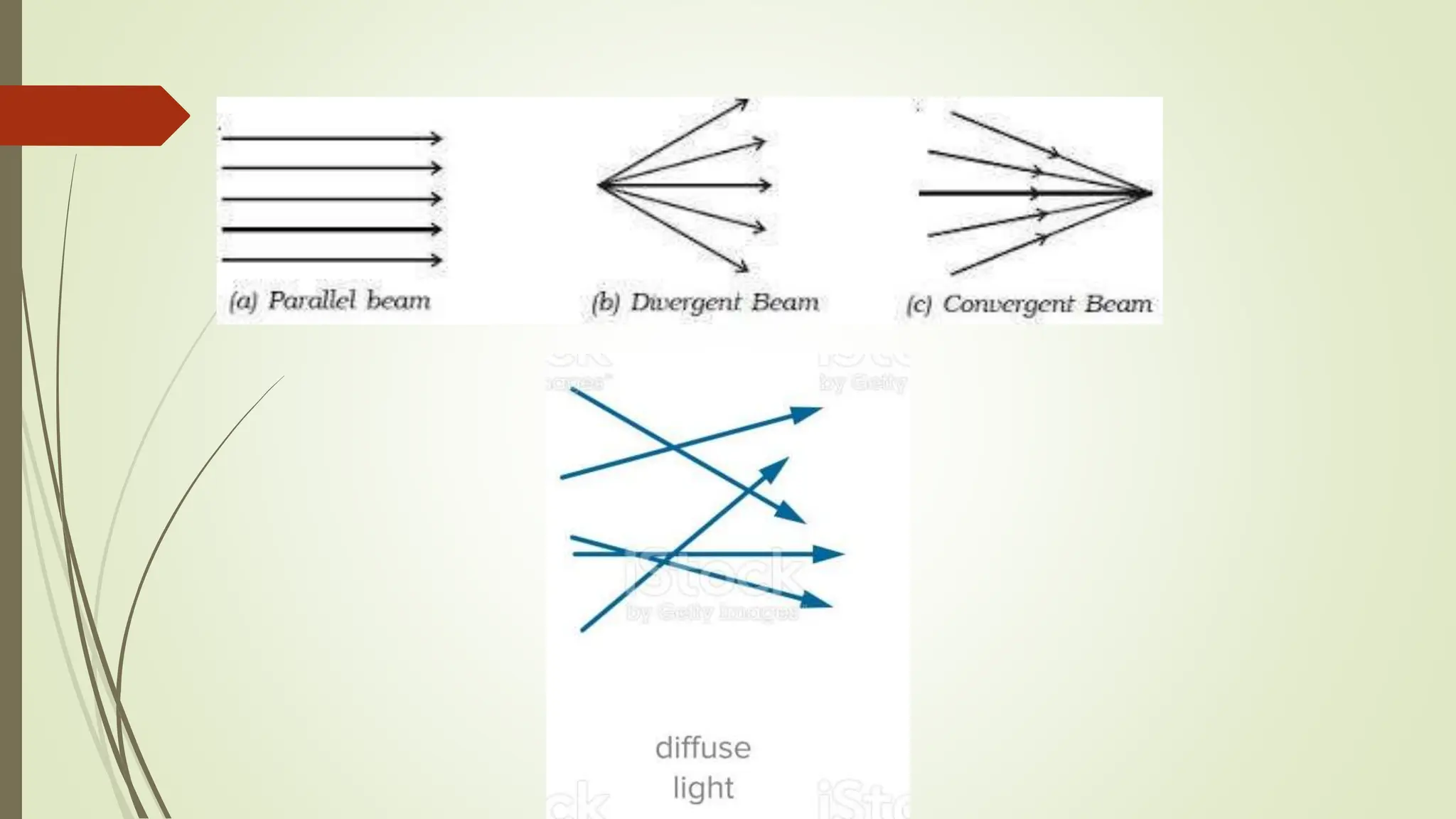
3. Light travels in straight line – Rectilinear propagation of light
4. The speed of light is 3,00,000 kilometres per second.
5. An opaque object obstructs rays of light when it comes in the path of
light, and casts a shadow, this phenomenon tells that rays of light travels
in straight line.
6. When rays of light fall on an object, they bounce back and come to our
eyes. Bouncing back of light after falling on an object to our eyes enables
us to see a particular object.
7. We cannot see an object in dark, because there is no light present in dark
which can be bounced back to our eyes.
Reflection of light
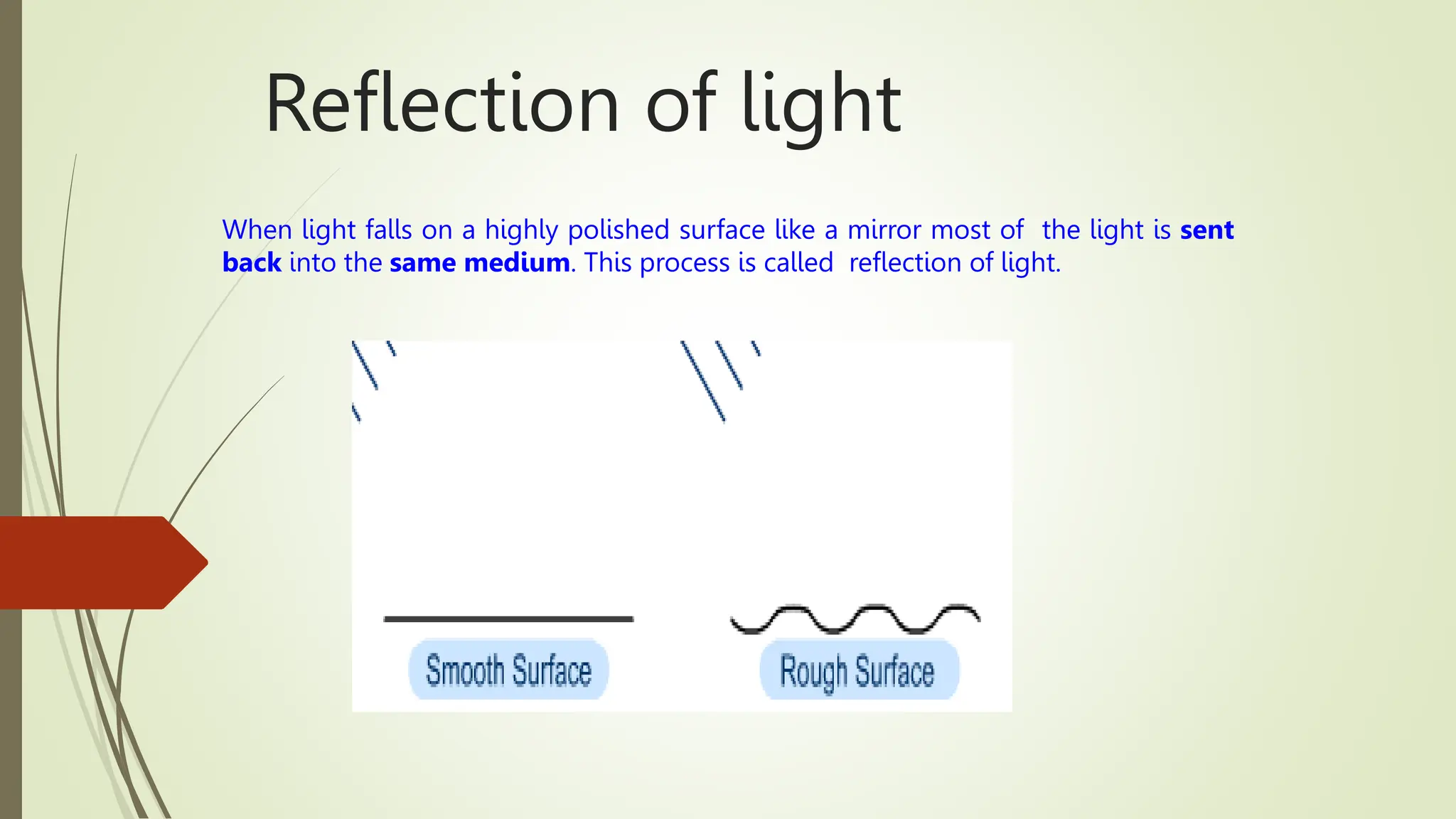
When light falls on a highly polished surface like a mirror most of the light is sent
back into the same medium. This process is called reflection of light.
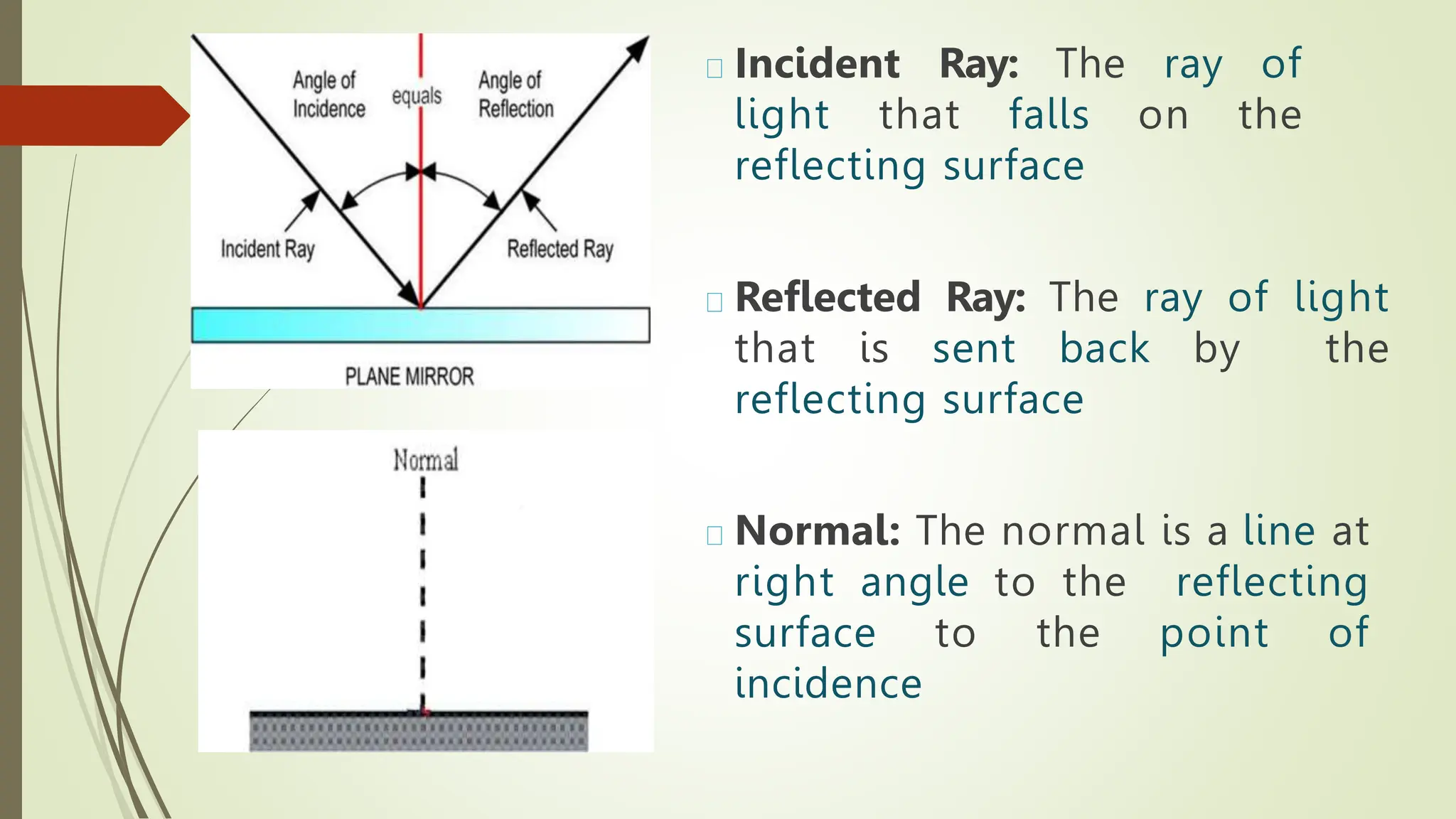
Incident Ray: The ray of
light that falls on the
reflecting surface
Reflected Ray: The ray of light
that is sent back by the
reflecting surface
Normal: The normal is a line at
right angle to the reflecting
surface to the point of
incidence
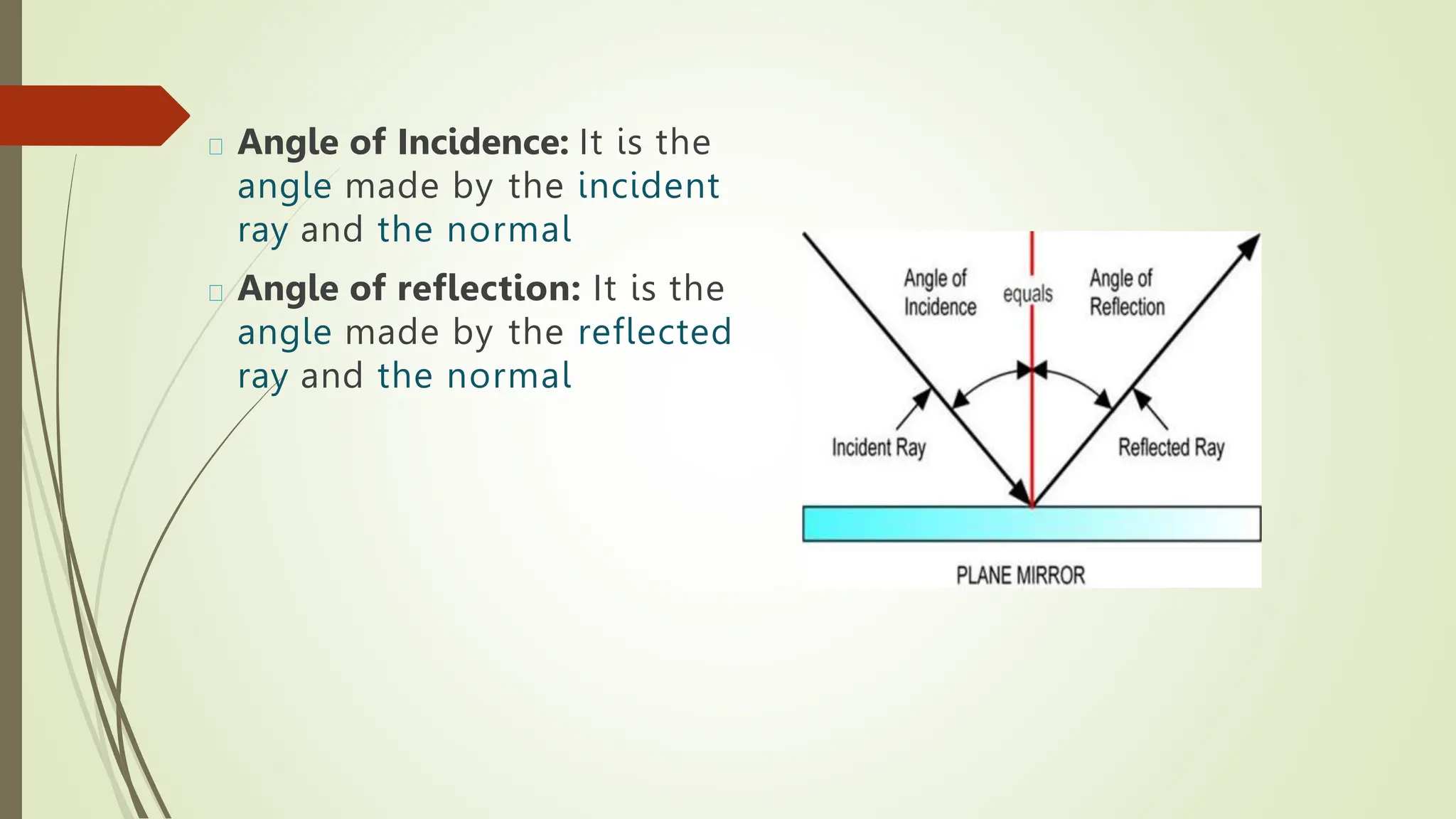
Angle of Incidence: It is the
angle made by the incident
ray and the normal
Angle of reflection: It is the
angle made by the reflected
ray and the normal
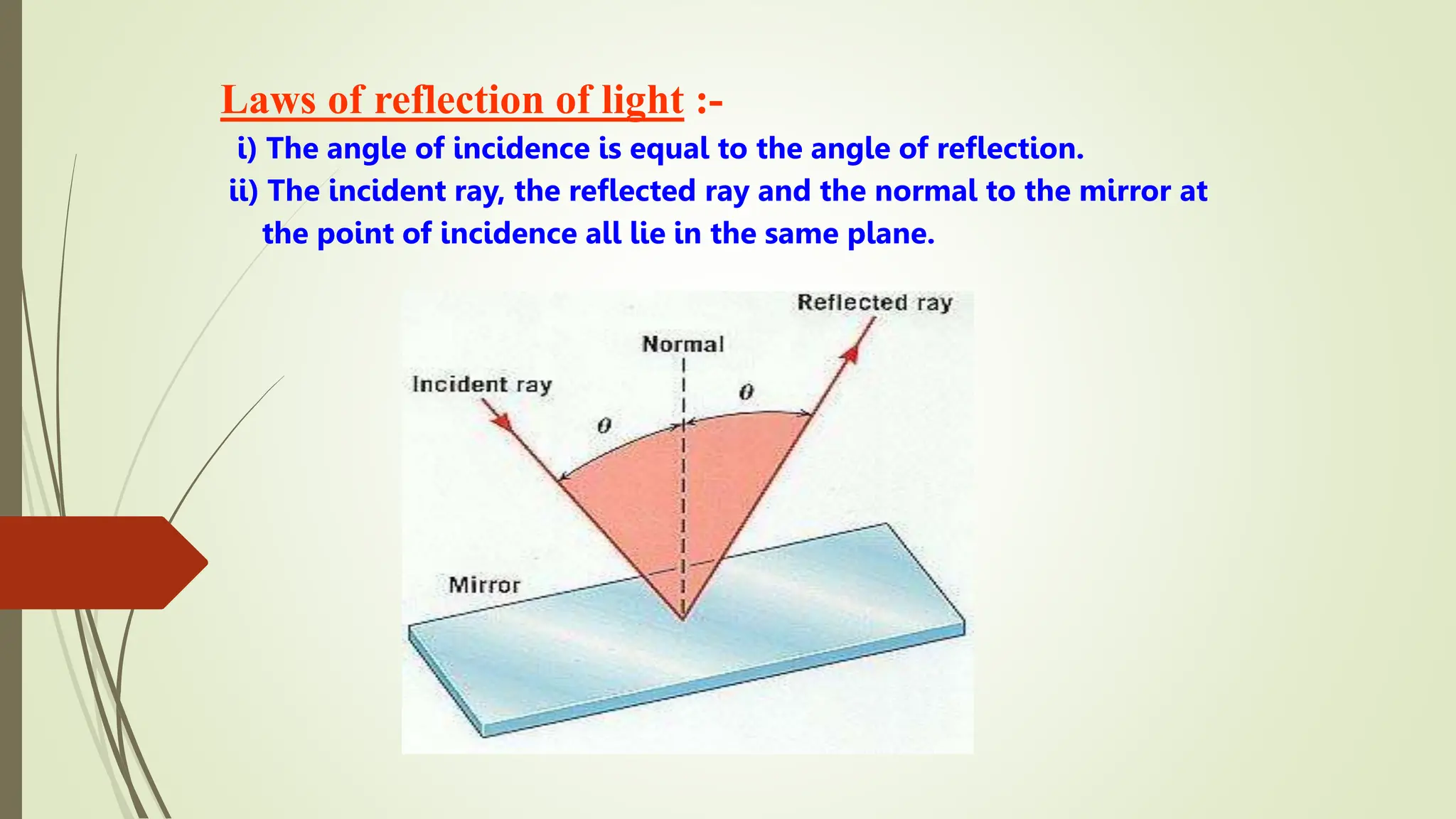
Laws of reflection of light :-
i) The angle of incidence is equal to the angle of reflection.
ii) The incident ray, the reflected ray and the normal to the mirror at
the point of incidence all lie in the same plane.
Terms related to reflection or Nature of an image
Object: It is the “thing” that forms an image on the screen
Image: It is the reflection of the object on the screen
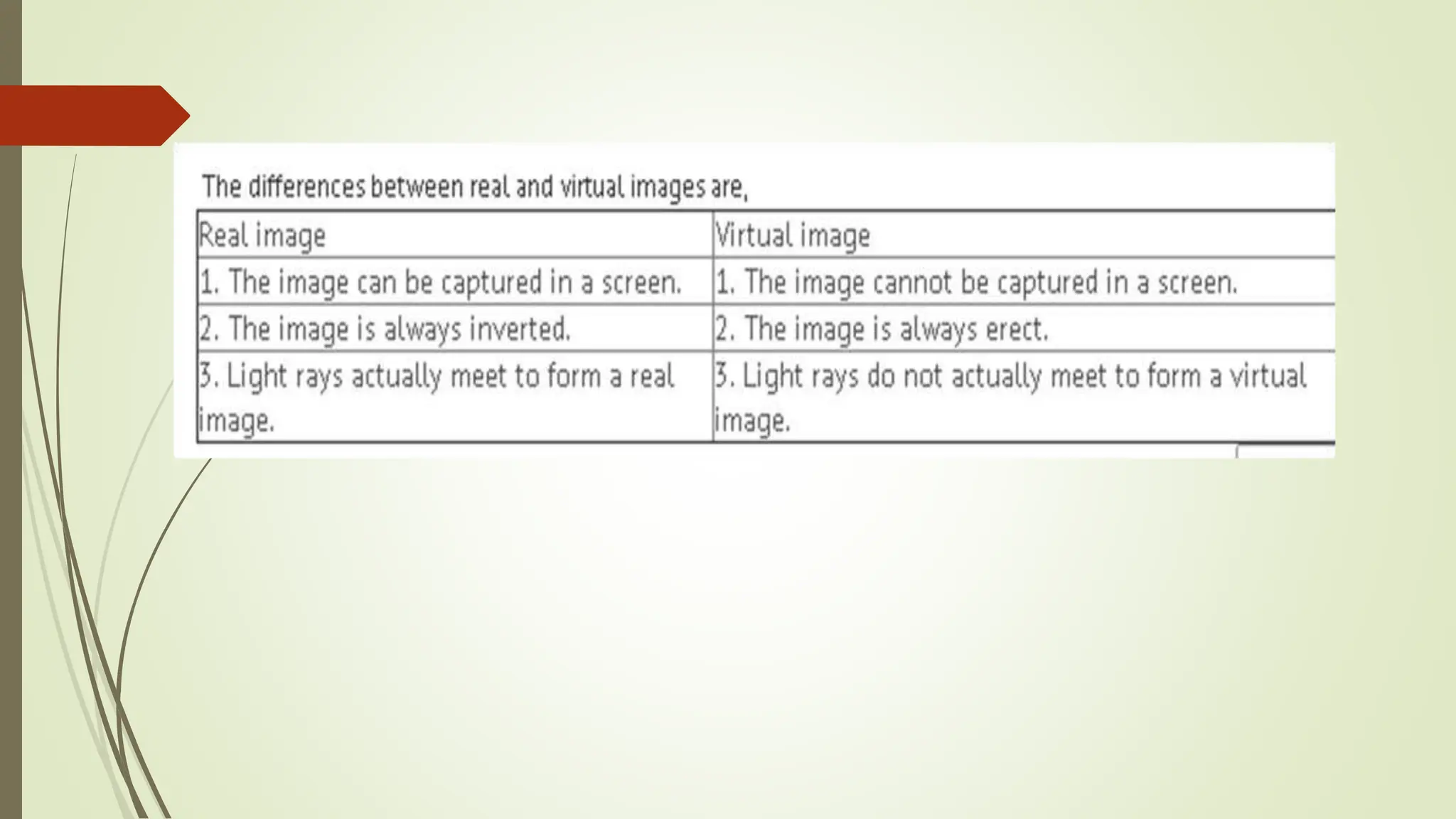
Virtual Image: The image that cannot be obtained on a screen (a surface
where image is formed)
Real Image: The image that is formed directly on the screen
Erect: The image is upright
Inverted: The image is upside-down
Enlarged: The image is larger in size than the actual object
Diminished: The image is smaller in size than the actual object
Same size: The image is of the same size as the actual object
Magnification: is a measure of the size of an image compared to the size of the
object.
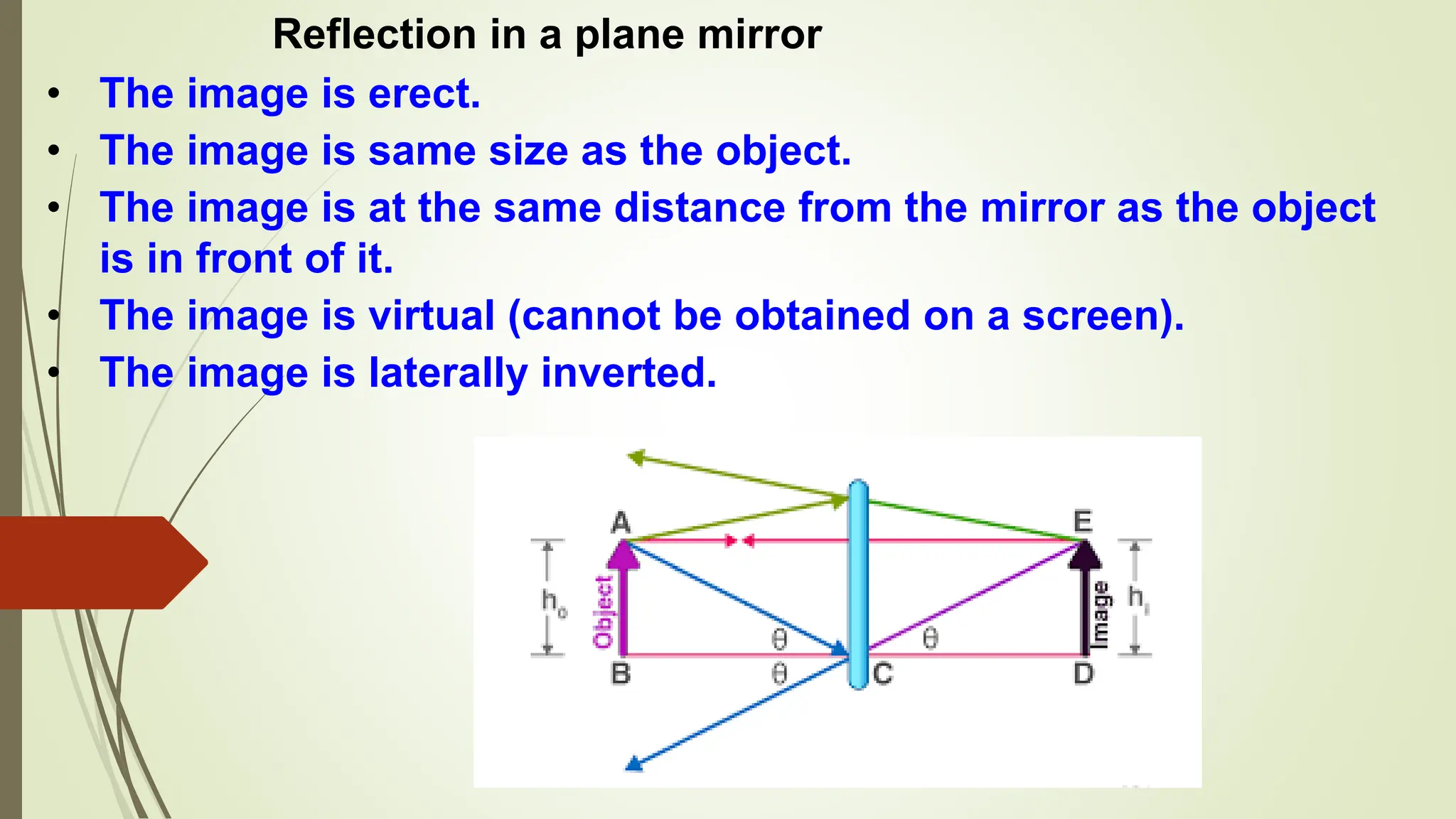
• The image is erect.
• The image is same size as the object.
• The image is at the same distance from the mirror as the object
is in front of it.
• The image is virtual (cannot be obtained on a screen).
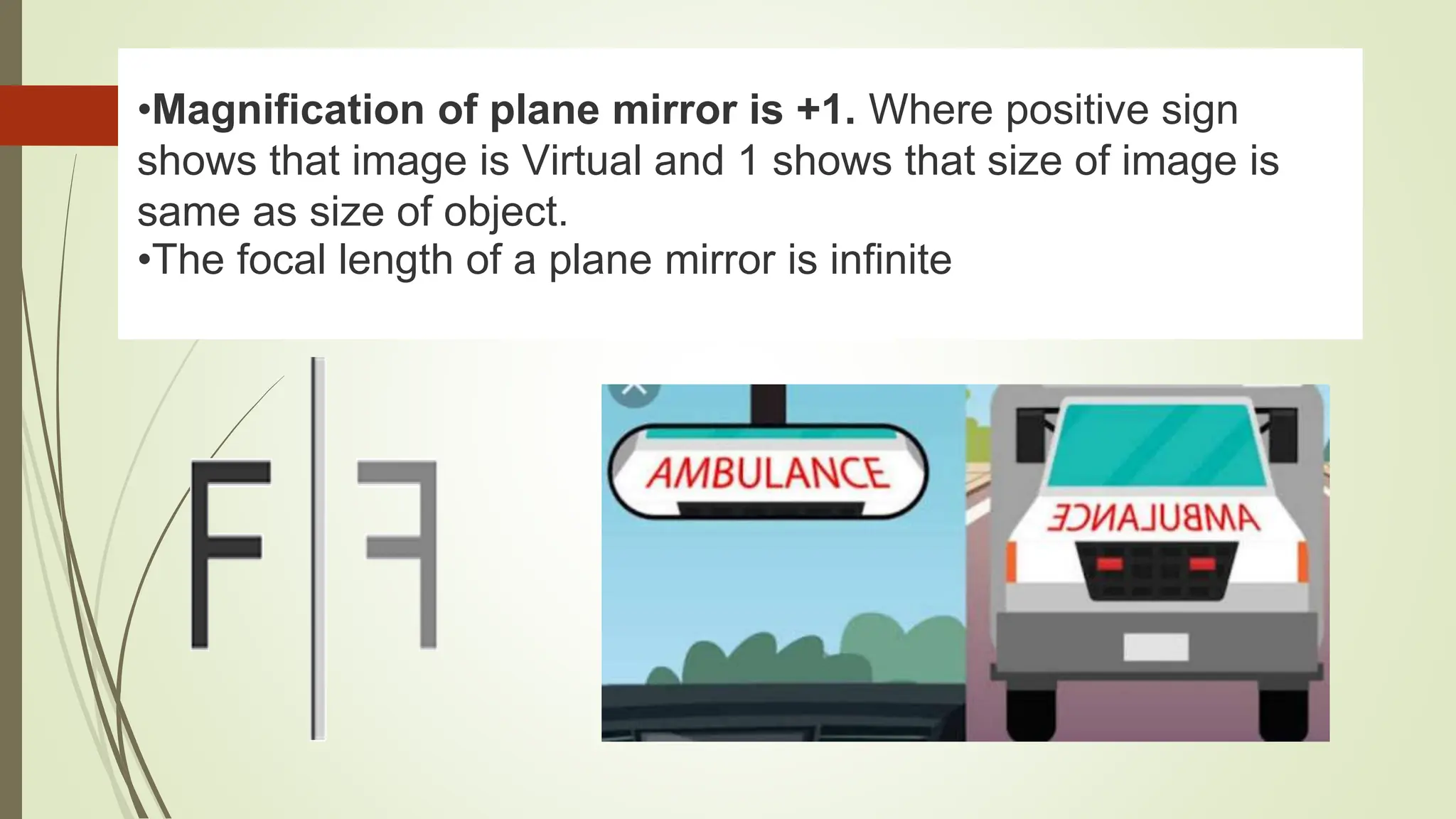
• The image is laterally inverted.
Reflection in a plane mirror
•Magnification of plane mirror is +1. Where positive sign
shows that image is Virtual and 1 shows that size of image is
same as size of object.
•The focal length of a plane mirror is infinite
3) Spherical mirrors :-
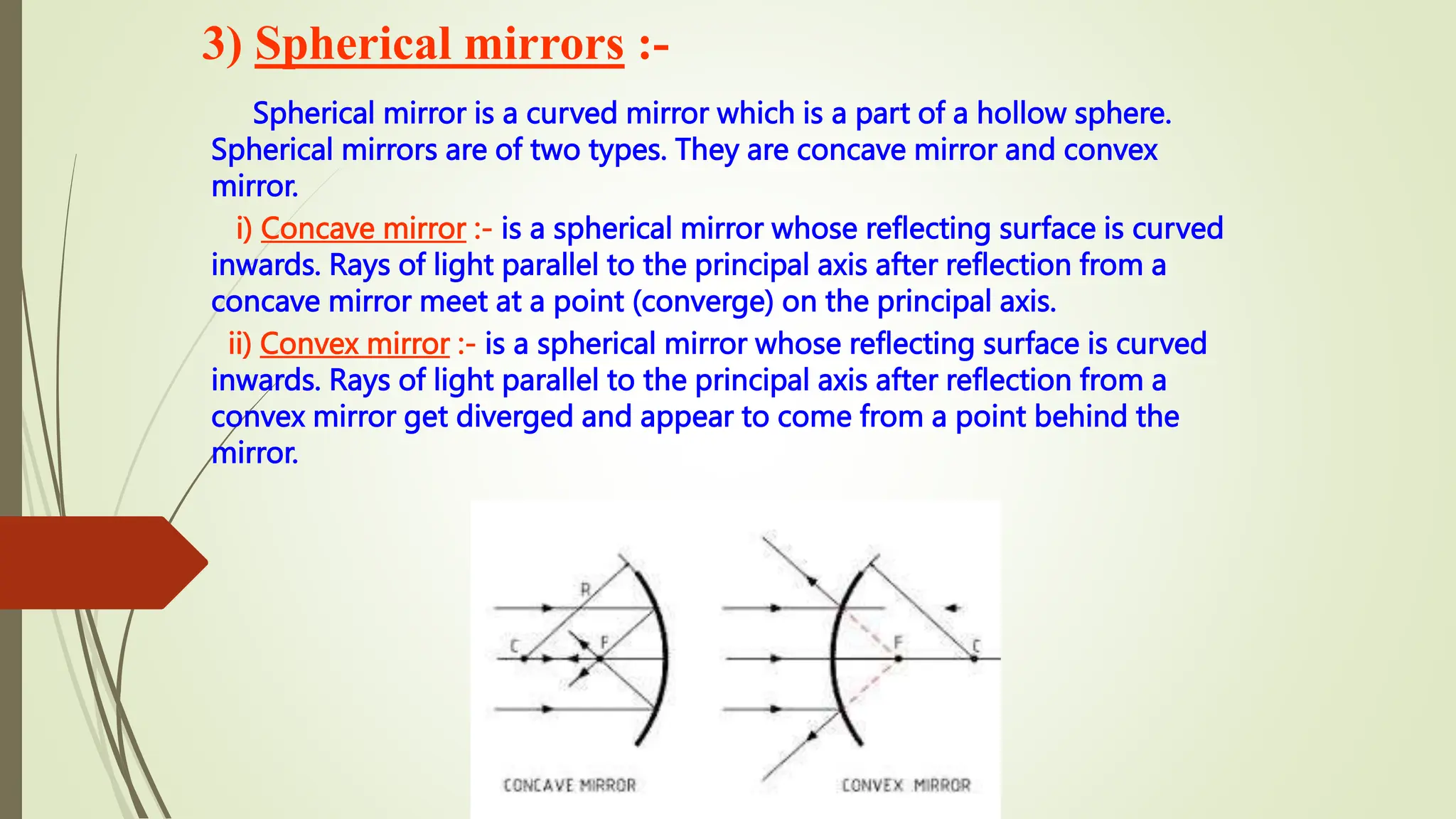
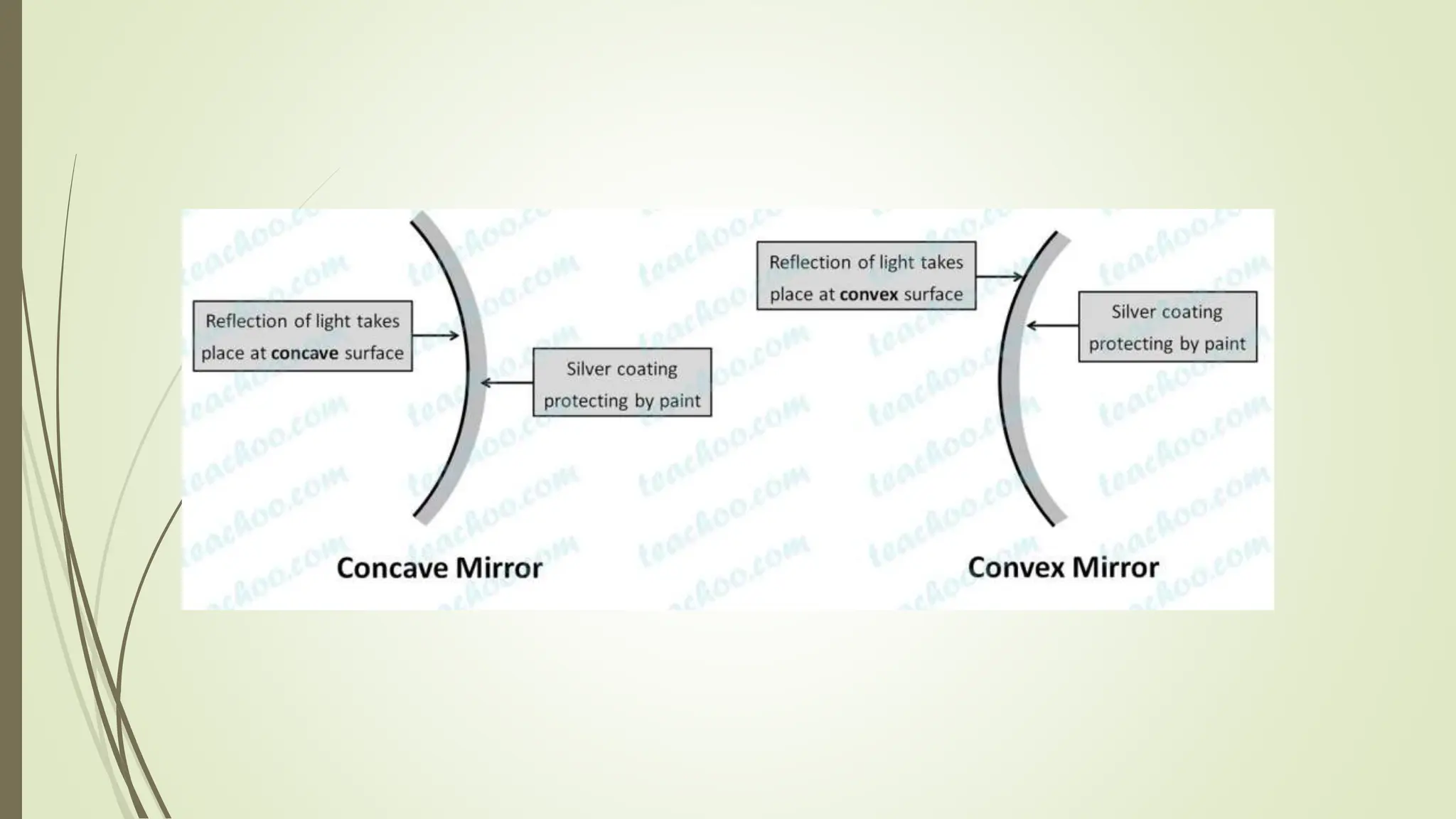
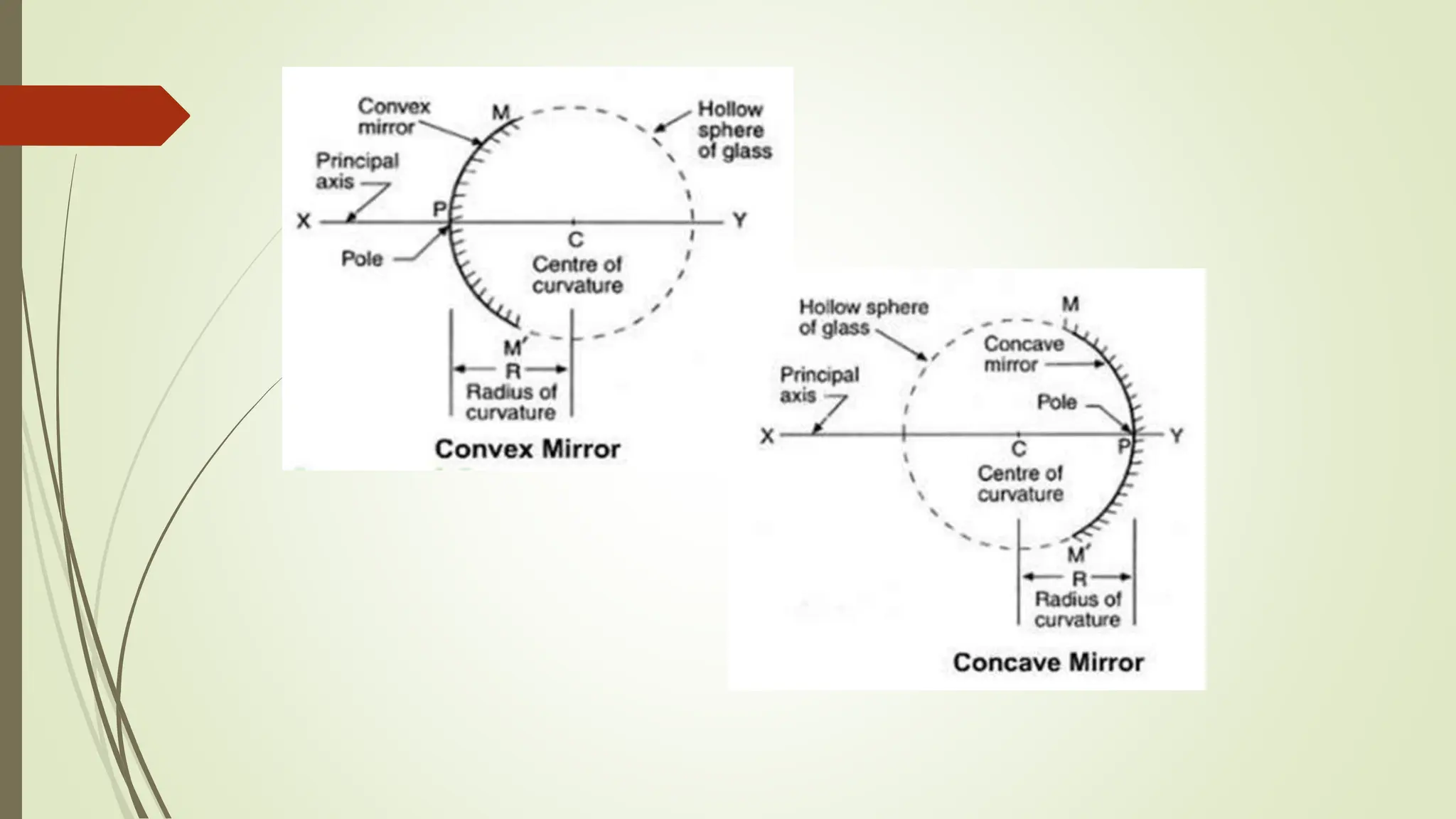
Spherical mirror is a curved mirror which is a part of a hollow sphere.
Spherical mirrors are of two types. They are concave mirror and convex
mirror.
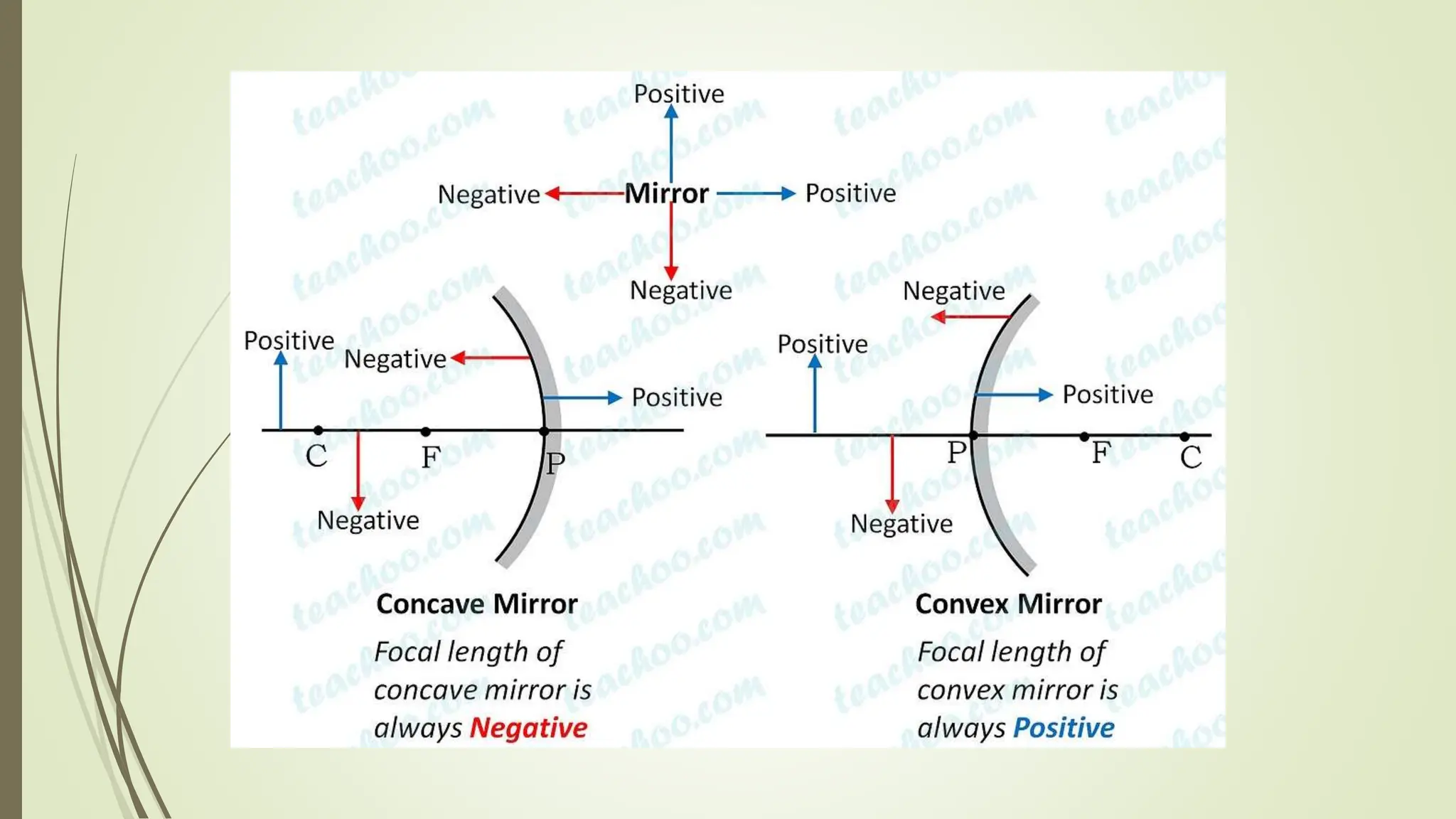
i) Concave mirror :- is a spherical mirror whose reflecting surface is curved
inwards. Rays of light parallel to the principal axis after reflection from a
concave mirror meet at a point (converge) on the principal axis.
ii) Convex mirror :- is a spherical mirror whose reflecting surface is curved
inwards. Rays of light parallel to the principal axis after reflection from a
convex mirror get diverged and appear to come from a point behind the
mirror.
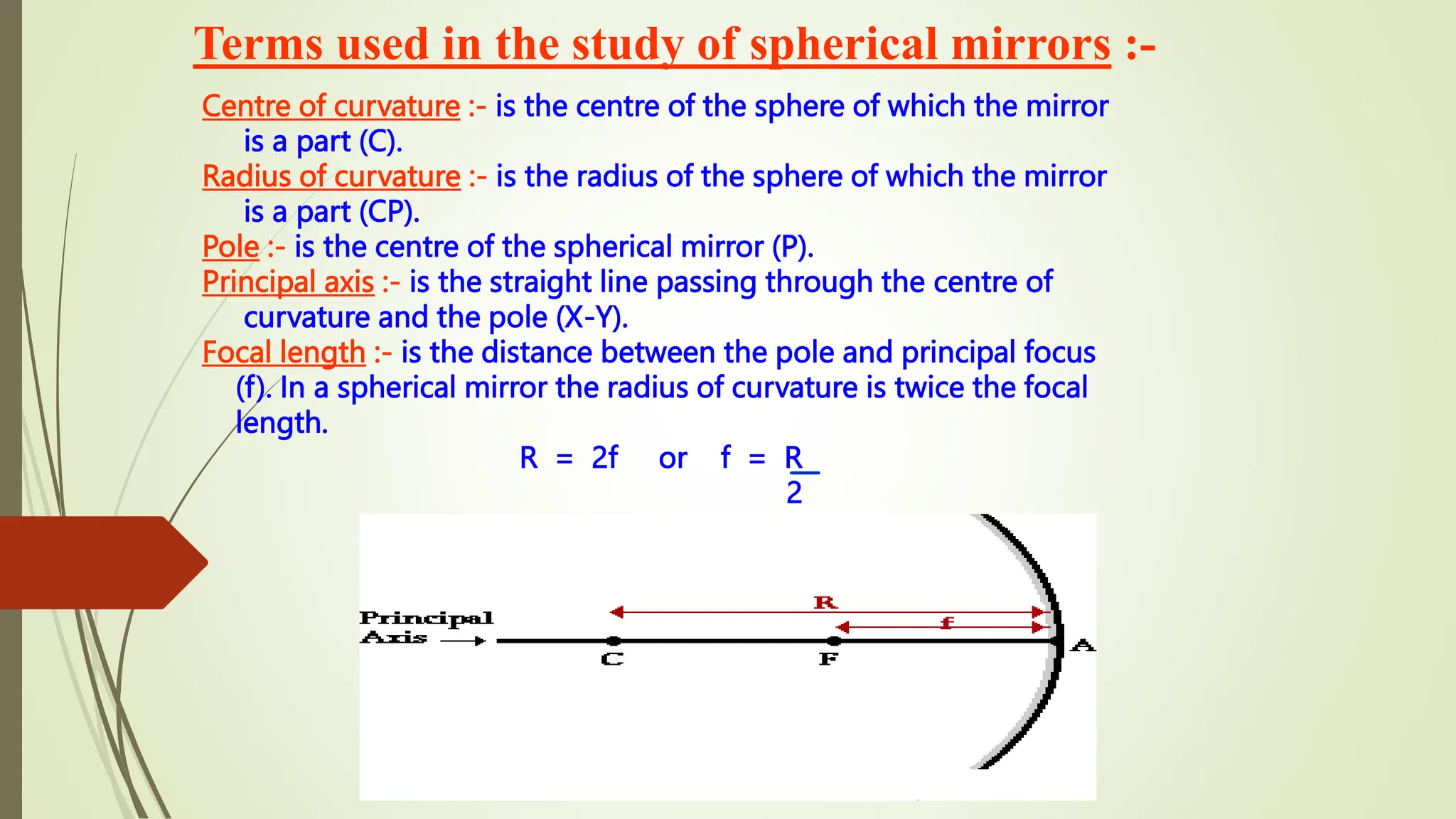
Terms used in the study of spherical mirrors :-
Centre of curvature :- is the centre of the sphere of which the mirror
is a part (C).
Radius of curvature :- is the radius of the sphere of which the mirror
is a part (CP).
Pole :- is the centre of the spherical mirror (P).
Principal axis :- is the straight line passing through the centre of
curvature and the pole (X-Y).
Focal length :- is the distance between the pole and principal focus
(f). In a spherical mirror the radius of curvature is twice the focal
length.
R = 2f or f = R
2
Aperture: The diameter of reflecting surface of a spherical
mirror is called aperture.
Principal focus :-
In a concave mirror, rays of light parallel to the
principal axis after reflection meet at a point on the
principal axis called principal focus(F).
In a convex mirror, rays of light parallel to the principal
axis after reflection get diverged and appear to come
from a point on the principal axis behind the mirror called
principal focus (F).
Reflection by spherical mirrors :-
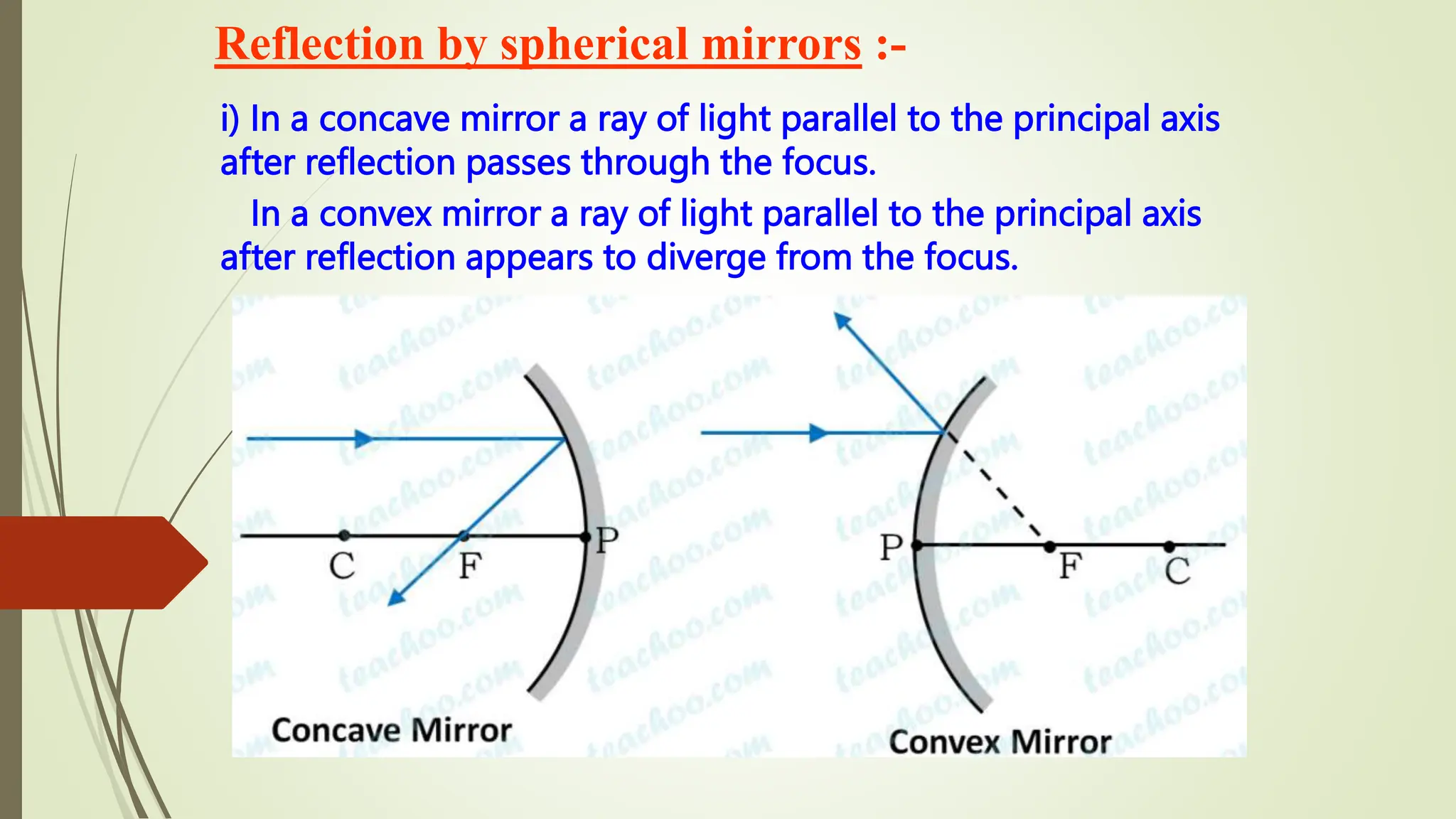
i) In a concave mirror a ray of light parallel to the principal axis
after reflection passes through the focus.
In a convex mirror a ray of light parallel to the principal axis
after reflection appears to diverge from the focus.
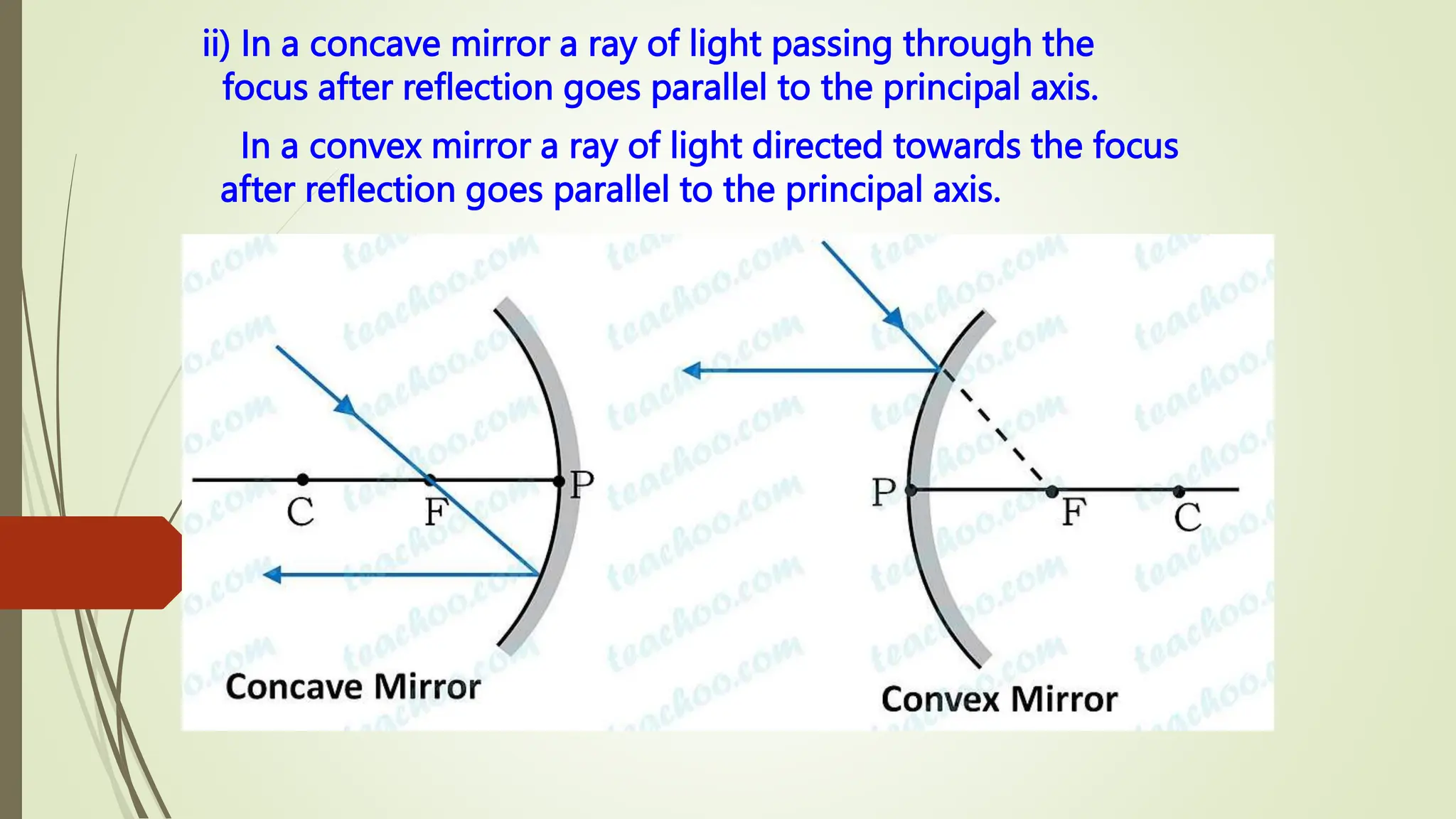
ii) In a concave mirror a ray of light passing through the
focus after reflection goes parallel to the principal axis.
In a convex mirror a ray of light directed towards the focus
after reflection goes parallel to the principal axis.
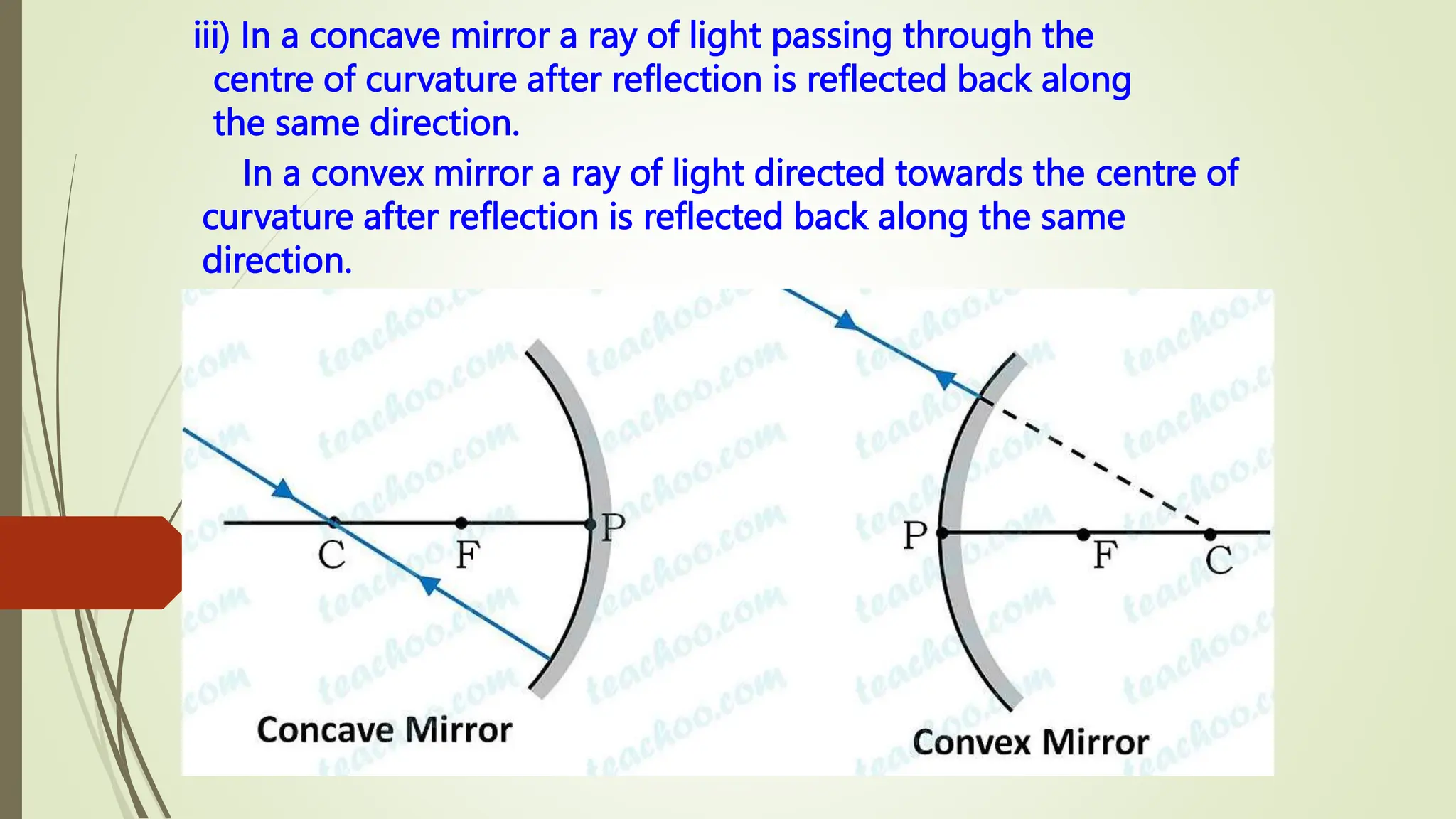
iii) In a concave mirror a ray of light passing through the
centre of curvature after reflection is reflected back along
the same direction.
In a convex mirror a ray of light directed towards the centre of
curvature after reflection is reflected back along the same
direction.
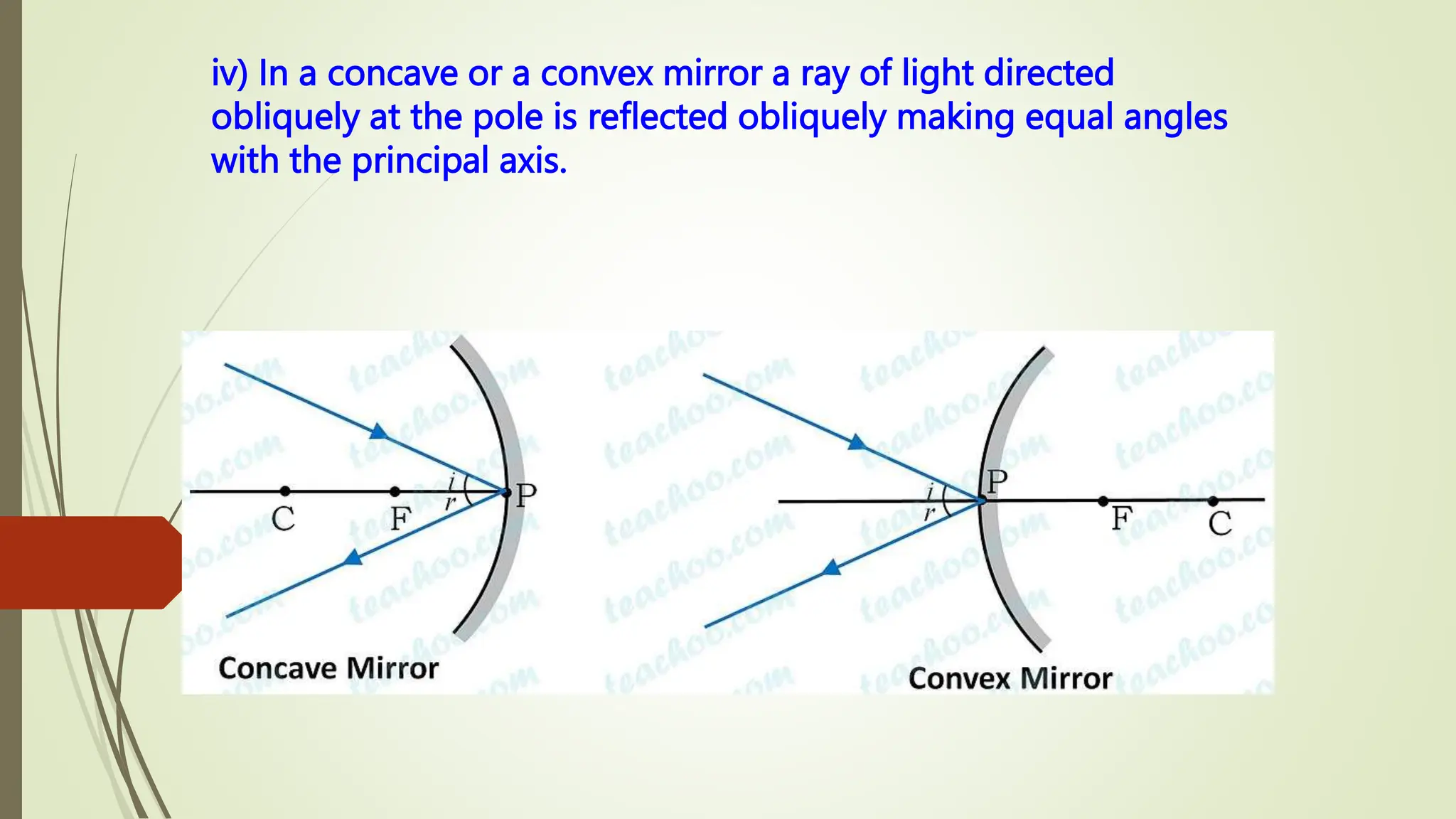
iv) In a concave or a convex mirror a ray of light directed
obliquely at the pole is reflected obliquely making equal angles
with the principal axis.
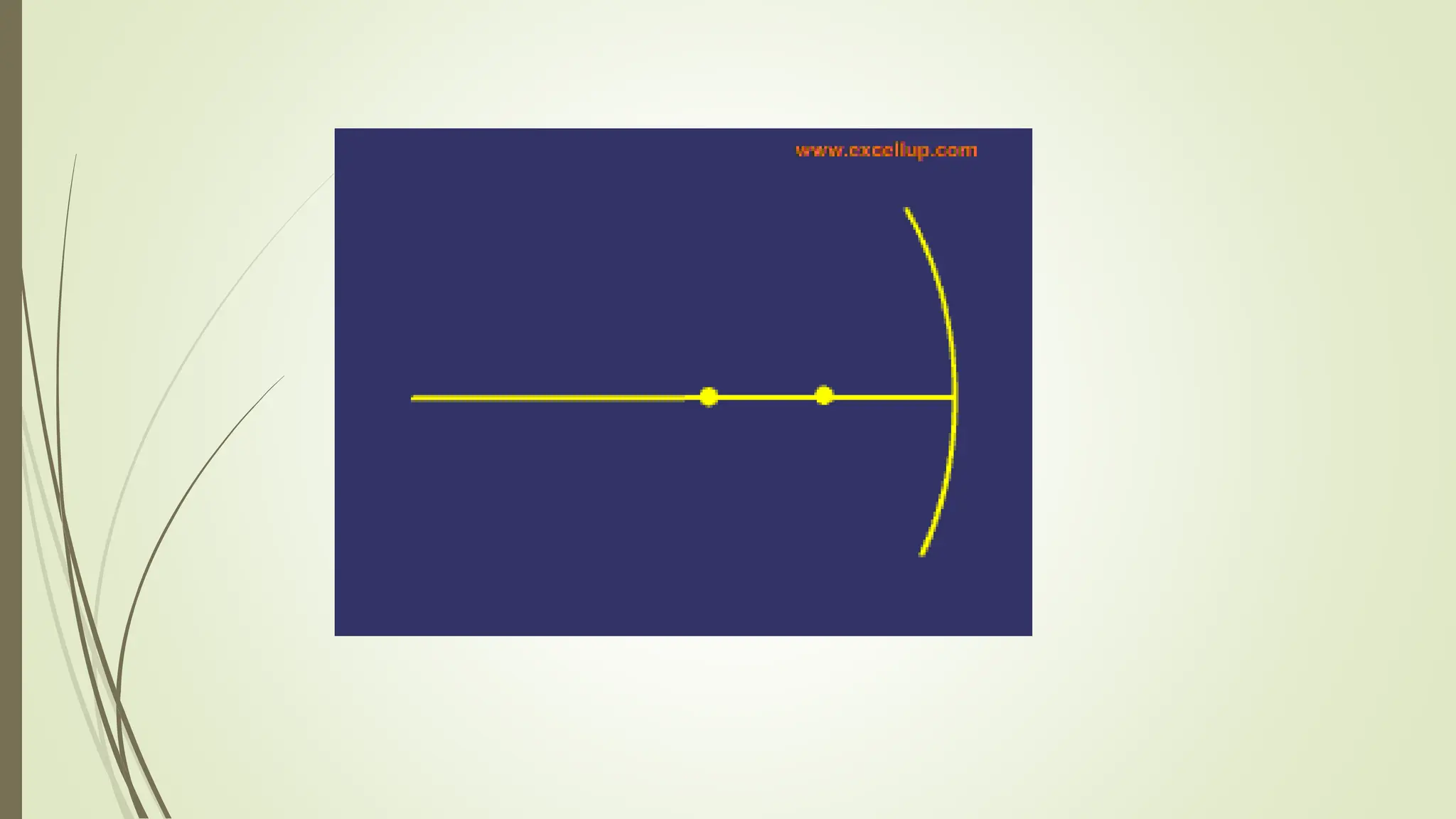
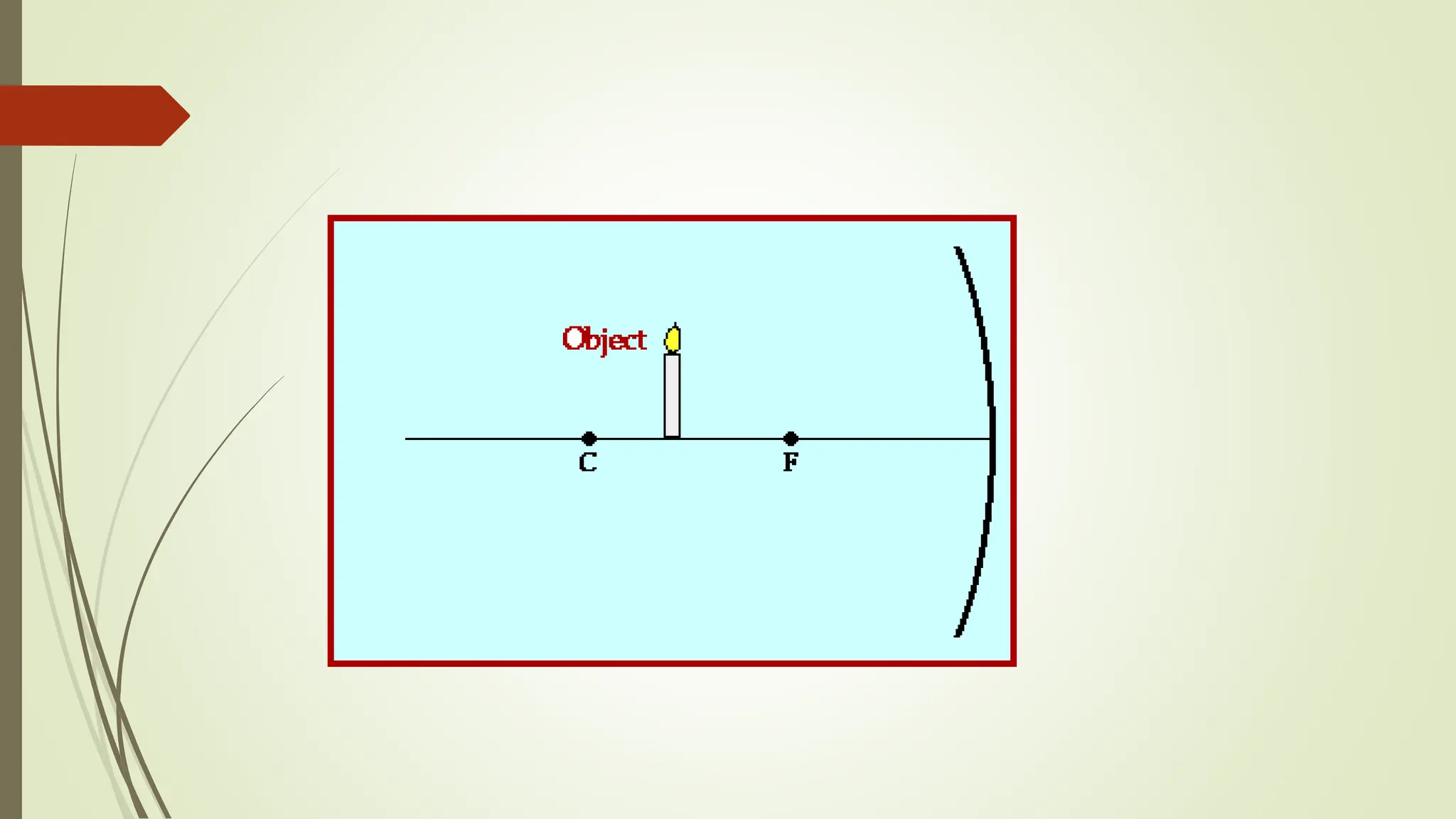
We can place the object at six positions
from the mirror:
◦ At infinity
◦ Beyond C
◦ At C
◦ Between C and F
◦ At F
◦ Between Fand P
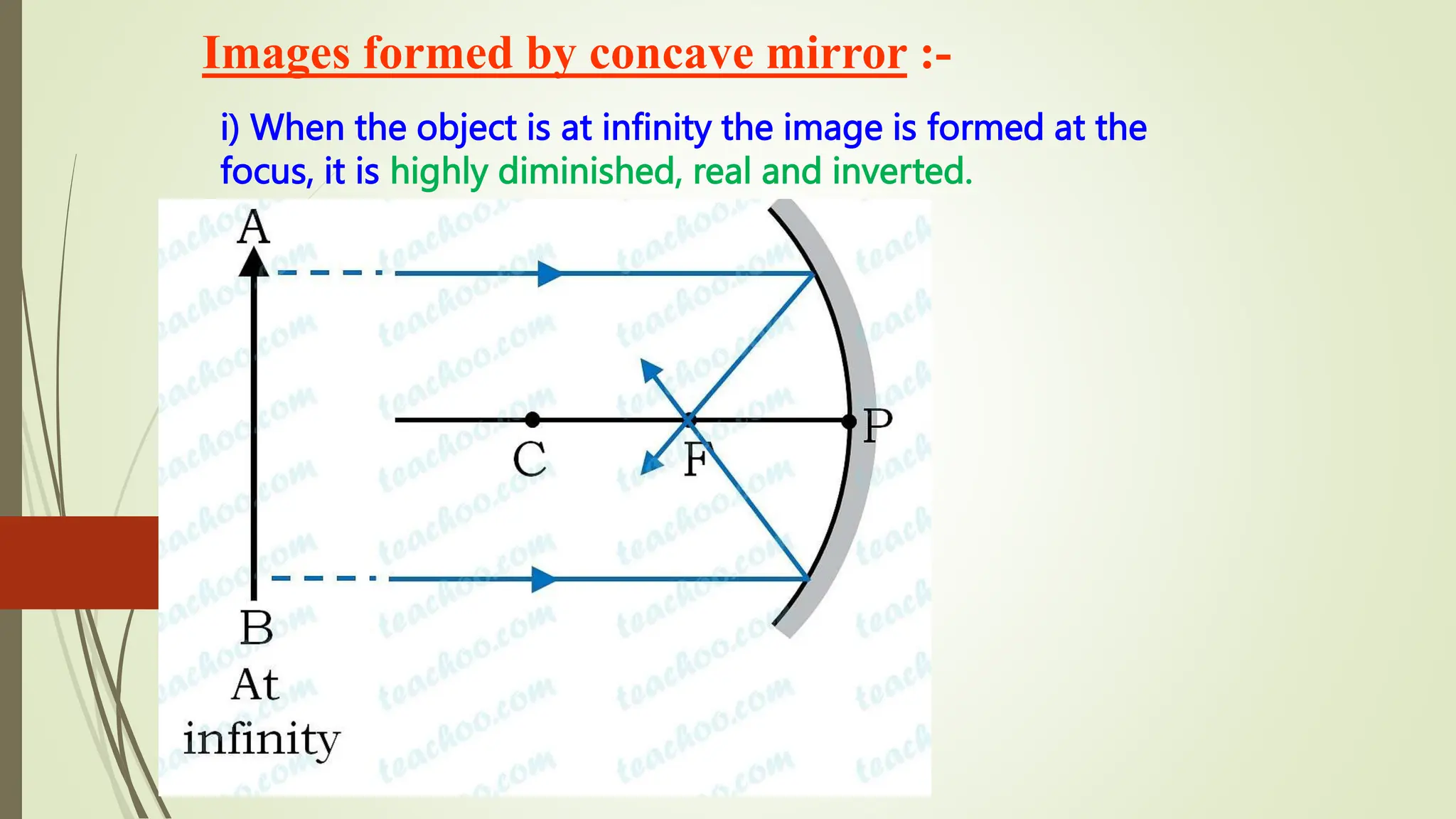
Images formed by concave mirror :-
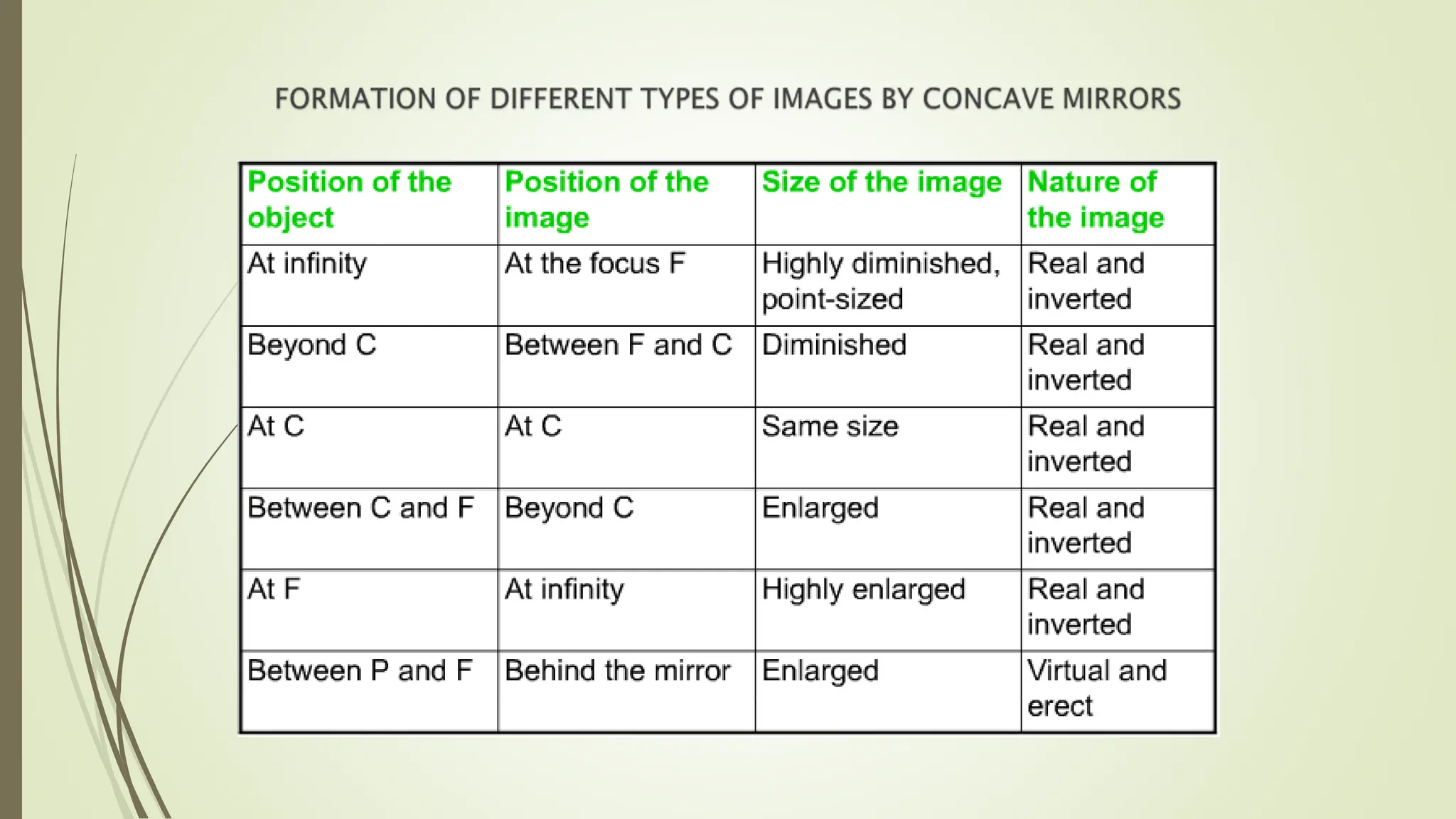
i) When the object is at infinity the image is formed at the
focus, it is highly diminished, real and inverted.
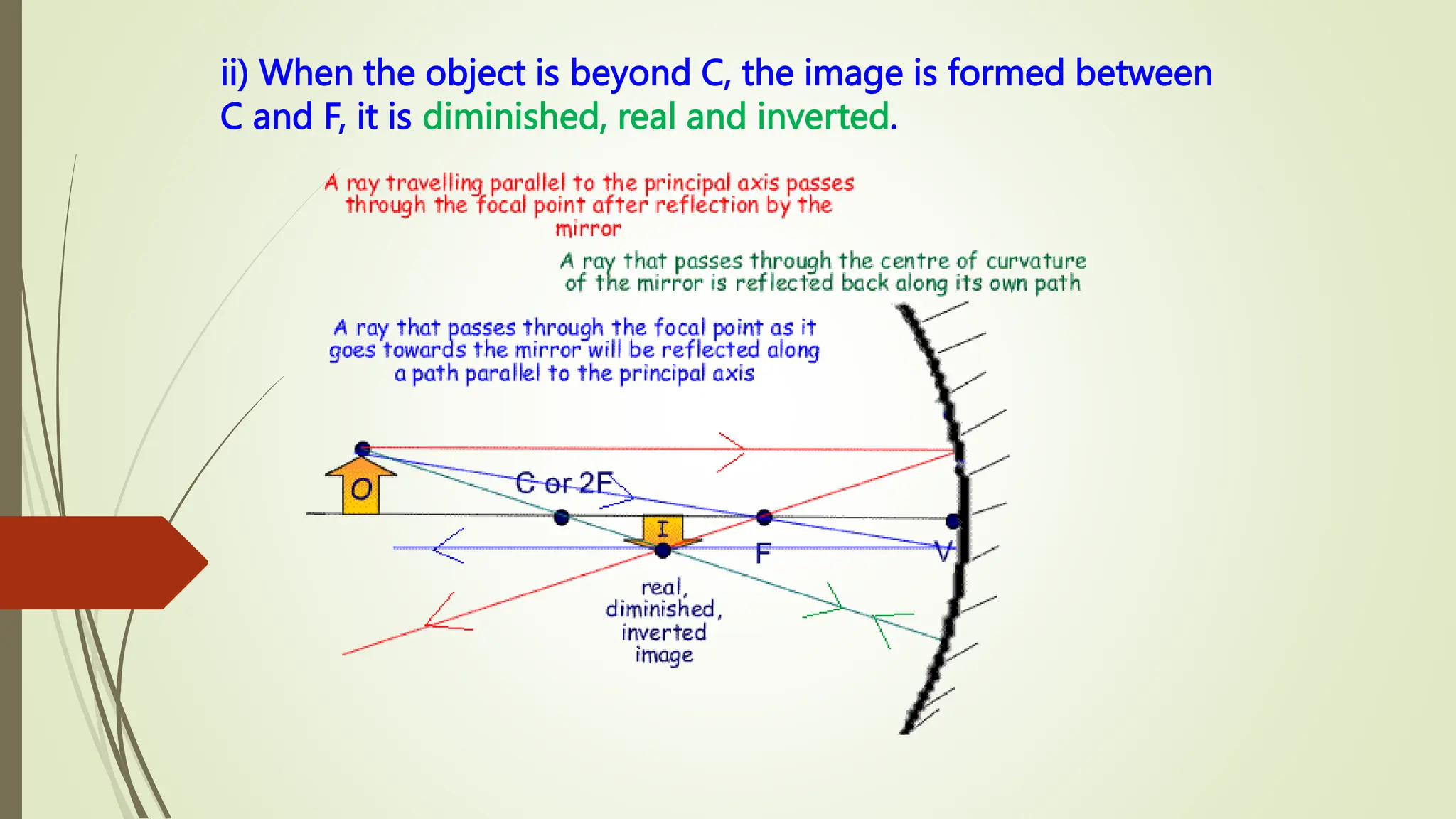
ii) When the object is beyond C, the image is formed between
C and F, it is diminished, real and inverted.
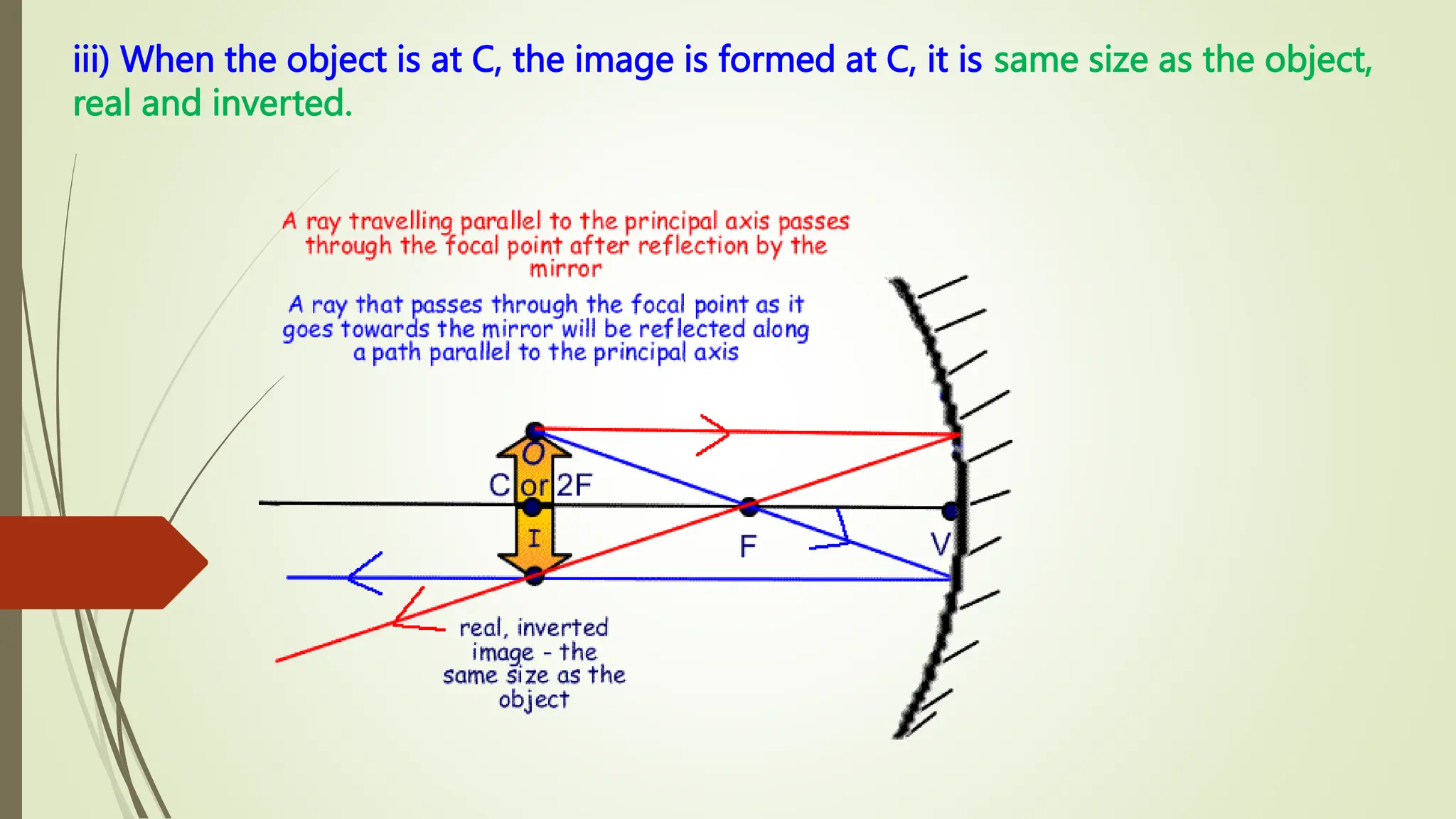
iii) When the object is at C, the image is formed at C, it is same size as the object,
real and inverted.
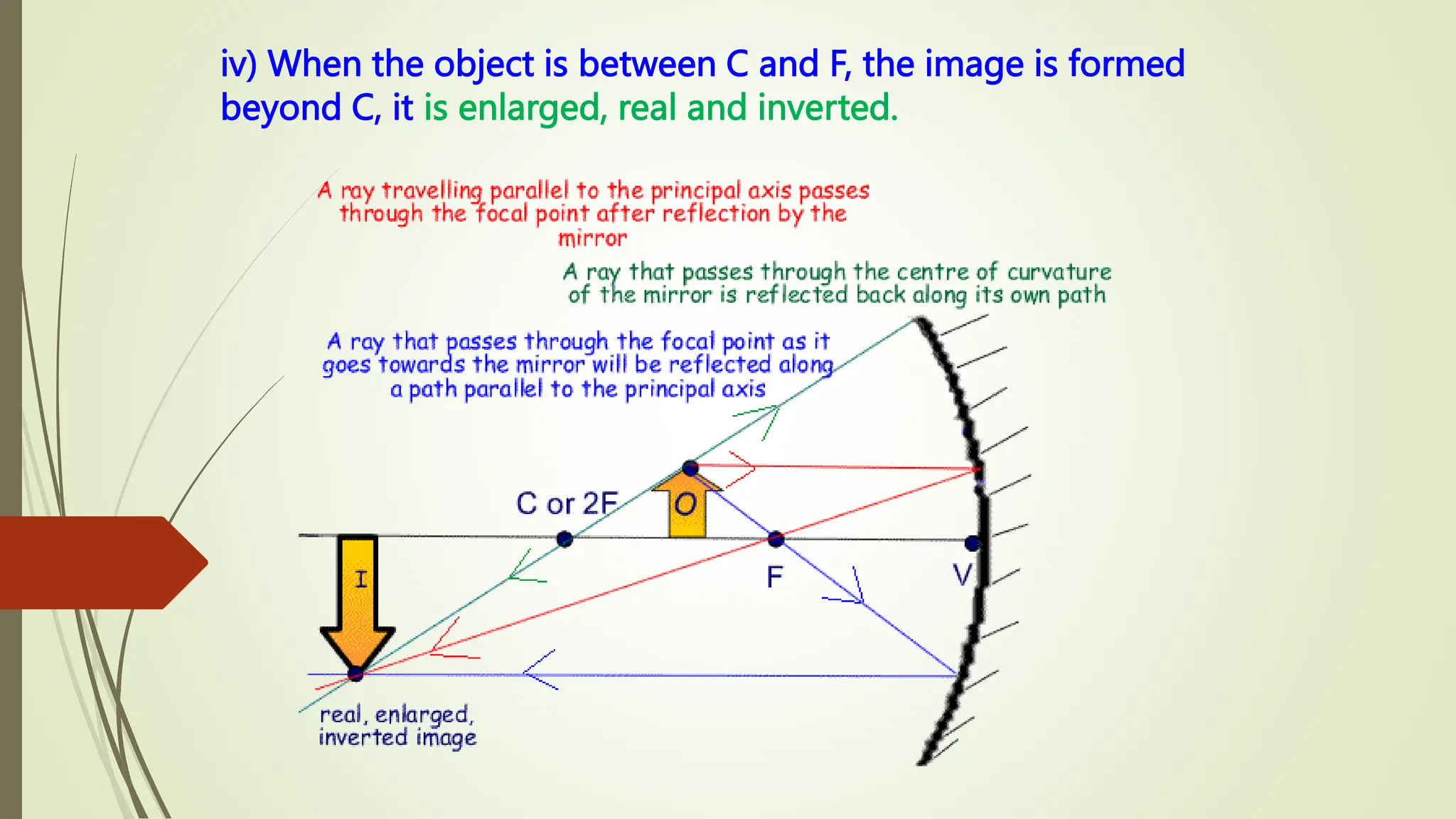
iv) When the object is between C and F, the image is formed
beyond C, it is enlarged, real and inverted.
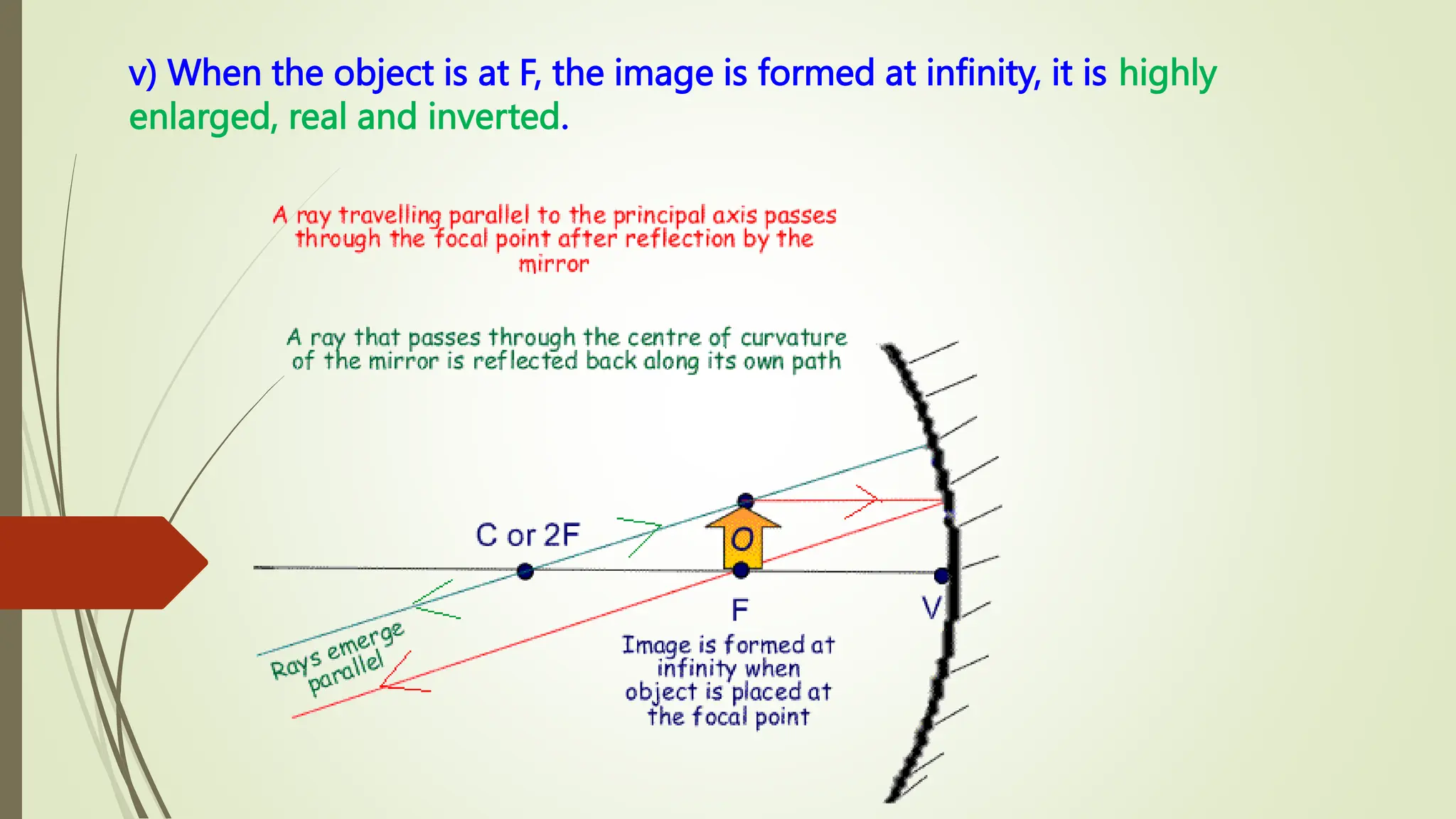
v) When the object is at F, the image is formed at infinity, it is highly
enlarged, real and inverted.
vi) When the object is between F and P, the image is formed behind the
mirror, it is enlarged, virtual and erect.
Uses of spherical mirrors :-
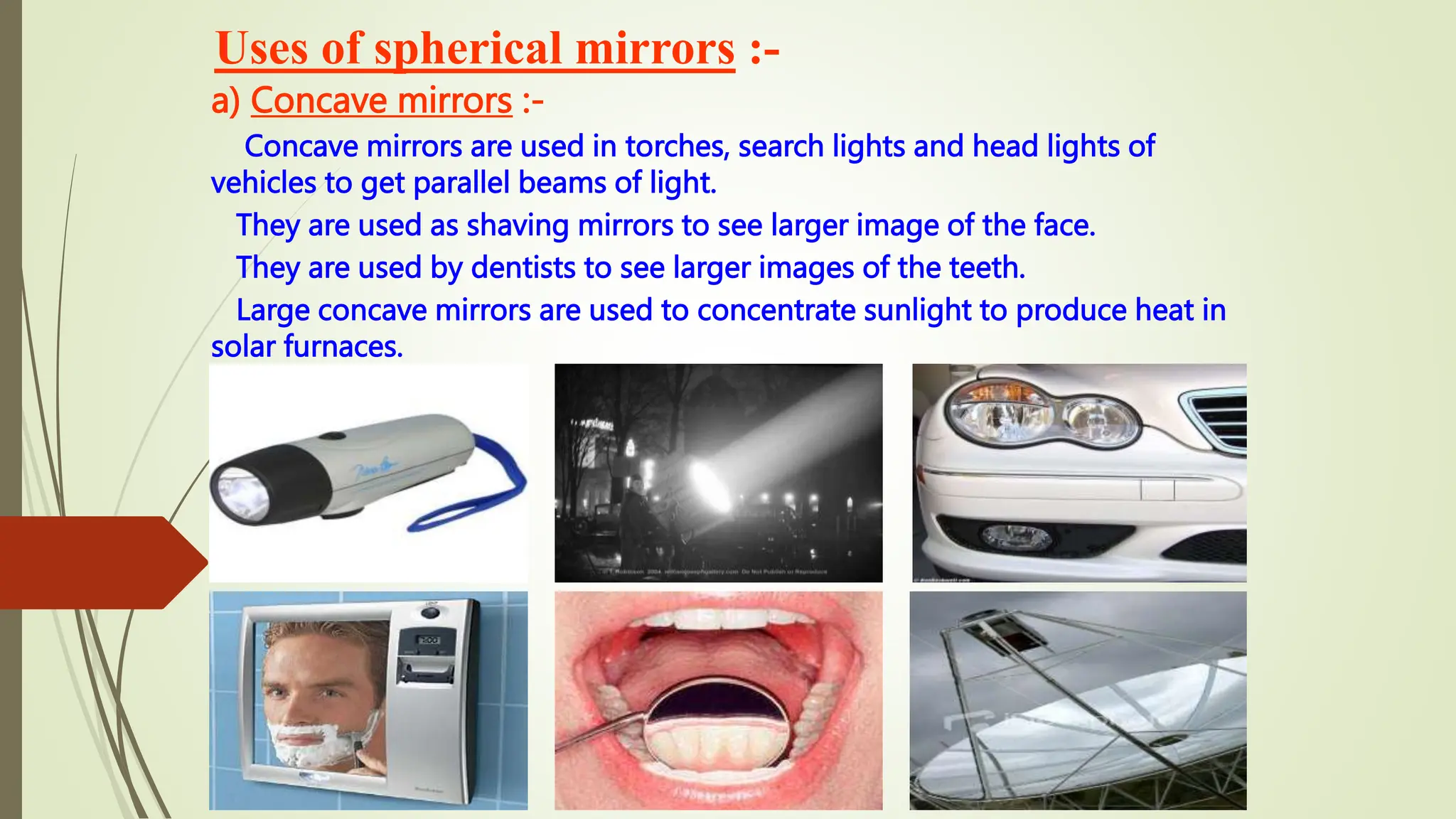
a) Concave mirrors :-
Concave mirrors are used in torches, search lights and head lights of
vehicles to get parallel beams of light.
They are used as shaving mirrors to see larger image of the face.
They are used by dentists to see larger images of the teeth.
Large concave mirrors are used to concentrate sunlight to produce heat in
solar furnaces.
Images formed by convex mirror :-
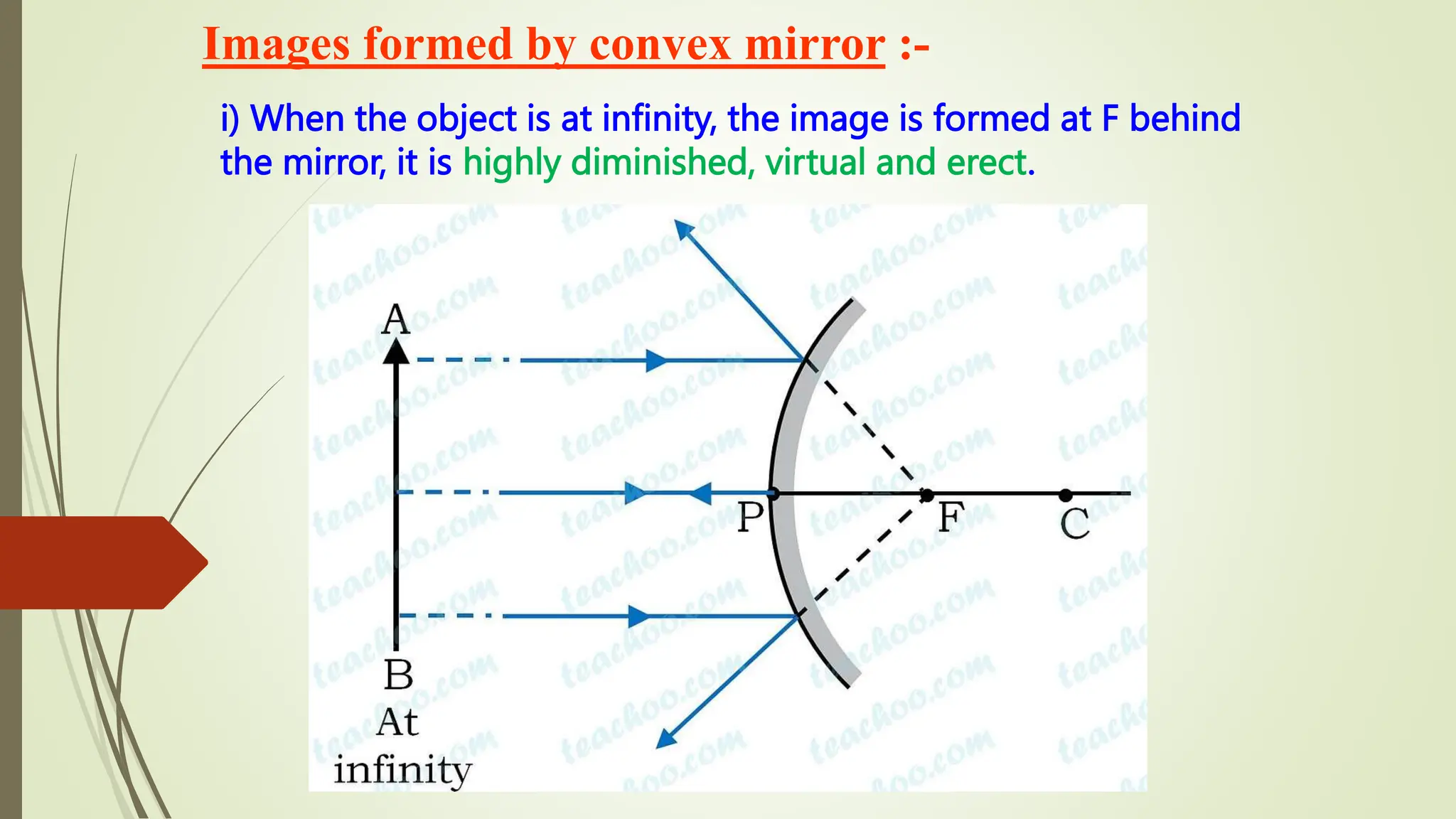
i) When the object is at infinity, the image is formed at F behind
the mirror, it is highly diminished, virtual and erect.
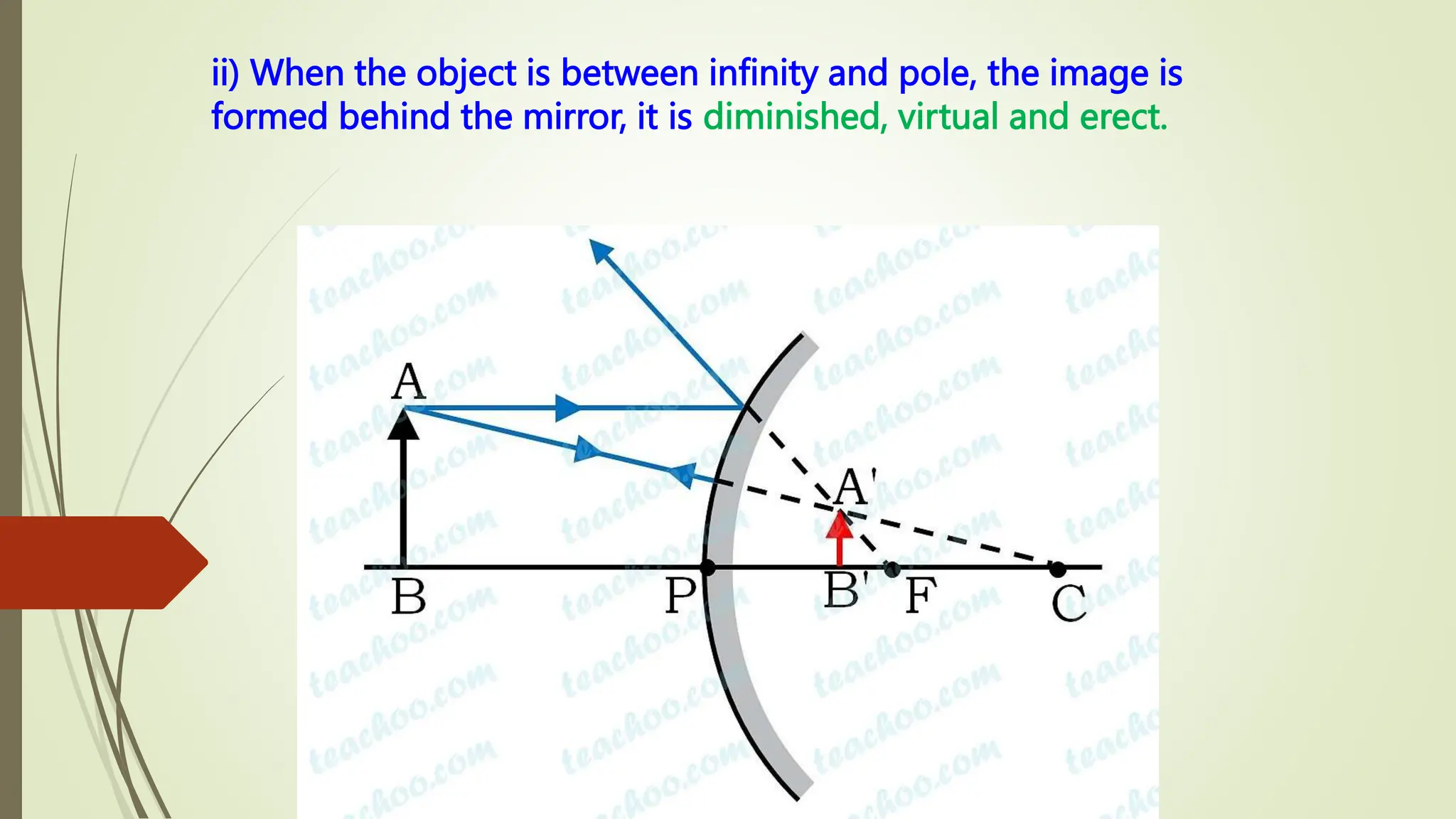
ii) When the object is between infinity and pole, the image is
formed behind the mirror, it is diminished, virtual and erect.
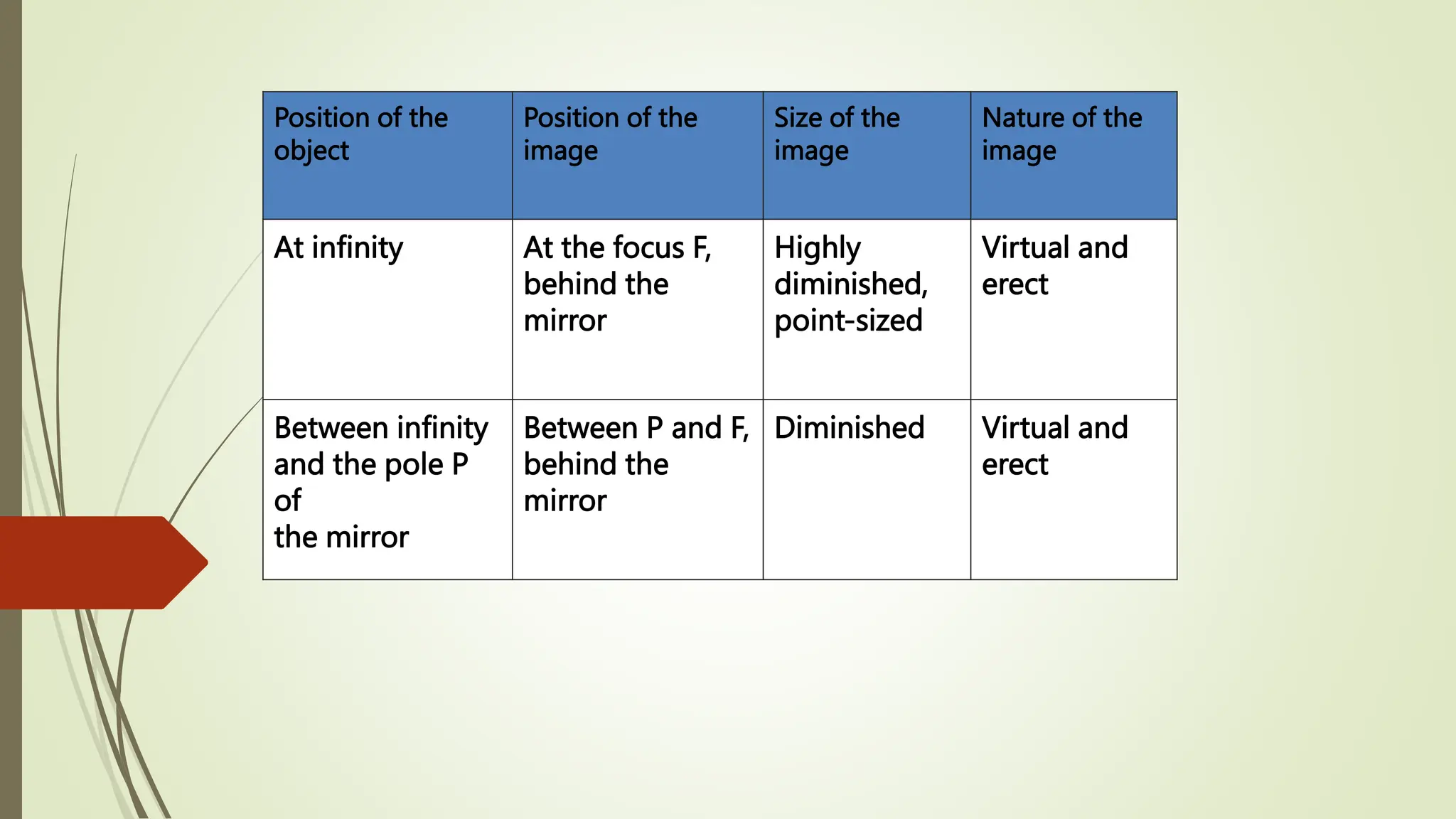
Position of the
object
Position of the
image
Size of the
image
Nature of the
image
At infinity At the focus F,
behind the
mirror
Highly
diminished,
point-sized
Virtual and
erect
Between infinity
and the pole P
of
the mirror
Between P and F,
behind the
mirror
Diminished Virtual and
erect
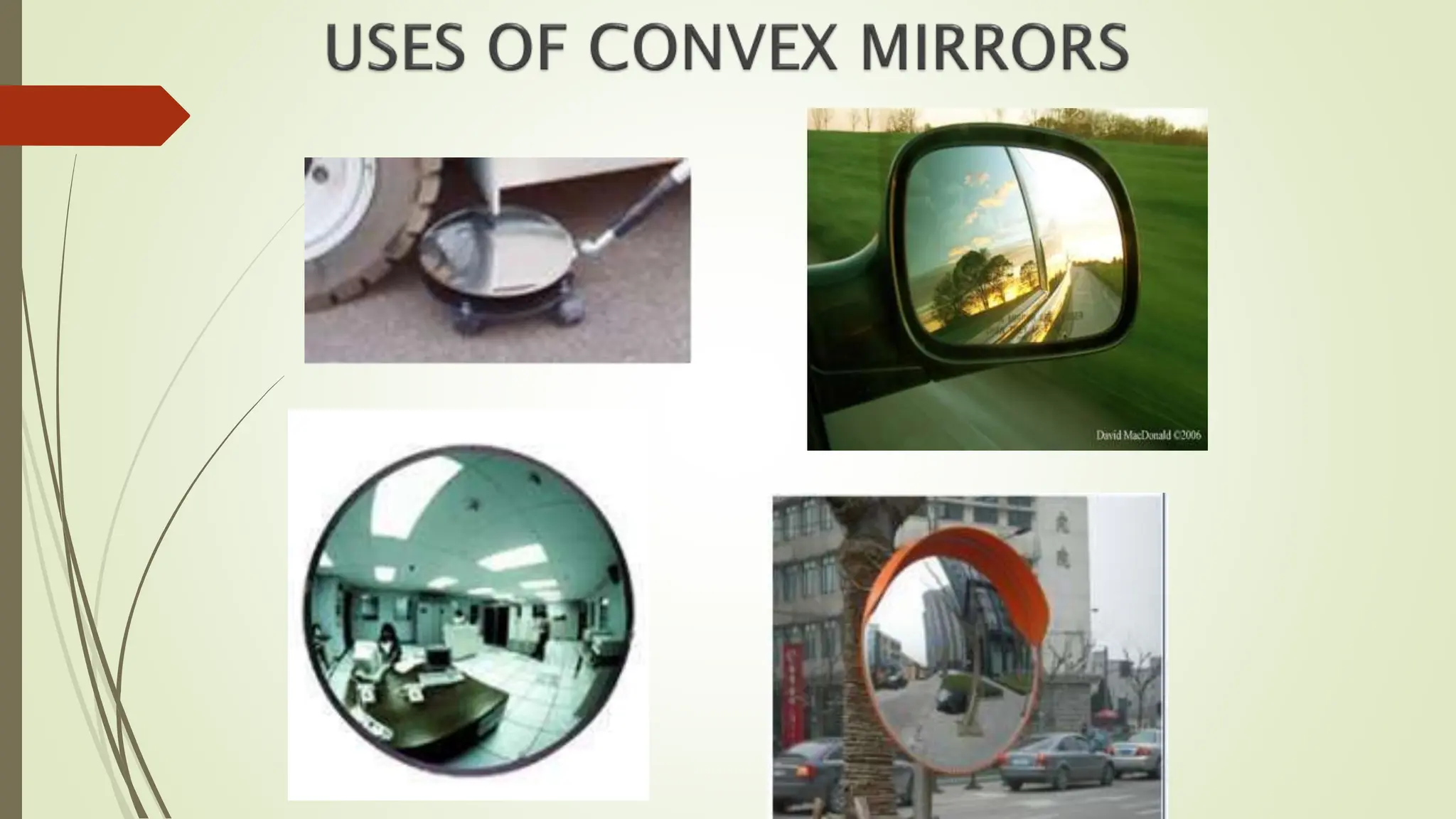
1. Rear view mirrors
2. Anti theft mirrors
3. Inspection mirrors
4. Blind curve navigation mirrors
What is Object Distance
Distance of Object from Pole is called Object Distance
It is denoted by u
What is Image Distance
Distance of Image formed from Pole of Mirror is called Image
Distance
It is denoted by v
What is Focal length
The Distance between focus and the Pole is Called Focal Length
It is denoted by f
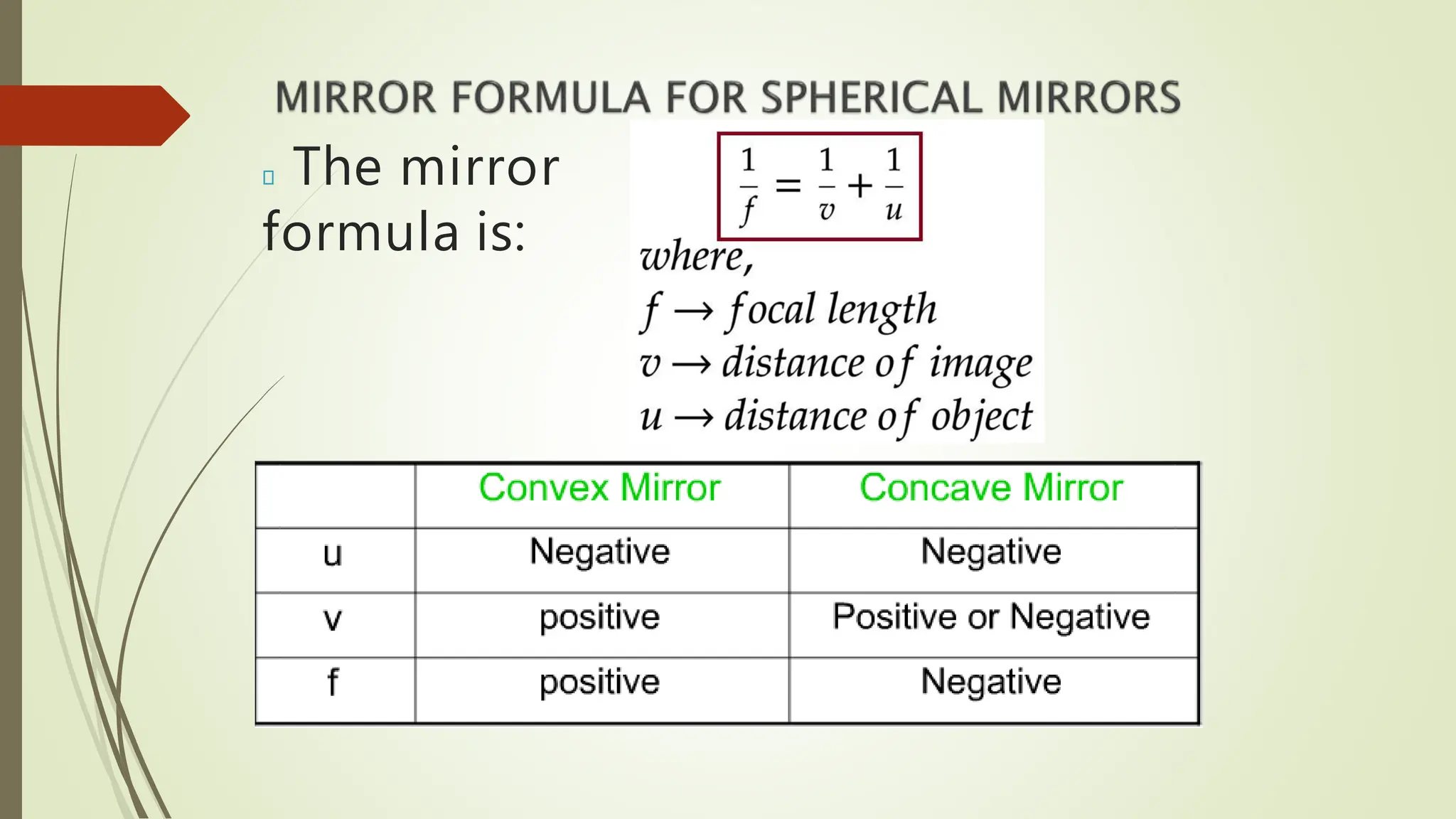
What is Mirror Formula
This formula denotes relationship between
•Object Distance(u)
•Image Distance(v)
•Focal length(f)
The mirror
formula is:
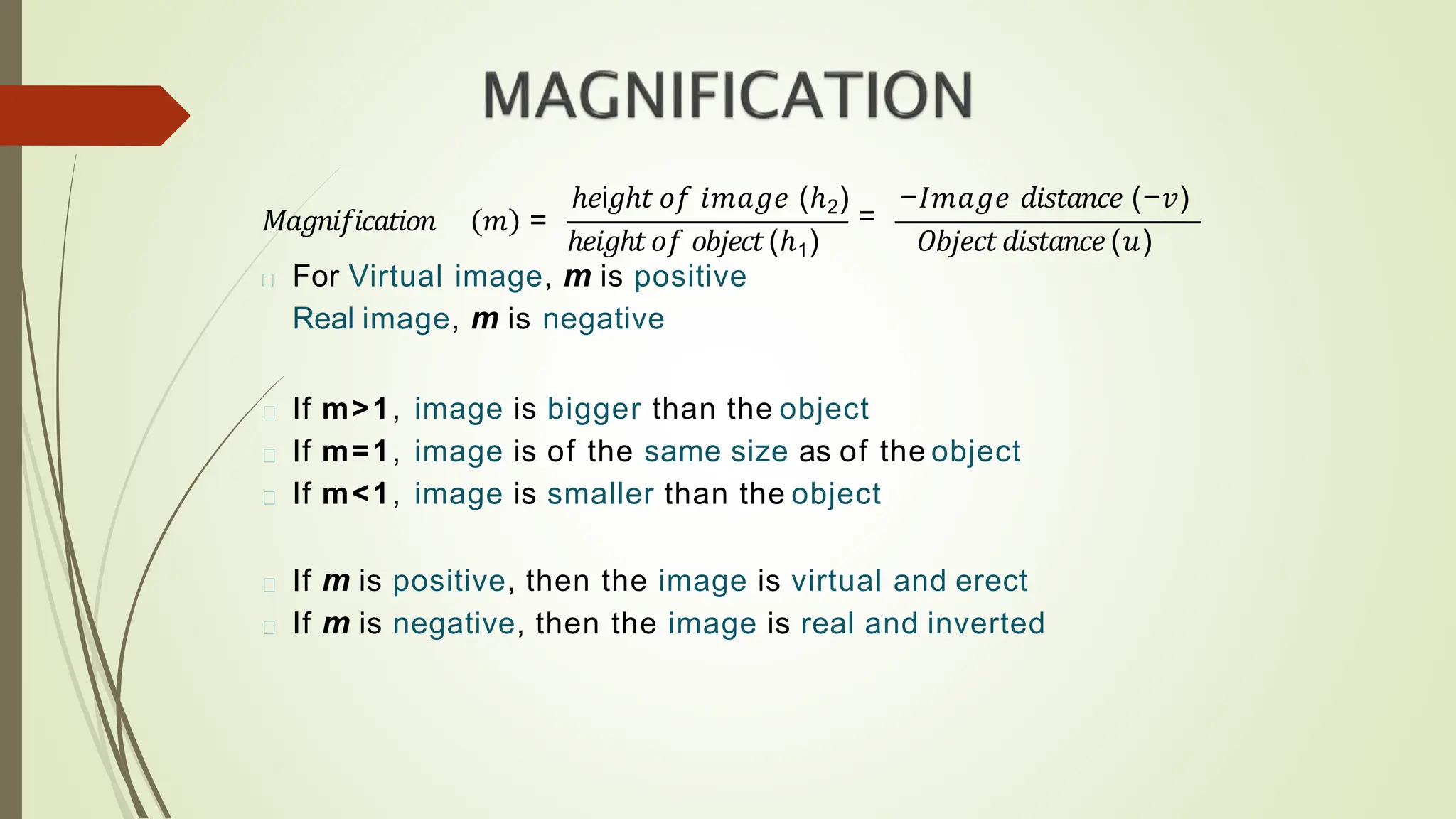
𝑀𝑎𝑔𝑛𝑖𝑓𝑖𝑐𝑎𝑡𝑖𝑜𝑛 𝑚 =
ℎ𝑒i𝑔ℎ𝑡 𝑜𝑓 𝑖𝑚𝑎𝑔𝑒 (ℎ2)
=
−𝐼𝑚𝑎𝑔𝑒 𝑑𝑖𝑠𝑡𝑎𝑛𝑐𝑒 (−𝑣)
ℎ𝑒𝑖𝑔ℎ𝑡𝑜𝑓 𝑜𝑏𝑗𝑒𝑐𝑡(ℎ1) 𝑂𝑏𝑗𝑒𝑐𝑡𝑑𝑖𝑠𝑡𝑎𝑛𝑐𝑒 (𝑢)
For Virtual image, m is positive
Real image, m is negative
If m>1, image is bigger than the object
If m=1, image is of the same size as of the object
If m<1, image is smaller than the object
If m is positive, then the image is virtual and erect
If m is negative, then the image is real and inverted
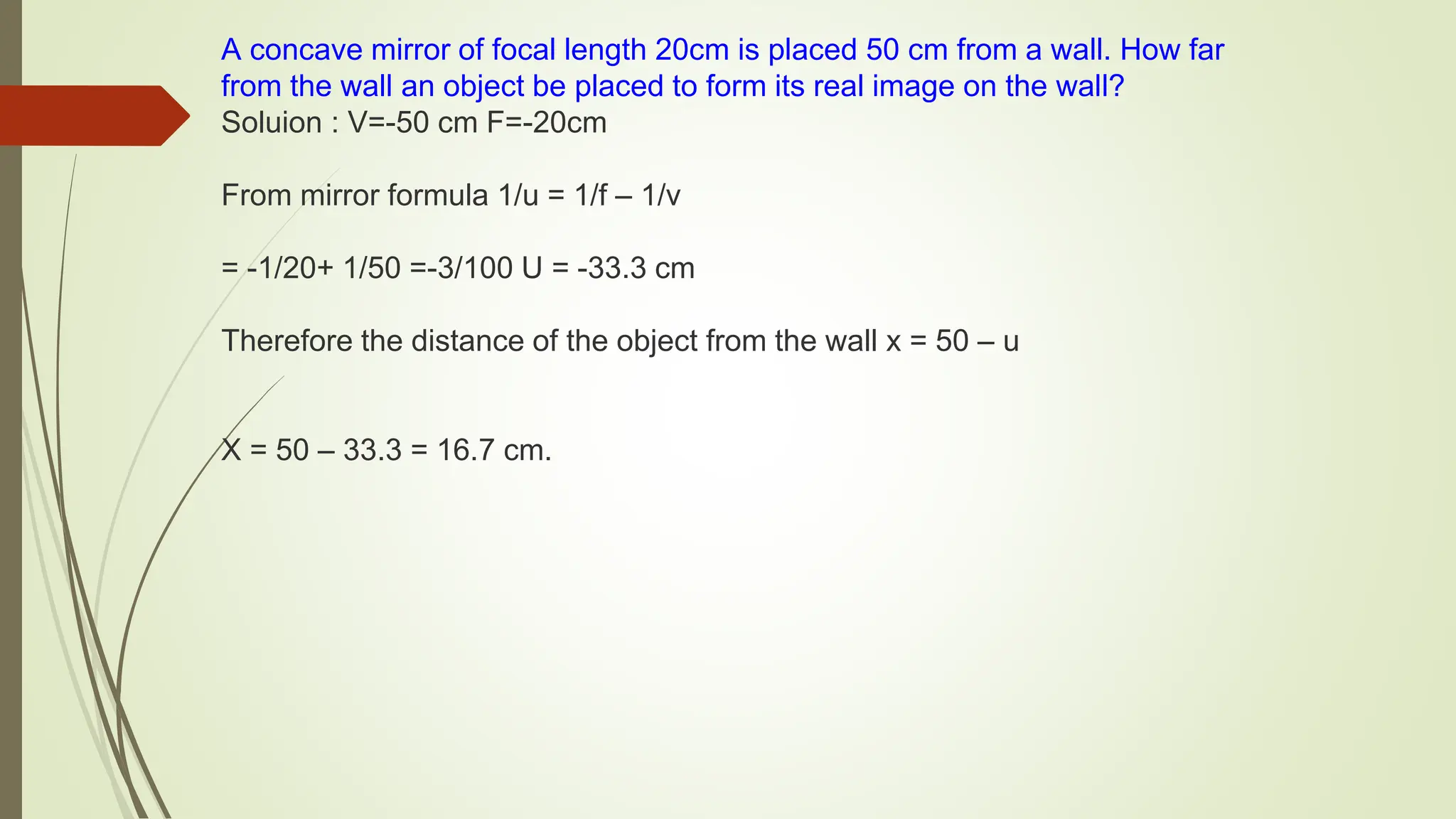
A concave mirror of focal length 20cm is placed 50 cm from a wall. How far
from the wall an object be placed to form its real image on the wall?
Soluion : V=-50 cm F=-20cm
From mirror formula 1/u = 1/f – 1/v
= -1/20+ 1/50 =-3/100 U = -33.3 cm
Therefore the distance of the object from the wall x = 50 – u
X = 50 – 33.3 = 16.7 cm.
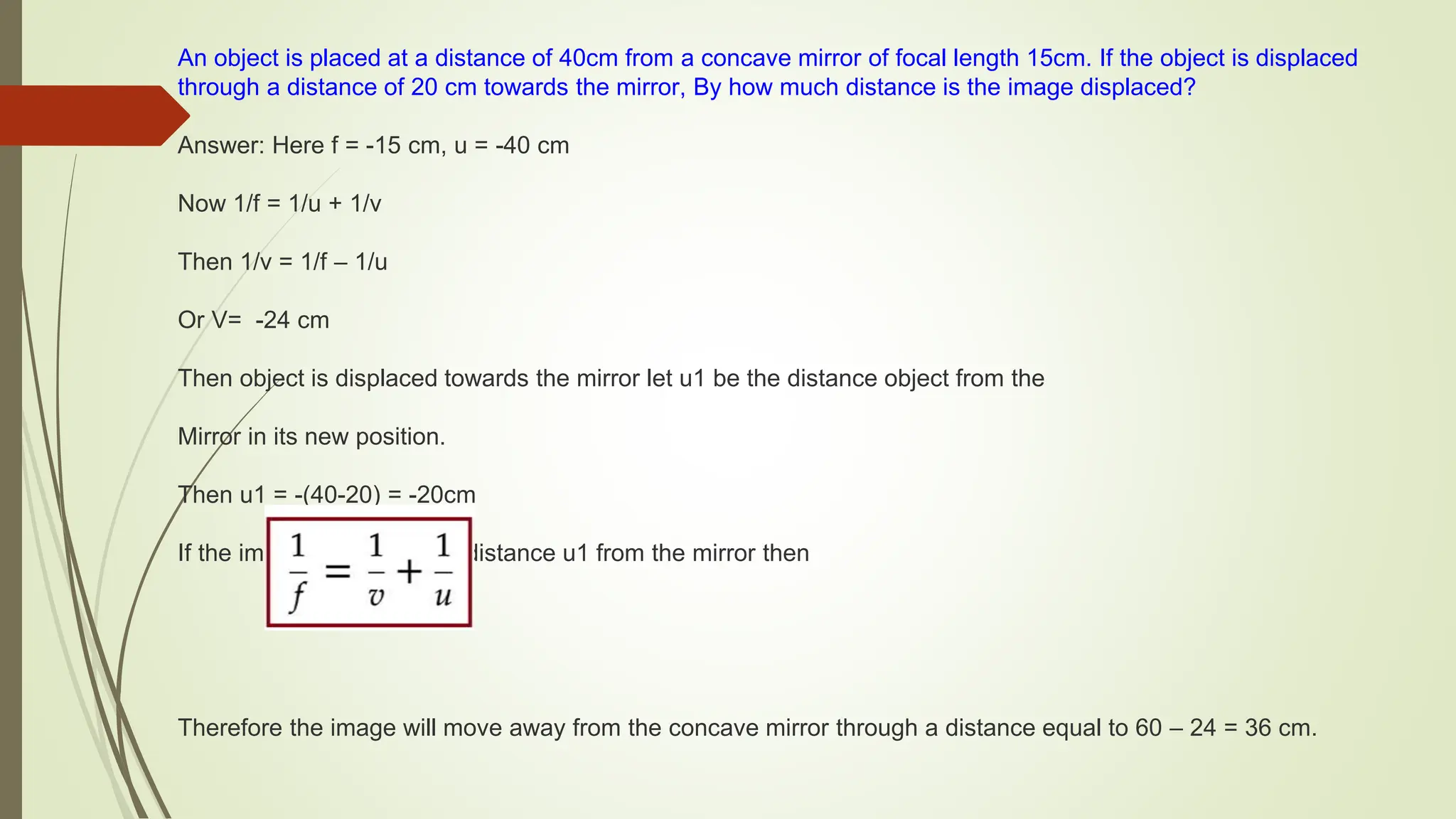
An object is placed at a distance of 40cm from a concave mirror of focal length 15cm. If the object is displaced
through a distance of 20 cm towards the mirror, By how much distance is the image displaced?
Answer: Here f = -15 cm, u = -40 cm
Now 1/f = 1/u + 1/v
Then 1/v = 1/f – 1/u
Or V= -24 cm
Then object is displaced towards the mirror let u1 be the distance object from the
Mirror in its new position.
Then u1 = -(40-20) = -20cm
If the image is formed at a distance u1 from the mirror then
Therefore the image will move away from the concave mirror through a distance equal to 60 – 24 = 36 cm.
An object is placed at distance of 25 cm from a spherical
mirror and its image is formed behind the mirror at distance of
5 cm. Find focal length? Is it concave or convex mirror?
Answer:
Here u = -25 cm , v = 5 cm from the mirror formula
1/f =1/u + 1/v
Then 1/f = -1/25 + 1/5 = 4/ 25
F = 6.25 cm
As the focal length is positive the mirror is convex in nature.
An object is placed in front of a convex mirror of radius of
curvature 40 cm at a distance of 10 cm. Find the position,
nature and magnification of mirror. Answer:
Here u = -10 cm, R = -40 cm
Then f = R/2 = - 20 cm
From the mirror formula 1/v = 1/f – 1/ u = -1/20 + 1/10 = 1/20.
V= 20 cm so v is positive , a virtual and erect image will be
formed on the other side of the object, i.e; behind the mirror.
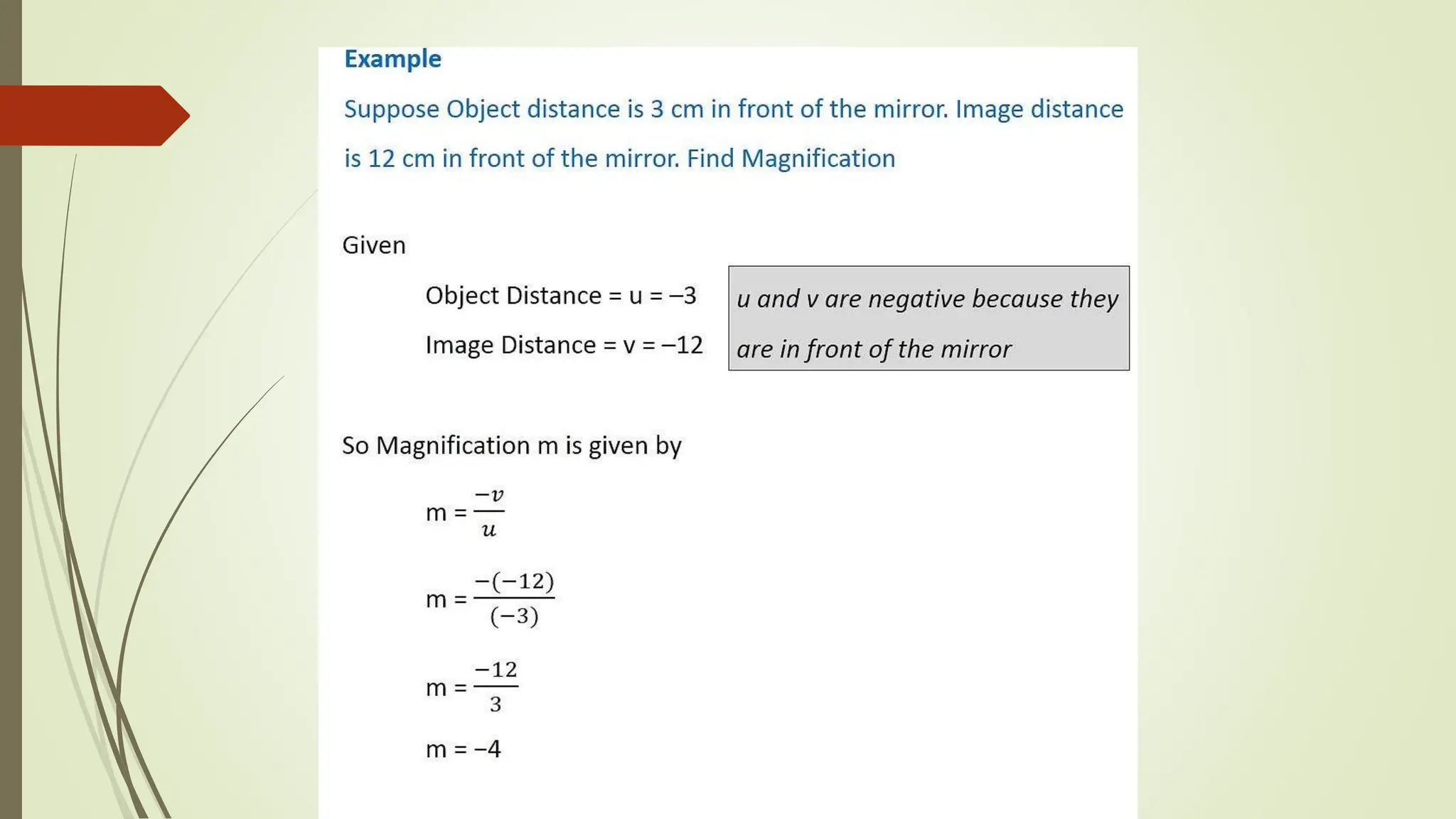
M=-v/u = -20/-10 = 2
An object is kept in front of a concave mirror of focal length of 15 cm. the image formed is 3 times
the size of the object. Calculate the two possible distances of the object from the mirror.
Answer: Case:1. Image is real. M = -3
Here f= -15 cm
Now m=-v/u = -3
Or , V = 3u
From the mirror formula
1/f = 1/u+1/v
-1/15 = 1/u + 1/3u
U= - 20 cm.
Case:2. When the image is virtual m = 3
Now m = -v/u = 3
Or, V=-3
From the mirror formula
1/f=1/u+1/v
Then -1/15 = 1/u-1/3u
2/3u = -1/15
U= -10cm.

LIGHT: CLASS X SCIENCE REFLECTION OF LIGHT

  • 1.
    CHAPTER - 10 LIGHT: REFLECTION AND REFRACTION
  • 2.
    1) Light :- 1.Light is a form of energy which gives us sensation of vision. 2. When light falls on objects, it reflects the light and when the reflected light reaches our eyes then we see the objects. 3. Light travels in straight line – Rectilinear propagation of light 4. The speed of light is 3,00,000 kilometres per second. 5. An opaque object obstructs rays of light when it comes in the path of light, and casts a shadow, this phenomenon tells that rays of light travels in straight line. 6. When rays of light fall on an object, they bounce back and come to our eyes. Bouncing back of light after falling on an object to our eyes enables us to see a particular object. 7. We cannot see an object in dark, because there is no light present in dark which can be bounced back to our eyes.
  • 4.
    Reflection of light Whenlight falls on a highly polished surface like a mirror most of the light is sent back into the same medium. This process is called reflection of light.
  • 5.
    Incident Ray: Theray of light that falls on the reflecting surface Reflected Ray: The ray of light that is sent back by the reflecting surface Normal: The normal is a line at right angle to the reflecting surface to the point of incidence
  • 6.
    Angle of Incidence:It is the angle made by the incident ray and the normal Angle of reflection: It is the angle made by the reflected ray and the normal
  • 7.
    Laws of reflectionof light :- i) The angle of incidence is equal to the angle of reflection. ii) The incident ray, the reflected ray and the normal to the mirror at the point of incidence all lie in the same plane.
  • 8.
    Terms related toreflection or Nature of an image Object: It is the “thing” that forms an image on the screen Image: It is the reflection of the object on the screen Virtual Image: The image that cannot be obtained on a screen (a surface where image is formed) Real Image: The image that is formed directly on the screen Erect: The image is upright Inverted: The image is upside-down Enlarged: The image is larger in size than the actual object Diminished: The image is smaller in size than the actual object Same size: The image is of the same size as the actual object Magnification: is a measure of the size of an image compared to the size of the object.
  • 10.
    • The imageis erect. • The image is same size as the object. • The image is at the same distance from the mirror as the object is in front of it. • The image is virtual (cannot be obtained on a screen). • The image is laterally inverted. Reflection in a plane mirror
  • 11.
    •Magnification of planemirror is +1. Where positive sign shows that image is Virtual and 1 shows that size of image is same as size of object. •The focal length of a plane mirror is infinite
  • 12.
    3) Spherical mirrors:- Spherical mirror is a curved mirror which is a part of a hollow sphere. Spherical mirrors are of two types. They are concave mirror and convex mirror. i) Concave mirror :- is a spherical mirror whose reflecting surface is curved inwards. Rays of light parallel to the principal axis after reflection from a concave mirror meet at a point (converge) on the principal axis. ii) Convex mirror :- is a spherical mirror whose reflecting surface is curved inwards. Rays of light parallel to the principal axis after reflection from a convex mirror get diverged and appear to come from a point behind the mirror.
  • 14.
    Terms used inthe study of spherical mirrors :- Centre of curvature :- is the centre of the sphere of which the mirror is a part (C). Radius of curvature :- is the radius of the sphere of which the mirror is a part (CP). Pole :- is the centre of the spherical mirror (P). Principal axis :- is the straight line passing through the centre of curvature and the pole (X-Y). Focal length :- is the distance between the pole and principal focus (f). In a spherical mirror the radius of curvature is twice the focal length. R = 2f or f = R 2
  • 15.
    Aperture: The diameterof reflecting surface of a spherical mirror is called aperture. Principal focus :- In a concave mirror, rays of light parallel to the principal axis after reflection meet at a point on the principal axis called principal focus(F). In a convex mirror, rays of light parallel to the principal axis after reflection get diverged and appear to come from a point on the principal axis behind the mirror called principal focus (F).
  • 17.
    Reflection by sphericalmirrors :- i) In a concave mirror a ray of light parallel to the principal axis after reflection passes through the focus. In a convex mirror a ray of light parallel to the principal axis after reflection appears to diverge from the focus.
  • 18.
    ii) In aconcave mirror a ray of light passing through the focus after reflection goes parallel to the principal axis. In a convex mirror a ray of light directed towards the focus after reflection goes parallel to the principal axis.
  • 19.
    iii) In aconcave mirror a ray of light passing through the centre of curvature after reflection is reflected back along the same direction. In a convex mirror a ray of light directed towards the centre of curvature after reflection is reflected back along the same direction.
  • 20.
    iv) In aconcave or a convex mirror a ray of light directed obliquely at the pole is reflected obliquely making equal angles with the principal axis.
  • 21.
    We can placethe object at six positions from the mirror: ◦ At infinity ◦ Beyond C ◦ At C ◦ Between C and F ◦ At F ◦ Between Fand P
  • 22.
    Images formed byconcave mirror :- i) When the object is at infinity the image is formed at the focus, it is highly diminished, real and inverted.
  • 24.
    ii) When theobject is beyond C, the image is formed between C and F, it is diminished, real and inverted.
  • 26.
    iii) When theobject is at C, the image is formed at C, it is same size as the object, real and inverted.
  • 28.
    iv) When theobject is between C and F, the image is formed beyond C, it is enlarged, real and inverted.
  • 30.
    v) When theobject is at F, the image is formed at infinity, it is highly enlarged, real and inverted.
  • 31.
    vi) When theobject is between F and P, the image is formed behind the mirror, it is enlarged, virtual and erect.
  • 33.
    Uses of sphericalmirrors :- a) Concave mirrors :- Concave mirrors are used in torches, search lights and head lights of vehicles to get parallel beams of light. They are used as shaving mirrors to see larger image of the face. They are used by dentists to see larger images of the teeth. Large concave mirrors are used to concentrate sunlight to produce heat in solar furnaces.
  • 34.
    Images formed byconvex mirror :- i) When the object is at infinity, the image is formed at F behind the mirror, it is highly diminished, virtual and erect.
  • 35.
    ii) When theobject is between infinity and pole, the image is formed behind the mirror, it is diminished, virtual and erect.
  • 36.
    Position of the object Positionof the image Size of the image Nature of the image At infinity At the focus F, behind the mirror Highly diminished, point-sized Virtual and erect Between infinity and the pole P of the mirror Between P and F, behind the mirror Diminished Virtual and erect
  • 38.
    1. Rear viewmirrors 2. Anti theft mirrors 3. Inspection mirrors 4. Blind curve navigation mirrors
  • 39.
    What is ObjectDistance Distance of Object from Pole is called Object Distance It is denoted by u What is Image Distance Distance of Image formed from Pole of Mirror is called Image Distance It is denoted by v What is Focal length The Distance between focus and the Pole is Called Focal Length It is denoted by f What is Mirror Formula This formula denotes relationship between •Object Distance(u) •Image Distance(v) •Focal length(f)
  • 40.
  • 42.
    𝑀𝑎𝑔𝑛𝑖𝑓𝑖𝑐𝑎𝑡𝑖𝑜𝑛 𝑚 = ℎ𝑒i𝑔ℎ𝑡𝑜𝑓 𝑖𝑚𝑎𝑔𝑒 (ℎ2) = −𝐼𝑚𝑎𝑔𝑒 𝑑𝑖𝑠𝑡𝑎𝑛𝑐𝑒 (−𝑣) ℎ𝑒𝑖𝑔ℎ𝑡𝑜𝑓 𝑜𝑏𝑗𝑒𝑐𝑡(ℎ1) 𝑂𝑏𝑗𝑒𝑐𝑡𝑑𝑖𝑠𝑡𝑎𝑛𝑐𝑒 (𝑢) For Virtual image, m is positive Real image, m is negative If m>1, image is bigger than the object If m=1, image is of the same size as of the object If m<1, image is smaller than the object If m is positive, then the image is virtual and erect If m is negative, then the image is real and inverted
  • 44.
    A concave mirrorof focal length 20cm is placed 50 cm from a wall. How far from the wall an object be placed to form its real image on the wall? Soluion : V=-50 cm F=-20cm From mirror formula 1/u = 1/f – 1/v = -1/20+ 1/50 =-3/100 U = -33.3 cm Therefore the distance of the object from the wall x = 50 – u X = 50 – 33.3 = 16.7 cm.
  • 45.
    An object isplaced at a distance of 40cm from a concave mirror of focal length 15cm. If the object is displaced through a distance of 20 cm towards the mirror, By how much distance is the image displaced? Answer: Here f = -15 cm, u = -40 cm Now 1/f = 1/u + 1/v Then 1/v = 1/f – 1/u Or V= -24 cm Then object is displaced towards the mirror let u1 be the distance object from the Mirror in its new position. Then u1 = -(40-20) = -20cm If the image is formed at a distance u1 from the mirror then Therefore the image will move away from the concave mirror through a distance equal to 60 – 24 = 36 cm.
  • 46.
    An object isplaced at distance of 25 cm from a spherical mirror and its image is formed behind the mirror at distance of 5 cm. Find focal length? Is it concave or convex mirror? Answer: Here u = -25 cm , v = 5 cm from the mirror formula 1/f =1/u + 1/v Then 1/f = -1/25 + 1/5 = 4/ 25 F = 6.25 cm As the focal length is positive the mirror is convex in nature.
  • 47.
    An object isplaced in front of a convex mirror of radius of curvature 40 cm at a distance of 10 cm. Find the position, nature and magnification of mirror. Answer: Here u = -10 cm, R = -40 cm Then f = R/2 = - 20 cm From the mirror formula 1/v = 1/f – 1/ u = -1/20 + 1/10 = 1/20. V= 20 cm so v is positive , a virtual and erect image will be formed on the other side of the object, i.e; behind the mirror. M=-v/u = -20/-10 = 2
  • 48.
    An object iskept in front of a concave mirror of focal length of 15 cm. the image formed is 3 times the size of the object. Calculate the two possible distances of the object from the mirror. Answer: Case:1. Image is real. M = -3 Here f= -15 cm Now m=-v/u = -3 Or , V = 3u From the mirror formula 1/f = 1/u+1/v -1/15 = 1/u + 1/3u U= - 20 cm. Case:2. When the image is virtual m = 3 Now m = -v/u = 3 Or, V=-3 From the mirror formula 1/f=1/u+1/v Then -1/15 = 1/u-1/3u 2/3u = -1/15 U= -10cm.