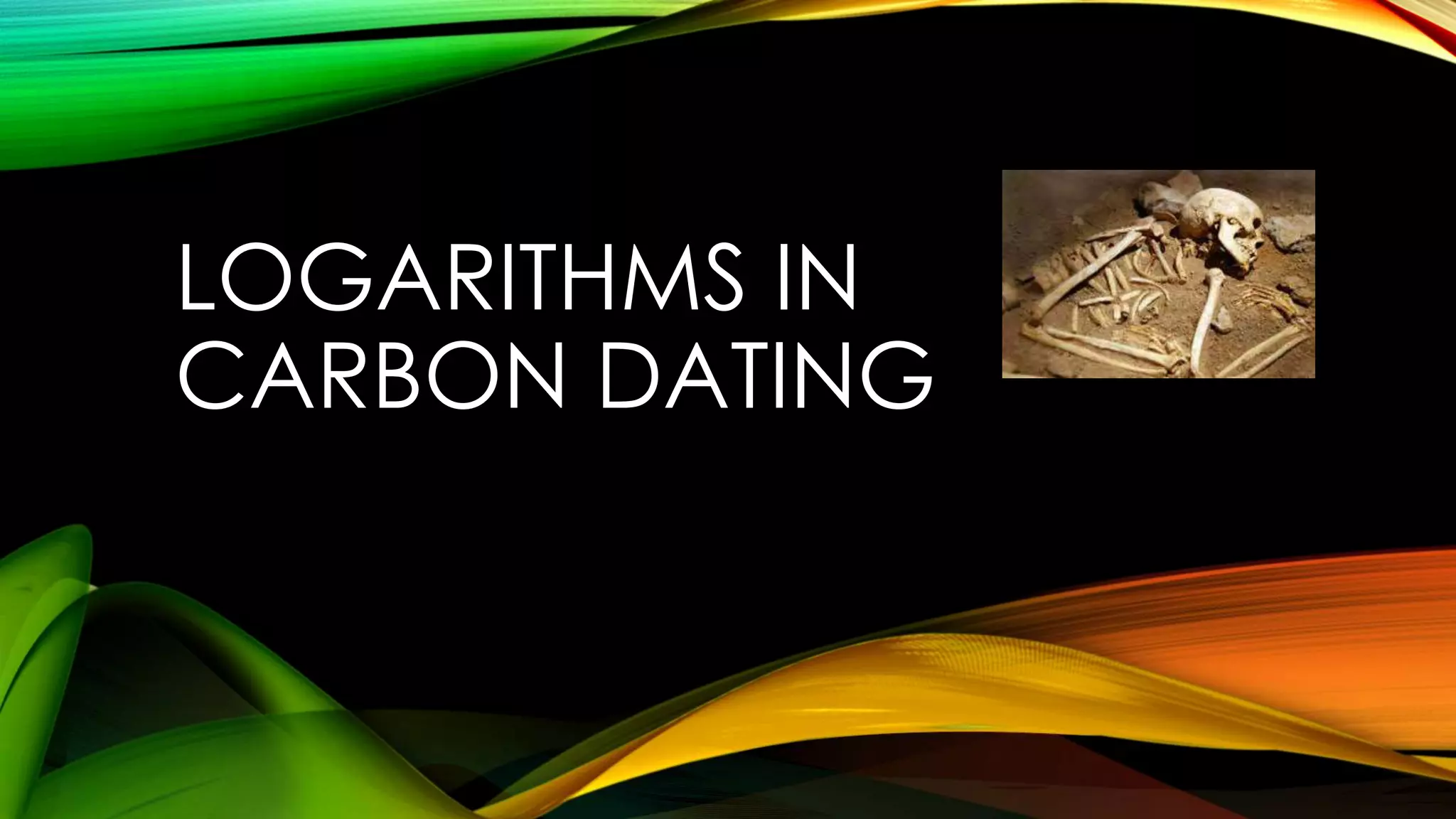
LOGARITHMS IN
CARBON DATING
STORY
• We are a research team from a star and we recently
found a fossil at sungei buloh
• We decided to use the method of carbon dating to
obtain a precise age of this fossil to aid in our
research
AGENCY
•A Star
WHAT IS CARBON DATING
• As soon as a living organism dies, it stops taking in new carbon.
• The ratio of carbon-12 to carbon-14 at the moment of death is the same as
every other living thing, but the carbon-14 decays and is not replaced.
• The carbon-14 decays with its half-life of 5,700 years, while the amount of
carbon-12 remains constant in the sample.
• By looking at the ratio of carbon-12 to carbon-14 in the sample and
comparing it to the ratio in a living organism, it is possible to determine the
age of a formerly living thing fairly precisely.
LOGARITHMS
•A formula to calculate how old a sample is
by carbon-14 dating is:
•t = [ ln (Nf/No) / (-0.693) ] x t1/2
•where ln is the natural logarithm, Nf/No is the
percent of carbon-14 in the sample
compared to the amount in living tissue, and
t1/2 is the half-life of carbon-14 (5,700 years).
AN EXAMPLE
• So, if you had a fossil that had 10 percent carbon-14
compared to a living sample, then that fossil would
be:
• t = [ ln (0.10) / (-0.693) ] x 5,700 years
• t = [ (-2.303) / (-0.693) ] x 5,700 years
• t = [ 3.323 ] x 5,700 years
• t = 18,940 years old
LIMITATIONS
• The use of various radioisotopes allows the dating of
biological and geological samples with a high
degree of accuracy.
• However, radioisotope dating may not work so well
in the future.
• Anything that dies after the 1940s, when Nuclear
bombs, nuclear reactors and open-air nuclear tests
started changing things, will be harder to date
precisely.
OTHER ELEMENTS TO USE FOR
CARBON DATING
•Radioactive dating elements include Uranium
-235 (half-life = 704 million years)
•Uranium -238 (half-life = 4.5 billion years)
•Thorium-232 (half-life = 14 billion years)
Rubidium-87 (half-life = 49 billion years)
QUESTION
•1) The carbon-14 isotope percentage
was 14%, determine its age
•2) The carbon-14 isotope has a 2:3
ration to carbon-12, determine its age
WORKED SOLUTIONS
• 1)
• t = [ ln (0.14) / (-0.693) ] x 5,700 years
• t = [ (-1.966) / (-0.693) ] x 5,700 years
• t = [ 2.837 ] x 5,700 years
• t = 16,170years old
WORKED SOLUTIONS
• 2)
• t = [ ln (0.40) / (-0.693) ] x 5,700 years
• t = [ (-0.916) / (-0.693) ] x 5,700 years
• t = [ 1.322 ] x 5,700 years
• t = 7536 years old
THANK YOU :D

Group 3: Logarithms (carbon dating)

  • 1.
  • 2.
    STORY • We area research team from a star and we recently found a fossil at sungei buloh • We decided to use the method of carbon dating to obtain a precise age of this fossil to aid in our research
  • 3.
  • 4.
    WHAT IS CARBONDATING • As soon as a living organism dies, it stops taking in new carbon. • The ratio of carbon-12 to carbon-14 at the moment of death is the same as every other living thing, but the carbon-14 decays and is not replaced. • The carbon-14 decays with its half-life of 5,700 years, while the amount of carbon-12 remains constant in the sample. • By looking at the ratio of carbon-12 to carbon-14 in the sample and comparing it to the ratio in a living organism, it is possible to determine the age of a formerly living thing fairly precisely.
  • 5.
    LOGARITHMS •A formula tocalculate how old a sample is by carbon-14 dating is: •t = [ ln (Nf/No) / (-0.693) ] x t1/2 •t = [ ln (Nf/No) / (-0.693) ] x t1/2 •where ln is the natural logarithm, Nf/No is the percent of carbon-14 in the sample compared to the amount in living tissue, and t1/2 is the half-life of carbon-14 (5,700 years).
  • 6.
    AN EXAMPLE • So,if you had a fossil that had 10 percent carbon-14 compared to a living sample, then that fossil would be: • t = [ ln (0.10) / (-0.693) ] x 5,700 years • t = [ (-2.303) / (-0.693) ] x 5,700 years • t = [ 3.323 ] x 5,700 years • t = 18,940 years old
  • 7.
    LIMITATIONS • The useof various radioisotopes allows the dating of biological and geological samples with a high degree of accuracy. • However, radioisotope dating may not work so well in the future. • Anything that dies after the 1940s, when Nuclear bombs, nuclear reactors and open-air nuclear tests started changing things, will be harder to date precisely.
  • 8.
    OTHER ELEMENTS TOUSE FOR CARBON DATING •Radioactive dating elements include Uranium -235 (half-life = 704 million years) •Uranium -238 (half-life = 4.5 billion years) •Thorium-232 (half-life = 14 billion years) Rubidium-87 (half-life = 49 billion years)
  • 9.
    QUESTION •1) The carbon-14isotope percentage was 14%, determine its age •2) The carbon-14 isotope has a 2:3 ration to carbon-12, determine its age
  • 10.
    WORKED SOLUTIONS • 1) •t = [ ln (0.14) / (-0.693) ] x 5,700 years • t = [ (-1.966) / (-0.693) ] x 5,700 years • t = [ 2.837 ] x 5,700 years • t = 16,170years old
  • 11.
    WORKED SOLUTIONS • 2) •t = [ ln (0.40) / (-0.693) ] x 5,700 years • t = [ (-0.916) / (-0.693) ] x 5,700 years • t = [ 1.322 ] x 5,700 years • t = 7536 years old
  • 12.