Dating Fossils and Rocks Mike Riddle www.Train2Equip.com
Topics A primer on radioactive decay Carbon-14 dating Radioisotope dating
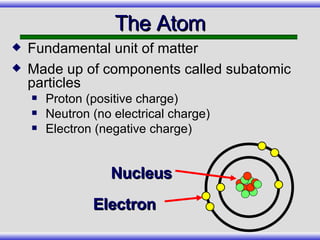
Fundamental unit of matter Made up of components called subatomic particles Proton (positive charge) Neutron (no electrical charge) Electron (negative charge) The Atom Electron Nucleus
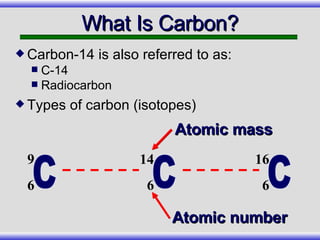
What Is Carbon? Carbon-14 is also referred to as: C-14 Radiocarbon Types of carbon (isotopes) C 14 6 C 9 6 C 16 6 Atomic mass Atomic number
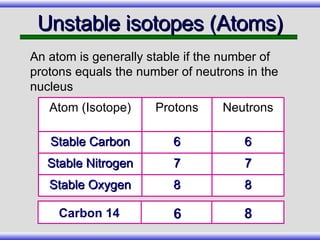
Unstable isotopes (Atoms) An atom is generally stable if the number of protons equals the number of neutrons in the nucleus 8 8 Stable Oxygen 7 7 Stable Nitrogen 6 6 Stable Carbon Neutrons Protons Atom (Isotope) Carbon 14 6 8
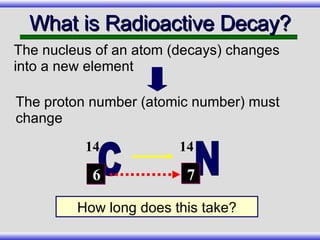
What is Radioactive Decay? The proton number (atomic number) must change How long does this take? The nucleus of an atom (decays) changes into a new element C N 14 6 14 7
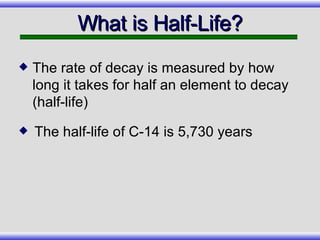
The half-life of C-14 is 5,730 years What is Half-Life? The rate of decay is measured by how long it takes for half an element to decay  (half-life)
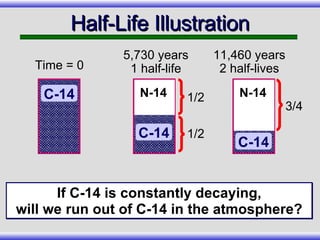
Half-Life Illustration If C-14 is constantly decaying, will we run out of C-14 in the atmosphere? Time = 0 C-14 5,730 years 1 half-life N-14 C-14 11,460 years 2 half-lives N-14 C-14 1/2 1/2 3/4
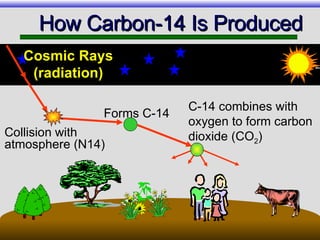
How Carbon-14 Is Produced Cosmic Rays (radiation) Collision with atmosphere (N14) Forms C-14 C-14 combines with oxygen to form carbon dioxide (CO 2 )
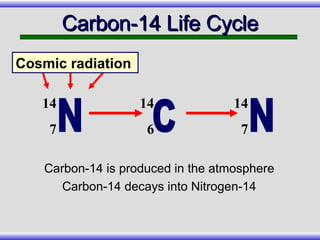
Carbon-14 Life Cycle Cosmic radiation Carbon-14 is produced in the atmosphere Carbon-14 decays into Nitrogen-14 C 14 6 N 14 7 N 14 7
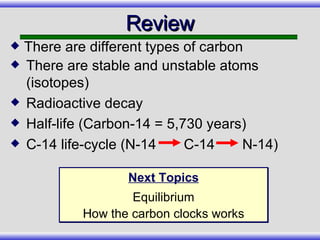
There are stable and unstable atoms (isotopes) Radioactive decay Half-life (Carbon-14 = 5,730 years) C-14 life-cycle (N-14  C-14  N-14) Review There are different types of carbon Next Topics Equilibrium How the carbon clocks works
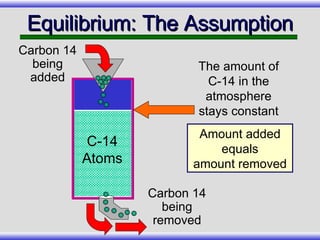
Equilibrium: The Assumption Carbon 14 being added Carbon 14 being removed The amount of C-14 in the atmosphere stays constant Amount added equals amount removed C-14 Atoms
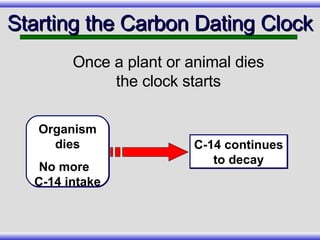
Starting the Carbon Dating Clock Once a plant or animal dies the clock starts Organism dies No more  C-14 intake C-14 continues to decay
There is a lot of C-14 remaining in the fossil  There is very little C-14 remaining in the fossil  There is no detectable C-14 in the fossil How the Carbon Clock Works The C-14 dating method relies on measuring the amount of C-14 in the fossil Three Scenarios
How fast it decays (measured in half-lives).  This is known (5,730 years). The starting amount of C-14 in the fossil. What We Need to Know What do we need to know to determine how many half-lives have expired? A critical Detail
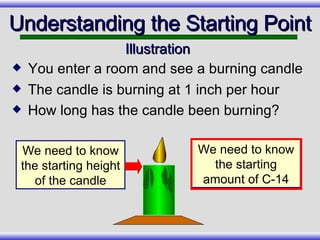
Understanding the Starting Point The candle is burning at 1 inch per hour How long has the candle been burning? Illustration You enter a room and see a burning candle We need to know the starting height of the candle We need to know the starting amount of C-14
Understanding the Starting Point If we find 1,000 C-14 atoms in a fossil, do we know how much C-14 has decayed? NO We need to know the starting amount of C-14. How is this done?
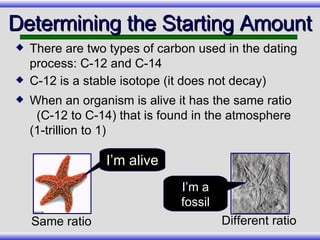
Determining the Starting Amount There are two types of carbon used in the dating process: C-12 and C-14 C-12 is a stable isotope (it does not decay) When an organism is alive it has the same ratio  (C-12 to C-14) that is found in the atmosphere (1-trillion to 1) Same ratio I’m alive Different ratio I’m a fossil
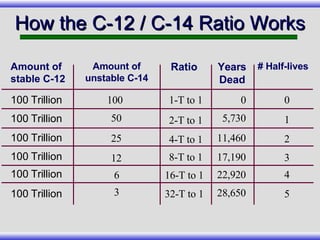
How the C-12 / C-14 Ratio Works Amount of stable C-12 Amount of unstable C-14 Ratio Years Dead # Half-lives 100 Trillion 100 1-T to 1 0 0 100 Trillion 50 2-T to 1 5,730 1 100 Trillion 25 4-T to 1 11,460 2 100 Trillion 12 8-T to 1 17,190 3 100 Trillion 6 16-T to 1 22,920 4 100 Trillion 3 32-T to 1 28,650 5
Has the ratio of C-12 to C-14  always been the same (1-trillion to 1)? A Critical Assumption If this assumption is  true  then carbon-14 dating is a reliable dating method If this assumption is  false  then carbon-14 dating is not a reliable dating method This is a key assumption
“ He found a considerable discrepancy in his measurements indicating that, apparently, radiocarbon was being created in the atmosphere somewhere around 25 percent faster than it was becoming extinct.  Since this result was inexplicable by any conventional scientific means, Libby put the discrepancy down to experimental error.” Dr. Willard Libby and Equilibrium Richard, Milton,  Shattering the Myths of Darwinism , 1997, p. 32.  (W. F. Libby,  Radiocarbon Dating,  1955)
“During the 1960s, Libby’s experiments were repeated by chemists… The new experiments, though, revealed that the discrepancy observed by Libby was not merely an experimental error – it did exist.” The Facts About Equilibrium Richard, Milton,  Shattering the Myths of Darwinism , 1997, p. 32.
“There is strong indication, despite the large errors, that the present natural production rate exceeds the natural decay rate by as much as 25 percent.” The Facts About Equilibrium Richard Lingenfelter, “Production of C-14 by cosmic ray neutrons”,  Review of Geophysics , 1963, p.51 . Are there any factors that can affect the amount of carbon in the atmosphere?
Cosmic ray penetration of the earth’s atmosphere The strength of the earth’s magnetic field The CO 2  levels in the atmosphere The Genesis Flood Factors Affecting Carbon-14 Dating Factors that would cause dates to appear older than they actually are include:
This buried carbon ( mostly C-12 ) is about 100 times the total carbon in the present biosphere Atmospheric Levels of Carbon What does this mean? The CO 2  level in the pre-Flood biosphere was different (a higher ratio of C-12 to C-14) C-14 dates using the present ratio of C12/C14 will give incorrect ages – ages that are too old The Genesis Flood buried much carbon from living organisms to form coal and oil
The Flood and C-14 Dating “Assuming the Flood did occur, little if any C-14 may have existed before then. This would give anything older than the Flood a false appearance of great age.” James Perloff,  Tornado in a Junkyard , 1999, p. 140.
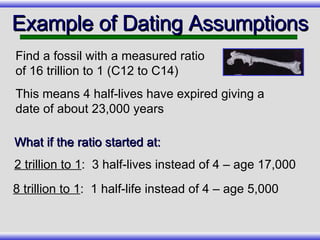
Example of Dating Assumptions Find a fossil with a measured ratio of 16 trillion to 1 (C12 to C14) This means 4 half-lives have expired giving a date of about 23,000 years 8 trillion to 1 :  1 half-life instead of 4 – age 5,000 What if the ratio started at: 2 trillion to 1 :  3 half-lives instead of 4 – age 17,000
The Assumption: Equilibrium “ We know that the assumption that the biospheric inventory of C 14  has remained constant over the past 50,000 years or so  is not true .” Elizabeth K. Ralph and Henry M. Michael, “Twenty-five Years of Radiocarbon Dating,”  American Scientist , Sep/Oct 1974 The assumption carbon-14 dating is based upon is FALSE
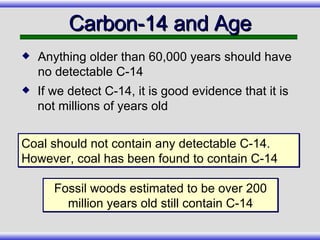
If we detect C-14, it is good evidence that it is not millions of years old Carbon-14 and Age Coal should not contain any detectable C-14. However, coal has been found to contain C-14 Fossil woods estimated to be over 200 million years old still contain C-14 Anything older than 60,000 years should have no detectable C-14
C-14 and Recent Dates Ancient human skeletons, when dated by the new Accelerator Mass Spectrometer technique, give surprisingly recent dates. In one study of eleven sets of ancient human bones, all were dated at about 5,000 radiocarbon years or less. R. E. Taylor, “Major Revisions in the Pleistocene Age Assignments for North American human Skeletons by C-14 Accelerator Mass Spectrometry”,  American Antiquity , Vol. 50, 1985, pp. 136-140.
Carbon-14 Summary Carbon-14 can only be used to date organic material Carbon-14 dating accuracy is dependent upon a consistent ratio between C-12 and C-14 (equilibrium) The assumption of equilibrium is FALSE There are factors that can affect C-14 in the atmosphere (Genesis Flood) Ancient fossils as well as coal contain C-14 residue
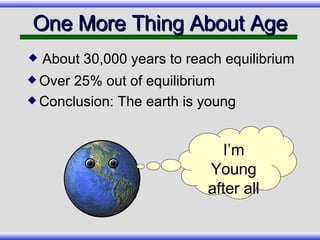
One More Thing About Age Over 25% out of equilibrium Conclusion: The earth is young I’m Young after all About 30,000 years to reach equilibrium
Carbon-14 Dating: Conclusion  “ The troubles of the radiocarbon dating method are undeniably deep and serious. Despite 35 years of technological refinement and better understanding, the underlying assumptions have been strongly challenged…. It should be of no surprise, then, that fully half of the dates are rejected. The wonder is, that the remaining half came to be accepted. Robert E. Lee, “Radiocarbon: Ages in Error,”  Anthropological Journal of Canada , 1981, pp. 26-27. continued
The implications of pervasive contamination and ancient variations in carbon-14 levels are steadfastly ignored by those who base their argument upon the dates…. While the method cannot be counted on to give good, unequivocal results, the numbers do impress people, and save them the trouble of thinking excessively.”
Radioisotope Dating Methods Dating Rocks What are they and how do they operate? What is the basic perception? How accurate are they? Are there any hidden assumptions?
Scientists have proven the earth old Peer pressure (specifically the education system) Intellectualism (science versus religion) Don’t want to hear the information Young earther’s are ignoring the scientific evidence The Bible does not teach how old the earth is Not an important issue, but it must be old Most scientists believe in an old earth Pride Why People Believe
Analyzing statements Does everyone agree? Am I being given all the information (selective data)? Does it work in all cases – are there exceptions? Are there any hidden assumptions? Are they assuming an answer without presenting supporting evidence? Are they appealing to ignorance? Are their attacks on the opposition valid – are they distorting data to make other views look non-credible? Who made the statement and what was their bias?
“Using radioactive dating, scientists have determined that the Earth is about 4.5 billion years old, ancient enough for all species to have been formed through evolution.” Textbooks Biology: Visualizing Life , Holt, Rinehart, Winston, 1998, p.177.
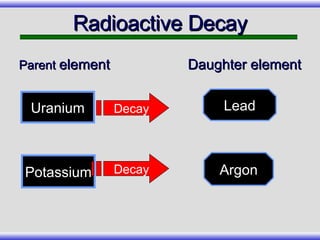
Radioactive Decay Decay Decay Uranium Lead Potassium Argon Parent  element Daughter element
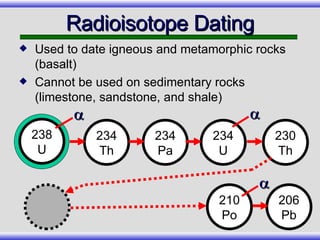
Used to date igneous and metamorphic rocks (basalt) Cannot be used on sedimentary rocks (limestone, sandstone, and shale) Radioisotope Dating 238 U 234 Th 234 Pa 234 U 230 Th 206 Pb 210 Po   
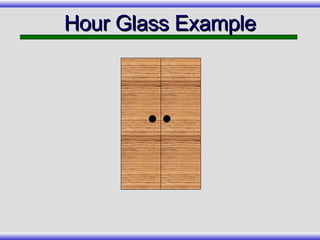
Hour Glass Example
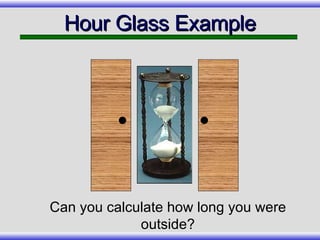
Hour Glass Example Can you calculate how long you were outside?
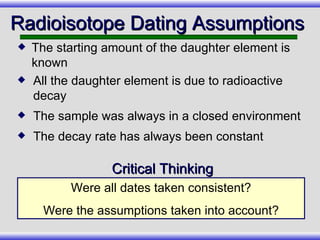
All the daughter element is due to radioactive decay The sample was always in a closed environment The decay rate has always been constant Radioisotope Dating Assumptions  Were all dates taken consistent? Were the assumptions taken into account? Critical Thinking The starting amount of the daughter element is known
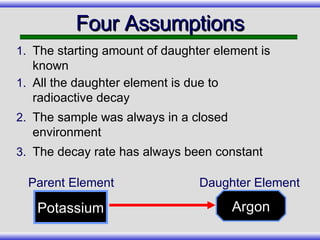
All the daughter element is due to radioactive decay The sample was always in a closed environment The decay rate has always been constant Four Assumptions The starting amount of daughter element is known Potassium Argon Parent Element Daughter Element
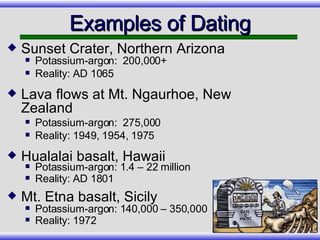
Sunset Crater, Northern Arizona Potassium-argon:  200,000+ Reality: AD 1065 Lava flows at Mt. Ngaurhoe, New Zealand Potassium-argon:  275,000 Reality: 1949, 1954, 1975 Hualalai basalt, Hawaii Potassium-argon: 1.4 – 22 million Reality: AD 1801 Mt. Etna basalt, Sicily Potassium-argon: 140,000 – 350,000 Reality: 1972 Examples of Dating
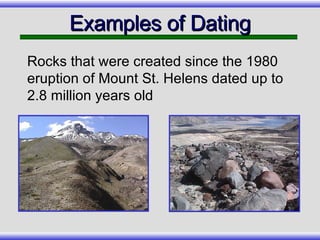
Rocks that were created since the 1980 eruption of Mount St. Helens dated up to 2.8 million years old Examples of Dating
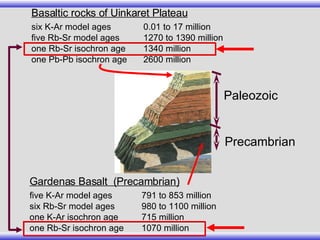
Basaltic rocks of Uinkaret Plateau six K-Ar model ages 0.01 to 17 million five Rb-Sr model ages 1270 to 1390 million one Rb-Sr isochron age 1340 million one Pb-Pb isochron age 2600 million Gardenas Basalt  (Precambrian) five K-Ar model ages 791 to 853 million six Rb-Sr model ages 980 to 1100 million one K-Ar isochron age 715 million one Rb-Sr isochron age 1070 million Paleozoic Precambrian
Radioisotope Dating Reliability and Consistency If the dates are never right when we know the age of the rocks, how can we be sure they are correct when we don’t know the exact date of the rocks?
“When the same rock is dated by more than one method, it will often yield different ‘ages.’ And when the rock is dated more than one time by the same method, it will often give different results.” Radioisotope Dating John Morris, Ph.D. Geology,  The Geology Book , 2000, p. 52. Reliability and Consistency
Assumptions If you base your theory on a wrong assumption, all your work can be correct, but the result will be wrong.
Scientific Evidence for a Young Earth
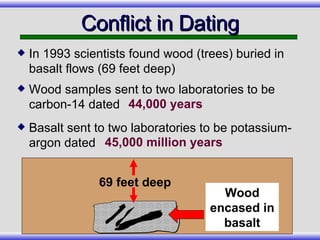
Conflict in Dating In 1993 scientists found wood (trees) buried in basalt flows (69 feet deep) Wood samples sent to two laboratories to be carbon-14 dated Basalt sent to two laboratories to be potassium-argon dated 44,000 years 45,000 million years Wood embedded in lava flow (basalt) 69 feet deep Wood encased in basalt
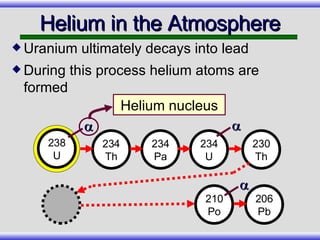
Helium in the Atmosphere Uranium ultimately decays into lead During this process helium atoms are formed   238 U 234 Th 234 Pa 234 U 230 Th 206 Pb 210 Po  Helium nucleus
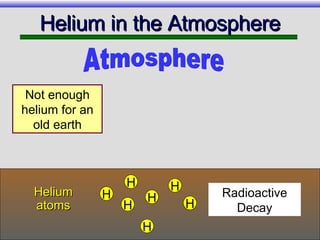
Helium in the Atmosphere H H H H H H H Atmosphere Not enough helium for an old earth Radioactive Decay Helium atoms
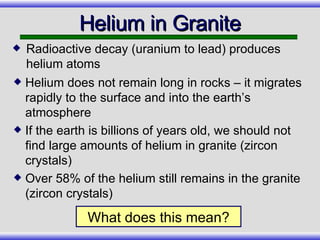
Helium in Granite Helium does not remain long in rocks – it migrates rapidly to the surface and into the earth’s atmosphere If the earth is billions of years old, we should not find large amounts of helium in granite (zircon crystals) Over 58% of the helium still remains in the granite (zircon crystals) What does this mean? Radioactive decay (uranium to lead) produces helium atoms
Evidence for a Young Earth The evolution model of billions of years does not match the data The creation model of a young earth best matches the data (about 6,000 years) There has not been enough time for the helium to diffuse out of the granite (zircon crystals) I’m Young after all
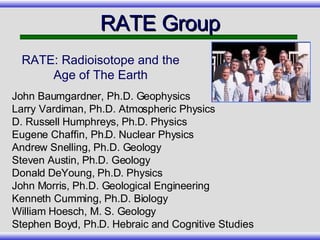
RATE Group RATE: Radioisotope and the Age of The Earth John Baumgardner, Ph.D. Geophysics Larry Vardiman, Ph.D. Atmospheric Physics D. Russell Humphreys, Ph.D. Physics Eugene Chaffin, Ph.D. Nuclear Physics Andrew Snelling, Ph.D. Geology Steven Austin, Ph.D. Geology Donald DeYoung, Ph.D. Physics John Morris, Ph.D. Geological Engineering Kenneth Cumming, Ph.D. Biology William Hoesch, M. S. Geology Stephen Boyd, Ph.D. Hebraic and Cognitive Studies
Evidences for a Young Earth Helium in the Earth’s atmosphere Nuclear decay rates (Radioisotope dating)  Sodium in the oceans Rapid disintegration of comets Erosion of continents Sediments in the ocean Decay of the Earth’s magnetic field Carbon-14 ratio in the atmosphere Radiohalos for polonium in granites Population statistics Recession of the moon Many more …..
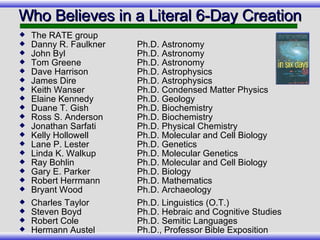
Who Believes in a Literal 6-Day Creation The RATE group Danny R. Faulkner   Ph.D. Astronomy John Byl Ph.D. Astronomy Tom Greene Ph.D. Astronomy Dave Harrison Ph.D. Astrophysics James Dire Ph.D. Astrophysics Keith Wanser Ph.D. Condensed Matter Physics Elaine Kennedy Ph.D. Geology Duane T. Gish   Ph.D. Biochemistry Ross S. Anderson Ph.D. Biochemistry Jonathan Sarfati   Ph.D. Physical Chemistry Kelly Hollowell Ph.D. Molecular and Cell Biology Lane P. Lester   Ph.D. Genetics Linda K. Walkup Ph.D. Molecular Genetics Ray Bohlin Ph.D. Molecular and Cell Biology Gary E. Parker   Ph.D. Biology Robert Herrmann Ph.D. Mathematics Bryant Wood Ph.D. Archaeology Charles Taylor Ph.D. Linguistics (O.T.) Steven Boyd Ph.D. Hebraic and Cognitive Studies Robert Cole Ph.D. Semitic Languages Hermann Austel Ph.D., Professor Bible Exposition
Belief in a Young Earth “I am convinced there is far more evidence for a recent, six-day creation and a global Flood than there is for an old earth and evolution.” Keith Wanser (Ph.D. Condensed Matter Physics), Creation ex nihilo, 1999, p. 39.
Conclusion: Five Facts The earth has not been scientifically proven to be billions of years old The Bible teaches a literal 6-day creation Many scientists believe in a literal 6-day creation about 6,000 years ago New evidence from nuclear decay supports a young earth model There are many scientific evidences for a young earth
Psalm 118:8   It is better to trust in the Lord than to put confidence in man John 17:17 Sanctify them through thy truth: thy word is truth

Dating Fossils And Rocks

  • 1.
    Dating Fossils andRocks Mike Riddle www.Train2Equip.com
  • 2.
    Topics A primeron radioactive decay Carbon-14 dating Radioisotope dating
  • 3.
    Fundamental unit ofmatter Made up of components called subatomic particles Proton (positive charge) Neutron (no electrical charge) Electron (negative charge) The Atom Electron Nucleus
  • 4.
    What Is Carbon?Carbon-14 is also referred to as: C-14 Radiocarbon Types of carbon (isotopes) C 14 6 C 9 6 C 16 6 Atomic mass Atomic number
  • 5.
    Unstable isotopes (Atoms)An atom is generally stable if the number of protons equals the number of neutrons in the nucleus 8 8 Stable Oxygen 7 7 Stable Nitrogen 6 6 Stable Carbon Neutrons Protons Atom (Isotope) Carbon 14 6 8
  • 6.
    What is RadioactiveDecay? The proton number (atomic number) must change How long does this take? The nucleus of an atom (decays) changes into a new element C N 14 6 14 7
  • 7.
    The half-life ofC-14 is 5,730 years What is Half-Life? The rate of decay is measured by how long it takes for half an element to decay (half-life)
  • 8.
    Half-Life Illustration IfC-14 is constantly decaying, will we run out of C-14 in the atmosphere? Time = 0 C-14 5,730 years 1 half-life N-14 C-14 11,460 years 2 half-lives N-14 C-14 1/2 1/2 3/4
  • 9.
    How Carbon-14 IsProduced Cosmic Rays (radiation) Collision with atmosphere (N14) Forms C-14 C-14 combines with oxygen to form carbon dioxide (CO 2 )
  • 10.
    Carbon-14 Life CycleCosmic radiation Carbon-14 is produced in the atmosphere Carbon-14 decays into Nitrogen-14 C 14 6 N 14 7 N 14 7
  • 11.
    There are stableand unstable atoms (isotopes) Radioactive decay Half-life (Carbon-14 = 5,730 years) C-14 life-cycle (N-14 C-14 N-14) Review There are different types of carbon Next Topics Equilibrium How the carbon clocks works
  • 12.
    Equilibrium: The AssumptionCarbon 14 being added Carbon 14 being removed The amount of C-14 in the atmosphere stays constant Amount added equals amount removed C-14 Atoms
  • 13.
    Starting the CarbonDating Clock Once a plant or animal dies the clock starts Organism dies No more C-14 intake C-14 continues to decay
  • 14.
    There is alot of C-14 remaining in the fossil There is very little C-14 remaining in the fossil There is no detectable C-14 in the fossil How the Carbon Clock Works The C-14 dating method relies on measuring the amount of C-14 in the fossil Three Scenarios
  • 15.
    How fast itdecays (measured in half-lives). This is known (5,730 years). The starting amount of C-14 in the fossil. What We Need to Know What do we need to know to determine how many half-lives have expired? A critical Detail
  • 16.
    Understanding the StartingPoint The candle is burning at 1 inch per hour How long has the candle been burning? Illustration You enter a room and see a burning candle We need to know the starting height of the candle We need to know the starting amount of C-14
  • 17.
    Understanding the StartingPoint If we find 1,000 C-14 atoms in a fossil, do we know how much C-14 has decayed? NO We need to know the starting amount of C-14. How is this done?
  • 18.
    Determining the StartingAmount There are two types of carbon used in the dating process: C-12 and C-14 C-12 is a stable isotope (it does not decay) When an organism is alive it has the same ratio (C-12 to C-14) that is found in the atmosphere (1-trillion to 1) Same ratio I’m alive Different ratio I’m a fossil
  • 19.
    How the C-12/ C-14 Ratio Works Amount of stable C-12 Amount of unstable C-14 Ratio Years Dead # Half-lives 100 Trillion 100 1-T to 1 0 0 100 Trillion 50 2-T to 1 5,730 1 100 Trillion 25 4-T to 1 11,460 2 100 Trillion 12 8-T to 1 17,190 3 100 Trillion 6 16-T to 1 22,920 4 100 Trillion 3 32-T to 1 28,650 5
  • 20.
    Has the ratioof C-12 to C-14 always been the same (1-trillion to 1)? A Critical Assumption If this assumption is true then carbon-14 dating is a reliable dating method If this assumption is false then carbon-14 dating is not a reliable dating method This is a key assumption
  • 21.
    “ He founda considerable discrepancy in his measurements indicating that, apparently, radiocarbon was being created in the atmosphere somewhere around 25 percent faster than it was becoming extinct. Since this result was inexplicable by any conventional scientific means, Libby put the discrepancy down to experimental error.” Dr. Willard Libby and Equilibrium Richard, Milton, Shattering the Myths of Darwinism , 1997, p. 32. (W. F. Libby, Radiocarbon Dating, 1955)
  • 22.
    “During the 1960s,Libby’s experiments were repeated by chemists… The new experiments, though, revealed that the discrepancy observed by Libby was not merely an experimental error – it did exist.” The Facts About Equilibrium Richard, Milton, Shattering the Myths of Darwinism , 1997, p. 32.
  • 23.
    “There is strongindication, despite the large errors, that the present natural production rate exceeds the natural decay rate by as much as 25 percent.” The Facts About Equilibrium Richard Lingenfelter, “Production of C-14 by cosmic ray neutrons”, Review of Geophysics , 1963, p.51 . Are there any factors that can affect the amount of carbon in the atmosphere?
  • 24.
    Cosmic ray penetrationof the earth’s atmosphere The strength of the earth’s magnetic field The CO 2 levels in the atmosphere The Genesis Flood Factors Affecting Carbon-14 Dating Factors that would cause dates to appear older than they actually are include:
  • 25.
    This buried carbon( mostly C-12 ) is about 100 times the total carbon in the present biosphere Atmospheric Levels of Carbon What does this mean? The CO 2 level in the pre-Flood biosphere was different (a higher ratio of C-12 to C-14) C-14 dates using the present ratio of C12/C14 will give incorrect ages – ages that are too old The Genesis Flood buried much carbon from living organisms to form coal and oil
  • 26.
    The Flood andC-14 Dating “Assuming the Flood did occur, little if any C-14 may have existed before then. This would give anything older than the Flood a false appearance of great age.” James Perloff, Tornado in a Junkyard , 1999, p. 140.
  • 27.
    Example of DatingAssumptions Find a fossil with a measured ratio of 16 trillion to 1 (C12 to C14) This means 4 half-lives have expired giving a date of about 23,000 years 8 trillion to 1 : 1 half-life instead of 4 – age 5,000 What if the ratio started at: 2 trillion to 1 : 3 half-lives instead of 4 – age 17,000
  • 28.
    The Assumption: Equilibrium“ We know that the assumption that the biospheric inventory of C 14 has remained constant over the past 50,000 years or so is not true .” Elizabeth K. Ralph and Henry M. Michael, “Twenty-five Years of Radiocarbon Dating,” American Scientist , Sep/Oct 1974 The assumption carbon-14 dating is based upon is FALSE
  • 29.
    If we detectC-14, it is good evidence that it is not millions of years old Carbon-14 and Age Coal should not contain any detectable C-14. However, coal has been found to contain C-14 Fossil woods estimated to be over 200 million years old still contain C-14 Anything older than 60,000 years should have no detectable C-14
  • 30.
    C-14 and RecentDates Ancient human skeletons, when dated by the new Accelerator Mass Spectrometer technique, give surprisingly recent dates. In one study of eleven sets of ancient human bones, all were dated at about 5,000 radiocarbon years or less. R. E. Taylor, “Major Revisions in the Pleistocene Age Assignments for North American human Skeletons by C-14 Accelerator Mass Spectrometry”, American Antiquity , Vol. 50, 1985, pp. 136-140.
  • 31.
    Carbon-14 Summary Carbon-14can only be used to date organic material Carbon-14 dating accuracy is dependent upon a consistent ratio between C-12 and C-14 (equilibrium) The assumption of equilibrium is FALSE There are factors that can affect C-14 in the atmosphere (Genesis Flood) Ancient fossils as well as coal contain C-14 residue
  • 32.
    One More ThingAbout Age Over 25% out of equilibrium Conclusion: The earth is young I’m Young after all About 30,000 years to reach equilibrium
  • 33.
    Carbon-14 Dating: Conclusion “ The troubles of the radiocarbon dating method are undeniably deep and serious. Despite 35 years of technological refinement and better understanding, the underlying assumptions have been strongly challenged…. It should be of no surprise, then, that fully half of the dates are rejected. The wonder is, that the remaining half came to be accepted. Robert E. Lee, “Radiocarbon: Ages in Error,” Anthropological Journal of Canada , 1981, pp. 26-27. continued
  • 34.
    The implications ofpervasive contamination and ancient variations in carbon-14 levels are steadfastly ignored by those who base their argument upon the dates…. While the method cannot be counted on to give good, unequivocal results, the numbers do impress people, and save them the trouble of thinking excessively.”
  • 35.
    Radioisotope Dating MethodsDating Rocks What are they and how do they operate? What is the basic perception? How accurate are they? Are there any hidden assumptions?
  • 36.
    Scientists have proventhe earth old Peer pressure (specifically the education system) Intellectualism (science versus religion) Don’t want to hear the information Young earther’s are ignoring the scientific evidence The Bible does not teach how old the earth is Not an important issue, but it must be old Most scientists believe in an old earth Pride Why People Believe
  • 37.
    Analyzing statements Doeseveryone agree? Am I being given all the information (selective data)? Does it work in all cases – are there exceptions? Are there any hidden assumptions? Are they assuming an answer without presenting supporting evidence? Are they appealing to ignorance? Are their attacks on the opposition valid – are they distorting data to make other views look non-credible? Who made the statement and what was their bias?
  • 38.
    “Using radioactive dating,scientists have determined that the Earth is about 4.5 billion years old, ancient enough for all species to have been formed through evolution.” Textbooks Biology: Visualizing Life , Holt, Rinehart, Winston, 1998, p.177.
  • 39.
    Radioactive Decay DecayDecay Uranium Lead Potassium Argon Parent element Daughter element
  • 40.
    Used to dateigneous and metamorphic rocks (basalt) Cannot be used on sedimentary rocks (limestone, sandstone, and shale) Radioisotope Dating 238 U 234 Th 234 Pa 234 U 230 Th 206 Pb 210 Po   
  • 41.
  • 42.
    Hour Glass ExampleCan you calculate how long you were outside?
  • 43.
    All the daughterelement is due to radioactive decay The sample was always in a closed environment The decay rate has always been constant Radioisotope Dating Assumptions Were all dates taken consistent? Were the assumptions taken into account? Critical Thinking The starting amount of the daughter element is known
  • 44.
    All the daughterelement is due to radioactive decay The sample was always in a closed environment The decay rate has always been constant Four Assumptions The starting amount of daughter element is known Potassium Argon Parent Element Daughter Element
  • 45.
    Sunset Crater, NorthernArizona Potassium-argon: 200,000+ Reality: AD 1065 Lava flows at Mt. Ngaurhoe, New Zealand Potassium-argon: 275,000 Reality: 1949, 1954, 1975 Hualalai basalt, Hawaii Potassium-argon: 1.4 – 22 million Reality: AD 1801 Mt. Etna basalt, Sicily Potassium-argon: 140,000 – 350,000 Reality: 1972 Examples of Dating
  • 46.
    Rocks that werecreated since the 1980 eruption of Mount St. Helens dated up to 2.8 million years old Examples of Dating
  • 47.
    Basaltic rocks ofUinkaret Plateau six K-Ar model ages 0.01 to 17 million five Rb-Sr model ages 1270 to 1390 million one Rb-Sr isochron age 1340 million one Pb-Pb isochron age 2600 million Gardenas Basalt (Precambrian) five K-Ar model ages 791 to 853 million six Rb-Sr model ages 980 to 1100 million one K-Ar isochron age 715 million one Rb-Sr isochron age 1070 million Paleozoic Precambrian
  • 48.
    Radioisotope Dating Reliabilityand Consistency If the dates are never right when we know the age of the rocks, how can we be sure they are correct when we don’t know the exact date of the rocks?
  • 49.
    “When the samerock is dated by more than one method, it will often yield different ‘ages.’ And when the rock is dated more than one time by the same method, it will often give different results.” Radioisotope Dating John Morris, Ph.D. Geology, The Geology Book , 2000, p. 52. Reliability and Consistency
  • 50.
    Assumptions If youbase your theory on a wrong assumption, all your work can be correct, but the result will be wrong.
  • 51.
  • 52.
    Conflict in DatingIn 1993 scientists found wood (trees) buried in basalt flows (69 feet deep) Wood samples sent to two laboratories to be carbon-14 dated Basalt sent to two laboratories to be potassium-argon dated 44,000 years 45,000 million years Wood embedded in lava flow (basalt) 69 feet deep Wood encased in basalt
  • 53.
    Helium in theAtmosphere Uranium ultimately decays into lead During this process helium atoms are formed   238 U 234 Th 234 Pa 234 U 230 Th 206 Pb 210 Po  Helium nucleus
  • 54.
    Helium in theAtmosphere H H H H H H H Atmosphere Not enough helium for an old earth Radioactive Decay Helium atoms
  • 55.
    Helium in GraniteHelium does not remain long in rocks – it migrates rapidly to the surface and into the earth’s atmosphere If the earth is billions of years old, we should not find large amounts of helium in granite (zircon crystals) Over 58% of the helium still remains in the granite (zircon crystals) What does this mean? Radioactive decay (uranium to lead) produces helium atoms
  • 56.
    Evidence for aYoung Earth The evolution model of billions of years does not match the data The creation model of a young earth best matches the data (about 6,000 years) There has not been enough time for the helium to diffuse out of the granite (zircon crystals) I’m Young after all
  • 57.
    RATE Group RATE:Radioisotope and the Age of The Earth John Baumgardner, Ph.D. Geophysics Larry Vardiman, Ph.D. Atmospheric Physics D. Russell Humphreys, Ph.D. Physics Eugene Chaffin, Ph.D. Nuclear Physics Andrew Snelling, Ph.D. Geology Steven Austin, Ph.D. Geology Donald DeYoung, Ph.D. Physics John Morris, Ph.D. Geological Engineering Kenneth Cumming, Ph.D. Biology William Hoesch, M. S. Geology Stephen Boyd, Ph.D. Hebraic and Cognitive Studies
  • 58.
    Evidences for aYoung Earth Helium in the Earth’s atmosphere Nuclear decay rates (Radioisotope dating) Sodium in the oceans Rapid disintegration of comets Erosion of continents Sediments in the ocean Decay of the Earth’s magnetic field Carbon-14 ratio in the atmosphere Radiohalos for polonium in granites Population statistics Recession of the moon Many more …..
  • 59.
    Who Believes ina Literal 6-Day Creation The RATE group Danny R. Faulkner Ph.D. Astronomy John Byl Ph.D. Astronomy Tom Greene Ph.D. Astronomy Dave Harrison Ph.D. Astrophysics James Dire Ph.D. Astrophysics Keith Wanser Ph.D. Condensed Matter Physics Elaine Kennedy Ph.D. Geology Duane T. Gish Ph.D. Biochemistry Ross S. Anderson Ph.D. Biochemistry Jonathan Sarfati Ph.D. Physical Chemistry Kelly Hollowell Ph.D. Molecular and Cell Biology Lane P. Lester Ph.D. Genetics Linda K. Walkup Ph.D. Molecular Genetics Ray Bohlin Ph.D. Molecular and Cell Biology Gary E. Parker Ph.D. Biology Robert Herrmann Ph.D. Mathematics Bryant Wood Ph.D. Archaeology Charles Taylor Ph.D. Linguistics (O.T.) Steven Boyd Ph.D. Hebraic and Cognitive Studies Robert Cole Ph.D. Semitic Languages Hermann Austel Ph.D., Professor Bible Exposition
  • 60.
    Belief in aYoung Earth “I am convinced there is far more evidence for a recent, six-day creation and a global Flood than there is for an old earth and evolution.” Keith Wanser (Ph.D. Condensed Matter Physics), Creation ex nihilo, 1999, p. 39.
  • 61.
    Conclusion: Five FactsThe earth has not been scientifically proven to be billions of years old The Bible teaches a literal 6-day creation Many scientists believe in a literal 6-day creation about 6,000 years ago New evidence from nuclear decay supports a young earth model There are many scientific evidences for a young earth
  • 62.
    Psalm 118:8 It is better to trust in the Lord than to put confidence in man John 17:17 Sanctify them through thy truth: thy word is truth