Devotional
Paths to the
Divine
Class 7 History Chapter 8
Table of Contents
01 The Idea of a Supreme
God
02
A New Kind of Bhakti in
South India – Nayanars and
Alvars
03 Philosophy and Bhakti
04 Basavanna’s Virashaivism
05 The Saints of Maharashtra
06
Nathpanthis, Siddhas and
Yogis
07 Islam and Sufism
08
New Religious Developments
in North India
09 A Closer Look: Kabir
10
A Closer Look: Baba Guru
Nanak
The Idea of a Supreme
God
01
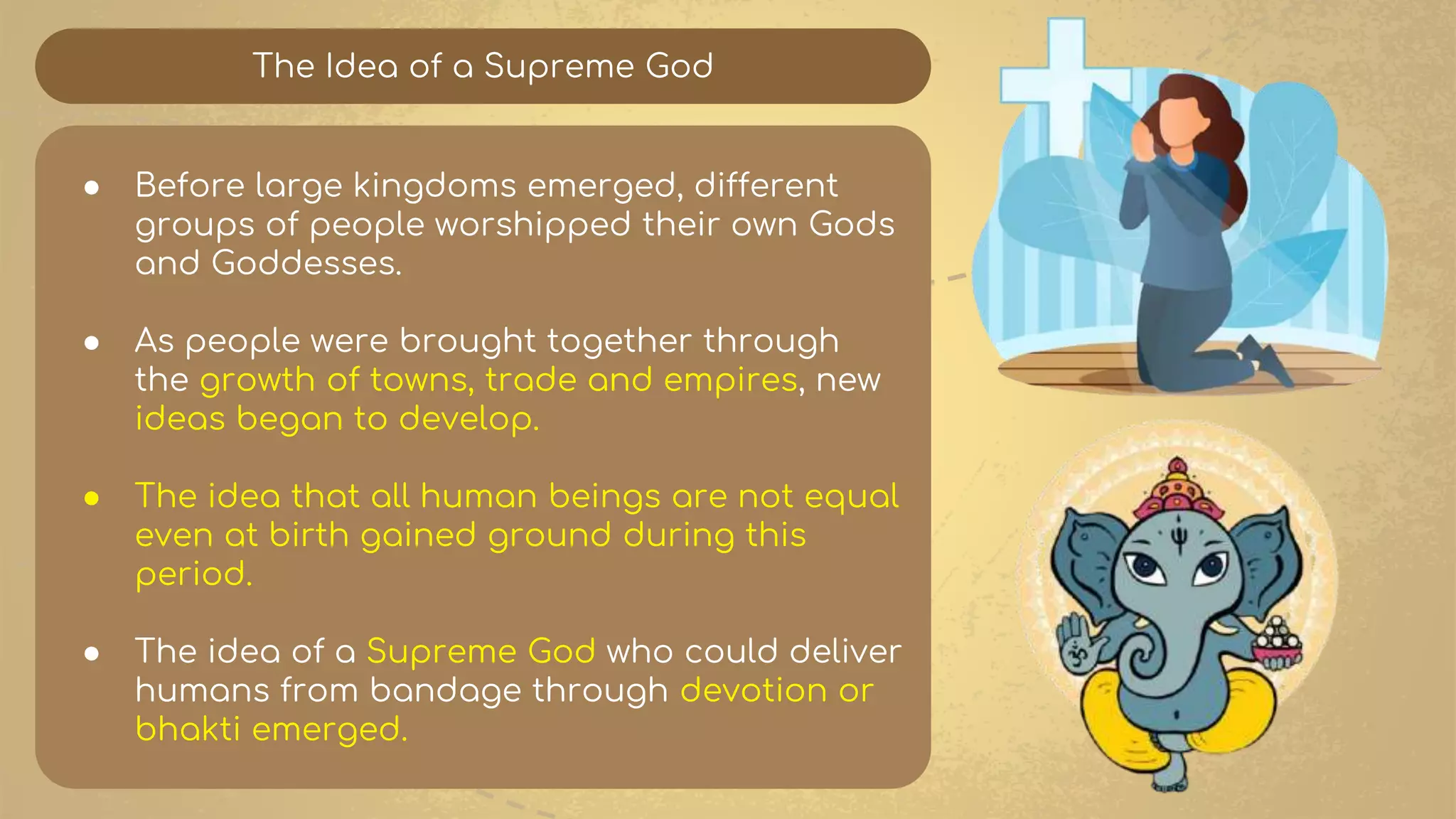
The Idea of a Supreme God
● Before large kingdoms emerged, different
groups of people worshipped their own Gods
and Goddesses.
● As people were brought together through
the growth of towns, trade and empires, new
ideas began to develop.
● The idea that all human beings are not equal
even at birth gained ground during this
period.
● The idea of a Supreme God who could deliver
humans from bandage through devotion or
bhakti emerged.
The Idea of a Supreme God
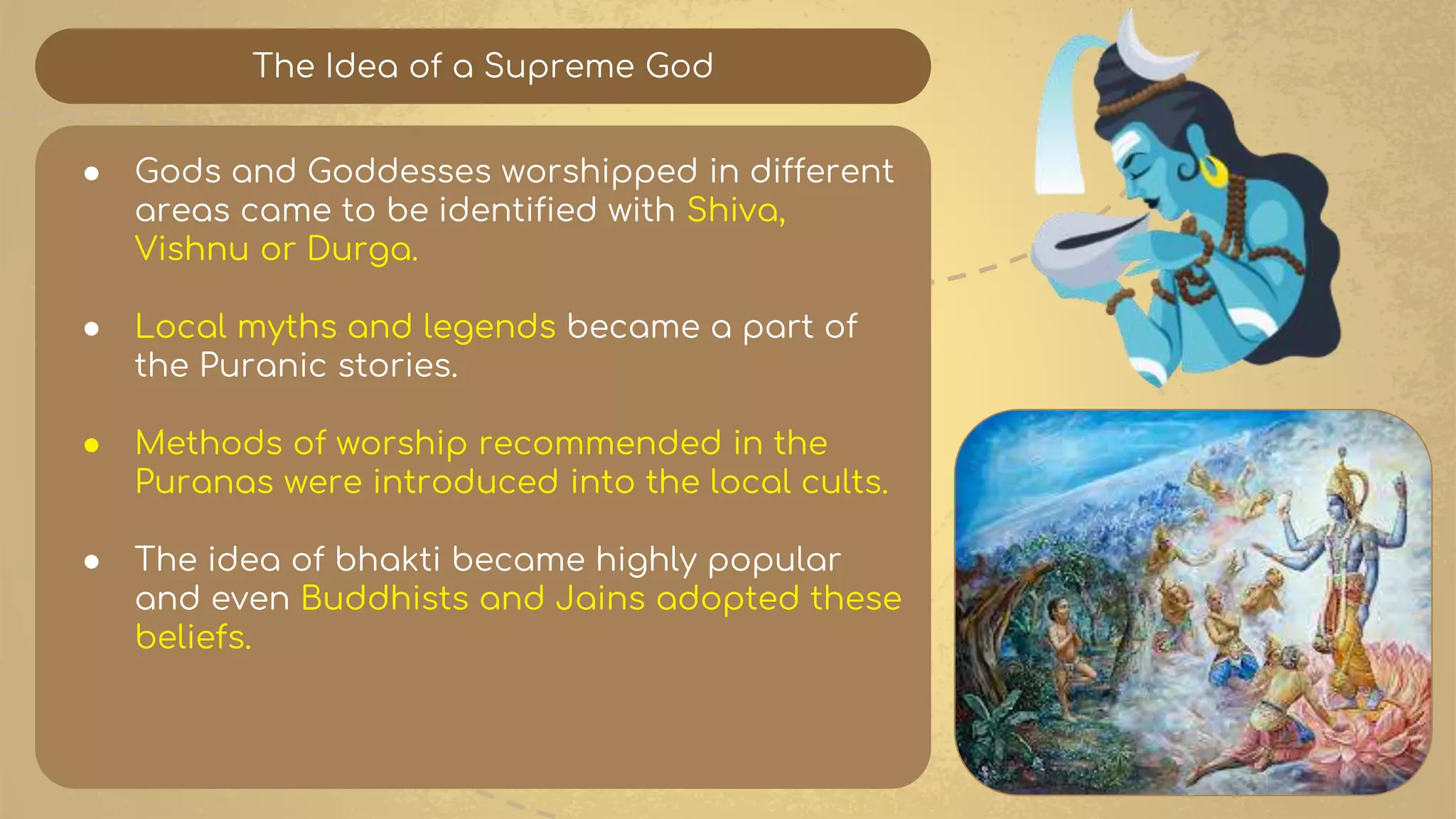
● Gods and Goddesses worshipped in different
areas came to be identified with Shiva,
Vishnu or Durga.
● Local myths and legends became a part of
the Puranic stories.
● Methods of worship recommended in the
Puranas were introduced into the local cults.
● The idea of bhakti became highly popular
and even Buddhists and Jains adopted these
beliefs.
A New Kind of Bhakti in
South India – Nayanars and
Alvars
02
A New Kind of Bhakti in South India – Nayanars and
Alvars
● Between the 7th and the 9th centuries, there
was an emergence of new religious
movements led by Nayanars (saints devoted
to Shiva) and Alvars (saints devoted to
Vishnu).
● They came from all castes, including those
considered “untouchables”, such as the
Pulaiyar and the Panars.
● They detested Buddhists and Jains and
preached that love for Shiva and Vishnu was
the path to salvation.
● They believed in the ideals of love and
heroism from the Sangam literature and
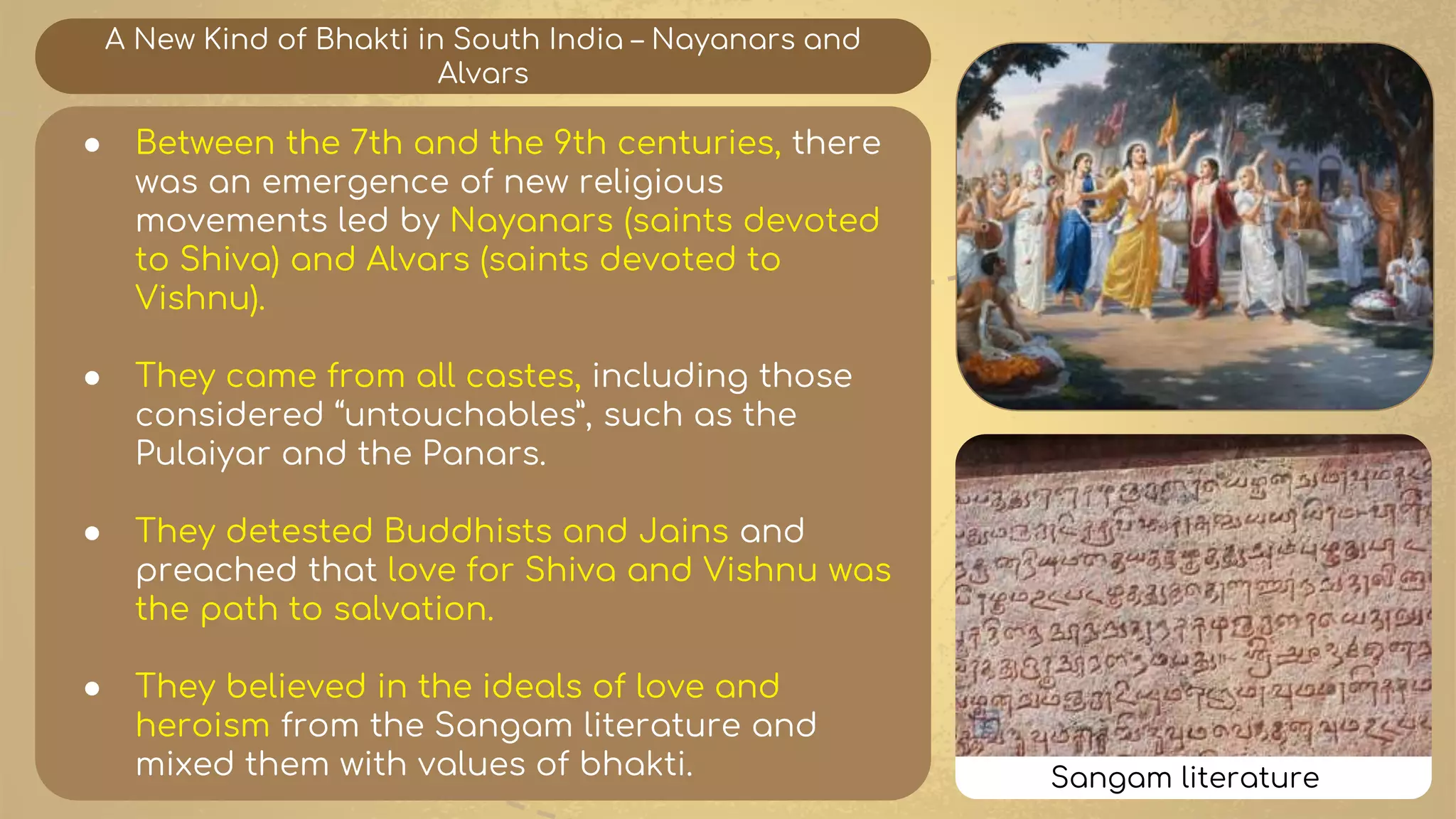
mixed them with values of bhakti. Sangam literature
A New Kind of Bhakti in South India – Nayanars and
Alvars
● Nayanars and Alvars wandered from place to
place and composed unique poems and
music in praise of their deities.
● Between the 10th and 12th centuries, the
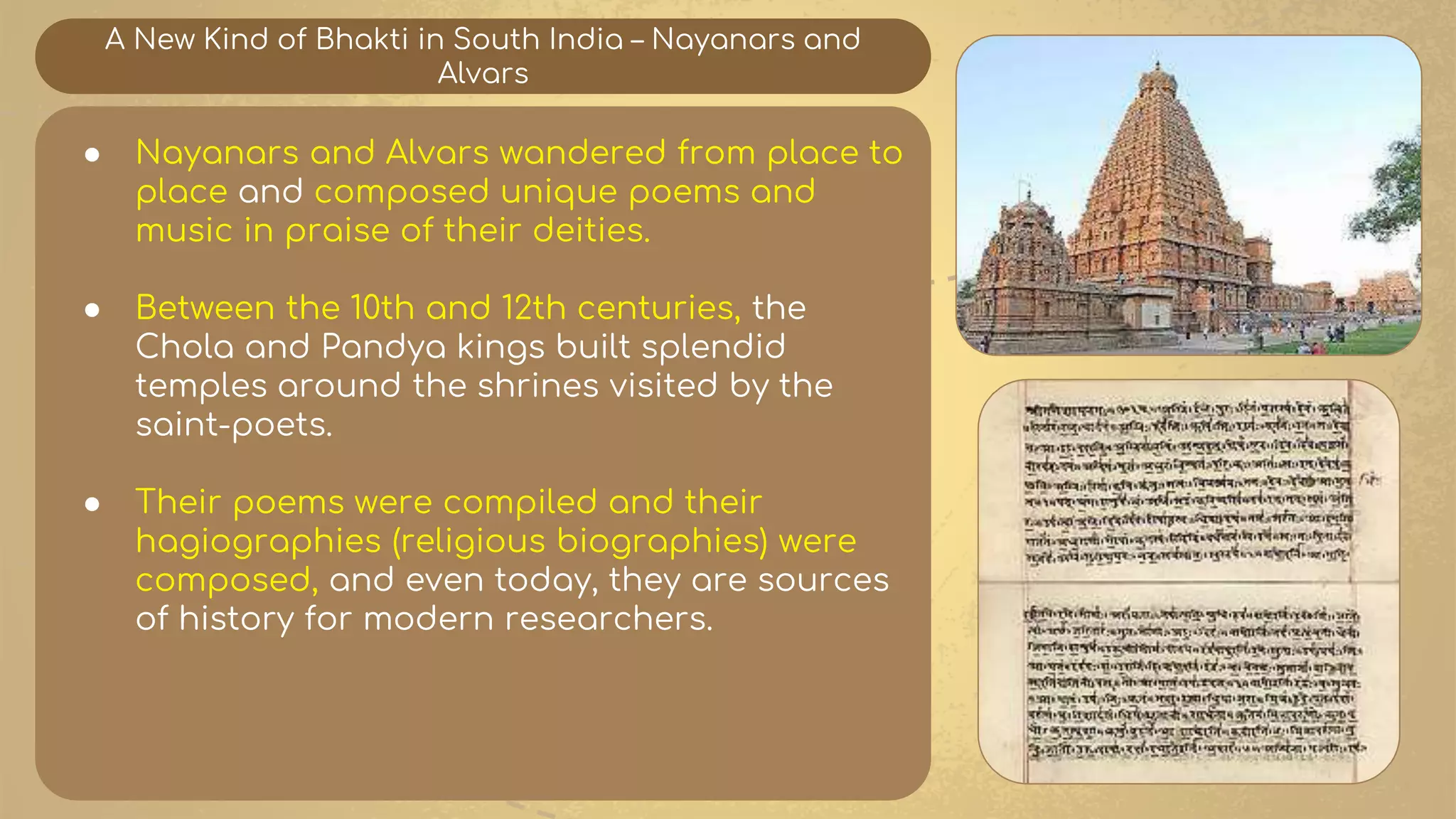
Chola and Pandya kings built splendid
temples around the shrines visited by the
saint-poets.
● Their poems were compiled and their
hagiographies (religious biographies) were
composed, and even today, they are sources
of history for modern researchers.
Philosophy and Bhakti
03
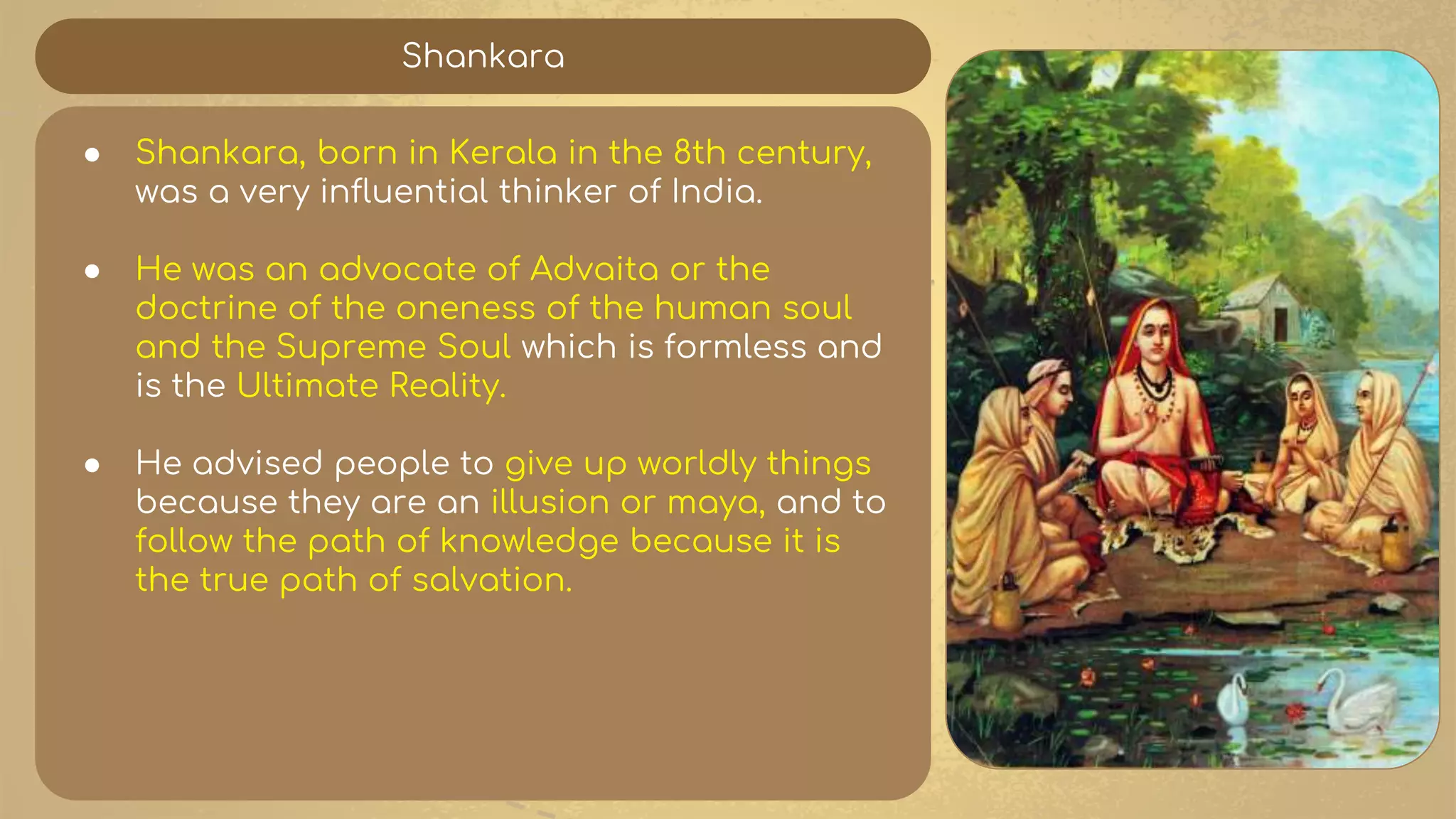
Shankara
● Shankara, born in Kerala in the 8th century,
was a very influential thinker of India.
● He was an advocate of Advaita or the
doctrine of the oneness of the human soul
and the Supreme Soul which is formless and
is the Ultimate Reality.
● He advised people to give up worldly things
because they are an illusion or maya, and to
follow the path of knowledge because it is
the true path of salvation.
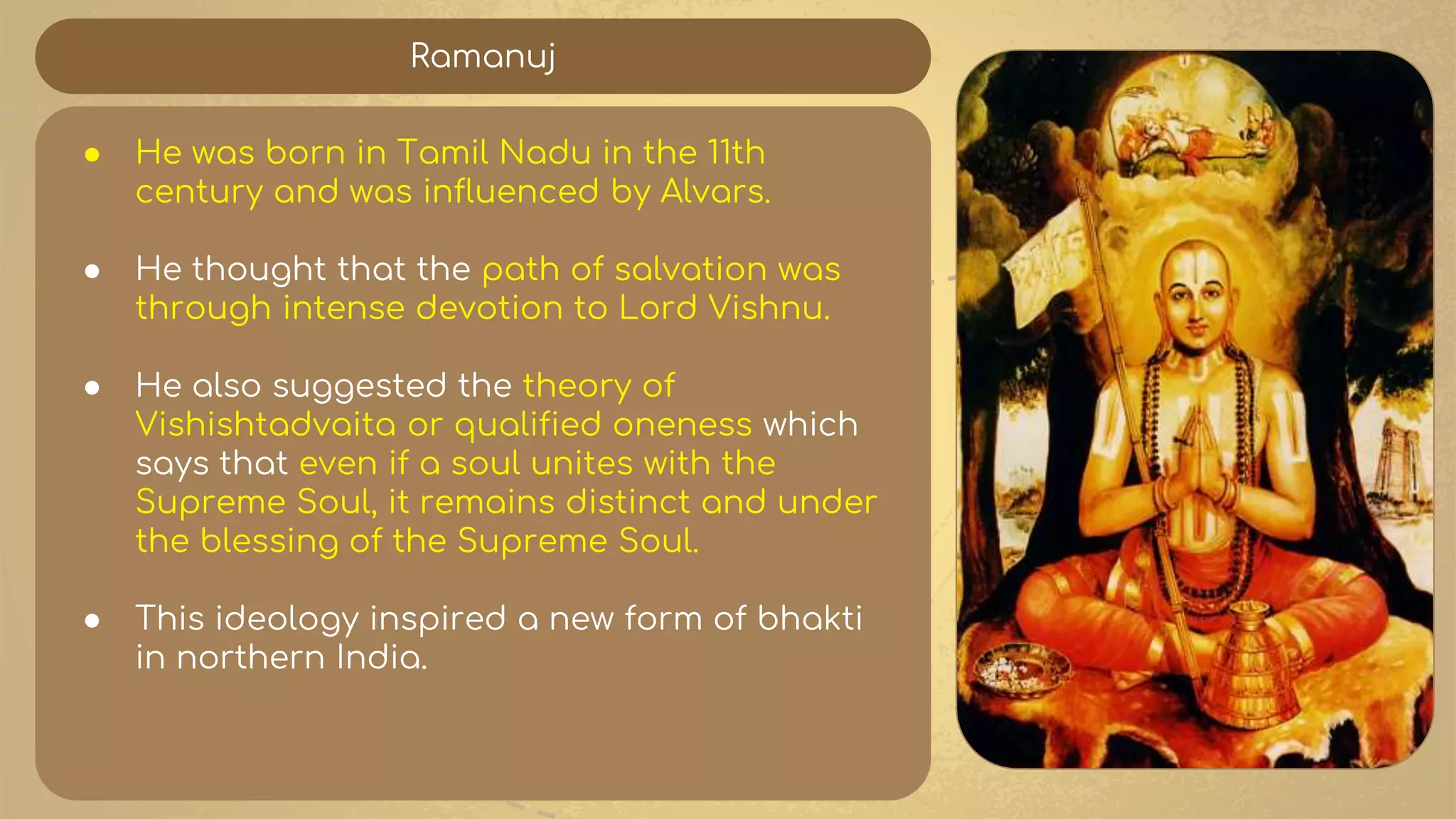
Ramanuj
● He was born in Tamil Nadu in the 11th
century and was influenced by Alvars.
● He thought that the path of salvation was
through intense devotion to Lord Vishnu.
● He also suggested the theory of
Vishishtadvaita or qualified oneness which
says that even if a soul unites with the
Supreme Soul, it remains distinct and under
the blessing of the Supreme Soul.
● This ideology inspired a new form of bhakti
in northern India.
Basavanna’s Virashaivism
04
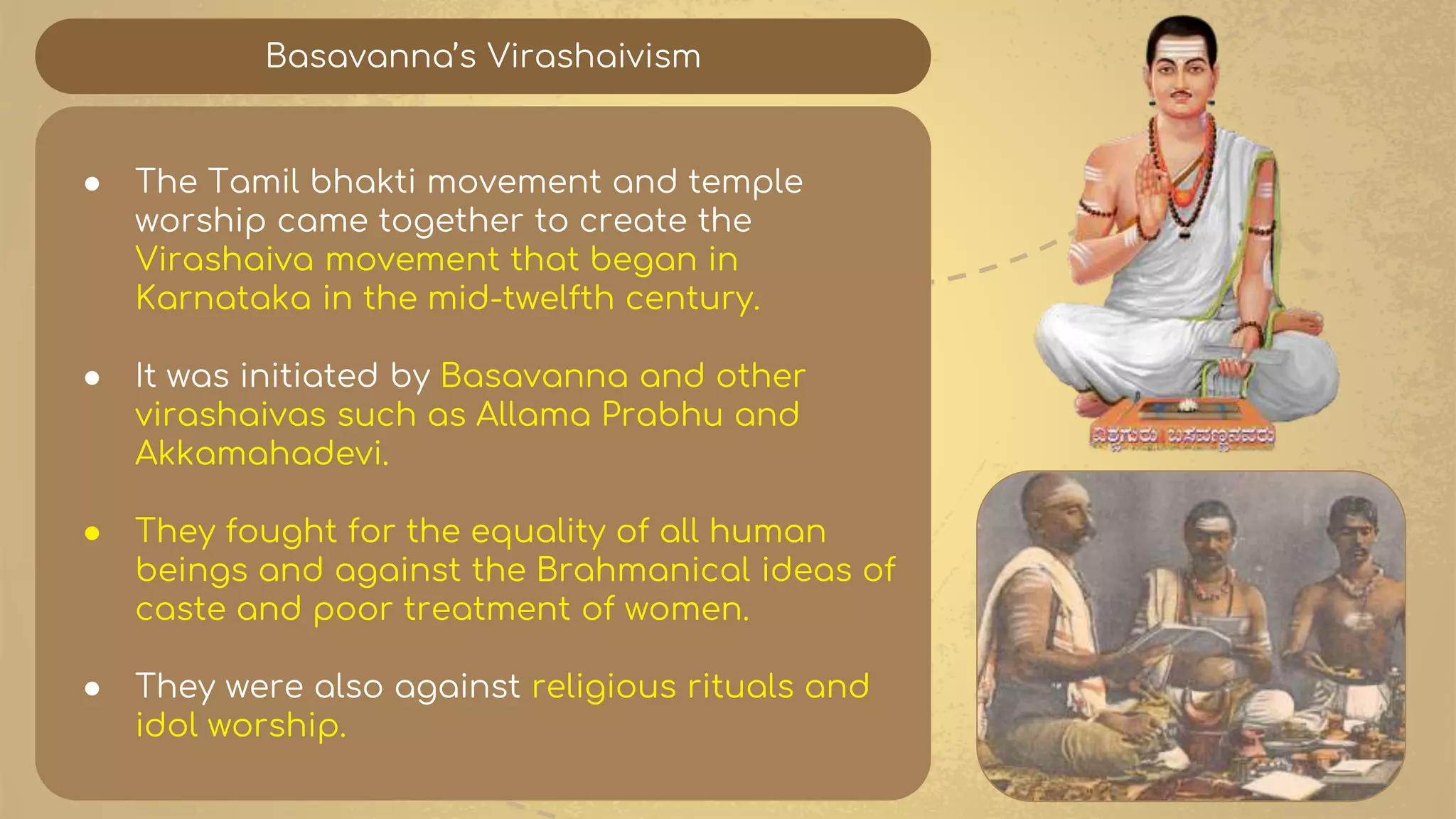
Basavanna’s Virashaivism
● The Tamil bhakti movement and temple
worship came together to create the
Virashaiva movement that began in
Karnataka in the mid-twelfth century.
● It was initiated by Basavanna and other
virashaivas such as Allama Prabhu and
Akkamahadevi.
● They fought for the equality of all human
beings and against the Brahmanical ideas of
caste and poor treatment of women.
● They were also against religious rituals and
idol worship.
The Saints of Maharashtra
05
The Saints of Maharashtra
Between the 13th and the 17th centuries-
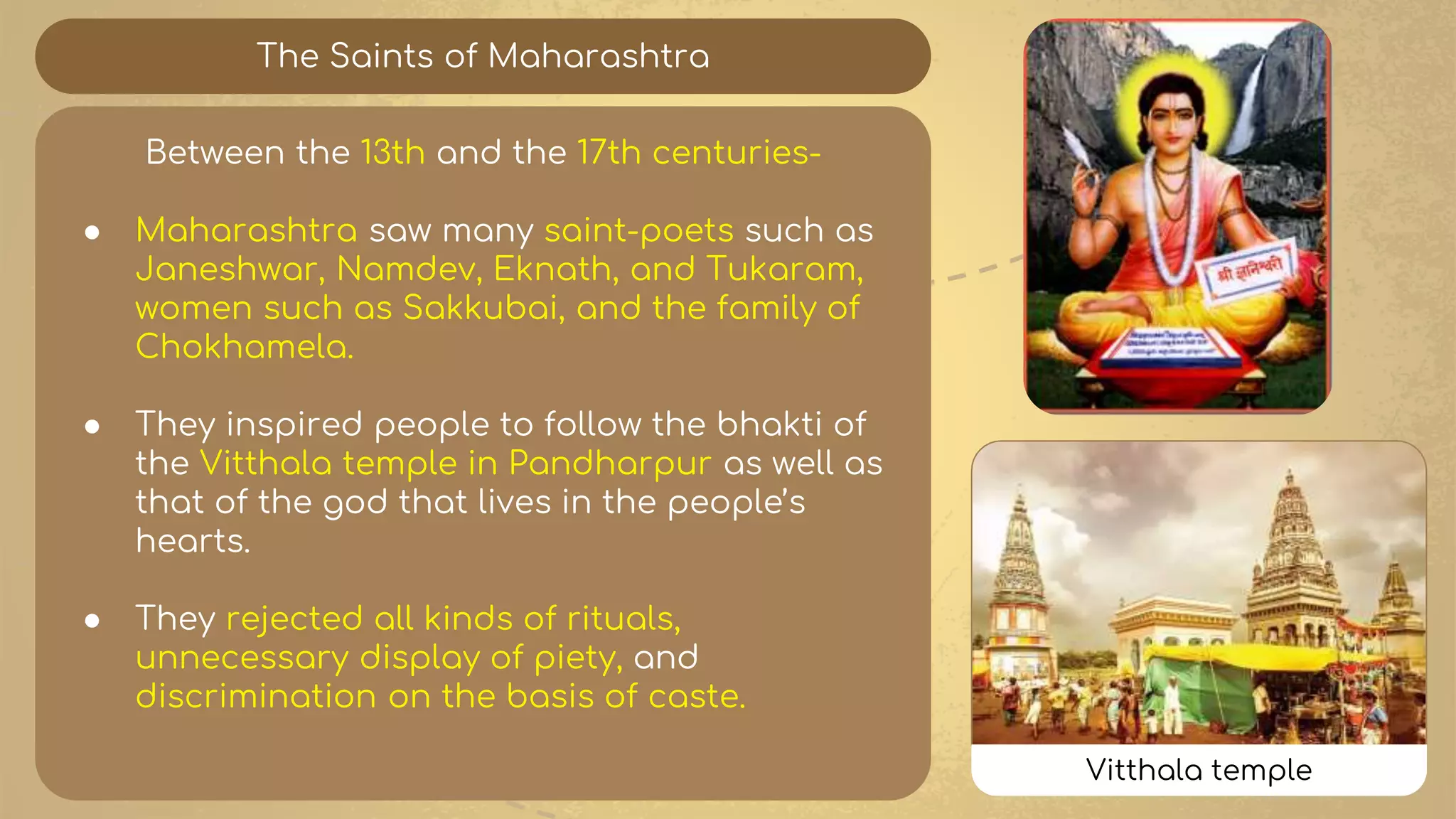
● Maharashtra saw many saint-poets such as
Janeshwar, Namdev, Eknath, and Tukaram,
women such as Sakkubai, and the family of
Chokhamela.
● They inspired people to follow the bhakti of
the Vitthala temple in Pandharpur as well as
that of the god that lives in the people’s
hearts.
● They rejected all kinds of rituals,
unnecessary display of piety, and
discrimination on the basis of caste.
Vitthala temple
The Saints of Maharashtra
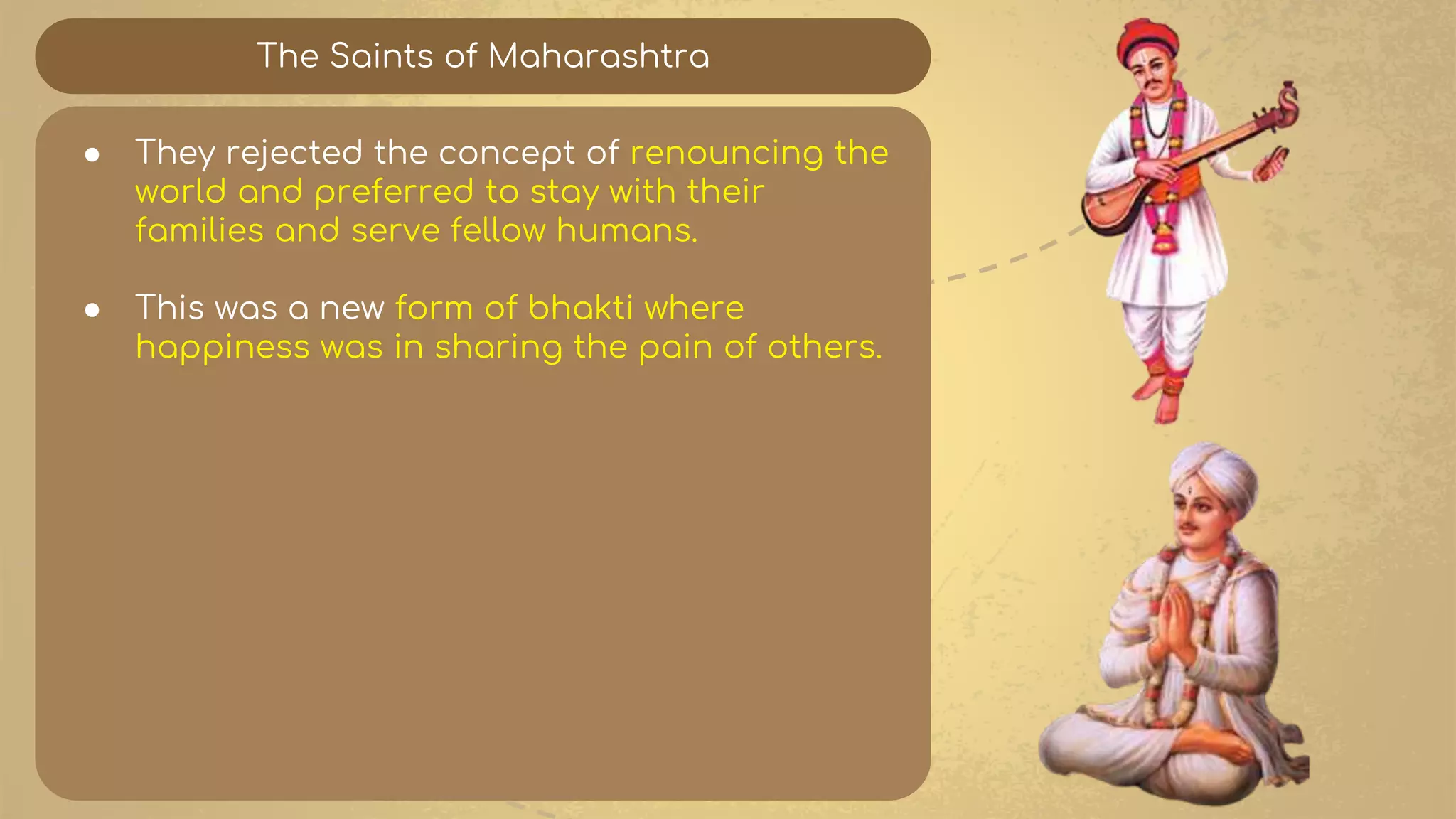
● They rejected the concept of renouncing the
world and preferred to stay with their
families and serve fellow humans.
● This was a new form of bhakti where
happiness was in sharing the pain of others.
Nathpanthis, Siddhas and
Yogis
06
Nathpanthis, Siddhas and Yogis
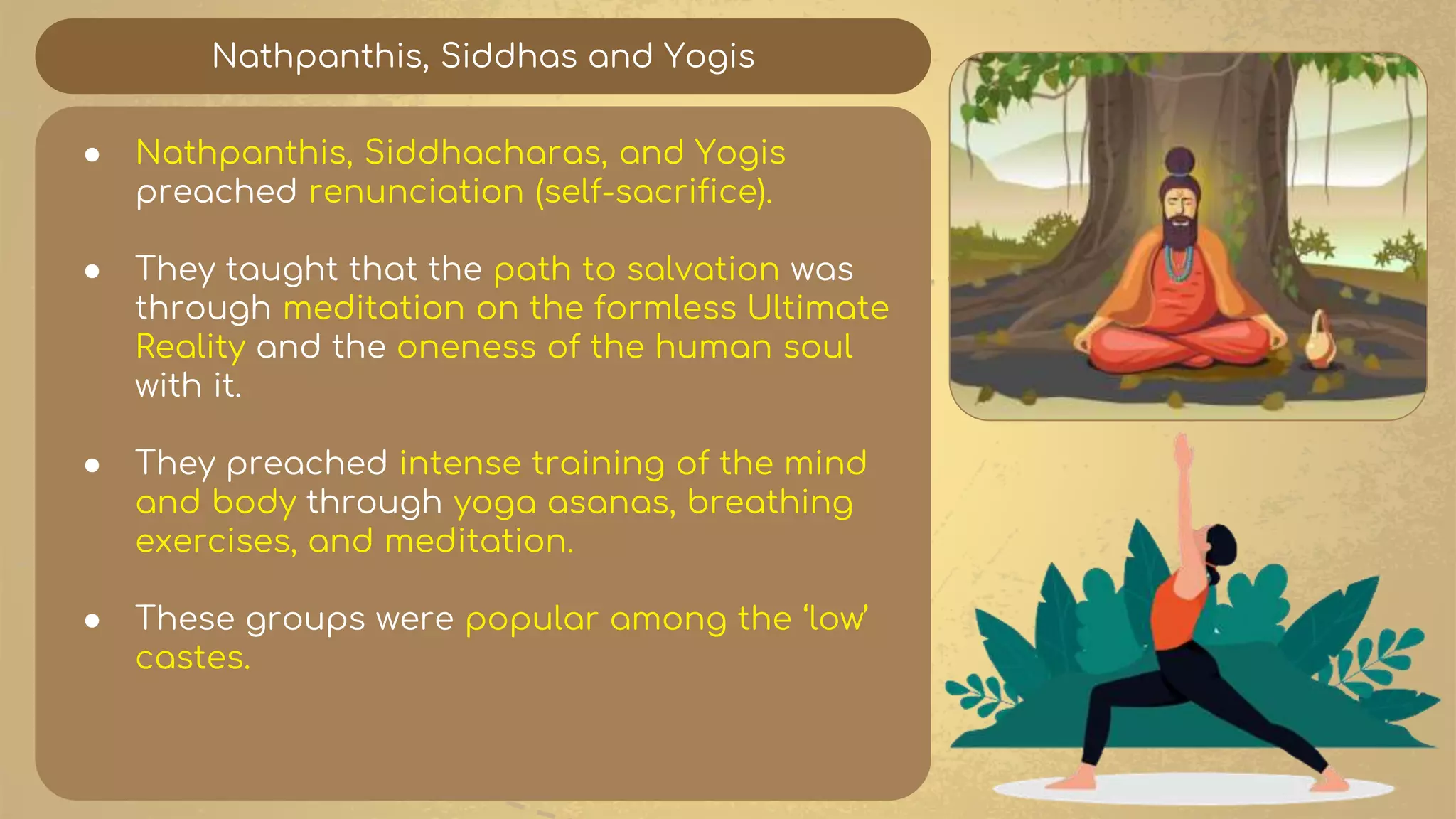
● Nathpanthis, Siddhacharas, and Yogis
preached renunciation (self-sacrifice).
● They taught that the path to salvation was
through meditation on the formless Ultimate
Reality and the oneness of the human soul
with it.
● They preached intense training of the mind
and body through yoga asanas, breathing
exercises, and meditation.
● These groups were popular among the ‘low’
castes.
Nathpanthis, Siddhas and Yogis
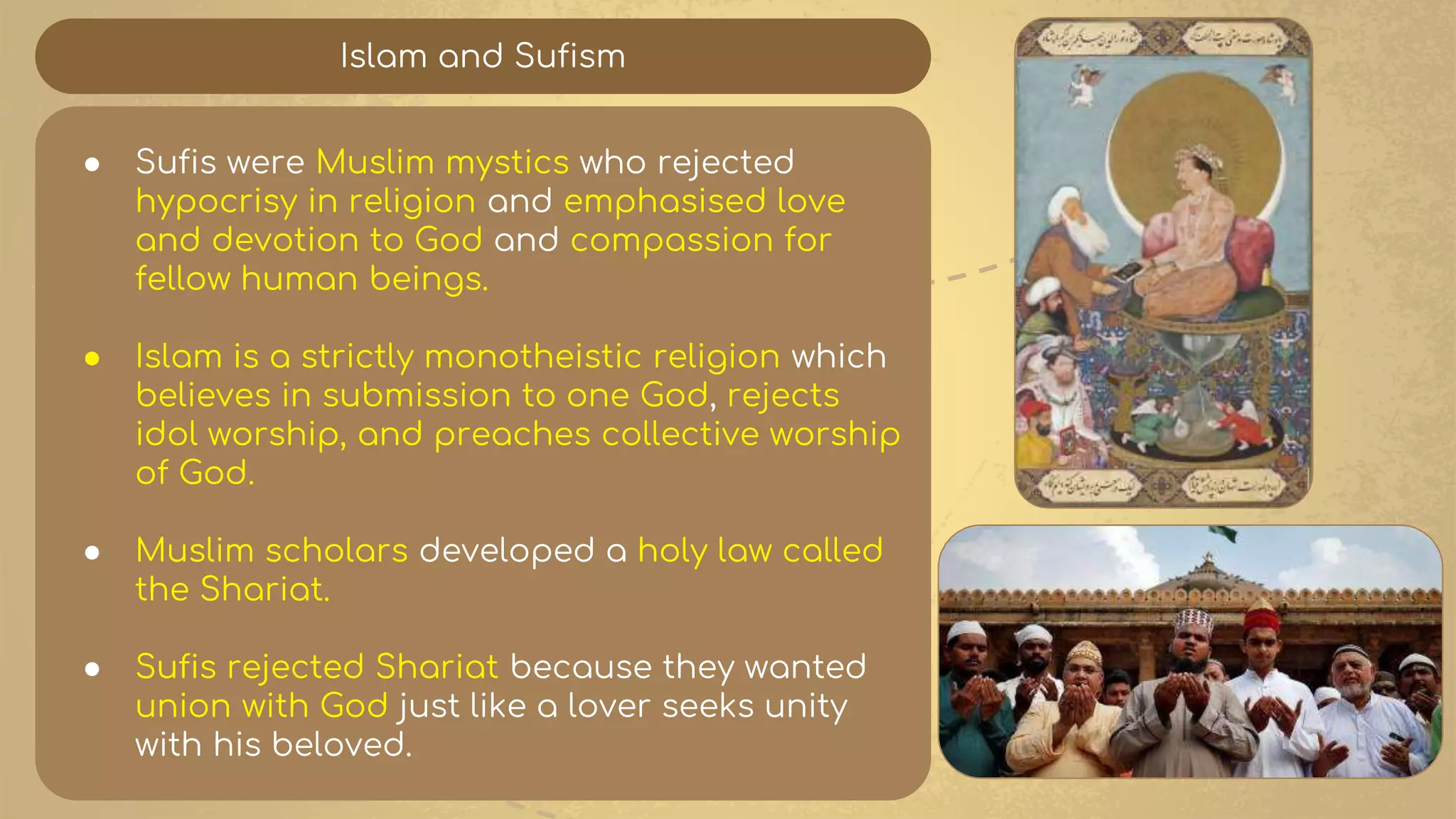
● Their criticism for the common Vedic religion
created a base for a new religion to become
a common power in the north.
Islam and Sufism
07
Islam and Sufism
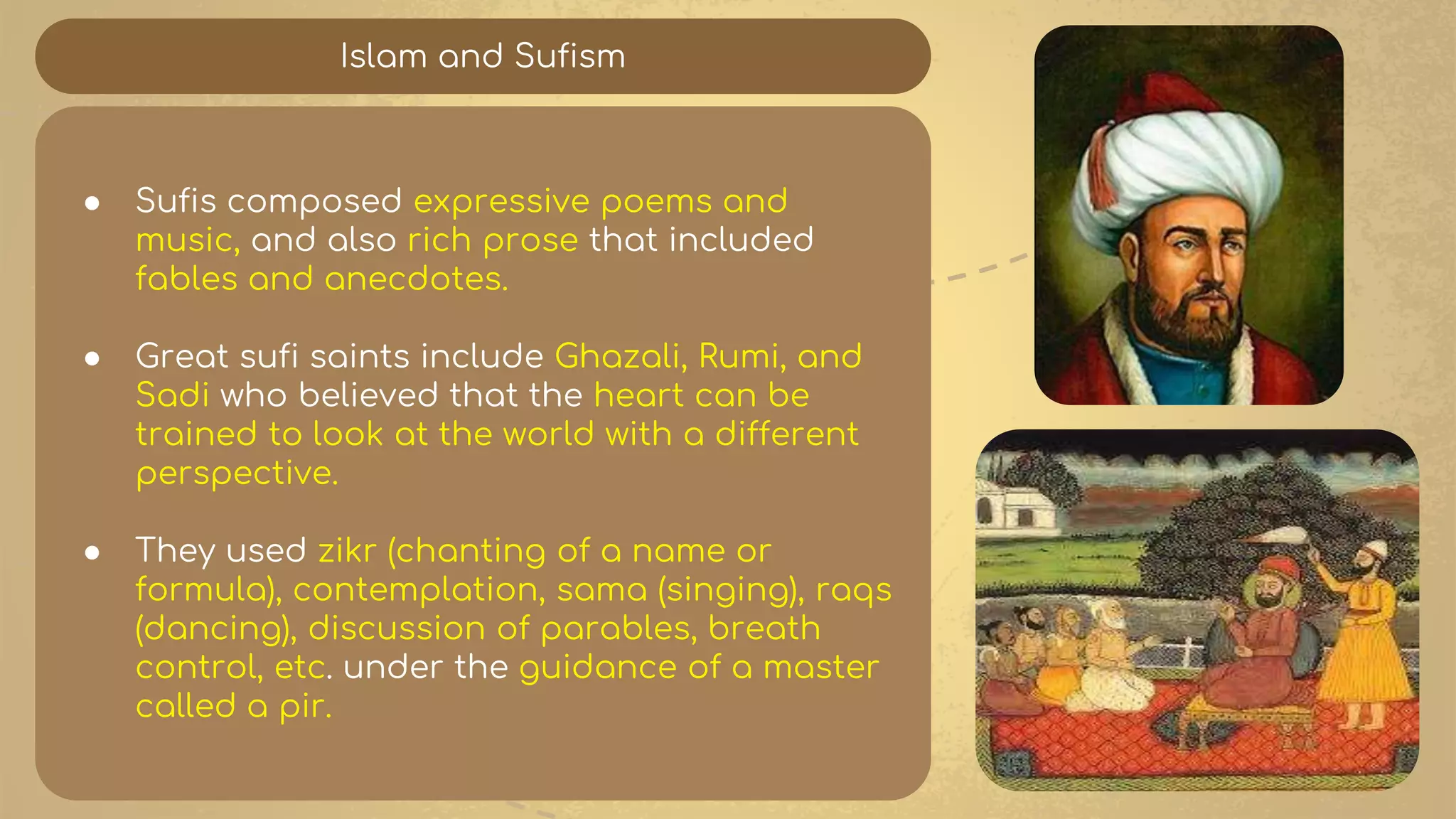
● Sufis were Muslim mystics who rejected
hypocrisy in religion and emphasised love
and devotion to God and compassion for
fellow human beings.
● Islam is a strictly monotheistic religion which
believes in submission to one God, rejects
idol worship, and preaches collective worship
of God.
● Muslim scholars developed a holy law called
the Shariat.
● Sufis rejected Shariat because they wanted
union with God just like a lover seeks unity
with his beloved.
Islam and Sufism
● Sufis composed expressive poems and
music, and also rich prose that included
fables and anecdotes.
● Great sufi saints include Ghazali, Rumi, and
Sadi who believed that the heart can be
trained to look at the world with a different
perspective.
● They used zikr (chanting of a name or
formula), contemplation, sama (singing), raqs
(dancing), discussion of parables, breath
control, etc. under the guidance of a master
called a pir.
Islam and Sufism
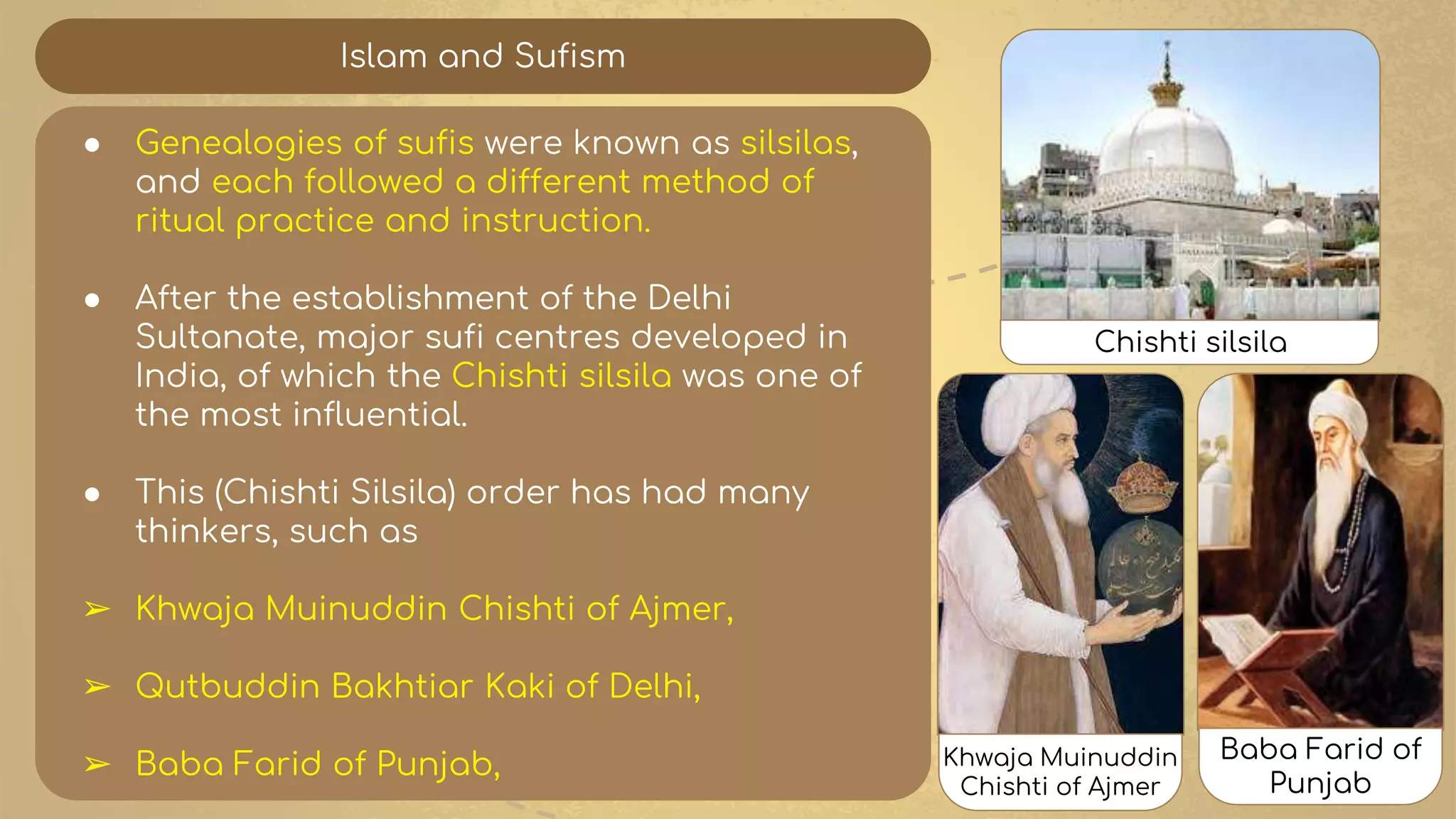
● Genealogies of sufis were known as silsilas,
and each followed a different method of
ritual practice and instruction.
● After the establishment of the Delhi
Sultanate, major sufi centres developed in
India, of which the Chishti silsila was one of
the most influential.
● This (Chishti Silsila) order has had many
thinkers, such as
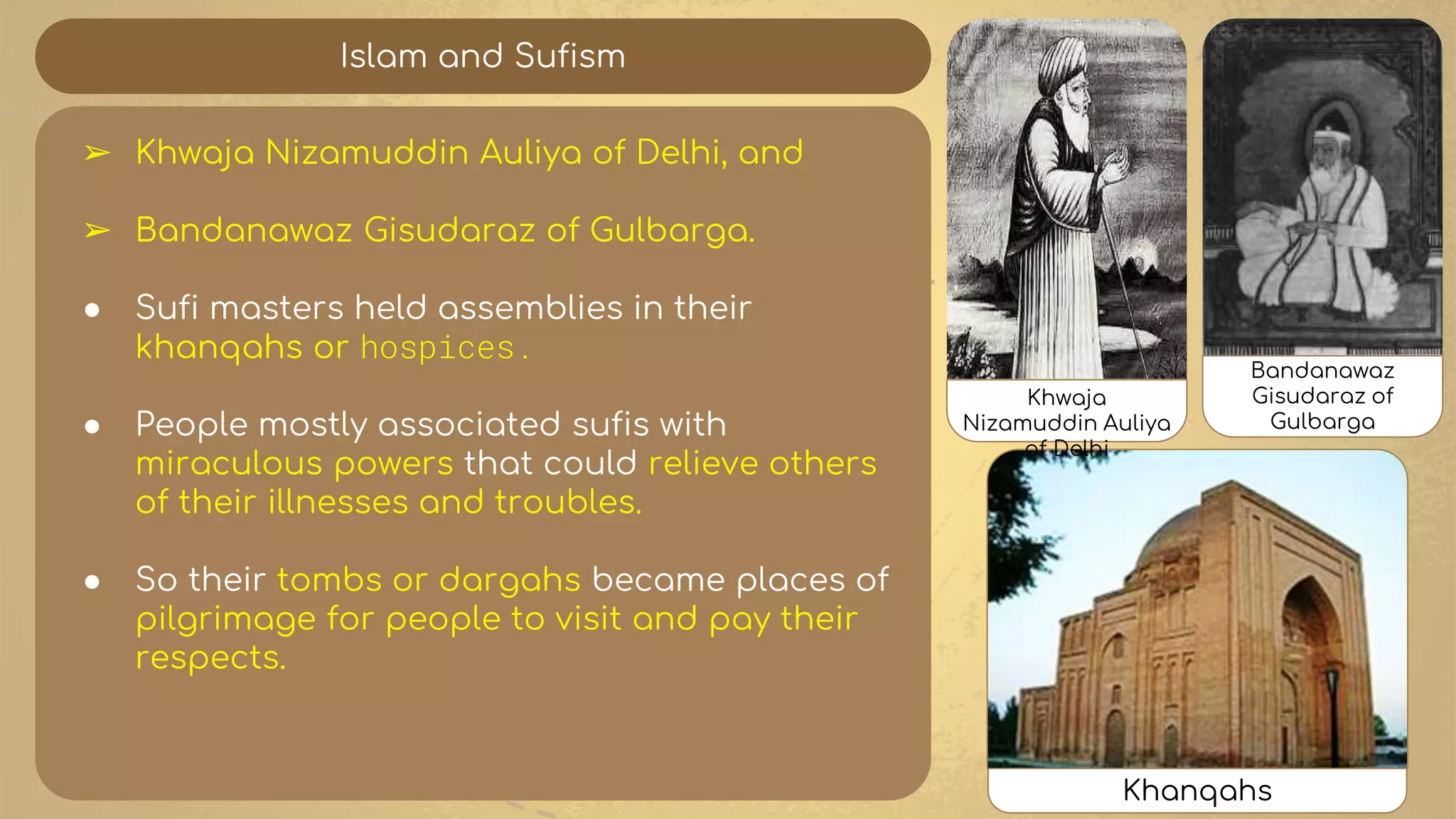
➢ Khwaja Muinuddin Chishti of Ajmer,
➢ Qutbuddin Bakhtiar Kaki of Delhi,
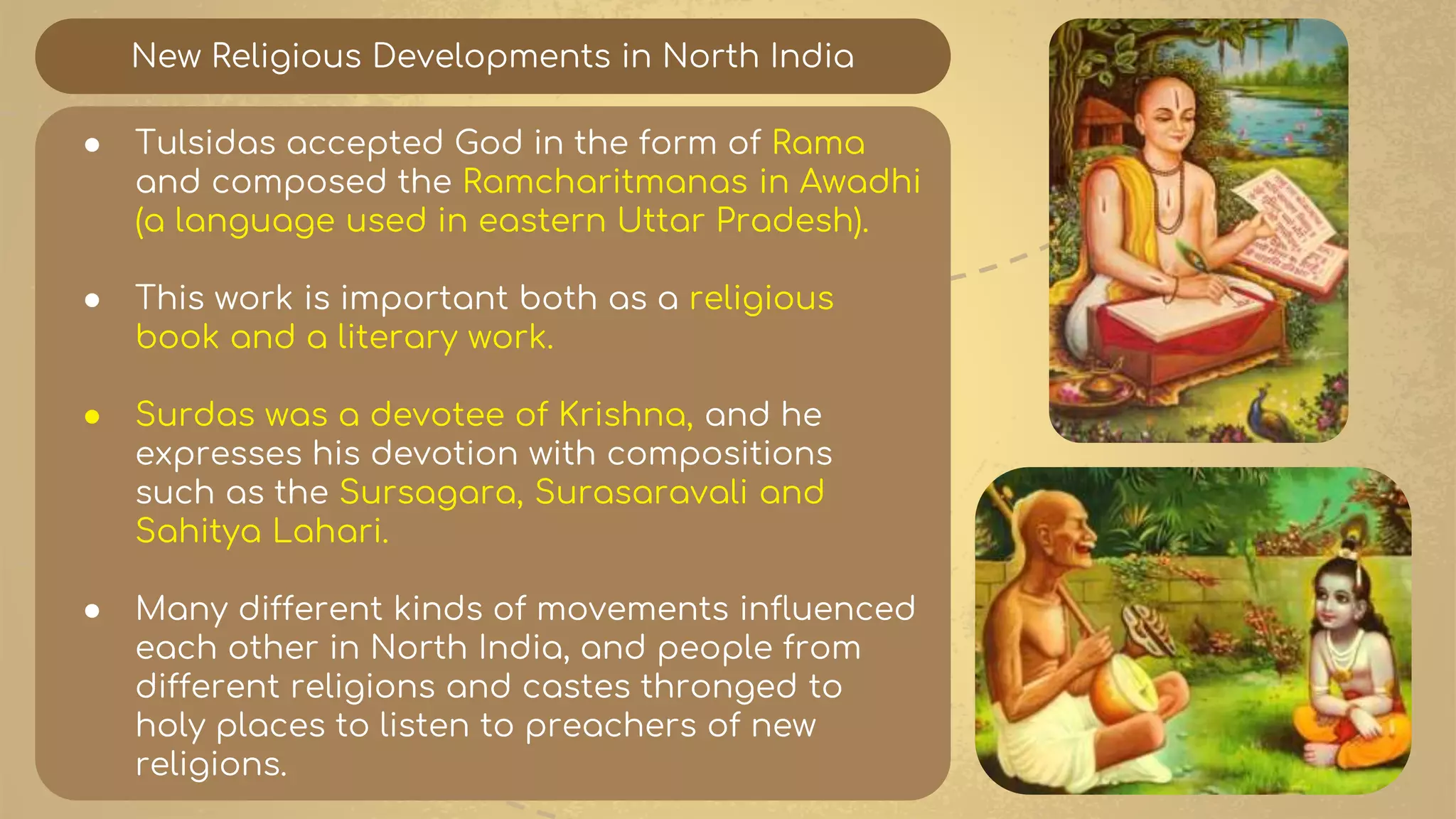
➢ Baba Farid of Punjab,
Chishti silsila
Khwaja Muinuddin
Chishti of Ajmer
Baba Farid of
Punjab
Islam and Sufism
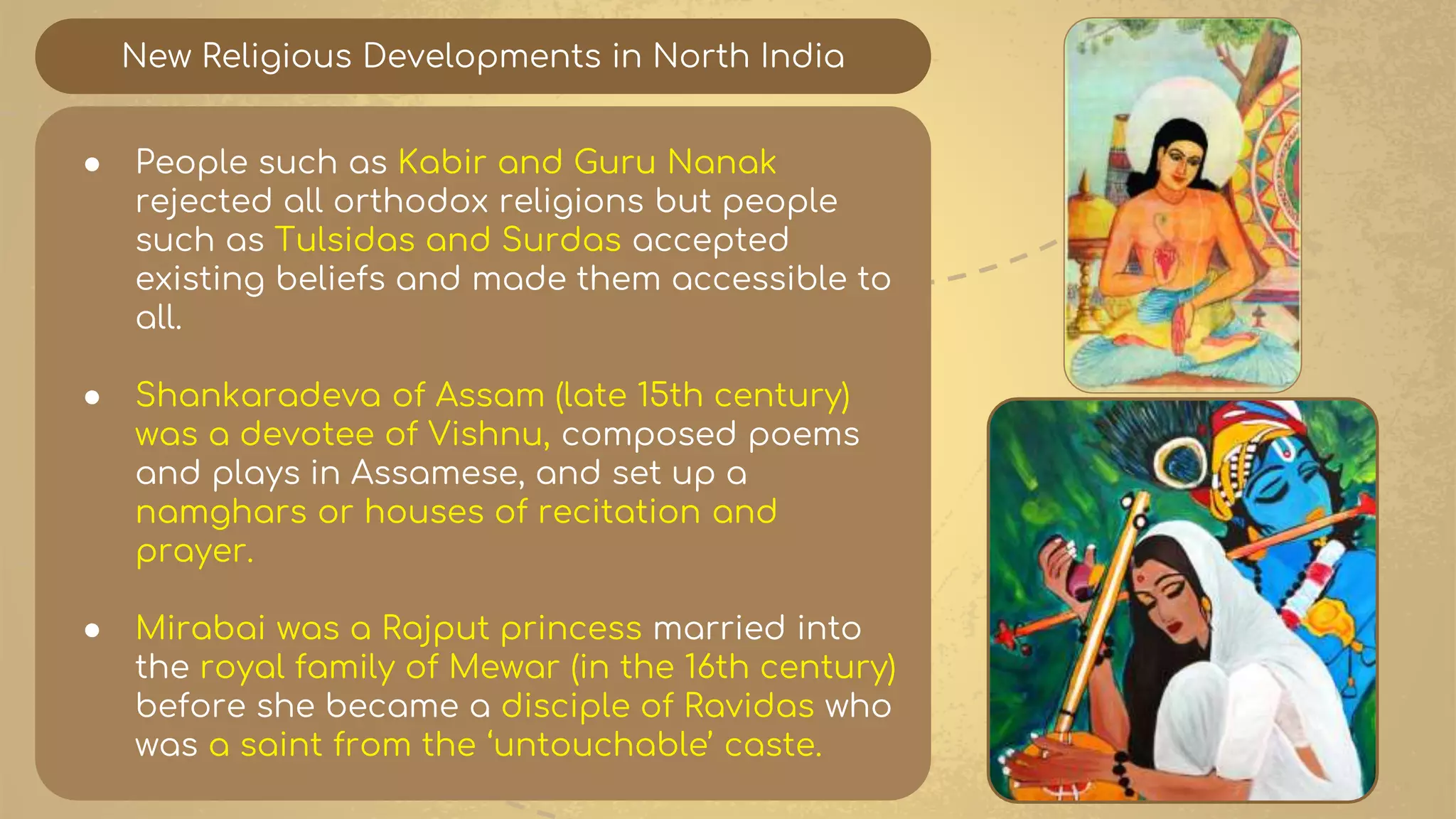
➢ Khwaja Nizamuddin Auliya of Delhi, and
➢ Bandanawaz Gisudaraz of Gulbarga.
● Sufi masters held assemblies in their
khanqahs or hospices.
● People mostly associated sufis with
miraculous powers that could relieve others
of their illnesses and troubles.
● So their tombs or dargahs became places of
pilgrimage for people to visit and pay their
respects.
Khwaja
Nizamuddin Auliya
of Delhi
Bandanawaz
Gisudaraz of
Gulbarga
Khanqahs
New Religious Developments
in North India
08
New Religious Developments in North India
● Tulsidas accepted God in the form of Rama
and composed the Ramcharitmanas in Awadhi
(a language used in eastern Uttar Pradesh).
● This work is important both as a religious
book and a literary work.
● Surdas was a devotee of Krishna, and he
expresses his devotion with compositions
such as the Sursagara, Surasaravali and
Sahitya Lahari.
● Many different kinds of movements influenced
each other in North India, and people from
different religions and castes thronged to
holy places to listen to preachers of new
religions.
New Religious Developments in North India
● People such as Kabir and Guru Nanak
rejected all orthodox religions but people
such as Tulsidas and Surdas accepted
existing beliefs and made them accessible to
all.
● Shankaradeva of Assam (late 15th century)
was a devotee of Vishnu, composed poems
and plays in Assamese, and set up a
namghars or houses of recitation and
prayer.
● Mirabai was a Rajput princess married into
the royal family of Mewar (in the 16th century)
before she became a disciple of Ravidas who
was a saint from the ‘untouchable’ caste.
New Religious Developments in North India
● She was a devotee of Krishna and composed
many bhajans which became popular among
the people of Rajasthan and Gujarat.
A Closer Look: Kabir
09
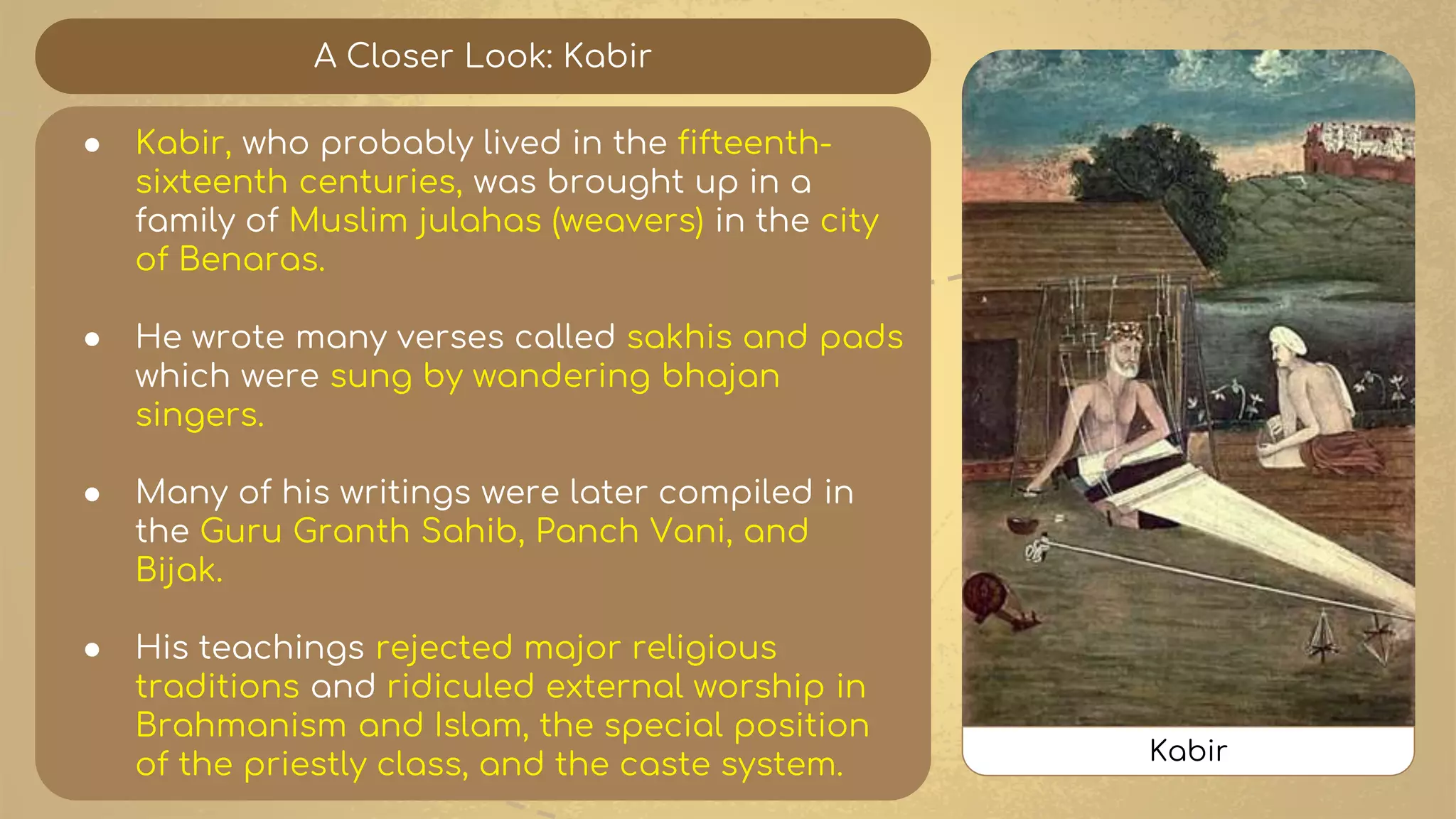
A Closer Look: Kabir
● Kabir, who probably lived in the fifteenth-
sixteenth centuries, was brought up in a
family of Muslim julahas (weavers) in the city
of Benaras.
● He wrote many verses called sakhis and pads
which were sung by wandering bhajan
singers.
● Many of his writings were later compiled in
the Guru Granth Sahib, Panch Vani, and
Bijak.
● His teachings rejected major religious
traditions and ridiculed external worship in
Brahmanism and Islam, the special position
of the priestly class, and the caste system. Kabir
A Closer Look: Kabir
● He mostly wrote in Hindi, but he also used a
cryptic language sometimes.
● He believed in a formless Supreme God and
preached that the only path to salvation was
through bhakti (devotion).
Guru Granth Sahib
A Closer Look: Baba Guru
Nanak
10
A Closer Look: Baba Guru Nanak
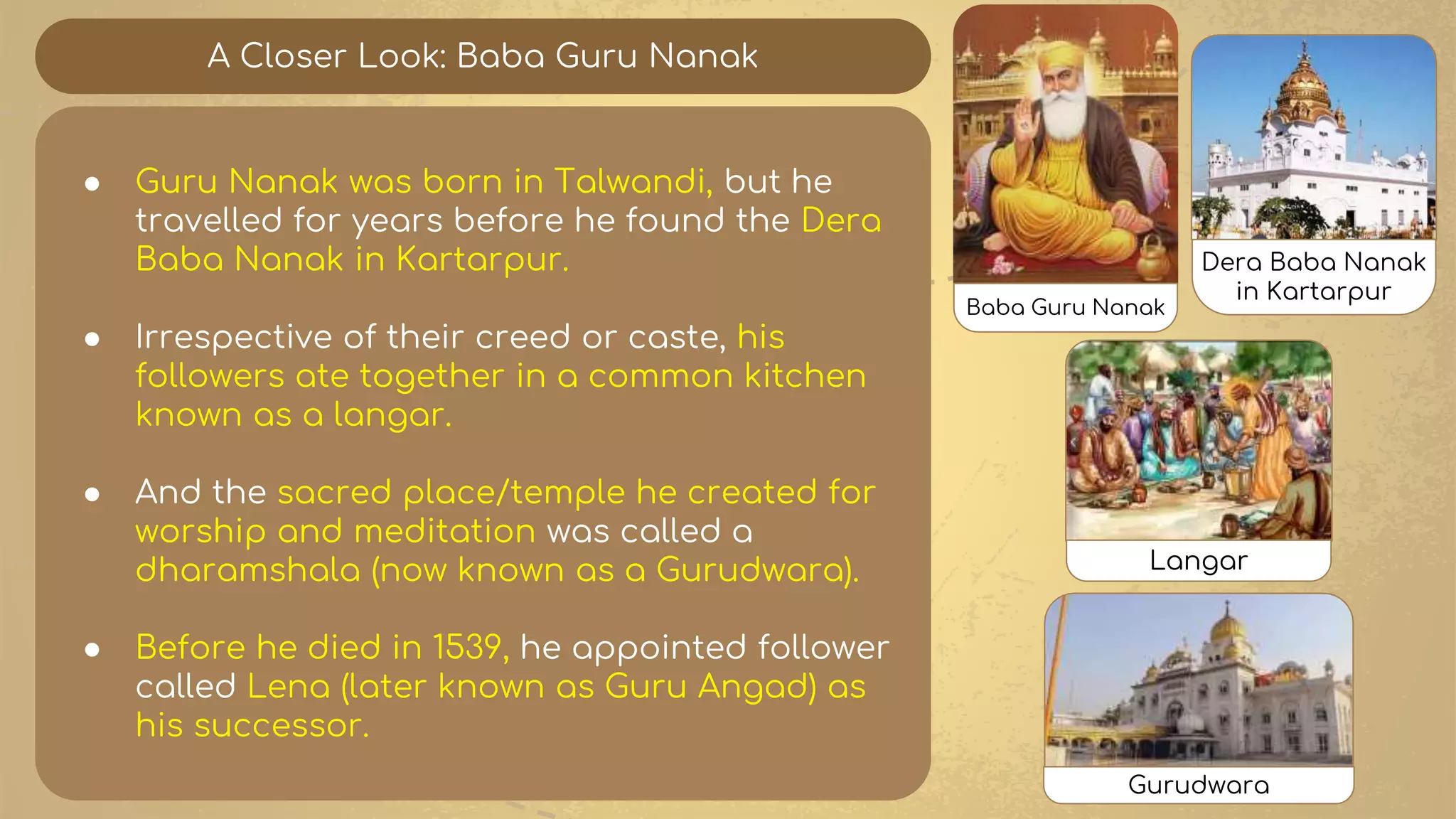
● Guru Nanak was born in Talwandi, but he
travelled for years before he found the Dera
Baba Nanak in Kartarpur.
● Irrespective of their creed or caste, his
followers ate together in a common kitchen
known as a langar.
● And the sacred place/temple he created for
worship and meditation was called a
dharamshala (now known as a Gurudwara).
● Before he died in 1539, he appointed follower
called Lena (later known as Guru Angad) as
his successor.
Baba Guru Nanak
Dera Baba Nanak
in Kartarpur
Langar
Gurudwara
A Closer Look: Baba Guru Nanak
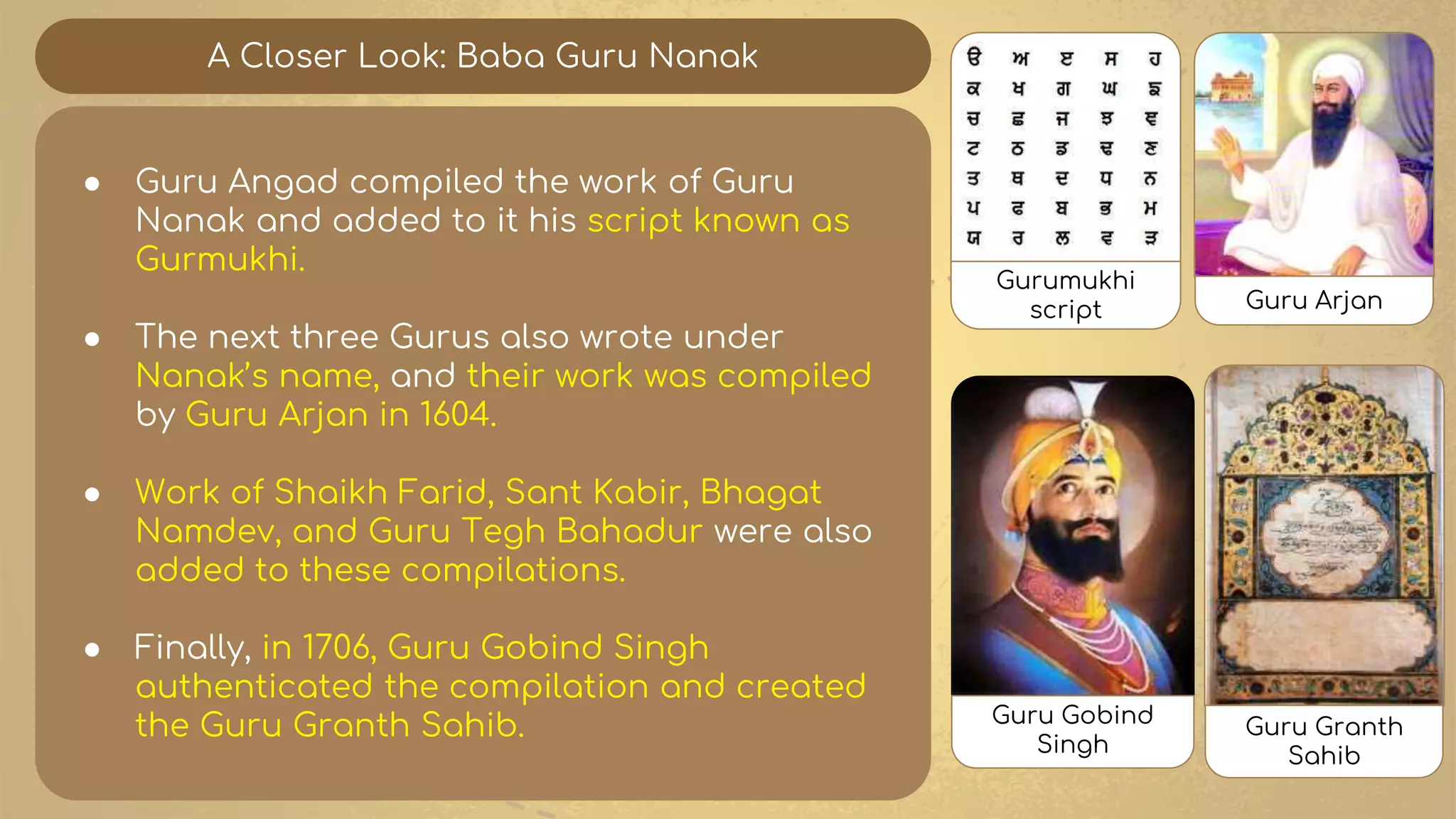
● Guru Angad compiled the work of Guru
Nanak and added to it his script known as
Gurmukhi.
● The next three Gurus also wrote under
Nanak’s name, and their work was compiled
by Guru Arjan in 1604.
● Work of Shaikh Farid, Sant Kabir, Bhagat
Namdev, and Guru Tegh Bahadur were also
added to these compilations.
● Finally, in 1706, Guru Gobind Singh
authenticated the compilation and created
the Guru Granth Sahib.
Gurumukhi
script Guru Arjan
Guru Gobind
Singh
Guru Granth
Sahib
A Closer Look: Baba Guru Nanak
● Guru Nanak’s followers increased in the 16th
century as people from all castes and
occupations joined the community.
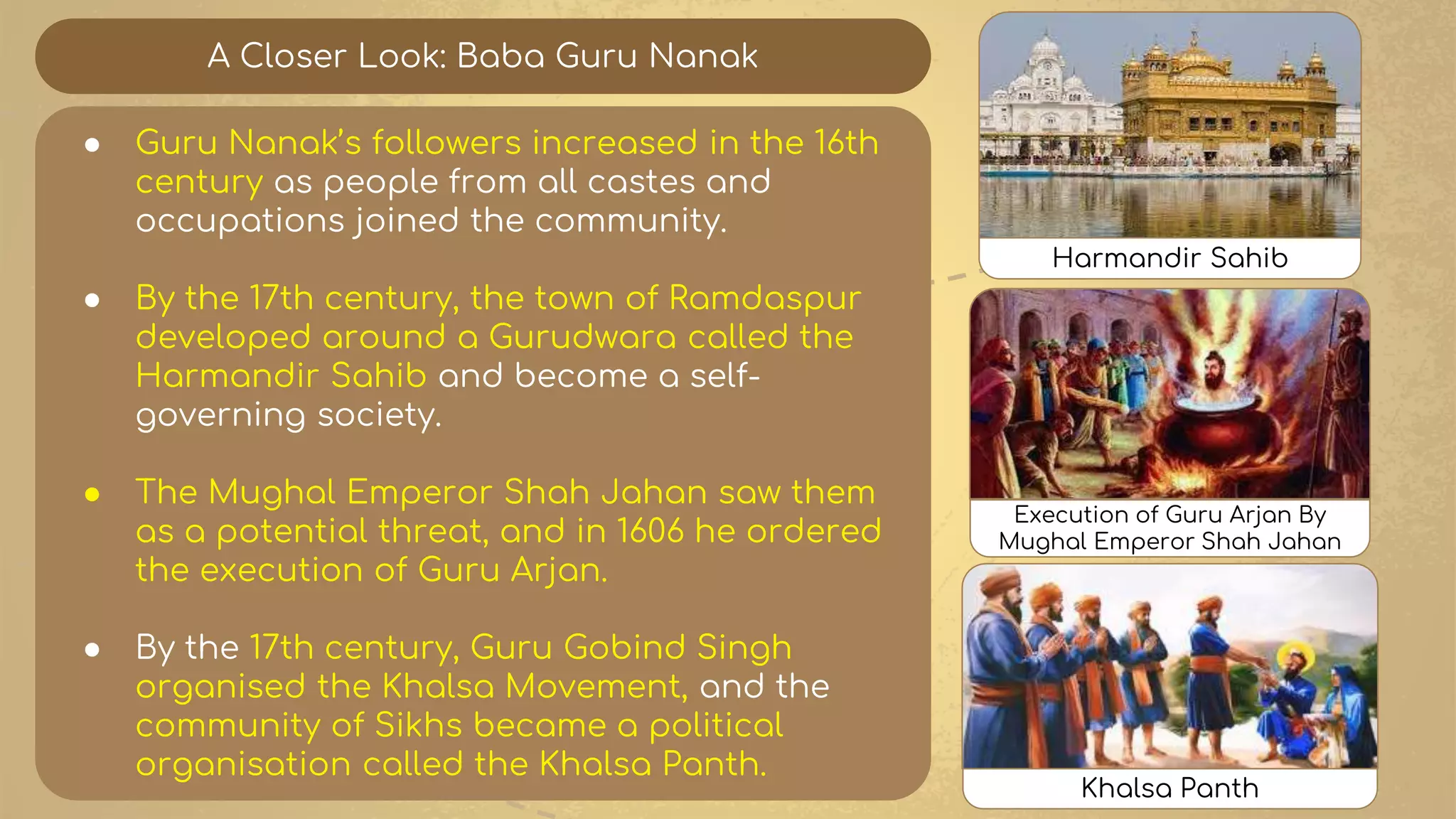
● By the 17th century, the town of Ramdaspur
developed around a Gurudwara called the
Harmandir Sahib and become a self-
governing society.
● The Mughal Emperor Shah Jahan saw them
as a potential threat, and in 1606 he ordered
the execution of Guru Arjan.
● By the 17th century, Guru Gobind Singh
organised the Khalsa Movement, and the
community of Sikhs became a political
organisation called the Khalsa Panth.
Execution of Guru Arjan By
Mughal Emperor Shah Jahan
Harmandir Sahib
Khalsa Panth
A Closer Look: Baba Guru Nanak
● Guru Nanak emphasised the worship of one
God and insisted that caste, creed, and
gender were irrelevant to attaining salvation.
● According to him, pursuit of an active life
would liberate humans, and he also used the
terms nam, dan, and isnan to mean right
worship, welfare, and purity of conduct.
● His ideas today are called nam-japna, kirat-
karna, and vand-chhakna, which mean right
belief and worship, honest living, and helping
others.
Kirat-karna (honest
living)
Thankyou

CBSE Class 7 History chapter 8

  • 1.
  • 2.
    Table of Contents 01The Idea of a Supreme God 02 A New Kind of Bhakti in South India – Nayanars and Alvars 03 Philosophy and Bhakti 04 Basavanna’s Virashaivism 05 The Saints of Maharashtra 06 Nathpanthis, Siddhas and Yogis 07 Islam and Sufism 08 New Religious Developments in North India 09 A Closer Look: Kabir 10 A Closer Look: Baba Guru Nanak
  • 3.
    The Idea ofa Supreme God 01
  • 4.
    The Idea ofa Supreme God ● Before large kingdoms emerged, different groups of people worshipped their own Gods and Goddesses. ● As people were brought together through the growth of towns, trade and empires, new ideas began to develop. ● The idea that all human beings are not equal even at birth gained ground during this period. ● The idea of a Supreme God who could deliver humans from bandage through devotion or bhakti emerged.
  • 5.
    The Idea ofa Supreme God ● Gods and Goddesses worshipped in different areas came to be identified with Shiva, Vishnu or Durga. ● Local myths and legends became a part of the Puranic stories. ● Methods of worship recommended in the Puranas were introduced into the local cults. ● The idea of bhakti became highly popular and even Buddhists and Jains adopted these beliefs.
  • 6.
    A New Kindof Bhakti in South India – Nayanars and Alvars 02
  • 7.
    A New Kindof Bhakti in South India – Nayanars and Alvars ● Between the 7th and the 9th centuries, there was an emergence of new religious movements led by Nayanars (saints devoted to Shiva) and Alvars (saints devoted to Vishnu). ● They came from all castes, including those considered “untouchables”, such as the Pulaiyar and the Panars. ● They detested Buddhists and Jains and preached that love for Shiva and Vishnu was the path to salvation. ● They believed in the ideals of love and heroism from the Sangam literature and mixed them with values of bhakti. Sangam literature
  • 8.
    A New Kindof Bhakti in South India – Nayanars and Alvars ● Nayanars and Alvars wandered from place to place and composed unique poems and music in praise of their deities. ● Between the 10th and 12th centuries, the Chola and Pandya kings built splendid temples around the shrines visited by the saint-poets. ● Their poems were compiled and their hagiographies (religious biographies) were composed, and even today, they are sources of history for modern researchers.
  • 9.
  • 10.
    Shankara ● Shankara, bornin Kerala in the 8th century, was a very influential thinker of India. ● He was an advocate of Advaita or the doctrine of the oneness of the human soul and the Supreme Soul which is formless and is the Ultimate Reality. ● He advised people to give up worldly things because they are an illusion or maya, and to follow the path of knowledge because it is the true path of salvation.
  • 11.
    Ramanuj ● He wasborn in Tamil Nadu in the 11th century and was influenced by Alvars. ● He thought that the path of salvation was through intense devotion to Lord Vishnu. ● He also suggested the theory of Vishishtadvaita or qualified oneness which says that even if a soul unites with the Supreme Soul, it remains distinct and under the blessing of the Supreme Soul. ● This ideology inspired a new form of bhakti in northern India.
  • 12.
  • 13.
    Basavanna’s Virashaivism ● TheTamil bhakti movement and temple worship came together to create the Virashaiva movement that began in Karnataka in the mid-twelfth century. ● It was initiated by Basavanna and other virashaivas such as Allama Prabhu and Akkamahadevi. ● They fought for the equality of all human beings and against the Brahmanical ideas of caste and poor treatment of women. ● They were also against religious rituals and idol worship.
  • 14.
    The Saints ofMaharashtra 05
  • 15.
    The Saints ofMaharashtra Between the 13th and the 17th centuries- ● Maharashtra saw many saint-poets such as Janeshwar, Namdev, Eknath, and Tukaram, women such as Sakkubai, and the family of Chokhamela. ● They inspired people to follow the bhakti of the Vitthala temple in Pandharpur as well as that of the god that lives in the people’s hearts. ● They rejected all kinds of rituals, unnecessary display of piety, and discrimination on the basis of caste. Vitthala temple
  • 16.
    The Saints ofMaharashtra ● They rejected the concept of renouncing the world and preferred to stay with their families and serve fellow humans. ● This was a new form of bhakti where happiness was in sharing the pain of others.
  • 17.
  • 18.
    Nathpanthis, Siddhas andYogis ● Nathpanthis, Siddhacharas, and Yogis preached renunciation (self-sacrifice). ● They taught that the path to salvation was through meditation on the formless Ultimate Reality and the oneness of the human soul with it. ● They preached intense training of the mind and body through yoga asanas, breathing exercises, and meditation. ● These groups were popular among the ‘low’ castes.
  • 19.
    Nathpanthis, Siddhas andYogis ● Their criticism for the common Vedic religion created a base for a new religion to become a common power in the north.
  • 20.
  • 21.
    Islam and Sufism ●Sufis were Muslim mystics who rejected hypocrisy in religion and emphasised love and devotion to God and compassion for fellow human beings. ● Islam is a strictly monotheistic religion which believes in submission to one God, rejects idol worship, and preaches collective worship of God. ● Muslim scholars developed a holy law called the Shariat. ● Sufis rejected Shariat because they wanted union with God just like a lover seeks unity with his beloved.
  • 22.
    Islam and Sufism ●Sufis composed expressive poems and music, and also rich prose that included fables and anecdotes. ● Great sufi saints include Ghazali, Rumi, and Sadi who believed that the heart can be trained to look at the world with a different perspective. ● They used zikr (chanting of a name or formula), contemplation, sama (singing), raqs (dancing), discussion of parables, breath control, etc. under the guidance of a master called a pir.
  • 23.
    Islam and Sufism ●Genealogies of sufis were known as silsilas, and each followed a different method of ritual practice and instruction. ● After the establishment of the Delhi Sultanate, major sufi centres developed in India, of which the Chishti silsila was one of the most influential. ● This (Chishti Silsila) order has had many thinkers, such as ➢ Khwaja Muinuddin Chishti of Ajmer, ➢ Qutbuddin Bakhtiar Kaki of Delhi, ➢ Baba Farid of Punjab, Chishti silsila Khwaja Muinuddin Chishti of Ajmer Baba Farid of Punjab
  • 24.
    Islam and Sufism ➢Khwaja Nizamuddin Auliya of Delhi, and ➢ Bandanawaz Gisudaraz of Gulbarga. ● Sufi masters held assemblies in their khanqahs or hospices. ● People mostly associated sufis with miraculous powers that could relieve others of their illnesses and troubles. ● So their tombs or dargahs became places of pilgrimage for people to visit and pay their respects. Khwaja Nizamuddin Auliya of Delhi Bandanawaz Gisudaraz of Gulbarga Khanqahs
  • 25.
  • 26.
    New Religious Developmentsin North India ● Tulsidas accepted God in the form of Rama and composed the Ramcharitmanas in Awadhi (a language used in eastern Uttar Pradesh). ● This work is important both as a religious book and a literary work. ● Surdas was a devotee of Krishna, and he expresses his devotion with compositions such as the Sursagara, Surasaravali and Sahitya Lahari. ● Many different kinds of movements influenced each other in North India, and people from different religions and castes thronged to holy places to listen to preachers of new religions.
  • 27.
    New Religious Developmentsin North India ● People such as Kabir and Guru Nanak rejected all orthodox religions but people such as Tulsidas and Surdas accepted existing beliefs and made them accessible to all. ● Shankaradeva of Assam (late 15th century) was a devotee of Vishnu, composed poems and plays in Assamese, and set up a namghars or houses of recitation and prayer. ● Mirabai was a Rajput princess married into the royal family of Mewar (in the 16th century) before she became a disciple of Ravidas who was a saint from the ‘untouchable’ caste.
  • 28.
    New Religious Developmentsin North India ● She was a devotee of Krishna and composed many bhajans which became popular among the people of Rajasthan and Gujarat.
  • 29.
  • 30.
    A Closer Look:Kabir ● Kabir, who probably lived in the fifteenth- sixteenth centuries, was brought up in a family of Muslim julahas (weavers) in the city of Benaras. ● He wrote many verses called sakhis and pads which were sung by wandering bhajan singers. ● Many of his writings were later compiled in the Guru Granth Sahib, Panch Vani, and Bijak. ● His teachings rejected major religious traditions and ridiculed external worship in Brahmanism and Islam, the special position of the priestly class, and the caste system. Kabir
  • 31.
    A Closer Look:Kabir ● He mostly wrote in Hindi, but he also used a cryptic language sometimes. ● He believed in a formless Supreme God and preached that the only path to salvation was through bhakti (devotion). Guru Granth Sahib
  • 32.
    A Closer Look:Baba Guru Nanak 10
  • 33.
    A Closer Look:Baba Guru Nanak ● Guru Nanak was born in Talwandi, but he travelled for years before he found the Dera Baba Nanak in Kartarpur. ● Irrespective of their creed or caste, his followers ate together in a common kitchen known as a langar. ● And the sacred place/temple he created for worship and meditation was called a dharamshala (now known as a Gurudwara). ● Before he died in 1539, he appointed follower called Lena (later known as Guru Angad) as his successor. Baba Guru Nanak Dera Baba Nanak in Kartarpur Langar Gurudwara
  • 34.
    A Closer Look:Baba Guru Nanak ● Guru Angad compiled the work of Guru Nanak and added to it his script known as Gurmukhi. ● The next three Gurus also wrote under Nanak’s name, and their work was compiled by Guru Arjan in 1604. ● Work of Shaikh Farid, Sant Kabir, Bhagat Namdev, and Guru Tegh Bahadur were also added to these compilations. ● Finally, in 1706, Guru Gobind Singh authenticated the compilation and created the Guru Granth Sahib. Gurumukhi script Guru Arjan Guru Gobind Singh Guru Granth Sahib
  • 35.
    A Closer Look:Baba Guru Nanak ● Guru Nanak’s followers increased in the 16th century as people from all castes and occupations joined the community. ● By the 17th century, the town of Ramdaspur developed around a Gurudwara called the Harmandir Sahib and become a self- governing society. ● The Mughal Emperor Shah Jahan saw them as a potential threat, and in 1606 he ordered the execution of Guru Arjan. ● By the 17th century, Guru Gobind Singh organised the Khalsa Movement, and the community of Sikhs became a political organisation called the Khalsa Panth. Execution of Guru Arjan By Mughal Emperor Shah Jahan Harmandir Sahib Khalsa Panth
  • 36.
    A Closer Look:Baba Guru Nanak ● Guru Nanak emphasised the worship of one God and insisted that caste, creed, and gender were irrelevant to attaining salvation. ● According to him, pursuit of an active life would liberate humans, and he also used the terms nam, dan, and isnan to mean right worship, welfare, and purity of conduct. ● His ideas today are called nam-japna, kirat- karna, and vand-chhakna, which mean right belief and worship, honest living, and helping others. Kirat-karna (honest living)
  • 37.