1
Genome Editing
CRISPR-cas9 Technique
2
By AminaAshiq
Mphil Pharmaceutics GCUF
CONTENTS:
• Introduction
• The CRISPR-Cas9 System
• The Genome Editing Process
• General Protocol
• Applications of CRISPR-Cas9 Genome Editing
• Ethical Considerations
• Conclusion
3
Genome Editing
A Powerful Tool for Genetic Modification.
Significance:
This immense technique is used in many fields, including Medicine (treating
diseases like cystic fibrosis), Agriculture (improving nutritional values,
enhancing the yield), and Research (exploring and understanding gene
functions).
https://doi.org/10.1016/j.biori.2019.07.001 4
“Genome editing, also known as gene editing, is a
revolutionary technique that enables scientists to modify
the DNA sequence of living organisms. It allows
researchers to correct genetic defects, introduce new traits,
and potentially treat a wide range of diseases by inserting,
removing, or replacing DNA from a genome.”
Introduction
“A Bacterial Defense System.”
• CRISPR-Cas9 (Clustered Regularly Interspaced Short Palindromic Repeats
– CRISPR-associated protein 9) is derived from the natural defense
mechanisms of bacteria.
• Bacteria employ CRISPR-Cas9 to recognize and eliminate invading viruses
by incorporating fragments of viral DNA into their own genomes.
• To understand how genes work, researchers need to control them.
Changing genes in living cells is difficult, but this technique improve the
ability to edit DNA of any species, including humans.
• This technique is most famous nowadays due to the reasons like easy to
build, cheap, high success rate, and high specificity.
https://doi.org/10.54112/bcsrj.v2020i1.17
5
CRISPR/Cas9
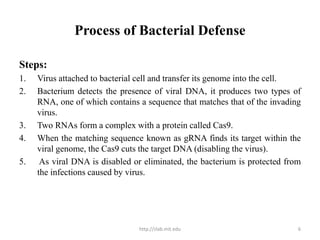
Process of Bacterial Defense
Steps:
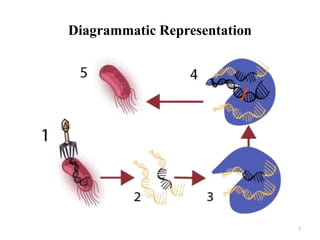
1. Virus attached to bacterial cell and transfer its genome into the cell.
2. Bacterium detects the presence of viral DNA, it produces two types of
RNA, one of which contains a sequence that matches that of the invading
virus.
3. Two RNAs form a complex with a protein called Cas9.
4. When the matching sequence known as gRNA finds its target within the
viral genome, the Cas9 cuts the target DNA (disabling the virus).
5. As viral DNA is disabled or eliminated, the bacterium is protected from
the infections caused by virus.
http://zlab.mit.edu 6
Diagrammatic Representation
7
1. Target Identification:
The first step in genome editing is to identify the specific DNA sequence that
you want to modify. This sequence is usually associated with a particular gene
or region of interest.
2. Designing Guide RNA (gRNA):
Once the target DNA sequence is identified, a small piece of RNA called guide
RNA (gRNA) is designed. The gRNA is engineered to be complementary to
the target DNA sequence. It will guide the Cas9 protein to the precise location
on the DNA.
3. Assembling the CRISPR-Cas9 Complex:
The Cas9 protein is an enzyme that acts like molecular scissors. It is combined
with the gRNA to form the CRISPR-Cas9 complex. The gRNA helps the Cas9
protein locate the target DNA by binding to the complementary DNA
sequence.
https://doi.org/10.1146/annurev-pharmtox-010814-124454 8
Genome Editing Process
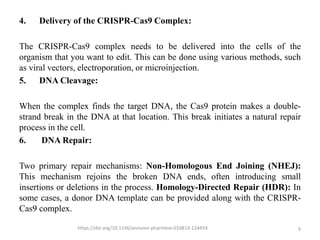
4. Delivery of the CRISPR-Cas9 Complex:
The CRISPR-Cas9 complex needs to be delivered into the cells of the
organism that you want to edit. This can be done using various methods, such
as viral vectors, electroporation, or microinjection.
5. DNA Cleavage:
When the complex finds the target DNA, the Cas9 protein makes a double-
strand break in the DNA at that location. This break initiates a natural repair
process in the cell.
6. DNA Repair:
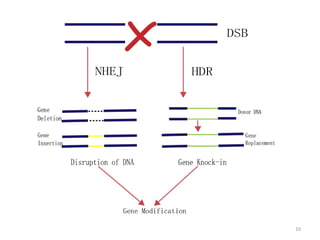
Two primary repair mechanisms: Non-Homologous End Joining (NHEJ):
This mechanism rejoins the broken DNA ends, often introducing small
insertions or deletions in the process. Homology-Directed Repair (HDR): In
some cases, a donor DNA template can be provided along with the CRISPR-
Cas9 complex.
https://doi.org/10.1146/annurev-pharmtox-010814-124454 9
10
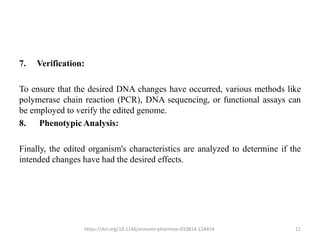
7. Verification:
To ensure that the desired DNA changes have occurred, various methods like
polymerase chain reaction (PCR), DNA sequencing, or functional assays can
be employed to verify the edited genome.
8. Phenotypic Analysis:
Finally, the edited organism's characteristics are analyzed to determine if the
intended changes have had the desired effects.
https://doi.org/10.1146/annurev-pharmtox-010814-124454 11
12
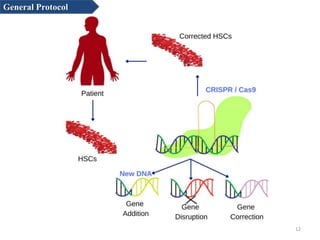
General Protocol
13
 Gene Therapy for Genetic Diseases:
CRISPR-Cas9 has been used to edit genes associated with genetic disorders,
such as sickle cell anemia and beta-thalassemia.
 Cancer Research and Treatment:
Researchers are exploring the use of CRISPR-Cas9 to target and modify genes
involved in cancer, leading to potential therapies.
 Agriculture and Crop Improvement:
CRISPR-Cas9 can be used to create genetically modified crops with desired
traits, such as increased resistance to pests or improved nutritional content.
DOI: 10.1056/NEJMoa2031054
https://pubmed.ncbi.nlm.nih.gov 14
Applications
 Biotechnology and Drug Development:
CRISPR-Cas9 is used to engineer cells for bioproduction of therapeutic
proteins and to develop disease models for drug screening.
 Functional Genomics and Basic Research:
CRISPR-Cas9 enables the study of gene function and regulation by creating
knockout or knock-in models.
 Infectious Disease Research:
CRISPR-Cas9 can be used to study host-pathogen interactions and develop
potential therapies for infectious diseases.
 Conservation and Environmental Applications:
CRISPR-Cas9 is explored for its potential to protect endangered species or
manage invasive species.
https://pubmed.ncbi.nlm.nih.gov
15
• CRISPR-Cas9 can unintentionally modify unintended DNA sequences,
potentially leading to unforeseen consequences (Off-Target Mutations).
• Modifying the genetic makeup of human embryos or germline cells raises
concerns about the potential for unintended consequences in future
generations (Human Germline Editing).
• Establishing clear guidelines and regulations is crucial to ensure the
responsible and ethical use of CRISPR-Cas9 technology.
16
Ethical Considerations
CRISPR-Cas9 has emerged as a transformative technology with far-reaching
implications for biology and medicine. With careful consideration of the
ethical and societal implications, CRISPR-Cas9 holds the promise of
revolutionizing healthcare, agriculture, and our understanding of the
fundamental principles of life.
17
Conclusion
Gene Editing (Through CRISPR Cas9 Protein).pptx

Gene Editing (Through CRISPR Cas9 Protein).pptx

  • 1.
  • 2.
    Genome Editing CRISPR-cas9 Technique 2 ByAminaAshiq Mphil Pharmaceutics GCUF
  • 3.
    CONTENTS: • Introduction • TheCRISPR-Cas9 System • The Genome Editing Process • General Protocol • Applications of CRISPR-Cas9 Genome Editing • Ethical Considerations • Conclusion 3
  • 4.
    Genome Editing A PowerfulTool for Genetic Modification. Significance: This immense technique is used in many fields, including Medicine (treating diseases like cystic fibrosis), Agriculture (improving nutritional values, enhancing the yield), and Research (exploring and understanding gene functions). https://doi.org/10.1016/j.biori.2019.07.001 4 “Genome editing, also known as gene editing, is a revolutionary technique that enables scientists to modify the DNA sequence of living organisms. It allows researchers to correct genetic defects, introduce new traits, and potentially treat a wide range of diseases by inserting, removing, or replacing DNA from a genome.” Introduction
  • 5.
    “A Bacterial DefenseSystem.” • CRISPR-Cas9 (Clustered Regularly Interspaced Short Palindromic Repeats – CRISPR-associated protein 9) is derived from the natural defense mechanisms of bacteria. • Bacteria employ CRISPR-Cas9 to recognize and eliminate invading viruses by incorporating fragments of viral DNA into their own genomes. • To understand how genes work, researchers need to control them. Changing genes in living cells is difficult, but this technique improve the ability to edit DNA of any species, including humans. • This technique is most famous nowadays due to the reasons like easy to build, cheap, high success rate, and high specificity. https://doi.org/10.54112/bcsrj.v2020i1.17 5 CRISPR/Cas9
  • 6.
    Process of BacterialDefense Steps: 1. Virus attached to bacterial cell and transfer its genome into the cell. 2. Bacterium detects the presence of viral DNA, it produces two types of RNA, one of which contains a sequence that matches that of the invading virus. 3. Two RNAs form a complex with a protein called Cas9. 4. When the matching sequence known as gRNA finds its target within the viral genome, the Cas9 cuts the target DNA (disabling the virus). 5. As viral DNA is disabled or eliminated, the bacterium is protected from the infections caused by virus. http://zlab.mit.edu 6
  • 7.
  • 8.
    1. Target Identification: Thefirst step in genome editing is to identify the specific DNA sequence that you want to modify. This sequence is usually associated with a particular gene or region of interest. 2. Designing Guide RNA (gRNA): Once the target DNA sequence is identified, a small piece of RNA called guide RNA (gRNA) is designed. The gRNA is engineered to be complementary to the target DNA sequence. It will guide the Cas9 protein to the precise location on the DNA. 3. Assembling the CRISPR-Cas9 Complex: The Cas9 protein is an enzyme that acts like molecular scissors. It is combined with the gRNA to form the CRISPR-Cas9 complex. The gRNA helps the Cas9 protein locate the target DNA by binding to the complementary DNA sequence. https://doi.org/10.1146/annurev-pharmtox-010814-124454 8 Genome Editing Process
  • 9.
    4. Delivery ofthe CRISPR-Cas9 Complex: The CRISPR-Cas9 complex needs to be delivered into the cells of the organism that you want to edit. This can be done using various methods, such as viral vectors, electroporation, or microinjection. 5. DNA Cleavage: When the complex finds the target DNA, the Cas9 protein makes a double- strand break in the DNA at that location. This break initiates a natural repair process in the cell. 6. DNA Repair: Two primary repair mechanisms: Non-Homologous End Joining (NHEJ): This mechanism rejoins the broken DNA ends, often introducing small insertions or deletions in the process. Homology-Directed Repair (HDR): In some cases, a donor DNA template can be provided along with the CRISPR- Cas9 complex. https://doi.org/10.1146/annurev-pharmtox-010814-124454 9
  • 10.
  • 11.
    7. Verification: To ensurethat the desired DNA changes have occurred, various methods like polymerase chain reaction (PCR), DNA sequencing, or functional assays can be employed to verify the edited genome. 8. Phenotypic Analysis: Finally, the edited organism's characteristics are analyzed to determine if the intended changes have had the desired effects. https://doi.org/10.1146/annurev-pharmtox-010814-124454 11
  • 12.
  • 13.
  • 14.
     Gene Therapyfor Genetic Diseases: CRISPR-Cas9 has been used to edit genes associated with genetic disorders, such as sickle cell anemia and beta-thalassemia.  Cancer Research and Treatment: Researchers are exploring the use of CRISPR-Cas9 to target and modify genes involved in cancer, leading to potential therapies.  Agriculture and Crop Improvement: CRISPR-Cas9 can be used to create genetically modified crops with desired traits, such as increased resistance to pests or improved nutritional content. DOI: 10.1056/NEJMoa2031054 https://pubmed.ncbi.nlm.nih.gov 14 Applications
  • 15.
     Biotechnology andDrug Development: CRISPR-Cas9 is used to engineer cells for bioproduction of therapeutic proteins and to develop disease models for drug screening.  Functional Genomics and Basic Research: CRISPR-Cas9 enables the study of gene function and regulation by creating knockout or knock-in models.  Infectious Disease Research: CRISPR-Cas9 can be used to study host-pathogen interactions and develop potential therapies for infectious diseases.  Conservation and Environmental Applications: CRISPR-Cas9 is explored for its potential to protect endangered species or manage invasive species. https://pubmed.ncbi.nlm.nih.gov 15
  • 16.
    • CRISPR-Cas9 canunintentionally modify unintended DNA sequences, potentially leading to unforeseen consequences (Off-Target Mutations). • Modifying the genetic makeup of human embryos or germline cells raises concerns about the potential for unintended consequences in future generations (Human Germline Editing). • Establishing clear guidelines and regulations is crucial to ensure the responsible and ethical use of CRISPR-Cas9 technology. 16 Ethical Considerations
  • 17.
    CRISPR-Cas9 has emergedas a transformative technology with far-reaching implications for biology and medicine. With careful consideration of the ethical and societal implications, CRISPR-Cas9 holds the promise of revolutionizing healthcare, agriculture, and our understanding of the fundamental principles of life. 17 Conclusion