Humanities


Lecture (5)
Learning & Creative Thought
Reference:

 Paul H. Wright, “Introduction to Engineering”,

  3rd Edition, Chapter (3)
The Successful Engineering Student
It is the student who determines his or her success or
   failure
• The successful student
- Should have the motivation and perseverance to get
   the task.
- Quickly learns how to make advantage of all resources
   offered by the university to enrich the learning
   process.
- Has the interest to learn the engineering curriculum.
Resources for Engineering students
 The teaching staff (tutoring, counseling,…)
 Library
 Computer Center
 Laboratories
 Physical education and recreation
 Culture presentations
The engineering curriculum include:
- Basic Sciences :   serve as the foundation of an
 engineering education.

- Engineering Sciences : such courses are strongly
 rooted in basic sciences and mathematics providing a
 bridge between basic subjects and engineering design.

- Applied Sciences : these are highly specialized courses
  intended to equip the student for practice in his or her
  chosen specialty.
The Learning Process
 Learning is a lifelong , continuous process.

 We learn not only through direct experience , but also
 by watching what happens to other people or by just
 being told about something .
 We receive information from various senses: sight,
 hearing, smell, touch, and taste
Determinants of Efficient Learning
1- The material to be learned: the more meaningful the
   material to be learned, the more easy it is learned.
2- The psychological state of the learner : a moderate
   level of anxiety is believed to be beneficial to learning.
   But extremely low or extremely high levels are
   detrimental to student success.
3- Learning strategies : rehearsal is one of the most
   popular strategies in learning.      The more students
   practice, the better they perform.              Preparing
   summaries.      Writing answers to expected questions
   …
Practical suggestion for learning
• Regularly attend classes and laboratory sessions.
• Be alert and listen attentively in class.
• Record points of significance for the lecture.
• Do not hesitate to seek clarification on unclear issues.
• Do your work because you want to, not because you
  have to.
• Find time to relax and rest.
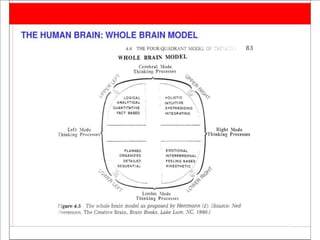
Differences in the Way People Think
  In his brain dominance model, Herrmann identifies
  four different modes of thinking:
A- Analytical thinking
B- Sequential thinking
C- Emotional thinking
D- Imaginative thinking
CREATIVITY
• Engineering is a creative profession
• Every person has creative abilities
• Use our creative potential
• “That which is used strengthens & grows
  .. and that which is not used withers and dies ..” Socrates
• Nurture and develop our creativity


What is Creativity?
• “Ideas that can lead to new or modified useful concepts,
  products or processes”
THE CREATIVE PROCESS
 Recognition of a need or a problem
 A period of intense concentration
 A period of relaxation or incubation
 The illumination, when solution suddenly appears
 Evaluation or verification of the solution
The Nature of Creativity
1- Creativity associated with profound and abstract
  concepts (Einstein, Isaac Newton)

2- Creativity associated with the artist and writers
  (inspired people)

3- Applied creativity associated with engineers and
  scientists
PROBLEM SOLVING & CREATIVITY
• Beware of Fixation or Mental Set            “The persistent
  application of an inappropriate strategy”

• Previous experience or knowledge may limit the thinking
  process to other possibilities

• Keep your motivational level in a balanced state

• Must be flexible and open to new ideas and strategies

• Avoid placing unnecessary constraints on the problem
PROBLEM SOLVING & CREATIVITY
 Search for different ways to view the problem

 Brainstorming with other team members

 Solutions from other disciplines

 Divide complex problems into manageable parts

 Intense concentration, followed by “incubation” time

 Be open to variety of problem-solving strategies
GENN001 FALL2013 Session #6 learning & creative thought

GENN001 FALL2013 Session #6 learning & creative thought

  • 1.
  • 2.
    Reference:  Paul H.Wright, “Introduction to Engineering”, 3rd Edition, Chapter (3)
  • 3.
    The Successful EngineeringStudent It is the student who determines his or her success or failure • The successful student - Should have the motivation and perseverance to get the task. - Quickly learns how to make advantage of all resources offered by the university to enrich the learning process. - Has the interest to learn the engineering curriculum.
  • 4.
    Resources for Engineeringstudents  The teaching staff (tutoring, counseling,…)  Library  Computer Center  Laboratories  Physical education and recreation  Culture presentations
  • 5.
    The engineering curriculuminclude: - Basic Sciences : serve as the foundation of an engineering education. - Engineering Sciences : such courses are strongly rooted in basic sciences and mathematics providing a bridge between basic subjects and engineering design. - Applied Sciences : these are highly specialized courses intended to equip the student for practice in his or her chosen specialty.
  • 6.
    The Learning Process Learning is a lifelong , continuous process.  We learn not only through direct experience , but also by watching what happens to other people or by just being told about something .  We receive information from various senses: sight, hearing, smell, touch, and taste
  • 7.
    Determinants of EfficientLearning 1- The material to be learned: the more meaningful the material to be learned, the more easy it is learned. 2- The psychological state of the learner : a moderate level of anxiety is believed to be beneficial to learning. But extremely low or extremely high levels are detrimental to student success. 3- Learning strategies : rehearsal is one of the most popular strategies in learning. The more students practice, the better they perform. Preparing summaries. Writing answers to expected questions …
  • 8.
    Practical suggestion forlearning • Regularly attend classes and laboratory sessions. • Be alert and listen attentively in class. • Record points of significance for the lecture. • Do not hesitate to seek clarification on unclear issues. • Do your work because you want to, not because you have to. • Find time to relax and rest.
  • 9.
    Differences in theWay People Think In his brain dominance model, Herrmann identifies four different modes of thinking: A- Analytical thinking B- Sequential thinking C- Emotional thinking D- Imaginative thinking
  • 12.
    CREATIVITY • Engineering isa creative profession • Every person has creative abilities • Use our creative potential • “That which is used strengthens & grows .. and that which is not used withers and dies ..” Socrates • Nurture and develop our creativity What is Creativity? • “Ideas that can lead to new or modified useful concepts, products or processes”
  • 13.
    THE CREATIVE PROCESS Recognition of a need or a problem  A period of intense concentration  A period of relaxation or incubation  The illumination, when solution suddenly appears  Evaluation or verification of the solution
  • 14.
    The Nature ofCreativity 1- Creativity associated with profound and abstract concepts (Einstein, Isaac Newton) 2- Creativity associated with the artist and writers (inspired people) 3- Applied creativity associated with engineers and scientists
  • 15.
    PROBLEM SOLVING &CREATIVITY • Beware of Fixation or Mental Set “The persistent application of an inappropriate strategy” • Previous experience or knowledge may limit the thinking process to other possibilities • Keep your motivational level in a balanced state • Must be flexible and open to new ideas and strategies • Avoid placing unnecessary constraints on the problem
  • 16.
    PROBLEM SOLVING &CREATIVITY  Search for different ways to view the problem  Brainstorming with other team members  Solutions from other disciplines  Divide complex problems into manageable parts  Intense concentration, followed by “incubation” time  Be open to variety of problem-solving strategies