Developing Critical Thinking
Postgraduate Course The Case Study Approach
Critical Thinking in Action: Feedback
Dr Angus Nurse

Email – a.nurse@mdx.ac.uk
The Value of Case Studies

Case Studies:
• “bridge the gap between theory and
practice and between the academy
and the workplace”
(Barkley, Cross, and Major 2005, p.182)
Student Views – Developing
Skills
• Greater emphasis on practical work required
• Move away from teacher led instruction to student centred
learning
• The ‘how’ of analytical/critical thinking rather than just
subject specific analysis.
• Motivation is improved when reasoning is explained,
developed and understood.
Student Views: The Light at the End
of the Tunnel…

• Analysis of how ‘correct’ reasoning is arrived at
• Discussion of elements in faulty reasoning and steps leading up
to incorrect conclusions
• Workshop discussion of flawed cases, common errors and
misconceptions
• Analysis of areas of dispute/conflict between professionals, text
book authors - the ‘what if’s’
• Techniques for evaluating evidence and detail so that
conclusions can withstand scrutiny
The Nature of Case Studies

• They can be short (a few paragraphs) or long (e.g. 20+ pages).
• They can be used in lecture-based or discussion-based classes.
• They can be real, with all the detail drawn from actual people and
circumstances, or simply realistic.
• They can provide all the relevant data students need to discuss and
resolve the central issue, or only some of it, requiring students to identify,
and possibly fill in (via outside research), the missing information.
• They can require students to examine multiple aspects of a problem, or
just a circumscribed piece.
• They can require students to propose a solution for the case or simply to
identify the parameters of the problem.
Case Studies as Experiential
Learning

Slide 6

28/11/13
Criminology – Case
Study Approaches
Possible Approaches:
– Evaluating a scenario and identifying what may be
important and what is irrelevant;
– Analysing law, case law and Government or sector
specific guidance;
– Evaluating evidence including witness statements,
interview evidence and contradictory or ambiguous
material; and
– Critical evaluation of a practical case to analyse the
material and reach a conclusion.
– Case study based on placement/internship experience
Developing Case Studies

Clarify objectives:
• What do you want students to learn from the discussion
of the case?
• What do they know already that applies to the case?
• What are the issues (central and peripheral) that may be
raised in discussion?
• Can the case "carry" the discussion (Is it appropriate to
your objectives)?

(Cornell University, Teaching Guidance)
Elements of a Good Case Study

Davis (1993) suggests a good case study should:
• tell a “real” and engaging story
• raise a thought-provoking issue
• have elements of conflict
• promote empathy with the central characters
• lack an obvious or clear-cut right answer
• encourage students to think and take a position
• portray actors in moments of decision
• provide plenty of data about character, location, context,
actions
• be relatively concise
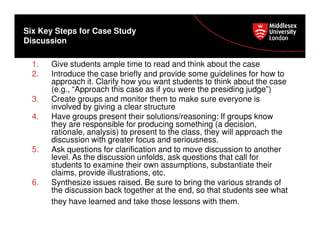
Six Key Steps for Case Study
Discussion
1.
2.
3.
4.

5.

6.

Give students ample time to read and think about the case
Introduce the case briefly and provide some guidelines for how to
approach it. Clarify how you want students to think about the case
(e.g., “Approach this case as if you were the presiding judge”)
Create groups and monitor them to make sure everyone is
involved by giving a clear structure
Have groups present their solutions/reasoning: If groups know
they are responsible for producing something (a decision,
rationale, analysis) to present to the class, they will approach the
discussion with greater focus and seriousness.
Ask questions for clarification and to move discussion to another
level. As the discussion unfolds, ask questions that call for
students to examine their own assumptions, substantiate their
claims, provide illustrations, etc.
Synthesize issues raised. Be sure to bring the various strands of
the discussion back together at the end, so that students see what
they have learned and take those lessons with them.
References

• Barkley, E. F, Cross, K. P. & Major, C. H.
(2005) Collaborative Learning Techniques:
A Handbook for College Faculty. SanFrancisco: Jossey-Bass.
• Christensen, C. R. (1981) Teaching By the
Case Method. Boston: Harvard Business
School.
• Davis, B. G. (1993) Tools for Teaching.
San Francisco: Jossey-Bass.

Critical thinking in action. The case study approach - Angus Nurse

  • 1.
    Developing Critical Thinking PostgraduateCourse The Case Study Approach Critical Thinking in Action: Feedback Dr Angus Nurse Email – a.nurse@mdx.ac.uk
  • 2.
    The Value ofCase Studies Case Studies: • “bridge the gap between theory and practice and between the academy and the workplace” (Barkley, Cross, and Major 2005, p.182)
  • 3.
    Student Views –Developing Skills • Greater emphasis on practical work required • Move away from teacher led instruction to student centred learning • The ‘how’ of analytical/critical thinking rather than just subject specific analysis. • Motivation is improved when reasoning is explained, developed and understood.
  • 4.
    Student Views: TheLight at the End of the Tunnel… • Analysis of how ‘correct’ reasoning is arrived at • Discussion of elements in faulty reasoning and steps leading up to incorrect conclusions • Workshop discussion of flawed cases, common errors and misconceptions • Analysis of areas of dispute/conflict between professionals, text book authors - the ‘what if’s’ • Techniques for evaluating evidence and detail so that conclusions can withstand scrutiny
  • 5.
    The Nature ofCase Studies • They can be short (a few paragraphs) or long (e.g. 20+ pages). • They can be used in lecture-based or discussion-based classes. • They can be real, with all the detail drawn from actual people and circumstances, or simply realistic. • They can provide all the relevant data students need to discuss and resolve the central issue, or only some of it, requiring students to identify, and possibly fill in (via outside research), the missing information. • They can require students to examine multiple aspects of a problem, or just a circumscribed piece. • They can require students to propose a solution for the case or simply to identify the parameters of the problem.
  • 6.
    Case Studies asExperiential Learning Slide 6 28/11/13
  • 7.
    Criminology – Case StudyApproaches Possible Approaches: – Evaluating a scenario and identifying what may be important and what is irrelevant; – Analysing law, case law and Government or sector specific guidance; – Evaluating evidence including witness statements, interview evidence and contradictory or ambiguous material; and – Critical evaluation of a practical case to analyse the material and reach a conclusion. – Case study based on placement/internship experience
  • 8.
    Developing Case Studies Clarifyobjectives: • What do you want students to learn from the discussion of the case? • What do they know already that applies to the case? • What are the issues (central and peripheral) that may be raised in discussion? • Can the case "carry" the discussion (Is it appropriate to your objectives)? (Cornell University, Teaching Guidance)
  • 9.
    Elements of aGood Case Study Davis (1993) suggests a good case study should: • tell a “real” and engaging story • raise a thought-provoking issue • have elements of conflict • promote empathy with the central characters • lack an obvious or clear-cut right answer • encourage students to think and take a position • portray actors in moments of decision • provide plenty of data about character, location, context, actions • be relatively concise
  • 10.
    Six Key Stepsfor Case Study Discussion 1. 2. 3. 4. 5. 6. Give students ample time to read and think about the case Introduce the case briefly and provide some guidelines for how to approach it. Clarify how you want students to think about the case (e.g., “Approach this case as if you were the presiding judge”) Create groups and monitor them to make sure everyone is involved by giving a clear structure Have groups present their solutions/reasoning: If groups know they are responsible for producing something (a decision, rationale, analysis) to present to the class, they will approach the discussion with greater focus and seriousness. Ask questions for clarification and to move discussion to another level. As the discussion unfolds, ask questions that call for students to examine their own assumptions, substantiate their claims, provide illustrations, etc. Synthesize issues raised. Be sure to bring the various strands of the discussion back together at the end, so that students see what they have learned and take those lessons with them.
  • 11.
    References • Barkley, E.F, Cross, K. P. & Major, C. H. (2005) Collaborative Learning Techniques: A Handbook for College Faculty. SanFrancisco: Jossey-Bass. • Christensen, C. R. (1981) Teaching By the Case Method. Boston: Harvard Business School. • Davis, B. G. (1993) Tools for Teaching. San Francisco: Jossey-Bass.