Using information: going
beyond the point
• Explain what critical analysis
is
• Employ critical questioning
to visual and written sources
• Evaluate the argument in a
piece of text
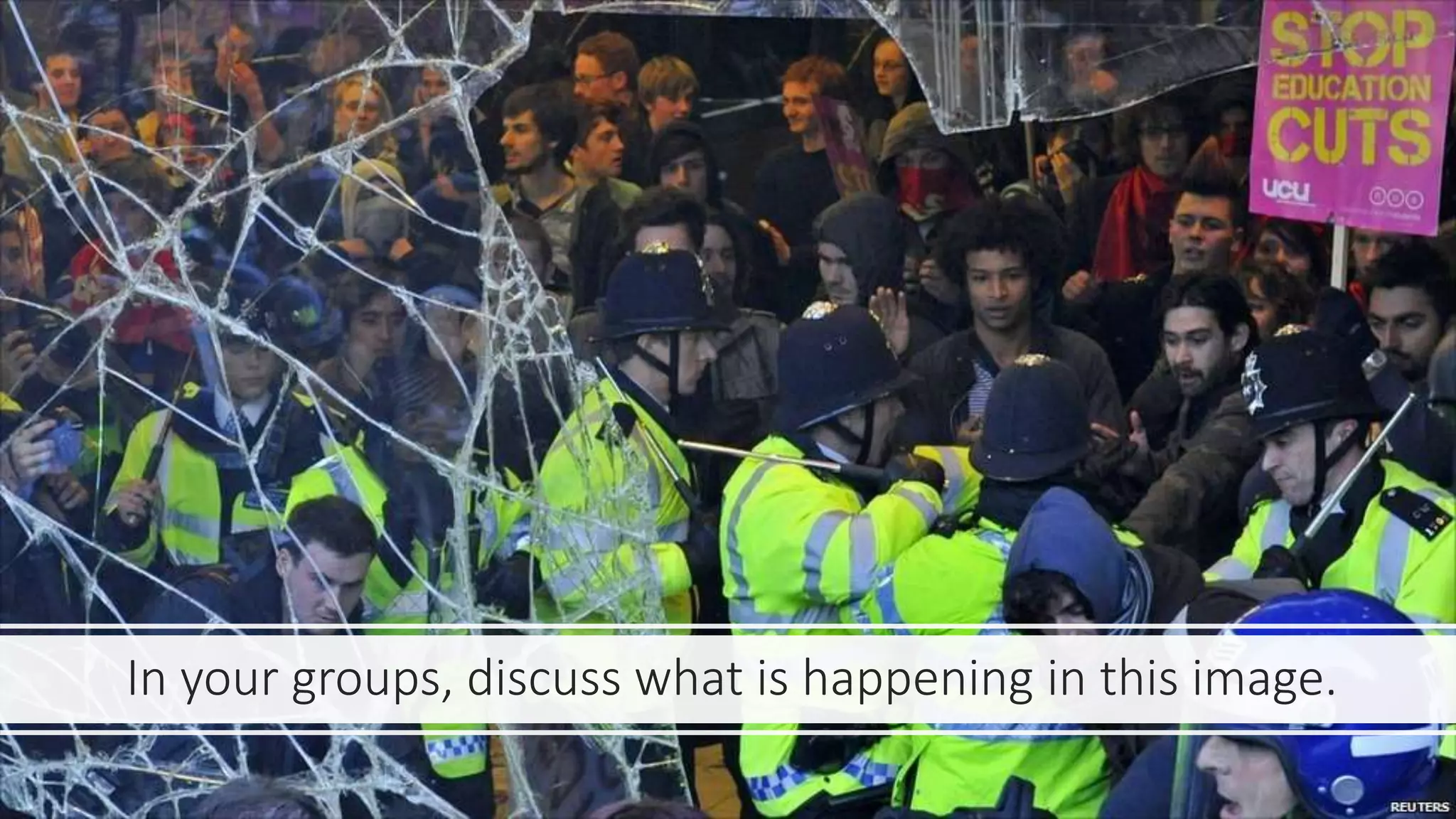
In your groups, discuss what is happening in this image.
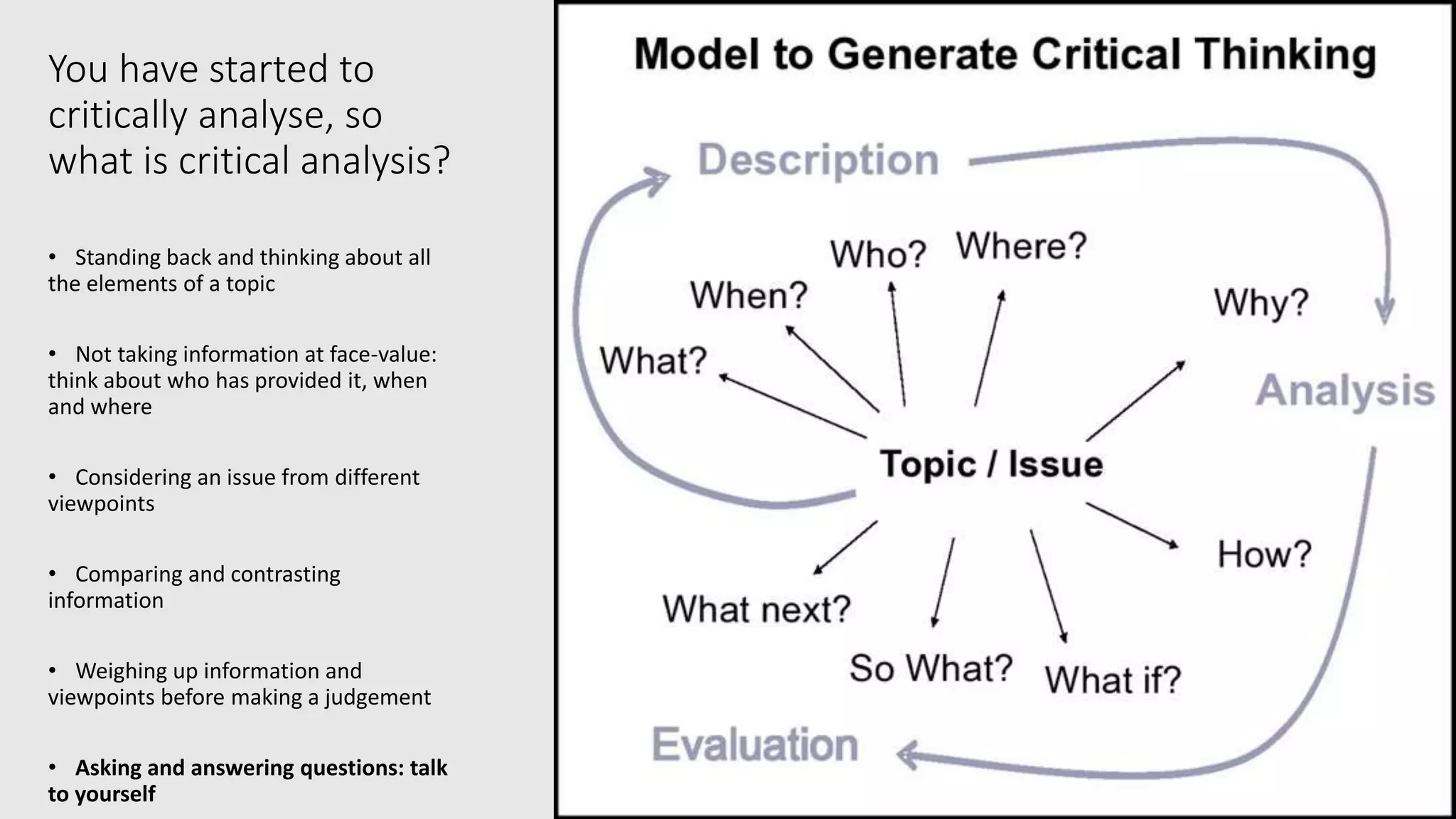
You have started to
critically analyse, so
what is critical analysis?
• Standing back and thinking about all
the elements of a topic
• Not taking information at face-value:
think about who has provided it, when
and where
• Considering an issue from different
viewpoints
• Comparing and contrasting
information
• Weighing up information and
viewpoints before making a judgement
• Asking and answering questions: talk
to yourself
• This means you need to
‘Zoom in and zoom out’:
• Zoom in on a single piece
of information and
analyse it in detail, then
zoom out to compare it
others and place it in a
wider context.
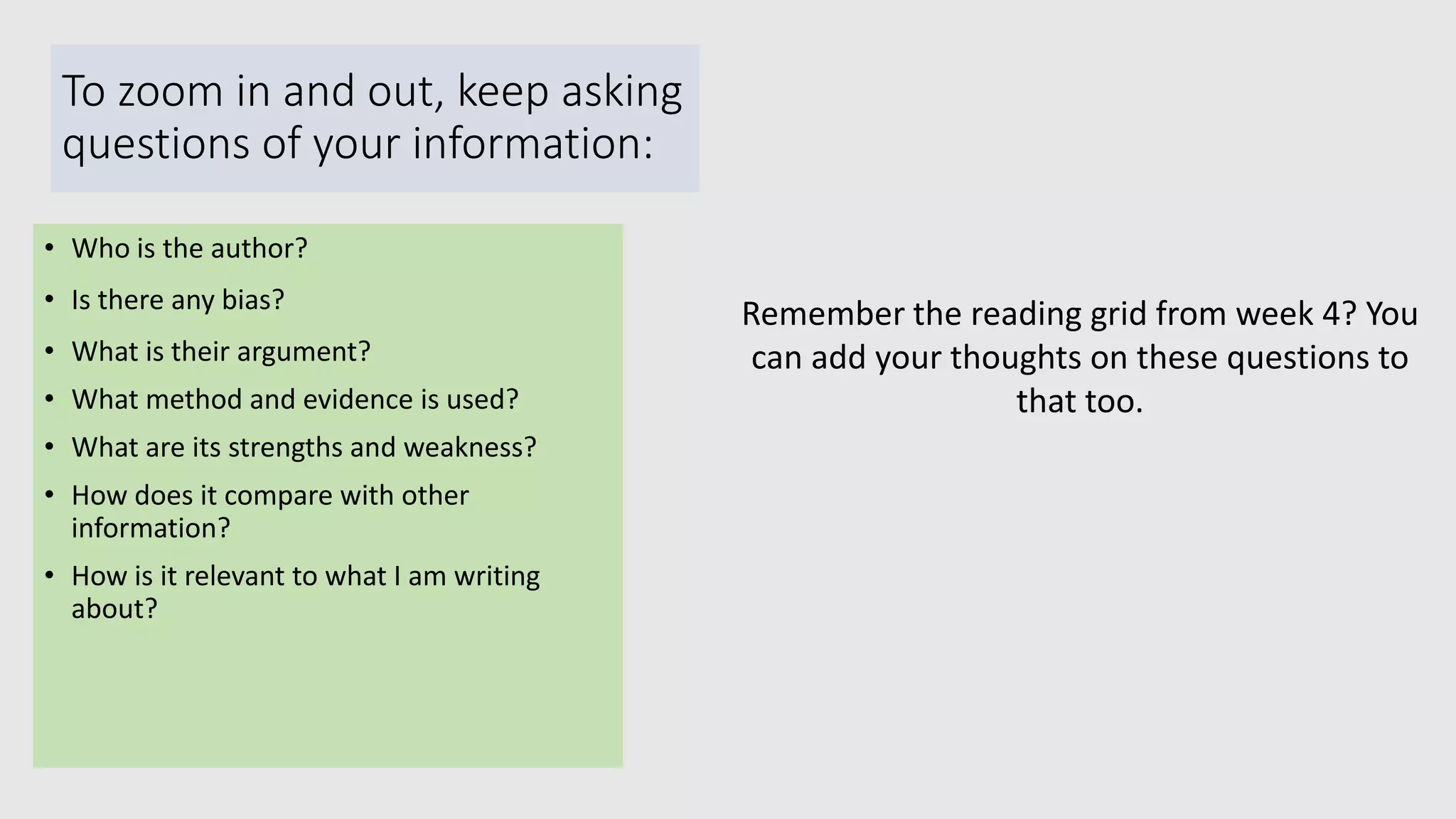
To zoom in and out, keep asking
questions of your information:
• Who is the author?
• Is there any bias?
• What is their argument?
• What method and evidence is used?
• What are its strengths and weakness?
• How does it compare with other
information?
• How is it relevant to what I am writing
about?
Remember the reading grid from week 4? You
can add your thoughts on these questions to
that too.
Have a go…
You have been given the question:
‘What is the purpose of Higher
Education?’
On your handout, add some
comments to this grid.
Have a go...
• You now have some extracts from four
different writers about what they think
the purpose of Higher Education is.
• In your groups, read and discuss them,
using some of the critical reading
questions.
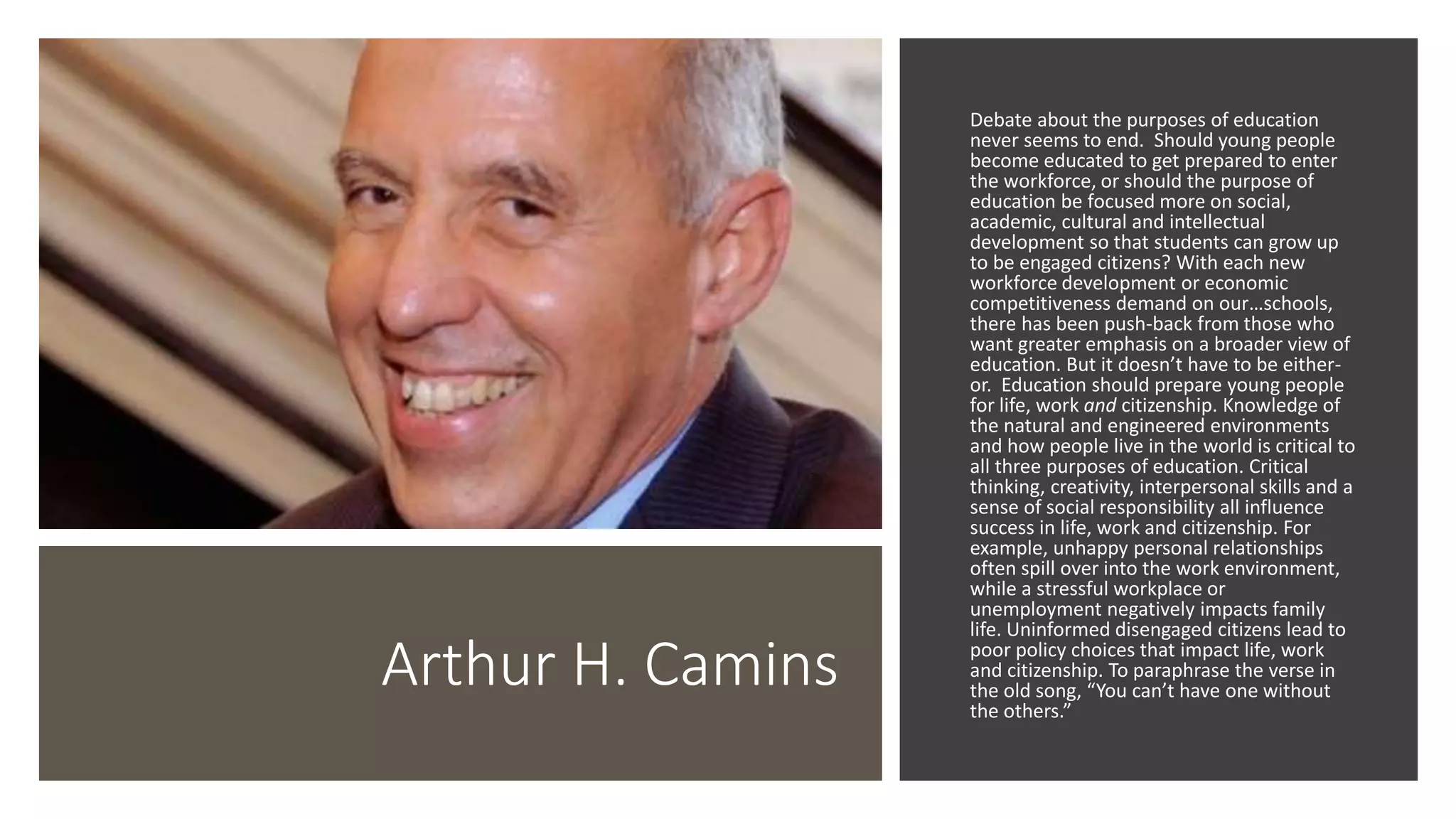
Arthur H. Camins
Debate about the purposes of education
never seems to end. Should young people
become educated to get prepared to enter
the workforce, or should the purpose of
education be focused more on social,
academic, cultural and intellectual
development so that students can grow up
to be engaged citizens? With each new
workforce development or economic
competitiveness demand on our…schools,
there has been push-back from those who
want greater emphasis on a broader view of
education. But it doesn’t have to be either-
or. Education should prepare young people
for life, work and citizenship. Knowledge of
the natural and engineered environments
and how people live in the world is critical to
all three purposes of education. Critical
thinking, creativity, interpersonal skills and a
sense of social responsibility all influence
success in life, work and citizenship. For
example, unhappy personal relationships
often spill over into the work environment,
while a stressful workplace or
unemployment negatively impacts family
life. Uninformed disengaged citizens lead to
poor policy choices that impact life, work
and citizenship. To paraphrase the verse in
the old song, “You can’t have one without
the others.”
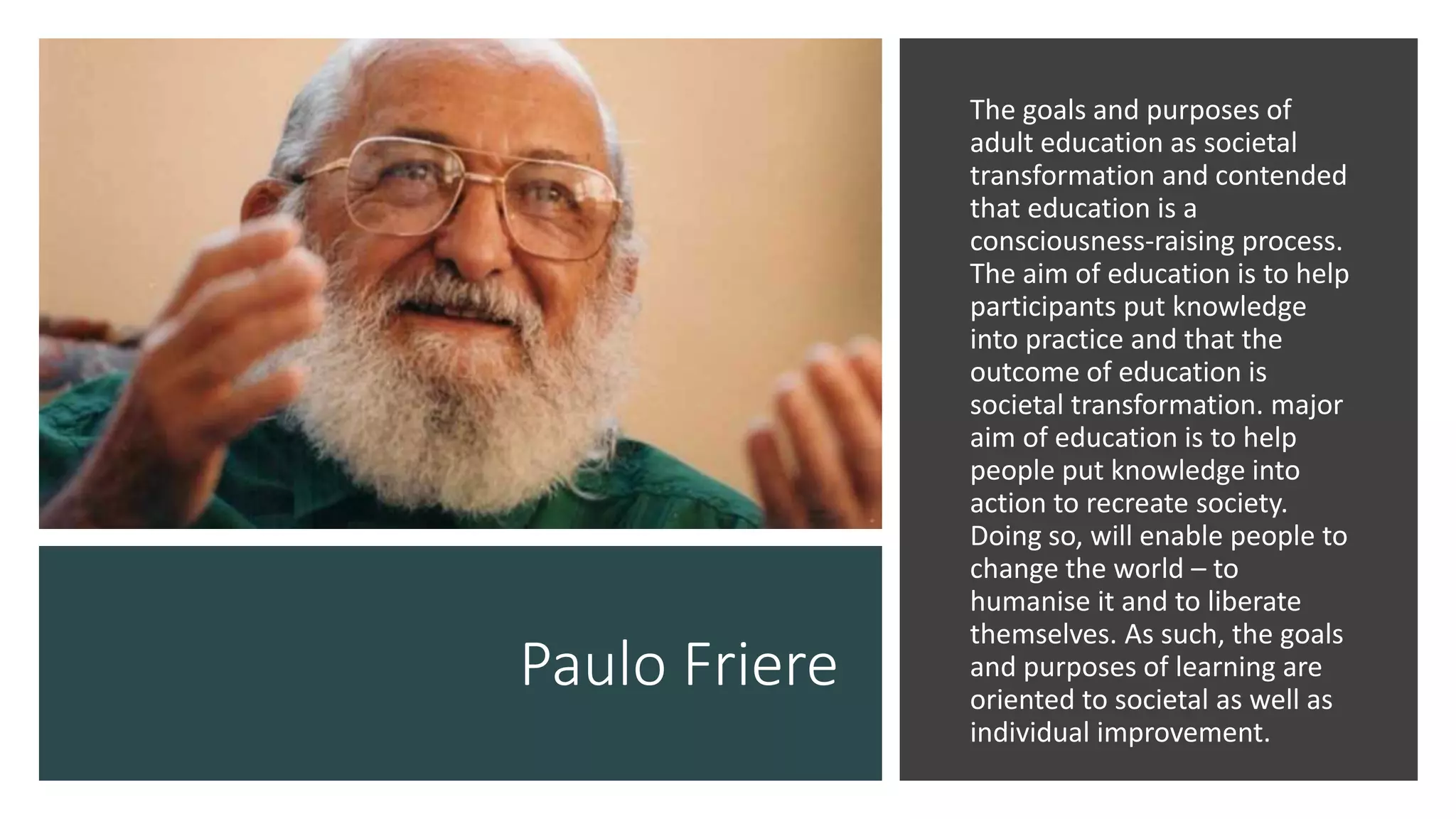
Paulo Friere
The goals and purposes of
adult education as societal
transformation and contended
that education is a
consciousness-raising process.
The aim of education is to help
participants put knowledge
into practice and that the
outcome of education is
societal transformation. major
aim of education is to help
people put knowledge into
action to recreate society.
Doing so, will enable people to
change the world – to
humanise it and to liberate
themselves. As such, the goals
and purposes of learning are
oriented to societal as well as
individual improvement.
bell hooks
The heart of education as a
practice of freedom is to
promote growth. It's very much
an act of love in that sense of
love as something that promotes
our spiritual and mental growth.
When people frequently ask me,
'What changed your life; what
enabled you to come from this
working-class, segregated home
where [your] parents were not
college-educated people into
being one of our nation's well-
known intellectuals?' [My
answer is,] 'It's there in that
space where I learned to be a
reader and a critical thinker.’
Mike Rustin
Opposition to the government's higher education
policy [of greater focus on employability skills] is from
people who has so far been expressed in very
traditionalist terms – with the idea that a university
has an intrinsic value and good. On the one hand, you
have the marketised view of universities as equipping
people to earn their living, and on the other hand, a
traditional view that universities are about pure
learning, but the students we have here have always
seen benefits beyond learning for its own sake. We
have really hard evidence to show that students are
fairly clear about why they want to go to university –
and for the vast majority, it is about getting a better
job and having a successful career. A lot of people say
what about learning for learning's sake? I find that
problematic. Everyone has a purpose for why they
want to learn.
More analysis…
• Which argument did you find the most
convincing? Why?
• Have your views changed?
• Note this down on your handout.
Online learning and homework this week
• Your blog – you may want to
include your reflection from
today
• On Canvas, go to Week 7 Activity
and enrol on the LJMU Equality,
Diversity and Inclusivity Canvas
module and work your way
through it.
• Complete Week 7’s ‘How are you
doing?’ activity and submit by
midnight on Thursday
• Don’t forget to complete
Assignment 1

Week 7

  • 1.
    Using information: going beyondthe point • Explain what critical analysis is • Employ critical questioning to visual and written sources • Evaluate the argument in a piece of text
  • 2.
    In your groups,discuss what is happening in this image.
  • 3.
    You have startedto critically analyse, so what is critical analysis? • Standing back and thinking about all the elements of a topic • Not taking information at face-value: think about who has provided it, when and where • Considering an issue from different viewpoints • Comparing and contrasting information • Weighing up information and viewpoints before making a judgement • Asking and answering questions: talk to yourself
  • 4.
    • This meansyou need to ‘Zoom in and zoom out’: • Zoom in on a single piece of information and analyse it in detail, then zoom out to compare it others and place it in a wider context.
  • 5.
    To zoom inand out, keep asking questions of your information: • Who is the author? • Is there any bias? • What is their argument? • What method and evidence is used? • What are its strengths and weakness? • How does it compare with other information? • How is it relevant to what I am writing about? Remember the reading grid from week 4? You can add your thoughts on these questions to that too.
  • 6.
    Have a go… Youhave been given the question: ‘What is the purpose of Higher Education?’ On your handout, add some comments to this grid.
  • 7.
    Have a go... •You now have some extracts from four different writers about what they think the purpose of Higher Education is. • In your groups, read and discuss them, using some of the critical reading questions.
  • 8.
    Arthur H. Camins Debateabout the purposes of education never seems to end. Should young people become educated to get prepared to enter the workforce, or should the purpose of education be focused more on social, academic, cultural and intellectual development so that students can grow up to be engaged citizens? With each new workforce development or economic competitiveness demand on our…schools, there has been push-back from those who want greater emphasis on a broader view of education. But it doesn’t have to be either- or. Education should prepare young people for life, work and citizenship. Knowledge of the natural and engineered environments and how people live in the world is critical to all three purposes of education. Critical thinking, creativity, interpersonal skills and a sense of social responsibility all influence success in life, work and citizenship. For example, unhappy personal relationships often spill over into the work environment, while a stressful workplace or unemployment negatively impacts family life. Uninformed disengaged citizens lead to poor policy choices that impact life, work and citizenship. To paraphrase the verse in the old song, “You can’t have one without the others.”
  • 9.
    Paulo Friere The goalsand purposes of adult education as societal transformation and contended that education is a consciousness-raising process. The aim of education is to help participants put knowledge into practice and that the outcome of education is societal transformation. major aim of education is to help people put knowledge into action to recreate society. Doing so, will enable people to change the world – to humanise it and to liberate themselves. As such, the goals and purposes of learning are oriented to societal as well as individual improvement.
  • 10.
    bell hooks The heartof education as a practice of freedom is to promote growth. It's very much an act of love in that sense of love as something that promotes our spiritual and mental growth. When people frequently ask me, 'What changed your life; what enabled you to come from this working-class, segregated home where [your] parents were not college-educated people into being one of our nation's well- known intellectuals?' [My answer is,] 'It's there in that space where I learned to be a reader and a critical thinker.’
  • 11.
    Mike Rustin Opposition tothe government's higher education policy [of greater focus on employability skills] is from people who has so far been expressed in very traditionalist terms – with the idea that a university has an intrinsic value and good. On the one hand, you have the marketised view of universities as equipping people to earn their living, and on the other hand, a traditional view that universities are about pure learning, but the students we have here have always seen benefits beyond learning for its own sake. We have really hard evidence to show that students are fairly clear about why they want to go to university – and for the vast majority, it is about getting a better job and having a successful career. A lot of people say what about learning for learning's sake? I find that problematic. Everyone has a purpose for why they want to learn.
  • 12.
    More analysis… • Whichargument did you find the most convincing? Why? • Have your views changed? • Note this down on your handout.
  • 13.
    Online learning andhomework this week • Your blog – you may want to include your reflection from today • On Canvas, go to Week 7 Activity and enrol on the LJMU Equality, Diversity and Inclusivity Canvas module and work your way through it. • Complete Week 7’s ‘How are you doing?’ activity and submit by midnight on Thursday • Don’t forget to complete Assignment 1

Editor's Notes

  • #3 15 minutes including discussion. Follow up with some discussion, questioning – push for challenging them on preconceived bias/perspectives. It’s worth spending some time on this to help them to establish some principles of critical analysis. Finish off by telling them that they have just been critically analysing to lead into the next slide (so this becomes a deductive activity). This is also a way of them starting to realise that critical analysis isn’t too hard – they can do it.
  • #4 5 minutes – 10 if needed. To help extend their discussion. Relate each of these back to the image and their comments, or ask them for examples themselves. When you get to the compare and contrast, relate it to week 5 - they were starting to critically analyse then too. You could also relate back to week 2 and their work on evaluating the reliability of information (what they should use) – keep pushing the scaffolded and holistic nature of what they’ve been doing so far.
  • #5 This is just to briefly sum up key aspects of critical analysis – 2 minutes
  • #6 5 minutes max. Relate each of these critical questions to the previous slides but also to the session they did on compare and contrast (week 5).
  • #7 5 minutes Start this off with some open discussion, even breaking it down to ‘why are you here?’. You could refer back to their initial getting to Know You activity (most related that question to the job they want). You can also relate this to the initial image – why are they protesting about education? Why does it mean so much to them? Is it because they want to protect it’s purpose? Is it because they simply don’t want to pay more for it? Indeed, do they have such an idealistic view of education t, that they are protesting about fees being charged at all?
  • #8 15 – 20 minutes depending on the discussion. Get some feedback and discussion going – remind them that they need to go through this process before they are ready to use their reading in their assignments, whether that is written or a presentation. The following slides are to have up as you go through each one, but also as a way of highlighting who these writers are, and how that may affect their view.
  • #13 5 minutes – ask them for their responses as a form of plenary – you will be able to develop their comments through questioning but it also an opportunity to reinforce, clarify or correct anything. This is a shorter session to allow for time to go through the assignment.