Critical Thinking:
Time for a New Theory?
Ronald Barnett, University College London Institute of Education
Critical Thinking Summit, Leuven, 3 June 2019
Centre for Higher
Education Studies
Sub-brand to go here
2
It´s scary, apparently
 How CT is seen by some in Texas
 Not, we may assume, an issue with logical thinking
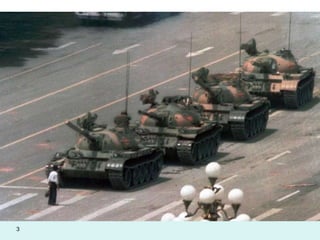
 Critical thinking is dangerous
 NB: Socrates lost his life for corrupting the young of Athens by asking
questions
 And today, whistle-blowers lose their livelihoods
 And in some countries, critics are put in prison
(including students and academics)
- & in other countries (UK), ‘critical thinking’ slips out of the lexicon.
3
And yet
• Evidence
• Not only that students are not very good at it
• But that they even may regress in higher education
• But why might that be?
• We have to come back to this matter.
4
Some (initial) technical problems
• Context-free or context-laden?
– CT in nanotechnology differs somewhat from CT in
literature studies and from CT in sociology …
• Disciplines or special units?
• Curriculum or Pedagogy?
5
Pitfalls (1)
• Privileging the humanities
• CT skills and dispositions – their relationships …
• Skills of reasoning and argument are not to be despised
– to the contrary)
 But tacit assumption: look after the skills and the
dispositions will follow. No!
6
Pitfalls (2)
• ‘Critical Pedagogy’ – ideological – but has some merit
• ‘Our discipline naturally encourages critical thinking’ (so no
change needed)
• [CT can lead to entrapment, because the educator is liable to be
entrapped, not least by her/his disc frameworks]
• So beware of Greeks bearing gifts
• No simple solutions (to complex issue of being critical in the C21).
7
But what is CT?
(a) Skills in evaluating theories & evidence in a discipline?
(b) An ability to identify ‘fake news’ in the wider world (& post-truth age)?
(c) An ease in certain kinds of logical argumentation?
(d) A propensity to spot & to call out bad work practices or organizations?
(e) A disposition to be self-critical? (Hearing the critics before they speak.)
(f) A will & the courage to speak truth to power, ie to hold the powerful –
incl the state – to account.
ie, ‘CT’ – a contested concept – a multiplicity of problems
NB: ‘It’s all of these’ is no get-out.
8
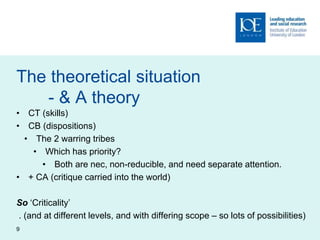
The theoretical situation
- & A theory
• CT (skills)
• CB (dispositions)
• The 2 warring tribes
• Which has priority?
• Both are nec, non-reducible, and need separate attention.
• + CA (critique carried into the world)
So ‘Criticality’
. (and at different levels, and with differing scope – so lots of possibilities)
9
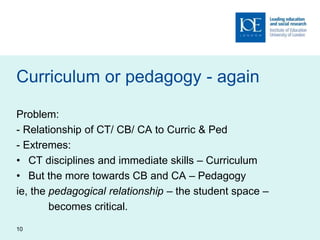
Curriculum or pedagogy - again
Problem:
- Relationship of CT/ CB/ CA to Curric & Ped
- Extremes:
• CT disciplines and immediate skills – Curriculum
• But the more towards CB and CA – Pedagogy
ie, the pedagogical relationship – the student space –
becomes critical.
10
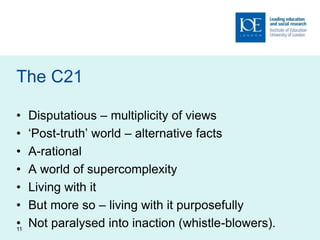
The C21
• Disputatious – multiplicity of views
• ‘Post-truth’ world – alternative facts
• A-rational
• A world of supercomplexity
• Living with it
• But more so – living with it purposefully
• Not paralysed into inaction (whistle-blowers).11
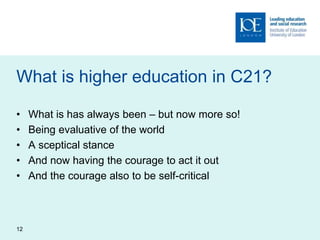
What is higher education in C21?
• What is has always been – but now more so!
• Being evaluative of the world
• A sceptical stance
• And now having the courage to act it out
• And the courage also to be self-critical
12
A necessary curriculum
• Choices - making a choice
• Here I stand (for now)
• Controversial issues – difficult situations
• In any subject – always disputes (incl hard sciences –
– NB problem of non-reducibility)
• Facing up to multiple views
• Being tested and stretched
• A curriculum of risk.
13
A necessary pedagogy
• A spacious pedagogy
• Not easy
• The student’s tale
• Being asked to discern
• Sense from nonsense? No, sense maximising.
• Being asked to declare
• Unsettling - A pedagogy of strangeness.
NB: The paradox of CT – unsettlement is good for retention
14
Being critical
• Being critical – has been too cognitive
• The dispositional and the active sides
• Need to be given much more weight
• But the cognitive also needs to be given more weight!
• Being is crucial – but at the highest level, it requires
cognition – deep knowledge and understanding
• Consider the whistle-blower in the health sector
• How develop the dispositions and a preparedness to act?
• - Perhaps start with action – action learning/ civic spaces
15
Openness
• Being critical in & for an unknown world
• Requires an open education
• Unpredictable outcomes
• Unforseeable events
• Not learning ‘outcomes’
16
The virtues of criticality
• Courage
• Persistence/ steadfastness (under fire)
• Diplomacy
• Authenticity
• Wisdom
• Care & Precision (the words matter, the argumentation matters)
• Openness
• Self-displacement - ‘The student as global citizen’
 These are NOT ‘skills’, but are matters of sheer being.
17
Glimpsing a new theory of criticality
- an ecological approach
• Seeing higher education as interwoven with the world
• - with the ecosystems of the world – knowledge, society,
economy, natural environment, persons, learning …
• Criticality now to be recast as stretching out and across
these ecosystems
• The critical student – lives, evaluates and acts purposively
(and critically) in the world, with all of its challenges
• Where there are no definite ways forward …
18
Trouble at t’mill
– the institutional environment
• Aiding & abetting or diminishing & constraining?
• Permitting trigger warnings & safe spaces
• Allowing controversial speakers on campus
- & shouting down such speakers
• An environment of open critical engagement:
• Do we allow all-comers a right to speak?
• Does critique have its limits?19
20
Conclusions
 CT is more necessary than ever before
 A world of dispute, manipulation and power
 The problem space of CT has to be widened (beyond skills)
 A new theory - CT has to be understood as CB in the world
(‘being critical’/ students as critical persons)
 And that has large implications for higher education
 For Curriculum and for Pedagogy
 But difficult choices to be made – at all levels of a university
 What is clear is the absolute necessity for criticality
 No criticality – no higher education
 Vital if the university is to realise its responsibilities in C21.
Institute of Education
University of London
20 Bedford Way
London WC1H 0AL
Tel +44 (0)20 7612 6000
Fax +44 (0)20 7612 6126
Email info@ioe.ac.uk
Web www.ioe.ac.uk

Critical Thinking: Time for a New Theory?

  • 1.
    Critical Thinking: Time fora New Theory? Ronald Barnett, University College London Institute of Education Critical Thinking Summit, Leuven, 3 June 2019 Centre for Higher Education Studies Sub-brand to go here
  • 2.
    2 It´s scary, apparently How CT is seen by some in Texas  Not, we may assume, an issue with logical thinking  Critical thinking is dangerous  NB: Socrates lost his life for corrupting the young of Athens by asking questions  And today, whistle-blowers lose their livelihoods  And in some countries, critics are put in prison (including students and academics) - & in other countries (UK), ‘critical thinking’ slips out of the lexicon.
  • 3.
  • 4.
    And yet • Evidence •Not only that students are not very good at it • But that they even may regress in higher education • But why might that be? • We have to come back to this matter. 4
  • 5.
    Some (initial) technicalproblems • Context-free or context-laden? – CT in nanotechnology differs somewhat from CT in literature studies and from CT in sociology … • Disciplines or special units? • Curriculum or Pedagogy? 5
  • 6.
    Pitfalls (1) • Privilegingthe humanities • CT skills and dispositions – their relationships … • Skills of reasoning and argument are not to be despised – to the contrary)  But tacit assumption: look after the skills and the dispositions will follow. No! 6
  • 7.
    Pitfalls (2) • ‘CriticalPedagogy’ – ideological – but has some merit • ‘Our discipline naturally encourages critical thinking’ (so no change needed) • [CT can lead to entrapment, because the educator is liable to be entrapped, not least by her/his disc frameworks] • So beware of Greeks bearing gifts • No simple solutions (to complex issue of being critical in the C21). 7
  • 8.
    But what isCT? (a) Skills in evaluating theories & evidence in a discipline? (b) An ability to identify ‘fake news’ in the wider world (& post-truth age)? (c) An ease in certain kinds of logical argumentation? (d) A propensity to spot & to call out bad work practices or organizations? (e) A disposition to be self-critical? (Hearing the critics before they speak.) (f) A will & the courage to speak truth to power, ie to hold the powerful – incl the state – to account. ie, ‘CT’ – a contested concept – a multiplicity of problems NB: ‘It’s all of these’ is no get-out. 8
  • 9.
    The theoretical situation -& A theory • CT (skills) • CB (dispositions) • The 2 warring tribes • Which has priority? • Both are nec, non-reducible, and need separate attention. • + CA (critique carried into the world) So ‘Criticality’ . (and at different levels, and with differing scope – so lots of possibilities) 9
  • 10.
    Curriculum or pedagogy- again Problem: - Relationship of CT/ CB/ CA to Curric & Ped - Extremes: • CT disciplines and immediate skills – Curriculum • But the more towards CB and CA – Pedagogy ie, the pedagogical relationship – the student space – becomes critical. 10
  • 11.
    The C21 • Disputatious– multiplicity of views • ‘Post-truth’ world – alternative facts • A-rational • A world of supercomplexity • Living with it • But more so – living with it purposefully • Not paralysed into inaction (whistle-blowers).11
  • 12.
    What is highereducation in C21? • What is has always been – but now more so! • Being evaluative of the world • A sceptical stance • And now having the courage to act it out • And the courage also to be self-critical 12
  • 13.
    A necessary curriculum •Choices - making a choice • Here I stand (for now) • Controversial issues – difficult situations • In any subject – always disputes (incl hard sciences – – NB problem of non-reducibility) • Facing up to multiple views • Being tested and stretched • A curriculum of risk. 13
  • 14.
    A necessary pedagogy •A spacious pedagogy • Not easy • The student’s tale • Being asked to discern • Sense from nonsense? No, sense maximising. • Being asked to declare • Unsettling - A pedagogy of strangeness. NB: The paradox of CT – unsettlement is good for retention 14
  • 15.
    Being critical • Beingcritical – has been too cognitive • The dispositional and the active sides • Need to be given much more weight • But the cognitive also needs to be given more weight! • Being is crucial – but at the highest level, it requires cognition – deep knowledge and understanding • Consider the whistle-blower in the health sector • How develop the dispositions and a preparedness to act? • - Perhaps start with action – action learning/ civic spaces 15
  • 16.
    Openness • Being criticalin & for an unknown world • Requires an open education • Unpredictable outcomes • Unforseeable events • Not learning ‘outcomes’ 16
  • 17.
    The virtues ofcriticality • Courage • Persistence/ steadfastness (under fire) • Diplomacy • Authenticity • Wisdom • Care & Precision (the words matter, the argumentation matters) • Openness • Self-displacement - ‘The student as global citizen’  These are NOT ‘skills’, but are matters of sheer being. 17
  • 18.
    Glimpsing a newtheory of criticality - an ecological approach • Seeing higher education as interwoven with the world • - with the ecosystems of the world – knowledge, society, economy, natural environment, persons, learning … • Criticality now to be recast as stretching out and across these ecosystems • The critical student – lives, evaluates and acts purposively (and critically) in the world, with all of its challenges • Where there are no definite ways forward … 18
  • 19.
    Trouble at t’mill –the institutional environment • Aiding & abetting or diminishing & constraining? • Permitting trigger warnings & safe spaces • Allowing controversial speakers on campus - & shouting down such speakers • An environment of open critical engagement: • Do we allow all-comers a right to speak? • Does critique have its limits?19
  • 20.
    20 Conclusions  CT ismore necessary than ever before  A world of dispute, manipulation and power  The problem space of CT has to be widened (beyond skills)  A new theory - CT has to be understood as CB in the world (‘being critical’/ students as critical persons)  And that has large implications for higher education  For Curriculum and for Pedagogy  But difficult choices to be made – at all levels of a university  What is clear is the absolute necessity for criticality  No criticality – no higher education  Vital if the university is to realise its responsibilities in C21. Institute of Education University of London 20 Bedford Way London WC1H 0AL Tel +44 (0)20 7612 6000 Fax +44 (0)20 7612 6126 Email info@ioe.ac.uk Web www.ioe.ac.uk