
INTRODUCTION
                  TO
          GENETIC DISORDERS


Presented By :
Velo, John R.
DMD2D
What is an Allele?

 an alternative form of a gene located at a specific
  position on a specific chromosome.

 These DNA codings determine distinct traits that
  can be passed on from parents to offspring.

 May be dominant or recessive

 The process by which alleles are transmitted was
  discovered by Gregor Mendel and formulated in
  what is known as Mendel's law of segregation.
Difference between a dominant and
recessive allele
 If the two alleles from both parents are :

   Similar : homozygous offsprings
   Different : heterozygous


 the stronger of the two will show up in the
  offspring while the weaker one is masked
Difference between a dominant and
recessive allele
 Dominant Allele
   A gene (allele) which is expressed clinically in the
    heterozygous state
   In a dominant disorder, only one mutant allele need be
    present as it masks the normal allele
 Recessive Allele
   A gene (allele) which is only expressed clinically in the
    homozygous state
   can be suppressed if present with a dominant gene and will
    not show it's character in presence of a dominant gene
   Recessive alleles or genes will only show up if the offspring
    inherits recessive copies of the trait from both parents
Difference between a dominant and
recessive allele
 Dominant genes are usually the ones that are oftentimes
  observed in an offspring and passed down to subsequent
  generations while recessive genes will only show for a few
  generations and eventually disappear.

 Dominant genes are represented by capital letters and
  recessive genes are represented by small letters.

 There are three combinations of genotypes or alleles:

    AA (receives dominant traits from both parents),
    Aa (receives a dominant trait from one parent and a recessive
     trait from the other), and
    aa (receives recessive traits from both parents)
What is a Punnett Square?

 a diagram that is used to predict an outcome
  of a particular cross or breeding experiment

 is visual representation of Mendelian
  inheritance
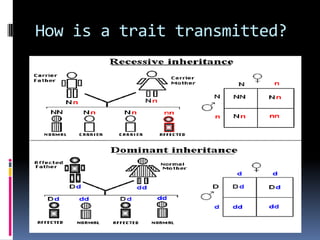
How is a trait transmitted?
Types of Genetic Disorders :

 Genetic disorder - disease caused by
  abnormalities in an individual’s genetic
  material (genome).

 The four different types of genetic disorders
  are :
     (1) single-gene,
     (2) multifactorial,
     (3) chromosomal, and
     (4) mitochondrial
(1) Single-gene (Mendelian or
monogenic)
 caused by changes or mutations that occur in the
  DNA sequence of one gene.

 Genes code for proteins, perform most life
  functions, and make up the majority of cellular
  structures. When a gene is mutated, it's protein
  product can no longer carry out its normal
  function, a disorder can result.

 Some examples are cystic fibrosis, sickle cell
  anemia, Marfan syndrome, Huntington’s
  disease, and hereditary hemochromatosis.
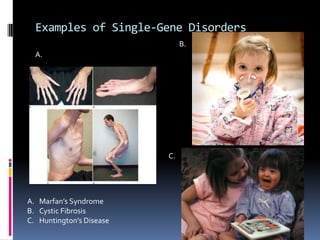
Examples of Single-Gene Disorders
                               B.
  A.


                          C.


A. Marfan’s Syndrome
B. Cystic Fibrosis
C. Huntington’s Disease
(2) Multifactorial (complex or
polygenic)
 caused by a combination of environmental
  factors and mutations in multiple genes.

 Examples include heart disease, high blood
  pressure, Alzheimer’s
  disease, arthritis, diabetes, cancer, and
  obesity

 Multifactorial inheritance is also associated
  with heritable traits such as fingerprint
  patterns, height, eye color, and skin color.
(3) Chromosomal

 Chromosomes - distinct structures made up of DNA
  and protein, are located in the nucleus of each cell

 Because chromosomes are carriers of genetic
  material, such abnormalities in chromosome
  structure as missing or extra copies or gross breaks
  and rejoinings (translocations) can result in disease.

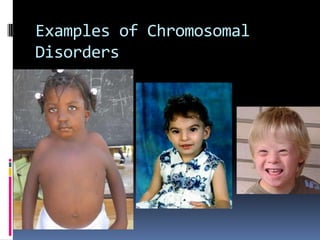
 Examples include Down syndrome or trisomy
  21, Turner syndrome (45,X), Klinefelter syndrome
  (47, XXY) and cri du chat syndrome, or the "cry of
  the cat" syndrome (46, XX or XY, 5p-).
Examples of Chromosomal
Disorders
(4) Mitochondrial

 This relatively rare type of genetic disorder is caused
  by mutations in the nonchromosomal DNA of
  mitochondria.

 Examples of mitochondrial disease include:

   an eye disease called Leber's hereditary optic atrophy;
   a type of epilepsy called MERRF which stands for
    myoclonus epilepsy with Ragged Red Fibers; and
   a form of dementia called MELAS for mitochondrial
    encephalopathy, lactic acidosis and stroke-like episodes
1. velo   introduction

1. velo introduction

  • 1.
    INTRODUCTION TO GENETIC DISORDERS Presented By : Velo, John R. DMD2D
  • 2.
    What is anAllele?  an alternative form of a gene located at a specific position on a specific chromosome.  These DNA codings determine distinct traits that can be passed on from parents to offspring.  May be dominant or recessive  The process by which alleles are transmitted was discovered by Gregor Mendel and formulated in what is known as Mendel's law of segregation.
  • 3.
    Difference between adominant and recessive allele  If the two alleles from both parents are :  Similar : homozygous offsprings  Different : heterozygous  the stronger of the two will show up in the offspring while the weaker one is masked
  • 4.
    Difference between adominant and recessive allele  Dominant Allele  A gene (allele) which is expressed clinically in the heterozygous state  In a dominant disorder, only one mutant allele need be present as it masks the normal allele  Recessive Allele  A gene (allele) which is only expressed clinically in the homozygous state  can be suppressed if present with a dominant gene and will not show it's character in presence of a dominant gene  Recessive alleles or genes will only show up if the offspring inherits recessive copies of the trait from both parents
  • 5.
    Difference between adominant and recessive allele  Dominant genes are usually the ones that are oftentimes observed in an offspring and passed down to subsequent generations while recessive genes will only show for a few generations and eventually disappear.  Dominant genes are represented by capital letters and recessive genes are represented by small letters.  There are three combinations of genotypes or alleles:  AA (receives dominant traits from both parents),  Aa (receives a dominant trait from one parent and a recessive trait from the other), and  aa (receives recessive traits from both parents)
  • 6.
    What is aPunnett Square?  a diagram that is used to predict an outcome of a particular cross or breeding experiment  is visual representation of Mendelian inheritance
  • 7.
    How is atrait transmitted?
  • 8.
    Types of GeneticDisorders :  Genetic disorder - disease caused by abnormalities in an individual’s genetic material (genome).  The four different types of genetic disorders are :  (1) single-gene,  (2) multifactorial,  (3) chromosomal, and  (4) mitochondrial
  • 9.
    (1) Single-gene (Mendelianor monogenic)  caused by changes or mutations that occur in the DNA sequence of one gene.  Genes code for proteins, perform most life functions, and make up the majority of cellular structures. When a gene is mutated, it's protein product can no longer carry out its normal function, a disorder can result.  Some examples are cystic fibrosis, sickle cell anemia, Marfan syndrome, Huntington’s disease, and hereditary hemochromatosis.
  • 10.
    Examples of Single-GeneDisorders B. A. C. A. Marfan’s Syndrome B. Cystic Fibrosis C. Huntington’s Disease
  • 11.
    (2) Multifactorial (complexor polygenic)  caused by a combination of environmental factors and mutations in multiple genes.  Examples include heart disease, high blood pressure, Alzheimer’s disease, arthritis, diabetes, cancer, and obesity  Multifactorial inheritance is also associated with heritable traits such as fingerprint patterns, height, eye color, and skin color.
  • 12.
    (3) Chromosomal  Chromosomes- distinct structures made up of DNA and protein, are located in the nucleus of each cell  Because chromosomes are carriers of genetic material, such abnormalities in chromosome structure as missing or extra copies or gross breaks and rejoinings (translocations) can result in disease.  Examples include Down syndrome or trisomy 21, Turner syndrome (45,X), Klinefelter syndrome (47, XXY) and cri du chat syndrome, or the "cry of the cat" syndrome (46, XX or XY, 5p-).
  • 13.
  • 14.
    (4) Mitochondrial  Thisrelatively rare type of genetic disorder is caused by mutations in the nonchromosomal DNA of mitochondria.  Examples of mitochondrial disease include:  an eye disease called Leber's hereditary optic atrophy;  a type of epilepsy called MERRF which stands for myoclonus epilepsy with Ragged Red Fibers; and  a form of dementia called MELAS for mitochondrial encephalopathy, lactic acidosis and stroke-like episodes