Dr. G. Shanmugavel,
Assistant Professor of Biology ,
Department of HSS,
Puducherry Technological University
Email : shanmugavel.g@ptuniv.edu.in
Genetic disorder
• Disorder or disease is any deviation from the normal structure
and function of the body, which are transmitted from one
generation to next generation are called genetic disorder or
genetically transmitted disease.
• Genetic disorders are congenital disease i.e. disease condition
that occur during intrauterine life.
• Genetic disorder also called as birth defects.
• Genetic disorder caused by changes in the structure or
number of DNA sequence and chromosome mainly due to
mutation.
• It can be caused by a mutation in a single gene (monogenic)
or multiple genes (polygenic) or by a chromosomal
abnormality.
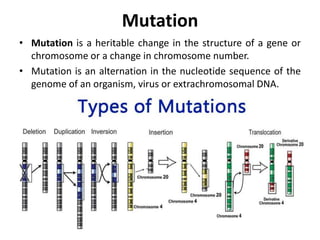
Mutation
• Mutation is a heritable change in the structure of a gene or
chromosome or a change in chromosome number.
• Mutation is an alternation in the nucleotide sequence of the
genome of an organism, virus or extrachromosomal DNA.
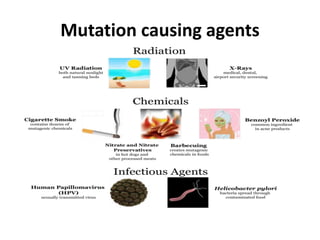
Mutation causing agents
Mutations are categories into of three classes:
Gene mutation
– Changes occurs in the gene (DNA sequence) is
known as gene mutation or point mutation.
Chromosomal mutation
– Structural changes occurs in the chromosome is
called as chromosomal mutation.
Genomic mutations
– Variation in chromosome number of a whole
genome is known as genomic mutations.
Types of genetic disorders
1. Single gene disorder
• Autosomal dominant disorder
• Autosomal recessive disorder
• Sex-linked inheritance
– X linked disorder
– Y linked disorder
2. Multifactorial disorder
3. Chromosome disorder
Single gene inheritance
• Single gene inheritance is also called
Mendelian or monogenetic inheritance.
• Changes or mutations that occur in the DNA
sequence of a single gene cause this type of
inheritance.
• There are thousands of known single-gene
disorders. These disorders are known as
monogenetic disorders (disorders of a single
gene).
Autosomal dominant disorder
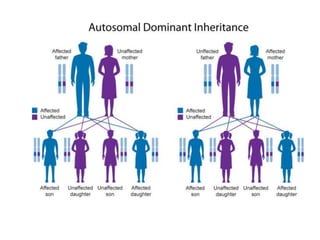
• Autosomal dominant disorders occur when only one
mutated gene in a pair of chromosome is sufficient to
cause disease.
• Mutated genes are dominant over their alleles in this
category of disorders. Such disorders are inherited like
typical Mendelian dominant characters.
• An essential feature of a dominantly inherited disorder
is that it is always present in at least one parent in each
ancestral generation.
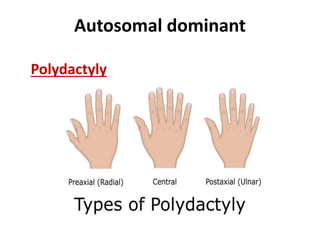
• Some common dominant defective traits are
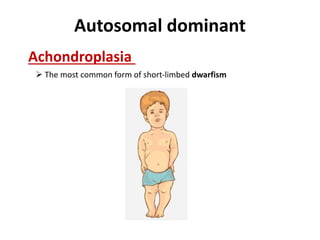
Polydactyly, Achondroplastic dwarfism, Huntington's
chorea and Opalescent teeth.
Autosomal dominant
Polydactyly
Autosomal dominant
Achondroplasia
 The most common form of short-limbed dwarfism
Autosomal recessive disorder
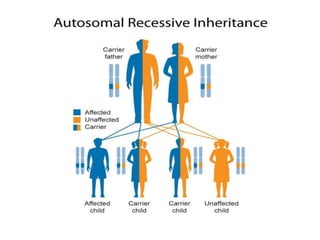
• Both chromosomes in a pair must have a mutated
gene that could cause a genetic disorder.
• If only one chromosome has a mutated gene, the
person is a carrier and does not have symptoms.
• These disorders are expressed only in a
homozygous condition.
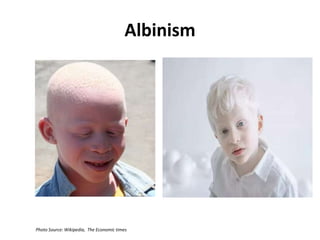
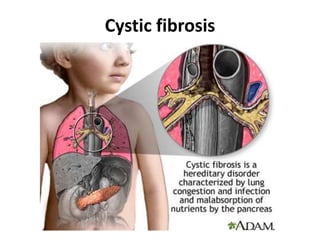
• Major autosomal recessive disorders are Sickle
cell anemia, Phenylketonuria, Albinism,
Tay - Sachs disease, Cystic fibrosis, etc
Albinism
Photo Source: Wikipedia, The Economic times
Cystic fibrosis
Sex-linked disorder
• Disorders caused by mutated genes that are
located in sex chromosomes.
• The pattern of inheritances for sex-linked
differ from autosomal, because male and
female differ in their sex chromosomes.
• Based on the location of mutated gene in sex
chromosome, it classified as X-linked and Y
linked.
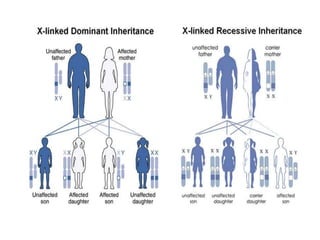
X-linked disorder
• Mutated genes located on the X chromosome cause
determine X-linked disorder.
• X-linked disorders are predominately inherited because
it presence in both the sex (Female - XX; Male - XY).
• X-linked disorders are more common in men than
women due to their X-linked inheritance pattern.
• X-linked disorders are categories into dominant and
recessive traits.
• In human, color blindness, hemophilia, muscular
dystrophy, fragile-X syndrome, etc. are X-linked
disorder.
X-linked disorder
• X-linked dominant disorder
– Fragile-X Syndrome
– Goltz syndrome
– X-linked dominant porphyria
• X-linked recessive disorder
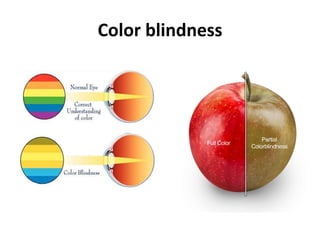
– Color blindness
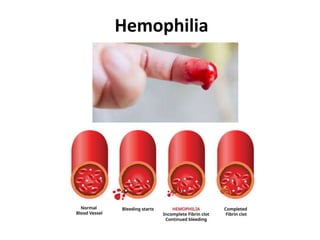
– Hemophilia
– Duchenne muscular dystrophy
Color blindness
Hemophilia
Y-linked disorder
• Mutated genes located on the Y chromosome cause Y-linked
disorder. It is also known as holandric inheritance.
• These disorders are present only in males, because only males
possess a Y chromosome. Thus, it can only pass from father to
son.
• In human, Y-linked disorder
– Hypertrichosis of the ears
– Webbed toes
– Male infertility
Hypertrichosis or hair pinna of the ears
Photo Source: Internet
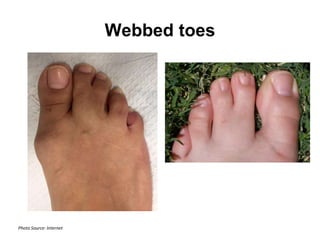
Webbed toes
Photo Source: Internet
Multifactorial disorder
• Multifactorial disorders are caused by a
combination of mutations in multiple genes and
environmental factors.
• It is also called as complex or polygenic disorder.
• The genetic mechanisms underlying these
disorders are not well understood.
• Alzheimer disease, Bipolar disorder, Cleft lip or
palate, Neural tube defects, Diabetes,
hypertension, etc. are multifactorial disorder.
Multifactorial inheritance
• Birth defects such as neural tube defects and cleft palate
• Cancers of the breast, ovaries, bowel, prostate, and skin
• High blood pressure and high cholesterol
• Diabetes
• Alzheimer disease
• Schizophrenia
• Bipolar disorder
• Arthritis
• Osteoporosis
• Skin conditions such as psoriasis, moles, and eczema
• Asthma and allergies
• Multiple sclerosis and other autoimmune disorders
Chromosomal disorder
(Chromosomal abnormality)
• Abnormalities in chromosome number or structure can
result in this disorder.
• This type of abnormality results either loss or addition
of one or more chromosomes.
• It is typically occur due to a problem with cell division,
which leads to euploidy and aneuploidy condition of
chromosome.
• Euploidy is common in plants whereas aneuploidy is
common in animals.
• Examples of chromosomal disorders in humans are
Down syndrome (trisomy 21), Edward’s syndrome
(trisomy 18), Turner syndrome (45, X), Klinefelter
syndrome (47, XXY), etc.
Chromosomal abnormalities
• Down syndrome (trisomy 21)
• 45, X (Turner syndrome)
• 47, XXY (Klinefelter syndrome)
• 47, XYY; and 47, XXX
• The major chromosomal aneuploidies seen in
live-born babies are: trisomy 18; trisomy 13.
References:
• Concepts of Genetics (9th ed.), W. S. Klug, M. R. Cummings, C.
Spencer, C. A. Spencer, and M. A. Palladino, Pearson, 2008.
• Molecular Genetics (Second edition), Stent, G. S.; and Calender,
R. W.H. Freeman and company, Distributed by Satish Kumar Jain
for CBS Publisher.
• Human genetics : concepts and applications. Lewis, Ricki.
(2007). Boston :McGraw-Hill Higher Education.
• Genetics (9th ed.), Verma PS and Agarwal VK (2010). Publisher:
S Chand & Co Ltd.
• Textbook of PUBLIC HEALTH AND HYGIENE, G Shanmugavel
and Binu George (2021). Publisher: Darshan Publishers.
• Textbook of BIOLOGY FOR ENGINEERS, G Shanmugavel (2024).
Publisher: Lambert academic publishing.

Genetic disorder or Genetically transmitted disease

  • 1.
    Dr. G. Shanmugavel, AssistantProfessor of Biology , Department of HSS, Puducherry Technological University Email : shanmugavel.g@ptuniv.edu.in
  • 2.
    Genetic disorder • Disorderor disease is any deviation from the normal structure and function of the body, which are transmitted from one generation to next generation are called genetic disorder or genetically transmitted disease. • Genetic disorders are congenital disease i.e. disease condition that occur during intrauterine life. • Genetic disorder also called as birth defects. • Genetic disorder caused by changes in the structure or number of DNA sequence and chromosome mainly due to mutation. • It can be caused by a mutation in a single gene (monogenic) or multiple genes (polygenic) or by a chromosomal abnormality.
  • 3.
    Mutation • Mutation isa heritable change in the structure of a gene or chromosome or a change in chromosome number. • Mutation is an alternation in the nucleotide sequence of the genome of an organism, virus or extrachromosomal DNA.
  • 4.
  • 5.
    Mutations are categoriesinto of three classes: Gene mutation – Changes occurs in the gene (DNA sequence) is known as gene mutation or point mutation. Chromosomal mutation – Structural changes occurs in the chromosome is called as chromosomal mutation. Genomic mutations – Variation in chromosome number of a whole genome is known as genomic mutations.
  • 6.
    Types of geneticdisorders 1. Single gene disorder • Autosomal dominant disorder • Autosomal recessive disorder • Sex-linked inheritance – X linked disorder – Y linked disorder 2. Multifactorial disorder 3. Chromosome disorder
  • 7.
    Single gene inheritance •Single gene inheritance is also called Mendelian or monogenetic inheritance. • Changes or mutations that occur in the DNA sequence of a single gene cause this type of inheritance. • There are thousands of known single-gene disorders. These disorders are known as monogenetic disorders (disorders of a single gene).
  • 8.
    Autosomal dominant disorder •Autosomal dominant disorders occur when only one mutated gene in a pair of chromosome is sufficient to cause disease. • Mutated genes are dominant over their alleles in this category of disorders. Such disorders are inherited like typical Mendelian dominant characters. • An essential feature of a dominantly inherited disorder is that it is always present in at least one parent in each ancestral generation. • Some common dominant defective traits are Polydactyly, Achondroplastic dwarfism, Huntington's chorea and Opalescent teeth.
  • 9.
  • 10.
    Autosomal dominant Achondroplasia  Themost common form of short-limbed dwarfism
  • 12.
    Autosomal recessive disorder •Both chromosomes in a pair must have a mutated gene that could cause a genetic disorder. • If only one chromosome has a mutated gene, the person is a carrier and does not have symptoms. • These disorders are expressed only in a homozygous condition. • Major autosomal recessive disorders are Sickle cell anemia, Phenylketonuria, Albinism, Tay - Sachs disease, Cystic fibrosis, etc
  • 13.
  • 14.
  • 16.
    Sex-linked disorder • Disorderscaused by mutated genes that are located in sex chromosomes. • The pattern of inheritances for sex-linked differ from autosomal, because male and female differ in their sex chromosomes. • Based on the location of mutated gene in sex chromosome, it classified as X-linked and Y linked.
  • 17.
    X-linked disorder • Mutatedgenes located on the X chromosome cause determine X-linked disorder. • X-linked disorders are predominately inherited because it presence in both the sex (Female - XX; Male - XY). • X-linked disorders are more common in men than women due to their X-linked inheritance pattern. • X-linked disorders are categories into dominant and recessive traits. • In human, color blindness, hemophilia, muscular dystrophy, fragile-X syndrome, etc. are X-linked disorder.
  • 18.
    X-linked disorder • X-linkeddominant disorder – Fragile-X Syndrome – Goltz syndrome – X-linked dominant porphyria • X-linked recessive disorder – Color blindness – Hemophilia – Duchenne muscular dystrophy
  • 19.
  • 20.
  • 22.
    Y-linked disorder • Mutatedgenes located on the Y chromosome cause Y-linked disorder. It is also known as holandric inheritance. • These disorders are present only in males, because only males possess a Y chromosome. Thus, it can only pass from father to son. • In human, Y-linked disorder – Hypertrichosis of the ears – Webbed toes – Male infertility
  • 23.
    Hypertrichosis or hairpinna of the ears Photo Source: Internet
  • 24.
  • 25.
    Multifactorial disorder • Multifactorialdisorders are caused by a combination of mutations in multiple genes and environmental factors. • It is also called as complex or polygenic disorder. • The genetic mechanisms underlying these disorders are not well understood. • Alzheimer disease, Bipolar disorder, Cleft lip or palate, Neural tube defects, Diabetes, hypertension, etc. are multifactorial disorder.
  • 26.
    Multifactorial inheritance • Birthdefects such as neural tube defects and cleft palate • Cancers of the breast, ovaries, bowel, prostate, and skin • High blood pressure and high cholesterol • Diabetes • Alzheimer disease • Schizophrenia • Bipolar disorder • Arthritis • Osteoporosis • Skin conditions such as psoriasis, moles, and eczema • Asthma and allergies • Multiple sclerosis and other autoimmune disorders
  • 27.
    Chromosomal disorder (Chromosomal abnormality) •Abnormalities in chromosome number or structure can result in this disorder. • This type of abnormality results either loss or addition of one or more chromosomes. • It is typically occur due to a problem with cell division, which leads to euploidy and aneuploidy condition of chromosome. • Euploidy is common in plants whereas aneuploidy is common in animals. • Examples of chromosomal disorders in humans are Down syndrome (trisomy 21), Edward’s syndrome (trisomy 18), Turner syndrome (45, X), Klinefelter syndrome (47, XXY), etc.
  • 28.
    Chromosomal abnormalities • Downsyndrome (trisomy 21) • 45, X (Turner syndrome) • 47, XXY (Klinefelter syndrome) • 47, XYY; and 47, XXX • The major chromosomal aneuploidies seen in live-born babies are: trisomy 18; trisomy 13.
  • 29.
    References: • Concepts ofGenetics (9th ed.), W. S. Klug, M. R. Cummings, C. Spencer, C. A. Spencer, and M. A. Palladino, Pearson, 2008. • Molecular Genetics (Second edition), Stent, G. S.; and Calender, R. W.H. Freeman and company, Distributed by Satish Kumar Jain for CBS Publisher. • Human genetics : concepts and applications. Lewis, Ricki. (2007). Boston :McGraw-Hill Higher Education. • Genetics (9th ed.), Verma PS and Agarwal VK (2010). Publisher: S Chand & Co Ltd. • Textbook of PUBLIC HEALTH AND HYGIENE, G Shanmugavel and Binu George (2021). Publisher: Darshan Publishers. • Textbook of BIOLOGY FOR ENGINEERS, G Shanmugavel (2024). Publisher: Lambert academic publishing.