GENETIC CODE AND ITS
CHARACTERISTICS
Presented by:
Mrs. Anjula Chaudhary
Assistant Professor
School of Biosciences
IMS Ghaziabad UC campus
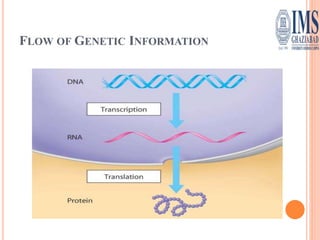
FLOW OF GENETIC INFORMATION
GENETIC CODE
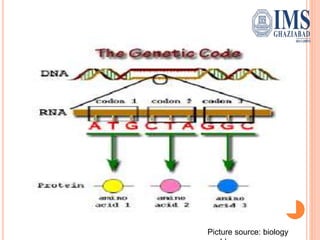
ï‚ą The genetic code may be defined as the exact
sequence of DNA nucleotides read as three letter
words or codons, that determines the sequence of
amino acids in protein synthesis.
or
ï‚ą The genetic code is a set of three-letter
combinations of nucleotides called codons, each of
which corresponds to a specific amino acid or stop
signal.
GENETIC CODE

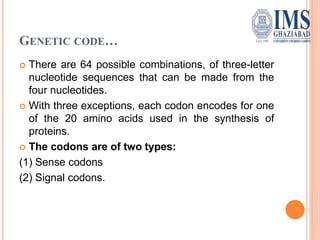
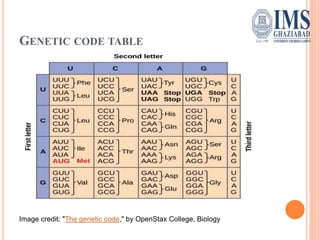
ï‚ą There are 64 possible combinations, of three-letter
nucleotide sequences that can be made from the
four nucleotides.
ï‚ą With three exceptions, each codon encodes for one
of the 20 amino acids used in the synthesis of
proteins.
ï‚ą The codons are of two types:
(1) Sense codons
(2) Signal codons.
GENETIC CODE
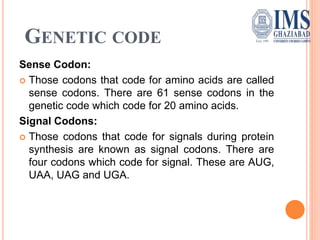
Sense Codon:
ï‚ą Those codons that code for amino acids are called
sense codons. There are 61 sense codons in the
genetic code which code for 20 amino acids.
Signal Codons:
ï‚ą Those codons that code for signals during protein
synthesis are known as signal codons. There are
four codons which code for signal. These are AUG,
UAA, UAG and UGA.
GENETIC CODE
History
ï‚ą The concept of codons was first described by
Francis Crick and his colleagues in 1961.
ï‚ą Marshall Nirenberg and Heinrich Matthaei
performed experiments for deciphering the genetic
code in 1961.
ï‚ą Later on, Nirenberg, Philip Leder, and Gobind
Khorana identified the rest of the genetic code and
fully described each three-letter codon and its
corresponding amino acid.
Picture source: biology
PROPERTIES OF GENETIC CODE
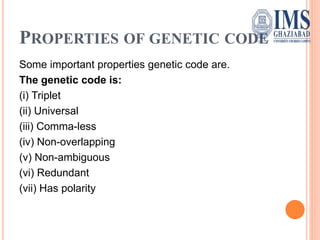
Some important properties genetic code are.
The genetic code is:
(i) Triplet
(ii) Universal
(iii) Comma-less
(iv) Non-overlapping
(v) Non-ambiguous
(vi) Redundant
(vii) Has polarity
GENETIC CODE TABLE
Image credit: "The genetic code," by OpenStax College, Biology
TRIPLET
ï‚ą The genetic code is triplet. The triplet code has 64
codons which are sufficient to code for 20 amino
acids and also for start and stop signals in the
synthesis of polypeptide chain.
ï‚ą Example ..UUU
UNIVERSAL
ï‚ą The universality of genetic code was explained by
Marshall, Caskey and Nirenberg (1967) who found
that E. coli (Bacterium), Xenopus laevis
(Amphibian) and guinea pig (mammal) amino acyl-
tRNA use almost the same code.
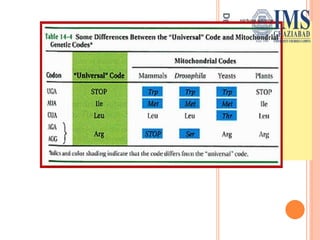
D
EVIATION
FROM
UNIVERSALITY
picture source:
Plant Cell Biology
For Masters
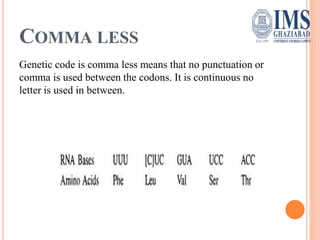
COMMA LESS
Genetic code is comma less means that no punctuation or
comma is used between the codons. It is continuous no
letter is used in between.
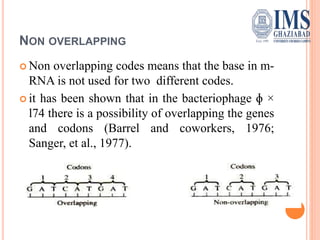
NON OVERLAPPING
ï‚ą Non overlapping codes means that the base in m-
RNA is not used for two different codes.
ï‚ą it has been shown that in the bacteriophage Éž ×
l74 there is a possibility of overlapping the genes
and codons (Barrel and coworkers, 1976;
Sanger, et al., 1977).
UNAMBIGUOUS AND DEGENERATE
Unambiguous nature of the code means that same
codon will code for only one amino acid where
ever it is present.
Degenerate nature of genetic code means that
there is more than one codon for same amino acid
but it will always code for the same amino acid.
Genetic code microbiology molecular biology

Genetic code microbiology molecular biology

  • 1.
    GENETIC CODE ANDITS CHARACTERISTICS Presented by: Mrs. Anjula Chaudhary Assistant Professor School of Biosciences IMS Ghaziabad UC campus
  • 2.
    FLOW OF GENETICINFORMATION
  • 3.
    GENETIC CODE ï‚ą Thegenetic code may be defined as the exact sequence of DNA nucleotides read as three letter words or codons, that determines the sequence of amino acids in protein synthesis. or ï‚ą The genetic code is a set of three-letter combinations of nucleotides called codons, each of which corresponds to a specific amino acid or stop signal.
  • 4.
    GENETIC CODE
 ï‚ą Thereare 64 possible combinations, of three-letter nucleotide sequences that can be made from the four nucleotides. ï‚ą With three exceptions, each codon encodes for one of the 20 amino acids used in the synthesis of proteins. ï‚ą The codons are of two types: (1) Sense codons (2) Signal codons.
  • 5.
    GENETIC CODE Sense Codon: ï‚ąThose codons that code for amino acids are called sense codons. There are 61 sense codons in the genetic code which code for 20 amino acids. Signal Codons: ï‚ą Those codons that code for signals during protein synthesis are known as signal codons. There are four codons which code for signal. These are AUG, UAA, UAG and UGA.
  • 6.
    GENETIC CODE History ï‚ą Theconcept of codons was first described by Francis Crick and his colleagues in 1961. ï‚ą Marshall Nirenberg and Heinrich Matthaei performed experiments for deciphering the genetic code in 1961. ï‚ą Later on, Nirenberg, Philip Leder, and Gobind Khorana identified the rest of the genetic code and fully described each three-letter codon and its corresponding amino acid.
  • 7.
  • 8.
    PROPERTIES OF GENETICCODE Some important properties genetic code are. The genetic code is: (i) Triplet (ii) Universal (iii) Comma-less (iv) Non-overlapping (v) Non-ambiguous (vi) Redundant (vii) Has polarity
  • 9.
    GENETIC CODE TABLE Imagecredit: "The genetic code," by OpenStax College, Biology
  • 10.
    TRIPLET ï‚ą The geneticcode is triplet. The triplet code has 64 codons which are sufficient to code for 20 amino acids and also for start and stop signals in the synthesis of polypeptide chain. ï‚ą Example ..UUU
  • 11.
    UNIVERSAL ï‚ą The universalityof genetic code was explained by Marshall, Caskey and Nirenberg (1967) who found that E. coli (Bacterium), Xenopus laevis (Amphibian) and guinea pig (mammal) amino acyl- tRNA use almost the same code.
  • 12.
  • 13.
    COMMA LESS Genetic codeis comma less means that no punctuation or comma is used between the codons. It is continuous no letter is used in between.
  • 14.
    NON OVERLAPPING ï‚ą Nonoverlapping codes means that the base in m- RNA is not used for two different codes. ï‚ą it has been shown that in the bacteriophage Éž × l74 there is a possibility of overlapping the genes and codons (Barrel and coworkers, 1976; Sanger, et al., 1977).
  • 15.
    UNAMBIGUOUS AND DEGENERATE Unambiguousnature of the code means that same codon will code for only one amino acid where ever it is present. Degenerate nature of genetic code means that there is more than one codon for same amino acid but it will always code for the same amino acid.