Strategic
Planning
For ___Planning Unit___
9/24/2015 1
9/24/2015
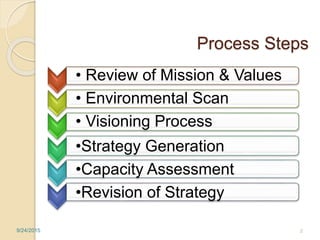
Process Steps
2
• Review of Mission & Values
• Environmental Scan
• Visioning Process
•Strategy Generation
•Capacity Assessment
•Revision of Strategy
9/24/2015
Review Mission & Values
“Organization as a Catholic liberal arts
college, creates a community of active
learners, reflective thinkers, ethical
decision-makers, and responsible
contributors in diverse professional,
social, and religious roles.”
3
9/24/2015
Values
Catholic Identity Statement
4
9/24/2015
What is Spiritual Life’s Current Mission?
Inspired by Catholic Tradition we
help realize the spiritual potential of
all persons.
5
9/24/2015
What is the Current Vision of Campus
Spiritual Life?
Spiritual Life at organization invites personal
transformation through a deeper understanding of the
Gospel of Jesus Christ. The Gospel, coupled with our
faith tradition, is the lens through which we view our
baptismal call, personal giftedness, and relationships.
Through personal transformation we seek to deepen
both our understanding and integration of our faith
tradition, and our commitment to spiritual growth through
the challenge and support of community.
6
9/24/2015
What is the Current Vision of Campus Spiritual
Life?
The context of Spiritual Life at Organization
emphasizes openness to understanding the breadth
and depth of the Catholic faith tradition through our
vision of church (ecclesiology), our personal
relationship with God (spirituality), our understanding
and articulation of the teaching of the Church
(theology), and our service to the world.
7
9/24/2015
Current Strategic Themes
 Forming the Faith Community
 Appropriating the Faith
 Forming the Christian Conscience
 Educating for Justice
 Facilitating Personal Development
 Developing Leaders for the Future
8
9/24/2015
Environmental Scan
 Future Trend Analysis
 Not limited to Competitive
Marketplace
 Anticipates needs of target
populations
“Given our mission & values, what is the
“best guess” picture of the future
environment for our organization in the 9
9/24/2015
Trend Areas
 Technology
 Education Trends
 Socio-Cultural Change
 Demographics
 Legislation/Government Action
 Geo-political
10
9/24/2015
Technological Trends
 Web 3D– Virtual Worlds—the
Metaverse
 Rise of Social Networking
 Google is the library
 E-books, not textbooks
 Rise of Mobile Platform, Smart-
Phones, etc.
 More courses on the internet (ÜDÜTÜ)
 “Green” Campus initiatives
11
9/24/2015
Technological Trends
 “Green” also means less paper, more
digital.
 More Geo-tagging and location based
service delivery
 Video content of everything in and
around the learning environment
 New course management platforms
 Learning Objects, SCORM & LCMS
 Need for greater information security
12
9/24/2015
Technological Trends
 Increased use of Nano technology
and robotics
 Smart Robots; Artificial Intelligence
matures
 Japan & its neighbors will dominate
the next phase in internet growth.
13
9/24/2015
Economic Trends
 Lower enrollments, mean less money for capital
investments
 Anticipate multiple years of negative budget growth
 Influx of “Big Science” Federal Grants on
Campuses
 Shift from oil-based to knowledge-based economy
 Talent shortages will undermine the new economy
14
9/24/2015
Educational Trends
 Peer –to-Peer Learning
 Simulation & Gaming
 Growing potential for an “Open University” platform
online
 Virtual Education increases (Teachers identified as
the critical path limiter on delivery)
15
9/24/2015
Educational Trends
Former MIT President Charles Vests suggested that, as
early as 2006 …
“…a meta-university would be ‘a
transcendent, accessible,
empowering, dynamic, communally
constructed framework of open
materials and platforms on which
much of higher education worldwide
can be constructed or enhanced.”
16
9/24/2015
Socio Cultural Trends
 Emphasis on “green” systems & sustainability
 Changes in family structures
 Globalization. The world becomes smaller and
more diverse
 Knowledge Work requires greater Knowledge
Management
 Global Access
17
9/24/2015
Socio Cultural Trends
 Telemedicine
 Increased use of artificial organs
 Cancer cure
 Life extension (could approach 120
yrs by 2030)
 Hybrid fuel-cell cars
 Automated highways
18
9/24/2015
Socio Cultural Trends
 Hypersonic planes
 Space tourism
 Moon colony & humans on Mars
 Number of US jobs filled by
telecommuters could grow fourfold to 19
million by 2012
 First synthetic cells distributed for public
use
19
9/24/2015
Demographics
 Pop. Of US will rise to 438 million in 2050
 82% of increase will be due to immigration
 Nearly 1 in 5 Americans will be an immigrant in 2050
 Latino population will triple in size & account for most
of US population growth
 Non-Hispanic population to increase more slowly
 Whites become a minority (47%) by 2050
20
9/24/2015
Demographics
 Adults aged 100 or older are a fast-growing
population group
 Nation’s elderly population will more than double
in size from now to 2050
 US Senior Citizens postponing retirement
 Dependency Ratio (number of children & elderly
per 100 adults of working age) will rise to 72
dependents per 100 adults of working age by
2050
21
9/24/2015
Legislative Trends
 Small governments will eclipse big governments as
a threat to privacy/liberty
 Power & Influence will shift away from the US and
toward Asia by 2025
 Consumption of goods in the US will return to
historically normal levels as the millennial
generation comes of age
22
9/24/2015
Geo-political Trends
 Increase in alternative fuels, e.g. hydrogen
 Increased needs for access to fresh water
(desalination)
 Precision farming: Computerized control of
irrigation, seed fertilization & pesticide application
based on GPS-specific needs
 Increased us of Biometrics to control security and
prevent identity theft
23
9/24/2015
Identify Significant trends
• Write down 5 trends you believe will have the
greatest impact on your work
• Share choices
• Set priorities
• Use these as a backdrop for visioning exercise
24
9/24/2015
Visioning
 No Limits (No self-editing)
 The Bigger the Better (Big Hairy Audacious
Goals)
 Rule: If you can dream it; you can do it
 Engaging
 Beyond your wildest expectations
 Clear & Palpable (Visual or Graphic)
 Memorable
25
9/24/2015
New Zealand Ministry of Education
26
9/24/2015
Nike’s Vision Statement
"To bring inspiration and innovation to every
athlete* in the world"
* If you have a body, you are an athlete.
27
Ikea’s Vision Statement
“Affordable solutions for better living”
Heinz’ Vision Statement
“To be the world's premier food company,
offering nutritious, superior tasting foods to
people everywhere."
9/24/2015
Visioning Scenario
It’s 2015 and you are at a reception in honor of your
team. It is attended by television, magazine ,and
newspaper reporters. There are tables with copies of
the Chronicle of Higher Education, the New York
Times and the Washington Post. There are awards
and citations on the tables. Each article and citation
talks about the amazing success of your innovative
team and the contribution they have made, not just to
the college, but to colleges everywhere.
28
9/24/2015
Strategy Generation
 Identify major goals from vision
 Generate new strategies to get you
from “here” to “there”
 Organize into Strategic “Themes”
or “Planks”
29
9/24/2015
List of New Strategies/Services
New Services/Strategies
30
9/24/2015
Capacity Assessment
 List current projects, deliverables,
and services:
◦ Who are your target audiences?
◦ For each audience, what do you deliver?
 List new projects, deliverables and services from
new strategic initiatives
 Rate each item on the list on capacity and
importance to implementation of the strategic
plan.
31
9/24/2015
Customer/Service Matrix
Customer
Service
Students Customer
2
Customer
3
Customer
4
Service 1 Service
Work
Service 2
Service 3
Service 4
Service 5
Service 6
Service 7
32
9/24/2015
Boston Consulting Group’s Approach to SWOT
33
Strategy G C
1. Add staff H H
2. New Service L H
3. Expand H L
4. Overseas L L
5. Self Service H H
6. New Course L H
7. Acquisition H L
5
1
4
3
7
2
6
9/24/2015
Boston Consulting Group’s Approach to SWOT
34
Question Mark:
(Set a time limit and
amount of money to
attempt to turn the
question mark into a
star.)
Hitch Your Wagon To
The Star
Shoot The Dog :
(It drags you down.)
Milk the Cash Cow:
(Invest the profits
elsewhere)
9/24/2015
Review & Revise Strategy
 Add strategies to build capacity, where
needed or to evaluate the “Question
Marks”
 Communicate results of process and
gather feedback and gain adherents
 Review & revise priorities based on
assessment
35

Generic strategic planning process

  • 1.
  • 2.
    9/24/2015 Process Steps 2 • Reviewof Mission & Values • Environmental Scan • Visioning Process •Strategy Generation •Capacity Assessment •Revision of Strategy
  • 3.
    9/24/2015 Review Mission &Values “Organization as a Catholic liberal arts college, creates a community of active learners, reflective thinkers, ethical decision-makers, and responsible contributors in diverse professional, social, and religious roles.” 3
  • 4.
  • 5.
    9/24/2015 What is SpiritualLife’s Current Mission? Inspired by Catholic Tradition we help realize the spiritual potential of all persons. 5
  • 6.
    9/24/2015 What is theCurrent Vision of Campus Spiritual Life? Spiritual Life at organization invites personal transformation through a deeper understanding of the Gospel of Jesus Christ. The Gospel, coupled with our faith tradition, is the lens through which we view our baptismal call, personal giftedness, and relationships. Through personal transformation we seek to deepen both our understanding and integration of our faith tradition, and our commitment to spiritual growth through the challenge and support of community. 6
  • 7.
    9/24/2015 What is theCurrent Vision of Campus Spiritual Life? The context of Spiritual Life at Organization emphasizes openness to understanding the breadth and depth of the Catholic faith tradition through our vision of church (ecclesiology), our personal relationship with God (spirituality), our understanding and articulation of the teaching of the Church (theology), and our service to the world. 7
  • 8.
    9/24/2015 Current Strategic Themes Forming the Faith Community  Appropriating the Faith  Forming the Christian Conscience  Educating for Justice  Facilitating Personal Development  Developing Leaders for the Future 8
  • 9.
    9/24/2015 Environmental Scan  FutureTrend Analysis  Not limited to Competitive Marketplace  Anticipates needs of target populations “Given our mission & values, what is the “best guess” picture of the future environment for our organization in the 9
  • 10.
    9/24/2015 Trend Areas  Technology Education Trends  Socio-Cultural Change  Demographics  Legislation/Government Action  Geo-political 10
  • 11.
    9/24/2015 Technological Trends  Web3D– Virtual Worlds—the Metaverse  Rise of Social Networking  Google is the library  E-books, not textbooks  Rise of Mobile Platform, Smart- Phones, etc.  More courses on the internet (ÜDÜTÜ)  “Green” Campus initiatives 11
  • 12.
    9/24/2015 Technological Trends  “Green”also means less paper, more digital.  More Geo-tagging and location based service delivery  Video content of everything in and around the learning environment  New course management platforms  Learning Objects, SCORM & LCMS  Need for greater information security 12
  • 13.
    9/24/2015 Technological Trends  Increaseduse of Nano technology and robotics  Smart Robots; Artificial Intelligence matures  Japan & its neighbors will dominate the next phase in internet growth. 13
  • 14.
    9/24/2015 Economic Trends  Lowerenrollments, mean less money for capital investments  Anticipate multiple years of negative budget growth  Influx of “Big Science” Federal Grants on Campuses  Shift from oil-based to knowledge-based economy  Talent shortages will undermine the new economy 14
  • 15.
    9/24/2015 Educational Trends  Peer–to-Peer Learning  Simulation & Gaming  Growing potential for an “Open University” platform online  Virtual Education increases (Teachers identified as the critical path limiter on delivery) 15
  • 16.
    9/24/2015 Educational Trends Former MITPresident Charles Vests suggested that, as early as 2006 … “…a meta-university would be ‘a transcendent, accessible, empowering, dynamic, communally constructed framework of open materials and platforms on which much of higher education worldwide can be constructed or enhanced.” 16
  • 17.
    9/24/2015 Socio Cultural Trends Emphasis on “green” systems & sustainability  Changes in family structures  Globalization. The world becomes smaller and more diverse  Knowledge Work requires greater Knowledge Management  Global Access 17
  • 18.
    9/24/2015 Socio Cultural Trends Telemedicine  Increased use of artificial organs  Cancer cure  Life extension (could approach 120 yrs by 2030)  Hybrid fuel-cell cars  Automated highways 18
  • 19.
    9/24/2015 Socio Cultural Trends Hypersonic planes  Space tourism  Moon colony & humans on Mars  Number of US jobs filled by telecommuters could grow fourfold to 19 million by 2012  First synthetic cells distributed for public use 19
  • 20.
    9/24/2015 Demographics  Pop. OfUS will rise to 438 million in 2050  82% of increase will be due to immigration  Nearly 1 in 5 Americans will be an immigrant in 2050  Latino population will triple in size & account for most of US population growth  Non-Hispanic population to increase more slowly  Whites become a minority (47%) by 2050 20
  • 21.
    9/24/2015 Demographics  Adults aged100 or older are a fast-growing population group  Nation’s elderly population will more than double in size from now to 2050  US Senior Citizens postponing retirement  Dependency Ratio (number of children & elderly per 100 adults of working age) will rise to 72 dependents per 100 adults of working age by 2050 21
  • 22.
    9/24/2015 Legislative Trends  Smallgovernments will eclipse big governments as a threat to privacy/liberty  Power & Influence will shift away from the US and toward Asia by 2025  Consumption of goods in the US will return to historically normal levels as the millennial generation comes of age 22
  • 23.
    9/24/2015 Geo-political Trends  Increasein alternative fuels, e.g. hydrogen  Increased needs for access to fresh water (desalination)  Precision farming: Computerized control of irrigation, seed fertilization & pesticide application based on GPS-specific needs  Increased us of Biometrics to control security and prevent identity theft 23
  • 24.
    9/24/2015 Identify Significant trends •Write down 5 trends you believe will have the greatest impact on your work • Share choices • Set priorities • Use these as a backdrop for visioning exercise 24
  • 25.
    9/24/2015 Visioning  No Limits(No self-editing)  The Bigger the Better (Big Hairy Audacious Goals)  Rule: If you can dream it; you can do it  Engaging  Beyond your wildest expectations  Clear & Palpable (Visual or Graphic)  Memorable 25
  • 26.
  • 27.
    9/24/2015 Nike’s Vision Statement "Tobring inspiration and innovation to every athlete* in the world" * If you have a body, you are an athlete. 27 Ikea’s Vision Statement “Affordable solutions for better living” Heinz’ Vision Statement “To be the world's premier food company, offering nutritious, superior tasting foods to people everywhere."
  • 28.
    9/24/2015 Visioning Scenario It’s 2015and you are at a reception in honor of your team. It is attended by television, magazine ,and newspaper reporters. There are tables with copies of the Chronicle of Higher Education, the New York Times and the Washington Post. There are awards and citations on the tables. Each article and citation talks about the amazing success of your innovative team and the contribution they have made, not just to the college, but to colleges everywhere. 28
  • 29.
    9/24/2015 Strategy Generation  Identifymajor goals from vision  Generate new strategies to get you from “here” to “there”  Organize into Strategic “Themes” or “Planks” 29
  • 30.
    9/24/2015 List of NewStrategies/Services New Services/Strategies 30
  • 31.
    9/24/2015 Capacity Assessment  Listcurrent projects, deliverables, and services: ◦ Who are your target audiences? ◦ For each audience, what do you deliver?  List new projects, deliverables and services from new strategic initiatives  Rate each item on the list on capacity and importance to implementation of the strategic plan. 31
  • 32.
    9/24/2015 Customer/Service Matrix Customer Service Students Customer 2 Customer 3 Customer 4 Service1 Service Work Service 2 Service 3 Service 4 Service 5 Service 6 Service 7 32
  • 33.
    9/24/2015 Boston Consulting Group’sApproach to SWOT 33 Strategy G C 1. Add staff H H 2. New Service L H 3. Expand H L 4. Overseas L L 5. Self Service H H 6. New Course L H 7. Acquisition H L 5 1 4 3 7 2 6
  • 34.
    9/24/2015 Boston Consulting Group’sApproach to SWOT 34 Question Mark: (Set a time limit and amount of money to attempt to turn the question mark into a star.) Hitch Your Wagon To The Star Shoot The Dog : (It drags you down.) Milk the Cash Cow: (Invest the profits elsewhere)
  • 35.
    9/24/2015 Review & ReviseStrategy  Add strategies to build capacity, where needed or to evaluate the “Question Marks”  Communicate results of process and gather feedback and gain adherents  Review & revise priorities based on assessment 35

Editor's Notes

  • #2 1
  • #3 There are many ways to do strategic planning, but these steps represent “best-practice”. The first five steps are fairly standard. In this case, we’ll need spend some time identifying and mapping core processes and in clarifying roles, duties and tasks in order to focus on development of a unit structure that will be most appropriate to delivering the products and services that are most critical to IT’s functioning.
  • #4 The mission is the core purpose of the organization and the values guide the methods and choices by which that mission is accomplished. It is the “what” and the “how”. A mission statement should be: visionary; broad (enough to be sustainable over time); realistic; motivational; short and concise; and easily understood. It should be “memorable”. For example: Microsoft’s first Mission statement was: “Windows on every desktop.” It was later changed to “to enable people and businesses throughout the world to realize their full potential”. "McDonald's: “to be the world's best quick service restaurant experience. Being the best means providing outstanding quality, service, cleanliness, and value, so that we make every customer in every restaurant smile." Levi-Straus: "We will market the most appealing and widely worn casual clothing in the world. We will clothe the world." Anheuser Busch: “Be the world's beer company. Through all of our products, services and relationships, we will add to life's enjoyment.” Ford (Early 1900s): “Democratize the automobile” Heinz: “… to be "The world's premier food company, offering nutritious, superior tasting foods to people everywhere.“ What are the key elements in Loras College’s Mission? To create a community of: Active learners Reflective thinkers Ethical decision-makers and Responsible contributors
  • #5 For Loras, the Catholic Identity Statement is a public acknowledgement of the college’s core values. (Handout Statement). Let’s discuss the five values and make sure we understand what they imply for us. Promote critical inquiry & academic conversations that includes varied voices Reverence the spirituality if each person Recognize the importance of personal and communal worship Welcome the responsibility to serve Advocate respect for diversity
  • #6 IT has it’s own mission statement. What are it’s key elements? Dedicated to: Providing decisive, positive and informed direction & support Creating and maintaining an intellectual, active & ethical computing environment What does this mean to you? Is it still a viable statement? Is the core purpose of the organization clear? Does the statement effectively guide your decision making about the kind of work that IT should do? Is it visionary; broad (enough to be sustainable over time); realistic; motivational; short and concise; easily understood, or “memorable”? Are there any suggestions for change?
  • #7 Vision is to be an enabling force? How are we doing on bringing new capabilities to the learning environment? Do you feel that IT has been a leader? Has IT kept up with technology? What is the technology in service of? What is the “enabling force” enabling? We may not be able to answer these questions until we conduct our environmental scan. Let’s start there. First let’s discuss what an environmental scan is.
  • #8 Vision is to be an enabling force? How are we doing on bringing new capabilities to the learning environment? Do you feel that IT has been a leader? Has IT kept up with technology? What is the technology in service of? What is the “enabling force” enabling? We may not be able to answer these questions until we conduct our environmental scan. Let’s start there. First let’s discuss what an environmental scan is.
  • #10 An environmental scan is a future trend analysis, usually considering trends in the following areas: Demographics (especially for Target Populations) Technology Economic Business Trends (Marketplace) Legal & Regulatory Changes Trends in Higher Education Socio-Cultural Trends Geopolitical Trends Ecological Trends The planning group then considers the potential impact of these trends on the populations that the organization serves. They are trying to answer the question, “Given our mission & values, what is the “best guess” picture of the future environment for our organization in the next 2, 5 or 10 years.” These ideas about impacts and issues will help in the development of strategies designed to sustain the organization through environmental changes.
  • #11 `
  • #26 A vision needs to be so exciting that everyone in the organization can see the future and is anxious to get there. It needs to be tangible (palpable), so that it is as memorable and specific as possible (videos, graphics, etc.). It should be a room that is well furnitured and decorated. Create images of possibility Give voice to a preferred future Affirm the best of what could be Describe aspirations rather than “musts” Many neglect this step and vision statements sound like mission statements. An aspirational and engaging vision is the force that drives alignment. People will come together and sacrifice in order to be part of a monumental achievement. They want to be able to say that they were part of the team that made _____ happen.” They seek “worthy work”.
  • #29 What did you do to achieve this acclaim? What are the headlines? What questions are the interviewers asking? What are the awards for?
  • #30 The goal of assessing the capacity of the organization to achieve it’s mission is to determine whether new strategies are needed, resources need to be reallocated, or strategies eliminated. Once the vision is established, planners should generate strategies designed to implement the vision—to get from “here” to “there”. They should be able to assess those strategies on two variables: It’s strategic importance relative to the overall plan and the organization’s ability or “capacity” to implement and sustain the strategy.
  • #34 Once you’ve listed each strategy, the planning team makes a cumulative judgment about the initiative’s relative strategic importance or growth potential and the organization’s capacity to be successful in achieving that strategy based on existing financial, human and intellectual capital.
  • #35 Given the scoring, a determination can be made about what to do with a particular strategy.
  • #36 Add strategies to build capacity, where needed or to evaluate the “Question Marks”. Once you have a solid “draft” plan, it and the information used to develop the plan should be disseminated to the stakeholder groups for feedback and new input. Stakeholders must have an opportunity to buy into the vision and strategy. It’s also important for leadership to Communicate results of process and gather feedback and gain enthusiastic adherents. Feedback gathering and requests for input must be genuine and taken seriously. Then the plan should be revised to incorporate these new ideas. It should then be redistributed to communicate the fact that the input was considered and incorporated as appropriate. Review & revise priorities based on assessment