

Return on Investment for
 Training and Development

LOCATING THE BOTTOM LINE


                Gloria Regalbuto Bentley, Ph.D.
Overview


 What’s your motivation?
 Who’s responsibility is it, anyway?
 The “Front-end” of “Front-end” Analysis
 Negotiate Learning and Performance
  Objectives
 Use Existing Metrics
 Maybe it’s not ROI; it’s ROM
What’s your motivation?


 Feeling Defensive?
 What are you measuring?
 Competence Assessment?
 Other Goals?
 Are there things you
 shouldn’t measure?
What’s your motivation?


Feeling Defensive?
 Importance of ROI
 Defending Existence
 Other Options:
  Full Cost of Training &
   Development
  Cost of Management

  Use Capital Asset Budgeting
   Model
What’s your motivation?

What are you measuring?
 Kirkpatrick’s 4 levels:
 1.   Intervention Quality
 2.   Acquisition
 3.   Application
 4.   Organizational Payoff
 Social Contribution-(R.
  Kaufman)
 Success-Case Evaluation (R.
  Brinkerhoff)
What’s your motivation?


Competence Assessment?
 Talent or Performance
  Management System
 % Competence Attained
What’s your motivation?


Other Goals?
 Compliance & Certification
 “Fetch” Competency
 “Networking”
 The CEO wants it…
What’s your motivation?

Are there things you
shouldn’t measure?
 Jobs requiring high levels of
  expertise
 Jobs requiring high levels of
  discretionary decision-making
 Jobs with idiosyncratic,
  unique, or unrepeatable output
Who’s responsibility is it, anyway?


               Do you have control
                over application?
               What is the supervisor’s
                role?
               If you take
                responsibility, do you
                cause supervisors to
                abdicate theirs?
The “Front-end” of “Front-end” Analysis

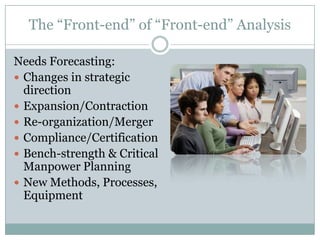
Needs Forecasting:
 Changes in strategic
  direction
 Expansion/Contraction
 Re-organization/Merger
 Compliance/Certification
 Bench-strength & Critical
  Manpower Planning
 New Methods, Processes,
  Equipment
Negotiate Learning and Performance Objectives

 Through Job & Task Analysis, target performance
  objectives linked to improved performance
 Measure the value of improved output, e.g.:
 o   Increased Output Volume
 o   Reduced Scrap or Waste
 o   Reduced Labor Hours
 o   Reduced Machine Maintenance
 o   Reduced Turnover/Increased Retention
 o   Increased Sales
 o   New “Big Data” Technologies (e.g. sensors, GPS, etc.)
Use Existing Metrics

New Metrics:
 Require new infrastructure
 Sustained tracking overtime
 Must be anchored in the
  workflow
 Incurs new labor costs
 Requires time to gain
  credibility
Maybe it’s not ROI; it’s ROM


             Change in cultural ethos
             Accomplishment of vision &
              mission
             Creation of good-will and/or
              customer satisfaction
             Visible adherence to stated
              values and ethics
             Societal Impact and
              Corporate Citizenship (Roger
              Kaufman’s #5)
Q&A: Discussion


     Any questions related to
     the presentation?

     What’s your personal
     experience?

     Are you working on
     anything right now that
     discussion might help?

Return on Investment for Training and Development

  • 1.
    Return on Investmentfor Training and Development LOCATING THE BOTTOM LINE Gloria Regalbuto Bentley, Ph.D.
  • 2.
    Overview  What’s yourmotivation?  Who’s responsibility is it, anyway?  The “Front-end” of “Front-end” Analysis  Negotiate Learning and Performance Objectives  Use Existing Metrics  Maybe it’s not ROI; it’s ROM
  • 3.
    What’s your motivation? Feeling Defensive?  What are you measuring?  Competence Assessment?  Other Goals?  Are there things you shouldn’t measure?
  • 4.
    What’s your motivation? FeelingDefensive?  Importance of ROI  Defending Existence  Other Options:  Full Cost of Training & Development  Cost of Management  Use Capital Asset Budgeting Model
  • 5.
    What’s your motivation? Whatare you measuring?  Kirkpatrick’s 4 levels: 1. Intervention Quality 2. Acquisition 3. Application 4. Organizational Payoff  Social Contribution-(R. Kaufman)  Success-Case Evaluation (R. Brinkerhoff)
  • 6.
    What’s your motivation? CompetenceAssessment?  Talent or Performance Management System  % Competence Attained
  • 7.
    What’s your motivation? OtherGoals?  Compliance & Certification  “Fetch” Competency  “Networking”  The CEO wants it…
  • 8.
    What’s your motivation? Arethere things you shouldn’t measure?  Jobs requiring high levels of expertise  Jobs requiring high levels of discretionary decision-making  Jobs with idiosyncratic, unique, or unrepeatable output
  • 9.
    Who’s responsibility isit, anyway?  Do you have control over application?  What is the supervisor’s role?  If you take responsibility, do you cause supervisors to abdicate theirs?
  • 10.
    The “Front-end” of“Front-end” Analysis Needs Forecasting:  Changes in strategic direction  Expansion/Contraction  Re-organization/Merger  Compliance/Certification  Bench-strength & Critical Manpower Planning  New Methods, Processes, Equipment
  • 11.
    Negotiate Learning andPerformance Objectives  Through Job & Task Analysis, target performance objectives linked to improved performance  Measure the value of improved output, e.g.: o Increased Output Volume o Reduced Scrap or Waste o Reduced Labor Hours o Reduced Machine Maintenance o Reduced Turnover/Increased Retention o Increased Sales o New “Big Data” Technologies (e.g. sensors, GPS, etc.)
  • 12.
    Use Existing Metrics NewMetrics:  Require new infrastructure  Sustained tracking overtime  Must be anchored in the workflow  Incurs new labor costs  Requires time to gain credibility
  • 13.
    Maybe it’s notROI; it’s ROM  Change in cultural ethos  Accomplishment of vision & mission  Creation of good-will and/or customer satisfaction  Visible adherence to stated values and ethics  Societal Impact and Corporate Citizenship (Roger Kaufman’s #5)
  • 14.
    Q&A: Discussion  Any questions related to the presentation?  What’s your personal experience?  Are you working on anything right now that discussion might help?

Editor's Notes

  • #5 Feeling Defensive?Assumes ROI is the important thing?If you are looking to defend your existence, the problem isn’t going to be solved with ROI.Lack of understanding of investments in human capitalLack of understanding of talent and performance management as integrated systems to ensure performance against strategic vision and objectives.That being said, there are ways to defend your existence…Calculate full cost of training, including professional development seminars, travel, consultants, across the corporation. Someone needs to be managing this.Calculate the full cost of management (Sum of Management Salaries). Who’s protecting that investment?Establish a Capital Asset Budget Model for T&D:Assess functional needsSubmit budgets central with justificationAllow Executives review and approve through the budget-cycle, based on relative importance to the strategic vision/plan.
  • #6 What are you measuring? (Kirkpatrick’s 4 levels=1: Quality of the intervention (learning materials); 2: Acquisition; 3: Application; 4: Organizational Payoff Immediate answer is 4: organizational payoff, but do you have control over application? Do you have control over supervisor’s? 5: Social Contribution (Roger Kaufman’s)“Success-case” Evaluation (Robert Brinkerhoff) is about sustained performance
  • #7 Does your organization care about competence (building up its human capital investment)Talent management systems require measure of “capacity for growth” in order to determine who to invest in as “high-potentials” and build bench-strengthDo you hold supervisors accountable for “% competence attained”?
  • #8 Other Goals?What about training for compliance? Certification?What about investments in the future (Fetch competencies)?What’s the value of “networking” for expert workers?The CEO wants it…
  • #9 Are there things you shouldn’t measure?Jobs requiring high levels of expertiseJobs with high levels of discretionary decision-makingJobs with idiosyncratic, unique, or unrepeatable outputDifficult to measure the value of non-repeatable output and probably not worth the cost in dollars or labor.