International Marketing
15th edition
Philip R. Cateora, Mary C. Gilly, and John L. Graham
McGraw-Hill/Irwin Copyright © 2011 by The McGraw-Hill Companies, Inc. All rights reserved.
4
Chapter Objectives
At the end of this topic, students are expected to
understand the following:
• The importance of culture to an international
marketer
• Definition and origins of culture
• The elements of culture
• The impact of cultural change and cultural
borrowing
• Strategies of planned and unplanned change
Roy Philip 4-2
4
Introduction (1 of 2)
• Culture is pertinent to the study of international
marketing.
• Culture is pervasive in all marketing activities –
pricing, promotions, channels of distributions,
product, packaging and styling.
• The priority of needs and wants and the manner
in which they are satisfied are functions of
culture that eventually dictate styles of living.
• Markets constantly change and markets and
market behavior are part of a country’s culture.
Roy Philip 4-3
4
Introduction (2 of 2)
• One cannot truly understand how markets
evolve or how they react to a marketer’s effort
without appreciating that markets are a result of
culture.
• In fact, markets are a result of the three-way
interaction of a marketer’s efforts, economic
conditions, and all other elements of the culture.
• Marketers are constantly adjusting their efforts
to cultural demands of the market, but they are
also acting as “agents of change” whenever the
product or idea being marketed is innovative.
Roy Philip 4-4
4Definitions and
Origins of Culture
• Traditional definition of culture
– Culture is the sum of the values, rituals, symbols,
beliefs, and thought processes that are learned,
shared by a group of people, and transmitted
from generation to generation.
• Individuals learn culture in three ways
– Socialization (growing up)
– Acculturation (adjusting to a new culture)
– Application (decisions about consumption and
production)
Roy Philip 4-5
4
Geography
• Exercises a profound control
– Includes climate, topography, flora, fauna, and
microbiology
– Influenced history, technology, economics, social
institutions and way of thinking
Roy Philip 4-6
4
History
• History - Impact of specific events can be seen
reflected in technology, social institutions, cultural
values, and even consumer behavior
Roy Philip 4-7
4Political Economy and
Technology
• Political Economy - Three approaches to governance
competed for world dominance
– Fascism
– Communism
– Democracy/free enterprise
• Technology
– Jet aircraft, air conditioning, televisions, computers,
Internet, etc.
– None more important than the birth control pill
– Although America has the best healthcare technology,
people in many countries have greater longevity;
lifestyle choices are important
Roy Philip 4-8
4
Social Institutions (1 of 4)
• Family
• Religion
• School
• The media
• Government
• Corporations
Roy Philip 4-9
4
Social Institutions (2 of 4)
• Family
– Nepotism
– Role of extended family
– Favoritism of boys in some cultures
– Gender equality is changing
• Religion - Major Religions
– First institution infants are exposed to outside the
home
– Impact of values systems
– Misunderstanding of beliefs
– An American women jailed in Saudi Arabia for sitting
with man at Starbucks
Next
Roy Philip 4-10
4
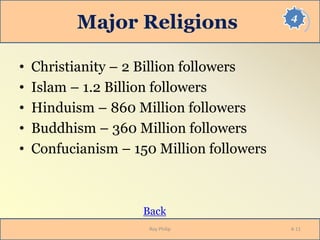
Major Religions
• Christianity – 2 Billion followers
• Islam – 1.2 Billion followers
• Hinduism – 860 Million followers
• Buddhism – 360 Million followers
• Confucianism – 150 Million followers
Back
Roy Philip 4-11
4
Social Institutions (3 of 4)
• School – the most important social institution
– Direct link between a nation’s literacy rate and its
economic development
– Difficult to communicate with a market when a
company must depend on symbols and pictures
• The media – it has replaced family time
• TV and the Internet
• American educational system produces a lower
percentage of college graduates than 12 other
countries including Russia, Japan, and France
Roy Philip 4-12
4
Social Institutions (4 of 4)
• Government - influences the thinking and
behaviors of adult citizens
– Propaganda through media
– Passage, promulgation, promotion, and
enforcement of laws
• Corporations - most innovations are introduced
to societies by companies
– Spread through media
– Change agents
Roy Philip 4-13
4
Elements of Culture (1 of 4)
• Values
• Rituals
• Symbols
• Beliefs
• Thought processes
Roy Philip 4-14
4
Elements of Culture (2 of 4)
• Cultural values – Geert Hofstede
– Individualism/Collectivism Index
• Reflects the preference of behavior that promotes
one’s self interest
– Power Distance Index
• Measures the tolerance of social inequality
– Uncertainty Avoidance Index
• Measures the tolerance of uncertainty and
ambiguity
– Cultural Values and Consumer Behavior
Roy Philip 4-15
4
Elements of Culture (3 of 4)
• Rituals – patterns of behavior and interaction that are
learned and repeated
– Marriages , funerals, baptisms, graduations
• Symbols
– Language
• Linguistic distance – relationship between
language and international marketing
– Aesthetics as symbols
• Insensitivity to aesthetic values can offend, create a
negative impression, and, in general, render
marketing efforts ineffective or even damaging
Next
Roy Philip 4-16
4
Language
• According to www.ethnologue.com:
– A total of 7,413 known living languages exist
in the world
– 311 being spoken in the U.S.; 297 in Mexico,
13 in Finland, and 241 in China
– EU has 20 official languages
– India alone has 452 known languages!
Back
Roy Philip 4-17
4
Elements of Culture (4 of 4)
• Beliefs
– Superstitions play a large role in a society’s belief
system and therefore, to make light of superstitions in
other cultures can be an expensive mistake
– The number 13 in the western hemisphere is
considered unlucky, where as the number 8 in China
connotes “prosperity”
– The practice of “Feng Shui”
• Thought processes
– Difference in perception between the East and the
West
• Focus vs. big-picture
Roy Philip 4-18
4Cultural Sensitivity
and Tolerance
• It is imperative that the marketer be attuned to
the nuances of culture so that a new culture can
be viewed objectively, evaluated and appreciated
– Cultures are not right or wrong, better or worse,
they are simply different
– The more exotic the situation, the more sensitive,
tolerant, and flexible one needs to be
– There must be an appreciation of how cultures
change and accept or reject new ideas
Roy Philip 4-19
4
Cultural Change
• Dynamic in nature – it is a living process
• Paradoxical because culture is conservative and
resists change
– Changes caused by war or natural disasters
– Society seeking ways to solve problems created by
changes in environment
– Culture is the means used in adjusting to the
environmental and historical components of
human existence
Roy Philip 4-20
4
Cultural Borrowing
• A responsible effort to learn from others’ cultural
ways in the quest for better solutions to a
society’s particular problems
– Imitating diversities of other cultures make
cultures unique
– Contact can make cultures grow closer or further
apart
• Habits, foods, and customs are adapted to fit
each society’s needs
• The marketer must eventually gain cultural
empathy
Roy Philip 4-21
4
Similarities – An Illusion
• A common language does not guarantee a
similar interpretation of word or phrases
– Difference between British and American English
– http://www.woodlands-
junior.kent.sch.uk/customs/questions/americanb
ritish/index.html
• Just because something sells in one country
doesn’t mean it will sell in another
– Cultural differences among member of
European Union a product of centuries of
history
Roy Philip 4-22
4
Resistance to Change
• Gradual cultural growth does not occur without
some resistance
– New methods, ideas, and products are held to be
suspect before they are accepted
• Resistance to change varies between cultures
• The most important factor in determining how
much of an innovation will be accepted is the
degree of interest in the particular subject, as
well as how drastically the new will change the
old
Roy Philip 4-23
4Planned and Unplanned
Cultural Change
• Determine which cultural factors conflict with an
innovation
• Change those factors from obstacles to acceptance into
stimulants for change
• Marketers have two options when introducing and
innovation to a culture
– They can wait (unplanned change)
– They can cause change (planned change)
• Cultural congruence
– Marketing products similar to ones already on the market
in a manner as congruent as possible with existing cultural
norms
Roy Philip 4-24

Chapter 2 Cultural Dynamics in Assessing Global Markets

  • 1.
    International Marketing 15th edition PhilipR. Cateora, Mary C. Gilly, and John L. Graham McGraw-Hill/Irwin Copyright © 2011 by The McGraw-Hill Companies, Inc. All rights reserved.
  • 2.
    4 Chapter Objectives At theend of this topic, students are expected to understand the following: • The importance of culture to an international marketer • Definition and origins of culture • The elements of culture • The impact of cultural change and cultural borrowing • Strategies of planned and unplanned change Roy Philip 4-2
  • 3.
    4 Introduction (1 of2) • Culture is pertinent to the study of international marketing. • Culture is pervasive in all marketing activities – pricing, promotions, channels of distributions, product, packaging and styling. • The priority of needs and wants and the manner in which they are satisfied are functions of culture that eventually dictate styles of living. • Markets constantly change and markets and market behavior are part of a country’s culture. Roy Philip 4-3
  • 4.
    4 Introduction (2 of2) • One cannot truly understand how markets evolve or how they react to a marketer’s effort without appreciating that markets are a result of culture. • In fact, markets are a result of the three-way interaction of a marketer’s efforts, economic conditions, and all other elements of the culture. • Marketers are constantly adjusting their efforts to cultural demands of the market, but they are also acting as “agents of change” whenever the product or idea being marketed is innovative. Roy Philip 4-4
  • 5.
    4Definitions and Origins ofCulture • Traditional definition of culture – Culture is the sum of the values, rituals, symbols, beliefs, and thought processes that are learned, shared by a group of people, and transmitted from generation to generation. • Individuals learn culture in three ways – Socialization (growing up) – Acculturation (adjusting to a new culture) – Application (decisions about consumption and production) Roy Philip 4-5
  • 6.
    4 Geography • Exercises aprofound control – Includes climate, topography, flora, fauna, and microbiology – Influenced history, technology, economics, social institutions and way of thinking Roy Philip 4-6
  • 7.
    4 History • History -Impact of specific events can be seen reflected in technology, social institutions, cultural values, and even consumer behavior Roy Philip 4-7
  • 8.
    4Political Economy and Technology •Political Economy - Three approaches to governance competed for world dominance – Fascism – Communism – Democracy/free enterprise • Technology – Jet aircraft, air conditioning, televisions, computers, Internet, etc. – None more important than the birth control pill – Although America has the best healthcare technology, people in many countries have greater longevity; lifestyle choices are important Roy Philip 4-8
  • 9.
    4 Social Institutions (1of 4) • Family • Religion • School • The media • Government • Corporations Roy Philip 4-9
  • 10.
    4 Social Institutions (2of 4) • Family – Nepotism – Role of extended family – Favoritism of boys in some cultures – Gender equality is changing • Religion - Major Religions – First institution infants are exposed to outside the home – Impact of values systems – Misunderstanding of beliefs – An American women jailed in Saudi Arabia for sitting with man at Starbucks Next Roy Philip 4-10
  • 11.
    4 Major Religions • Christianity– 2 Billion followers • Islam – 1.2 Billion followers • Hinduism – 860 Million followers • Buddhism – 360 Million followers • Confucianism – 150 Million followers Back Roy Philip 4-11
  • 12.
    4 Social Institutions (3of 4) • School – the most important social institution – Direct link between a nation’s literacy rate and its economic development – Difficult to communicate with a market when a company must depend on symbols and pictures • The media – it has replaced family time • TV and the Internet • American educational system produces a lower percentage of college graduates than 12 other countries including Russia, Japan, and France Roy Philip 4-12
  • 13.
    4 Social Institutions (4of 4) • Government - influences the thinking and behaviors of adult citizens – Propaganda through media – Passage, promulgation, promotion, and enforcement of laws • Corporations - most innovations are introduced to societies by companies – Spread through media – Change agents Roy Philip 4-13
  • 14.
    4 Elements of Culture(1 of 4) • Values • Rituals • Symbols • Beliefs • Thought processes Roy Philip 4-14
  • 15.
    4 Elements of Culture(2 of 4) • Cultural values – Geert Hofstede – Individualism/Collectivism Index • Reflects the preference of behavior that promotes one’s self interest – Power Distance Index • Measures the tolerance of social inequality – Uncertainty Avoidance Index • Measures the tolerance of uncertainty and ambiguity – Cultural Values and Consumer Behavior Roy Philip 4-15
  • 16.
    4 Elements of Culture(3 of 4) • Rituals – patterns of behavior and interaction that are learned and repeated – Marriages , funerals, baptisms, graduations • Symbols – Language • Linguistic distance – relationship between language and international marketing – Aesthetics as symbols • Insensitivity to aesthetic values can offend, create a negative impression, and, in general, render marketing efforts ineffective or even damaging Next Roy Philip 4-16
  • 17.
    4 Language • According towww.ethnologue.com: – A total of 7,413 known living languages exist in the world – 311 being spoken in the U.S.; 297 in Mexico, 13 in Finland, and 241 in China – EU has 20 official languages – India alone has 452 known languages! Back Roy Philip 4-17
  • 18.
    4 Elements of Culture(4 of 4) • Beliefs – Superstitions play a large role in a society’s belief system and therefore, to make light of superstitions in other cultures can be an expensive mistake – The number 13 in the western hemisphere is considered unlucky, where as the number 8 in China connotes “prosperity” – The practice of “Feng Shui” • Thought processes – Difference in perception between the East and the West • Focus vs. big-picture Roy Philip 4-18
  • 19.
    4Cultural Sensitivity and Tolerance •It is imperative that the marketer be attuned to the nuances of culture so that a new culture can be viewed objectively, evaluated and appreciated – Cultures are not right or wrong, better or worse, they are simply different – The more exotic the situation, the more sensitive, tolerant, and flexible one needs to be – There must be an appreciation of how cultures change and accept or reject new ideas Roy Philip 4-19
  • 20.
    4 Cultural Change • Dynamicin nature – it is a living process • Paradoxical because culture is conservative and resists change – Changes caused by war or natural disasters – Society seeking ways to solve problems created by changes in environment – Culture is the means used in adjusting to the environmental and historical components of human existence Roy Philip 4-20
  • 21.
    4 Cultural Borrowing • Aresponsible effort to learn from others’ cultural ways in the quest for better solutions to a society’s particular problems – Imitating diversities of other cultures make cultures unique – Contact can make cultures grow closer or further apart • Habits, foods, and customs are adapted to fit each society’s needs • The marketer must eventually gain cultural empathy Roy Philip 4-21
  • 22.
    4 Similarities – AnIllusion • A common language does not guarantee a similar interpretation of word or phrases – Difference between British and American English – http://www.woodlands- junior.kent.sch.uk/customs/questions/americanb ritish/index.html • Just because something sells in one country doesn’t mean it will sell in another – Cultural differences among member of European Union a product of centuries of history Roy Philip 4-22
  • 23.
    4 Resistance to Change •Gradual cultural growth does not occur without some resistance – New methods, ideas, and products are held to be suspect before they are accepted • Resistance to change varies between cultures • The most important factor in determining how much of an innovation will be accepted is the degree of interest in the particular subject, as well as how drastically the new will change the old Roy Philip 4-23
  • 24.
    4Planned and Unplanned CulturalChange • Determine which cultural factors conflict with an innovation • Change those factors from obstacles to acceptance into stimulants for change • Marketers have two options when introducing and innovation to a culture – They can wait (unplanned change) – They can cause change (planned change) • Cultural congruence – Marketing products similar to ones already on the market in a manner as congruent as possible with existing cultural norms Roy Philip 4-24