If a doctor, lawyer, or dentist had 40 people
in his office at one time, all of whom had
different needs, and some of whom didn't
want to be there and were causing trouble,
and the doctor, lawyer, or dentist, without
assistance, had to treat them all with
professional excellence for nine months,
then he might have some conception of the
classroom teacher's job. ~Donald D. Quinn
Authority – power
and governing
control, or the
legal and territorial
extent of power
Accountability
-accepting the
authority and
responsibility for the
results of one’s
contributions, both
positive and negative
It is different from
responsibility. It is an
obligation, not just
something you will try
to do.
Responsibility
-a duty, the trait of being
answerable to someone for
something or being
responsible for one’s
conduct.
-a form of trustworthiness,
-the proper sphere or extent
of one’s activities.
1.Setting
the vision,
mission,
goals and
objectives
of the
school
“The State shall protect
and promote the right
of all citizens equality
education at all levels and
shall take appropriate steps
to make such education
accessible to all.”
To develop a highly
competent, civic
spirited, life skilled
and God-loving
Filipino youth
actively participated
in and contribute
towards the building
of a humane, healthy
and productive
society
Provide quality basic
education that is
equitably accessible
to all and lay the
foundation for life-
long learning and
service for the
common good.
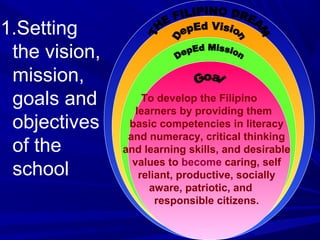
To develop the Filipino
learners by providing them
basic competencies in literacy
and numeracy, critical thinking
and learning skills, and desirable
values to become caring, self
reliant, productive, socially
aware, patriotic, and
responsible citizens.
2. Creating
an
environment
within the
school that
is conducive
to teaching
learning
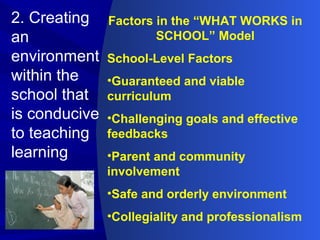
Factors in the “WHAT WORKS in
SCHOOL” Model
School-Level Factors
•Guaranteed and viable
curriculum
•Challenging goals and effective
feedbacks
•Parent and community
involvement
•Safe and orderly environment
•Collegiality and professionalism
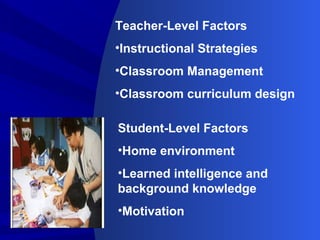
Teacher-Level Factors
•Instructional Strategies
•Classroom Management
•Classroom curriculum design
Student-Level Factors
•Home environment
•Learned intelligence and
background knowledge
•Motivation
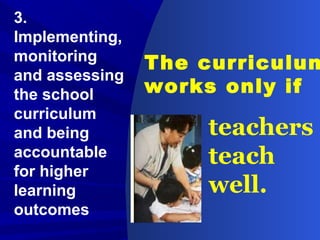
The curriculum
works only if
3.
Implementing,
monitoring
and assessing
the school
curriculum
and being
accountable
for higher
learning
outcomes
teachers
teach
well.
The curriculum
is like a
cemetery,we always
put in
something
and never take out of
anything.
A competent system proves
itself when everyone within
the system performs better
as a result of the collective
endeavors and accepts
accountability for that
improvement.
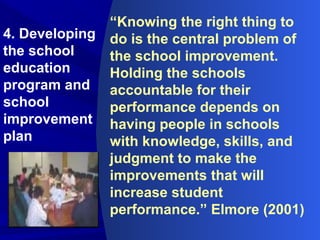
“Knowing the right thing to
do is the central problem of
the school improvement.
Holding the schools
accountable for their
performance depends on
having people in schools
with knowledge, skills, and
judgment to make the
improvements that will
increase student
performance.” Elmore (2001)
4. Developing
the school
education
program and
school
improvement
plan
“He who fails to
plan, plans to fail.”
Planning
“what is” and
“what should be”
is a process that
bridges between
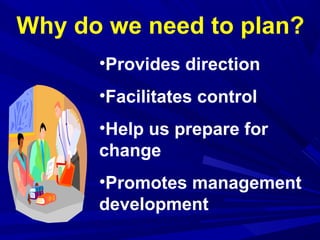
Why do we need to plan?
•Provides direction
•Facilitates control
•Help us prepare for
change
•Promotes management
development
By law, all
schools are
mandated to
prepare a
School
Improvement
Plan (SIP)
A SIP is the main
vehicle through
which schools
proceed down the
path to
improvement. It
should carefully
structured to focus
on key goals and
strategies which
will lead to greater
Planning
is about making a
difference.
a. Allocate
more resources
to basic
education,
deploy
resources to
improve
quality,
reinforce
behavior that
5. Offering
educational
programs,
projects and
services
which provide
equitable
opportunities
for all learners
in the
community.
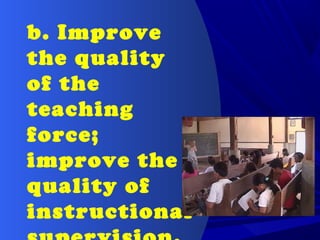
b. Improve
the quality
of the
teaching
force;
improve the
quality of
instructional
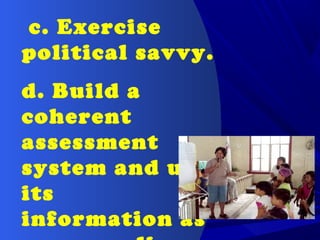
c. Exercise
political savvy.
d. Build a
coherent
assessment
system and use
its
information as
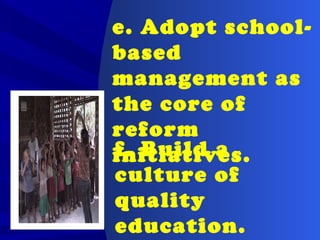
e. Adopt school-
based
management as
the core of
reform
initiatives.f. Build a
culture of
quality
education.
6. Introducing new
and innovative
modes of instruction
to achieve
higher
learning
outcomes
7. Administering
and managing all
personnel, physical
and fiscal
resources
of the school.
8. Recommending the
staff complement of
the school based on
its needs
9. Encouraging and
enhancing staff
development
For staff development
to be effective, it must
be an integral part of a
deliberately developed
continuous improvement
effort.
In a competent system, all
staff members believe that
what they have collectively
agreed to do is challenging,
possible, and
worthy
of the attempt.
10. Establishing school
community networks and
encouraging the active
participation of teacher
organizations, non-academic
personnel of public schools,
and parents-teachers-
community associations.
11. Accepting donations, gifts,
bequests and grants in accordance
with existing laws and policy of the
Department for the purpose of
upgrading teachers/learning
facilitators’ competencies, improving
and expanding school facilities and
providing instructional materials and
equipment. Such donations or grants
must be reported to the division
superintendents.
12. Performing such other
functions as may be
assigned by the Secretary,
Regional Director and
Schools Division
Superintendents where
they belong
The world has never seen a
great leader who lacked
commitment. Ed McElroy
spoke of its importance:
“Commitment gives us new
power. No matter what comes
to us – sickness, poverty, or
disaster – we never turn our eye
from the goal.”
If you want to be an effective
leader, you have to be committed.
True commitment inspires and
attracts people. It shows them that
you have conviction. They will
believe in you only if you believe in
your cause. As the Law of buy-In
states, people buy into the leader,
then vision.
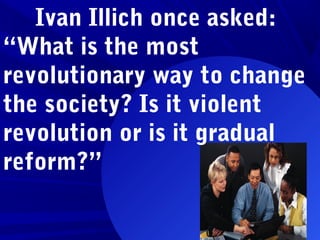
Ivan Illich once asked:
“What is the most
revolutionary way to change
the society? Is it violent
revolution or is it gradual
reform?”
He gave a careful answer.
Neither. If you want to
change society, then you
must tell an alternative
story.”
-Quote from Illich’s
Deschouling Society
Ra 9155schoollevel

Ra 9155schoollevel

  • 2.
    If a doctor,lawyer, or dentist had 40 people in his office at one time, all of whom had different needs, and some of whom didn't want to be there and were causing trouble, and the doctor, lawyer, or dentist, without assistance, had to treat them all with professional excellence for nine months, then he might have some conception of the classroom teacher's job. ~Donald D. Quinn
  • 4.
    Authority – power andgoverning control, or the legal and territorial extent of power
  • 5.
    Accountability -accepting the authority and responsibilityfor the results of one’s contributions, both positive and negative
  • 6.
    It is differentfrom responsibility. It is an obligation, not just something you will try to do.
  • 7.
    Responsibility -a duty, thetrait of being answerable to someone for something or being responsible for one’s conduct. -a form of trustworthiness, -the proper sphere or extent of one’s activities.
  • 8.
    1.Setting the vision, mission, goals and objectives ofthe school “The State shall protect and promote the right of all citizens equality education at all levels and shall take appropriate steps to make such education accessible to all.” To develop a highly competent, civic spirited, life skilled and God-loving Filipino youth actively participated in and contribute towards the building of a humane, healthy and productive society Provide quality basic education that is equitably accessible to all and lay the foundation for life- long learning and service for the common good. To develop the Filipino learners by providing them basic competencies in literacy and numeracy, critical thinking and learning skills, and desirable values to become caring, self reliant, productive, socially aware, patriotic, and responsible citizens.
  • 9.
    2. Creating an environment within the schoolthat is conducive to teaching learning Factors in the “WHAT WORKS in SCHOOL” Model School-Level Factors •Guaranteed and viable curriculum •Challenging goals and effective feedbacks •Parent and community involvement •Safe and orderly environment •Collegiality and professionalism
  • 10.
    Teacher-Level Factors •Instructional Strategies •ClassroomManagement •Classroom curriculum design Student-Level Factors •Home environment •Learned intelligence and background knowledge •Motivation
  • 11.
    The curriculum works onlyif 3. Implementing, monitoring and assessing the school curriculum and being accountable for higher learning outcomes teachers teach well.
  • 12.
    The curriculum is likea cemetery,we always put in something and never take out of anything.
  • 13.
    A competent systemproves itself when everyone within the system performs better as a result of the collective endeavors and accepts accountability for that improvement.
  • 14.
    “Knowing the rightthing to do is the central problem of the school improvement. Holding the schools accountable for their performance depends on having people in schools with knowledge, skills, and judgment to make the improvements that will increase student performance.” Elmore (2001) 4. Developing the school education program and school improvement plan
  • 15.
    “He who failsto plan, plans to fail.” Planning “what is” and “what should be” is a process that bridges between
  • 16.
    Why do weneed to plan? •Provides direction •Facilitates control •Help us prepare for change •Promotes management development
  • 17.
    By law, all schoolsare mandated to prepare a School Improvement Plan (SIP) A SIP is the main vehicle through which schools proceed down the path to improvement. It should carefully structured to focus on key goals and strategies which will lead to greater
  • 18.
  • 19.
    a. Allocate more resources tobasic education, deploy resources to improve quality, reinforce behavior that 5. Offering educational programs, projects and services which provide equitable opportunities for all learners in the community.
  • 20.
    b. Improve the quality ofthe teaching force; improve the quality of instructional
  • 21.
    c. Exercise political savvy. d.Build a coherent assessment system and use its information as
  • 22.
    e. Adopt school- based managementas the core of reform initiatives.f. Build a culture of quality education.
  • 23.
    6. Introducing new andinnovative modes of instruction to achieve higher learning outcomes
  • 24.
    7. Administering and managingall personnel, physical and fiscal resources of the school.
  • 25.
    8. Recommending the staffcomplement of the school based on its needs
  • 26.
    9. Encouraging and enhancingstaff development For staff development to be effective, it must be an integral part of a deliberately developed continuous improvement effort.
  • 27.
    In a competentsystem, all staff members believe that what they have collectively agreed to do is challenging, possible, and worthy of the attempt.
  • 28.
    10. Establishing school communitynetworks and encouraging the active participation of teacher organizations, non-academic personnel of public schools, and parents-teachers- community associations.
  • 29.
    11. Accepting donations,gifts, bequests and grants in accordance with existing laws and policy of the Department for the purpose of upgrading teachers/learning facilitators’ competencies, improving and expanding school facilities and providing instructional materials and equipment. Such donations or grants must be reported to the division superintendents.
  • 30.
    12. Performing suchother functions as may be assigned by the Secretary, Regional Director and Schools Division Superintendents where they belong
  • 31.
    The world hasnever seen a great leader who lacked commitment. Ed McElroy spoke of its importance: “Commitment gives us new power. No matter what comes to us – sickness, poverty, or disaster – we never turn our eye from the goal.”
  • 32.
    If you wantto be an effective leader, you have to be committed. True commitment inspires and attracts people. It shows them that you have conviction. They will believe in you only if you believe in your cause. As the Law of buy-In states, people buy into the leader, then vision.
  • 33.
    Ivan Illich onceasked: “What is the most revolutionary way to change the society? Is it violent revolution or is it gradual reform?”
  • 34.
    He gave acareful answer. Neither. If you want to change society, then you must tell an alternative story.” -Quote from Illich’s Deschouling Society