TRAINING ON THE
MATATAG CURRICULUM
Venue
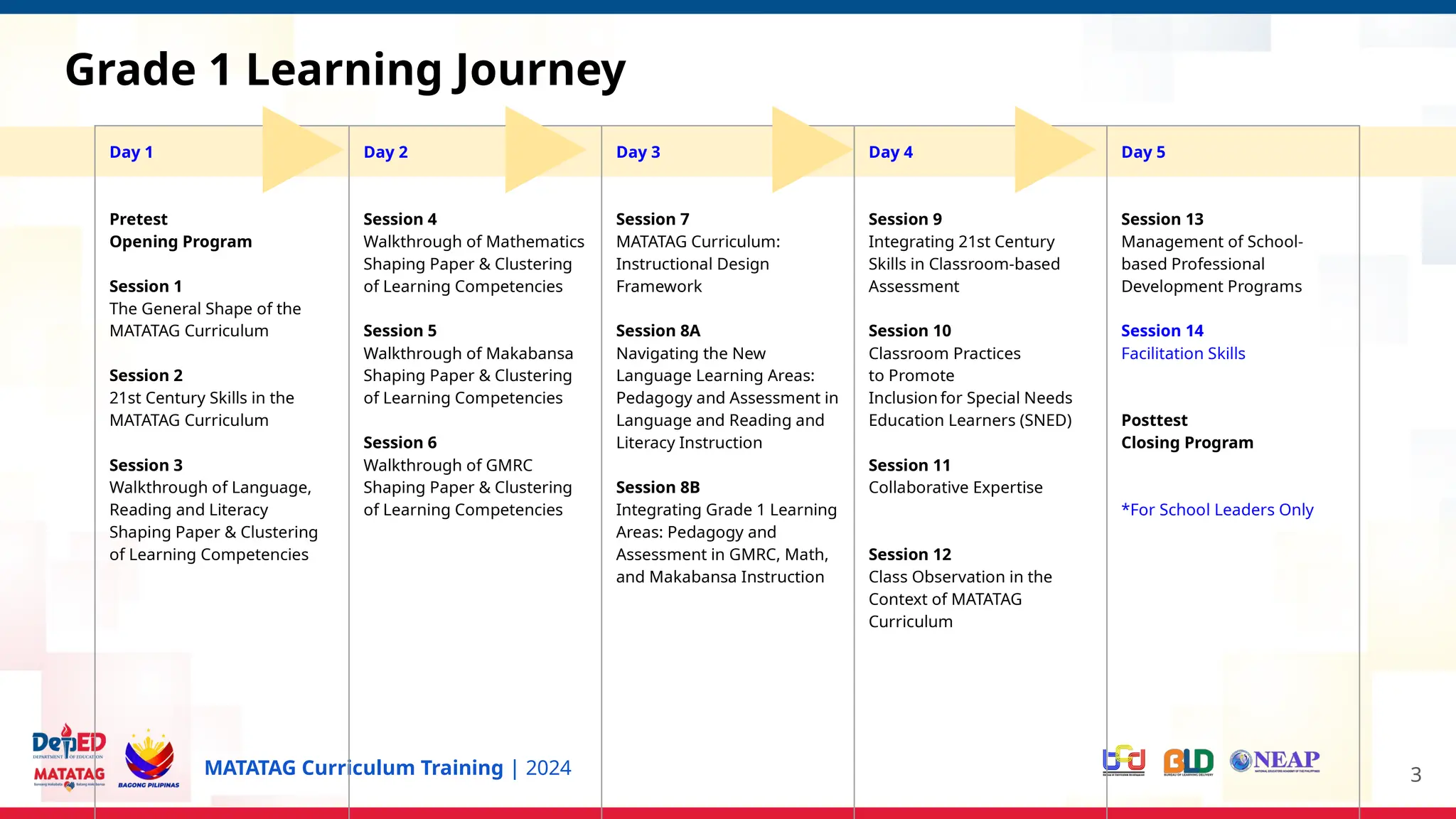
Date
1
TRAINING ON THE
MATATAG CURRICULUM
Venue
Date
2
GRADE 1 LANGUAGE AND READING &
LITERACY
MATATAG Curriculum Training | 2024
Grade 1 Learning Journey
3
Day 1
Pretest
Opening Program
Session 1
The General Shape of the
MATATAG Curriculum
Session 2
21st Century Skills in the
MATATAG Curriculum
Session 3
Walkthrough of Language,
Reading and Literacy
Shaping Paper & Clustering
of Learning Competencies
Day 2
Session 4
Walkthrough of Mathematics
Shaping Paper & Clustering
of Learning Competencies
Session 5
Walkthrough of Makabansa
Shaping Paper & Clustering
of Learning Competencies
Session 6
Walkthrough of GMRC
Shaping Paper & Clustering
of Learning Competencies
Day 3
Session 7
MATATAG Curriculum:
Instructional Design
Framework
Session 8A
Navigating the New
Language Learning Areas:
Pedagogy and Assessment in
Language and Reading and
Literacy Instruction
Session 8B
Integrating Grade 1 Learning
Areas: Pedagogy and
Assessment in GMRC, Math,
and Makabansa Instruction
Day 4
Session 9
Integrating 21st Century
Skills in Classroom-based
Assessment
Session 10
Classroom Practices
to Promote
Inclusion for Special Needs
Education Learners (SNED)
Session 11
Collaborative Expertise
Session 12
Class Observation in the
Context of MATATAG
Curriculum
Day 5
Session 13
Management of School-
based Professional
Development Programs
Session 14
Facilitation Skills
Posttest
Closing Program
*For School Leaders Only
MATATAG Curriculum Training | 2024
Grade 1 Learning Journey
4
Day 1
Pretest
Opening Program
Session 1
The General Shape of the
MATATAG Curriculum
Session 2
21st Century Skills in the
MATATAG Curriculum
Session 3
Walkthrough of Language,
Reading and Literacy
Shaping Paper & Clustering
of Learning Competencies
Day 2
Session 4
Walkthrough of Mathematics
Shaping Paper & Clustering
of Learning Competencies
Session 5
Walkthrough of Makabansa
Shaping Paper & Clustering
of Learning Competencies
Session 6
Walkthrough of GMRC
Shaping Paper & Clustering
of Learning Competencies
Day 3
Session 7
MATATAG Curriculum:
Instructional Design
Framework
Session 8A
Navigating the New
Language Learning Areas:
Pedagogy and Assessment in
Language and Reading and
Literacy Instruction
Session 8B
Integrating Grade 1 Learning
Areas: Pedagogy and
Assessment in GMRC, Math,
and Makabansa Instruction
Day 4
Session 9
Integrating 21st Century
Skills in Classroom-based
Assessment
Session 10
Classroom Practices
to Promote
Inclusion for Special Needs
Education Learners (SNED)
Session 11
Collaborative Expertise
Session 12
Class Observation in the
Context of MATATAG
Curriculum
Day 5
Session 13
Management of School-
based Professional
Development Programs
Session 14
Facilitation Skills
Posttest
Closing Program
*For School Leaders Only
MATATAG Curriculum Training | 2024
Session 3
The Shaping Paper &
Walkthrough of Language
and Reading & Literacy
JIFRIL P. ALBA
5
MATATAG Curriculum Training | 2024
Session Objectives
At the end of the session, participants will…
1. explain the key components of the Languages
Curriculum Framework;
2. identify learning standards (curriculum
standards);
3. determine possible topics for lessons in
Quarters 1 and 2;
6
MATATAG Curriculum Training | 2024
Session Objectives
At the end of the session, participants will…
4. unpack learning competencies in Quarters 1
and 2;
5. write specific, clear, and doable learning
objectives; and
6. identify the core pedagogical and assessment
principles of the curriculum.
7
MATATAG Curriculum Training | 2024 8
Professional Standards Addressed
Domain 1: Content Knowledge and Pedagogy
Domain 2: Diverse Learning Needs
Domain 3: Assessment and Reporting
Domain 4: Learning Environment
Domain 6: Professional Engagement and
Development
MATATAG Curriculum Training | 2024
The Language Framework
Language Curriculum Framework
The Big Ideas
Literacy Focus
Learning Subdomains
Curriculum Standards
9
Curriculum Guide
Session Flow
MATATAG Curriculum Training | 2024 10
What do you know
about the new
subjects: Language
and Reading and
Literacy?
What insights do you
have regarding the
delivery of these new
learning areas?
What are your thoughts
on the new subjects?
How important is it to
integrate language
instruction and why?
Candy Game
MATATAG Curriculum Training | 2024 11
Get ready for the next activity!
Dive into the curriculum with a critical eye using the guide
questions in Worksheet 1 .
MATATAG Curriculum Training | 2024
● What domains or subdomains are covered in
this curriculum?
● Which LCs are emphasized?
● How do these LCs contribute to the oracy and
literacy development of learners?
● Considering the curriculum's scope, what
content knowledge and pedagogical skills are
essential for teachers in order to implement
the curriculum?
12
Guided Observation
MATATAG Curriculum Training | 2024 13
Get ready for the next activity!
Engage in a meta-analysis of the curriculum guides for Language
and Reading and Literacy.
MATATAG Curriculum Training | 2024 14
Guided Meta-Analysis
● What overarching insights have we gained
about these new learning areas? How does
the new curriculum shape the experiences in
our classrooms?
MATATAG Curriculum Training | 2024 15
Guided Meta-Analysis
● How can these understandings influence
our teaching practices moving forward?
How do our insights influence the approach to
the delivery of the new learning areas? Given
the identified necessary content knowledge
and pedagogical skills, how prepared do we
feel as educators? What areas might require
further development or support?
MATATAG Curriculum Training | 2024 16
Addressing the Gaps
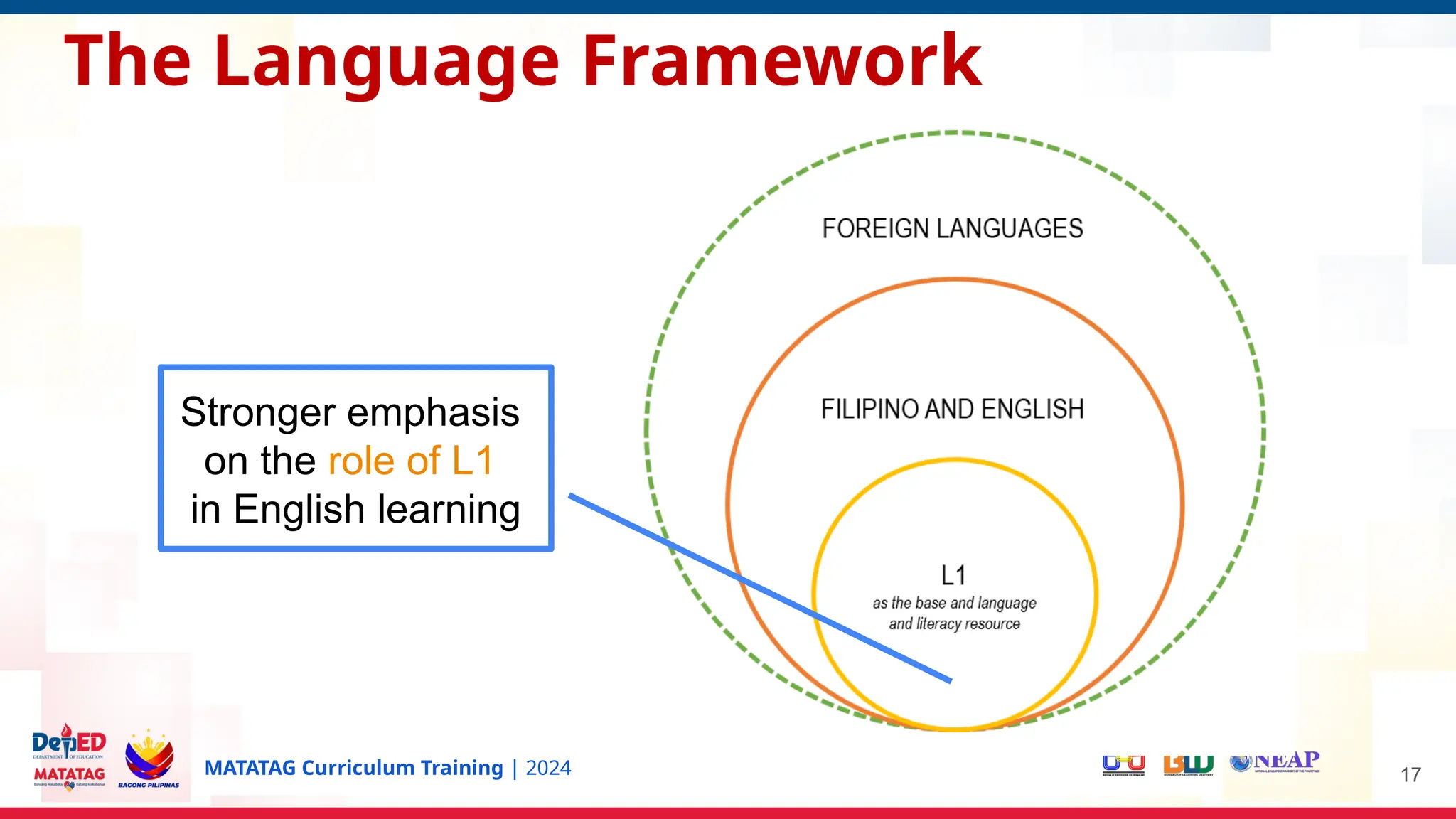
Three significant findings were put forth based on the
review of the curriculum:
● The curriculum was congested.
● Learning competencies were classified through
overlapping curriculum domains.
● Knowledge of language structure was emphasized
instead of literacy development.
MATATAG Curriculum Training | 2024 17
Stronger emphasis
on the role of L1
in English learning
The Language Framework
MATATAG Curriculum Training | 2024 18
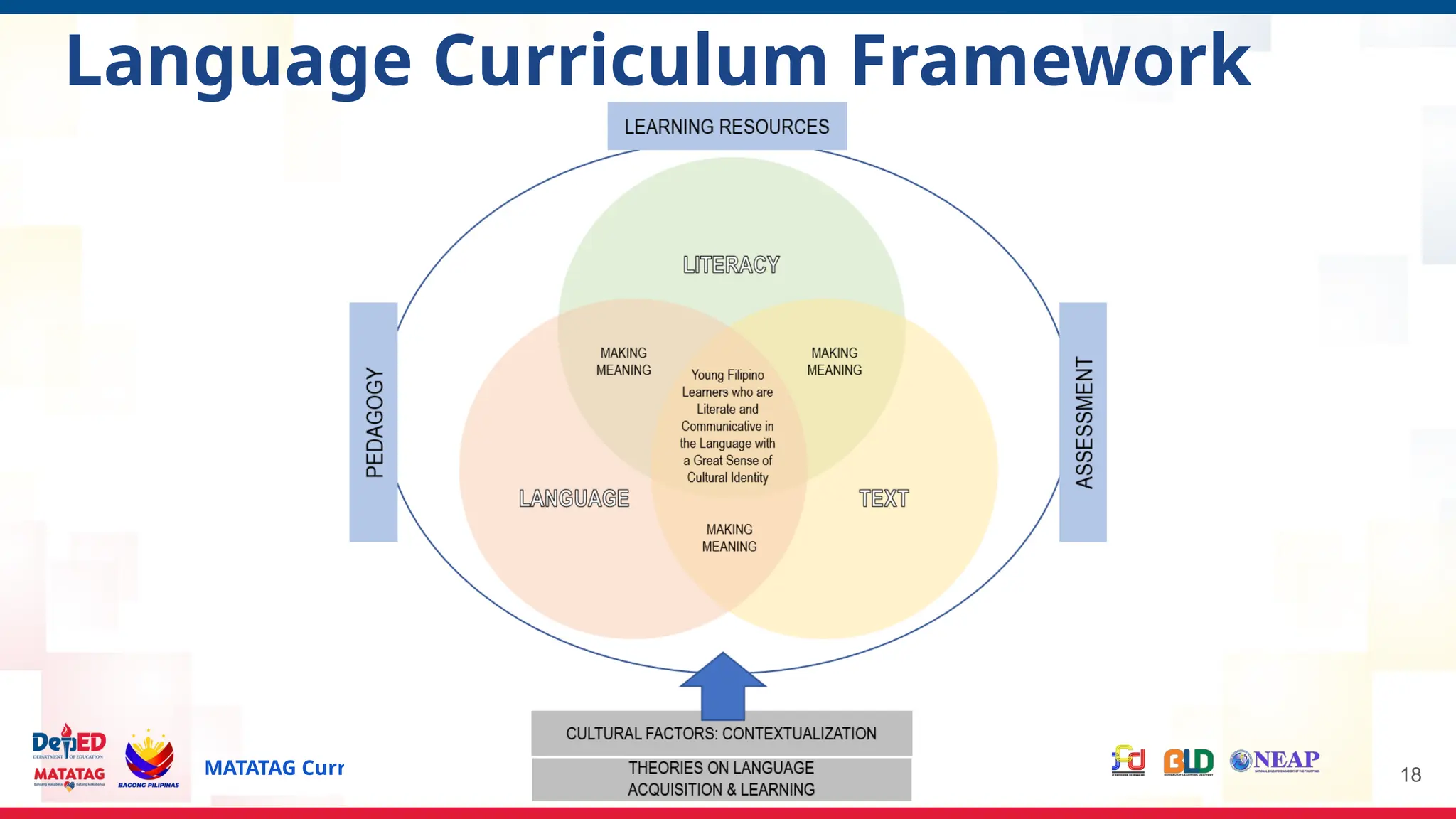
Language Curriculum Framework
MATATAG Curriculum Training | 2024 19
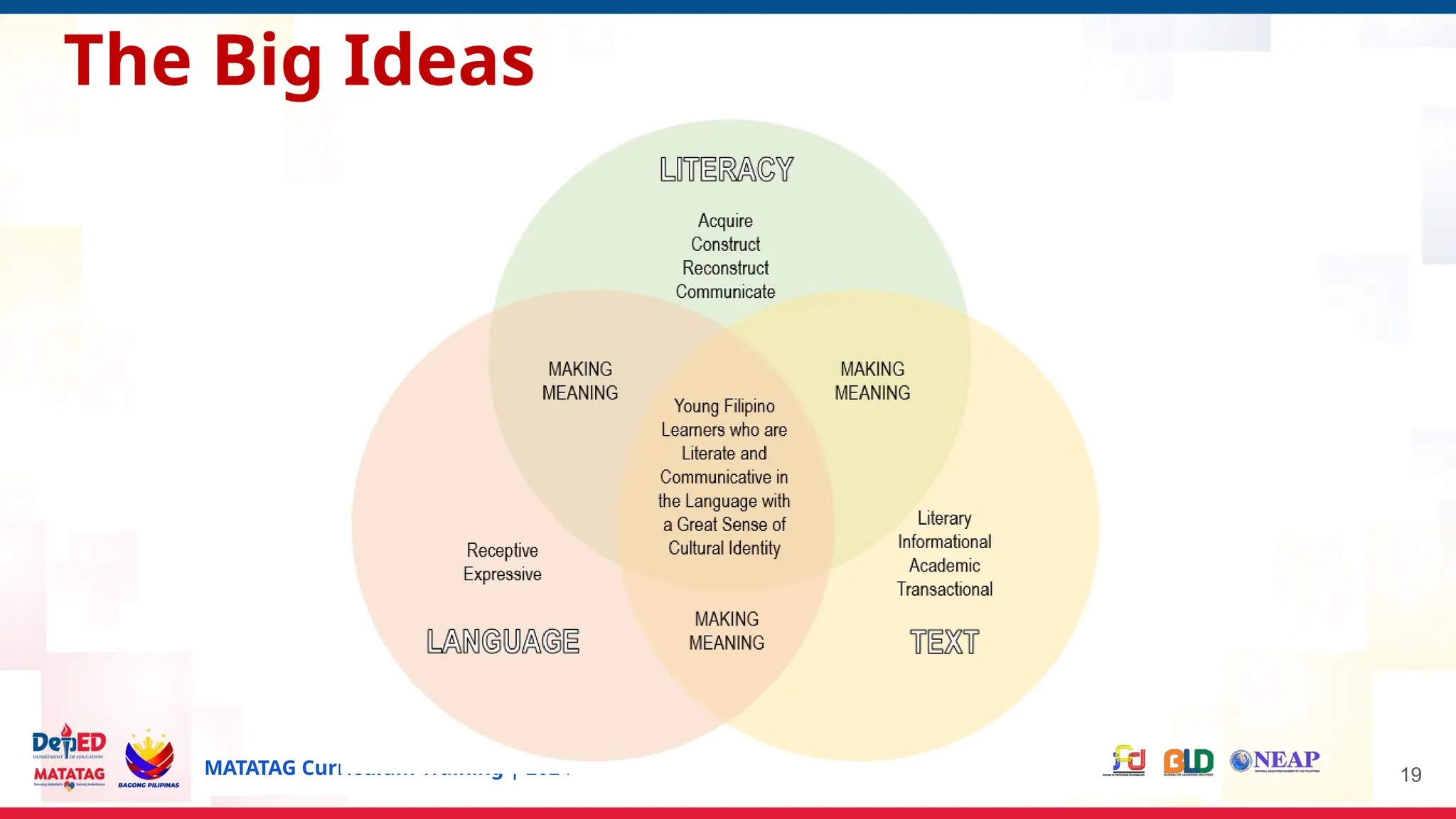
The Big Ideas
MATATAG Curriculum Training | 2024 20
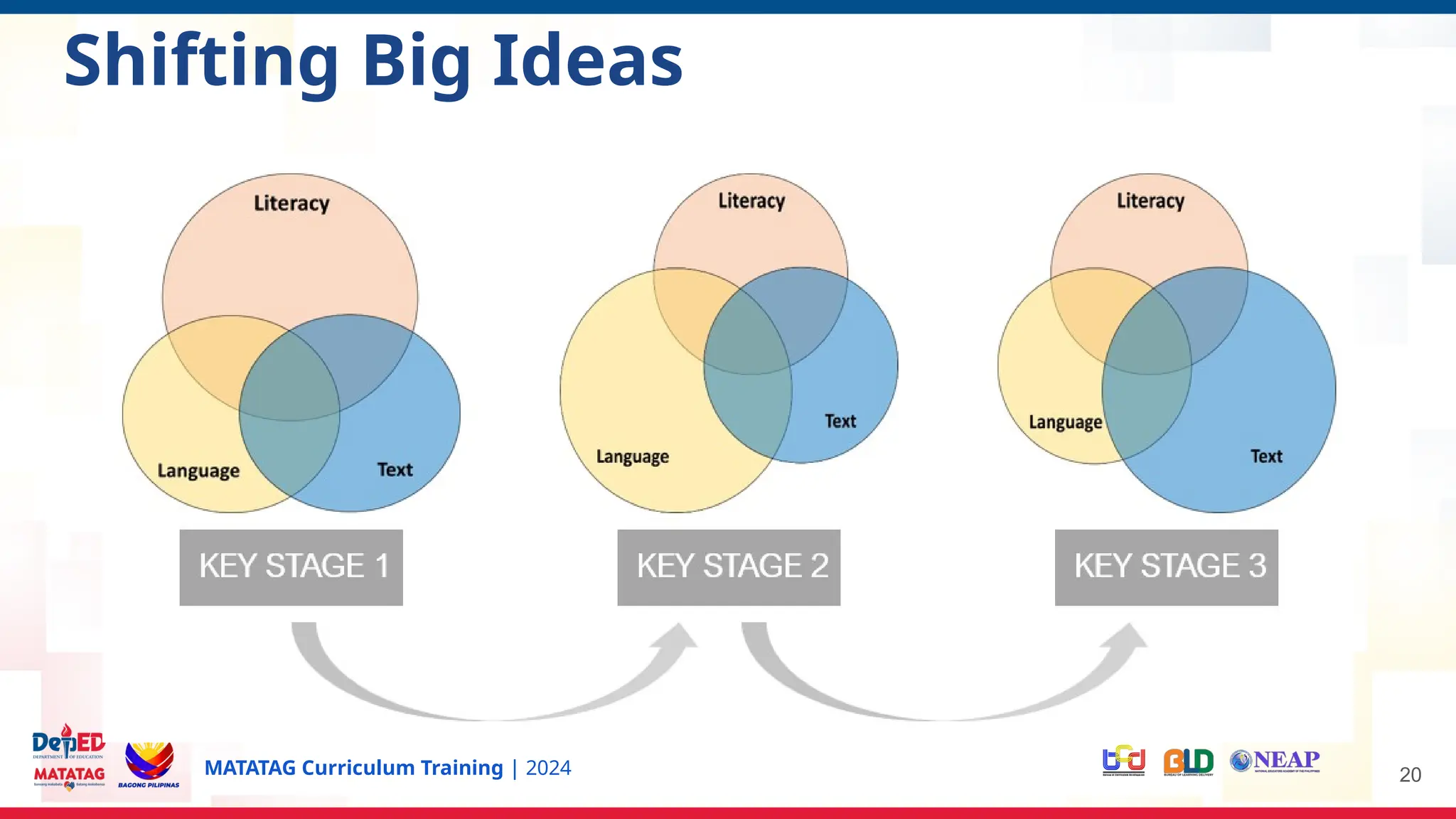
Shifting Big Ideas
MATATAG Curriculum Training | 2024 21
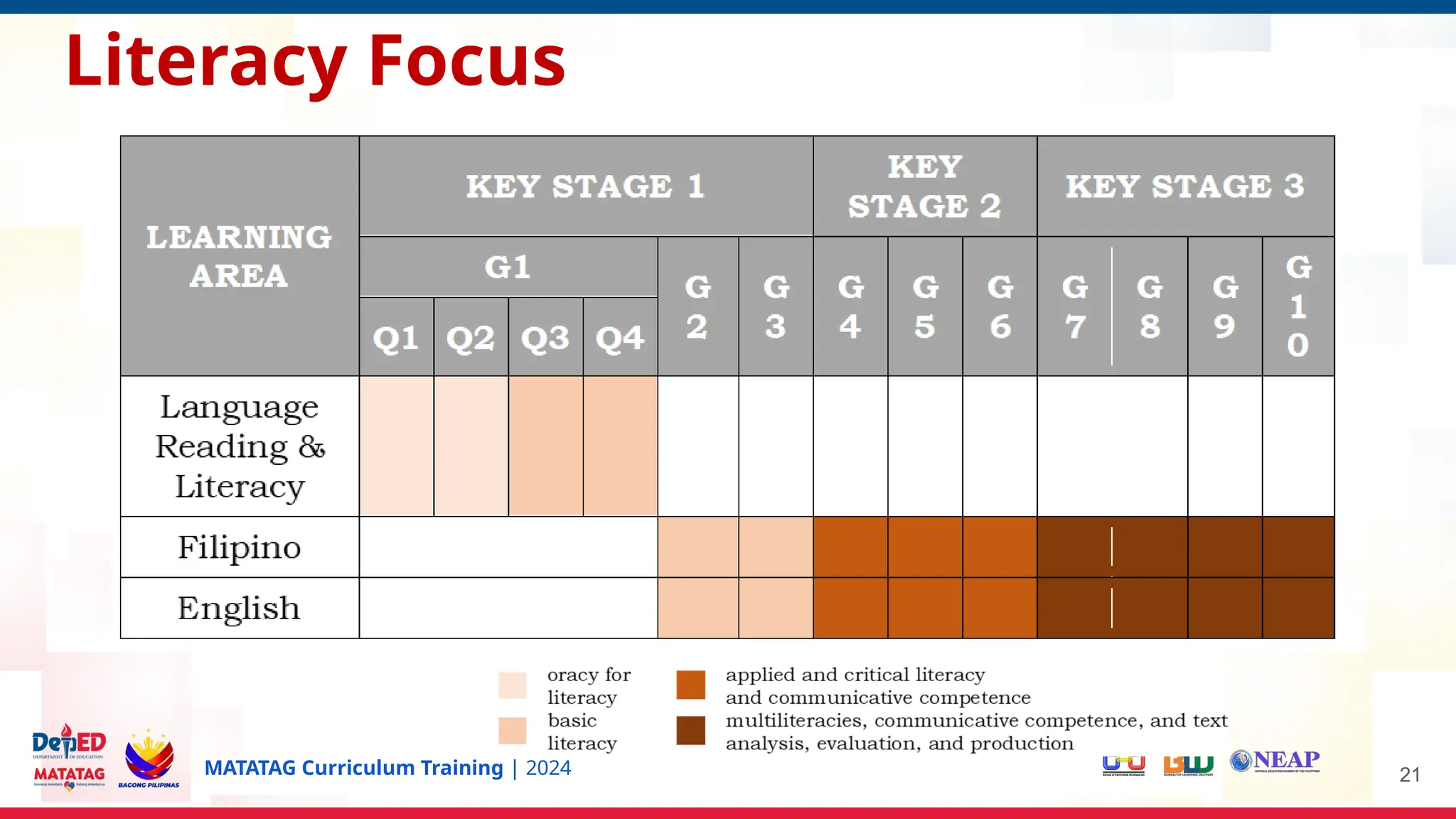
Literacy Focus
MATATAG Curriculum Training | 2024 22
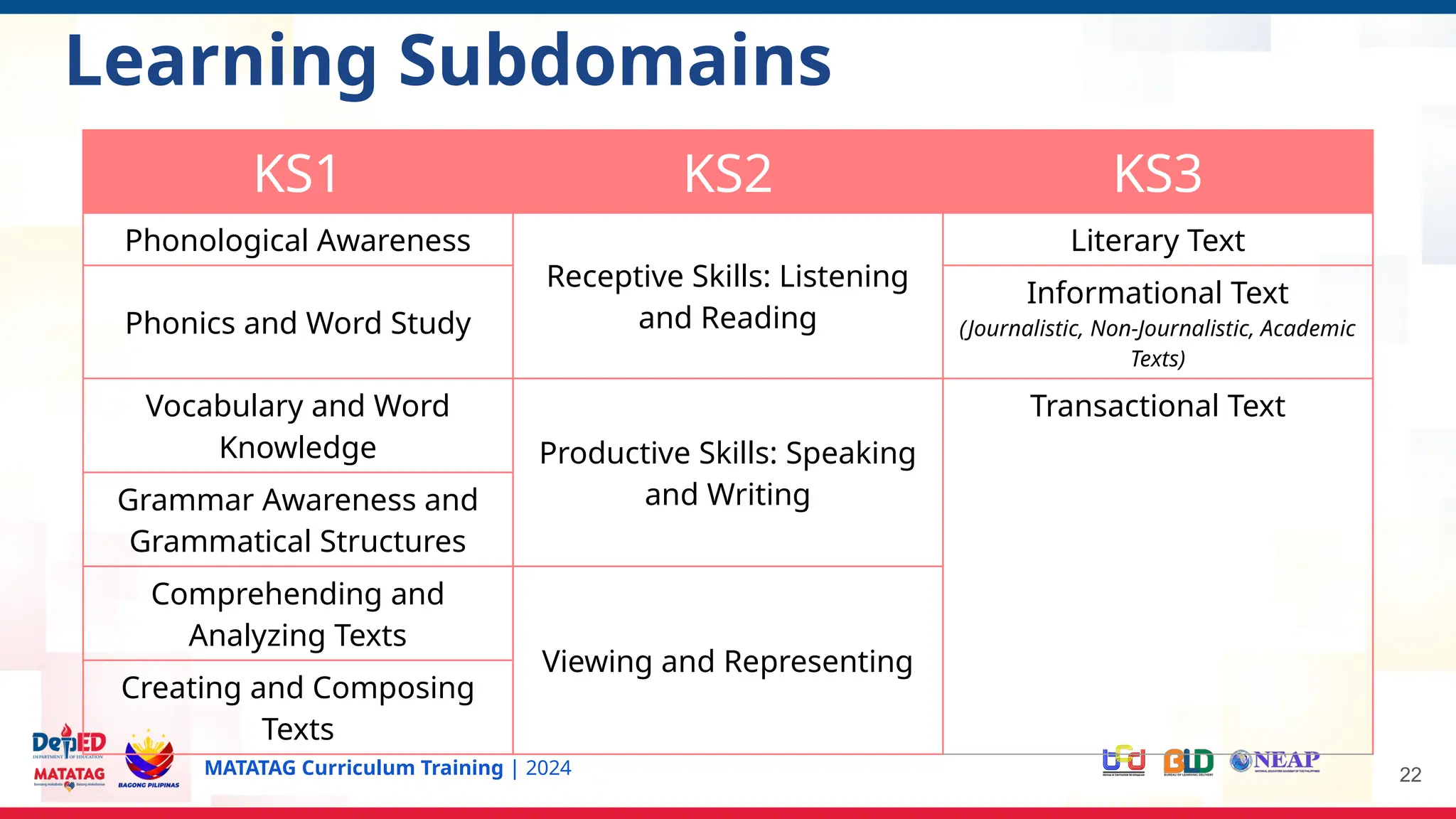
KS1 KS2 KS3
Phonological Awareness
Receptive Skills: Listening
and Reading
Literary Text
Phonics and Word Study
Informational Text
(Journalistic, Non-Journalistic, Academic
Texts)
Vocabulary and Word
Knowledge Productive Skills: Speaking
and Writing
Transactional Text
Grammar Awareness and
Grammatical Structures
Comprehending and
Analyzing Texts
Viewing and Representing
Creating and Composing
Texts
Learning Subdomains
MATATAG Curriculum Training | 2024 23
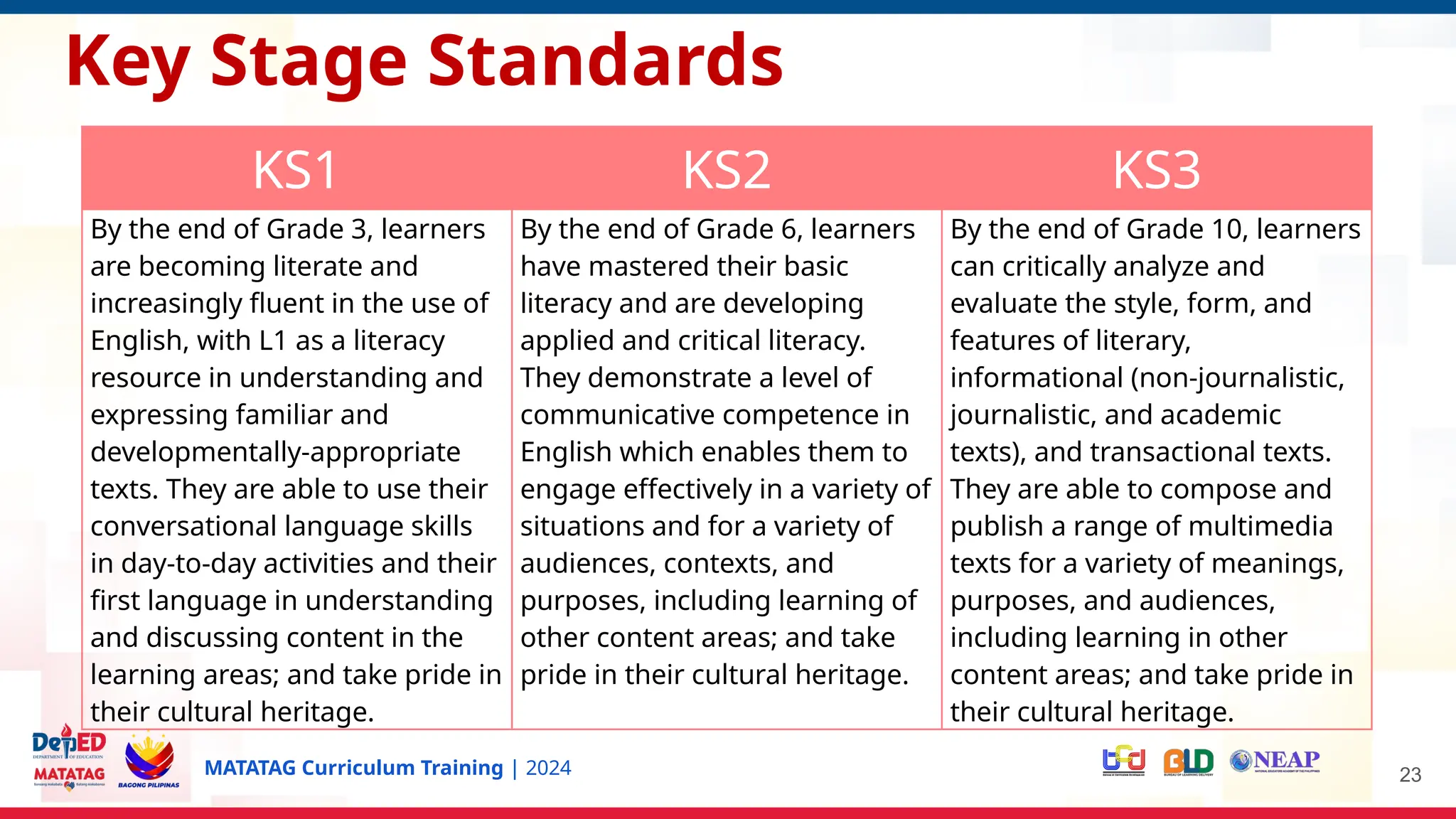
KS1 KS2 KS3
By the end of Grade 3, learners
are becoming literate and
increasingly fluent in the use of
English, with L1 as a literacy
resource in understanding and
expressing familiar and
developmentally-appropriate
texts. They are able to use their
conversational language skills
in day-to-day activities and their
first language in understanding
and discussing content in the
learning areas; and take pride in
their cultural heritage.
By the end of Grade 6, learners
have mastered their basic
literacy and are developing
applied and critical literacy.
They demonstrate a level of
communicative competence in
English which enables them to
engage effectively in a variety of
situations and for a variety of
audiences, contexts, and
purposes, including learning of
other content areas; and take
pride in their cultural heritage.
By the end of Grade 10, learners
can critically analyze and
evaluate the style, form, and
features of literary,
informational (non-journalistic,
journalistic, and academic
texts), and transactional texts.
They are able to compose and
publish a range of multimedia
texts for a variety of meanings,
purposes, and audiences,
including learning in other
content areas; and take pride in
their cultural heritage.
Key Stage Standards
MATATAG Curriculum Training | 2024 24
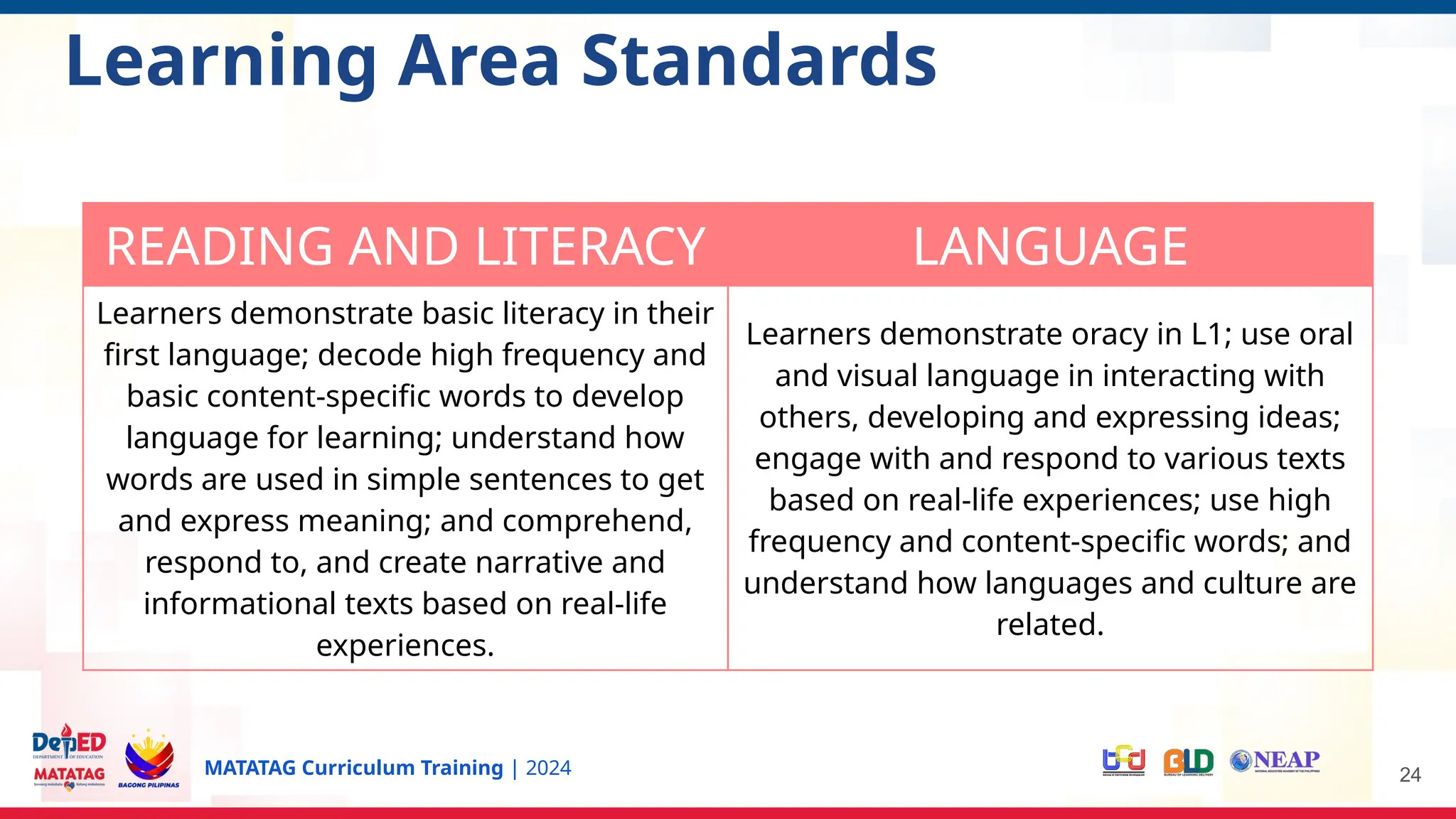
READING AND LITERACY LANGUAGE
Learners demonstrate basic literacy in their
first language; decode high frequency and
basic content-specific words to develop
language for learning; understand how
words are used in simple sentences to get
and express meaning; and comprehend,
respond to, and create narrative and
informational texts based on real-life
experiences.
Learners demonstrate oracy in L1; use oral
and visual language in interacting with
others, developing and expressing ideas;
engage with and respond to various texts
based on real-life experiences; use high
frequency and content-specific words; and
understand how languages and culture are
related.
Learning Area Standards
MATATAG Curriculum Training | 2024 25
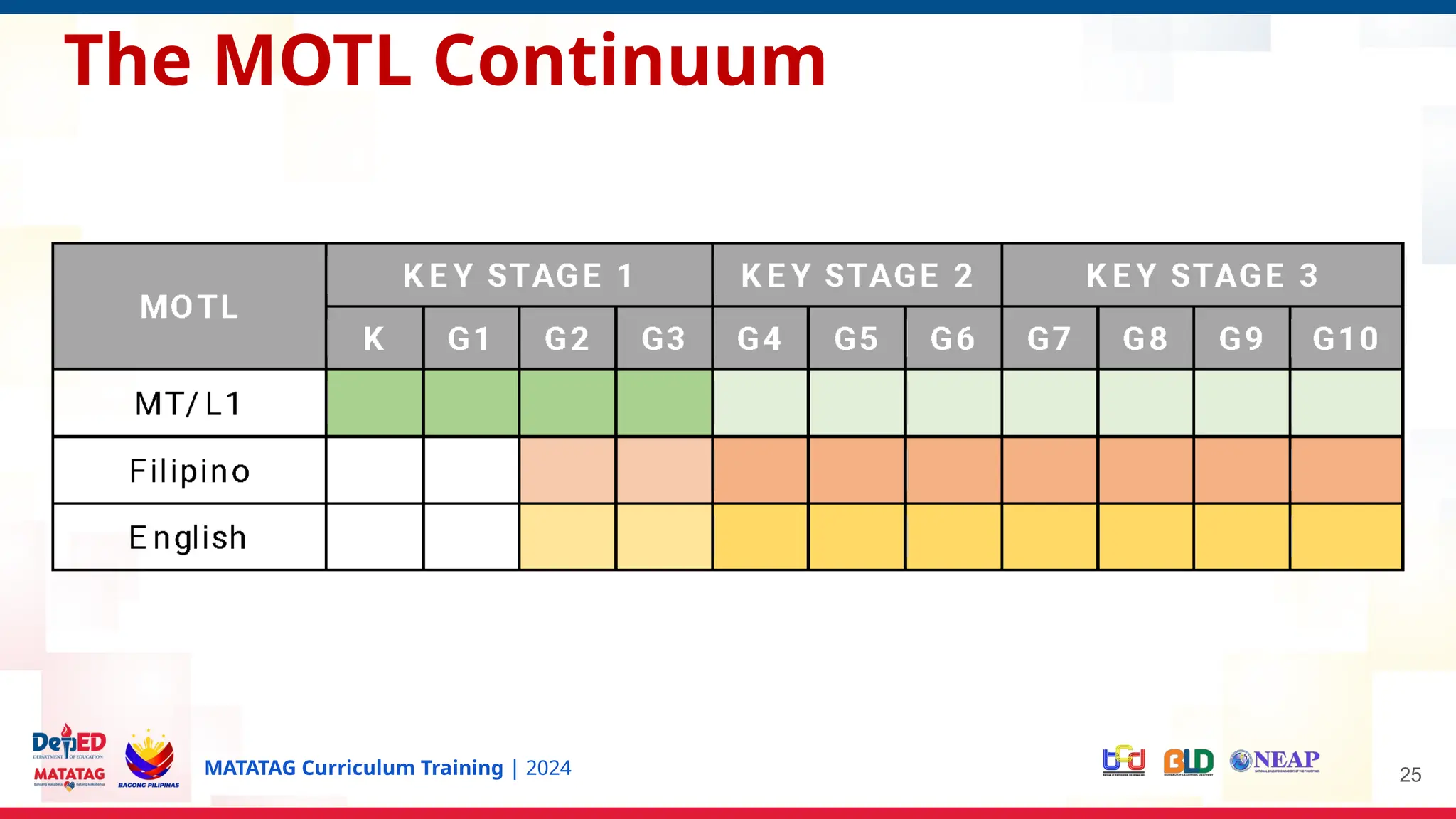
The MOTL Continuum
MATATAG Curriculum Training | 2024 26
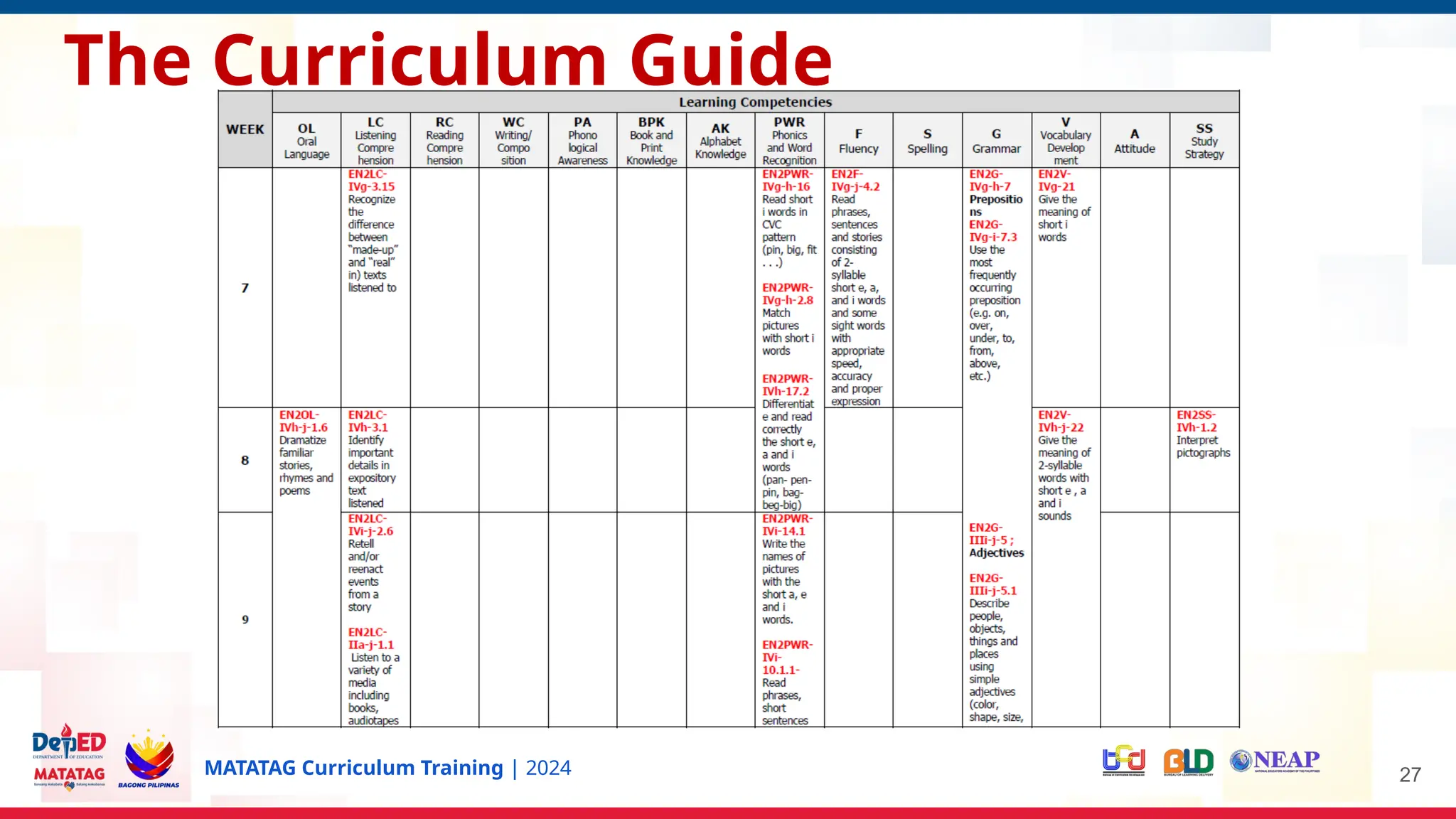
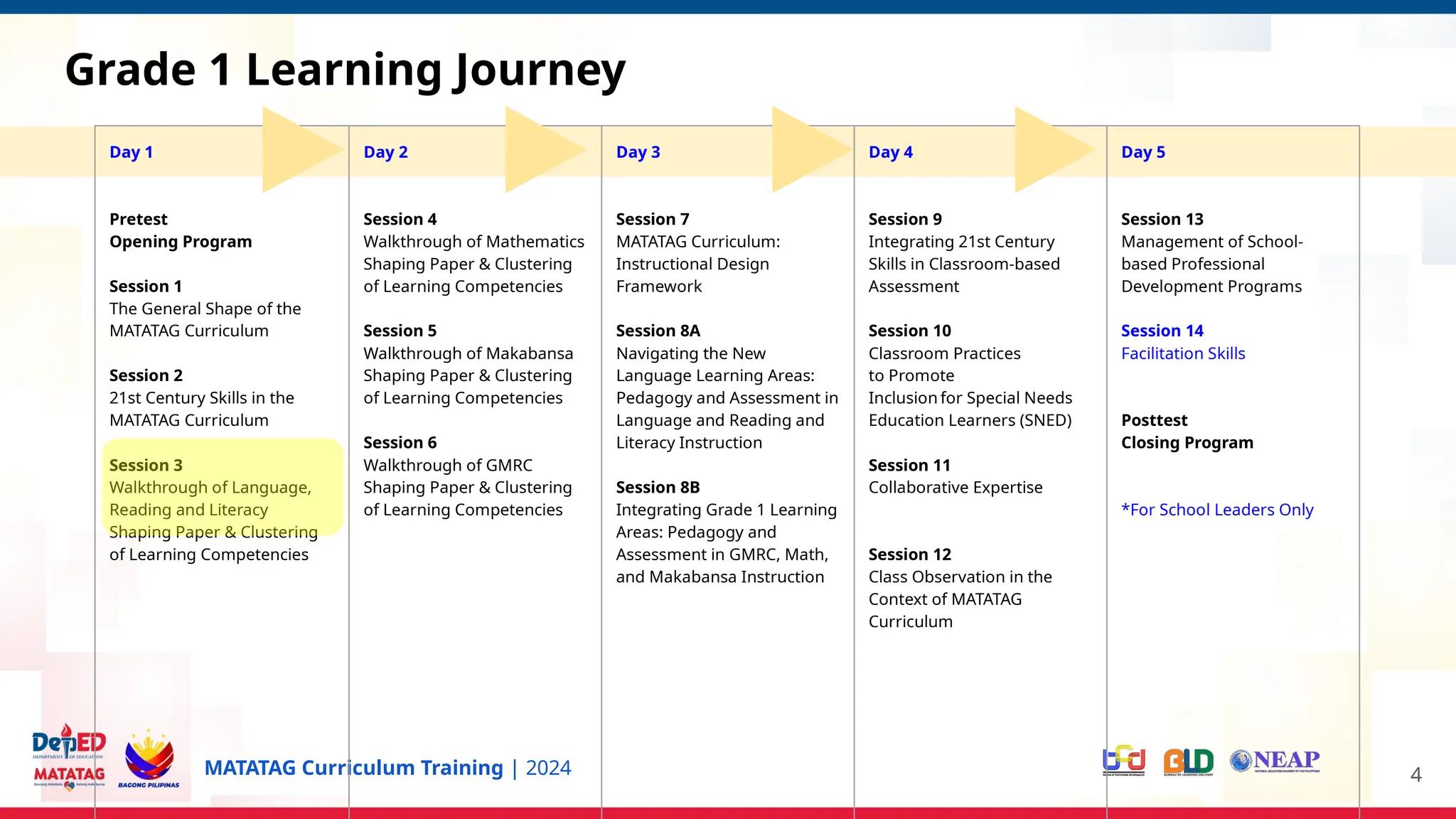
The Curriculum Guide
MATATAG Curriculum Training | 2024 27
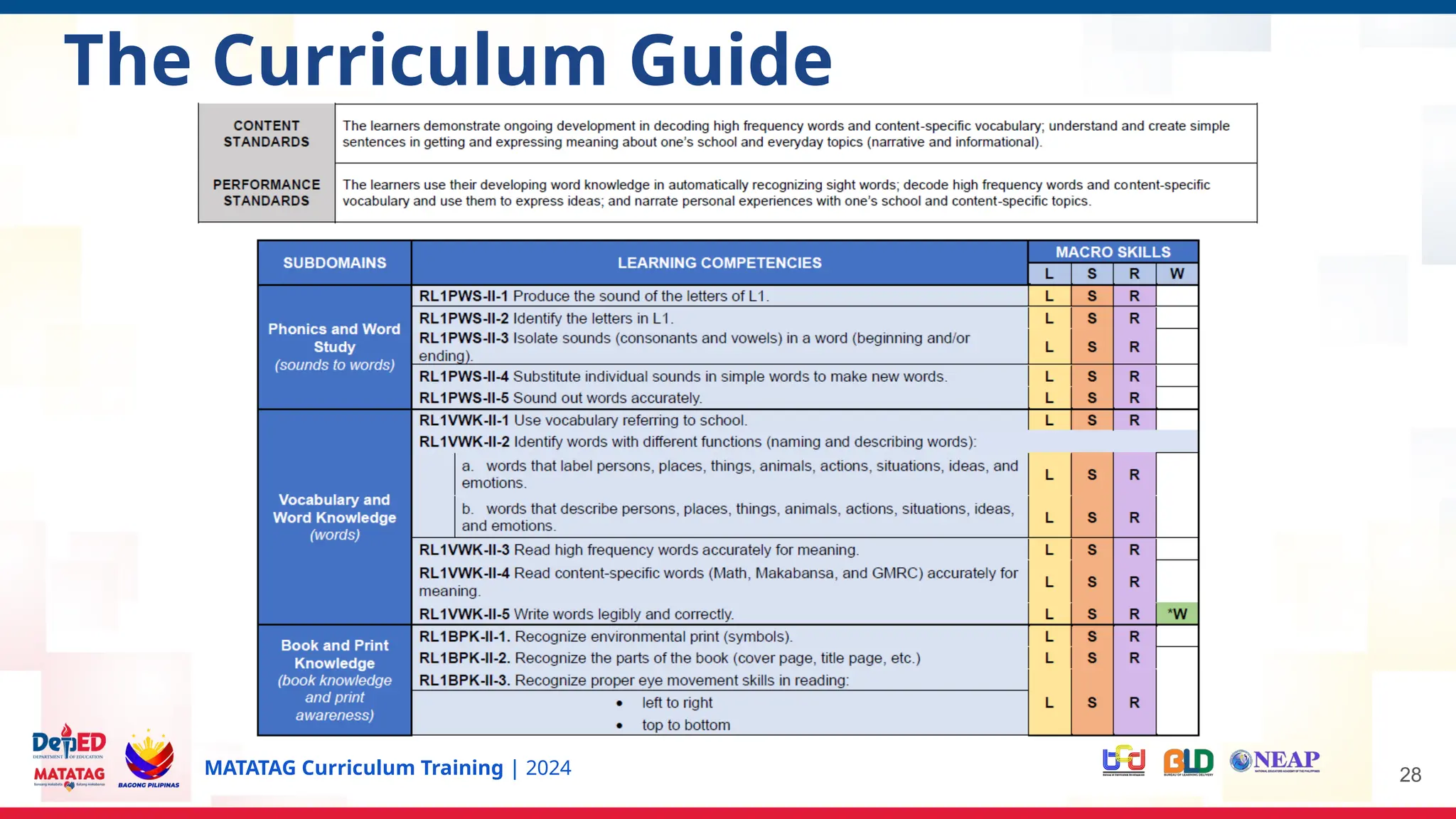
The Curriculum Guide
MATATAG Curriculum Training | 2024 28
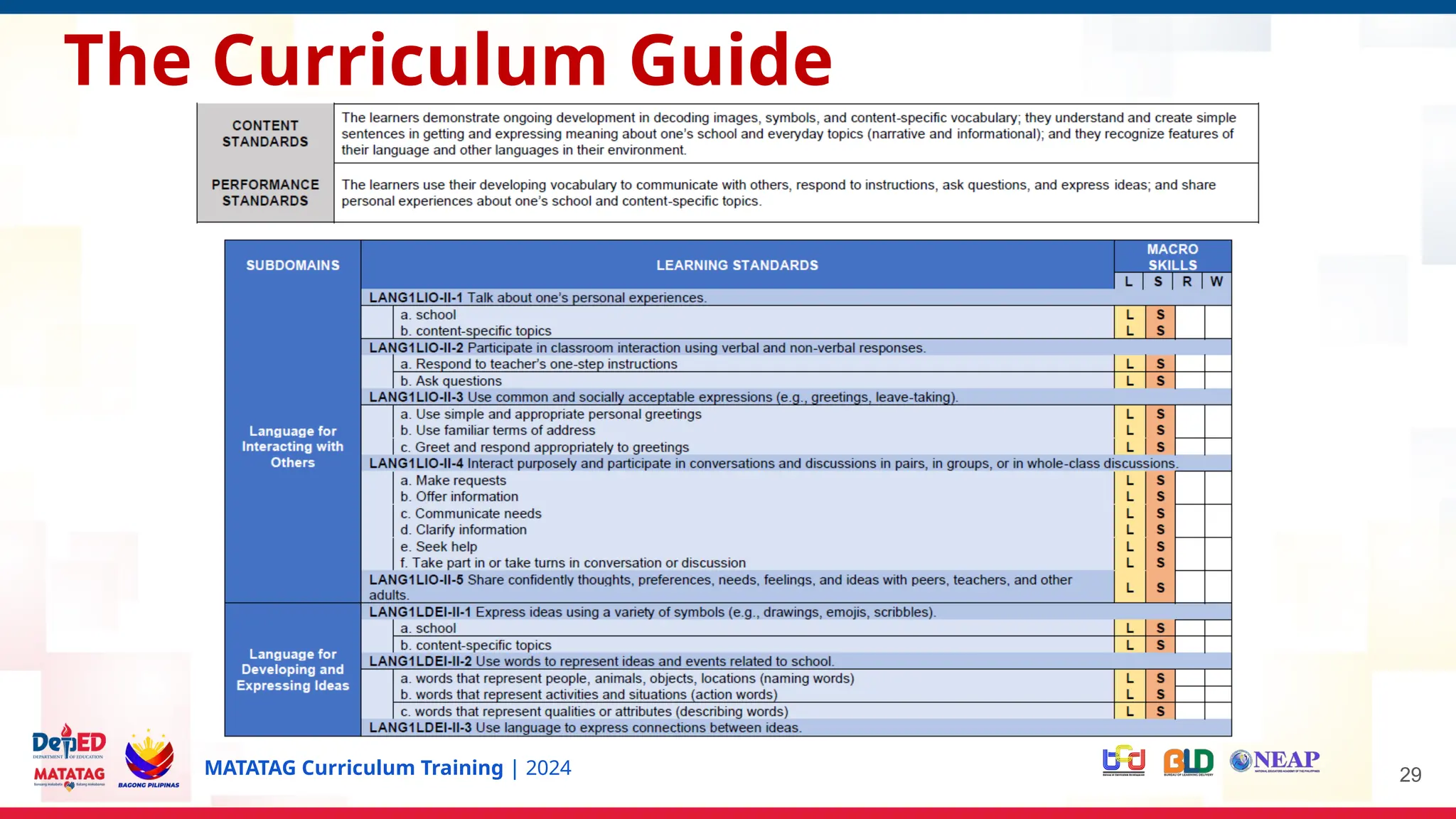
The Curriculum Guide
MATATAG Curriculum Training | 2024 29
The Curriculum Guide
MATATAG Curriculum Training | 2024
Refer to your copies of the Curriculum Guide.
30
Walkthrough of the CG
MATATAG Curriculum Training | 2024 31
Unpacking LCs
Establish the Premise:
● Standards-based, not content-based.
● The focus of unpacking is standards and
learning competencies.
● LCs are the unpacked version of the
content and performance standards.
MATATAG Curriculum Training | 2024 32
Unpacking LCs
What is Unpacking?
● It breaks down complex skills or concepts
into manageable parts.
● It makes curriculum standards and
learning competencies more explicit and
actionable through learning objectives.
MATATAG Curriculum Training | 2024 33
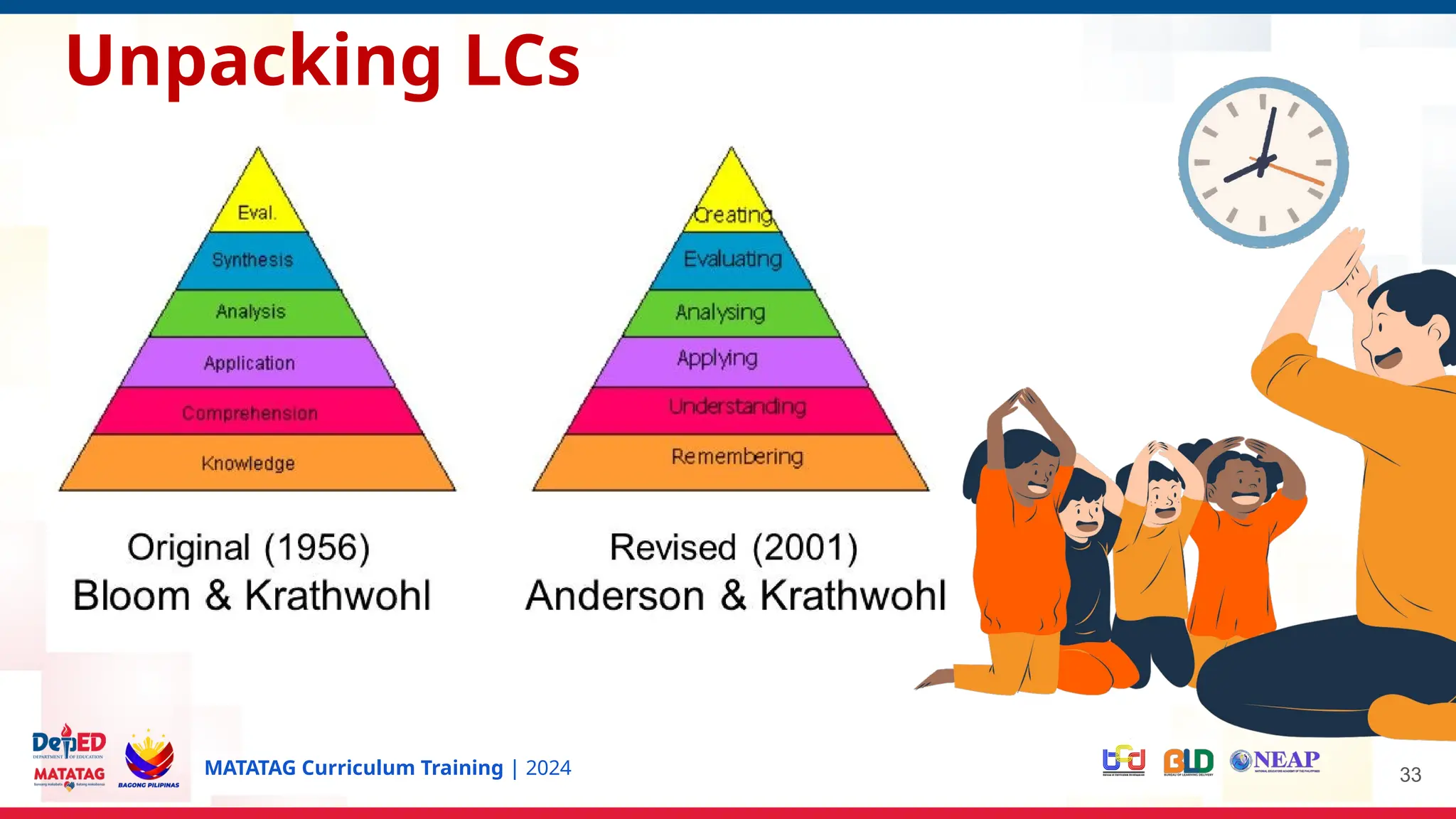
Unpacking LCs
When to Unpack?
When LCs have a high cognitive demand,
which may lead to students consistently
struggling and not making expected progress
in mastering a competency.
MATATAG Curriculum Training | 2024 34
Unpacking LCs
How to Unpack?
● Review the content and performance
standards.
● Identify the learning competency.
● Break down the LC into smaller or discrete
sub-skills or knowledge components.
MATATAG Curriculum Training | 2024 35
Unpacking LCs
How to Unpack?
● Specify the criteria for success in each sub-
skill or component through specific
learning objectives.
● Align assessment with unpacked
competencies.
● Design instructional pedagogies that allow
demonstration of mastery of sub-skills or
components.
MATATAG Curriculum Training | 2024 36
Unpacking LCs
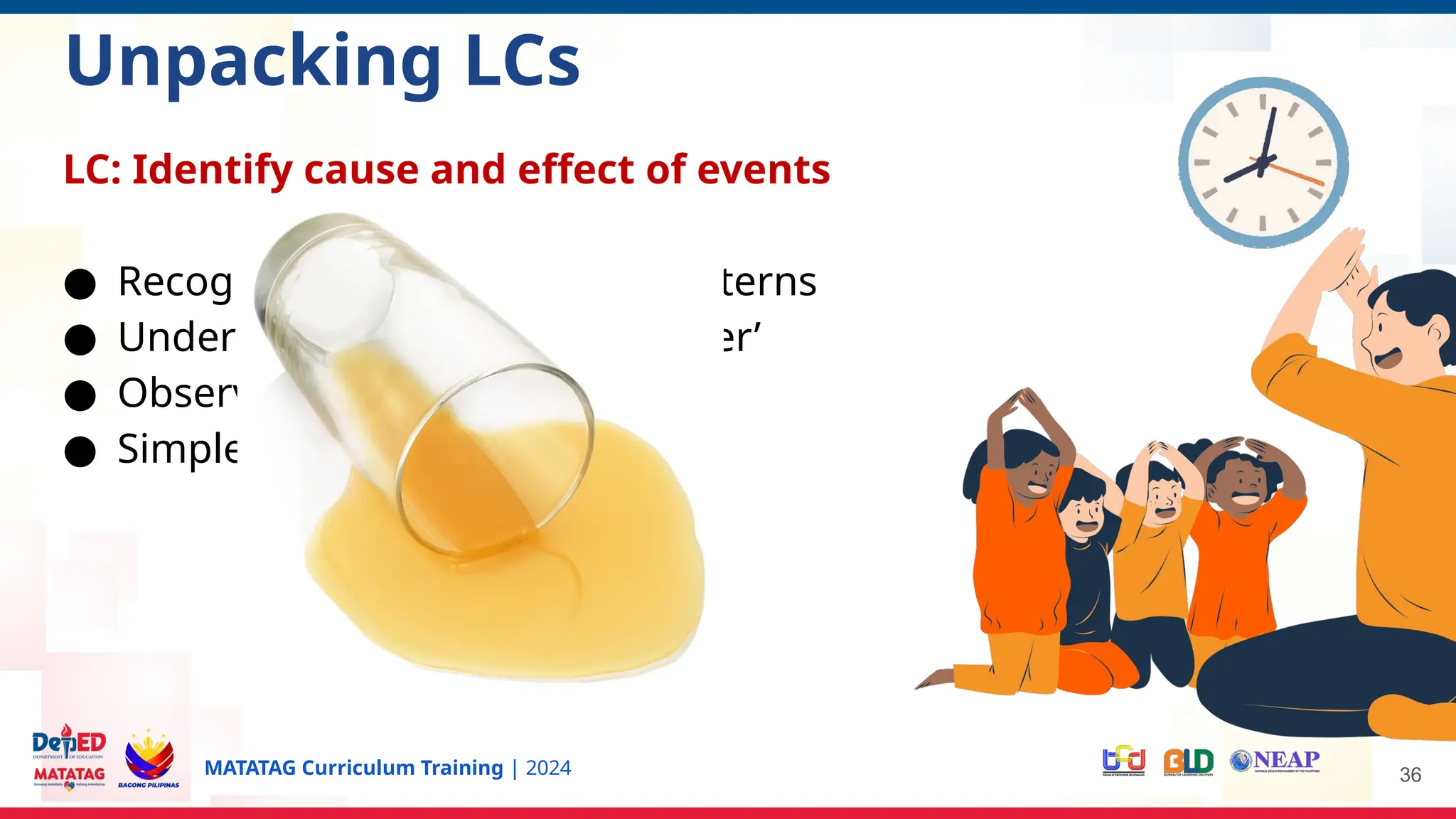
LC: Identify cause and effect of events
● Recognizing Sequences and Patterns
● Understanding 'Before' and 'After’
● Observation Skills
● Simple Problem-Solving
MATATAG Curriculum Training | 2024 37
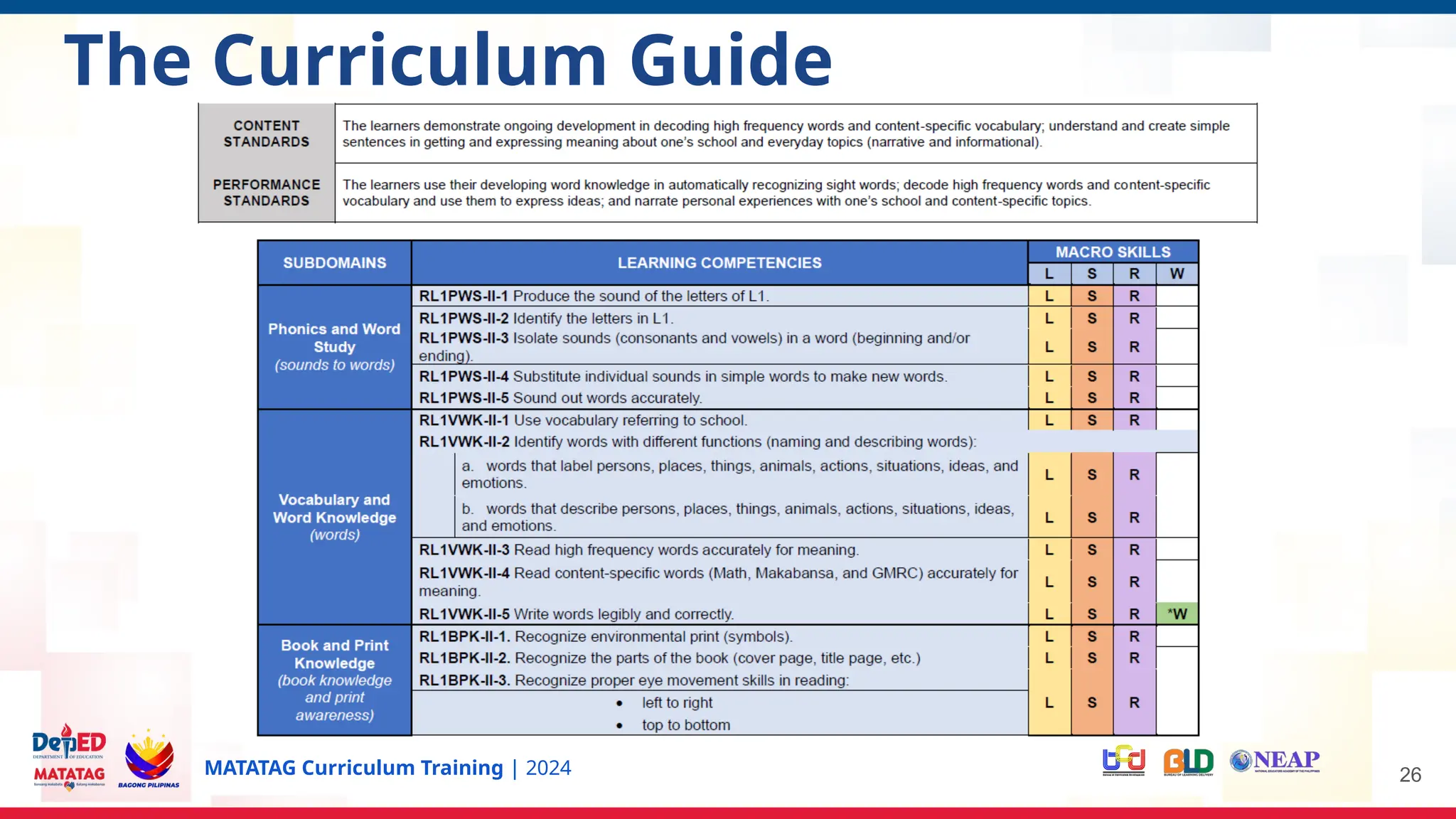
Clustering LCs
Teaching the new curricula observes the shift
from teaching isolated LCs to integrating
multiple LCs in a single lesson. Therefore,
teachers must understand the importance of
weaving LCs together for more coherent and
effective language instruction.
MATATAG Curriculum Training | 2024 38
Try it Yourself!
Using Worksheets 2 and 3, identify the learning competencies fit
for clustering and unpacking.
MATATAG Curriculum Training | 2024 39
Synthesis
As we conclude our training on the MATATAG
Language and Reading and Literacy Curricula, we
reflect on the following:
● the curriculum framework, design, structure, and
standards
● the literacy and MOTL continuum
● the Big Ideas and the dynamic focus across key
stages
● the process of unpacking standards and clustering
LCs
MATATAG Curriculum Training | 2024 40
Synthesis
Hopefully, this session has equipped us with valuable
knowledge and insights, preparing us to effectively
implement the curriculum in our classrooms and
shape the multilingual, multiliterate citizens of
tomorrow.
MATATAG Curriculum Training | 2024
Program Management Team
Curriculum and Teaching Strand
Bureau of Curriculum Development
Bureau of Learning Delivery
Bureau of Education Assessment
Bureau of Alternative Education
Bureau of Learning Resources
Human Resources and Organizational
Development Strand
National Educators Academy of the Philippines
(NEAP)
Professional Development Division
Quality Assurance Division
Session Guide and Presentation
Deck Developer/s
BCD
Ayette C. Ferriols
MATATAG CURRICULUM TRAINING RESOURCE PACKAGE
41
MARAMING SALAMAT!
42

Walkthrough of Language, Reading and Literacy Shaping Paper & Clustering of Learning Competencies.pptx

  • 1.
    TRAINING ON THE MATATAGCURRICULUM Venue Date 1
  • 2.
    TRAINING ON THE MATATAGCURRICULUM Venue Date 2 GRADE 1 LANGUAGE AND READING & LITERACY
  • 3.
    MATATAG Curriculum Training| 2024 Grade 1 Learning Journey 3 Day 1 Pretest Opening Program Session 1 The General Shape of the MATATAG Curriculum Session 2 21st Century Skills in the MATATAG Curriculum Session 3 Walkthrough of Language, Reading and Literacy Shaping Paper & Clustering of Learning Competencies Day 2 Session 4 Walkthrough of Mathematics Shaping Paper & Clustering of Learning Competencies Session 5 Walkthrough of Makabansa Shaping Paper & Clustering of Learning Competencies Session 6 Walkthrough of GMRC Shaping Paper & Clustering of Learning Competencies Day 3 Session 7 MATATAG Curriculum: Instructional Design Framework Session 8A Navigating the New Language Learning Areas: Pedagogy and Assessment in Language and Reading and Literacy Instruction Session 8B Integrating Grade 1 Learning Areas: Pedagogy and Assessment in GMRC, Math, and Makabansa Instruction Day 4 Session 9 Integrating 21st Century Skills in Classroom-based Assessment Session 10 Classroom Practices to Promote Inclusion for Special Needs Education Learners (SNED) Session 11 Collaborative Expertise Session 12 Class Observation in the Context of MATATAG Curriculum Day 5 Session 13 Management of School- based Professional Development Programs Session 14 Facilitation Skills Posttest Closing Program *For School Leaders Only
  • 4.
    MATATAG Curriculum Training| 2024 Grade 1 Learning Journey 4 Day 1 Pretest Opening Program Session 1 The General Shape of the MATATAG Curriculum Session 2 21st Century Skills in the MATATAG Curriculum Session 3 Walkthrough of Language, Reading and Literacy Shaping Paper & Clustering of Learning Competencies Day 2 Session 4 Walkthrough of Mathematics Shaping Paper & Clustering of Learning Competencies Session 5 Walkthrough of Makabansa Shaping Paper & Clustering of Learning Competencies Session 6 Walkthrough of GMRC Shaping Paper & Clustering of Learning Competencies Day 3 Session 7 MATATAG Curriculum: Instructional Design Framework Session 8A Navigating the New Language Learning Areas: Pedagogy and Assessment in Language and Reading and Literacy Instruction Session 8B Integrating Grade 1 Learning Areas: Pedagogy and Assessment in GMRC, Math, and Makabansa Instruction Day 4 Session 9 Integrating 21st Century Skills in Classroom-based Assessment Session 10 Classroom Practices to Promote Inclusion for Special Needs Education Learners (SNED) Session 11 Collaborative Expertise Session 12 Class Observation in the Context of MATATAG Curriculum Day 5 Session 13 Management of School- based Professional Development Programs Session 14 Facilitation Skills Posttest Closing Program *For School Leaders Only
  • 5.
    MATATAG Curriculum Training| 2024 Session 3 The Shaping Paper & Walkthrough of Language and Reading & Literacy JIFRIL P. ALBA 5
  • 6.
    MATATAG Curriculum Training| 2024 Session Objectives At the end of the session, participants will… 1. explain the key components of the Languages Curriculum Framework; 2. identify learning standards (curriculum standards); 3. determine possible topics for lessons in Quarters 1 and 2; 6
  • 7.
    MATATAG Curriculum Training| 2024 Session Objectives At the end of the session, participants will… 4. unpack learning competencies in Quarters 1 and 2; 5. write specific, clear, and doable learning objectives; and 6. identify the core pedagogical and assessment principles of the curriculum. 7
  • 8.
    MATATAG Curriculum Training| 2024 8 Professional Standards Addressed Domain 1: Content Knowledge and Pedagogy Domain 2: Diverse Learning Needs Domain 3: Assessment and Reporting Domain 4: Learning Environment Domain 6: Professional Engagement and Development
  • 9.
    MATATAG Curriculum Training| 2024 The Language Framework Language Curriculum Framework The Big Ideas Literacy Focus Learning Subdomains Curriculum Standards 9 Curriculum Guide Session Flow
  • 10.
    MATATAG Curriculum Training| 2024 10 What do you know about the new subjects: Language and Reading and Literacy? What insights do you have regarding the delivery of these new learning areas? What are your thoughts on the new subjects? How important is it to integrate language instruction and why? Candy Game
  • 11.
    MATATAG Curriculum Training| 2024 11 Get ready for the next activity! Dive into the curriculum with a critical eye using the guide questions in Worksheet 1 .
  • 12.
    MATATAG Curriculum Training| 2024 ● What domains or subdomains are covered in this curriculum? ● Which LCs are emphasized? ● How do these LCs contribute to the oracy and literacy development of learners? ● Considering the curriculum's scope, what content knowledge and pedagogical skills are essential for teachers in order to implement the curriculum? 12 Guided Observation
  • 13.
    MATATAG Curriculum Training| 2024 13 Get ready for the next activity! Engage in a meta-analysis of the curriculum guides for Language and Reading and Literacy.
  • 14.
    MATATAG Curriculum Training| 2024 14 Guided Meta-Analysis ● What overarching insights have we gained about these new learning areas? How does the new curriculum shape the experiences in our classrooms?
  • 15.
    MATATAG Curriculum Training| 2024 15 Guided Meta-Analysis ● How can these understandings influence our teaching practices moving forward? How do our insights influence the approach to the delivery of the new learning areas? Given the identified necessary content knowledge and pedagogical skills, how prepared do we feel as educators? What areas might require further development or support?
  • 16.
    MATATAG Curriculum Training| 2024 16 Addressing the Gaps Three significant findings were put forth based on the review of the curriculum: ● The curriculum was congested. ● Learning competencies were classified through overlapping curriculum domains. ● Knowledge of language structure was emphasized instead of literacy development.
  • 17.
    MATATAG Curriculum Training| 2024 17 Stronger emphasis on the role of L1 in English learning The Language Framework
  • 18.
    MATATAG Curriculum Training| 2024 18 Language Curriculum Framework
  • 19.
    MATATAG Curriculum Training| 2024 19 The Big Ideas
  • 20.
    MATATAG Curriculum Training| 2024 20 Shifting Big Ideas
  • 21.
    MATATAG Curriculum Training| 2024 21 Literacy Focus
  • 22.
    MATATAG Curriculum Training| 2024 22 KS1 KS2 KS3 Phonological Awareness Receptive Skills: Listening and Reading Literary Text Phonics and Word Study Informational Text (Journalistic, Non-Journalistic, Academic Texts) Vocabulary and Word Knowledge Productive Skills: Speaking and Writing Transactional Text Grammar Awareness and Grammatical Structures Comprehending and Analyzing Texts Viewing and Representing Creating and Composing Texts Learning Subdomains
  • 23.
    MATATAG Curriculum Training| 2024 23 KS1 KS2 KS3 By the end of Grade 3, learners are becoming literate and increasingly fluent in the use of English, with L1 as a literacy resource in understanding and expressing familiar and developmentally-appropriate texts. They are able to use their conversational language skills in day-to-day activities and their first language in understanding and discussing content in the learning areas; and take pride in their cultural heritage. By the end of Grade 6, learners have mastered their basic literacy and are developing applied and critical literacy. They demonstrate a level of communicative competence in English which enables them to engage effectively in a variety of situations and for a variety of audiences, contexts, and purposes, including learning of other content areas; and take pride in their cultural heritage. By the end of Grade 10, learners can critically analyze and evaluate the style, form, and features of literary, informational (non-journalistic, journalistic, and academic texts), and transactional texts. They are able to compose and publish a range of multimedia texts for a variety of meanings, purposes, and audiences, including learning in other content areas; and take pride in their cultural heritage. Key Stage Standards
  • 24.
    MATATAG Curriculum Training| 2024 24 READING AND LITERACY LANGUAGE Learners demonstrate basic literacy in their first language; decode high frequency and basic content-specific words to develop language for learning; understand how words are used in simple sentences to get and express meaning; and comprehend, respond to, and create narrative and informational texts based on real-life experiences. Learners demonstrate oracy in L1; use oral and visual language in interacting with others, developing and expressing ideas; engage with and respond to various texts based on real-life experiences; use high frequency and content-specific words; and understand how languages and culture are related. Learning Area Standards
  • 25.
    MATATAG Curriculum Training| 2024 25 The MOTL Continuum
  • 26.
    MATATAG Curriculum Training| 2024 26 The Curriculum Guide
  • 27.
    MATATAG Curriculum Training| 2024 27 The Curriculum Guide
  • 28.
    MATATAG Curriculum Training| 2024 28 The Curriculum Guide
  • 29.
    MATATAG Curriculum Training| 2024 29 The Curriculum Guide
  • 30.
    MATATAG Curriculum Training| 2024 Refer to your copies of the Curriculum Guide. 30 Walkthrough of the CG
  • 31.
    MATATAG Curriculum Training| 2024 31 Unpacking LCs Establish the Premise: ● Standards-based, not content-based. ● The focus of unpacking is standards and learning competencies. ● LCs are the unpacked version of the content and performance standards.
  • 32.
    MATATAG Curriculum Training| 2024 32 Unpacking LCs What is Unpacking? ● It breaks down complex skills or concepts into manageable parts. ● It makes curriculum standards and learning competencies more explicit and actionable through learning objectives.
  • 33.
    MATATAG Curriculum Training| 2024 33 Unpacking LCs When to Unpack? When LCs have a high cognitive demand, which may lead to students consistently struggling and not making expected progress in mastering a competency.
  • 34.
    MATATAG Curriculum Training| 2024 34 Unpacking LCs How to Unpack? ● Review the content and performance standards. ● Identify the learning competency. ● Break down the LC into smaller or discrete sub-skills or knowledge components.
  • 35.
    MATATAG Curriculum Training| 2024 35 Unpacking LCs How to Unpack? ● Specify the criteria for success in each sub- skill or component through specific learning objectives. ● Align assessment with unpacked competencies. ● Design instructional pedagogies that allow demonstration of mastery of sub-skills or components.
  • 36.
    MATATAG Curriculum Training| 2024 36 Unpacking LCs LC: Identify cause and effect of events ● Recognizing Sequences and Patterns ● Understanding 'Before' and 'After’ ● Observation Skills ● Simple Problem-Solving
  • 37.
    MATATAG Curriculum Training| 2024 37 Clustering LCs Teaching the new curricula observes the shift from teaching isolated LCs to integrating multiple LCs in a single lesson. Therefore, teachers must understand the importance of weaving LCs together for more coherent and effective language instruction.
  • 38.
    MATATAG Curriculum Training| 2024 38 Try it Yourself! Using Worksheets 2 and 3, identify the learning competencies fit for clustering and unpacking.
  • 39.
    MATATAG Curriculum Training| 2024 39 Synthesis As we conclude our training on the MATATAG Language and Reading and Literacy Curricula, we reflect on the following: ● the curriculum framework, design, structure, and standards ● the literacy and MOTL continuum ● the Big Ideas and the dynamic focus across key stages ● the process of unpacking standards and clustering LCs
  • 40.
    MATATAG Curriculum Training| 2024 40 Synthesis Hopefully, this session has equipped us with valuable knowledge and insights, preparing us to effectively implement the curriculum in our classrooms and shape the multilingual, multiliterate citizens of tomorrow.
  • 41.
    MATATAG Curriculum Training| 2024 Program Management Team Curriculum and Teaching Strand Bureau of Curriculum Development Bureau of Learning Delivery Bureau of Education Assessment Bureau of Alternative Education Bureau of Learning Resources Human Resources and Organizational Development Strand National Educators Academy of the Philippines (NEAP) Professional Development Division Quality Assurance Division Session Guide and Presentation Deck Developer/s BCD Ayette C. Ferriols MATATAG CURRICULUM TRAINING RESOURCE PACKAGE 41
  • 42.

Editor's Notes

  • #1 Purpose of the Slide: Say: Do: Note: Change the title to reflect the governance level and target audience. Download this document as a PPT.
  • #2 Purpose of the Slide: Say: Do: Note: Change the title to reflect the governance level and target audience. Download this document as a PPT.
  • #3 Purpose of the Slide: to give an overview of the sessions Say: To refresh your memory, there are X sessions for this training--. What session are we now? Other Notes: Replace it with the next slide if this will be used for a school leaders’ training.
  • #4 Purpose of the Slide: to give an overview of the sessions Say: To refresh your memory, there are X sessions for this training--. What session are we now? Other Notes: Replace it with the next slide if this will be used for a school leaders’ training.
  • #5 Purpose of the Slide: to give the title of the session and name of the RP/LF Say: I am _____________ and I will be facilitating the session titled ______. Other Notes: Faci may add more ad libs.
  • #6 Purpose of the Slide: To give the objective/aim of the session Say: In this session, you will be ___________. At the end of the session, you will also be ____________. Below are the strands of the professional standards that this PD addresses. Other Notes:
  • #7 Purpose of the Slide: To give the objective/aim of the session Say: In this session, you will be ___________. At the end of the session, you will also be ____________. Below are the strands of the professional standards that this PD addresses. Other Notes:
  • #8 Purpose of the Slide: To give the objective/aim of the session Say: In this session, you will be ___________. At the end of the session, you will also be ____________. Below are the strands of the professional standards that this PD addresses. Other Notes:
  • #36 Ask participants to try to unpack the LC above. Using the simple illustration above, show an example of basic cause and effect relationship. Break down or divide the competency into smaller learning objectives: Understand the concept of 'cause' (something that makes something else happen). Understand the concept of 'effect' (what happens as a result of the cause). Identify simple cause and effect relationships in familiar contexts.