BY: JOHN CLARENCE T. YARTE
deItennd CrrucmuliuIntended Curriculum
• refers to a set of objectives
Examples of the questions:
• Are the
within the learners’
developmental levels?
ojbceitvse elbavaciehobjectives achievable
• Can the objectives be accomplished
within the frame?emtitime
• Are the a adequate
to accomplish the objectives?
reeouresseruocesrresources
• Are the objectives cifiespc and arleac?specific and clear?
Implemented
Curriculum
Implemented
Curriculum
 refer to the various learning activities
or experiences of the students in
order to achieve the intended
curricular outcomes
To assess the implemented curriculum the following question
can be addressed:
1.Are the learning activities congruent with the
stated objectives?
2.Are the materials and method appropriate for the
objective set?
3.Does the teacher have the skill to implemented the
activities or use the strategy?
4. Does the teacher utilize the various ways of
doing to complement the learning styles of the
students?
5. Are there alternative provide maximum
learning experiences?
6. Are there activities provided to address
individual differences?
7. Do the activities provide maximum
learning experiences?
8. Do the activities motivate the learners to
do more and harness their potentials?
9. Do the activities utilize multiple sensory
abilities of the learners?
10. Do the activities address multiple
intelligences of the learners?
Achieved Curriculum
What is achieved curriculum?
 refers to the curriculum outcomes based on the
first two types of curriculum, the intended and
the implemented. The achieved curriculum is
now considered the product. It can be the
learning outcomes, or a material product itself,
like book, module or instructional material.
To measure achieved curriculum the
following questions should be
addressed:
1. Do the learning outcomes achieved by the learners
approximate the level of performance set at the
beginning of the curriculum?
2. Are the learning outcomes achieved higher or lower
than the objectives set?
3. Do the achieved learning outcomes reflect the
knowledge, skills attitudes and skills intended to be
developed?
4. How many percent of the learners in the same class
perform higher than the level set at the beginning?
5. Do the curricular outcomes reflect the goals and the
aspirations of the community where the curriculum was
implemented.
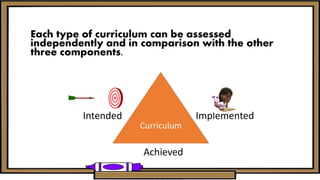
Each type of curriculum can be assessed
independently and in comparison with the other
three components.
Intended
Curriculum
Implemented
Achieved
The Basic Education Curriculum (BEC) and the Three
Types of Curriculum: Intended, Implemented and
Achieved
Question 1- What does the BEC aim to accomplish? (Intended Curriculum)
1. To raise the quality of Filipino learners and
graduates who will become lifelong learners.
2. To decongest the curriculum in order that the
teachers and learners will be able to contextualize it
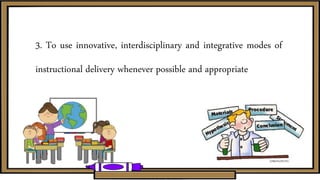
3. To use innovative, interdisciplinary and integrative modes of
instructional delivery whenever possible and appropriate
4. To make values development integral to all learning areas in high
school
5. To increase time for tasks in order to gain mastery of competencies of
the basic tool subjects
The curriculum objects are expressed in terms of competencies: knowledge, skills,
values and attitudes which the learners will develop or acquire. These objectives or
competencies determine the content which focuses on learning how to learn.
Implemented Curriculum- refers to the various activities
conducted for the purposes of accomplishing the objectives.
BEC- Basic Education Curriculum
a)Araling Panlipunan or Social Studies (Sibika at Kultura for Grade 1 and 2
and Heograpiya, Kasaysayan at Sibika (HeKaSi) for Grade 4, 5 and 6)
b)Edukasyong Pantahanan at Pangkabuhayan (EPP) for Grade 5 and 6
c)Musika, Sining at Edukasyong Pangkatawan (MSEP) for Grade 4 to 6
while for grades 1-3, MSEP is integrated in Sibika and Kultura.
d)Good Manners and Right Conduct (GMRC) is integrated in all learning
areas.
For the High School, the components of
Makabayan Learning area are as
follows:
a)Araling Panlipunan (AP) or Social Studies is composed of
Philippine History and Government, 1st Year; Asian Studies,
2nd year; World History, 3rd Year and Economics, 4th year.
b)Technology and Home Economics
c)Physical Education, Health, Music, and Arts (PEHMA)
d)Edukasyon sa Pagpapahalaga (EP) or Values Education
e)The school year 2002-2003 was declared as the pilot year in
the public schools. Private basic education schools were
encouraged to join in the implementation of the BEC in the
later years.
Question 3- What has the BEC
achieved? (Achieved Curriculum)
• From its pilot implementation, several monitoring
and evaluation processes were made the National
Education Testing and Research Center (NETRC), the
Bureau of Elementary Education (BEE) and the
Bureau of Secondary Education (BSE) were tasked to
do the evaluation of the BEC.
initial achievements of the BEC as expressed by teachers,
parents and students informally are the following:
Increased interest and motivation of students to go to school
Increased level of performance in the tool subject areas.
Change in teacher paradigm from a dispenser of
knowledge to facilitators of learning
Increased instructional material support for teaching and
learning
Increase in the in-service training of teachers
More opportunities of learners to learn on their own
Use of varied teaching strategies to complement the
learning styles of the students
More involvement of other stakeholders in the education
of the children
More involvement of the school principals in decision
making that relate to curriculum implementation
Empowered teachers and school officials
Intended vs Implemented vs Achieved Curriculum

Intended vs Implemented vs Achieved Curriculum

  • 1.
  • 3.
    deItennd CrrucmuliuIntended Curriculum •refers to a set of objectives
  • 4.
    Examples of thequestions: • Are the within the learners’ developmental levels? ojbceitvse elbavaciehobjectives achievable
  • 5.
    • Can theobjectives be accomplished within the frame?emtitime
  • 6.
    • Are thea adequate to accomplish the objectives? reeouresseruocesrresources
  • 7.
    • Are theobjectives cifiespc and arleac?specific and clear?
  • 8.
  • 9.
    Implemented Curriculum  refer tothe various learning activities or experiences of the students in order to achieve the intended curricular outcomes
  • 10.
    To assess theimplemented curriculum the following question can be addressed: 1.Are the learning activities congruent with the stated objectives? 2.Are the materials and method appropriate for the objective set? 3.Does the teacher have the skill to implemented the activities or use the strategy?
  • 11.
    4. Does theteacher utilize the various ways of doing to complement the learning styles of the students? 5. Are there alternative provide maximum learning experiences? 6. Are there activities provided to address individual differences?
  • 12.
    7. Do theactivities provide maximum learning experiences? 8. Do the activities motivate the learners to do more and harness their potentials? 9. Do the activities utilize multiple sensory abilities of the learners? 10. Do the activities address multiple intelligences of the learners?
  • 13.
  • 14.
    What is achievedcurriculum?  refers to the curriculum outcomes based on the first two types of curriculum, the intended and the implemented. The achieved curriculum is now considered the product. It can be the learning outcomes, or a material product itself, like book, module or instructional material.
  • 15.
    To measure achievedcurriculum the following questions should be addressed: 1. Do the learning outcomes achieved by the learners approximate the level of performance set at the beginning of the curriculum? 2. Are the learning outcomes achieved higher or lower than the objectives set?
  • 16.
    3. Do theachieved learning outcomes reflect the knowledge, skills attitudes and skills intended to be developed? 4. How many percent of the learners in the same class perform higher than the level set at the beginning? 5. Do the curricular outcomes reflect the goals and the aspirations of the community where the curriculum was implemented.
  • 17.
    Each type ofcurriculum can be assessed independently and in comparison with the other three components. Intended Curriculum Implemented Achieved
  • 18.
    The Basic EducationCurriculum (BEC) and the Three Types of Curriculum: Intended, Implemented and Achieved
  • 19.
    Question 1- Whatdoes the BEC aim to accomplish? (Intended Curriculum) 1. To raise the quality of Filipino learners and graduates who will become lifelong learners.
  • 20.
    2. To decongestthe curriculum in order that the teachers and learners will be able to contextualize it
  • 21.
    3. To useinnovative, interdisciplinary and integrative modes of instructional delivery whenever possible and appropriate
  • 22.
    4. To makevalues development integral to all learning areas in high school 5. To increase time for tasks in order to gain mastery of competencies of the basic tool subjects
  • 23.
    The curriculum objectsare expressed in terms of competencies: knowledge, skills, values and attitudes which the learners will develop or acquire. These objectives or competencies determine the content which focuses on learning how to learn.
  • 25.
    Implemented Curriculum- refersto the various activities conducted for the purposes of accomplishing the objectives. BEC- Basic Education Curriculum
  • 27.
    a)Araling Panlipunan orSocial Studies (Sibika at Kultura for Grade 1 and 2 and Heograpiya, Kasaysayan at Sibika (HeKaSi) for Grade 4, 5 and 6) b)Edukasyong Pantahanan at Pangkabuhayan (EPP) for Grade 5 and 6 c)Musika, Sining at Edukasyong Pangkatawan (MSEP) for Grade 4 to 6 while for grades 1-3, MSEP is integrated in Sibika and Kultura. d)Good Manners and Right Conduct (GMRC) is integrated in all learning areas.
  • 28.
    For the HighSchool, the components of Makabayan Learning area are as follows: a)Araling Panlipunan (AP) or Social Studies is composed of Philippine History and Government, 1st Year; Asian Studies, 2nd year; World History, 3rd Year and Economics, 4th year. b)Technology and Home Economics c)Physical Education, Health, Music, and Arts (PEHMA) d)Edukasyon sa Pagpapahalaga (EP) or Values Education e)The school year 2002-2003 was declared as the pilot year in the public schools. Private basic education schools were encouraged to join in the implementation of the BEC in the later years.
  • 29.
    Question 3- Whathas the BEC achieved? (Achieved Curriculum)
  • 30.
    • From itspilot implementation, several monitoring and evaluation processes were made the National Education Testing and Research Center (NETRC), the Bureau of Elementary Education (BEE) and the Bureau of Secondary Education (BSE) were tasked to do the evaluation of the BEC.
  • 31.
    initial achievements ofthe BEC as expressed by teachers, parents and students informally are the following: Increased interest and motivation of students to go to school Increased level of performance in the tool subject areas.
  • 32.
    Change in teacherparadigm from a dispenser of knowledge to facilitators of learning Increased instructional material support for teaching and learning
  • 33.
    Increase in thein-service training of teachers More opportunities of learners to learn on their own Use of varied teaching strategies to complement the learning styles of the students
  • 34.
    More involvement ofother stakeholders in the education of the children More involvement of the school principals in decision making that relate to curriculum implementation Empowered teachers and school officials