Strategic Planning
Williams College
Spring Managers Series
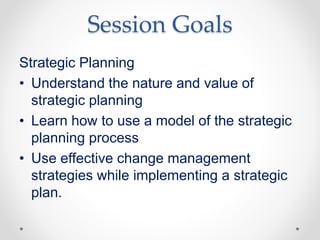
Session Goals
Strategic Planning
• Understand the nature and value of
strategic planning
• Learn how to use a model of the strategic
planning process
• Use effective change management
strategies while implementing a strategic
plan.
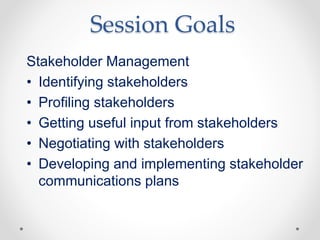
Session Goals
Stakeholder Management
• Identifying stakeholders
• Profiling stakeholders
• Getting useful input from stakeholders
• Negotiating with stakeholders
• Developing and implementing stakeholder
communications plans
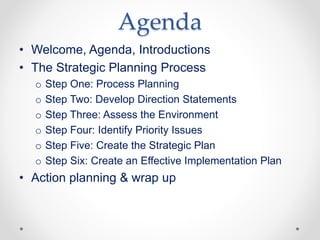
Agenda
• Welcome, Agenda, Introductions
• The Strategic Planning Process
o Step One: Process Planning
o Step Two: Develop Direction Statements
o Step Three: Assess the Environment
o Step Four: Identify Priority Issues
o Step Five: Create the Strategic Plan
o Step Six: Create an Effective Implementation Plan
• Action planning & wrap up
What is Strategic
Planning?
Strategic planning is a systematic process
through which an organization agrees on – and
builds commitment among key stakeholders to
– priorities that are essential to its mission and
are responsive to the environment. Strategic
planning guides the acquisition and allocation
of resources to achieve these priorities.
Strategic Planning for Nonprofit Organizations,
Second Edition
End Game of Strategic
Planning
Have a plan that:
oIs realistic
oReady to be implemented
oGuides decision making
oBuilds commitment
Strategic Planning Process
Overview
• Clarify roles
• Agree on planning process
• Identify organizational mandates
• Clarify (or develop) mission, vision, values
• Scan the environment
• Draft priority issues
• Create high-level action plans
• Create the strategic plan document
• Implement, review, assess and adjust as needed
Identify Planning Process Issues
and Outcomes
• What would success look like at the completion of
the planning process?
• What does your organization wish to achieve from a
planning process?
• What issues or choices do you think need to be
addressed during the planning process?
• Are there any non-negotiables that need to be
articulated upfront?
• Any constraints regarding the planning process?
Mission Statement
Statement of purpose, why your organization exists
Google’s Mission
Google’s mission is to organize the world’s information and
make it universally accessible and useful.
MISSION OF WILLIAMS COLLEGE
Williams seeks to provide the finest possible liberal
arts education by nurturing in students the
academic and civic virtues, and their related traits
of character. Academic virtues include the
capacities to explore widely and deeply, think
critically, reason empirically, express clearly, and
connect ideas creatively. Civic virtues include
commitment to engage both the broad public realm
and community life, and the skills to do so
effectively.
Vision Statement
• An image of the future you seek
to create.
• What does your organization
aspire to?
• What is it striving for?
Teach It Forward
Campaign
Vision Statement
The American Red Cross
through its strong network of volunteers, donors and partners, is always
there in times of need. We aspire to turn compassion into action so
that...
..all people affected by disaster across the country and around the
world receive care, shelter and hope;
...our communities are ready and prepared for disasters;
...everyone in our country has access to safe, lifesaving blood and
blood products;
...all members of our armed services and their families find support and
comfort whenever needed; and
...in an emergency, there are always trained individuals nearby, ready
to use their Red Cross skills to save lives.
Values Example
Northwest Human Services:
Core Values
• COMMUNITY: Those we work with and those
we serve.
• COOPERATION: The spirit of our work ethics.
• COMPASSION: The inspiration that guides our
work.
• COMMITMENT: The pledge we make to quality
services
Values Example
LL Bean Values
Much has changed since 1912, but some things remain the
same. The values that the company's founder, L.L. Bean,
was raised to believe in were simple and deeply
ingrained. Nature is something to be revered. Family ties
are a priority. Being neighborly is a matter of course. And
"do unto others" is not just a saying, but a way of life. When
L.L. launched his company, he believed so strongly in the
Golden Rule that he made it the foundation of his business.
Assess the Environment - SWOT
• List strengths and weaknesses—internal forces working
for and against our organization achieving its mission.
• List key opportunities and threats—political, economic,
social, technological, demographic, or legal trends that
are or may impact our organization’s ability to achieve its
mission.
• (Optional) Indicate any possible connection between an
opportunity or threat and a strength or weakness? (Are
there any opportunities we can take advantage of
because of a particular strength? Are there any threats
that are compounded by a weakness?)
Then What?
• Identify priority issues
• Create high-level action plans
• Create the strategic plan
• Implement and make adjustments as
necessary
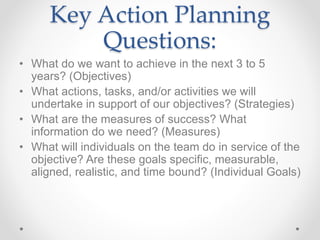
Key Action Planning
Questions:
• What do we want to achieve in the next 3 to 5
years? (Objectives)
• What actions, tasks, and/or activities we will
undertake in support of our objectives? (Strategies)
• What are the measures of success? What
information do we need? (Measures)
• What will individuals on the team do in service of the
objective? Are these goals specific, measurable,
aligned, realistic, and time bound? (Individual Goals)
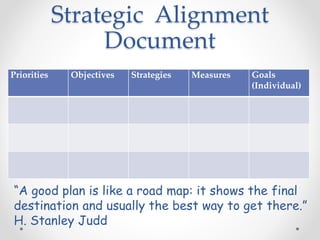
Strategic Alignment
Document
Priorities Objectives Strategies Measures Goals
(Individual)
“A good plan is like a road map: it shows the final
destination and usually the best way to get there.”
H. Stanley Judd
Stakeholders and
Communication Planning
Map your authorizing environment
• Authorizers
• Friends/foes/potential
friends/potential foes
• Clients/beneficiaries/customers
Action Planning
What tools or frameworks did you find most helpful?
What discussion points did you find more helpful?
What are some specific actions you will take to apply
what you’ve learned?
What other learnings do you want to capture while the
information is still fresh?
That’s a Wrap!

Strategic planning

  • 1.
  • 2.
    Session Goals Strategic Planning •Understand the nature and value of strategic planning • Learn how to use a model of the strategic planning process • Use effective change management strategies while implementing a strategic plan.
  • 3.
    Session Goals Stakeholder Management •Identifying stakeholders • Profiling stakeholders • Getting useful input from stakeholders • Negotiating with stakeholders • Developing and implementing stakeholder communications plans
  • 4.
    Agenda • Welcome, Agenda,Introductions • The Strategic Planning Process o Step One: Process Planning o Step Two: Develop Direction Statements o Step Three: Assess the Environment o Step Four: Identify Priority Issues o Step Five: Create the Strategic Plan o Step Six: Create an Effective Implementation Plan • Action planning & wrap up
  • 5.
    What is Strategic Planning? Strategicplanning is a systematic process through which an organization agrees on – and builds commitment among key stakeholders to – priorities that are essential to its mission and are responsive to the environment. Strategic planning guides the acquisition and allocation of resources to achieve these priorities. Strategic Planning for Nonprofit Organizations, Second Edition
  • 6.
    End Game ofStrategic Planning Have a plan that: oIs realistic oReady to be implemented oGuides decision making oBuilds commitment
  • 7.
    Strategic Planning Process Overview •Clarify roles • Agree on planning process • Identify organizational mandates • Clarify (or develop) mission, vision, values • Scan the environment • Draft priority issues • Create high-level action plans • Create the strategic plan document • Implement, review, assess and adjust as needed
  • 8.
    Identify Planning ProcessIssues and Outcomes • What would success look like at the completion of the planning process? • What does your organization wish to achieve from a planning process? • What issues or choices do you think need to be addressed during the planning process? • Are there any non-negotiables that need to be articulated upfront? • Any constraints regarding the planning process?
  • 9.
    Mission Statement Statement ofpurpose, why your organization exists Google’s Mission Google’s mission is to organize the world’s information and make it universally accessible and useful.
  • 10.
    MISSION OF WILLIAMSCOLLEGE Williams seeks to provide the finest possible liberal arts education by nurturing in students the academic and civic virtues, and their related traits of character. Academic virtues include the capacities to explore widely and deeply, think critically, reason empirically, express clearly, and connect ideas creatively. Civic virtues include commitment to engage both the broad public realm and community life, and the skills to do so effectively.
  • 11.
    Vision Statement • Animage of the future you seek to create. • What does your organization aspire to? • What is it striving for?
  • 12.
  • 13.
    Vision Statement The AmericanRed Cross through its strong network of volunteers, donors and partners, is always there in times of need. We aspire to turn compassion into action so that... ..all people affected by disaster across the country and around the world receive care, shelter and hope; ...our communities are ready and prepared for disasters; ...everyone in our country has access to safe, lifesaving blood and blood products; ...all members of our armed services and their families find support and comfort whenever needed; and ...in an emergency, there are always trained individuals nearby, ready to use their Red Cross skills to save lives.
  • 14.
    Values Example Northwest HumanServices: Core Values • COMMUNITY: Those we work with and those we serve. • COOPERATION: The spirit of our work ethics. • COMPASSION: The inspiration that guides our work. • COMMITMENT: The pledge we make to quality services
  • 15.
    Values Example LL BeanValues Much has changed since 1912, but some things remain the same. The values that the company's founder, L.L. Bean, was raised to believe in were simple and deeply ingrained. Nature is something to be revered. Family ties are a priority. Being neighborly is a matter of course. And "do unto others" is not just a saying, but a way of life. When L.L. launched his company, he believed so strongly in the Golden Rule that he made it the foundation of his business.
  • 16.
    Assess the Environment- SWOT • List strengths and weaknesses—internal forces working for and against our organization achieving its mission. • List key opportunities and threats—political, economic, social, technological, demographic, or legal trends that are or may impact our organization’s ability to achieve its mission. • (Optional) Indicate any possible connection between an opportunity or threat and a strength or weakness? (Are there any opportunities we can take advantage of because of a particular strength? Are there any threats that are compounded by a weakness?)
  • 17.
    Then What? • Identifypriority issues • Create high-level action plans • Create the strategic plan • Implement and make adjustments as necessary
  • 18.
    Key Action Planning Questions: •What do we want to achieve in the next 3 to 5 years? (Objectives) • What actions, tasks, and/or activities we will undertake in support of our objectives? (Strategies) • What are the measures of success? What information do we need? (Measures) • What will individuals on the team do in service of the objective? Are these goals specific, measurable, aligned, realistic, and time bound? (Individual Goals)
  • 19.
    Strategic Alignment Document Priorities ObjectivesStrategies Measures Goals (Individual) “A good plan is like a road map: it shows the final destination and usually the best way to get there.” H. Stanley Judd
  • 20.
    Stakeholders and Communication Planning Mapyour authorizing environment • Authorizers • Friends/foes/potential friends/potential foes • Clients/beneficiaries/customers
  • 21.
    Action Planning What toolsor frameworks did you find most helpful? What discussion points did you find more helpful? What are some specific actions you will take to apply what you’ve learned? What other learnings do you want to capture while the information is still fresh?
  • 22.