An act of instituting a framework for
governance for basic education. Establishing
Authority and accountability, renaming the
Department of Education, Culture an d Shorts,
as the Department of Education and for other
purposes
Primary goal: To provide the school age
population and young adults with skills,
knowledge and values to become caring, self-
reliant, productive and patriotic citizens.
• Provide framework for Governance
of basic Education.
• Define the roles and
responsibilities of the offices in the
Education Department.
• Makes the schools and learning
centers the most important vehicle
for teaching and learning.
Core Competency [kawr.kompet'nsee]
n.
a defined level of expertise that is
essential or fundamental to a particular
job; the primary area of expertise,
specialty; the expertise that allows an
organization or individual to beat it's
competitors
• Alternative learning
System
• Basic Education
• Cluster of schools
• Formal Education
• Informal Education
• Integrated Education
• Learner
• Learning Center
• Learning facilitator
• non-formal Education
• Quality Education
• School
• School Head
• It is a principle which recognizes that
every unit in the education
bureaucracy has a particular role,
task, and responsibility inherent in the
office.
• Democratic consultation is observed
in the decision-making process at
appropriate levels.
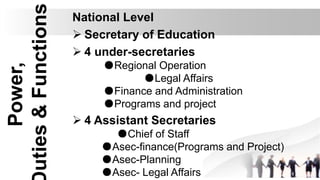
National Level
 Secretary of Education
 4 under-secretaries
●Regional Operation
●Legal Affairs
●Finance and Administration
●Programs and project
 4 Assistant Secretaries
●Chief of Staff
●Asec-finance(Programs and Project)
●Asec-Planning
●Asec- Legal Affairs
Power,
uties&Functions
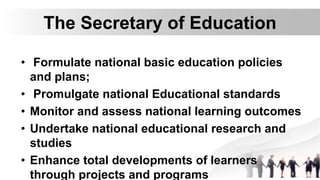
The Secretary of Education
• Formulate national basic education policies
and plans;
• Promulgate national Educational standards
• Monitor and assess national learning outcomes
• Undertake national educational research and
studies
• Enhance total developments of learners
through projects and programs
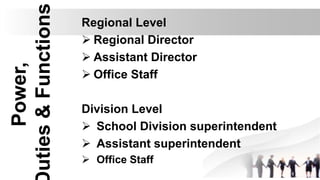
Regional Level
 Regional Director
 Assistant Director
 Office Staff
Division Level
 School Division superintendent
 Assistant superintendent
 Office Staff
Power,
uties&Functions
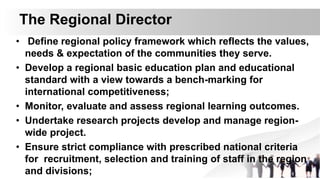
The Regional Director
• Define regional policy framework which reflects the values,
needs & expectation of the communities they serve.
• Develop a regional basic education plan and educational
standard with a view towards a bench-marking for
international competitiveness;
• Monitor, evaluate and assess regional learning outcomes.
• Undertake research projects develop and manage region-
wide project.
• Ensure strict compliance with prescribed national criteria
for recruitment, selection and training of staff in the region
and divisions;
Power,
uties&Functions
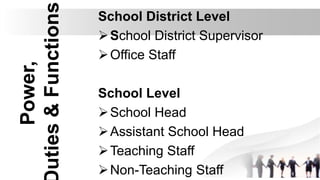
School District Level
School District Supervisor
Office Staff
School Level
School Head
Assistant School Head
Teaching Staff
Non-Teaching Staff
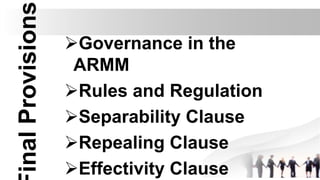
Governance in the
ARMM
Rules and Regulation
Separability Clause
Repealing Clause
Effectivity Clause
inalProvisions

REPUBLIC ACT NO 9155

  • 2.
    An act ofinstituting a framework for governance for basic education. Establishing Authority and accountability, renaming the Department of Education, Culture an d Shorts, as the Department of Education and for other purposes Primary goal: To provide the school age population and young adults with skills, knowledge and values to become caring, self- reliant, productive and patriotic citizens.
  • 4.
    • Provide frameworkfor Governance of basic Education. • Define the roles and responsibilities of the offices in the Education Department. • Makes the schools and learning centers the most important vehicle for teaching and learning.
  • 5.
    Core Competency [kawr.kompet'nsee] n. adefined level of expertise that is essential or fundamental to a particular job; the primary area of expertise, specialty; the expertise that allows an organization or individual to beat it's competitors
  • 6.
    • Alternative learning System •Basic Education • Cluster of schools • Formal Education • Informal Education • Integrated Education • Learner • Learning Center • Learning facilitator • non-formal Education • Quality Education • School • School Head
  • 7.
    • It isa principle which recognizes that every unit in the education bureaucracy has a particular role, task, and responsibility inherent in the office. • Democratic consultation is observed in the decision-making process at appropriate levels.
  • 8.
    National Level  Secretaryof Education  4 under-secretaries ●Regional Operation ●Legal Affairs ●Finance and Administration ●Programs and project  4 Assistant Secretaries ●Chief of Staff ●Asec-finance(Programs and Project) ●Asec-Planning ●Asec- Legal Affairs Power, uties&Functions
  • 9.
    The Secretary ofEducation • Formulate national basic education policies and plans; • Promulgate national Educational standards • Monitor and assess national learning outcomes • Undertake national educational research and studies • Enhance total developments of learners through projects and programs
  • 10.
    Regional Level  RegionalDirector  Assistant Director  Office Staff Division Level  School Division superintendent  Assistant superintendent  Office Staff Power, uties&Functions
  • 11.
    The Regional Director •Define regional policy framework which reflects the values, needs & expectation of the communities they serve. • Develop a regional basic education plan and educational standard with a view towards a bench-marking for international competitiveness; • Monitor, evaluate and assess regional learning outcomes. • Undertake research projects develop and manage region- wide project. • Ensure strict compliance with prescribed national criteria for recruitment, selection and training of staff in the region and divisions;
  • 12.
    Power, uties&Functions School District Level SchoolDistrict Supervisor Office Staff School Level School Head Assistant School Head Teaching Staff Non-Teaching Staff
  • 13.
    Governance in the ARMM Rulesand Regulation Separability Clause Repealing Clause Effectivity Clause inalProvisions