  Sustainability is the capacity to endure.
  In ECOLOGY the word describes how
biological systems remain diverse and
productive over time.
  For HUMANSpotential for long-term
maintenance of well being, which has
ecological, economic, political and cultural
dimensions.
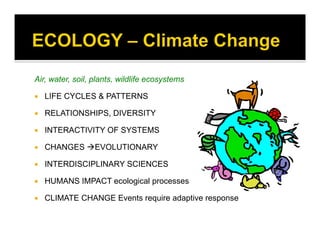
Air, water, soil, plants, wildlife ecosystems
  LIFE CYCLES & PATTERNS
  RELATIONSHIPS, DIVERSITY
  INTERACTIVITY OF SYSTEMS
  CHANGES EVOLUTIONARY
  INTERDISCIPLINARY SCIENCES
  HUMANS IMPACT ecological processes
  CLIMATE CHANGE Events require adaptive response
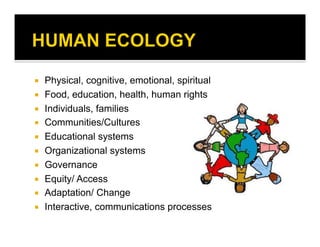
  Physical, cognitive, emotional, spiritual
  Food, education, health, human rights
  Individuals, families
  Communities/Cultures
  Educational systems
  Organizational systems
  Governance
  Equity/ Access
  Adaptation/ Change
  Interactive, communications processes
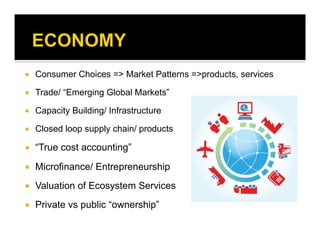
  Consumer Choices => Market Patterns =>products, services
  Trade/ “Emerging Global Markets”
  Capacity Building/ Infrastructure
  Closed loop supply chain/ products
  “True cost accounting”
  Microfinance/ Entrepreneurship
  Valuation of Ecosystem Services
  Private vs public “ownership”
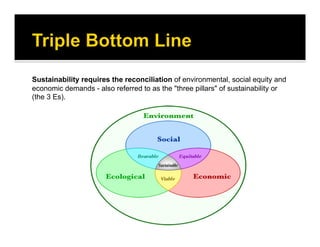
Sustainability requires the reconciliation of environmental, social equity and
economic demands - also referred to as the "three pillars" of sustainability or
(the 3 Es).
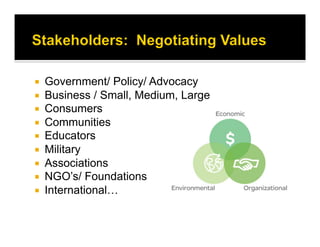
  Government/ Policy/ Advocacy
  Business / Small, Medium, Large
  Consumers
  Communities
  Educators
  Military
  Associations
  NGO’s/ Foundations
  International…
•  7Billion on the Planet –water, food, energy, shelter
•  Local vs global supply chain/ “Green Business”
•  Biofuels/ Alternative Energy -- “Smart Grid” Incentives
•  Construction/ Green Building
•  Biotechnology/ Global Public Health
•  Transportation Systems – Changing Work Systems
•  Communications Systems – Access vs. Security
•  Food production – Domestic vs. Global Distribution
•  International Trade/ Economy vs. Public Policy
•  Public-Private Partnerships/ Resource Sharing
•  Interdisciplinary Problem Solving/ Niche Experts
•  Collaborative Teams/ Interactive Systems
•  Diversity/ Equity Issues /Policy Change & Advocacy
•  Post-Crisis Event/ Ecological Restoration Projects
  Internet Connectivity & Collaboration
  Public & Private Partners
  Interdisciplinary Problem Solving
  Diversity & International Exchange
  Social “Conscience” & Responsibility
  Shared Environment/ Sustainability
  EQ Assessments for Best Leadership
"Destiny is not a matter of
chance,
it is a matter of choice;
it is not a thing to be
waited for,
it is a thing
to be achieved."
- Winston Churchill
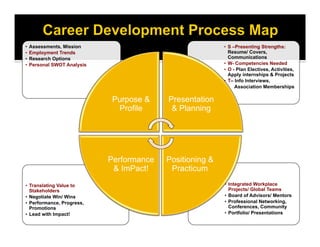
•  Integrated Workplace
Projects/ Global Teams
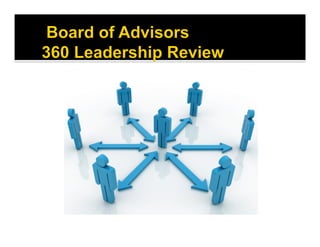
•  Board of Advisors/ Mentors
•  Professional Networking,
Conferences, Community
•  Portfolio/ Presentations
•  Translating Value to
Stakeholders
•  Negotiate Win/ Wins
•  Performance, Progress,
Promotions
•  Lead with Impact!
•  S –Presenting Strengths:
Resume/ Covers,
Communications
•  W- Competencies Needed
•  O - Plan Electives, Activities,
Apply internships & Projects
•  T– Info Interviews,
•  Association Memberships
•  Assessments, Mission
•  Employment Trends
•  Research Options
•  Personal SWOT Analysis
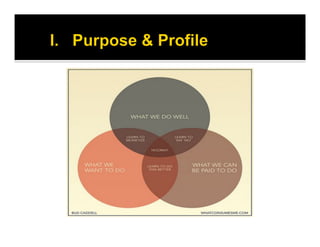
Purpose &
Profile
Presentation
& Planning
Positioning &
Practicum
Performance
& ImPact!
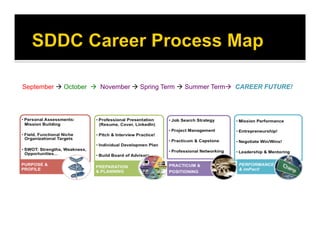
September  October  November  Spring Term  Summer Term CAREER FUTURE!
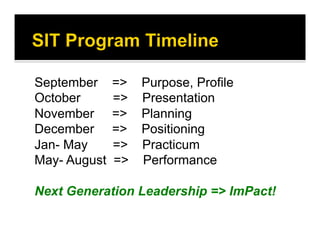
September => Purpose, Profile
October => Presentation
November => Planning
December => Positioning
Jan- May => Practicum
May- August => Performance
Next Generation Leadership => ImPact!
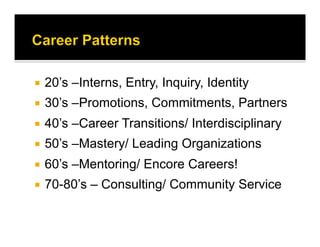
  20’s –Interns, Entry, Inquiry, Identity
  30’s –Promotions, Commitments, Partners
  40’s –Career Transitions/ Interdisciplinary
  50’s –Mastery/ Leading Organizations
  60’s –Mentoring/ Encore Careers!
  70-80’s – Consulting/ Community Service
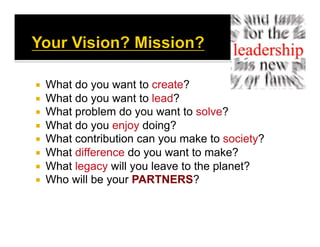
  What do you want to create?
  What do you want to lead?
  What problem do you want to solve?
  What do you enjoy doing?
  What contribution can you make to society?
  What difference do you want to make?
  What legacy will you leave to the planet?
  Who will be your PARTNERS?
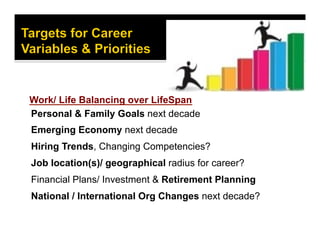
Personal & Family Goals next decade
Emerging Economy next decade
Hiring Trends, Changing Competencies?
Job location(s)/ geographical radius for career?
Financial Plans/ Investment & Retirement Planning
National / International Org Changes next decade?
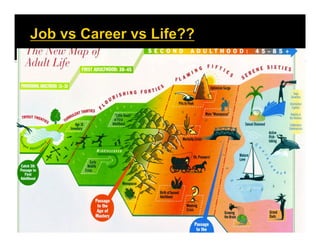
Work/ Life Balancing over LifeSpan
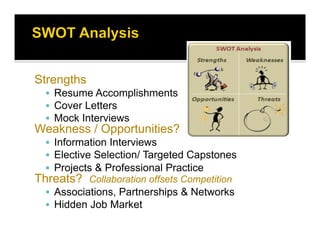
Strengths
  Resume Accomplishments
  Cover Letters
  Mock Interviews
Weakness / Opportunities?
  Information Interviews
  Elective Selection/ Targeted Capstones
  Projects & Professional Practice
Threats? Collaboration offsets Competition
  Associations, Partnerships & Networks
  Hidden Job Market
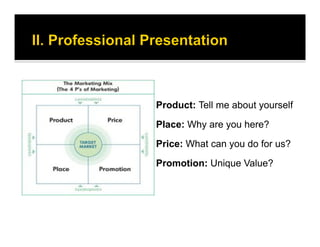
•  Product: Tell me about yourself
•  Place: Why are you here?
•  Price: What can you do for us?
•  Promotion: Unique Value?
  What is relevant to employer?
  What is your mission?
  What are your areas of expertise?
  What are your proven accomplishments?
  How can you show results?
  What organization do you want to join?
  What can you bring to the team?
  What makes you the BEST candidate?
•  Executives were asked, "How long does
it typically take you to form either a
positive or negative opinion of a job
candidate during an initial interview?"
The mean response was 10 minutes.
•  Robert Half Finance & Accounting,, 2007. 150
senior executives with Fortune 1,000 companies.
•  Personal Polish/ The Suit
•  Business Cards
•  Cover Letter
•  Resume AND LinkedIN!
•  Exhibits of Accomplishment
•  Web-based publications or exhibits
•  References/ Associations
What’s your Personal BRAND
Google Yourself – What do you find?
Are you on LinkedIn – Recruiters ARE!
  working in teams, particularly teams drawn from multiple disciplines and
varied backgrounds
  understanding and applying systems thinking
  engaging in strategic planning
  applying the principles of return on investment for sustainable practices
  evaluating environmental performance, economic performance, and
social performance
  understanding how values affect policy and decision-making
  communicating with people from a variety of backgrounds
  working with multiple stakeholders 
  completion of a specific project or deliverable that serves an outside
client, audience or community group
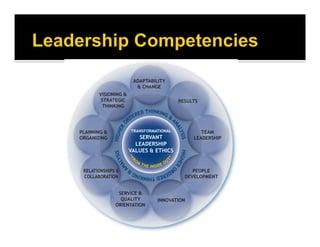
  Leadership – vision, inspiring others, win/win solutions
  Ethical Judgment- Integrity impacts business value
  Executive “Presence” – Presentation & Communications
  Technology – management efficiency & effectiveness
  Team-collaborative innovation and “negotiation”
  Problem Solving – ambiguities, complexity, limited
resources, strategic coordination of talent, tools, information
  Accountability – balancing with flexibility & autonomy
  Financial processes- global transactions/ “insecurities”
  Data/ Decision Processes – information sharing vs. security
  Analytical Perspective – Systems implications of actions
DRIVE! (Dan Pink, 2009)
  Autonomy – Own The Question
  Purpose – Develop your Mission
  Mastery – Improve Skills, Innovate!
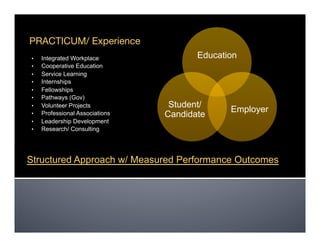
•  Integrated Workplace
•  Cooperative Education
•  Service Learning
•  Internships
•  Fellowships
•  Pathways (Gov)
•  Volunteer Projects
•  Professional Associations
•  Leadership Development
•  Research/ Consulting
Education
Employer
Student/
Candidate
PRACTICUM/ Experience
Structured Approach w/ Measured Performance Outcomes
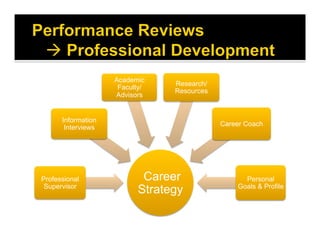
Career
Strategy
Professional
Supervisor
Information
Interviews
Academic
Faculty/
Advisors
Research/
Resources
Career Coach
Personal
Goals & Profile
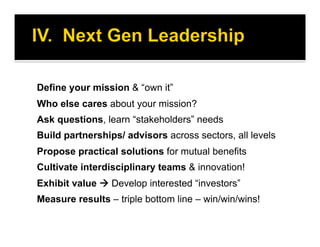
Define your mission & “own it”
Who else cares about your mission?
Ask questions, learn “stakeholders” needs
Build partnerships/ advisors across sectors, all levels
Propose practical solutions for mutual benefits
Cultivate interdisciplinary teams & innovation!
Exhibit value  Develop interested “investors”
Measure results – triple bottom line – win/win/wins!
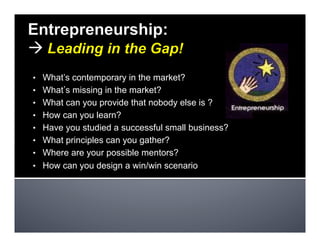
•  What’s contemporary in the market?
•  What s missing in the market?
•  What can you provide that nobody else is ?
•  How can you learn?
•  Have you studied a successful small business?
•  What principles can you gather?
•  Where are your possible mentors?
•  How can you design a win/win scenario
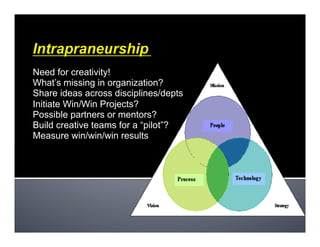
Need for creativity!
What’s missing in organization?
Share ideas across disciplines/depts
Initiate Win/Win Projects?
Possible partners or mentors?
Build creative teams for a “pilot”?
Measure win/win/win results
  Individual Career Coaching
  Group Workshops / Webinars
  Practicum Planning & Placement
  Squeak Stone, Director/ Vermont Office
  Career Connect, Jobs Database
  Moodle Resources, Career Preparation
  Professional Insights:
  Brownbags, Seminars, Panels, Events
  Local meetings / Skype/ “Google Groups”
  All sectors/ Gov, Biz, Edu, NGO’s
  Professional Associations
  Information Interviews/ Local Professionals
  International/ Diversity/ Cultural Exchange
  Environment, Economic, Social Justice
  International Roundtable/ WNG
  Next Gen Leaders/ DC “meet-ups”
  Green Festival @ DC Sept 21
  Sustainable Solutions Forum / Nov 6
  NCSE Climate Change Conference / Jan 28-30
  2 days Career “Bootcamp”!
  September 4 & 5, 2-4pm
  Pre-work will be sent by email
  Coach appointments
  Phyllis.Thibodeau@sit.edu
  Appointy (will send you links via email)
  In person or via skype, phone, google video
  Groups, Calendar, Docs, Hangout, Network
  CareerCoachsddc@gmail.com
  LinkedIn/ Next Generation Leaders/ DC
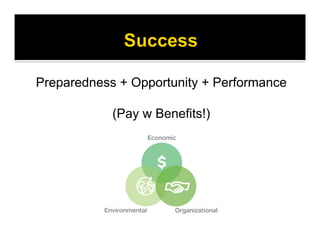
Preparedness + Opportunity + Performance
(Pay w Benefits!)

Sustainable Solutions: Next Generation Careers

  • 2.
      Sustainability isthe capacity to endure.   In ECOLOGY the word describes how biological systems remain diverse and productive over time.   For HUMANSpotential for long-term maintenance of well being, which has ecological, economic, political and cultural dimensions.
  • 3.
    Air, water, soil,plants, wildlife ecosystems   LIFE CYCLES & PATTERNS   RELATIONSHIPS, DIVERSITY   INTERACTIVITY OF SYSTEMS   CHANGES EVOLUTIONARY   INTERDISCIPLINARY SCIENCES   HUMANS IMPACT ecological processes   CLIMATE CHANGE Events require adaptive response
  • 4.
      Physical, cognitive,emotional, spiritual   Food, education, health, human rights   Individuals, families   Communities/Cultures   Educational systems   Organizational systems   Governance   Equity/ Access   Adaptation/ Change   Interactive, communications processes
  • 5.
      Consumer Choices=> Market Patterns =>products, services   Trade/ “Emerging Global Markets”   Capacity Building/ Infrastructure   Closed loop supply chain/ products   “True cost accounting”   Microfinance/ Entrepreneurship   Valuation of Ecosystem Services   Private vs public “ownership”
  • 6.
    Sustainability requires thereconciliation of environmental, social equity and economic demands - also referred to as the "three pillars" of sustainability or (the 3 Es).
  • 7.
      Government/ Policy/Advocacy   Business / Small, Medium, Large   Consumers   Communities   Educators   Military   Associations   NGO’s/ Foundations   International…
  • 11.
    •  7Billion onthe Planet –water, food, energy, shelter •  Local vs global supply chain/ “Green Business” •  Biofuels/ Alternative Energy -- “Smart Grid” Incentives •  Construction/ Green Building •  Biotechnology/ Global Public Health •  Transportation Systems – Changing Work Systems •  Communications Systems – Access vs. Security •  Food production – Domestic vs. Global Distribution •  International Trade/ Economy vs. Public Policy •  Public-Private Partnerships/ Resource Sharing •  Interdisciplinary Problem Solving/ Niche Experts •  Collaborative Teams/ Interactive Systems •  Diversity/ Equity Issues /Policy Change & Advocacy •  Post-Crisis Event/ Ecological Restoration Projects
  • 12.
      Internet Connectivity& Collaboration   Public & Private Partners   Interdisciplinary Problem Solving   Diversity & International Exchange   Social “Conscience” & Responsibility   Shared Environment/ Sustainability   EQ Assessments for Best Leadership
  • 14.
    "Destiny is nota matter of chance, it is a matter of choice; it is not a thing to be waited for, it is a thing to be achieved." - Winston Churchill
  • 15.
    •  Integrated Workplace Projects/Global Teams •  Board of Advisors/ Mentors •  Professional Networking, Conferences, Community •  Portfolio/ Presentations •  Translating Value to Stakeholders •  Negotiate Win/ Wins •  Performance, Progress, Promotions •  Lead with Impact! •  S –Presenting Strengths: Resume/ Covers, Communications •  W- Competencies Needed •  O - Plan Electives, Activities, Apply internships & Projects •  T– Info Interviews, •  Association Memberships •  Assessments, Mission •  Employment Trends •  Research Options •  Personal SWOT Analysis Purpose & Profile Presentation & Planning Positioning & Practicum Performance & ImPact!
  • 16.
    September  October November  Spring Term  Summer Term CAREER FUTURE!
  • 17.
    September => Purpose,Profile October => Presentation November => Planning December => Positioning Jan- May => Practicum May- August => Performance Next Generation Leadership => ImPact!
  • 20.
      20’s –Interns,Entry, Inquiry, Identity   30’s –Promotions, Commitments, Partners   40’s –Career Transitions/ Interdisciplinary   50’s –Mastery/ Leading Organizations   60’s –Mentoring/ Encore Careers!   70-80’s – Consulting/ Community Service
  • 22.
      What doyou want to create?   What do you want to lead?   What problem do you want to solve?   What do you enjoy doing?   What contribution can you make to society?   What difference do you want to make?   What legacy will you leave to the planet?   Who will be your PARTNERS?
  • 23.
    Personal & FamilyGoals next decade Emerging Economy next decade Hiring Trends, Changing Competencies? Job location(s)/ geographical radius for career? Financial Plans/ Investment & Retirement Planning National / International Org Changes next decade? Work/ Life Balancing over LifeSpan
  • 24.
    Strengths   Resume Accomplishments  Cover Letters   Mock Interviews Weakness / Opportunities?   Information Interviews   Elective Selection/ Targeted Capstones   Projects & Professional Practice Threats? Collaboration offsets Competition   Associations, Partnerships & Networks   Hidden Job Market
  • 25.
    •  Product: Tellme about yourself •  Place: Why are you here? •  Price: What can you do for us? •  Promotion: Unique Value?
  • 26.
      What isrelevant to employer?   What is your mission?   What are your areas of expertise?   What are your proven accomplishments?   How can you show results?   What organization do you want to join?   What can you bring to the team?   What makes you the BEST candidate?
  • 27.
    •  Executives wereasked, "How long does it typically take you to form either a positive or negative opinion of a job candidate during an initial interview?" The mean response was 10 minutes. •  Robert Half Finance & Accounting,, 2007. 150 senior executives with Fortune 1,000 companies.
  • 28.
    •  Personal Polish/The Suit •  Business Cards •  Cover Letter •  Resume AND LinkedIN! •  Exhibits of Accomplishment •  Web-based publications or exhibits •  References/ Associations What’s your Personal BRAND Google Yourself – What do you find? Are you on LinkedIn – Recruiters ARE!
  • 29.
      working inteams, particularly teams drawn from multiple disciplines and varied backgrounds   understanding and applying systems thinking   engaging in strategic planning   applying the principles of return on investment for sustainable practices   evaluating environmental performance, economic performance, and social performance   understanding how values affect policy and decision-making   communicating with people from a variety of backgrounds   working with multiple stakeholders   completion of a specific project or deliverable that serves an outside client, audience or community group
  • 30.
      Leadership –vision, inspiring others, win/win solutions   Ethical Judgment- Integrity impacts business value   Executive “Presence” – Presentation & Communications   Technology – management efficiency & effectiveness   Team-collaborative innovation and “negotiation”   Problem Solving – ambiguities, complexity, limited resources, strategic coordination of talent, tools, information   Accountability – balancing with flexibility & autonomy   Financial processes- global transactions/ “insecurities”   Data/ Decision Processes – information sharing vs. security   Analytical Perspective – Systems implications of actions
  • 32.
    DRIVE! (Dan Pink,2009)   Autonomy – Own The Question   Purpose – Develop your Mission   Mastery – Improve Skills, Innovate!
  • 38.
    •  Integrated Workplace • Cooperative Education •  Service Learning •  Internships •  Fellowships •  Pathways (Gov) •  Volunteer Projects •  Professional Associations •  Leadership Development •  Research/ Consulting Education Employer Student/ Candidate PRACTICUM/ Experience Structured Approach w/ Measured Performance Outcomes
  • 41.
  • 42.
    Define your mission& “own it” Who else cares about your mission? Ask questions, learn “stakeholders” needs Build partnerships/ advisors across sectors, all levels Propose practical solutions for mutual benefits Cultivate interdisciplinary teams & innovation! Exhibit value  Develop interested “investors” Measure results – triple bottom line – win/win/wins!
  • 43.
    •  What’s contemporaryin the market? •  What s missing in the market? •  What can you provide that nobody else is ? •  How can you learn? •  Have you studied a successful small business? •  What principles can you gather? •  Where are your possible mentors? •  How can you design a win/win scenario
  • 44.
    Need for creativity! What’smissing in organization? Share ideas across disciplines/depts Initiate Win/Win Projects? Possible partners or mentors? Build creative teams for a “pilot”? Measure win/win/win results
  • 46.
      Individual CareerCoaching   Group Workshops / Webinars   Practicum Planning & Placement   Squeak Stone, Director/ Vermont Office   Career Connect, Jobs Database   Moodle Resources, Career Preparation   Professional Insights:   Brownbags, Seminars, Panels, Events   Local meetings / Skype/ “Google Groups”
  • 47.
      All sectors/Gov, Biz, Edu, NGO’s   Professional Associations   Information Interviews/ Local Professionals   International/ Diversity/ Cultural Exchange   Environment, Economic, Social Justice   International Roundtable/ WNG   Next Gen Leaders/ DC “meet-ups”   Green Festival @ DC Sept 21   Sustainable Solutions Forum / Nov 6   NCSE Climate Change Conference / Jan 28-30
  • 48.
      2 daysCareer “Bootcamp”!   September 4 & 5, 2-4pm   Pre-work will be sent by email   Coach appointments   Phyllis.Thibodeau@sit.edu   Appointy (will send you links via email)   In person or via skype, phone, google video   Groups, Calendar, Docs, Hangout, Network   CareerCoachsddc@gmail.com   LinkedIn/ Next Generation Leaders/ DC
  • 49.
    Preparedness + Opportunity+ Performance (Pay w Benefits!)