
WHAT IS THIS PRESENTATION
ALL ABOUT?
2
The Generations:
Who are they?
What are they like?
What are they doing?
How do we engage
them?
3
4
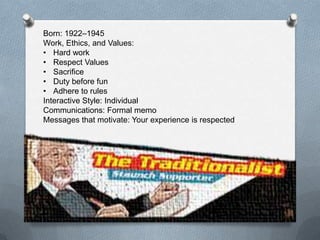
Born: 1922–1945 (About 6% of the Workforce)
Work, Ethics, and Values:
• Hard work
• Respect Values
• Sacrifice
• Duty before fun
• Adhere to rules
Interactive Style: Individual
Communications: Formal memo
Messages that motivate: Your experience is respected
5
Let them know that you value their
experience and loyalty to the organization,
spend adequate time in orientation and
training activities (including the use of
technology), and respect common norms
of courteous behavior.
6
Born: 1946–1964 (About 41% of the Workforce)
Work, Ethics, and Values:
• Workaholics
• Work efficiently
• Crusading causes
• Personal fulfillment
• Question Authority
Interactive Style: Team player, loves to have meetings
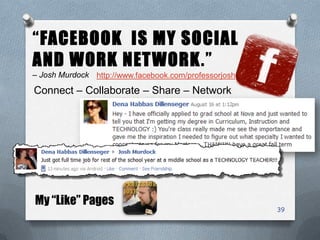
Communications: In person
Messages that motivate: Your are needed or valued
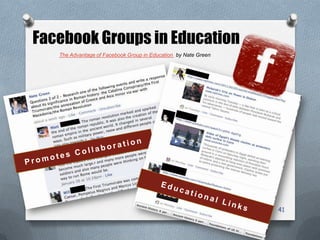
7
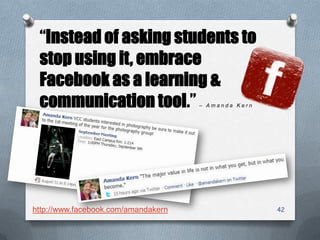
Millennials in the Workplace:
A Helpful Guide
(yes, this is a parody)
http://youtu.be/Sz0o9clVQu8
8
Show them how they can be an
organizational star, provide them with
training and developmental opportunities,
and involve them in operational matters.
9
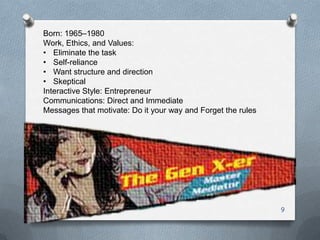
Born: 1965–1980 (About 29% of the Workforce)
Work, Ethics, and Values:
• Eliminate the task
• Self-reliance
• Want structure and direction
• Skeptical
Interactive Style: Entrepreneur
Communications: Direct and Immediate
Messages that motivate: Do it your way and Forget the rules
10
Partner them with mentors (ideally Boomers)
whom they can respect, do not expect them
to give up their life for the job, promote
work/life balance, and refrain from giving
them too much extended hands-on
supervision.
11
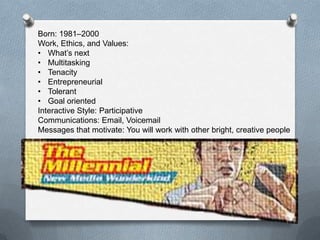
Born: 1981–2000 (About 24% of the Workforce)
Work, Ethics, and Values:
• What’s next
• Multitasking
• Tenacity
• Entrepreneurial
• Tolerant
• Goal oriented
Interactive Style: Participative
Communications: Email, Voicemail
Messages that motivate: You will work with other bright, creative people
12
Millennials Guide to
Baby Boomers
(yes, this is a parody)
http://youtu.be/C1a6M3dBNwc
13
Capitalize on their technological skills, provide
them with structure, allow them to work in a
collaborative manner, be generous with training
and orientation activities, and involve them in
reverse mentoring programs with Boomers and
Gen Xers.
http://www.youtube.com/watch?v=2_CgM2btWz
M
15
The Millennial Generation
16
The Millennial
Generation has emerged
as a force that will shape
the social and economic
dynamics of the next
decade
(Howe & Strauss, 2000).
Researchers agree that
the uniqueness of
millennials results
from technological
forces that have
affected this
generation.
Millennial Students Characteristics
17
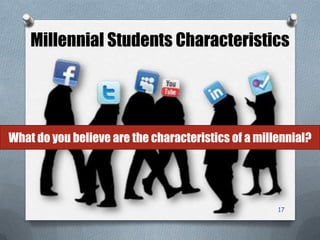
What do you believe are the characteristics of a millennial?
18
“Individuals raised with
computers deal with information
differently compared to previous
cohorts: They develop hypertext
minds, they leap around.”
- Marc Prensky
Characteristics of the Millennials
O Students of the Millennial
Generation are accustomed
O Learn better through discovery and
experientiallearning rather than by being
told
O Have the ability to shift their attention rapidly from one
task to another and may choose not to pay attention to
things that don’t interest them — attention
deployment
O Believe multitasking is a way of life and
are comfortable when engaged in multiple
activities simultaneously
19
20
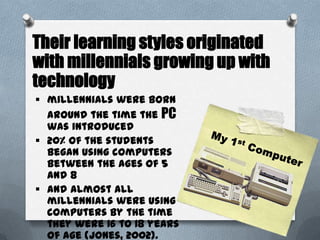
Their learning styles originated
with millennials growing up with
technology
 millennials were born
around the time the PC
was introduced
 20% of the students
began using computers
between the ages of 5
and 8
 and almost all
millennials were using
computers by the time
they were 16 to 18 years
of age (Jones, 2002).
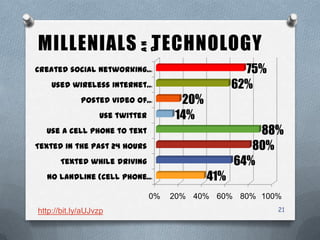
MILLENIALS TECHNOLOGY
21
0% 20% 40% 60% 80% 100%
No landline (cell phone…
Texted while driving
Texted in the past 24 hours
Use a cell phone to text
Use twitter
Posted video of…
Used wireless internet…
Created social networking…
41%
64%
80%
88%
14%
20%
62%
75%
AN
D
http://bit.ly/aUJvzp
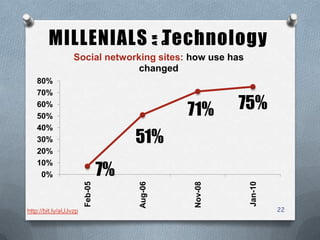
MILLENIALS Technology
22
AN
D
7%
51%
71% 75%
0%
10%
20%
30%
40%
50%
60%
70%
80%
Feb-05
Aug-06
Nov-08
Jan-10
Social networking sites: how use has
changed
http://bit.ly/aUJvzp
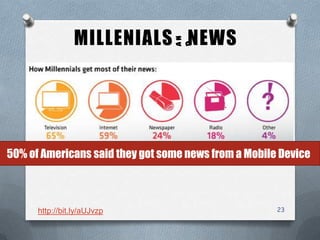
MILLENIALS NEWS
23
AN
D
http://bit.ly/aUJvzp
50% of Americans said they got some news from a Mobile Device
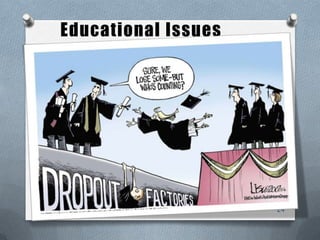
Educational Issues
O Diversity of needs, backgrounds, and
experiences
O High Drop-out and failure rates
(average 3 out of 10)
O Poor class participation
O Typically under prepared
O Difficulties relating to authority figures
using traditional communication
techniques 24
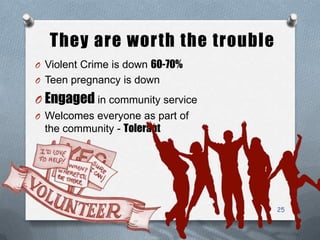
They are worth the trouble
O Violent Crime is down 60-70%
O Teen pregnancy is down
O Engaged in community service
O Welcomes everyone as part of
the community - Tolerant
25
How they “ Tick ”
O Exposed to vast amounts of
information at a very young age
O Different patterns of
communications and social
intimacy
O Ambitious, but with unrealistic
expectations
O Well aware of rules, but enjoy the
challenge of circumventing the rules
26
ENGAGING THE MILLENNIALS
O Learn at a fast pace that does not
involve a “telling style”/ “text-
oriented” style of teaching
O Like visual examples, less
text, and less telling
O Want interactivity
27
28
“Your goal should not be to discard
social media, but to figure out how
to make it a powerful tool, rather
than a useless distraction.”
-Ben Parr
A Vision of K-12 Students
Today
29
Social Media Revolution
30
“The qualities that
make Twitter seem
insane and half-baked
are what makes it so
powerful.”
- Jonathan Zittrain
–Harvard Law Professor & Internet Expert
31
Glossary of Twitter Terms
Tweet. A message sent via Twitter (140
Charters).
Hashtag. Hashtags allow the community to
easily stream a particular subject by using a
hash in front of the tag. Example: Putting
#iPhone in a tweet about the iPhone.
DM. A Direct Message sent via Twitter only the
recipient can see.
Twittastic. The Twitter version of fantastic.
Dweet. A tweet sent while drunk.
http://webtrends.about.com/od/twitter/a/twitter_glossary.htm
32
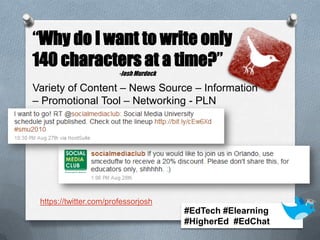
“Why do I want to write only
140 characters at a time?”
-Josh Murdock
Variety of Content – News Source – Information
– Promotional Tool – Networking - PLN
https://twitter.com/professorjosh
#EdTech #Elearning
#HigherEd #EdChat
33
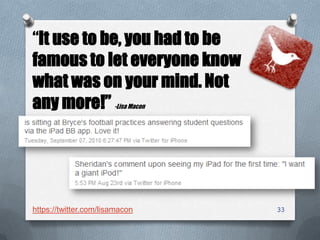
“It use to be, you had to be
famous to let everyone know
what was on your mind. Not
any more!” -Lisa Macon
https://twitter.com/lisamacon
34
“Academic Excellence in
140 Characters.” Rey Junco
Study showed the
positive effect of
Twitter on college
student engagement
and grades.
https://twitter.com/reyjunco
http://youtu.be/SVOY2x81_bg
35
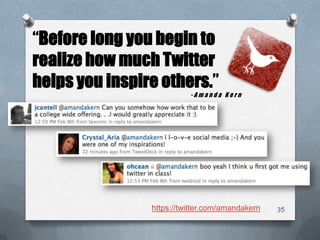
“Before long you begin to
realize how much Twitter
helps you inspire others.”
- A m a n d a K e r n
https://twitter.com/amandakern
36
“ The principle goal of education
is to create men and women who
are capable of doing new
things, not simply repeating
what other generations have
done.”
- Jean Piaget
38
Facebook Stats - www.facebook.com
More than 500 million active users
50% of our active users log on daily
Average 130 friends
People spend over 700 billion minutes per month
on Facebook
Average user is connected to 80 community
pages, groups, and events
Average user creates 90 pieces of content each
month
3939
“FACEBOOK IS MY SOCIAL
AND WORK NETWORK.”
– Josh Murdock
Connect – Collaborate – Share – Network
http://www.facebook.com/professorjosh
My “Like” Pages
4040
“Not being on Facebook is like
not having a TV or not owning a
cell phone. You can avoid it, but
you’ll really miss out. ” – Lisa Macon
http://www.facebook.com/lisamacon
4141
Facebook Groups in Education
The Advantage of Facebook Group in Education by Nate Green
4242
“Instead of asking students to
stop using it, embrace
Facebook as a learning &
communication tool.” – A m a n d a K e r n
http://www.facebook.com/amandakern
4343
“It’s not just about
recipes, fashion, and DIY ideas. You
can bookmark and share ideas
visually across educational
networks ” – Josh Murdock
http://www.pinterest.com/professorjosh
44
Twitter: @professorjosh
Facebook: facebook.com/professorjosh
Blog: http://professorjosh.com
Email: jmurdock3@valenciacollege.edu

Generational Differences: Millennials, Social media, and Education

  • 2.
    WHAT IS THISPRESENTATION ALL ABOUT? 2 The Generations: Who are they? What are they like? What are they doing? How do we engage them?
  • 3.
  • 4.
    4 Born: 1922–1945 (About6% of the Workforce) Work, Ethics, and Values: • Hard work • Respect Values • Sacrifice • Duty before fun • Adhere to rules Interactive Style: Individual Communications: Formal memo Messages that motivate: Your experience is respected
  • 5.
    5 Let them knowthat you value their experience and loyalty to the organization, spend adequate time in orientation and training activities (including the use of technology), and respect common norms of courteous behavior.
  • 6.
    6 Born: 1946–1964 (About41% of the Workforce) Work, Ethics, and Values: • Workaholics • Work efficiently • Crusading causes • Personal fulfillment • Question Authority Interactive Style: Team player, loves to have meetings Communications: In person Messages that motivate: Your are needed or valued
  • 7.
    7 Millennials in theWorkplace: A Helpful Guide (yes, this is a parody) http://youtu.be/Sz0o9clVQu8
  • 8.
    8 Show them howthey can be an organizational star, provide them with training and developmental opportunities, and involve them in operational matters.
  • 9.
    9 Born: 1965–1980 (About29% of the Workforce) Work, Ethics, and Values: • Eliminate the task • Self-reliance • Want structure and direction • Skeptical Interactive Style: Entrepreneur Communications: Direct and Immediate Messages that motivate: Do it your way and Forget the rules
  • 10.
    10 Partner them withmentors (ideally Boomers) whom they can respect, do not expect them to give up their life for the job, promote work/life balance, and refrain from giving them too much extended hands-on supervision.
  • 11.
    11 Born: 1981–2000 (About24% of the Workforce) Work, Ethics, and Values: • What’s next • Multitasking • Tenacity • Entrepreneurial • Tolerant • Goal oriented Interactive Style: Participative Communications: Email, Voicemail Messages that motivate: You will work with other bright, creative people
  • 12.
    12 Millennials Guide to BabyBoomers (yes, this is a parody) http://youtu.be/C1a6M3dBNwc
  • 13.
    13 Capitalize on theirtechnological skills, provide them with structure, allow them to work in a collaborative manner, be generous with training and orientation activities, and involve them in reverse mentoring programs with Boomers and Gen Xers.
  • 14.
  • 15.
    The Millennial Generation 16 TheMillennial Generation has emerged as a force that will shape the social and economic dynamics of the next decade (Howe & Strauss, 2000). Researchers agree that the uniqueness of millennials results from technological forces that have affected this generation.
  • 16.
    Millennial Students Characteristics 17 Whatdo you believe are the characteristics of a millennial?
  • 17.
    18 “Individuals raised with computersdeal with information differently compared to previous cohorts: They develop hypertext minds, they leap around.” - Marc Prensky
  • 18.
    Characteristics of theMillennials O Students of the Millennial Generation are accustomed O Learn better through discovery and experientiallearning rather than by being told O Have the ability to shift their attention rapidly from one task to another and may choose not to pay attention to things that don’t interest them — attention deployment O Believe multitasking is a way of life and are comfortable when engaged in multiple activities simultaneously 19
  • 19.
    20 Their learning stylesoriginated with millennials growing up with technology  millennials were born around the time the PC was introduced  20% of the students began using computers between the ages of 5 and 8  and almost all millennials were using computers by the time they were 16 to 18 years of age (Jones, 2002).
  • 20.
    MILLENIALS TECHNOLOGY 21 0% 20%40% 60% 80% 100% No landline (cell phone… Texted while driving Texted in the past 24 hours Use a cell phone to text Use twitter Posted video of… Used wireless internet… Created social networking… 41% 64% 80% 88% 14% 20% 62% 75% AN D http://bit.ly/aUJvzp
  • 21.
  • 22.
    MILLENIALS NEWS 23 AN D http://bit.ly/aUJvzp 50% ofAmericans said they got some news from a Mobile Device
  • 23.
    Educational Issues O Diversityof needs, backgrounds, and experiences O High Drop-out and failure rates (average 3 out of 10) O Poor class participation O Typically under prepared O Difficulties relating to authority figures using traditional communication techniques 24
  • 24.
    They are worththe trouble O Violent Crime is down 60-70% O Teen pregnancy is down O Engaged in community service O Welcomes everyone as part of the community - Tolerant 25
  • 25.
    How they “Tick ” O Exposed to vast amounts of information at a very young age O Different patterns of communications and social intimacy O Ambitious, but with unrealistic expectations O Well aware of rules, but enjoy the challenge of circumventing the rules 26
  • 26.
    ENGAGING THE MILLENNIALS OLearn at a fast pace that does not involve a “telling style”/ “text- oriented” style of teaching O Like visual examples, less text, and less telling O Want interactivity 27
  • 27.
    28 “Your goal shouldnot be to discard social media, but to figure out how to make it a powerful tool, rather than a useless distraction.” -Ben Parr
  • 28.
    A Vision ofK-12 Students Today 29 Social Media Revolution
  • 29.
    30 “The qualities that makeTwitter seem insane and half-baked are what makes it so powerful.” - Jonathan Zittrain –Harvard Law Professor & Internet Expert
  • 30.
    31 Glossary of TwitterTerms Tweet. A message sent via Twitter (140 Charters). Hashtag. Hashtags allow the community to easily stream a particular subject by using a hash in front of the tag. Example: Putting #iPhone in a tweet about the iPhone. DM. A Direct Message sent via Twitter only the recipient can see. Twittastic. The Twitter version of fantastic. Dweet. A tweet sent while drunk. http://webtrends.about.com/od/twitter/a/twitter_glossary.htm
  • 31.
    32 “Why do Iwant to write only 140 characters at a time?” -Josh Murdock Variety of Content – News Source – Information – Promotional Tool – Networking - PLN https://twitter.com/professorjosh #EdTech #Elearning #HigherEd #EdChat
  • 32.
    33 “It use tobe, you had to be famous to let everyone know what was on your mind. Not any more!” -Lisa Macon https://twitter.com/lisamacon
  • 33.
    34 “Academic Excellence in 140Characters.” Rey Junco Study showed the positive effect of Twitter on college student engagement and grades. https://twitter.com/reyjunco http://youtu.be/SVOY2x81_bg
  • 34.
    35 “Before long youbegin to realize how much Twitter helps you inspire others.” - A m a n d a K e r n https://twitter.com/amandakern
  • 35.
    36 “ The principlegoal of education is to create men and women who are capable of doing new things, not simply repeating what other generations have done.” - Jean Piaget
  • 36.
    38 Facebook Stats -www.facebook.com More than 500 million active users 50% of our active users log on daily Average 130 friends People spend over 700 billion minutes per month on Facebook Average user is connected to 80 community pages, groups, and events Average user creates 90 pieces of content each month
  • 37.
    3939 “FACEBOOK IS MYSOCIAL AND WORK NETWORK.” – Josh Murdock Connect – Collaborate – Share – Network http://www.facebook.com/professorjosh My “Like” Pages
  • 38.
    4040 “Not being onFacebook is like not having a TV or not owning a cell phone. You can avoid it, but you’ll really miss out. ” – Lisa Macon http://www.facebook.com/lisamacon
  • 39.
    4141 Facebook Groups inEducation The Advantage of Facebook Group in Education by Nate Green
  • 40.
    4242 “Instead of askingstudents to stop using it, embrace Facebook as a learning & communication tool.” – A m a n d a K e r n http://www.facebook.com/amandakern
  • 41.
    4343 “It’s not justabout recipes, fashion, and DIY ideas. You can bookmark and share ideas visually across educational networks ” – Josh Murdock http://www.pinterest.com/professorjosh
  • 42.
  • 43.
    Twitter: @professorjosh Facebook: facebook.com/professorjosh Blog:http://professorjosh.com Email: jmurdock3@valenciacollege.edu

Editor's Notes

  • #2 Generational Differences: Millennials, Social Media, and EducationJosh Murdock@ProfessorJoshInstructional Designer & Professor
  • #3 JoshThe Millennial Generation has emerged as a force that will shape the social and economic dynamics of the next decade (Howe & Strauss, 2000).The definition of when millennials were born varies, with estimates ranging from 1977 (Tapscott, 1998) to 1982 (Howe & Strauss, 2000).Researchers agree that the uniqueness of millennials results from technological forces that have affected this generation.Unique millennial competency is the ability to effectively use broadly networked digital communication technologies to quickly and seamlessly accomplish a variety of tasks.This competency has resulted from their experiences with Internet communities (Gorman, Nelson, & Glassman, 2004).
  • #6 Good business requires good communication. Robert Tanner, author of Understanding and Managing the Four Generations in the Workplace (2001), recommends that employers view generations as another form of diversity. By understanding the strengths, limitations, and values that each generation brings to the workplace, managers can anticipate miscommunications, avoid lost productivity as a result of conflicts, and minimize employee turnover. Tanner offers these suggestions for working effectively with the different age groups in the workplace:
  • #9 Good business requires good communication. Robert Tanner, author of Understanding and Managing the Four Generations in the Workplace (2001), recommends that employers view generations as another form of diversity. By understanding the strengths, limitations, and values that each generation brings to the workplace, managers can anticipate miscommunications, avoid lost productivity as a result of conflicts, and minimize employee turnover. Tanner offers these suggestions for working effectively with the different age groups in the workplace:
  • #11 Good business requires good communication. Robert Tanner, author of Understanding and Managing the Four Generations in the Workplace (2001), recommends that employers view generations as another form of diversity. By understanding the strengths, limitations, and values that each generation brings to the workplace, managers can anticipate miscommunications, avoid lost productivity as a result of conflicts, and minimize employee turnover. Tanner offers these suggestions for working effectively with the different age groups in the workplace:
  • #14 Good business requires good communication. Robert Tanner, author of Understanding and Managing the Four Generations in the Workplace (2001), recommends that employers view generations as another form of diversity. By understanding the strengths, limitations, and values that each generation brings to the workplace, managers can anticipate miscommunications, avoid lost productivity as a result of conflicts, and minimize employee turnover. Tanner offers these suggestions for working effectively with the different age groups in the workplace:
  • #16 Josh
  • #17 The Millennial Generation has emerged as a force that will shape the social and economic dynamics of the next decade (Howe & Strauss, 2000).The definition of when millennials were born varies, with estimates ranging from 1977 (Tapscott, 1998) to 1982 (Howe & Strauss, 2000).Researchers agree that the uniqueness of millennials results from technological forces that have affected this generation.Unique millennial competency is the ability to effectively use broadly networked digital communication technologies to quickly and seamlessly accomplish a variety of tasks.This competency has resulted from their experiences with Internet communities (Gorman, Nelson, & Glassman, 2004).
  • #18 Relatively ShelteredGrew up among “kid safety rules”: school lockdowns, national youth safety movementsMore conventional than Gen-XersHigh level confidence / self importanceTeam OrientedClose with ParentsTechnology Savvy
  • #20 Millennialsto using keyboards rather than pens or pencilsto reading information from computer screens or mobile devices rather than from printed textsto being connected with friends in digital environments learn better through discovery and experiential learning rather than by being toldhave the ability to shift their attention rapidly from one task to another and may choose not to pay attention to things that don’t interest them — attentional deploymentbelieve multitasking is a way of life and are comfortable when engaged in multiple activities simultaneouslybelieve staying connected is essential and they want a fast response time (Howe & Strauss, 2000)
  • #22 http://www.flowtown.com/blog/wp-content/uploads/2010/07/Millennials-7-16.png
  • #27 Most have never known a life without computers and the InternetConsider computers a part of lifeConnect to information Communicate in real-timeHave social networkingHave been raised in the presence of video and computer gamesStudents in their 20s may have had more experience with games than with reading (Oblinger,2004).
  • #33 Josh
  • #35 Academic Excellence in 140 Characters http://youtu.be/SVOY2x81_bg1st 2 minutes only!
  • #38 JoshHotseat, a social networking-powered mobile Web application, creates a collaborative classroom, allowing students to provide near real-time feedback during class and enabling professors to adjust the course content and improve the learning experience. Students can post messages to Hotseat using their Facebook or Twitter accounts, sending text messages, or logging in to the Hotseat Web site. http://www.itap.purdue.edu/tlt/hotseat/ http://mashable.com/2009/11/03/hotseat/
  • #42 Joshhttp://www.edsocialmedia.com/2011/02/the-advantage-of-facebook-groups-in-education/ HW Forums:The real beauty of this forum however, is that this model for homework promotes collaboration. Instead of grading homework assignments that are all the same, I have the students build answers to questions by adding off each other and questioning each other. Not only does this prepare a perfect study guide come test time, but it promotes academic discussion outside of the classroom. Some students are stronger in discussion when that discussion unfolds behind a computer screen with more time to analyze and articulate their thoughts in writing.Links & VideosFurthermore, I can also post links, videos, articles, pictures and documents to use in my course. Some of the students were so taken by our discussion of the events in Egypt that they posted news articles, links, and one student even posted a link of a protestor getting shot! This sharing of educational links has changed the way my students look at the facebook.
  • #45 Questions??
  • #46 Josh & Lisa