Designed by Pressfoto ­ Freepik.com
G R O W I N G
U P O N L I N E
Social media and Technology is
changing the way kids grow up
Created by Crystal Sutton
“With the explosive development of communication
technologies, children and adolescents found a near
perfect, presumably risk-free environment in which to
pursue their developmental drives for sensation,
connection, autonomy, and control” (Borzekowski, 2012)
Designed by Onlyyouqj ­ Freepik.com
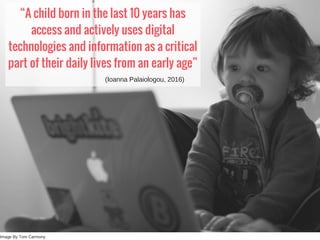
“A child born in the last 10 years has
access and actively uses digital
technologies and information as a critical
part of their daily lives from an early age”
Image By Tom Carmony
(Ioanna Palaiologou, 2016)
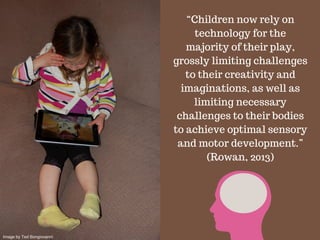
“Children now rely on
technology for the
majority of their play,
grossly limiting challenges
to their creativity and
imaginations, as well as
limiting necessary
challenges to their bodies
to achieve optimal sensory
and motor development.”
(Rowan, 2013)
Image by Ted Bongiovanni
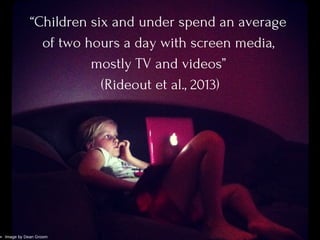
“Children six and under spend an average
of two hours a day with screen media,
mostly TV and videos”
 (Rideout et al., 2013)
Image by Dean Groom
“Children’s intellectual
development is at risk due
to the demands made on
cognitive resources.”
(McPake et al., 2010)
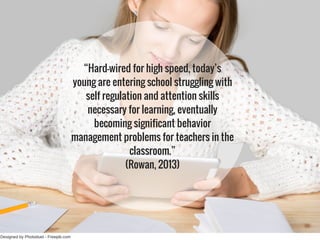
“Hard-wired for high speed, today’s
young are entering school struggling with
self regulation and attention skills
necessary for learning, eventually
becoming significant behavior
management problems for teachers in the
classroom.”
(Rowan, 2013)
Designed by Photoduet ­ Freepik.com
Designed by Pressfoto ­ Freepik.com
Parents have also learnt to alter the
way they interact with their kids:
“learning to summon the children for
chores using text messages, and to
check Facebook to determine if they’d
woken up” (Bielski, 2013)
Designed by Jcomp ­ Freepik.com
How technology
affects childhood is
also prominent the
way social media is
used by Teenagers.
“Our brains as adolescents and digital natives
have adapted to this media influence and
because we've grown up with it we're able to
cope with all these different stimuli”
–Alexandra
(Reddy, 2014)
Image by mkhmarketing
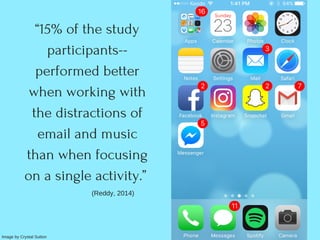
“15% of the study
participants--
performed better
when working with
the distractions of
email and music
than when focusing
on a single activity.” 
Image by Crystal Sutton
(Reddy, 2014)
57% of teens have met a
new friend online. Social
media and online
gameplay are the most
common digital venues
for meeting friends”
(Lenhart, 2015)
Image by Chris Potter
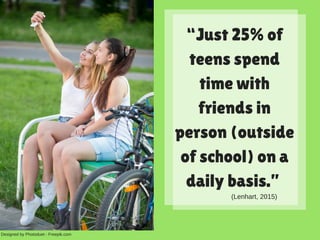
“Just 25% of
teens spend
time with
friends in
person (outside
of school) on a
daily basis.”
Designed by Photoduet ­ Freepik.com
(Lenhart, 2015)
Designed by Jcomp ­ Freepik.com
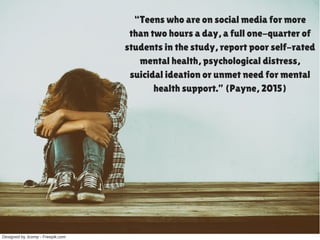
“Teens who are on social media for more
than two hours a day, a full one-quarter of
students in the study, report poor self-rated
mental health, psychological distress,
suicidal ideation or unmet need for mental
health support.” (Payne, 2015)
“53% of social media-using
teens have seen people
posting to social media about
events to which they were not
invited.”
Designed by Freepik
(Lenhart, 2015)
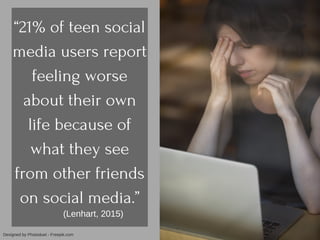
“21% of teen social
media users report
feeling worse
about their own
life because of
what they see
from other friends
on social media.”
Designed by Photoduet ­ Freepik.com
(Lenhart, 2015)
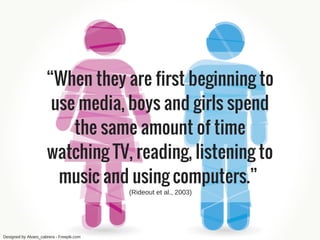
“When they are first beginning to
use media, boys and girls spend
the same amount of time
watching TV, reading, listening to
music and using computers.”
Designed by Alvaro_cabrera ­ Freepik.com
(Rideout et al., 2003)
Designed by Jcomp ­ Freepik.com
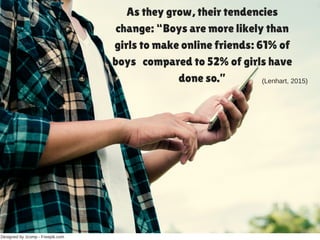
As they grow, their tendencies
change: “Boys are more likely than
girls to make online friends: 61% of
boys compared to 52% of girls have
done so.” (Lenhart, 2015)
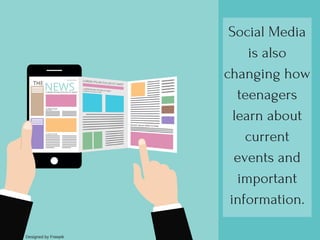
Social Media
is also
changing how
teenagers
learn about
current
events and
important
information.
Designed by Freepik
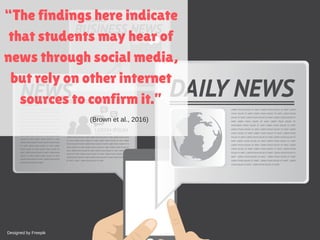
“The findings here indicate
that students may hear of
news through social media,
but rely on other internet
sources to confirm it.”
(Brown et al., 2016)
Designed by Freepik
Overall the change in social
media and technology for kids
and teens is that “We’re
communicating more but we’re
not communicating deeply.
That’s the disconnect.” 
(Bielski, 2013)
All images from Flickr and Freepik, with attributions on each page
 Borzekowski, Dina, and Michael Rich. "Children, Media, and Health." Scholars Portals Journals. Journal of
Children and Media, Feb. 2012. Web. 22 Oct. 2016
<http://journals2.scholarsportal.info.proxy.queensu.ca/details/17482798/v06i0001/1_cmah.xml> 
Palaiologou, Ioanna. "Children under Five and Digital Technologies: Implications for Early Years Pedagogy."
Scholars Portals Journals. European Early Childhood Education Research Journal, Jan. 2016. Web. 21 Oct.
2016<http://journals1.scholarsportal.info.proxy.queensu.ca/details/1350293x/v24i0001/5_cufadtifeyp.xml&su
b=all#BIB0014 >
BIELSKI, ZOSIA. "Portrait of an E­family: How They're ... ­ The Globe and Mail." Globe and Mail. Globe and
Mail, 22 Aug. 2013. Web. 21 Oct. 2016. <http://www.theglobeandmail.com/life/relationships/how­families­are­
making­their­hyper­digital­lives­work/article13924931/>
Lenhart, Amanda. "Teens, Technology and Friendships | Pew Research Center." Pew Research Center.
N.p., 6 Aug. 2015. Web. 23 Oct. 2016. <http://www.pewinternet.org/2015/08/06/teens­technology­and­
friendships/>
Payne, Elizabeth. "The Impact of Social Media on Adolescents' Mental Health." Proquest. Ottawa Citizen, 08
Aug. 2015. Web. 20 Oct. 2016.  <http://search.proquest.com.proxy.queensu.ca/docview/1702249271?
accountid=6180>
 Plowman, Lydia, Joanna McPake, and Christine Stephen. "The Technologisation of Childhood? Young
Children and Technology in the Home." Scholar Portal. Children & Society, 2010. Web. 20 Oct. 2016.
Rideout, Victoria J., Elizabeth A. Vandewater, and Ellen A. Wartella. "Zero to Six." Kaiser Family Foundation.
N.p., Fall 2003. Web. 22 Oct. 2016. < https://kaiserfamilyfoundation.files.wordpress.com/2013/01/zero­to­six­
electronic­media­in­the­lives­of­infants­toddlers­and­preschoolers­pdf.pdf >
Works Cited
Rosenagrd, Dana, Tim Brown, and Mary Tucker­McClaughlin. "The Impact of Social Media on
Adolescents' Mental Health." Sage Journals. University of Central Florida, 2016. Web. 23 Oct. 2016.
<http://enx.sagepub.com.proxy.queensu.ca/content/8/2/120>
Rowan, Chris. "The Impact of Technology on the Developing Child ..." Huffington Post. N.p., 29 May
2013. Web. 22 Oct. 2016. Sumanthi, Reddy. "Mental Illness, Teens & Social Media ­ Slideshare.net."
ProQuest. Wall Street Journal, 13 Oct. 2014. Web. 20 Oct. 2016.
<http://search.proquest.com.proxy.queensu.ca/docview/1610794735?accountid=6180>
Works Cited Continued

Growing up Online