General Review
 Countable and Uncountable
 Some, Any and Do
 How Much, How Many, A little, A few
 Object Personal Pronouns
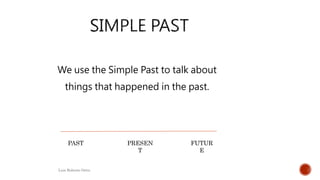
 Simple Past
 Affirmative
 Negative
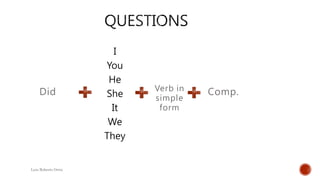
 Questions
 Differences between Can and Could
 Verbs in Past
Luis Roberto Ortiz
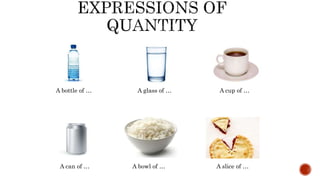
A bottle of … A glass of … A cup of …
A can of … A bowl of … A slice of …
 Countable nouns  are all the things that we can count, for example, a pen. We can
have one, two, three, or more pens.
 Uncountable nouns  are substances, concepts, etc. that we cannot divide into
separate elements. We are not able to "count" them
Luis Roberto Ortiz
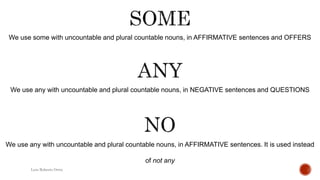
We use some with uncountable and plural countable nouns, in AFFIRMATIVE sentences and OFFERS
Luis Roberto Ortiz
We use any with uncountable and plural countable nouns, in NEGATIVE sentences and QUESTIONS
We use any with uncountable and plural countable nouns, in AFFIRMATIVE sentences. It is used instead
of not any
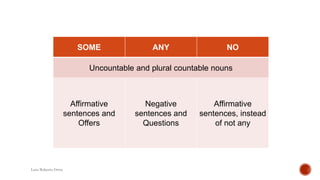
SOME ANY NO
Uncountable and plural countable nouns
Affirmative
sentences and
Offers
Negative
sentences and
Questions
Affirmative
sentences, instead
of not any
Luis Roberto Ortiz
Luis Roberto Ortiz
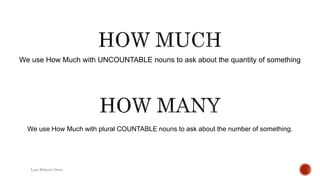
We use How Much with UNCOUNTABLE nouns to ask about the quantity of something
Luis Roberto Ortiz
We use How Much with plural COUNTABLE nouns to ask about the number of something.
Luis Roberto Ortiz
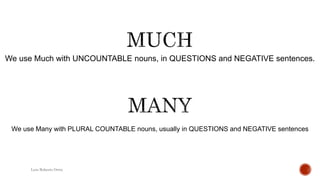
We use Much with UNCOUNTABLE nouns, in QUESTIONS and NEGATIVE sentences.
Luis Roberto Ortiz
We use Many with PLURAL COUNTABLE nouns, usually in QUESTIONS and NEGATIVE sentences
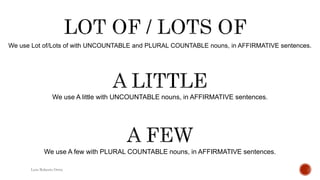
We use Lot of/Lots of with UNCOUNTABLE and PLURAL COUNTABLE nouns, in AFFIRMATIVE sentences.
Luis Roberto Ortiz
We use A little with UNCOUNTABLE nouns, in AFFIRMATIVE sentences.
We use A few with PLURAL COUNTABLE nouns, in AFFIRMATIVE sentences.
Object pronouns are used instead of nouns,
usually because we already know what the
object is. It makes the sentence easier to read
and understand and avoids repetition. We
normally use object pronouns after a verb or
a preposition.
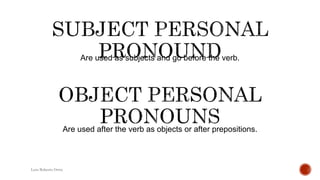
Are used as subjects and go before the verb.
Luis Roberto Ortiz
Are used after the verb as objects or after prepositions.
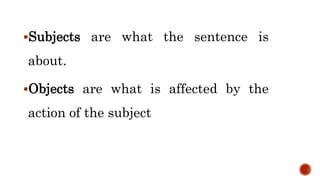
Subjects are what the sentence is
about.
Objects are what is affected by the
action of the subject
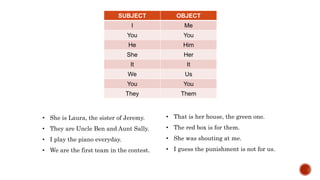
SUBJECT OBJECT
I Me
You You
He Him
She Her
It It
We Us
You You
They Them
• She is Laura, the sister of Jeremy.
• They are Uncle Ben and Aunt Sally.
• I play the piano everyday.
• We are the first team in the contest.
• That is her house, the green one.
• The red box is for them.
• She was shouting at me.
• I guess the punishment is not for us.
Luis Roberto Ortiz
We use the Simple Past to talk about
things that happened in the past.
Luis Roberto Ortiz
PAST FUTUR
E
PRESEN
T
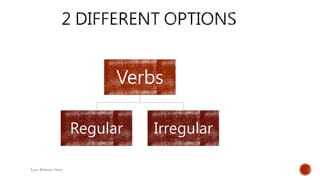
Verbs
Regular Irregular
Luis Roberto Ortiz
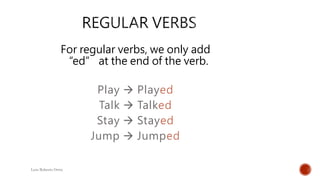
For regular verbs, we only add
“ed” at the end of the verb.
Luis Roberto Ortiz
Play  Played
Talk  Talked
Stay  Stayed
Jump  Jumped
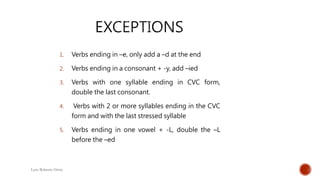
1. Verbs ending in –e, only add a –d at the end
2. Verbs ending in a consonant + -y, add –ied
3. Verbs with one syllable ending in CVC form,
double the last consonant.
4. Verbs with 2 or more syllables ending in the CVC
form and with the last stressed syllable
5. Verbs ending in one vowel + -L, double the –L
before the –ed
Luis Roberto Ortiz
Luis Roberto Ortiz
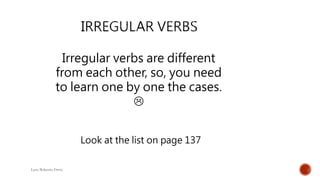
Irregular verbs are different
from each other, so, you need
to learn one by one the cases.

Look at the list on page 137
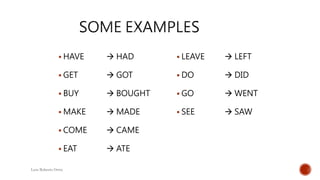
 HAVE  HAD
 GET  GOT
 BUY  BOUGHT
 MAKE  MADE
 COME  CAME
 EAT  ATE
 LEAVE  LEFT
 DO  DID
 GO  WENT
 SEE  SAW
Luis Roberto Ortiz
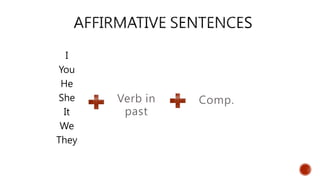
I
You
He
She
It
We
They
Verb in
past
Comp.
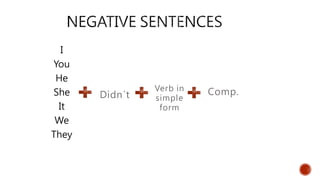
I
You
He
She
It
We
They
Didn´t Comp.Verb in
simple
form
I
You
He
She
It
We
They
Did Comp.Verb in
simple
form
Luis Roberto Ortiz
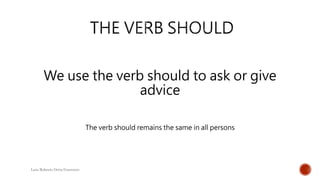
We use the verb should to ask or give
advice
The verb should remains the same in all persons
Luis Roberto Ortiz Guerrero

General Review

  • 1.
  • 2.
     Countable andUncountable  Some, Any and Do  How Much, How Many, A little, A few  Object Personal Pronouns  Simple Past  Affirmative  Negative  Questions  Differences between Can and Could  Verbs in Past
  • 3.
  • 4.
    A bottle of… A glass of … A cup of … A can of … A bowl of … A slice of …
  • 5.
     Countable nouns are all the things that we can count, for example, a pen. We can have one, two, three, or more pens.  Uncountable nouns  are substances, concepts, etc. that we cannot divide into separate elements. We are not able to "count" them
  • 6.
  • 7.
    We use somewith uncountable and plural countable nouns, in AFFIRMATIVE sentences and OFFERS Luis Roberto Ortiz We use any with uncountable and plural countable nouns, in NEGATIVE sentences and QUESTIONS We use any with uncountable and plural countable nouns, in AFFIRMATIVE sentences. It is used instead of not any
  • 8.
    SOME ANY NO Uncountableand plural countable nouns Affirmative sentences and Offers Negative sentences and Questions Affirmative sentences, instead of not any Luis Roberto Ortiz
  • 9.
  • 10.
    We use HowMuch with UNCOUNTABLE nouns to ask about the quantity of something Luis Roberto Ortiz We use How Much with plural COUNTABLE nouns to ask about the number of something.
  • 11.
  • 12.
    We use Muchwith UNCOUNTABLE nouns, in QUESTIONS and NEGATIVE sentences. Luis Roberto Ortiz We use Many with PLURAL COUNTABLE nouns, usually in QUESTIONS and NEGATIVE sentences
  • 13.
    We use Lotof/Lots of with UNCOUNTABLE and PLURAL COUNTABLE nouns, in AFFIRMATIVE sentences. Luis Roberto Ortiz We use A little with UNCOUNTABLE nouns, in AFFIRMATIVE sentences. We use A few with PLURAL COUNTABLE nouns, in AFFIRMATIVE sentences.
  • 15.
    Object pronouns areused instead of nouns, usually because we already know what the object is. It makes the sentence easier to read and understand and avoids repetition. We normally use object pronouns after a verb or a preposition.
  • 16.
    Are used assubjects and go before the verb. Luis Roberto Ortiz Are used after the verb as objects or after prepositions.
  • 17.
    Subjects are whatthe sentence is about. Objects are what is affected by the action of the subject
  • 18.
    SUBJECT OBJECT I Me YouYou He Him She Her It It We Us You You They Them • She is Laura, the sister of Jeremy. • They are Uncle Ben and Aunt Sally. • I play the piano everyday. • We are the first team in the contest. • That is her house, the green one. • The red box is for them. • She was shouting at me. • I guess the punishment is not for us.
  • 19.
  • 20.
    We use theSimple Past to talk about things that happened in the past. Luis Roberto Ortiz PAST FUTUR E PRESEN T
  • 21.
  • 22.
    For regular verbs,we only add “ed” at the end of the verb. Luis Roberto Ortiz Play  Played Talk  Talked Stay  Stayed Jump  Jumped
  • 23.
    1. Verbs endingin –e, only add a –d at the end 2. Verbs ending in a consonant + -y, add –ied 3. Verbs with one syllable ending in CVC form, double the last consonant. 4. Verbs with 2 or more syllables ending in the CVC form and with the last stressed syllable 5. Verbs ending in one vowel + -L, double the –L before the –ed Luis Roberto Ortiz
  • 24.
    Luis Roberto Ortiz Irregularverbs are different from each other, so, you need to learn one by one the cases.  Look at the list on page 137
  • 25.
     HAVE HAD  GET  GOT  BUY  BOUGHT  MAKE  MADE  COME  CAME  EAT  ATE  LEAVE  LEFT  DO  DID  GO  WENT  SEE  SAW Luis Roberto Ortiz
  • 26.
  • 27.
  • 28.
  • 29.
    We use theverb should to ask or give advice The verb should remains the same in all persons Luis Roberto Ortiz Guerrero