UNIDAD 2
¡Bienvenidos!
Spanish 8th
Nouns
 A Noun is a word used to identify,
people, animals, places, things or
ideas.
 In Spanish nouns have gender. They
are either masculine or feminine.
© by Vista Higher Learning, Inc. All rights
reserved.
1.1-3
© by Vista Higher Learning, Inc. All rights
reserved.
1.1-4
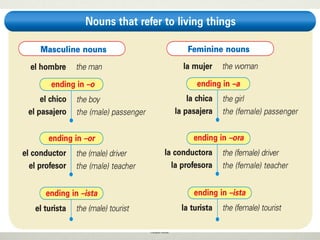
 Generally, nouns that refer to
males, like el hombre, are
masculine, while nouns that refer
to females, like
la mujer, are feminine.
© by Vista Higher Learning, Inc. All rights
reserved.
1.1-5
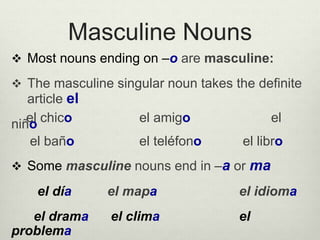
Masculine Nouns
 Most nouns ending on –o are masculine:
 The masculine singular noun takes the definite
article el
el chico el amigo elniño
el baño el teléfono el libro
 Some masculine nouns end in –a or ma
el día el mapa el idioma
el drama el clima el
problema
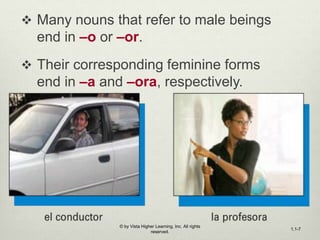
 Many nouns that refer to male beings
end in –o or –or.
 Their corresponding feminine forms
end in –a and –ora, respectively.
© by Vista Higher Learning, Inc. All rights
reserved.
1.1-7
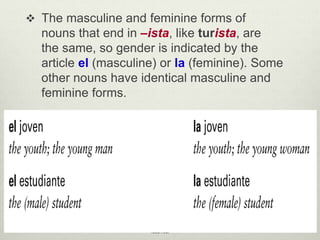
 The masculine and feminine forms of
nouns that end in –ista, like turista, are
the same, so gender is indicated by the
article el (masculine) or la (feminine). Some
other nouns have identical masculine and
feminine forms.
© by Vista Higher Learning, Inc. All rights
reserved.
1.1-8
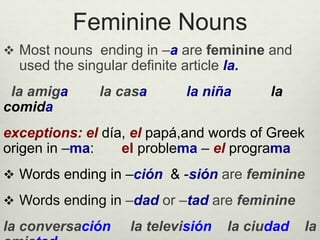
Feminine Nouns
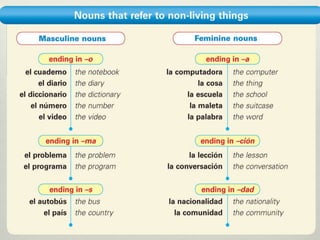
 Most nouns ending in –a are feminine and
used the singular definite article la.
la amiga la casa la niña la
comida
exceptions: el día, el papá,and words of Greek
origen in –ma: el problema – el programa
 Words ending in –ción & -sión are feminine
 Words ending in –dad or –tad are feminine
la conversación la televisión la ciudad la
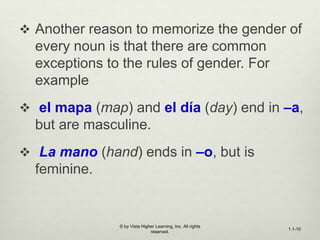
 Another reason to memorize the gender of
every noun is that there are common
exceptions to the rules of gender. For
example
 el mapa (map) and el día (day) end in –a,
but are masculine.
 La mano (hand) ends in –o, but is
feminine.
© by Vista Higher Learning, Inc. All rights
reserved.
1.1-10
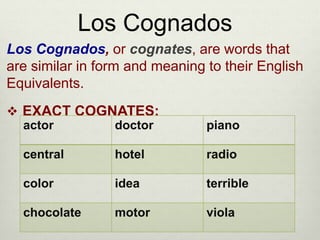
Los Cognados, or cognates, are words that
are similar in form and meaning to their English
Equivalents.
 EXACT COGNATES:
actor doctor piano
central hotel radio
color idea terrible
chocolate motor viola
Los Cognados
Los Cognados
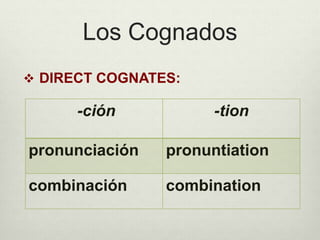
 DIRECT COGNATES:
-ción -tion
pronunciación pronuntiation
combinación combination
Los Cognados
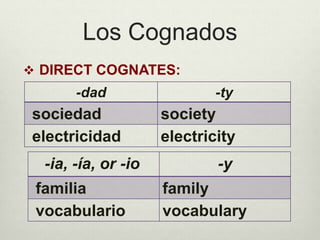
 DIRECT COGNATES:
-dad -ty
sociedad society
electricidad electricity
-ia, -ía, or -io -y
familia family
vocabulario vocabulary
Spanish articles
 As you know, English often uses
definite articles (the) and indefinite articles
(a, an) before nouns.
 Spanish also has definite and indefinite
articles. Unlike English, Spanish articles
vary in form because they agree in gender
and number with the nouns they modify.
© by Vista Higher Learning, Inc. All rights
reserved.
1.1-14
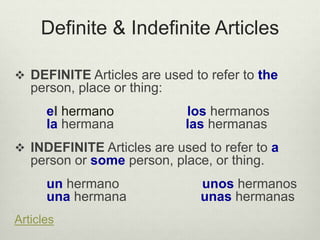
Definite & Indefinite Articles
 DEFINITE Articles are used to refer to the
person, place or thing:
el hermano los hermanos
la hermana las hermanas
 INDEFINITE Articles are used to refer to a
person or some person, place, or thing.
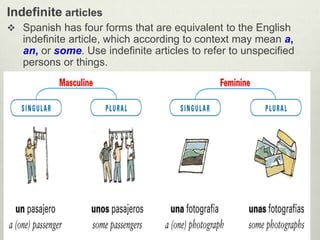
un hermano unos hermanos
una hermana unas hermanas
Articles
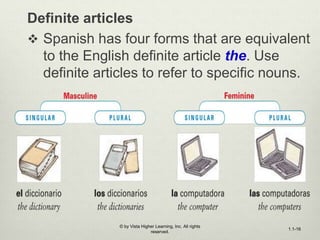
Definite articles
 Spanish has four forms that are equivalent
to the English definite article the. Use
definite articles to refer to specific nouns.
© by Vista Higher Learning, Inc. All rights
reserved.
1.1-16
Indefinite articles
 Spanish has four forms that are equivalent to the English
indefinite article, which according to context may mean a,
an, or some. Use indefinite articles to refer to unspecified
persons or things.
© by Vista Higher Learning, Inc. All rights
reserved.
1.1-17
© by Vista Higher Learning, Inc.
All rights reserved.
1.1-18
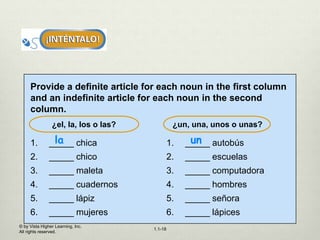
Provide a definite article for each noun in the first column
and an indefinite article for each noun in the second
column.
1. _____ chica
2. _____ chico
3. _____ maleta
4. _____ cuadernos
5. _____ lápiz
6. _____ mujeres
1. _____ autobús
2. _____ escuelas
3. _____ computadora
4. _____ hombres
5. _____ señora
6. _____ lápices
¿un, una, unos o unas?¿el, la, los o las?
la un
Plural of nouns
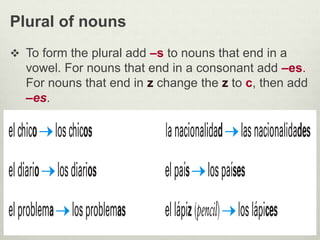
 To form the plural add –s to nouns that end in a
vowel. For nouns that end in a consonant add –es.
For nouns that end in z change the z to c, then add
–es.
© by Vista Higher Learning, Inc. All rights
reserved.
1.1-19
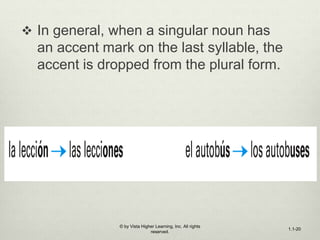
 In general, when a singular noun has
an accent mark on the last syllable, the
accent is dropped from the plural form.
© by Vista Higher Learning, Inc. All rights
reserved.
1.1-20
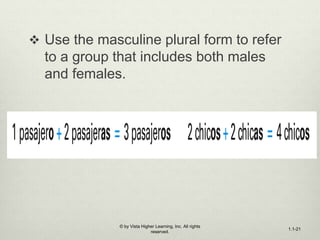
 Use the masculine plural form to refer
to a group that includes both males
and females.
© by Vista Higher Learning, Inc. All rights
reserved.
1.1-21
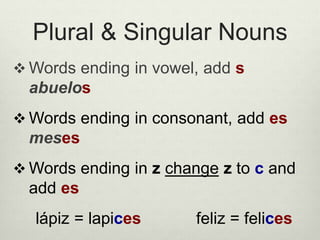
Plural & Singular Nouns
 Words ending in vowel, add s
abuelos
 Words ending in consonant, add es
meses
 Words ending in z change z to c and
add es
lápiz = lapices feliz = felices
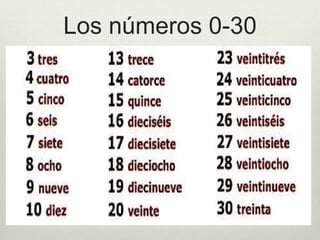
Los números 0-30
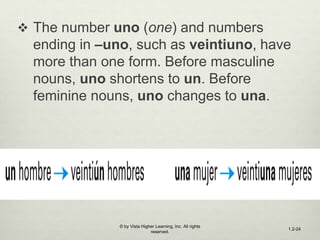
 The number uno (one) and numbers
ending in –uno, such as veintiuno, have
more than one form. Before masculine
nouns, uno shortens to un. Before
feminine nouns, uno changes to una.
© by Vista Higher Learning, Inc. All rights
reserved.
1.2-24
 ¡Atención! The forms uno and veintiuno
are used when counting (uno, dos, tres...
veinte, veintiuno, veintidós...). They are
also used when the number follows a
noun, even if the noun is feminine: la
lección uno.
© by Vista Higher Learning, Inc. All rights
reserved.
1.2-25
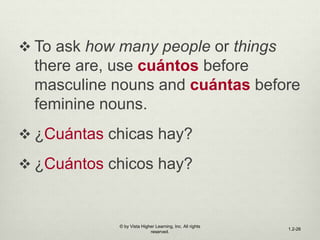
 To ask how many people or things
there are, use cuántos before
masculine nouns and cuántas before
feminine nouns.
 ¿Cuántas chicas hay?
 ¿Cuántos chicos hay?
© by Vista Higher Learning, Inc. All rights
reserved.
1.2-26
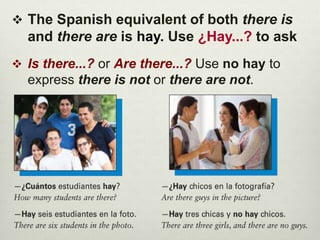
 The Spanish equivalent of both there is
and there are is hay. Use ¿Hay...? to ask
 Is there...? or Are there...? Use no hay to
express there is not or there are not.
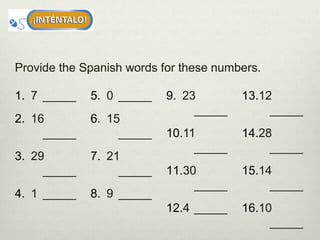
Provide the Spanish words for these numbers.
1. 7 _____
2. 16
_____
3. 29
_____
4. 1 _____
5. 0 _____
6. 15
_____
7. 21
_____
8. 9 _____
9. 23
_____
10.11
_____
11.30
_____
12.4 _____
13.12
_____
14.28
_____
15.14
_____
16.10
_____
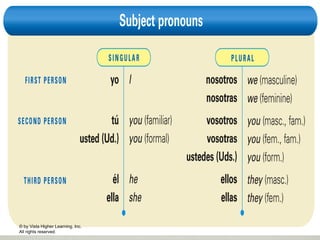
Subject pronouns
A pronoun is a word that takes
the place of a noun.
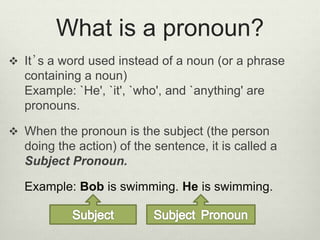
What is a pronoun?
 It’s a word used instead of a noun (or a phrase
containing a noun)
Example: `He', `it', `who', and `anything' are
pronouns.
 When the pronoun is the subject (the person
doing the action) of the sentence, it is called a
Subject Pronoun.
Example: Bob is swimming. He is swimming.
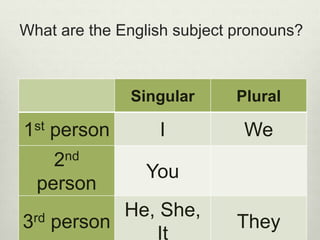
What are the English subject pronouns?
Singular Plural
1st person I We
2nd
person
You
3rd person
He, She,
It
They
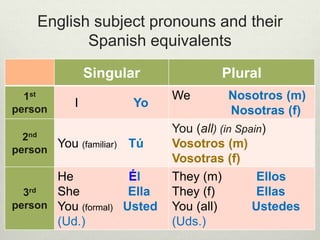
English subject pronouns and their
Spanish equivalents
Singular Plural
1st
person
I Yo
We Nosotros (m)
Nosotras (f)
2nd
person
You (familiar) Tú
You (all) (in Spain)
Vosotros (m)
Vosotras (f)
3rd
person
He Él
She Ella
You (formal) Usted
(Ud.)
They (m) Ellos
They (f) Ellas
You (all) Ustedes
(Uds.)
1.3-33
© by Vista Higher Learning, Inc.
All rights reserved.
1.3-34
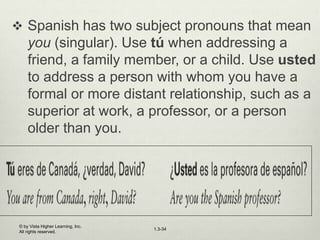
 Spanish has two subject pronouns that mean
you (singular). Use tú when addressing a
friend, a family member, or a child. Use usted
to address a person with whom you have a
formal or more distant relationship, such as a
superior at work, a professor, or a person
older than you.
© by Vista Higher Learning, Inc.
All rights reserved.
1.3-35
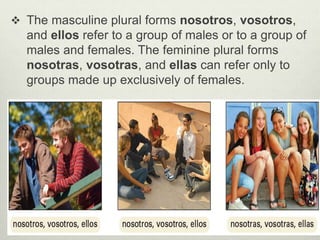
 The masculine plural forms nosotros, vosotros,
and ellos refer to a group of males or to a group of
males and females. The feminine plural forms
nosotras, vosotras, and ellas can refer only to
groups made up exclusively of females.
© by Vista Higher Learning, Inc.
All rights reserved.
1.3-36
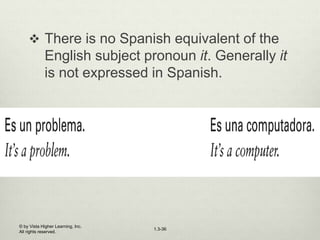
 There is no Spanish equivalent of the
English subject pronoun it. Generally it
is not expressed in Spanish.
© by Vista Higher Learning, Inc.
All rights reserved.
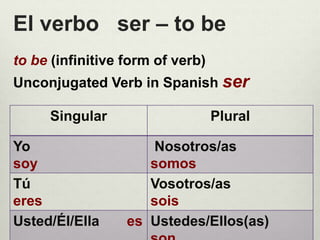
El verbo ser – to be
to be (infinitive form of verb)
Unconjugated Verb in Spanish ser
Singular Plural
Yo
soy
Nosotros/as
somos
Tú
eres
Vosotros/as
sois
Usted/Él/Ella es Ustedes/Ellos(as)
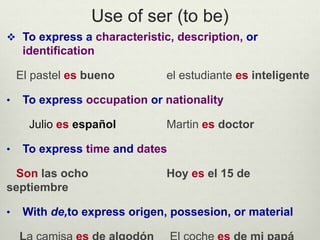
Use of ser (to be)
 To express a characteristic, description, or
identification
El pastel es bueno el estudiante es inteligente
• To express occupation or nationality
Julio es español Martin es doctor
• To express time and dates
Son las ocho Hoy es el 15 de
septiembre
• With de,to express origen, possesion, or material
1.3-39
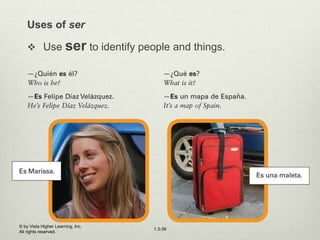
Uses of ser
 Use ser to identify people and things.
© by Vista Higher Learning, Inc.
All rights reserved.
1.3-40
 Ser also expresses possession, with
the preposition de. There is no Spanish
equivalent of the English construction
[noun] + ’s (Maru’s). In its place,
Spanish uses [noun] + de + [owner].
© by Vista Higher Learning, Inc.
All rights reserved.
1.3-41
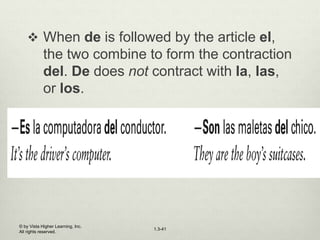
 When de is followed by the article el,
the two combine to form the contraction
del. De does not contract with la, las,
or los.
© by Vista Higher Learning, Inc.
All rights reserved.
1.3-42
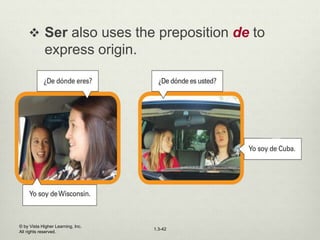
 Ser also uses the preposition de to
express origin.
© by Vista Higher Learning, Inc.
All rights reserved.
1.3-43
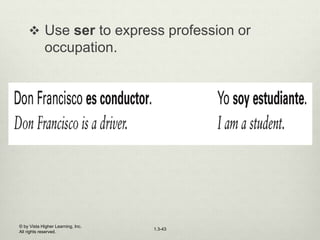
 Use ser to express profession or
occupation.
© by Vista Higher Learning, Inc.
All rights reserved.
1.3-44
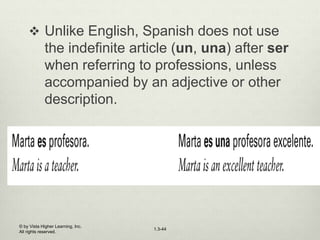
 Unlike English, Spanish does not use
the indefinite article (un, una) after ser
when referring to professions, unless
accompanied by an adjective or other
description.
© by Vista Higher Learning, Inc.
All rights reserved.
1.3-45
© by Vista Higher Learning, Inc.
All rights reserved.
1.3-46
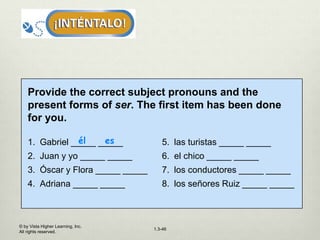
Provide the correct subject pronouns and the
present forms of ser. The first item has been done
for you.
1. Gabriel _____ _____
2. Juan y yo _____ _____
3. Óscar y Flora _____ _____
4. Adriana _____ _____
5. las turistas _____ _____
6. el chico _____ _____
7. los conductores _____ _____
8. los señores Ruiz _____ _____
él es
© by Vista Higher Learning, Inc.
All rights reserved.
© by Vista Higher Learning, Inc.
All rights reserved.
1.4-47
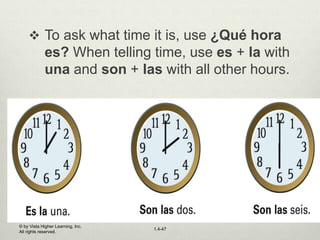
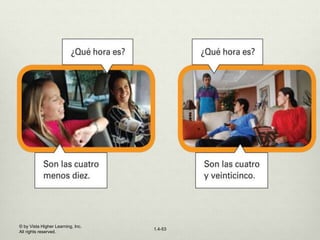
 To ask what time it is, use ¿Qué hora
es? When telling time, use es + la with
una and son + las with all other hours.
© by Vista Higher Learning, Inc.
All rights reserved.
1.4-48
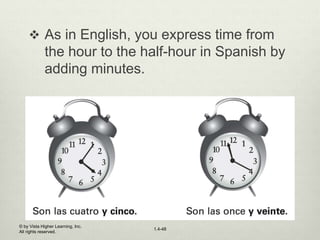
 As in English, you express time from
the hour to the half-hour in Spanish by
adding minutes.
© by Vista Higher Learning, Inc.
All rights reserved.
1.4-49
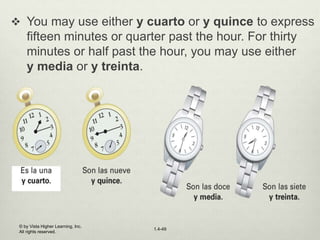
 You may use either y cuarto or y quince to express
fifteen minutes or quarter past the hour. For thirty
minutes or half past the hour, you may use either
y media or y treinta.
© by Vista Higher Learning, Inc.
All rights reserved.
1.4-50
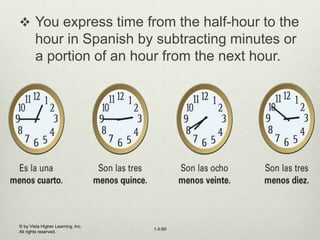
 You express time from the half-hour to the
hour in Spanish by subtracting minutes or
a portion of an hour from the next hour.
© by Vista Higher Learning, Inc.
All rights reserved.
1.4-51
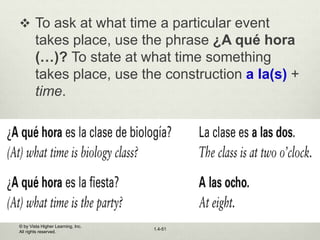
 To ask at what time a particular event
takes place, use the phrase ¿A qué hora
(…)? To state at what time something
takes place, use the construction a la(s) +
time.
© by Vista Higher Learning, Inc.
All rights reserved.
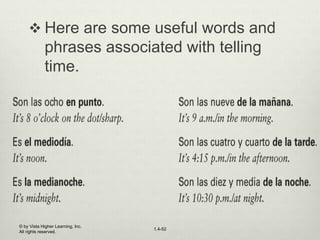
1.4-52
 Here are some useful words and
phrases associated with telling
time.
© by Vista Higher Learning, Inc.
All rights reserved.
1.4-53
© by Vista Higher Learning, Inc.
All rights reserved.
1.4-54
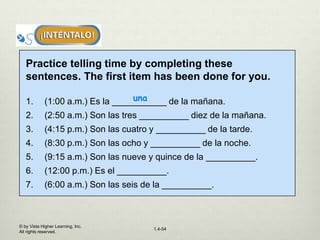
Practice telling time by completing these
sentences. The first item has been done for you.
1. (1:00 a.m.) Es la ___________ de la mañana.
2. (2:50 a.m.) Son las tres __________ diez de la mañana.
3. (4:15 p.m.) Son las cuatro y __________ de la tarde.
4. (8:30 p.m.) Son las ocho y __________ de la noche.
5. (9:15 a.m.) Son las nueve y quince de la __________.
6. (12:00 p.m.) Es el __________.
7. (6:00 a.m.) Son las seis de la __________.
una
© by Vista Higher Learning, Inc.
All rights reserved.
1.4-55
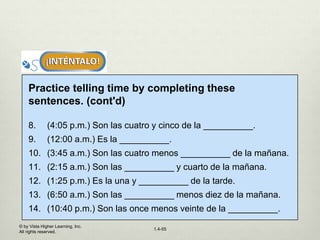
Practice telling time by completing these
sentences. (cont'd)
8. (4:05 p.m.) Son las cuatro y cinco de la __________.
9. (12:00 a.m.) Es la __________.
10. (3:45 a.m.) Son las cuatro menos __________ de la mañana.
11. (2:15 a.m.) Son las __________ y cuarto de la mañana.
12. (1:25 p.m.) Es la una y __________ de la tarde.
13. (6:50 a.m.) Son las __________ menos diez de la mañana.
14. (10:40 p.m.) Son las once menos veinte de la __________.
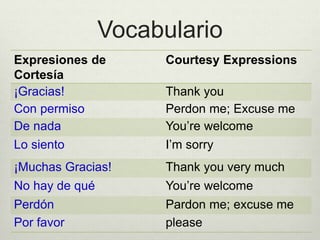
Vocabulario
Expresiones de
Cortesía
Courtesy Expressions
¡Gracias! Thank you
Con permiso Perdon me; Excuse me
De nada You’re welcome
Lo siento I’m sorry
¡Muchas Gracias! Thank you very much
No hay de qué You’re welcome
Perdón Pardon me; excuse me
Por favor please
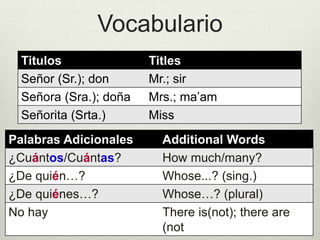
Vocabulario
Titulos Titles
Señor (Sr.); don Mr.; sir
Señora (Sra.); doña Mrs.; ma’am
Señorita (Srta.) Miss
Palabras Adicionales Additional Words
¿Cuántos/Cuántas? How much/many?
¿De quién…? Whose...? (sing.)
¿De quiénes…? Whose…? (plural)
No hay There is(not); there are
(not
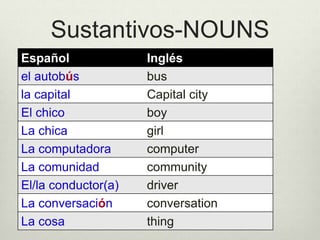
Sustantivos-NOUNS
Español Inglés
el autobús bus
la capital Capital city
El chico boy
La chica girl
La computadora computer
La comunidad community
El/la conductor(a) driver
La conversación conversation
La cosa thing
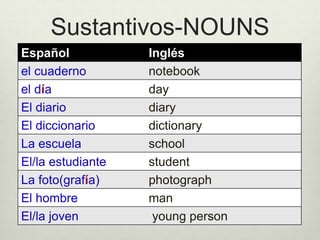
Sustantivos-NOUNS
Español Inglés
el cuaderno notebook
el día day
El diario diary
El diccionario dictionary
La escuela school
El/la estudiante student
La foto(grafía) photograph
El hombre man
El/la joven young person
Sustantivos-NOUNS
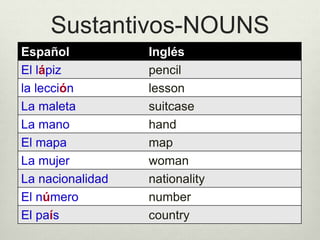
Español Inglés
El lápiz pencil
la lección lesson
La maleta suitcase
La mano hand
El mapa map
La mujer woman
La nacionalidad nationality
El número number
El país country
Sustantivos-NOUNS
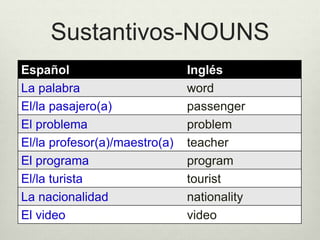
Español Inglés
La palabra word
El/la pasajero(a) passenger
El problema problem
El/la profesor(a)/maestro(a) teacher
El programa program
El/la turista tourist
La nacionalidad nationality
El video video

Unidad 2 ¡Bienvenidos!

  • 1.
  • 2.
    Nouns  A Nounis a word used to identify, people, animals, places, things or ideas.  In Spanish nouns have gender. They are either masculine or feminine.
  • 3.
    © by VistaHigher Learning, Inc. All rights reserved. 1.1-3
  • 4.
    © by VistaHigher Learning, Inc. All rights reserved. 1.1-4
  • 5.
     Generally, nounsthat refer to males, like el hombre, are masculine, while nouns that refer to females, like la mujer, are feminine. © by Vista Higher Learning, Inc. All rights reserved. 1.1-5
  • 6.
    Masculine Nouns  Mostnouns ending on –o are masculine:  The masculine singular noun takes the definite article el el chico el amigo elniño el baño el teléfono el libro  Some masculine nouns end in –a or ma el día el mapa el idioma el drama el clima el problema
  • 7.
     Many nounsthat refer to male beings end in –o or –or.  Their corresponding feminine forms end in –a and –ora, respectively. © by Vista Higher Learning, Inc. All rights reserved. 1.1-7
  • 8.
     The masculineand feminine forms of nouns that end in –ista, like turista, are the same, so gender is indicated by the article el (masculine) or la (feminine). Some other nouns have identical masculine and feminine forms. © by Vista Higher Learning, Inc. All rights reserved. 1.1-8
  • 9.
    Feminine Nouns  Mostnouns ending in –a are feminine and used the singular definite article la. la amiga la casa la niña la comida exceptions: el día, el papá,and words of Greek origen in –ma: el problema – el programa  Words ending in –ción & -sión are feminine  Words ending in –dad or –tad are feminine la conversación la televisión la ciudad la
  • 10.
     Another reasonto memorize the gender of every noun is that there are common exceptions to the rules of gender. For example  el mapa (map) and el día (day) end in –a, but are masculine.  La mano (hand) ends in –o, but is feminine. © by Vista Higher Learning, Inc. All rights reserved. 1.1-10
  • 11.
    Los Cognados, orcognates, are words that are similar in form and meaning to their English Equivalents.  EXACT COGNATES: actor doctor piano central hotel radio color idea terrible chocolate motor viola Los Cognados
  • 12.
    Los Cognados  DIRECTCOGNATES: -ción -tion pronunciación pronuntiation combinación combination
  • 13.
    Los Cognados  DIRECTCOGNATES: -dad -ty sociedad society electricidad electricity -ia, -ía, or -io -y familia family vocabulario vocabulary
  • 14.
    Spanish articles  Asyou know, English often uses definite articles (the) and indefinite articles (a, an) before nouns.  Spanish also has definite and indefinite articles. Unlike English, Spanish articles vary in form because they agree in gender and number with the nouns they modify. © by Vista Higher Learning, Inc. All rights reserved. 1.1-14
  • 15.
    Definite & IndefiniteArticles  DEFINITE Articles are used to refer to the person, place or thing: el hermano los hermanos la hermana las hermanas  INDEFINITE Articles are used to refer to a person or some person, place, or thing. un hermano unos hermanos una hermana unas hermanas Articles
  • 16.
    Definite articles  Spanishhas four forms that are equivalent to the English definite article the. Use definite articles to refer to specific nouns. © by Vista Higher Learning, Inc. All rights reserved. 1.1-16
  • 17.
    Indefinite articles  Spanishhas four forms that are equivalent to the English indefinite article, which according to context may mean a, an, or some. Use indefinite articles to refer to unspecified persons or things. © by Vista Higher Learning, Inc. All rights reserved. 1.1-17
  • 18.
    © by VistaHigher Learning, Inc. All rights reserved. 1.1-18 Provide a definite article for each noun in the first column and an indefinite article for each noun in the second column. 1. _____ chica 2. _____ chico 3. _____ maleta 4. _____ cuadernos 5. _____ lápiz 6. _____ mujeres 1. _____ autobús 2. _____ escuelas 3. _____ computadora 4. _____ hombres 5. _____ señora 6. _____ lápices ¿un, una, unos o unas?¿el, la, los o las? la un
  • 19.
    Plural of nouns To form the plural add –s to nouns that end in a vowel. For nouns that end in a consonant add –es. For nouns that end in z change the z to c, then add –es. © by Vista Higher Learning, Inc. All rights reserved. 1.1-19
  • 20.
     In general,when a singular noun has an accent mark on the last syllable, the accent is dropped from the plural form. © by Vista Higher Learning, Inc. All rights reserved. 1.1-20
  • 21.
     Use themasculine plural form to refer to a group that includes both males and females. © by Vista Higher Learning, Inc. All rights reserved. 1.1-21
  • 22.
    Plural & SingularNouns  Words ending in vowel, add s abuelos  Words ending in consonant, add es meses  Words ending in z change z to c and add es lápiz = lapices feliz = felices
  • 23.
  • 24.
     The numberuno (one) and numbers ending in –uno, such as veintiuno, have more than one form. Before masculine nouns, uno shortens to un. Before feminine nouns, uno changes to una. © by Vista Higher Learning, Inc. All rights reserved. 1.2-24
  • 25.
     ¡Atención! Theforms uno and veintiuno are used when counting (uno, dos, tres... veinte, veintiuno, veintidós...). They are also used when the number follows a noun, even if the noun is feminine: la lección uno. © by Vista Higher Learning, Inc. All rights reserved. 1.2-25
  • 26.
     To askhow many people or things there are, use cuántos before masculine nouns and cuántas before feminine nouns.  ¿Cuántas chicas hay?  ¿Cuántos chicos hay? © by Vista Higher Learning, Inc. All rights reserved. 1.2-26
  • 27.
     The Spanishequivalent of both there is and there are is hay. Use ¿Hay...? to ask  Is there...? or Are there...? Use no hay to express there is not or there are not.
  • 28.
    Provide the Spanishwords for these numbers. 1. 7 _____ 2. 16 _____ 3. 29 _____ 4. 1 _____ 5. 0 _____ 6. 15 _____ 7. 21 _____ 8. 9 _____ 9. 23 _____ 10.11 _____ 11.30 _____ 12.4 _____ 13.12 _____ 14.28 _____ 15.14 _____ 16.10 _____
  • 29.
    Subject pronouns A pronounis a word that takes the place of a noun.
  • 30.
    What is apronoun?  It’s a word used instead of a noun (or a phrase containing a noun) Example: `He', `it', `who', and `anything' are pronouns.  When the pronoun is the subject (the person doing the action) of the sentence, it is called a Subject Pronoun. Example: Bob is swimming. He is swimming.
  • 31.
    What are theEnglish subject pronouns? Singular Plural 1st person I We 2nd person You 3rd person He, She, It They
  • 32.
    English subject pronounsand their Spanish equivalents Singular Plural 1st person I Yo We Nosotros (m) Nosotras (f) 2nd person You (familiar) Tú You (all) (in Spain) Vosotros (m) Vosotras (f) 3rd person He Él She Ella You (formal) Usted (Ud.) They (m) Ellos They (f) Ellas You (all) Ustedes (Uds.)
  • 33.
    1.3-33 © by VistaHigher Learning, Inc. All rights reserved.
  • 34.
    1.3-34  Spanish hastwo subject pronouns that mean you (singular). Use tú when addressing a friend, a family member, or a child. Use usted to address a person with whom you have a formal or more distant relationship, such as a superior at work, a professor, or a person older than you. © by Vista Higher Learning, Inc. All rights reserved.
  • 35.
    1.3-35  The masculineplural forms nosotros, vosotros, and ellos refer to a group of males or to a group of males and females. The feminine plural forms nosotras, vosotras, and ellas can refer only to groups made up exclusively of females. © by Vista Higher Learning, Inc. All rights reserved.
  • 36.
    1.3-36  There isno Spanish equivalent of the English subject pronoun it. Generally it is not expressed in Spanish. © by Vista Higher Learning, Inc. All rights reserved.
  • 37.
    El verbo ser– to be to be (infinitive form of verb) Unconjugated Verb in Spanish ser Singular Plural Yo soy Nosotros/as somos Tú eres Vosotros/as sois Usted/Él/Ella es Ustedes/Ellos(as)
  • 38.
    Use of ser(to be)  To express a characteristic, description, or identification El pastel es bueno el estudiante es inteligente • To express occupation or nationality Julio es español Martin es doctor • To express time and dates Son las ocho Hoy es el 15 de septiembre • With de,to express origen, possesion, or material
  • 39.
    1.3-39 Uses of ser Use ser to identify people and things. © by Vista Higher Learning, Inc. All rights reserved.
  • 40.
    1.3-40  Ser alsoexpresses possession, with the preposition de. There is no Spanish equivalent of the English construction [noun] + ’s (Maru’s). In its place, Spanish uses [noun] + de + [owner]. © by Vista Higher Learning, Inc. All rights reserved.
  • 41.
    1.3-41  When deis followed by the article el, the two combine to form the contraction del. De does not contract with la, las, or los. © by Vista Higher Learning, Inc. All rights reserved.
  • 42.
    1.3-42  Ser alsouses the preposition de to express origin. © by Vista Higher Learning, Inc. All rights reserved.
  • 43.
    1.3-43  Use serto express profession or occupation. © by Vista Higher Learning, Inc. All rights reserved.
  • 44.
    1.3-44  Unlike English,Spanish does not use the indefinite article (un, una) after ser when referring to professions, unless accompanied by an adjective or other description. © by Vista Higher Learning, Inc. All rights reserved.
  • 45.
    1.3-45 © by VistaHigher Learning, Inc. All rights reserved.
  • 46.
    1.3-46 Provide the correctsubject pronouns and the present forms of ser. The first item has been done for you. 1. Gabriel _____ _____ 2. Juan y yo _____ _____ 3. Óscar y Flora _____ _____ 4. Adriana _____ _____ 5. las turistas _____ _____ 6. el chico _____ _____ 7. los conductores _____ _____ 8. los señores Ruiz _____ _____ él es © by Vista Higher Learning, Inc. All rights reserved.
  • 47.
    © by VistaHigher Learning, Inc. All rights reserved. 1.4-47  To ask what time it is, use ¿Qué hora es? When telling time, use es + la with una and son + las with all other hours.
  • 48.
    © by VistaHigher Learning, Inc. All rights reserved. 1.4-48  As in English, you express time from the hour to the half-hour in Spanish by adding minutes.
  • 49.
    © by VistaHigher Learning, Inc. All rights reserved. 1.4-49  You may use either y cuarto or y quince to express fifteen minutes or quarter past the hour. For thirty minutes or half past the hour, you may use either y media or y treinta.
  • 50.
    © by VistaHigher Learning, Inc. All rights reserved. 1.4-50  You express time from the half-hour to the hour in Spanish by subtracting minutes or a portion of an hour from the next hour.
  • 51.
    © by VistaHigher Learning, Inc. All rights reserved. 1.4-51  To ask at what time a particular event takes place, use the phrase ¿A qué hora (…)? To state at what time something takes place, use the construction a la(s) + time.
  • 52.
    © by VistaHigher Learning, Inc. All rights reserved. 1.4-52  Here are some useful words and phrases associated with telling time.
  • 53.
    © by VistaHigher Learning, Inc. All rights reserved. 1.4-53
  • 54.
    © by VistaHigher Learning, Inc. All rights reserved. 1.4-54 Practice telling time by completing these sentences. The first item has been done for you. 1. (1:00 a.m.) Es la ___________ de la mañana. 2. (2:50 a.m.) Son las tres __________ diez de la mañana. 3. (4:15 p.m.) Son las cuatro y __________ de la tarde. 4. (8:30 p.m.) Son las ocho y __________ de la noche. 5. (9:15 a.m.) Son las nueve y quince de la __________. 6. (12:00 p.m.) Es el __________. 7. (6:00 a.m.) Son las seis de la __________. una
  • 55.
    © by VistaHigher Learning, Inc. All rights reserved. 1.4-55 Practice telling time by completing these sentences. (cont'd) 8. (4:05 p.m.) Son las cuatro y cinco de la __________. 9. (12:00 a.m.) Es la __________. 10. (3:45 a.m.) Son las cuatro menos __________ de la mañana. 11. (2:15 a.m.) Son las __________ y cuarto de la mañana. 12. (1:25 p.m.) Es la una y __________ de la tarde. 13. (6:50 a.m.) Son las __________ menos diez de la mañana. 14. (10:40 p.m.) Son las once menos veinte de la __________.
  • 56.
    Vocabulario Expresiones de Cortesía Courtesy Expressions ¡Gracias!Thank you Con permiso Perdon me; Excuse me De nada You’re welcome Lo siento I’m sorry ¡Muchas Gracias! Thank you very much No hay de qué You’re welcome Perdón Pardon me; excuse me Por favor please
  • 57.
    Vocabulario Titulos Titles Señor (Sr.);don Mr.; sir Señora (Sra.); doña Mrs.; ma’am Señorita (Srta.) Miss Palabras Adicionales Additional Words ¿Cuántos/Cuántas? How much/many? ¿De quién…? Whose...? (sing.) ¿De quiénes…? Whose…? (plural) No hay There is(not); there are (not
  • 58.
    Sustantivos-NOUNS Español Inglés el autobúsbus la capital Capital city El chico boy La chica girl La computadora computer La comunidad community El/la conductor(a) driver La conversación conversation La cosa thing
  • 59.
    Sustantivos-NOUNS Español Inglés el cuadernonotebook el día day El diario diary El diccionario dictionary La escuela school El/la estudiante student La foto(grafía) photograph El hombre man El/la joven young person
  • 60.
    Sustantivos-NOUNS Español Inglés El lápizpencil la lección lesson La maleta suitcase La mano hand El mapa map La mujer woman La nacionalidad nationality El número number El país country
  • 61.
    Sustantivos-NOUNS Español Inglés La palabraword El/la pasajero(a) passenger El problema problem El/la profesor(a)/maestro(a) teacher El programa program El/la turista tourist La nacionalidad nationality El video video