CS 591 E / CS 791 L (CRN: 18390 / 18490)   Computer Vision Instructor: Guodong Guo [email_address]
Welcome! Introductions Administrative Matters Course Outline Applications of Computer Vision Computer Vision Focus Computer Vision Publications Journals  Conferences
Instructor Guodong Guo Ph.D. in CS from UW-Madison http://www.cs.wisc.edu/~gdguo Major Research Interest Computer Vision, Machine Learning, Pattern Recognition, Biometrics, Multimedia, and HCI
About You … What do you know already? C/C++ (Visual C++) Matlab Images OpenCV http://sourceforge.net/projects/opencvlibrary/ Install OpenCV in your PC or laptop,  Read the manual introduction Try to load and save images (homework #0)
Outline Introductions Administrative Matters Course Outline Applications of Computer Vision Computer Vision Focus Computer Vision Publications
Meeting Times Lectures M 17:00-19:30 pm  Room ESB-E 449 Office hours TR 1:00-2:00 pm (ESB 753)? Or by appointment
Grading The final grade depends on: Homework and programming assignments: 40% Exams (Midterm): 40% Final project (may include class presentation): 20% Class participation: (-5%, if absent >= 3times) Extra: 1~10% (for creative ideas, paper submission, etc.)
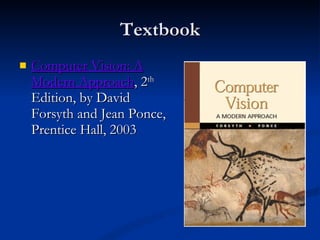
Textbook Computer Vision: A Modern Approach , 2 th  Edition, by David Forsyth and Jean Ponce, Prentice Hall, 2003
Look at the Syllabus Course Objectives Expected learning outcomes Detailed list of topics (maybe updated)
Outline Introductions Administrative Matters Course Outline Applications of Computer Vision Computer Vision Focus Computer Vision Publications
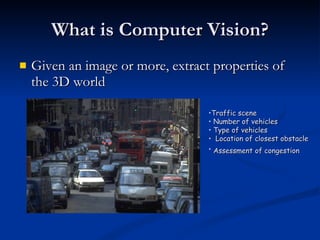
What is Computer Vision? Given an image or more, extract properties of the 3D world  Traffic scene Number of vehicles Type of vehicles Location of closest obstacle Assessment of congestion
Computer Vision vs. Graphics 3D  2D implies information loss sensitivity  to errors need for  models graphics vision
Computer Vision vs. Biometrics Biometrics  comprises methods for uniquely recognizing humans based upon one or more intrinsic physical or behavioral traits Physiological  are related to the shape of the body, e.g., fingerprint, face recognition, DNA, hand and palm geometry, iris recognition, which has largely replaced retina, and odor/scent Behavioral  are related to the behavior of a person, e.g., typing rhythm, gait, and voice
Computer Vision vs. Biometrics Biometrics is a branch of Computer Vision The development of Biometrics depends on Computer Vision techniques
Computer Vision vs. Machine Learning Machine learning  is a scientific discipline that is concerned with the design and development of algorithms that allow computers to change behavior based on data, such as from sensor data or databases  (from Wikipedia) A major focus of machine learning research is to automatically learn to recognize complex patterns and make intelligent decisions based on data.
Computer Vision vs. Machine Learning Machine Learning is very useful for Computer Vision (e.g., learning for vision) Computer Vision is more than just learning Modeling Example based learning In Machine Learning, it usually does not care about how to obtain the data or sensors In Computer Vision, we care how to obtain the visual data (sensor design, active vision), how to represent the visual data, and others
Vision Vision is the process of discovering what is present in the world and where it is by looking.
Computer Vision Computer Vision is the study of analysis of pictures and videos in order to achieve results similar to those as by people.
Why Computer Vision An image is worth 1000 words Many biological systems rely on vision The world is 3D and dynamic Cameras and computers are cheap …
Computer Vision Examples Finding People in images Problem 1:  Given an image I  Question:  Does I contain an image of a person?
“ Yes” Instances
“ No” Instances
Some Computer Vision Topics
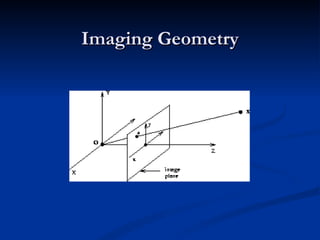
Imaging Geometry
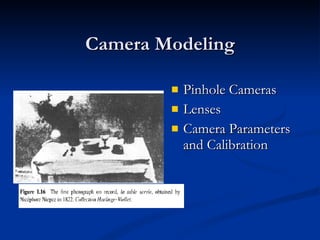
Camera Modeling Pinhole Cameras Lenses Camera Parameters and Calibration
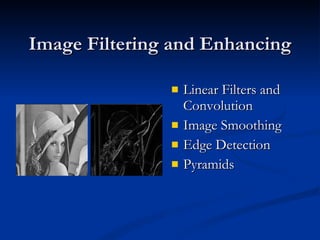
Image Filtering and Enhancing Linear Filters and Convolution Image Smoothing Edge Detection Pyramids
Image Filtering and Enhancing (cont.)
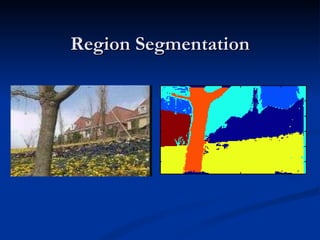
Region Segmentation
Color
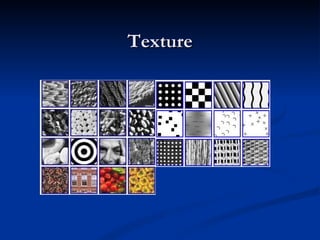
Texture
Image Restoration Original Synthetic
Perceptual Organization
Shape Analysis
Stereo
Motion and Optical Flow
High Level Vision
Image Mosaic
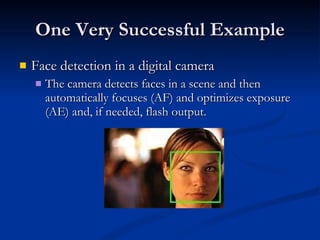
One Very Successful Example Face detection in a digital camera The camera detects faces in a scene and then automatically focuses (AF) and optimizes exposure (AE) and, if needed, flash output.
Outline Introductions Administrative Matters Course Outline Applications of Computer Vision Computer Vision Focus Computer Vision Publications
Applications autonomous cars, planes, missiles, robots, ... space exploration aid to the blind, ASL recognition manufacturing, quality control surveillance, security, biometrics image retrieval medical imaging and analysis ...
Outline Introductions Administrative Matters Course Outline Applications of Computer Vision Computer Vision Focus Computer Vision Publications
Computer Vision focuses on: What information should be extracted? How can it be extracted? How should it be represented? How can it be used to achieve the goal?
Related disciplines Image processing Pattern recognition Photogrammetry Computer graphics Artificial intelligence Machine learning Projective geometry Control theory
Active Research Topics Object recognition Human behavior analysis Internet and computer vision Biometrics and soft biometrics Large scale 3D reconstruction (city level) Medical image processing  Vision for robotics …
Outline Introductions Administrative Matters Course Outline Applications of Computer Vision Computer Vision Focus Computer Vision Publications
Computer Vision Publications Journals IEEE Trans. on Pattern Analysis and Machine Intelligence (TPAMI) #1 IEEE, Thompson-ISI impact factor: 5.96 #1 in both electrical engineering and artificial intelligence #3 in all of computer science Internal Journal of Computer Vision (IJCV) ISI impact factor: 5.358, Rank 2 of 94 in “CS, artificial intelligence IEEE Trans. on Image Processing …
Importance of CV From these major journal rankings, we can see the importance of Computer Vision research in the whole areas of  Computer Science Electrical Engineering
Computer Vision Publications Conferences International Conference on Computer Vision (ICCV) Conf. of Computer Vision and Pattern Recognition (CVPR) Europe Conference on Computer Vision (ECCV) …
Discussions and Questions

General introduction to computer vision

  • 1.
    CS 591 E/ CS 791 L (CRN: 18390 / 18490) Computer Vision Instructor: Guodong Guo [email_address]
  • 2.
    Welcome! Introductions AdministrativeMatters Course Outline Applications of Computer Vision Computer Vision Focus Computer Vision Publications Journals Conferences
  • 3.
    Instructor Guodong GuoPh.D. in CS from UW-Madison http://www.cs.wisc.edu/~gdguo Major Research Interest Computer Vision, Machine Learning, Pattern Recognition, Biometrics, Multimedia, and HCI
  • 4.
    About You …What do you know already? C/C++ (Visual C++) Matlab Images OpenCV http://sourceforge.net/projects/opencvlibrary/ Install OpenCV in your PC or laptop, Read the manual introduction Try to load and save images (homework #0)
  • 5.
    Outline Introductions AdministrativeMatters Course Outline Applications of Computer Vision Computer Vision Focus Computer Vision Publications
  • 6.
    Meeting Times LecturesM 17:00-19:30 pm Room ESB-E 449 Office hours TR 1:00-2:00 pm (ESB 753)? Or by appointment
  • 7.
    Grading The finalgrade depends on: Homework and programming assignments: 40% Exams (Midterm): 40% Final project (may include class presentation): 20% Class participation: (-5%, if absent >= 3times) Extra: 1~10% (for creative ideas, paper submission, etc.)
  • 8.
    Textbook Computer Vision:A Modern Approach , 2 th Edition, by David Forsyth and Jean Ponce, Prentice Hall, 2003
  • 9.
    Look at theSyllabus Course Objectives Expected learning outcomes Detailed list of topics (maybe updated)
  • 10.
    Outline Introductions AdministrativeMatters Course Outline Applications of Computer Vision Computer Vision Focus Computer Vision Publications
  • 11.
    What is ComputerVision? Given an image or more, extract properties of the 3D world Traffic scene Number of vehicles Type of vehicles Location of closest obstacle Assessment of congestion
  • 12.
    Computer Vision vs.Graphics 3D  2D implies information loss sensitivity to errors need for models graphics vision
  • 13.
    Computer Vision vs.Biometrics Biometrics comprises methods for uniquely recognizing humans based upon one or more intrinsic physical or behavioral traits Physiological are related to the shape of the body, e.g., fingerprint, face recognition, DNA, hand and palm geometry, iris recognition, which has largely replaced retina, and odor/scent Behavioral are related to the behavior of a person, e.g., typing rhythm, gait, and voice
  • 14.
    Computer Vision vs.Biometrics Biometrics is a branch of Computer Vision The development of Biometrics depends on Computer Vision techniques
  • 15.
    Computer Vision vs.Machine Learning Machine learning is a scientific discipline that is concerned with the design and development of algorithms that allow computers to change behavior based on data, such as from sensor data or databases (from Wikipedia) A major focus of machine learning research is to automatically learn to recognize complex patterns and make intelligent decisions based on data.
  • 16.
    Computer Vision vs.Machine Learning Machine Learning is very useful for Computer Vision (e.g., learning for vision) Computer Vision is more than just learning Modeling Example based learning In Machine Learning, it usually does not care about how to obtain the data or sensors In Computer Vision, we care how to obtain the visual data (sensor design, active vision), how to represent the visual data, and others
  • 17.
    Vision Vision isthe process of discovering what is present in the world and where it is by looking.
  • 18.
    Computer Vision ComputerVision is the study of analysis of pictures and videos in order to achieve results similar to those as by people.
  • 19.
    Why Computer VisionAn image is worth 1000 words Many biological systems rely on vision The world is 3D and dynamic Cameras and computers are cheap …
  • 20.
    Computer Vision ExamplesFinding People in images Problem 1: Given an image I Question: Does I contain an image of a person?
  • 21.
  • 22.
  • 23.
  • 24.
  • 25.
    Camera Modeling PinholeCameras Lenses Camera Parameters and Calibration
  • 26.
    Image Filtering andEnhancing Linear Filters and Convolution Image Smoothing Edge Detection Pyramids
  • 27.
    Image Filtering andEnhancing (cont.)
  • 28.
  • 29.
  • 30.
  • 31.
  • 32.
  • 33.
  • 34.
  • 35.
  • 36.
  • 37.
  • 38.
  • 39.
    One Very SuccessfulExample Face detection in a digital camera The camera detects faces in a scene and then automatically focuses (AF) and optimizes exposure (AE) and, if needed, flash output.
  • 40.
    Outline Introductions AdministrativeMatters Course Outline Applications of Computer Vision Computer Vision Focus Computer Vision Publications
  • 41.
    Applications autonomous cars,planes, missiles, robots, ... space exploration aid to the blind, ASL recognition manufacturing, quality control surveillance, security, biometrics image retrieval medical imaging and analysis ...
  • 42.
    Outline Introductions AdministrativeMatters Course Outline Applications of Computer Vision Computer Vision Focus Computer Vision Publications
  • 43.
    Computer Vision focuseson: What information should be extracted? How can it be extracted? How should it be represented? How can it be used to achieve the goal?
  • 44.
    Related disciplines Imageprocessing Pattern recognition Photogrammetry Computer graphics Artificial intelligence Machine learning Projective geometry Control theory
  • 45.
    Active Research TopicsObject recognition Human behavior analysis Internet and computer vision Biometrics and soft biometrics Large scale 3D reconstruction (city level) Medical image processing Vision for robotics …
  • 46.
    Outline Introductions AdministrativeMatters Course Outline Applications of Computer Vision Computer Vision Focus Computer Vision Publications
  • 47.
    Computer Vision PublicationsJournals IEEE Trans. on Pattern Analysis and Machine Intelligence (TPAMI) #1 IEEE, Thompson-ISI impact factor: 5.96 #1 in both electrical engineering and artificial intelligence #3 in all of computer science Internal Journal of Computer Vision (IJCV) ISI impact factor: 5.358, Rank 2 of 94 in “CS, artificial intelligence IEEE Trans. on Image Processing …
  • 48.
    Importance of CVFrom these major journal rankings, we can see the importance of Computer Vision research in the whole areas of Computer Science Electrical Engineering
  • 49.
    Computer Vision PublicationsConferences International Conference on Computer Vision (ICCV) Conf. of Computer Vision and Pattern Recognition (CVPR) Europe Conference on Computer Vision (ECCV) …
  • 50.