Computer Vision
Ali raja 13054119-147
Farhan Azmat 13054119-135
Husnain Farooq 13054119-173
 Humans use their eyes and their brains to see and
visually sense the world around them. Computer
vision is the science that aims to give a similar,
capability to a machine or computer.
 Computer vision is concerned with the automatic
extraction, analysis and understanding of useful
information from a single image or a sequence of
images. It involves the development of a theoretical
and algorithmic basis to achieve automatic visual
understanding.
What is Computer Vision?
 Computer vision is an interdisciplinary field that deals
with how computers can be made to gain high-level
understanding from digital images or videos. From the
perspective of engineering, it seeks to automate tasks
that the human visual system can do.
 Computer vision tasks include methods
for acquiring, processing, analyzing and understanding
digital images, and in general, deal with the extraction
of high-dimensional data from the real world in order to
produce numerical or symbolic information, e.g., in the
forms of decisions.
Computer Vision Cont…
 Understanding in this context means the transformation
of visual images (the input of the retina) into
descriptions of the world that can interface with other
thought processes and elicit appropriate action.
 This image understanding can be seen as the
disentangling of symbolic information from image data
using models constructed with the aid of geometry,
physics, statistics, and learning theory.
Cont…
Cont…
 As a scientific discipline, computer vision is concerned
with the theory behind artificial systems that extract
information from images. The image data can take
many forms, such as video sequences, views from
multiple cameras, or multi-dimensional data from a
medical scanner. As a technological discipline,
computer vision seeks to apply its theories and
models for the construction of computer vision
systems.
 In the late 1960s, computer vision began at
universities that were pioneering artificial
intelligence. It was meant to mimic the human visual
system, as a stepping stone to endowing robots with
intelligent behavior.[9] In 1966, it was believed that
this could be achieved through a summer project, by
attaching a camera to a computer and having it
"describe what it saw".
History Of Computer Vision
 What distinguished computer vision from the prevalent
field of digital image processing at that time was a desire
to extract three-dimensional structure from images with
the goal of achieving full scene understanding. Studies in
the 1970s formed the early foundations for many of the
computer vision algorithms that exist today,
including extraction of edges from images, labeling of
lines, non-polyhedral and polyhedral modeling,
representation of objects as interconnections of smaller
structures, optical flow, and motion estimation.
History Of Computer Vision
 Toward the end of the 1990s, a significant change
came about with the increased interaction between
the fields of computer graphics and computer vision.
This included image-based rendering, image
morphing, view interpolation, panoramic image
stitching.
History Of Computer Vision
Applications of Computer Vision
 Applications range from tasks such as
industrial machine vision systems which, say, inspect
bottles speeding by on a production line, to research
into artificial intelligence and computers or robots
that can comprehend the world around them. The
computer vision and machine vision fields have
significant overlap.
 Controlling processes, e.g., an industrial robot;
 Navigation, e.g., by an autonomous vehicle or mobile
robot;
 Detecting events, e.g., for visual surveillance or people
counting;
 Automatic inspection, e.g., in manufacturing
applications.
Applications of Computer Vision
 As each module is standalone application and there is
no dependencies on other modules so we can deliver
the project with initial developed feature and other
features could be added on incremental basis with
new releases.
 Incremental process goes until all the requirements
fulfilled and whole system gets developed.
Advantages
 It is easier to test and debug during a smaller project.
 In this model customer can respond to each built.
 It is flexible and less expensive to change
requirements.
 This model is more flexible
Disadvantages
 Total cost is higher than waterfall.
 Needs good planning and design.
 Needs a clear and complete definition of the whole
system before it can be broken down and built
incrementally.
Incremental model Disadvantages
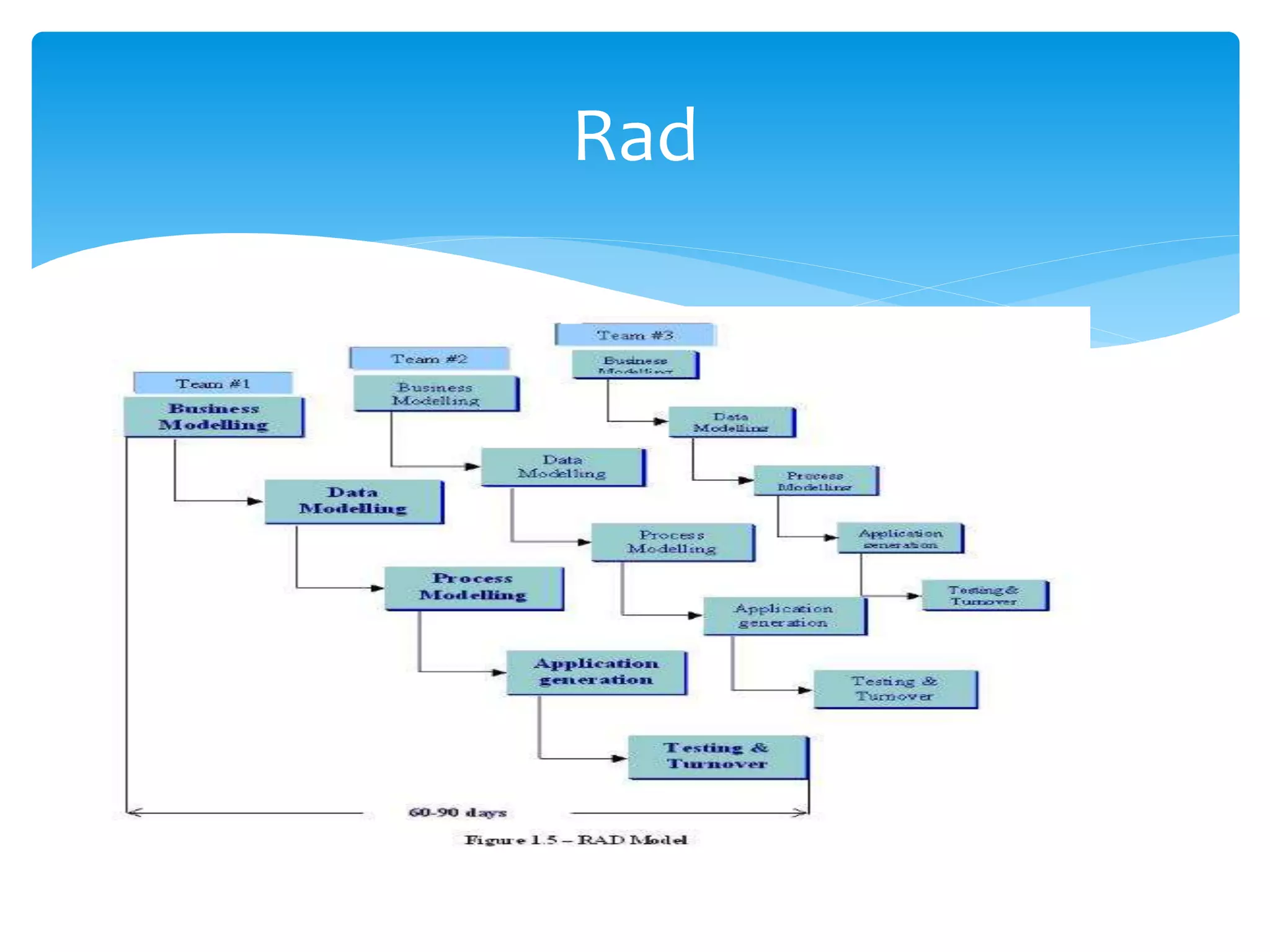
 RAD model is Rapid Application Development model.
 . It is a type of incremental model.
 In RAD model the components or functions are
developed in parallel as if they were mini projects.
The developments are time boxed, delivered and
then assembled into a working prototype.
Rad(Rapid Application development)
Rad
 Business modeling: The information flow is identified
between various business functions.
Data modeling: Information gathered from business
modeling is used to define data objects that are
needed for the business.
Process modeling: Data objects defined in data
modeling are converted to achieve the business
information flow to achieve some specific business
objective. Description are identified and created for
CRUD of data objects.
The phase of Rad
 Application generation: Automated tools are used to
convert process models into code and the actual
system.
Testing and turnover: Test new components and all
the interfaces.
The phase of Rad
 Reduced development time.
 Increases reusability of components
 Quick initial reviews occur
 Encourages customer feedback
Advantages of the RAD model:
 Depends on strong team and individual performances
for identifying business requirements.
 Only system that can be modularized can be built
using RAD
 Requires highly skilled developers/designers.
 High dependency on modeling skills
Disadvantages of RAD model
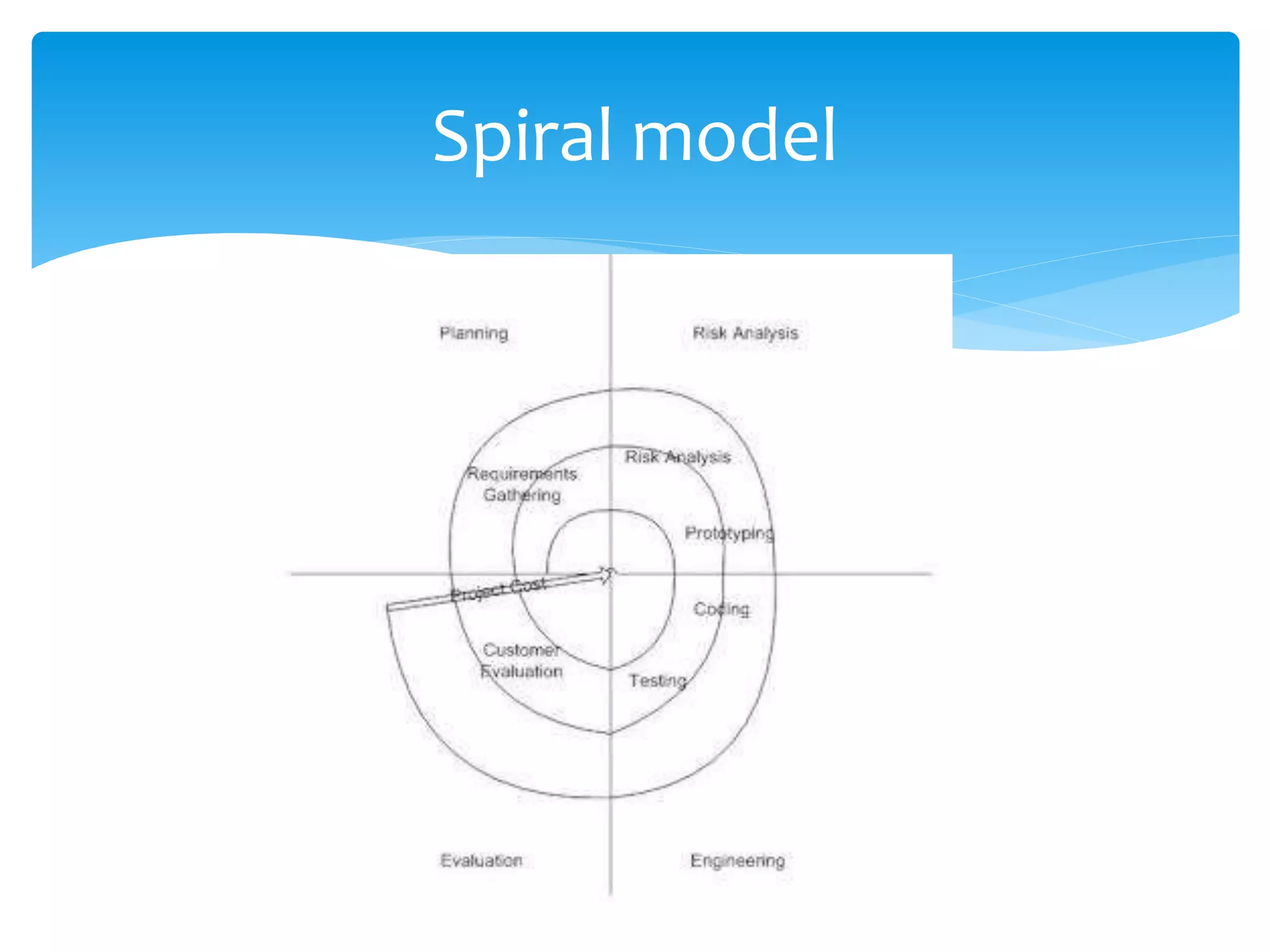
 The spiral model is similar to the incremental model,
with more emphasis placed on risk analysis.
 The spiral model has four phases.
 Planning.
 Risk Analysis.
 Engineering and Evaluation.
 A software project repeatedly passes through these
phases in iterations (called Spirals in this model).
Spiral Model
Spiral model
 Planning Phase: Requirements are gathered during
the planning phase. Requirements like ‘BRS’ that is
‘Business Requirement Specifications’ and ‘SRS’ that
is ‘System Requirement specifications’.
 Risk Analysis: In the risk analysis phase, a process is
undertaken to identify risk and alternate solutions. A
prototype is produced at the end of the risk analysis
phase. If any risk is found during the risk analysis then
alternate solutions are suggested and implemented.
Phase of Spiral Model
 Engineering Phase: In this phase software
is developed, along with testing at the end of the
phase. Hence in this phase the development and
testing is done.
 Evaluation phase: This phase allows the customer to
evaluate the output of the project to date before the
project continues to the next spiral.
Phase of Spiral Model
 High amount of risk analysis hence, avoidance of Risk
is enhanced.
 Good for large and mission-critical projects.
 Strong approval and documentation control.
 Additional Functionality can be added at a later date.
 Software is produced early in the software life cycle
Advantages of Spiral model:
 Can be a costly model to use.
 Risk analysis requires highly specific expertise.
 Project’s success is highly dependent on the risk
analysis phase.
 Doesn’t work well for smaller projects.

Disadvantages of Spiral model:

Computer vision

  • 1.
    Computer Vision Ali raja13054119-147 Farhan Azmat 13054119-135 Husnain Farooq 13054119-173
  • 2.
     Humans usetheir eyes and their brains to see and visually sense the world around them. Computer vision is the science that aims to give a similar, capability to a machine or computer.  Computer vision is concerned with the automatic extraction, analysis and understanding of useful information from a single image or a sequence of images. It involves the development of a theoretical and algorithmic basis to achieve automatic visual understanding. What is Computer Vision?
  • 3.
     Computer visionis an interdisciplinary field that deals with how computers can be made to gain high-level understanding from digital images or videos. From the perspective of engineering, it seeks to automate tasks that the human visual system can do.  Computer vision tasks include methods for acquiring, processing, analyzing and understanding digital images, and in general, deal with the extraction of high-dimensional data from the real world in order to produce numerical or symbolic information, e.g., in the forms of decisions. Computer Vision Cont…
  • 4.
     Understanding inthis context means the transformation of visual images (the input of the retina) into descriptions of the world that can interface with other thought processes and elicit appropriate action.  This image understanding can be seen as the disentangling of symbolic information from image data using models constructed with the aid of geometry, physics, statistics, and learning theory. Cont…
  • 5.
    Cont…  As ascientific discipline, computer vision is concerned with the theory behind artificial systems that extract information from images. The image data can take many forms, such as video sequences, views from multiple cameras, or multi-dimensional data from a medical scanner. As a technological discipline, computer vision seeks to apply its theories and models for the construction of computer vision systems.
  • 6.
     In thelate 1960s, computer vision began at universities that were pioneering artificial intelligence. It was meant to mimic the human visual system, as a stepping stone to endowing robots with intelligent behavior.[9] In 1966, it was believed that this could be achieved through a summer project, by attaching a camera to a computer and having it "describe what it saw". History Of Computer Vision
  • 7.
     What distinguishedcomputer vision from the prevalent field of digital image processing at that time was a desire to extract three-dimensional structure from images with the goal of achieving full scene understanding. Studies in the 1970s formed the early foundations for many of the computer vision algorithms that exist today, including extraction of edges from images, labeling of lines, non-polyhedral and polyhedral modeling, representation of objects as interconnections of smaller structures, optical flow, and motion estimation. History Of Computer Vision
  • 8.
     Toward theend of the 1990s, a significant change came about with the increased interaction between the fields of computer graphics and computer vision. This included image-based rendering, image morphing, view interpolation, panoramic image stitching. History Of Computer Vision
  • 9.
    Applications of ComputerVision  Applications range from tasks such as industrial machine vision systems which, say, inspect bottles speeding by on a production line, to research into artificial intelligence and computers or robots that can comprehend the world around them. The computer vision and machine vision fields have significant overlap.
  • 10.
     Controlling processes,e.g., an industrial robot;  Navigation, e.g., by an autonomous vehicle or mobile robot;  Detecting events, e.g., for visual surveillance or people counting;  Automatic inspection, e.g., in manufacturing applications. Applications of Computer Vision
  • 11.
     As eachmodule is standalone application and there is no dependencies on other modules so we can deliver the project with initial developed feature and other features could be added on incremental basis with new releases.  Incremental process goes until all the requirements fulfilled and whole system gets developed. Advantages
  • 12.
     It iseasier to test and debug during a smaller project.  In this model customer can respond to each built.  It is flexible and less expensive to change requirements.  This model is more flexible Disadvantages
  • 13.
     Total costis higher than waterfall.  Needs good planning and design.  Needs a clear and complete definition of the whole system before it can be broken down and built incrementally. Incremental model Disadvantages
  • 14.
     RAD modelis Rapid Application Development model.  . It is a type of incremental model.  In RAD model the components or functions are developed in parallel as if they were mini projects. The developments are time boxed, delivered and then assembled into a working prototype. Rad(Rapid Application development)
  • 15.
  • 16.
     Business modeling:The information flow is identified between various business functions. Data modeling: Information gathered from business modeling is used to define data objects that are needed for the business. Process modeling: Data objects defined in data modeling are converted to achieve the business information flow to achieve some specific business objective. Description are identified and created for CRUD of data objects. The phase of Rad
  • 17.
     Application generation:Automated tools are used to convert process models into code and the actual system. Testing and turnover: Test new components and all the interfaces. The phase of Rad
  • 18.
     Reduced developmenttime.  Increases reusability of components  Quick initial reviews occur  Encourages customer feedback Advantages of the RAD model:
  • 19.
     Depends onstrong team and individual performances for identifying business requirements.  Only system that can be modularized can be built using RAD  Requires highly skilled developers/designers.  High dependency on modeling skills Disadvantages of RAD model
  • 20.
     The spiralmodel is similar to the incremental model, with more emphasis placed on risk analysis.  The spiral model has four phases.  Planning.  Risk Analysis.  Engineering and Evaluation.  A software project repeatedly passes through these phases in iterations (called Spirals in this model). Spiral Model
  • 21.
  • 22.
     Planning Phase:Requirements are gathered during the planning phase. Requirements like ‘BRS’ that is ‘Business Requirement Specifications’ and ‘SRS’ that is ‘System Requirement specifications’.  Risk Analysis: In the risk analysis phase, a process is undertaken to identify risk and alternate solutions. A prototype is produced at the end of the risk analysis phase. If any risk is found during the risk analysis then alternate solutions are suggested and implemented. Phase of Spiral Model
  • 23.
     Engineering Phase:In this phase software is developed, along with testing at the end of the phase. Hence in this phase the development and testing is done.  Evaluation phase: This phase allows the customer to evaluate the output of the project to date before the project continues to the next spiral. Phase of Spiral Model
  • 24.
     High amountof risk analysis hence, avoidance of Risk is enhanced.  Good for large and mission-critical projects.  Strong approval and documentation control.  Additional Functionality can be added at a later date.  Software is produced early in the software life cycle Advantages of Spiral model:
  • 25.
     Can bea costly model to use.  Risk analysis requires highly specific expertise.  Project’s success is highly dependent on the risk analysis phase.  Doesn’t work well for smaller projects.  Disadvantages of Spiral model: