Introduction to
Computer Vision
Based on slides by
Jinxiang Chai,
Svetlana Lazebnik,
Guodong Guo
Assembled and modified
by Longin Jan Latecki
September 2012
What is Computer Vision?
• Computer vision is the science and technology of machines
that see.
• Concerned with the theory for building artificial systems that
obtain information from images.
• The image data can take many forms, such as a video
sequence, depth images, views from multiple cameras, or
multi-dimensional data from a medical scanner
Computer Vision
Make computers understand images and
videos.
What kind of scene?
Where are the cars?
How far is the
building?
…
Components of a computer vision system
Lighting
Scene
Camera
Computer
Scene Interpretation
Srinivasa Narasimhan’s slide
Computer vision vs human vision
What we see What a computer sees
Vision is really hard
• Vision is an amazing feat of natural
intelligence
– Visual cortex occupies about 50% of Macaque brain
– More human brain devoted to vision than anything else
Is that a
queen or a
bishop?
Vision is multidisciplinary
From wiki
Computer
Graphics
HCI
Why computer vision matters
Safety Health Security
Comfort Access
Fun
A little story about Computer Vision
In 1966, Marvin Minsky at MIT asked his undergraduate student
Gerald Jay Sussman to “spend the summer linking a camera to a
computer and getting the computer to describe what it saw”. We
now know that the problem is slightly more difficult than that.
(Szeliski 2009, Computer Vision)
A little story about Computer Vision
In 1966, Marvin Minsky at MIT asked his undergraduate student
Gerald Jay Sussman to “spend the summer linking a camera to a
computer and getting the computer to describe what it saw”. We
now know that the problem is slightly more difficult than that.
Founder, MIT AI project
A little story about Computer Vision
In 1966, Marvin Minsky at MIT asked his undergraduate student
Gerald Jay Sussman to “spend the summer linking a camera to a
computer and getting the computer to describe what it saw”. We
now know that the problem is slightly more difficult than that.
Image Understanding
Ridiculously brief history of computer vision
• 1966: Minsky assigns computer vision
as an undergrad summer project
• 1960’s: interpretation of synthetic
worlds
• 1970’s: some progress on interpreting
selected images
• 1980’s: ANNs come and go; shift toward
geometry and increased mathematical
rigor
• 1990’s: face recognition; statistical
analysis in vogue
• 2000’s: broader recognition; large
annotated datasets available; video
processing starts; vision & graphis;
vision for HCI; internet vision, etc.
Guzman ‘68
Ohta Kanade ‘78
Turk and Pentland ‘91
How vision is used now
• Examples of state-of-the-art
Optical character recognition (OCR)
Digit recognition, AT&T labs
http://www.research.att.com/~yann/
Technology to convert scanned docs to text
• If you have a scanner, it probably came with OCR software
License plate readers
http://en.wikipedia.org/wiki/Automatic_number_plate_recognition
Face detection
• Many new digital cameras now detect faces
– Canon, Sony, Fuji, …
Smile detection
Sony Cyber-shot® T70 Digital Still Camera
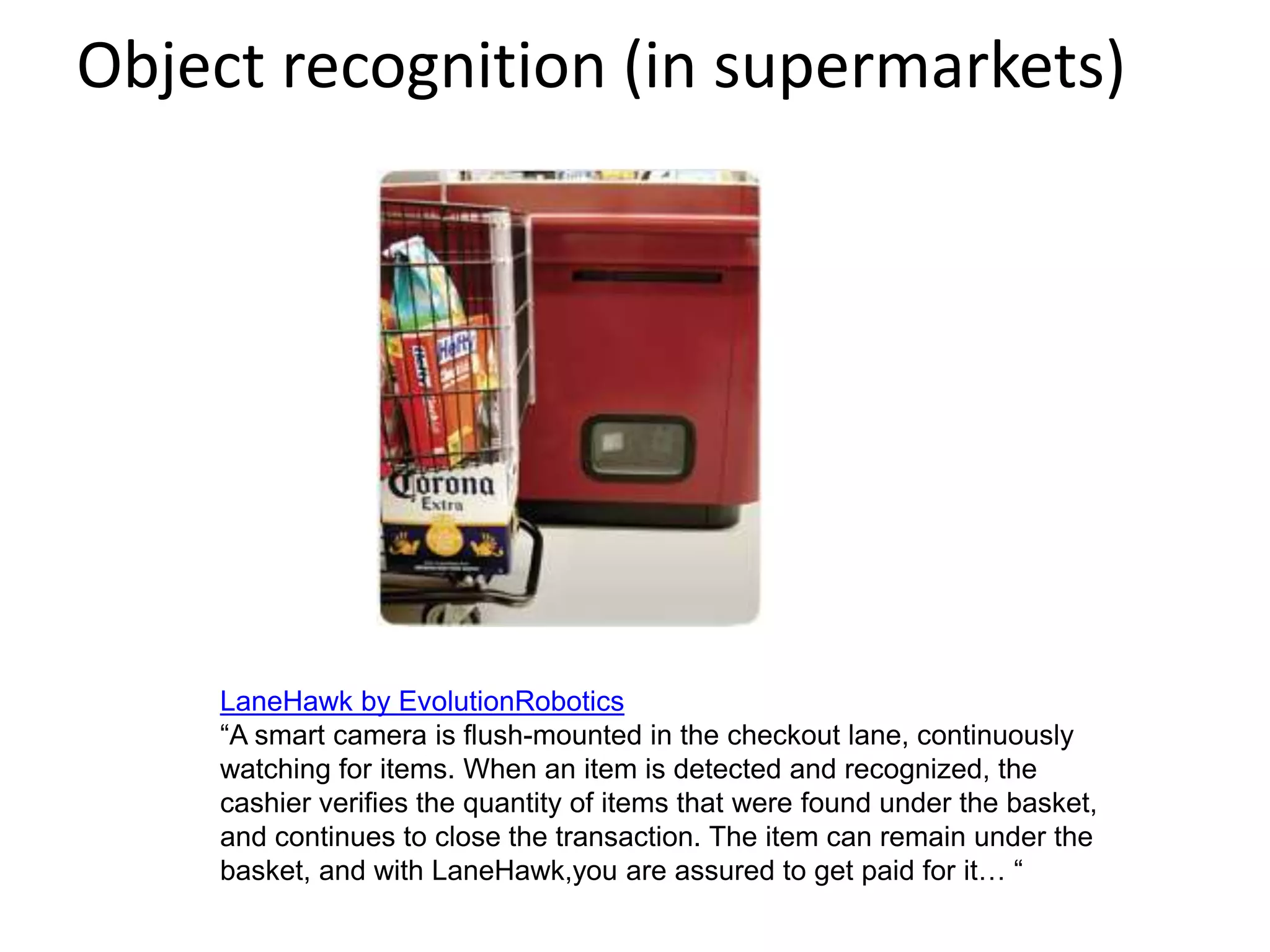
Object recognition (in supermarkets)
LaneHawk by EvolutionRobotics
“A smart camera is flush-mounted in the checkout lane, continuously
watching for items. When an item is detected and recognized, the
cashier verifies the quantity of items that were found under the basket,
and continues to close the transaction. The item can remain under the
basket, and with LaneHawk,you are assured to get paid for it… “
Vision-based biometrics
“How the Afghan Girl was Identified by Her Iris Patterns” Read the story
wikipedia
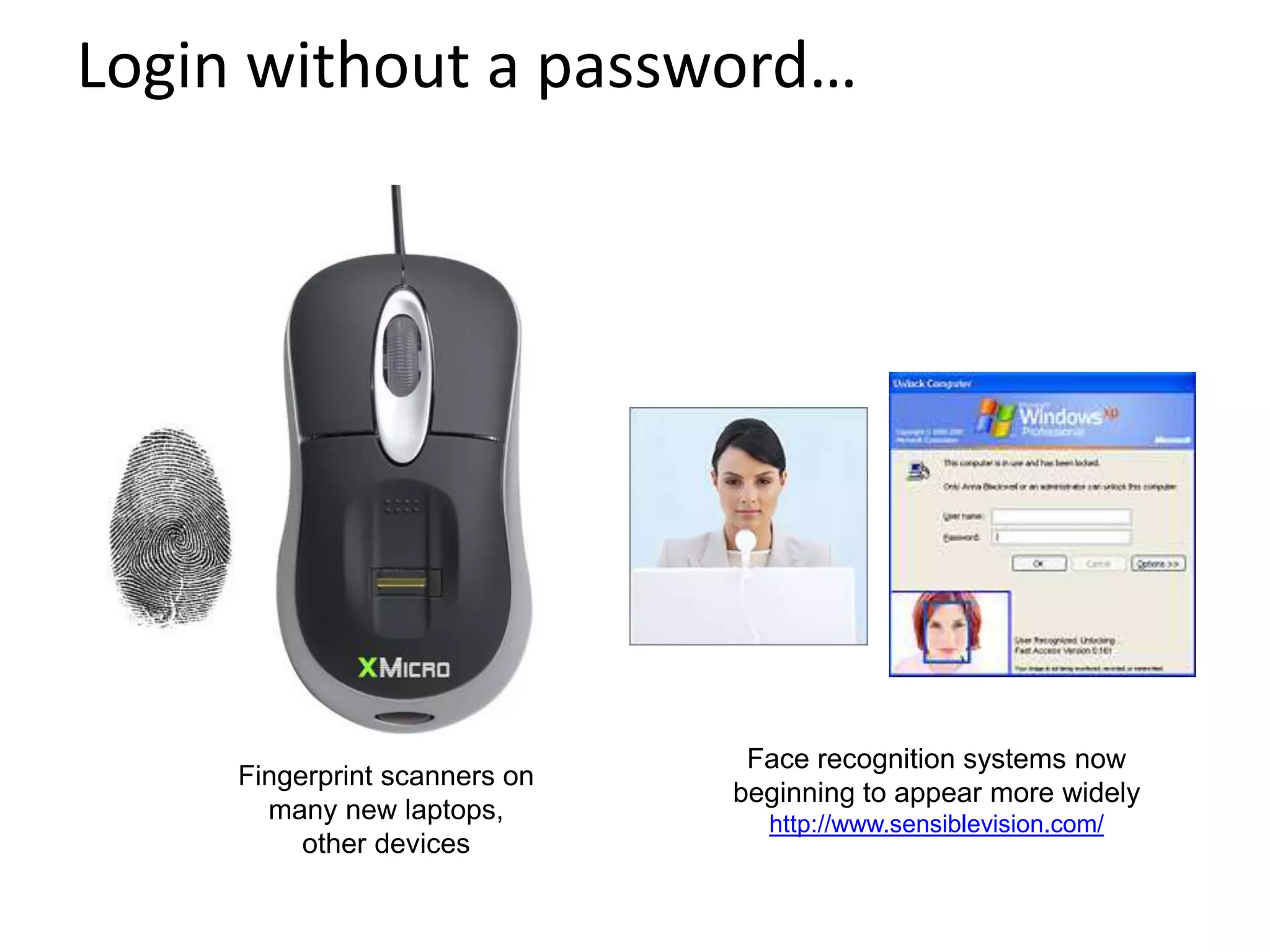
Login without a password…
Fingerprint scanners on
many new laptops,
other devices
Face recognition systems now
beginning to appear more widely
http://www.sensiblevision.com/
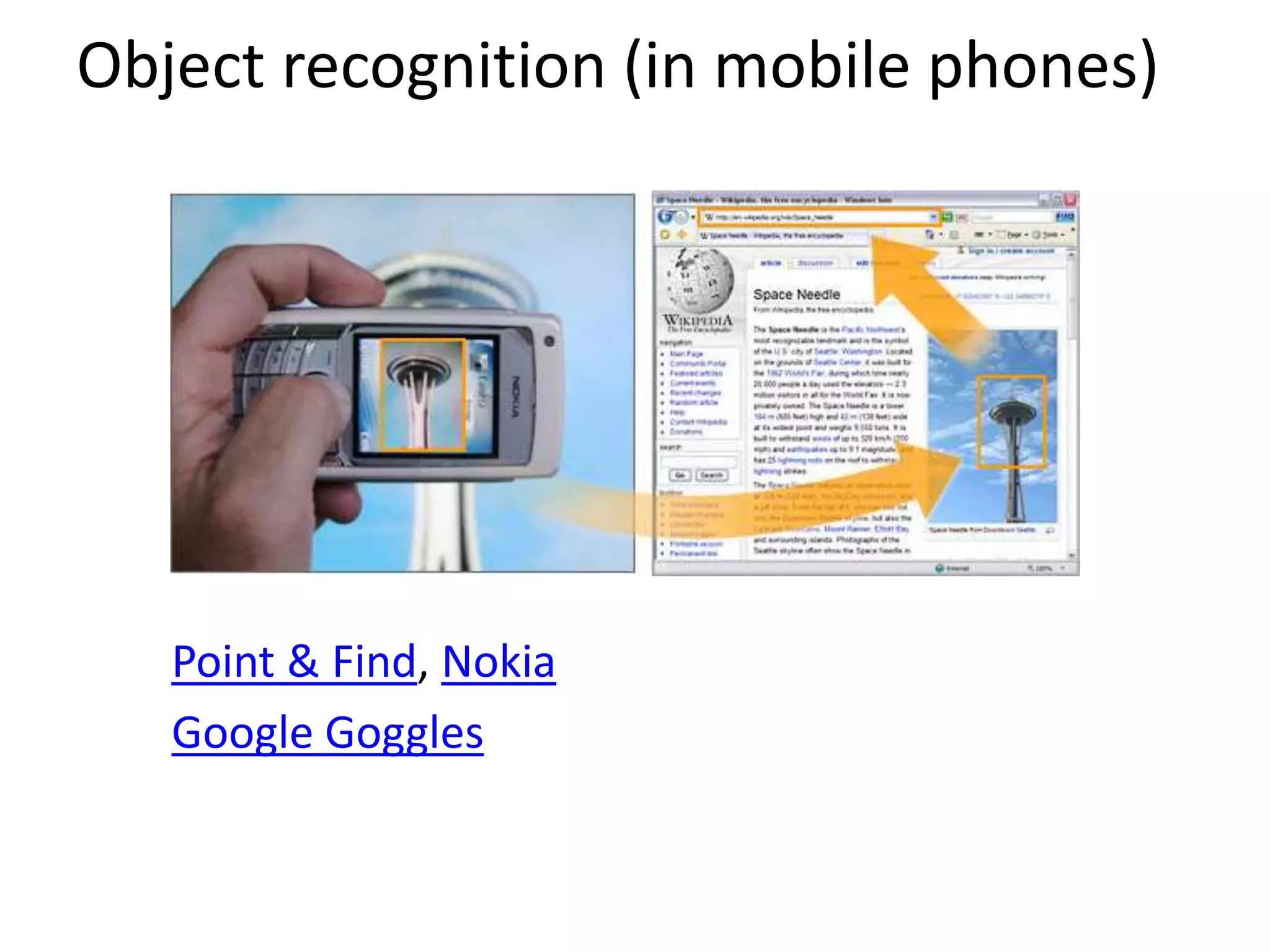
Object recognition (in mobile phones)
Point & Find, Nokia
Google Goggles
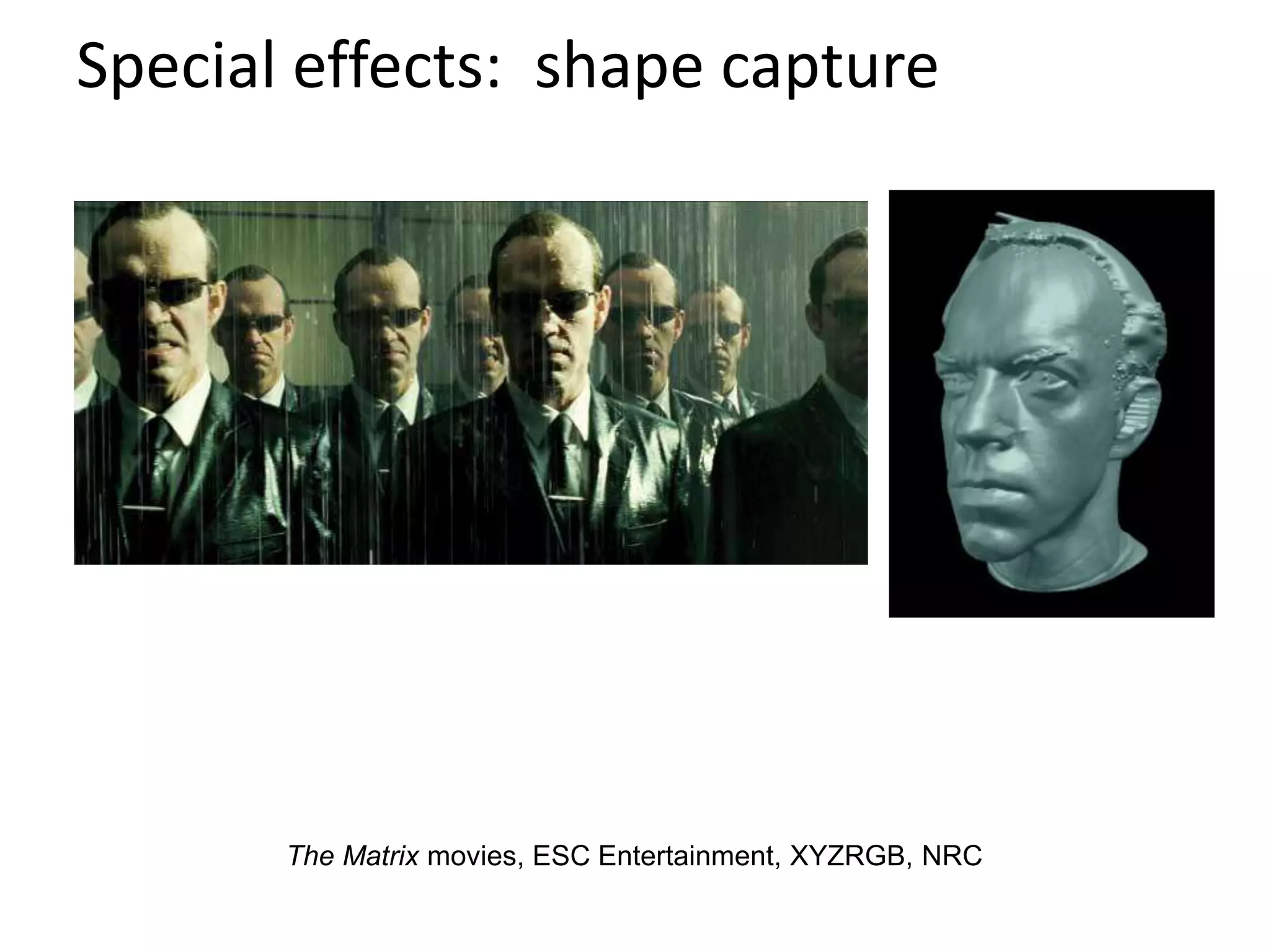
The Matrix movies, ESC Entertainment, XYZRGB, NRC
Special effects: shape capture
Pirates of the Carribean, Industrial Light and Magic
Special effects: motion capture
Sports
Sportvision first down line
Nice explanation on www.howstuffworks.com
http://www.sportvision.com/video.html
Smart cars
• Mobileye [wiki article]
– Vision systems currently in many car models
Slide content courtesy of Amnon Shashua
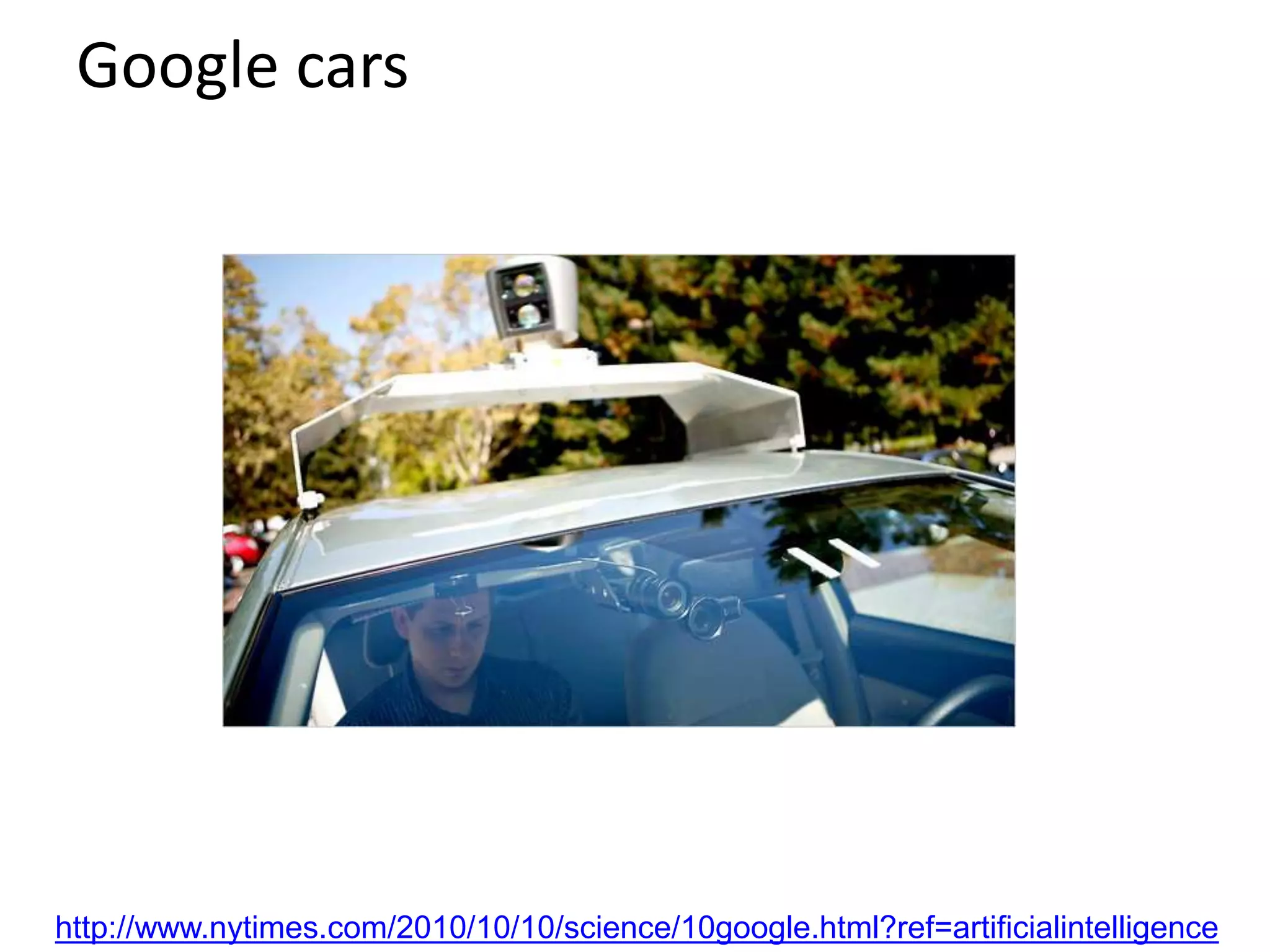
Google cars
http://www.nytimes.com/2010/10/10/science/10google.html?ref=artificialintelligence
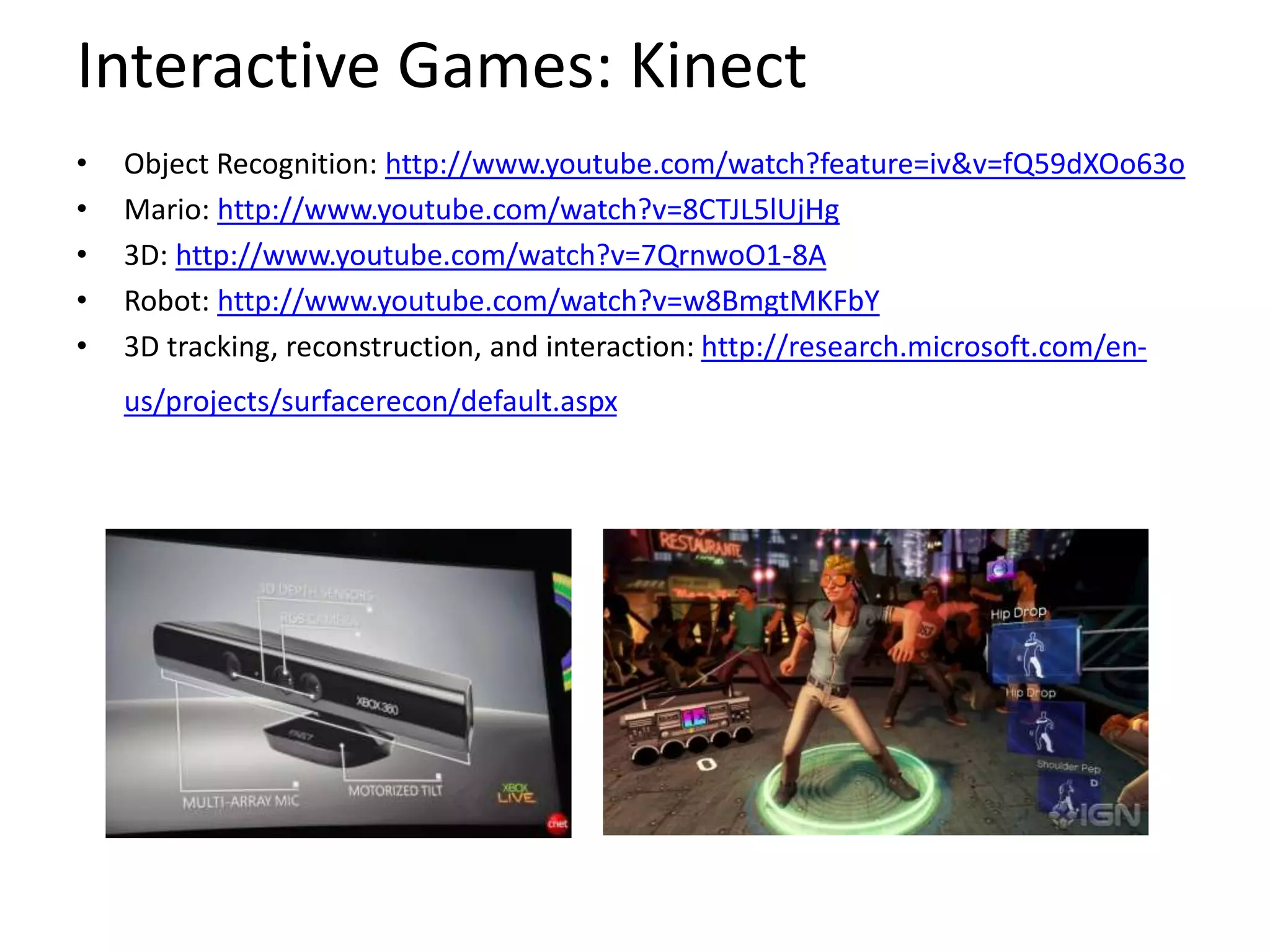
Interactive Games: Kinect
• Object Recognition: http://www.youtube.com/watch?feature=iv&v=fQ59dXOo63o
• Mario: http://www.youtube.com/watch?v=8CTJL5lUjHg
• 3D: http://www.youtube.com/watch?v=7QrnwoO1-8A
• Robot: http://www.youtube.com/watch?v=w8BmgtMKFbY
• 3D tracking, reconstruction, and interaction: http://research.microsoft.com/en-
us/projects/surfacerecon/default.aspx
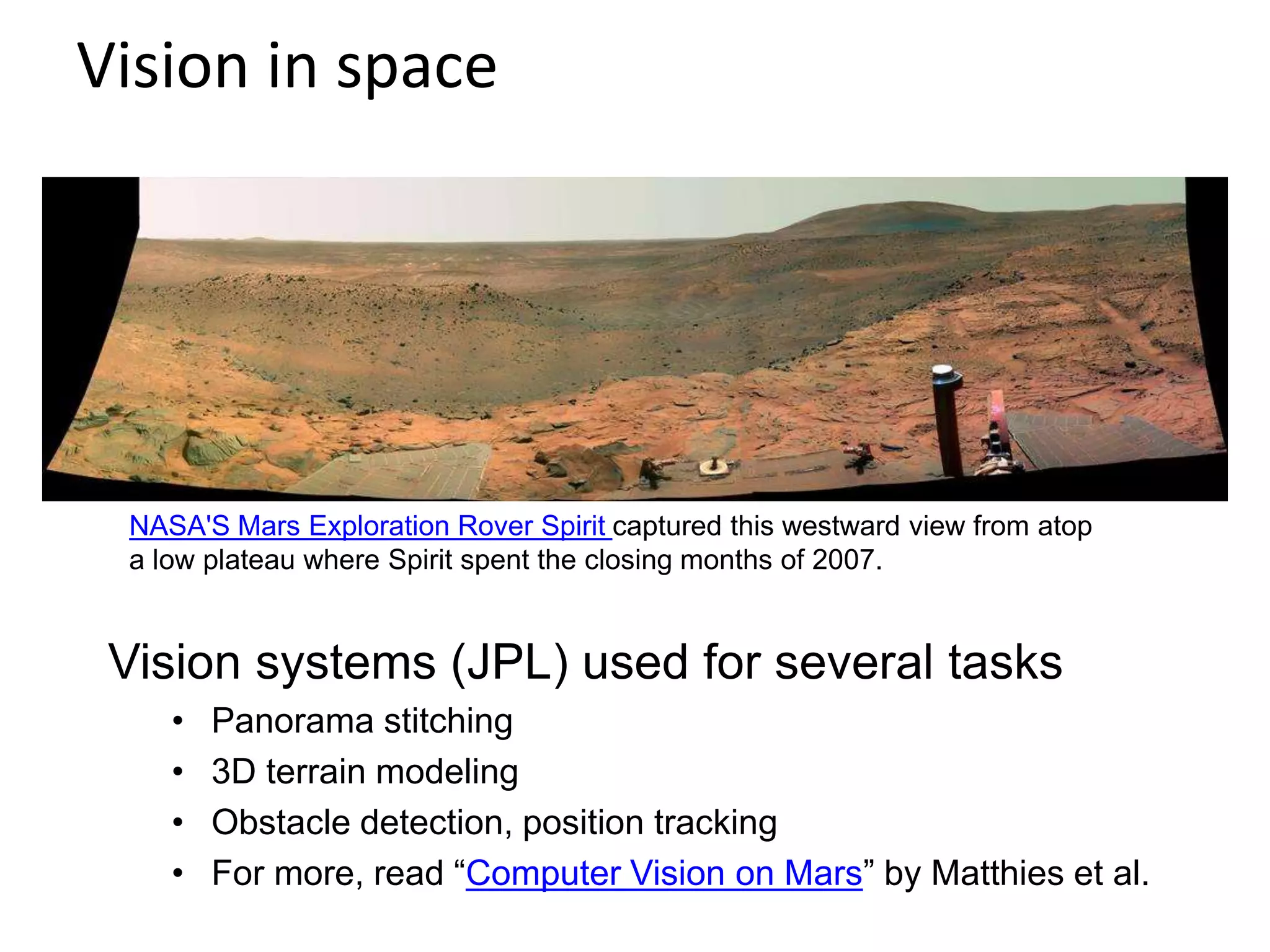
Vision in space
Vision systems (JPL) used for several tasks
• Panorama stitching
• 3D terrain modeling
• Obstacle detection, position tracking
• For more, read “Computer Vision on Mars” by Matthies et al.
NASA'S Mars Exploration Rover Spirit captured this westward view from atop
a low plateau where Spirit spent the closing months of 2007.
Industrial robots
Vision-guided robots position nut runners on wheels
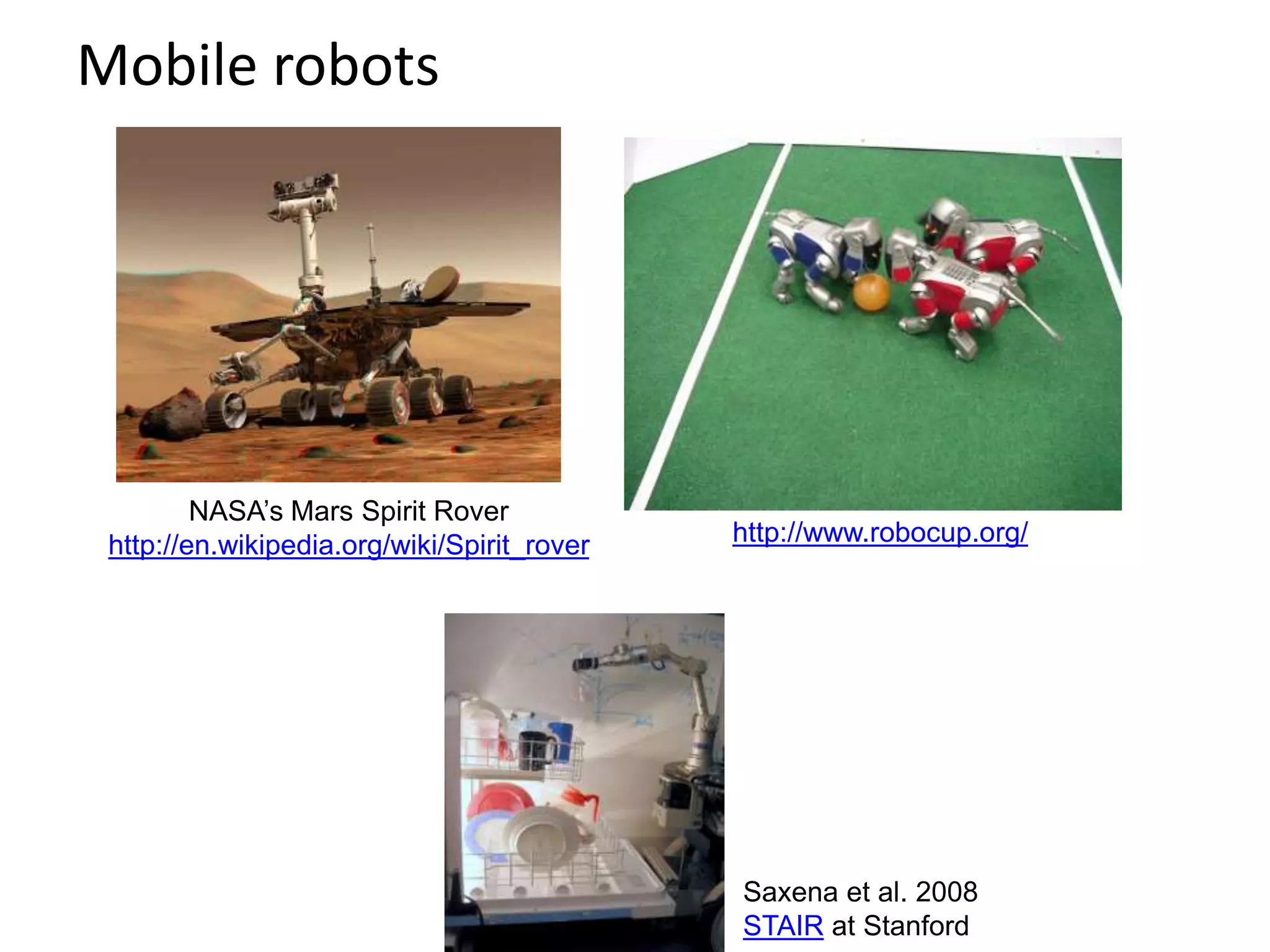
Mobile robots
http://www.robocup.org/
NASA’s Mars Spirit Rover
http://en.wikipedia.org/wiki/Spirit_rover
Saxena et al. 2008
STAIR at Stanford
Medical imaging
Image guided surgery
Grimson et al., MIT
3D imaging
MRI, CT
Vision as a source of semantic information
slide credit: Fei-Fei, Fergus
Object categorization
sky
building
flag
wall
banner
bus
cars
bus
face
street lamp
slide credit: Fei-Fei, Fergus
Scene and context categorization
• outdoor
• city
• traffic
• …
slide credit: Fei-Fei, Fergus
Qualitative spatial information
slanted
rigid moving
object
horizontal
vertical
slide credit: Fei-Fei, Fergus
rigid moving
object
non-rigid moving
object
Challenges: viewpoint variation
Michelangelo 1475-1564 slide credit: Fei-Fei, Fergus
Challenges: illumination
image credit: J. Koenderi
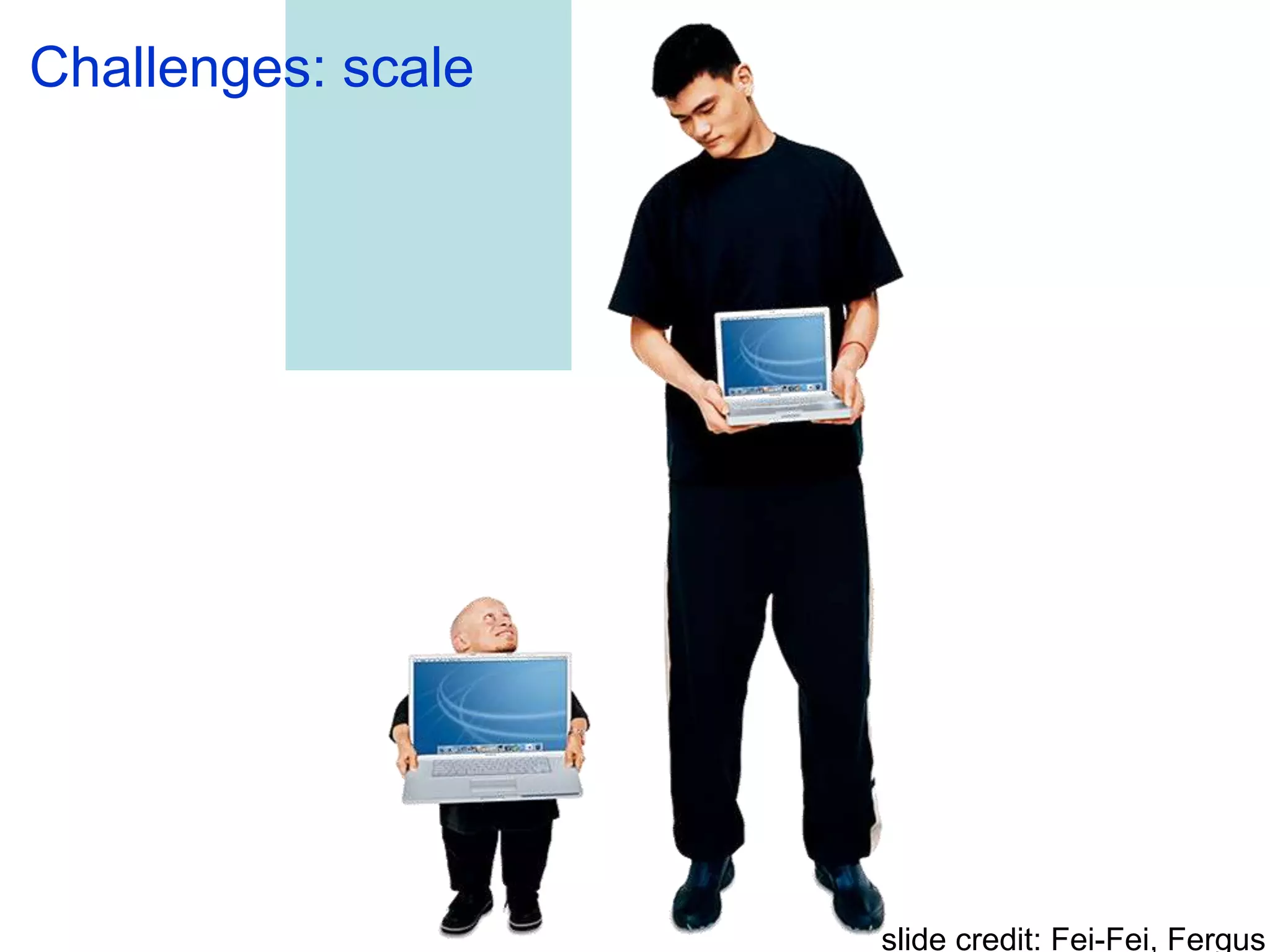
Challenges: scale
slide credit: Fei-Fei, Fergus
Challenges: deformation
Xu, Beihong 1943
slide credit: Fei-Fei, Fergus
Challenges: occlusion
Magritte, 1957 slide credit: Fei-Fei, Fergus
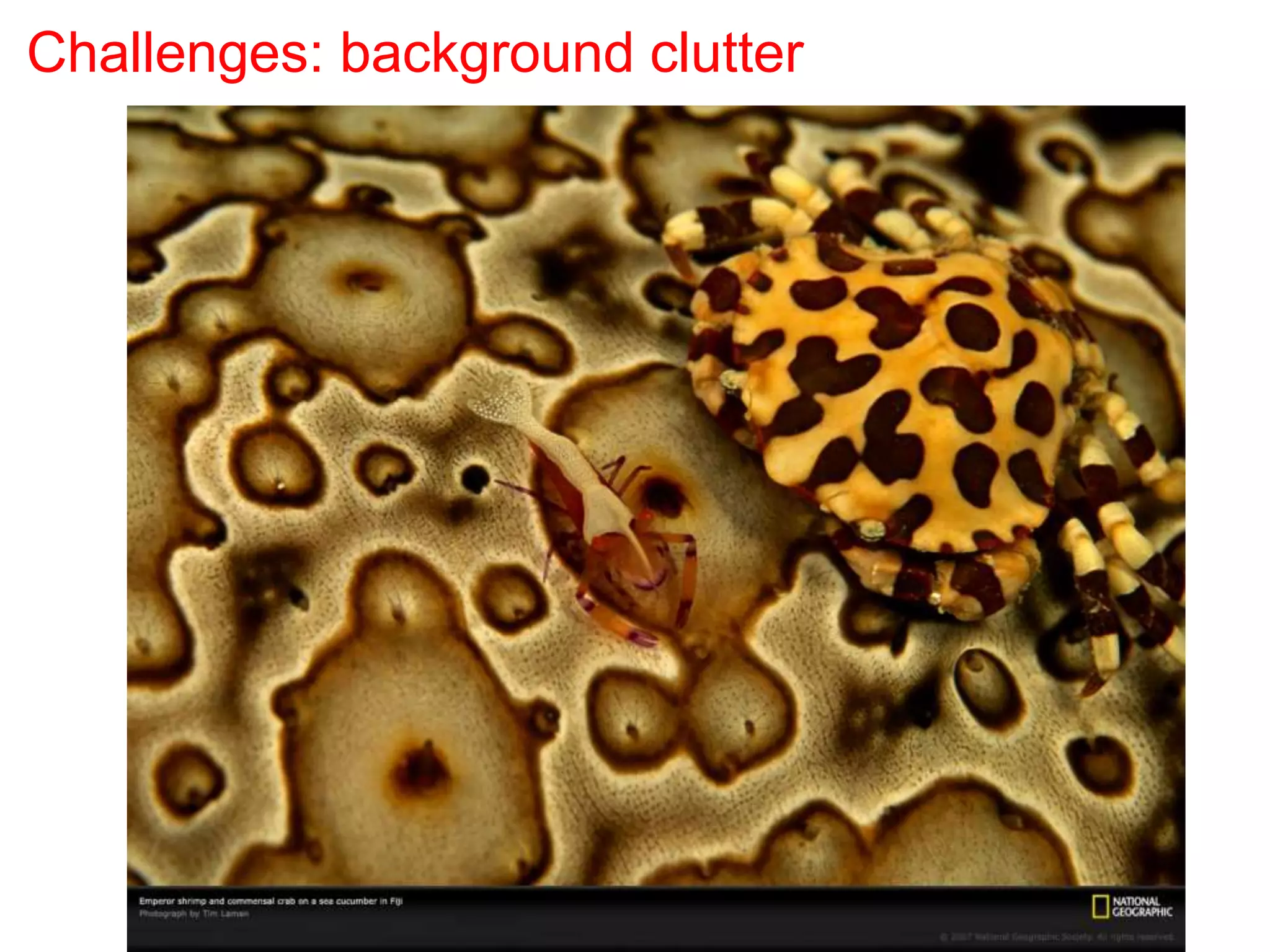
Challenges: background clutter
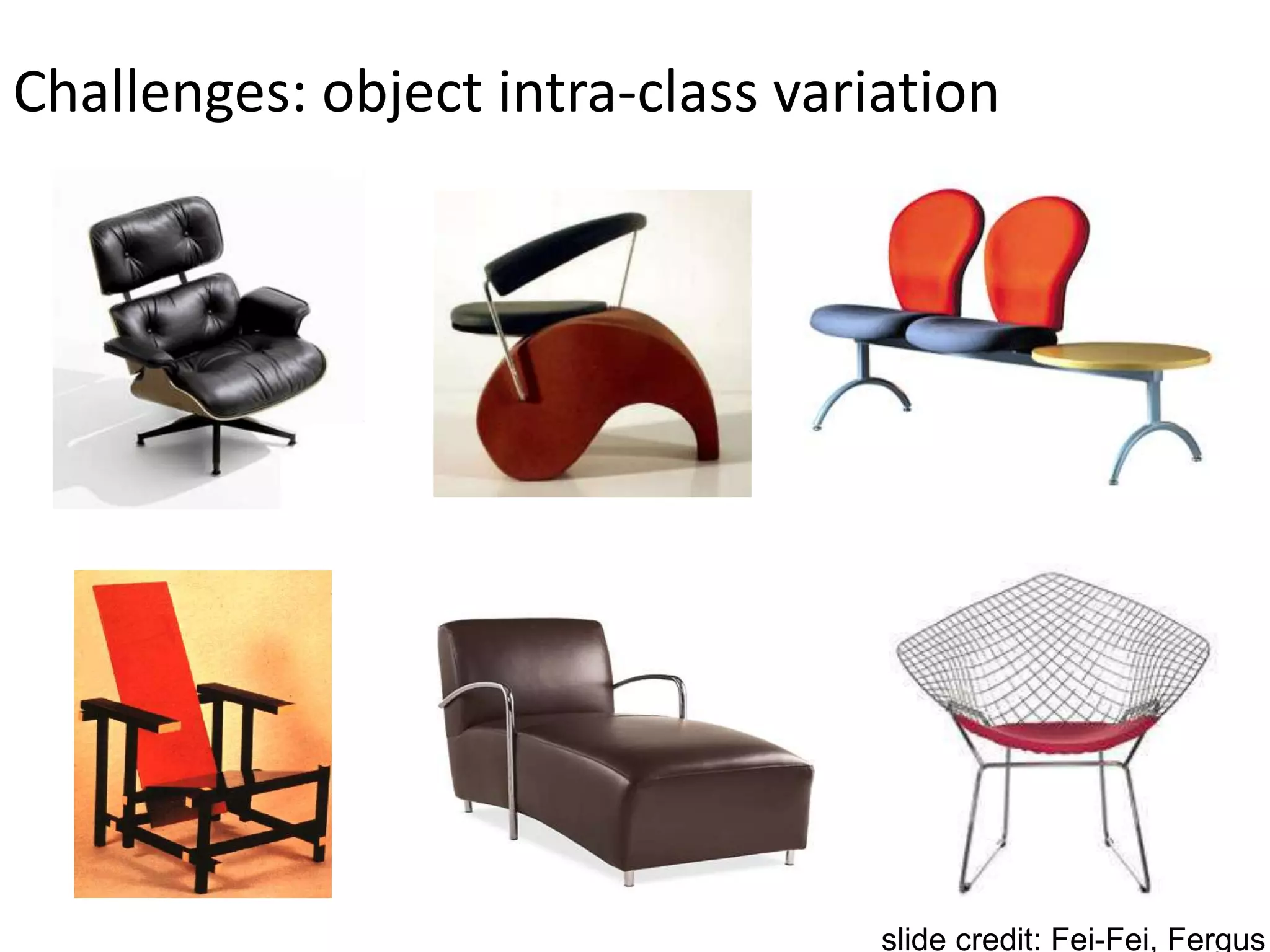
Challenges: object intra-class variation
slide credit: Fei-Fei, Fergus
Challenges: local ambiguity
slide credit: Fei-Fei, Fergus
Challenges or opportunities?
• Images are confusing, but they also reveal the
structure of the world through numerous cues
• Our job is to interpret the cues!
Image source: J. Koenderin
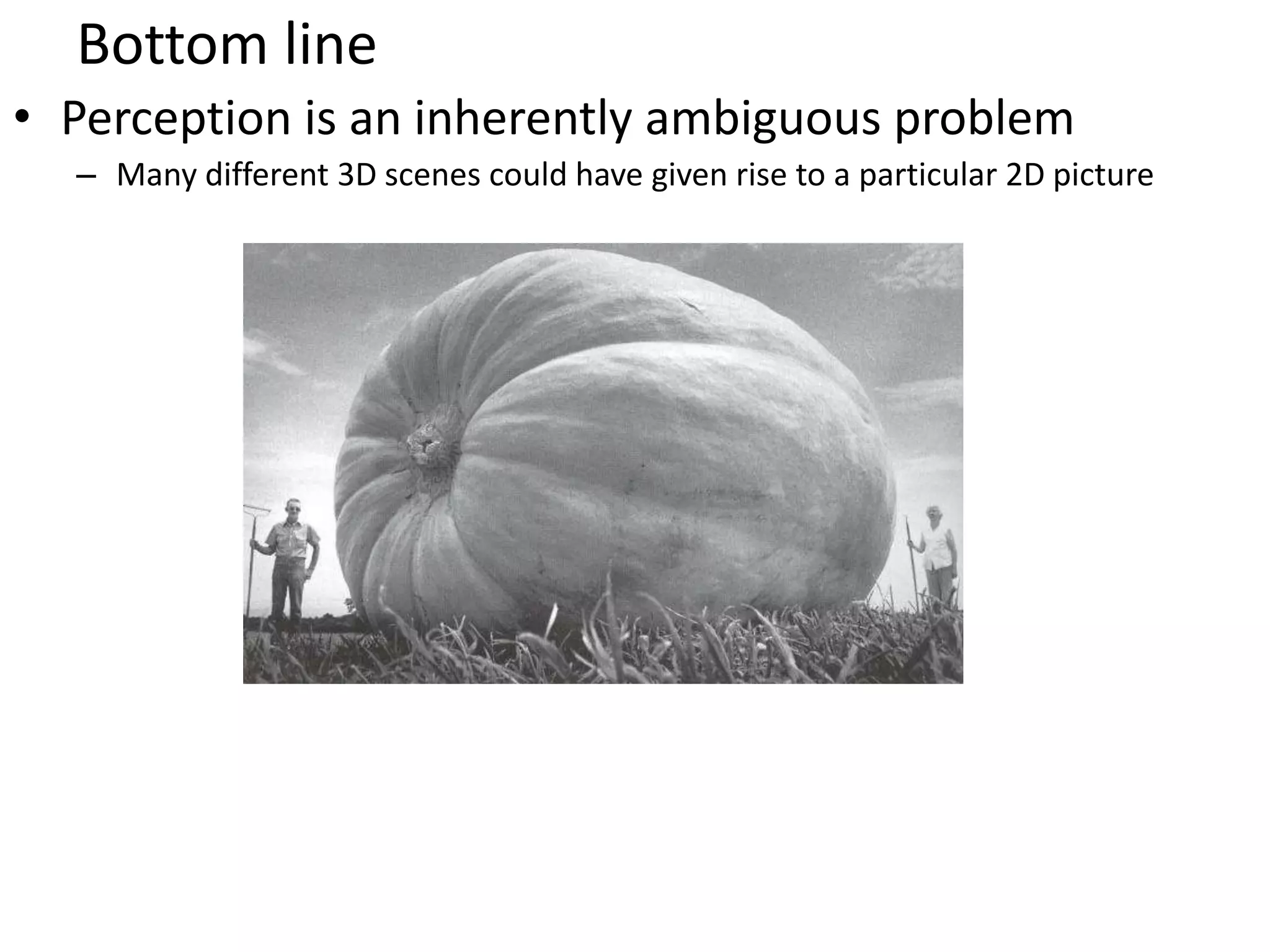
Bottom line
• Perception is an inherently ambiguous problem
– Many different 3D scenes could have given rise to a particular 2D picture
Image source: F. D
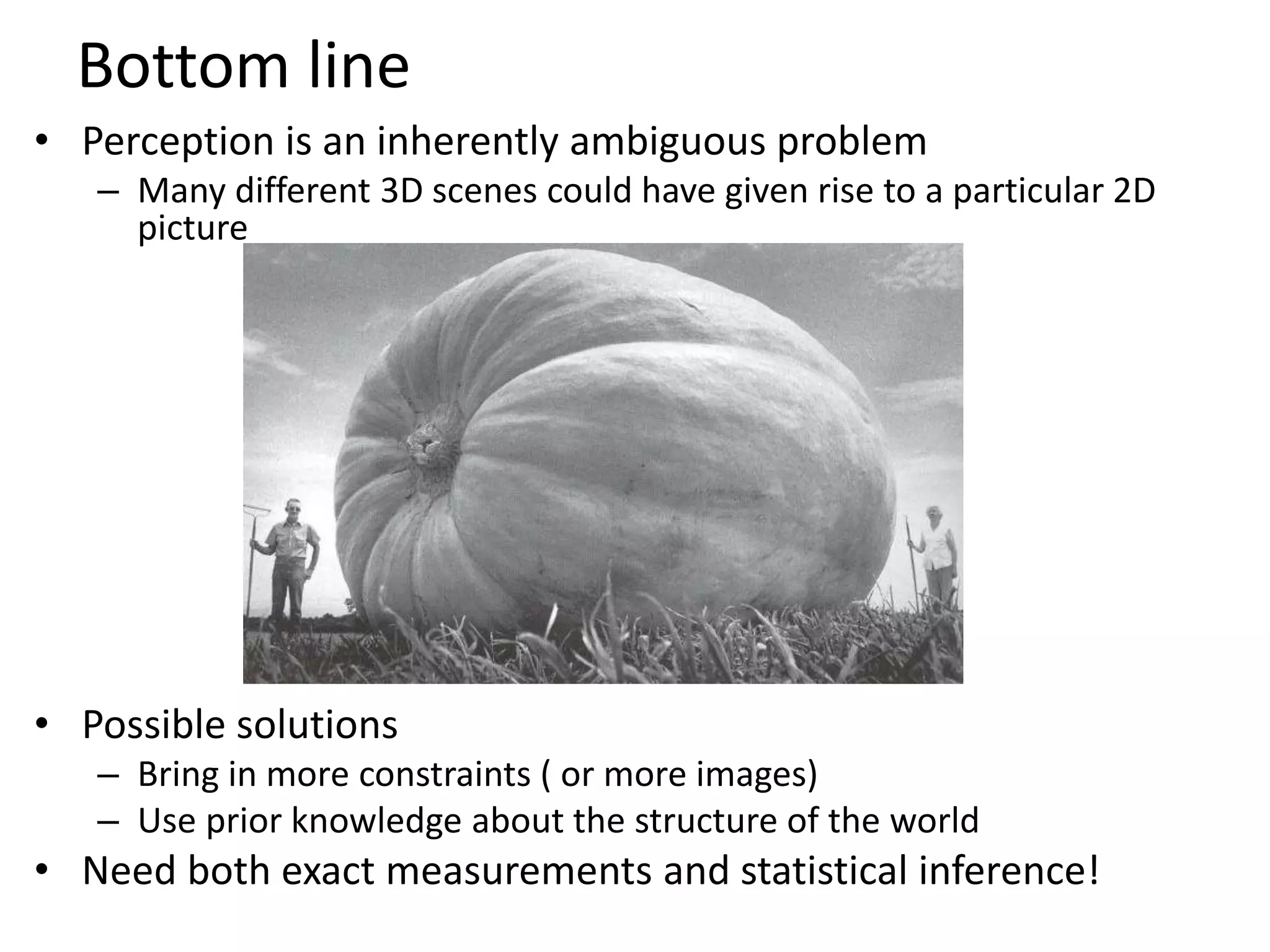
Bottom line
• Perception is an inherently ambiguous problem
– Many different 3D scenes could have given rise to a particular 2D
picture
• Possible solutions
– Bring in more constraints ( or more images)
– Use prior knowledge about the structure of the world
• Need both exact measurements and statistical inference!
Image source: F. D
Computer Vision vs. Graphics
• 3D 2D implies information loss
• sensitivity to errors
• need for models
graphics
vision
Imaging Geometry
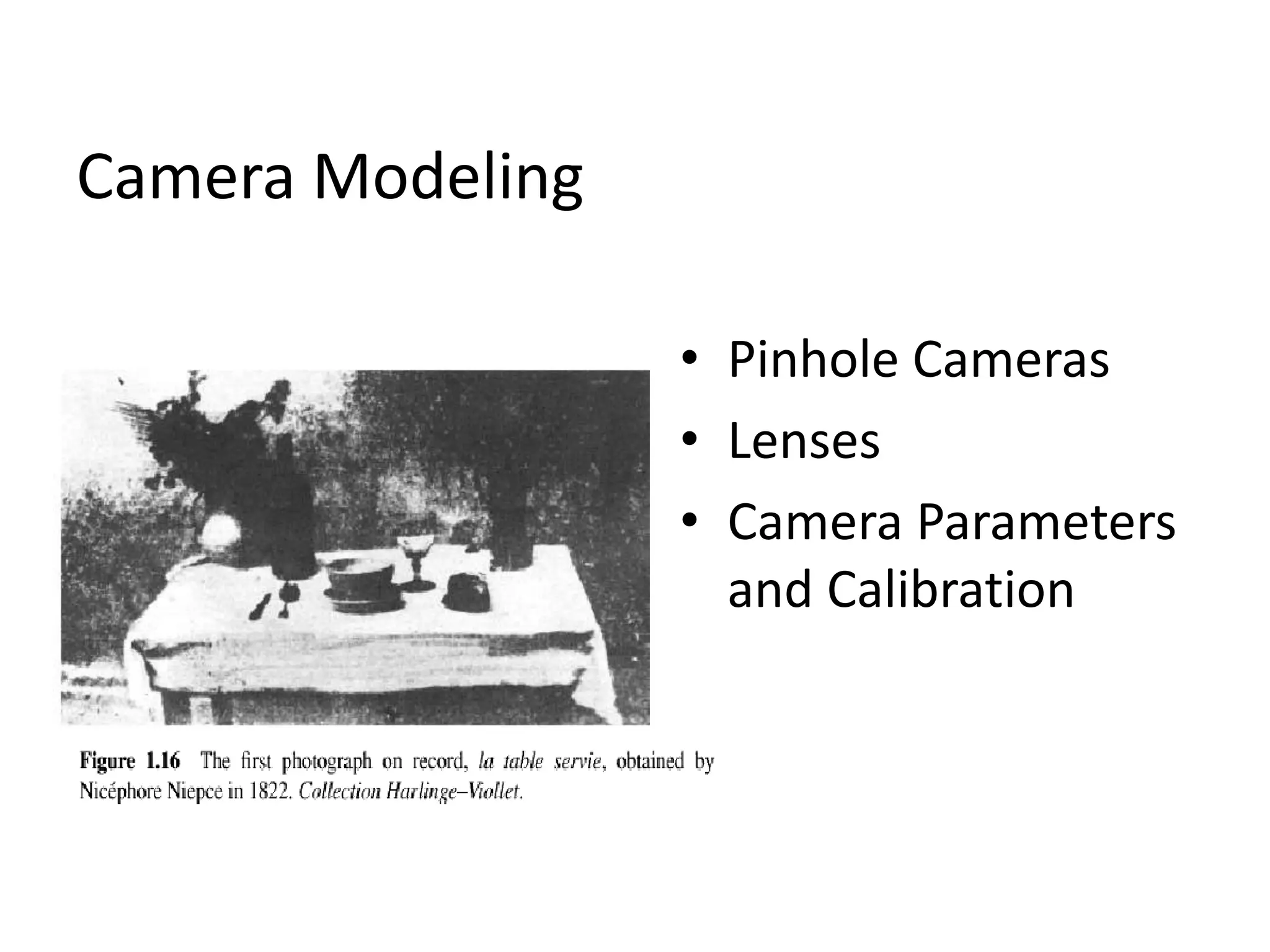
Camera Modeling
• Pinhole Cameras
• Lenses
• Camera Parameters
and Calibration
Image Filtering and Enhancing
• Linear Filters and
Convolution
• Image Smoothing
• Edge Detection
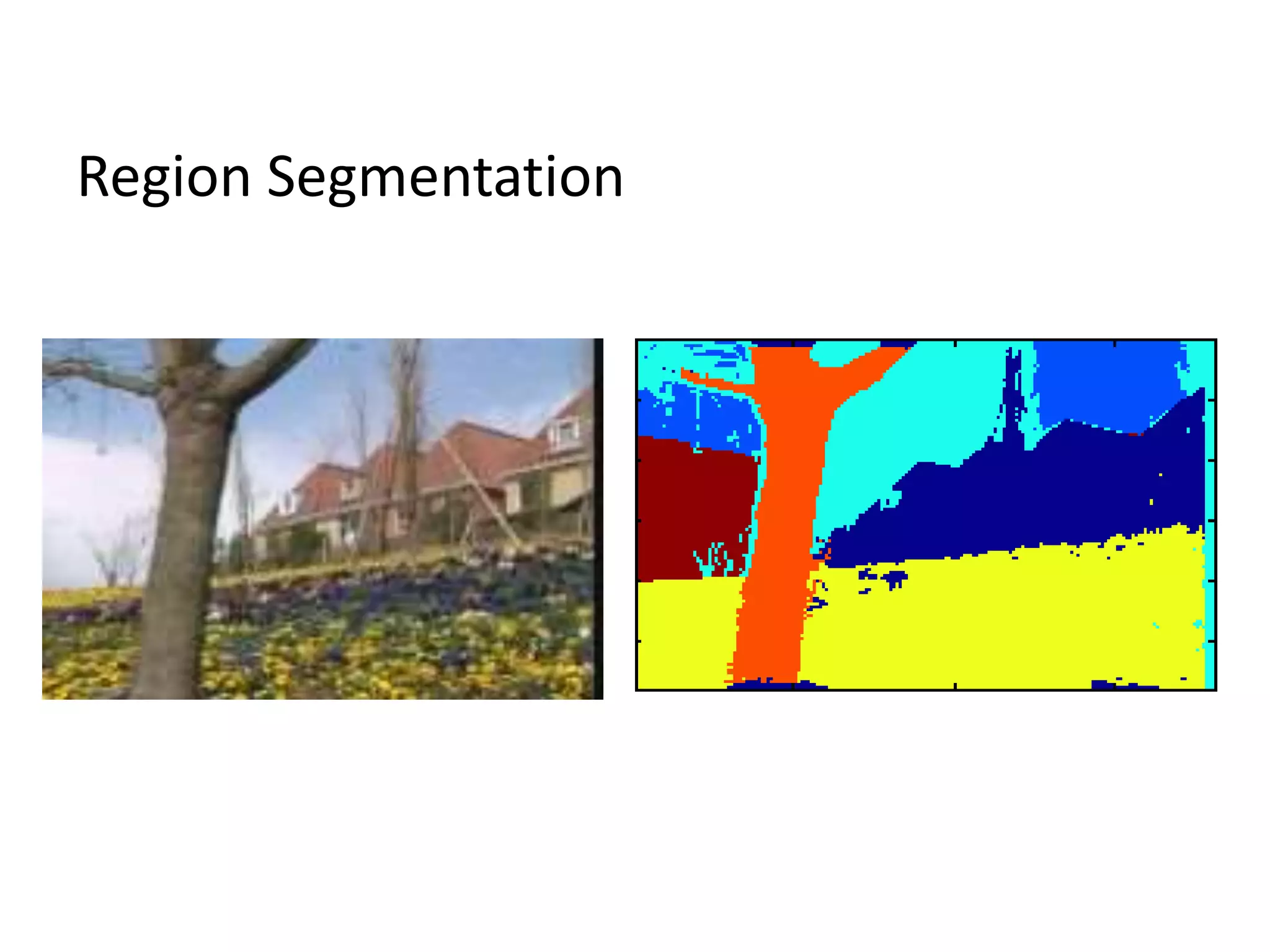
Region Segmentation
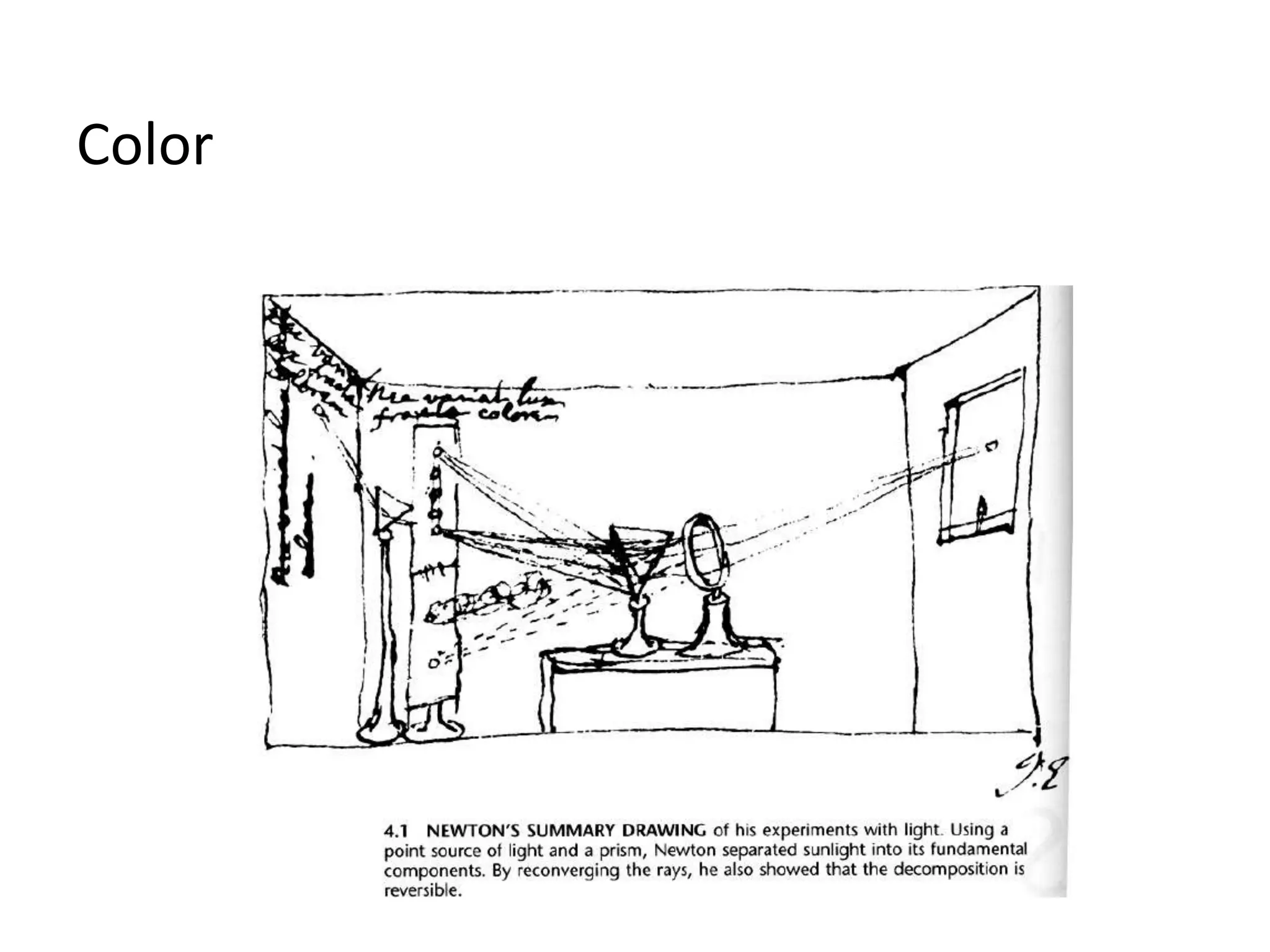
Color
Texture
Image Restoration / Nose Removal
Original Synthetic
Perceptual Organization
Shape Analysis
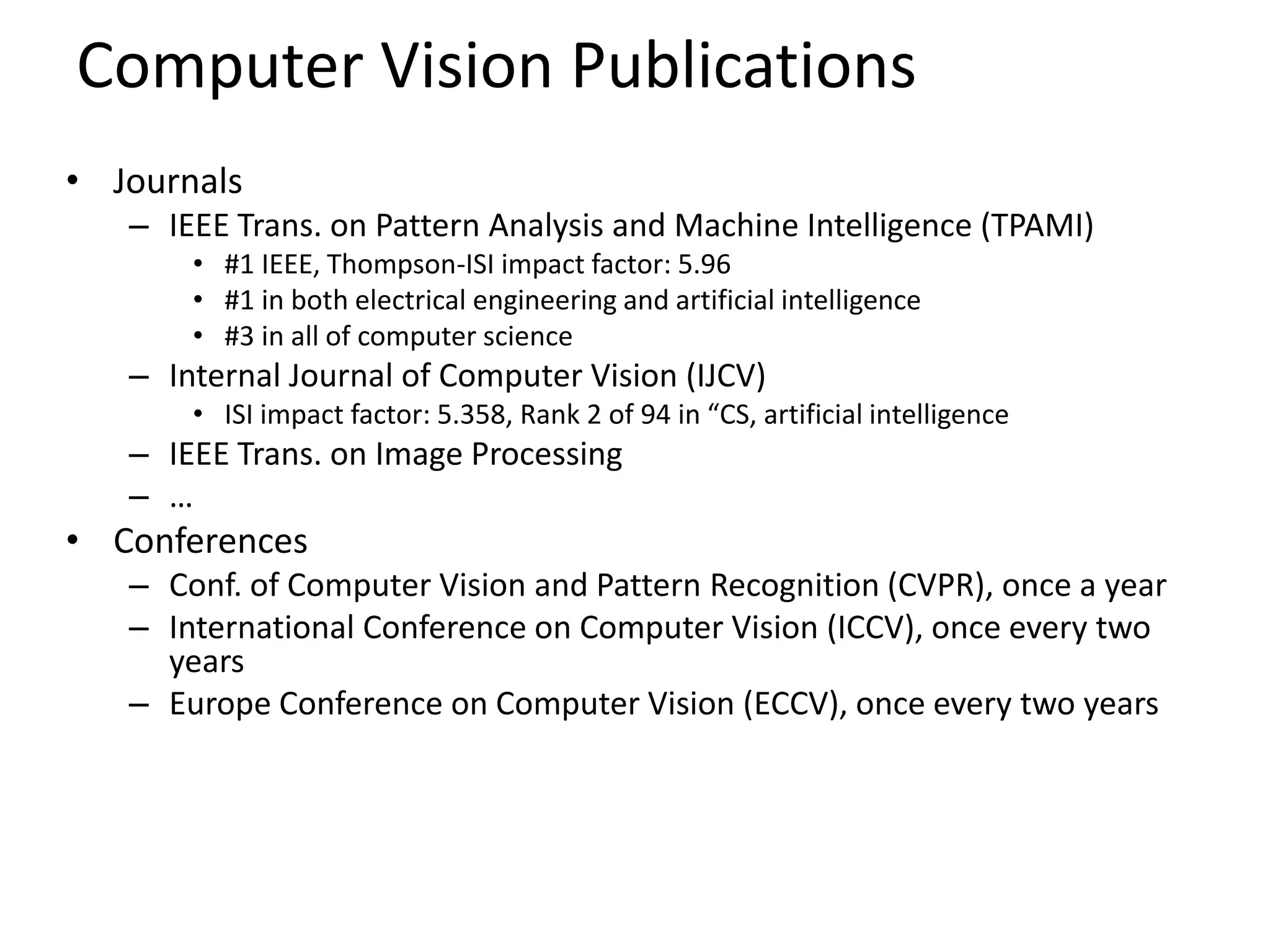
Computer Vision Publications
• Journals
– IEEE Trans. on Pattern Analysis and Machine Intelligence (TPAMI)
• #1 IEEE, Thompson-ISI impact factor: 5.96
• #1 in both electrical engineering and artificial intelligence
• #3 in all of computer science
– Internal Journal of Computer Vision (IJCV)
• ISI impact factor: 5.358, Rank 2 of 94 in “CS, artificial intelligence
– IEEE Trans. on Image Processing
– …
• Conferences
– Conf. of Computer Vision and Pattern Recognition (CVPR), once a year
– International Conference on Computer Vision (ICCV), once every two
years
– Europe Conference on Computer Vision (ECCV), once every two years

vision.ppt

  • 1.
    Introduction to Computer Vision Basedon slides by Jinxiang Chai, Svetlana Lazebnik, Guodong Guo Assembled and modified by Longin Jan Latecki September 2012
  • 2.
    What is ComputerVision? • Computer vision is the science and technology of machines that see. • Concerned with the theory for building artificial systems that obtain information from images. • The image data can take many forms, such as a video sequence, depth images, views from multiple cameras, or multi-dimensional data from a medical scanner
  • 3.
    Computer Vision Make computersunderstand images and videos. What kind of scene? Where are the cars? How far is the building? …
  • 4.
    Components of acomputer vision system Lighting Scene Camera Computer Scene Interpretation Srinivasa Narasimhan’s slide
  • 5.
    Computer vision vshuman vision What we see What a computer sees
  • 6.
    Vision is reallyhard • Vision is an amazing feat of natural intelligence – Visual cortex occupies about 50% of Macaque brain – More human brain devoted to vision than anything else Is that a queen or a bishop?
  • 7.
    Vision is multidisciplinary Fromwiki Computer Graphics HCI
  • 8.
    Why computer visionmatters Safety Health Security Comfort Access Fun
  • 9.
    A little storyabout Computer Vision In 1966, Marvin Minsky at MIT asked his undergraduate student Gerald Jay Sussman to “spend the summer linking a camera to a computer and getting the computer to describe what it saw”. We now know that the problem is slightly more difficult than that. (Szeliski 2009, Computer Vision)
  • 10.
    A little storyabout Computer Vision In 1966, Marvin Minsky at MIT asked his undergraduate student Gerald Jay Sussman to “spend the summer linking a camera to a computer and getting the computer to describe what it saw”. We now know that the problem is slightly more difficult than that. Founder, MIT AI project
  • 11.
    A little storyabout Computer Vision In 1966, Marvin Minsky at MIT asked his undergraduate student Gerald Jay Sussman to “spend the summer linking a camera to a computer and getting the computer to describe what it saw”. We now know that the problem is slightly more difficult than that. Image Understanding
  • 12.
    Ridiculously brief historyof computer vision • 1966: Minsky assigns computer vision as an undergrad summer project • 1960’s: interpretation of synthetic worlds • 1970’s: some progress on interpreting selected images • 1980’s: ANNs come and go; shift toward geometry and increased mathematical rigor • 1990’s: face recognition; statistical analysis in vogue • 2000’s: broader recognition; large annotated datasets available; video processing starts; vision & graphis; vision for HCI; internet vision, etc. Guzman ‘68 Ohta Kanade ‘78 Turk and Pentland ‘91
  • 13.
    How vision isused now • Examples of state-of-the-art
  • 14.
    Optical character recognition(OCR) Digit recognition, AT&T labs http://www.research.att.com/~yann/ Technology to convert scanned docs to text • If you have a scanner, it probably came with OCR software License plate readers http://en.wikipedia.org/wiki/Automatic_number_plate_recognition
  • 15.
    Face detection • Manynew digital cameras now detect faces – Canon, Sony, Fuji, …
  • 16.
    Smile detection Sony Cyber-shot®T70 Digital Still Camera
  • 17.
    Object recognition (insupermarkets) LaneHawk by EvolutionRobotics “A smart camera is flush-mounted in the checkout lane, continuously watching for items. When an item is detected and recognized, the cashier verifies the quantity of items that were found under the basket, and continues to close the transaction. The item can remain under the basket, and with LaneHawk,you are assured to get paid for it… “
  • 18.
    Vision-based biometrics “How theAfghan Girl was Identified by Her Iris Patterns” Read the story wikipedia
  • 19.
    Login without apassword… Fingerprint scanners on many new laptops, other devices Face recognition systems now beginning to appear more widely http://www.sensiblevision.com/
  • 20.
    Object recognition (inmobile phones) Point & Find, Nokia Google Goggles
  • 21.
    The Matrix movies,ESC Entertainment, XYZRGB, NRC Special effects: shape capture
  • 22.
    Pirates of theCarribean, Industrial Light and Magic Special effects: motion capture
  • 23.
    Sports Sportvision first downline Nice explanation on www.howstuffworks.com http://www.sportvision.com/video.html
  • 24.
    Smart cars • Mobileye[wiki article] – Vision systems currently in many car models Slide content courtesy of Amnon Shashua
  • 25.
  • 26.
    Interactive Games: Kinect •Object Recognition: http://www.youtube.com/watch?feature=iv&v=fQ59dXOo63o • Mario: http://www.youtube.com/watch?v=8CTJL5lUjHg • 3D: http://www.youtube.com/watch?v=7QrnwoO1-8A • Robot: http://www.youtube.com/watch?v=w8BmgtMKFbY • 3D tracking, reconstruction, and interaction: http://research.microsoft.com/en- us/projects/surfacerecon/default.aspx
  • 27.
    Vision in space Visionsystems (JPL) used for several tasks • Panorama stitching • 3D terrain modeling • Obstacle detection, position tracking • For more, read “Computer Vision on Mars” by Matthies et al. NASA'S Mars Exploration Rover Spirit captured this westward view from atop a low plateau where Spirit spent the closing months of 2007.
  • 28.
    Industrial robots Vision-guided robotsposition nut runners on wheels
  • 29.
    Mobile robots http://www.robocup.org/ NASA’s MarsSpirit Rover http://en.wikipedia.org/wiki/Spirit_rover Saxena et al. 2008 STAIR at Stanford
  • 30.
    Medical imaging Image guidedsurgery Grimson et al., MIT 3D imaging MRI, CT
  • 31.
    Vision as asource of semantic information slide credit: Fei-Fei, Fergus
  • 32.
  • 33.
    Scene and contextcategorization • outdoor • city • traffic • … slide credit: Fei-Fei, Fergus
  • 34.
    Qualitative spatial information slanted rigidmoving object horizontal vertical slide credit: Fei-Fei, Fergus rigid moving object non-rigid moving object
  • 35.
    Challenges: viewpoint variation Michelangelo1475-1564 slide credit: Fei-Fei, Fergus
  • 36.
  • 37.
  • 38.
    Challenges: deformation Xu, Beihong1943 slide credit: Fei-Fei, Fergus
  • 39.
    Challenges: occlusion Magritte, 1957slide credit: Fei-Fei, Fergus
  • 40.
  • 41.
    Challenges: object intra-classvariation slide credit: Fei-Fei, Fergus
  • 42.
    Challenges: local ambiguity slidecredit: Fei-Fei, Fergus
  • 43.
    Challenges or opportunities? •Images are confusing, but they also reveal the structure of the world through numerous cues • Our job is to interpret the cues! Image source: J. Koenderin
  • 44.
    Bottom line • Perceptionis an inherently ambiguous problem – Many different 3D scenes could have given rise to a particular 2D picture Image source: F. D
  • 45.
    Bottom line • Perceptionis an inherently ambiguous problem – Many different 3D scenes could have given rise to a particular 2D picture • Possible solutions – Bring in more constraints ( or more images) – Use prior knowledge about the structure of the world • Need both exact measurements and statistical inference! Image source: F. D
  • 46.
    Computer Vision vs.Graphics • 3D 2D implies information loss • sensitivity to errors • need for models graphics vision
  • 47.
  • 48.
    Camera Modeling • PinholeCameras • Lenses • Camera Parameters and Calibration
  • 49.
    Image Filtering andEnhancing • Linear Filters and Convolution • Image Smoothing • Edge Detection
  • 50.
  • 51.
  • 52.
  • 53.
    Image Restoration /Nose Removal Original Synthetic
  • 54.
  • 55.
  • 56.
  • 57.
    Computer Vision Publications •Journals – IEEE Trans. on Pattern Analysis and Machine Intelligence (TPAMI) • #1 IEEE, Thompson-ISI impact factor: 5.96 • #1 in both electrical engineering and artificial intelligence • #3 in all of computer science – Internal Journal of Computer Vision (IJCV) • ISI impact factor: 5.358, Rank 2 of 94 in “CS, artificial intelligence – IEEE Trans. on Image Processing – … • Conferences – Conf. of Computer Vision and Pattern Recognition (CVPR), once a year – International Conference on Computer Vision (ICCV), once every two years – Europe Conference on Computer Vision (ECCV), once every two years