Introduction to
Computer Vision
Submitted To: Submitted By:
Er. Chetan Singh Negi Sushant Kohli
Id- 57213
What is Computer Vision?
• Computer vision is the science and technology of machines
that see.
• Concerned with the theory for building artificial systems that
obtain information from images.
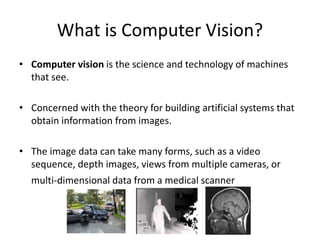
• The image data can take many forms, such as a video
sequence, depth images, views from multiple cameras, or
multi-dimensional data from a medical scanner
Computer Vision
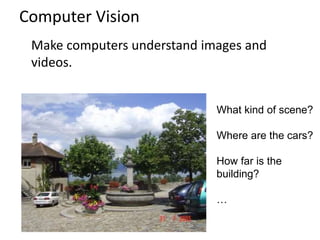
Make computers understand images and
videos.
What kind of scene?
Where are the cars?
How far is the
building?
…
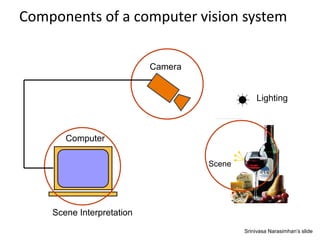
Components of a computer vision system
Lighting
Scene
Camera
Computer
Scene Interpretation
Srinivasa Narasimhan’s slide
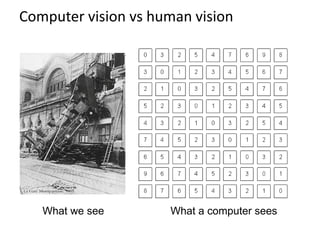
Computer vision vs human vision
What we see What a computer sees
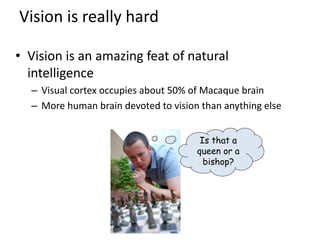
Vision is really hard
• Vision is an amazing feat of natural
intelligence
– Visual cortex occupies about 50% of Macaque brain
– More human brain devoted to vision than anything else
Is that a
queen or a
bishop?
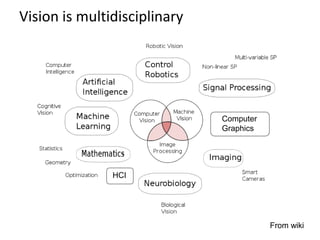
Vision is multidisciplinary
From wiki
Computer
Graphics
HCI
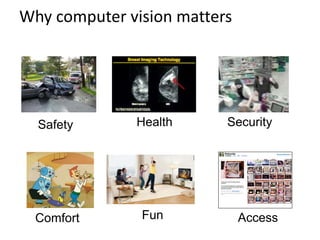
Why computer vision matters
Safety Health Security
Comfort Access
Fun
A little story about Computer Vision
In 1966, Marvin Minsky at MIT asked his undergraduate student
Gerald Jay Sussman to “spend the summer linking a camera to a
computer and getting the computer to describe what it saw”. We
now know that the problem is slightly more difficult than that.
(Szeliski 2009, Computer Vision)
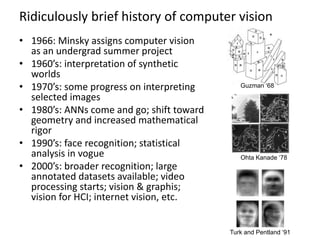
Ridiculously brief history of computer vision
• 1966: Minsky assigns computer vision
as an undergrad summer project
• 1960’s: interpretation of synthetic
worlds
• 1970’s: some progress on interpreting
selected images
• 1980’s: ANNs come and go; shift toward
geometry and increased mathematical
rigor
• 1990’s: face recognition; statistical
analysis in vogue
• 2000’s: broader recognition; large
annotated datasets available; video
processing starts; vision & graphis;
vision for HCI; internet vision, etc.
Guzman ‘68
Ohta Kanade ‘78
Turk and Pentland ‘91
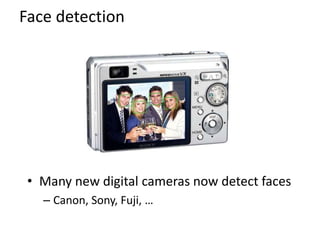
Face detection
• Many new digital cameras now detect faces
– Canon, Sony, Fuji, …
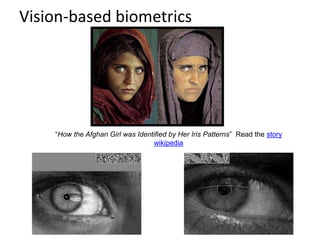
Vision-based biometrics
“How the Afghan Girl was Identified by Her Iris Patterns” Read the story
wikipedia
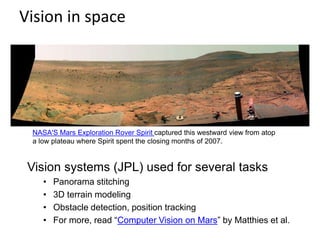
Vision in space
Vision systems (JPL) used for several tasks
• Panorama stitching
• 3D terrain modeling
• Obstacle detection, position tracking
• For more, read “Computer Vision on Mars” by Matthies et al.
NASA'S Mars Exploration Rover Spirit captured this westward view from atop
a low plateau where Spirit spent the closing months of 2007.
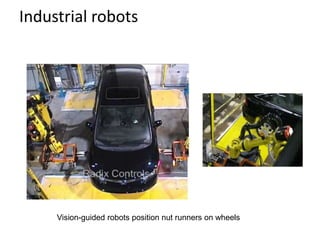
Industrial robots
Vision-guided robots position nut runners on wheels
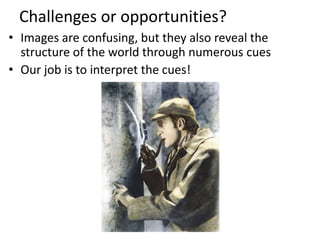
Challenges or opportunities?
• Images are confusing, but they also reveal the
structure of the world through numerous cues
• Our job is to interpret the cues!
Image source: J. Koenderin
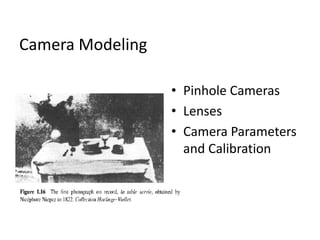
Camera Modeling
• Pinhole Cameras
• Lenses
• Camera Parameters
and Calibration
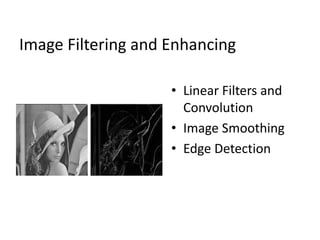
Image Filtering and Enhancing
• Linear Filters and
Convolution
• Image Smoothing
• Edge Detection
Computer Vision Publications
• Journals
– IEEE Trans. on Pattern Analysis and Machine Intelligence (TPAMI)
• #1 IEEE, Thompson-ISI impact factor: 5.96
• #1 in both electrical engineering and artificial intelligence
• #3 in all of computer science
– Internal Journal of Computer Vision (IJCV)
• ISI impact factor: 5.358, Rank 2 of 94 in “CS, artificial intelligence
– IEEE Trans. on Image Processing
– …
• Conferences
– Conf. of Computer Vision and Pattern Recognition (CVPR), once a year
– International Conference on Computer Vision (ICCV), once every two
years
– Europe Conference on Computer Vision (ECCV), once every two years
Conclusion
1. Practical applications of computer vision include autonomous
vehicles, surveillance systems, medical imaging, and
augmented reality.
2. Challenges such as real-world complexity, lighting variations,
occlusions, and the need for large-scale annotated datasets
persist.
3. Ethical concerns related to privacy, bias, and the misuse of
visual data need to be addressed.
4. Advancements in deep learning, neural networks, and
hardware capabilities are driving breakthroughs in accuracy
and efficiency.
5. Emerging technologies like edge computing and
neuromorphic engineering are poised to further enhance
computer vision systems.
6. The future of computer vision holds great promise, with
potential advancements that will reshape technology and
human perception.
Refereces
• https://chat.openai.com/
• https://www.ibm.com/
vision-1.ppt

vision-1.ppt

  • 1.
    Introduction to Computer Vision SubmittedTo: Submitted By: Er. Chetan Singh Negi Sushant Kohli Id- 57213
  • 2.
    What is ComputerVision? • Computer vision is the science and technology of machines that see. • Concerned with the theory for building artificial systems that obtain information from images. • The image data can take many forms, such as a video sequence, depth images, views from multiple cameras, or multi-dimensional data from a medical scanner
  • 3.
    Computer Vision Make computersunderstand images and videos. What kind of scene? Where are the cars? How far is the building? …
  • 4.
    Components of acomputer vision system Lighting Scene Camera Computer Scene Interpretation Srinivasa Narasimhan’s slide
  • 5.
    Computer vision vshuman vision What we see What a computer sees
  • 6.
    Vision is reallyhard • Vision is an amazing feat of natural intelligence – Visual cortex occupies about 50% of Macaque brain – More human brain devoted to vision than anything else Is that a queen or a bishop?
  • 7.
    Vision is multidisciplinary Fromwiki Computer Graphics HCI
  • 8.
    Why computer visionmatters Safety Health Security Comfort Access Fun
  • 9.
    A little storyabout Computer Vision In 1966, Marvin Minsky at MIT asked his undergraduate student Gerald Jay Sussman to “spend the summer linking a camera to a computer and getting the computer to describe what it saw”. We now know that the problem is slightly more difficult than that. (Szeliski 2009, Computer Vision)
  • 10.
    Ridiculously brief historyof computer vision • 1966: Minsky assigns computer vision as an undergrad summer project • 1960’s: interpretation of synthetic worlds • 1970’s: some progress on interpreting selected images • 1980’s: ANNs come and go; shift toward geometry and increased mathematical rigor • 1990’s: face recognition; statistical analysis in vogue • 2000’s: broader recognition; large annotated datasets available; video processing starts; vision & graphis; vision for HCI; internet vision, etc. Guzman ‘68 Ohta Kanade ‘78 Turk and Pentland ‘91
  • 11.
    Face detection • Manynew digital cameras now detect faces – Canon, Sony, Fuji, …
  • 12.
    Vision-based biometrics “How theAfghan Girl was Identified by Her Iris Patterns” Read the story wikipedia
  • 13.
    Vision in space Visionsystems (JPL) used for several tasks • Panorama stitching • 3D terrain modeling • Obstacle detection, position tracking • For more, read “Computer Vision on Mars” by Matthies et al. NASA'S Mars Exploration Rover Spirit captured this westward view from atop a low plateau where Spirit spent the closing months of 2007.
  • 14.
    Industrial robots Vision-guided robotsposition nut runners on wheels
  • 15.
    Challenges or opportunities? •Images are confusing, but they also reveal the structure of the world through numerous cues • Our job is to interpret the cues! Image source: J. Koenderin
  • 16.
    Camera Modeling • PinholeCameras • Lenses • Camera Parameters and Calibration
  • 17.
    Image Filtering andEnhancing • Linear Filters and Convolution • Image Smoothing • Edge Detection
  • 18.
    Computer Vision Publications •Journals – IEEE Trans. on Pattern Analysis and Machine Intelligence (TPAMI) • #1 IEEE, Thompson-ISI impact factor: 5.96 • #1 in both electrical engineering and artificial intelligence • #3 in all of computer science – Internal Journal of Computer Vision (IJCV) • ISI impact factor: 5.358, Rank 2 of 94 in “CS, artificial intelligence – IEEE Trans. on Image Processing – … • Conferences – Conf. of Computer Vision and Pattern Recognition (CVPR), once a year – International Conference on Computer Vision (ICCV), once every two years – Europe Conference on Computer Vision (ECCV), once every two years
  • 19.
    Conclusion 1. Practical applicationsof computer vision include autonomous vehicles, surveillance systems, medical imaging, and augmented reality. 2. Challenges such as real-world complexity, lighting variations, occlusions, and the need for large-scale annotated datasets persist. 3. Ethical concerns related to privacy, bias, and the misuse of visual data need to be addressed. 4. Advancements in deep learning, neural networks, and hardware capabilities are driving breakthroughs in accuracy and efficiency. 5. Emerging technologies like edge computing and neuromorphic engineering are poised to further enhance computer vision systems. 6. The future of computer vision holds great promise, with potential advancements that will reshape technology and human perception.
  • 20.