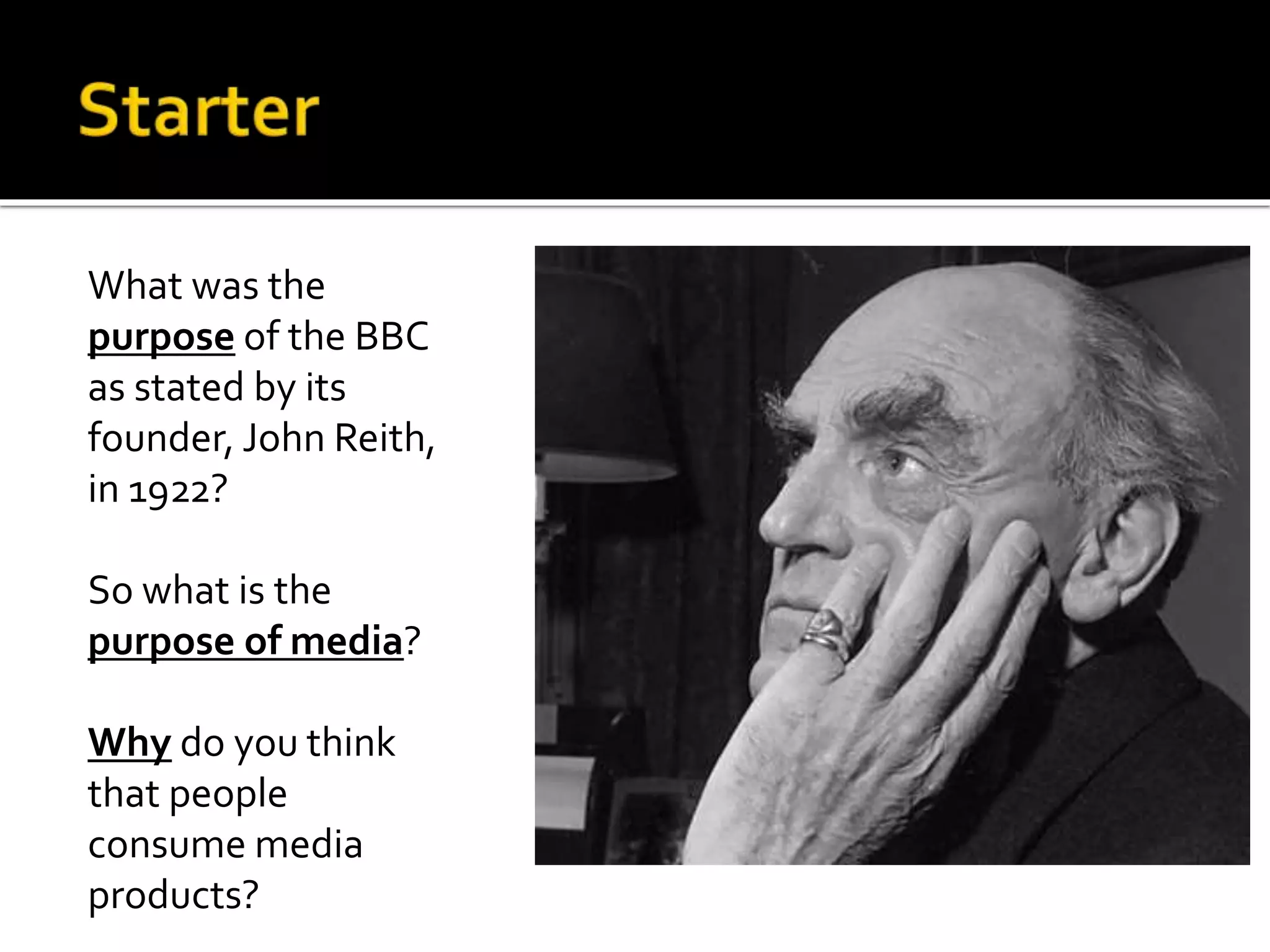
What was the
purpose of the BBC
as stated by its
founder, John Reith,
in 1922?
So what is the
purpose of media?
Why do you think
that people
consume media
products?
BBC's core mission, as set out by
the BBC's founder Director
Genera, Lord Reith in 1922, is to :
 to inform
 to educate
 to entertain.
 To know the meaning and purpose of the uses and
gratifications audience theory.
 Be able to understand and explain the purpose of the uses
and gratifications audience theory.
 By the end of the lesson you should be able to apply the
uses and gratifications audience theory to the analysis of a
given media text (exam related LO)
 The uses and gratifications is a theory that aims to
explain what motivates different audiences to
consume different media texts.
 In other words: Why do people watchTV, films,
read newspapers, listen to the radio,…?
 This theory refers to the use that audiences give
to media texts and the gratification that they
obtain from the consumption of those media texts.
Monday 25th September 2017
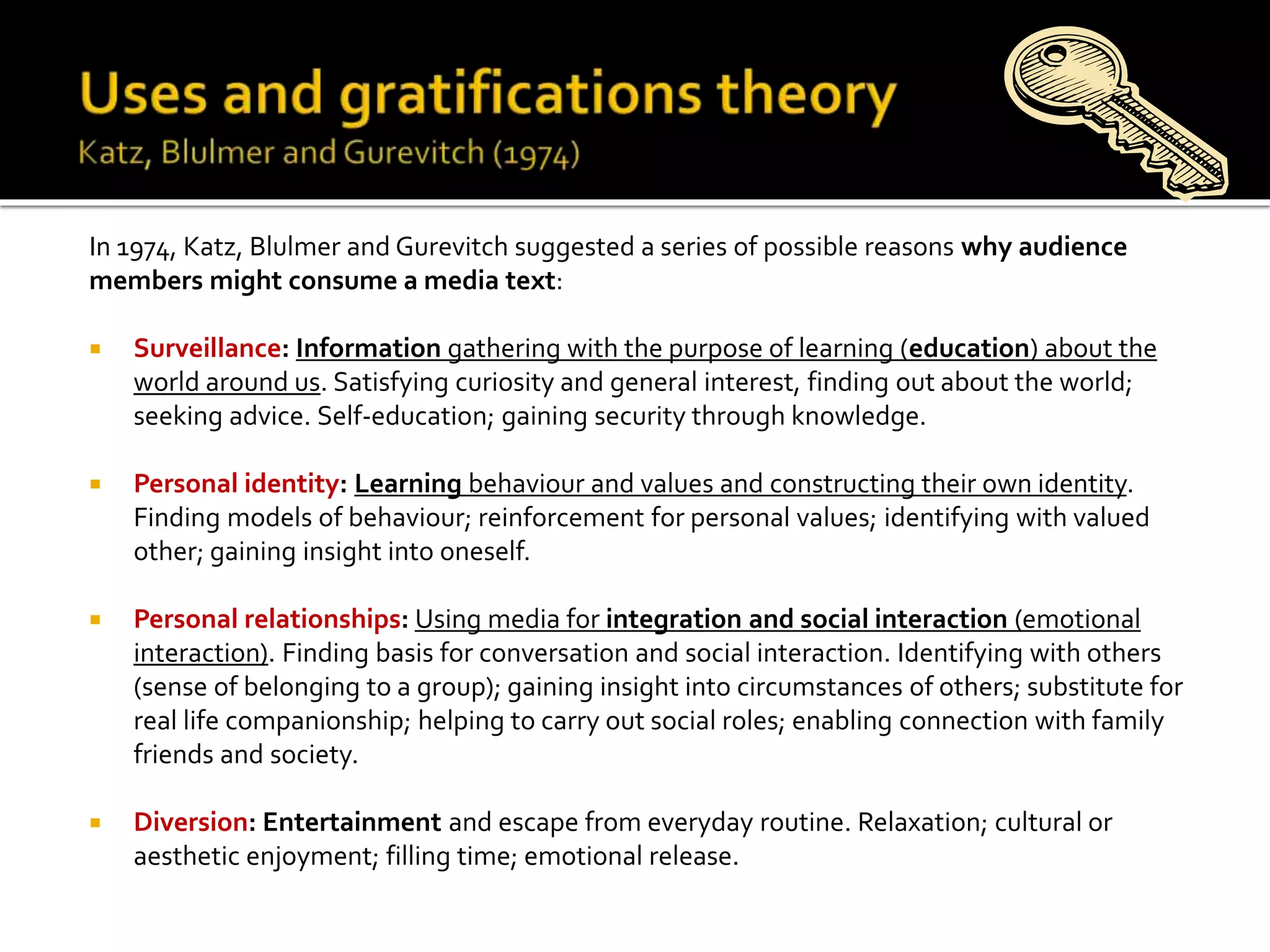
In 1974, Katz, Blulmer and Gurevitch suggested a series of possible reasons why audience
members might consume a media text:
 Surveillance: Information gathering with the purpose of learning (education) about the
world around us. Satisfying curiosity and general interest, finding out about the world;
seeking advice. Self-education; gaining security through knowledge.
 Personal identity: Learning behaviour and values and constructing their own identity.
Finding models of behaviour; reinforcement for personal values; identifying with valued
other; gaining insight into oneself.
 Personal relationships: Using media for integration and social interaction (emotional
interaction). Finding basis for conversation and social interaction. Identifying with others
(sense of belonging to a group); gaining insight into circumstances of others; substitute for
real life companionship; helping to carry out social roles; enabling connection with family
friends and society.
 Diversion: Entertainment and escape from everyday routine. Relaxation; cultural or
aesthetic enjoyment; filling time; emotional release.
Monday 25th September 2017
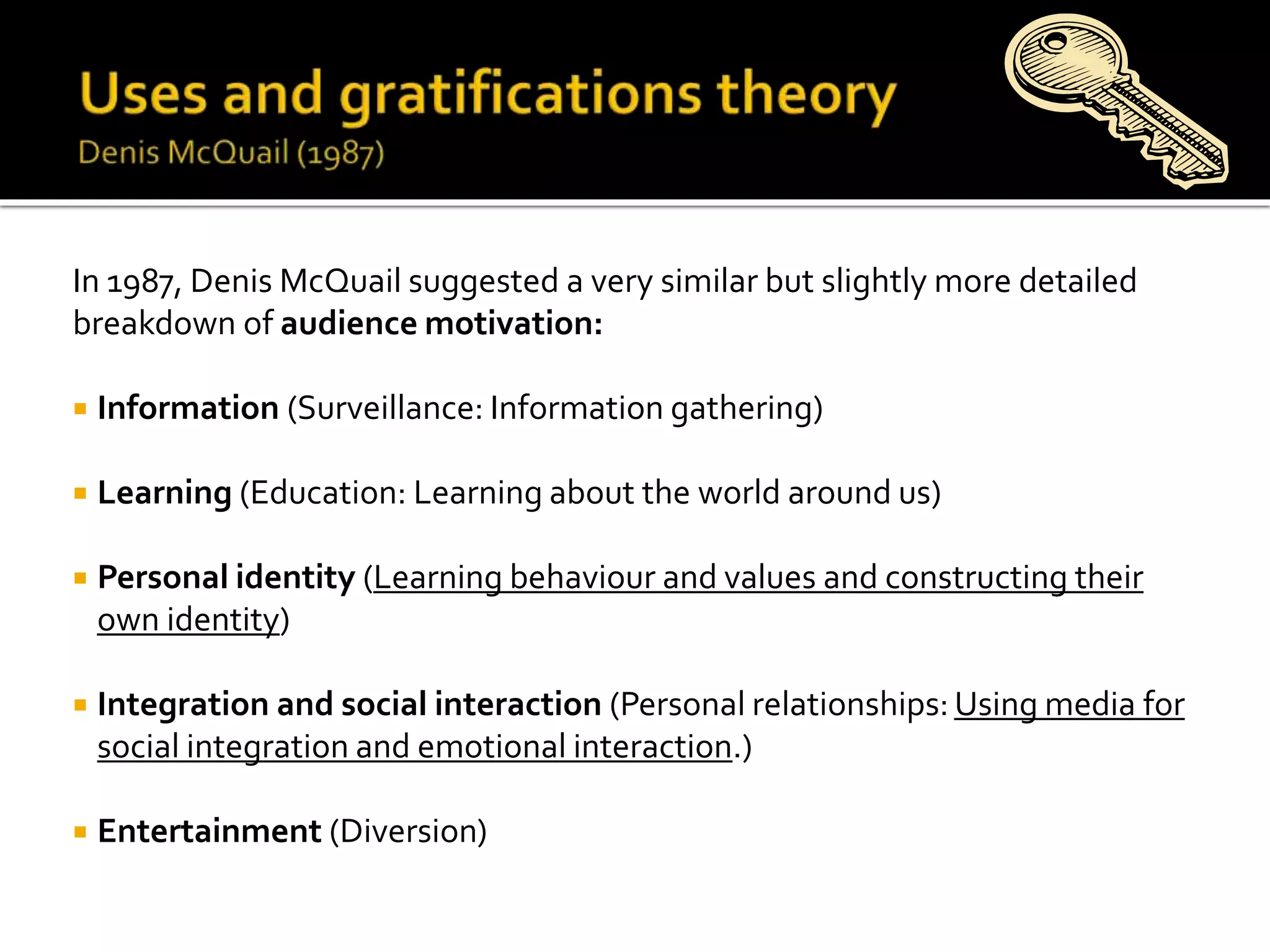
In 1987, Denis McQuail suggested a very similar but slightly more detailed
breakdown of audience motivation:
 Information (Surveillance: Information gathering)
 Learning (Education: Learning about the world around us)
 Personal identity (Learning behaviour and values and constructing their
own identity)
 Integration and social interaction (Personal relationships: Using media for
social integration and emotional interaction.)
 Entertainment (Diversion)
Can you provide an example of a specific media text that you
may use for:
 Information (Surveillance)
 Learning (Information and education)
 Personal identity (Personal identity)
 Integration and social interaction (Personal relationships)
 Entertainment (Diversion)
Monday 25th September 2017
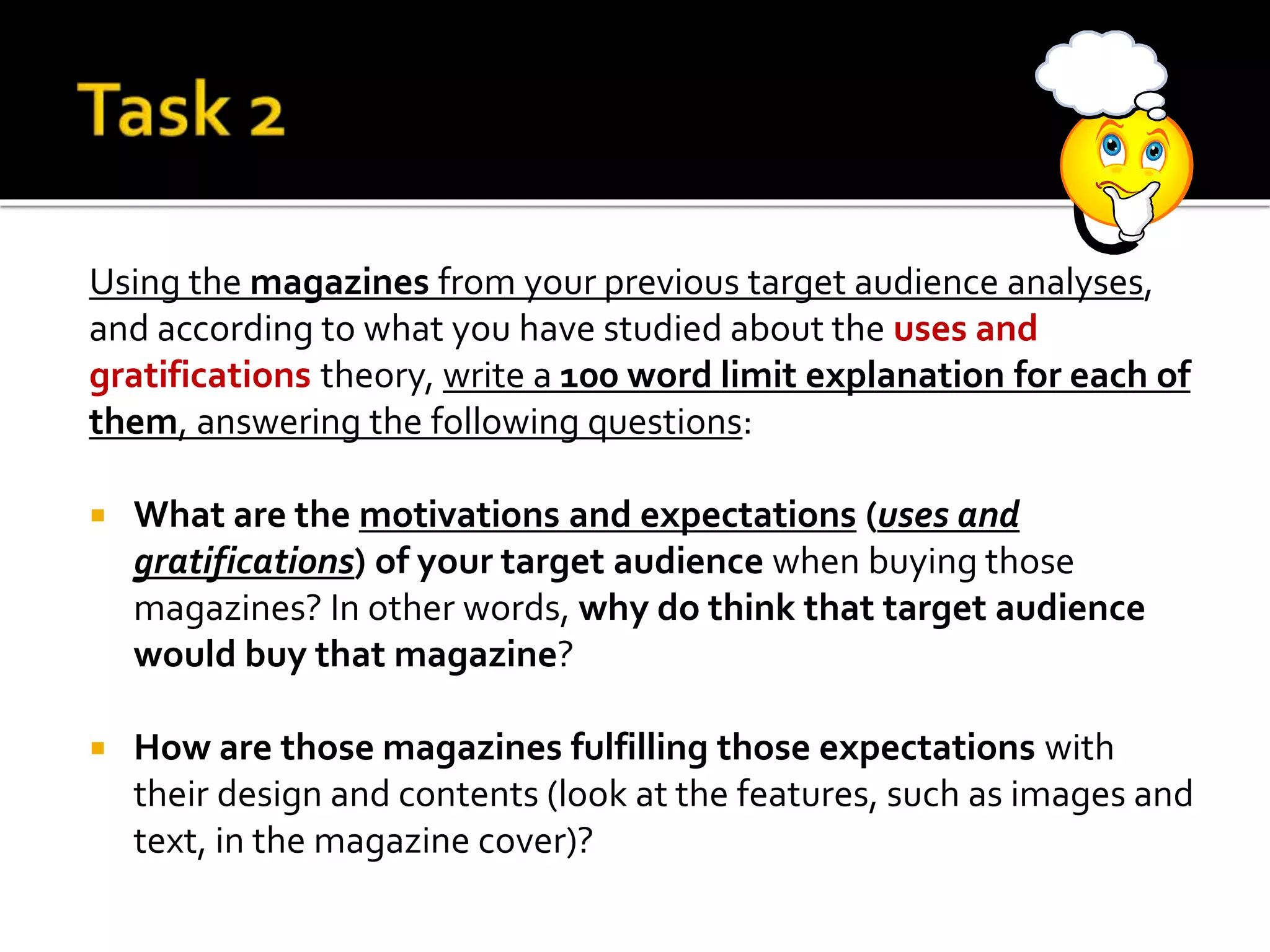
Using the magazines from your previous target audience analyses,
and according to what you have studied about the uses and
gratifications theory, write a 100 word limit explanation for each of
them, answering the following questions:
 What are the motivations and expectations (uses and
gratifications) of your target audience when buying those
magazines? In other words, why do think that target audience
would buy that magazine?
 How are those magazines fulfilling those expectations with
their design and contents (look at the features, such as images and
text, in the magazine cover)?
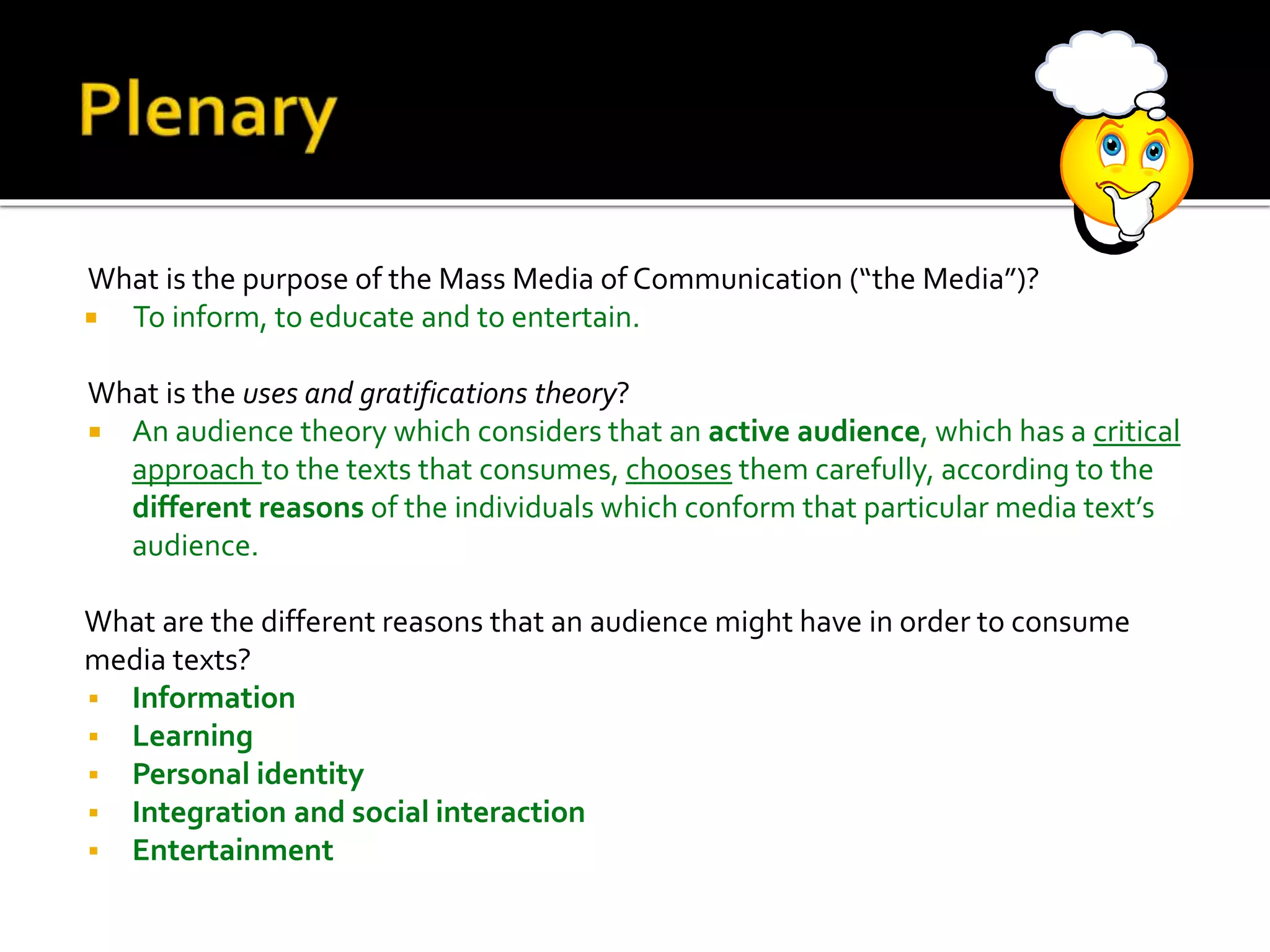
What is the purpose of the Mass Media of Communication (“the Media”)?
 To inform, to educate and to entertain.
What is the uses and gratifications theory?
 An audience theory which considers that an active audience, which has a critical
approach to the texts that consumes, chooses them carefully, according to the
different reasons of the individuals which conform that particular media text’s
audience.
What are the different reasons that an audience might have in order to consume
media texts?
 Information
 Learning
 Personal identity
 Integration and social interaction
 Entertainment
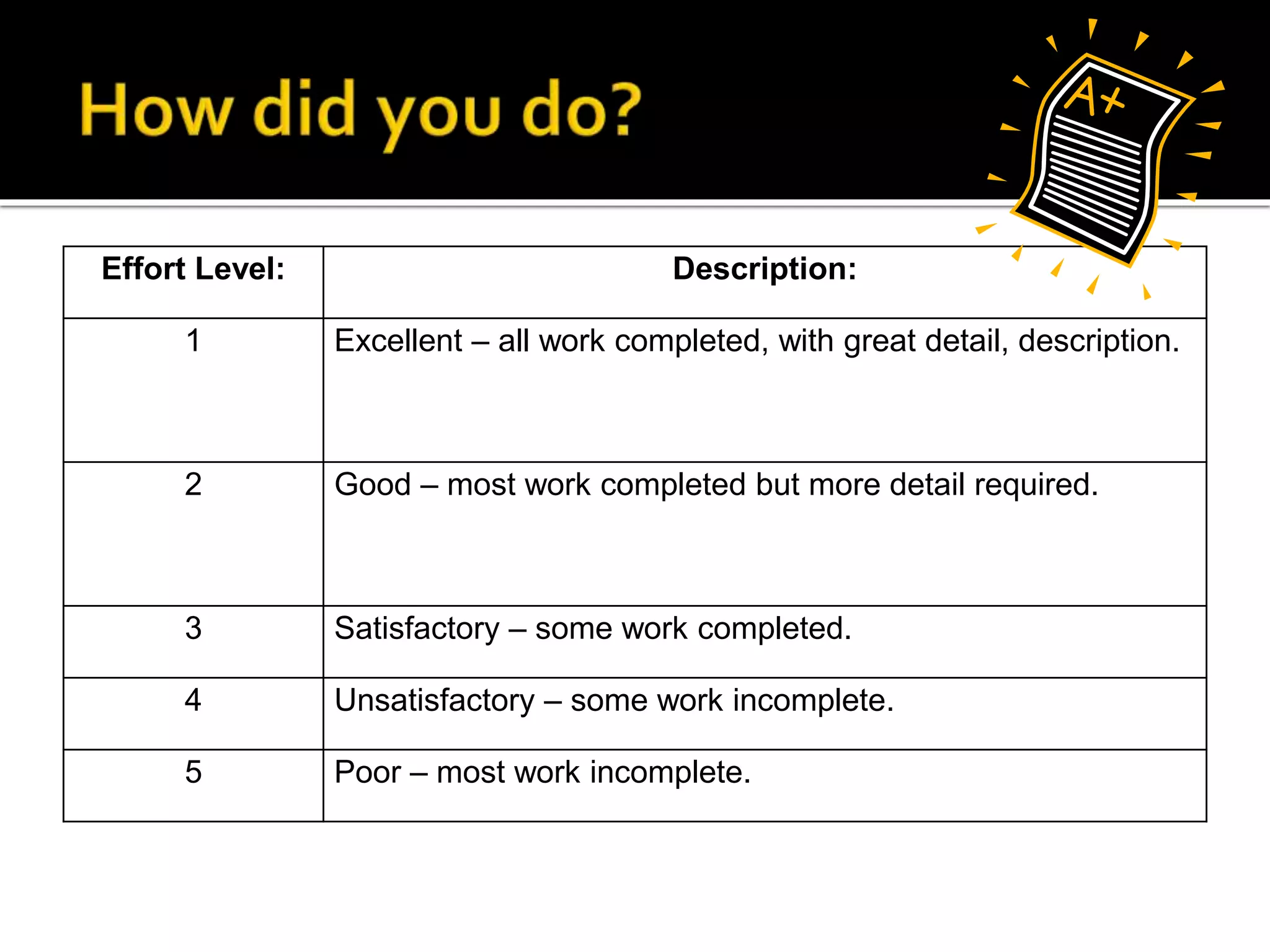
Effort Level: Description:
1 Excellent – all work completed, with great detail, description.
2 Good – most work completed but more detail required.
3 Satisfactory – some work completed.
4 Unsatisfactory – some work incomplete.
5 Poor – most work incomplete.
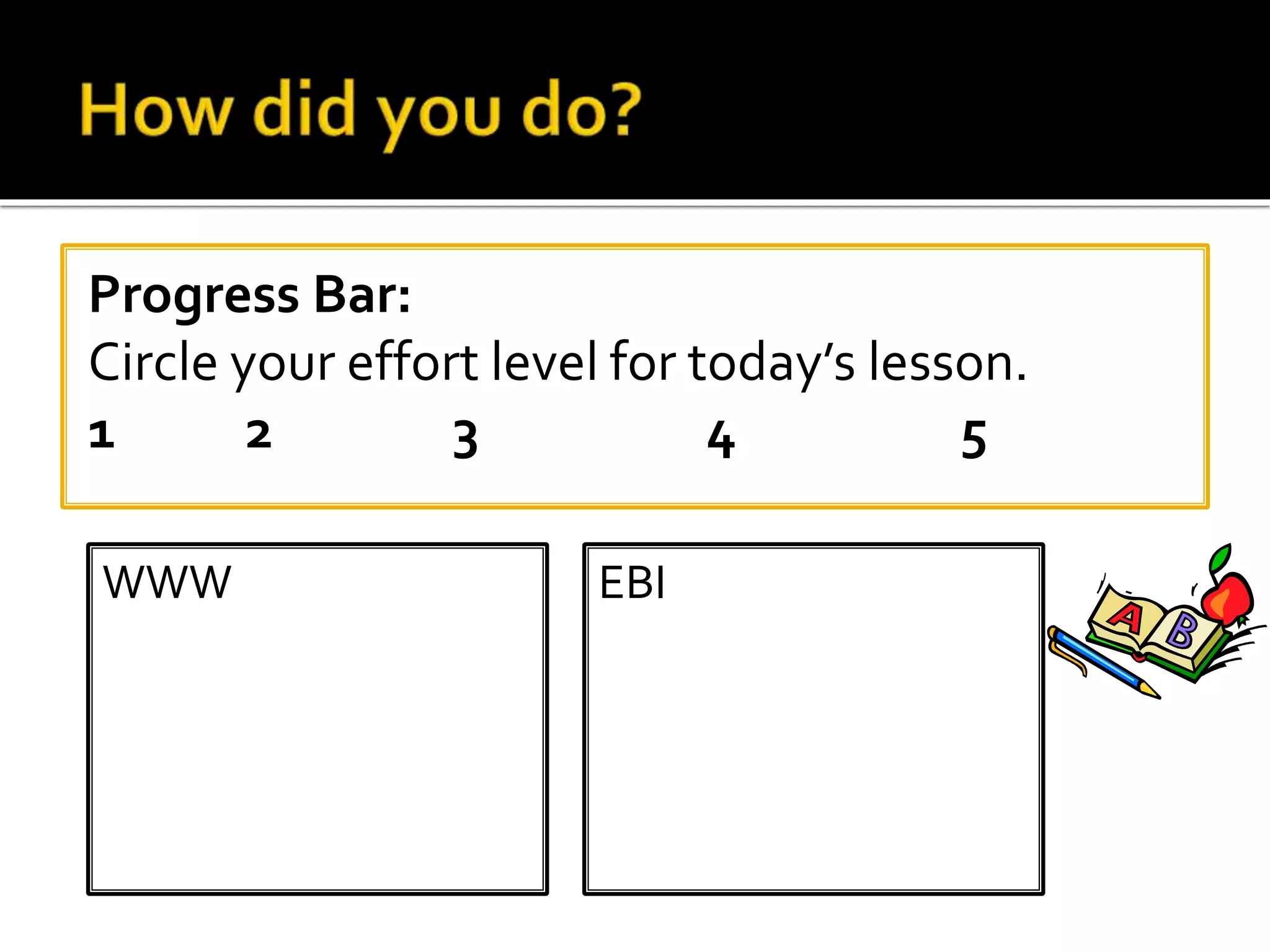
Progress Bar:
Circle your effort level for today’s lesson.
1 2 3 4 5
WWW EBI

GCSE Audience theories_The uses and gratifications theory

  • 2.
    What was the purposeof the BBC as stated by its founder, John Reith, in 1922? So what is the purpose of media? Why do you think that people consume media products?
  • 3.
    BBC's core mission,as set out by the BBC's founder Director Genera, Lord Reith in 1922, is to :  to inform  to educate  to entertain.
  • 4.
     To knowthe meaning and purpose of the uses and gratifications audience theory.  Be able to understand and explain the purpose of the uses and gratifications audience theory.  By the end of the lesson you should be able to apply the uses and gratifications audience theory to the analysis of a given media text (exam related LO)
  • 5.
     The usesand gratifications is a theory that aims to explain what motivates different audiences to consume different media texts.  In other words: Why do people watchTV, films, read newspapers, listen to the radio,…?  This theory refers to the use that audiences give to media texts and the gratification that they obtain from the consumption of those media texts. Monday 25th September 2017
  • 6.
    In 1974, Katz,Blulmer and Gurevitch suggested a series of possible reasons why audience members might consume a media text:  Surveillance: Information gathering with the purpose of learning (education) about the world around us. Satisfying curiosity and general interest, finding out about the world; seeking advice. Self-education; gaining security through knowledge.  Personal identity: Learning behaviour and values and constructing their own identity. Finding models of behaviour; reinforcement for personal values; identifying with valued other; gaining insight into oneself.  Personal relationships: Using media for integration and social interaction (emotional interaction). Finding basis for conversation and social interaction. Identifying with others (sense of belonging to a group); gaining insight into circumstances of others; substitute for real life companionship; helping to carry out social roles; enabling connection with family friends and society.  Diversion: Entertainment and escape from everyday routine. Relaxation; cultural or aesthetic enjoyment; filling time; emotional release. Monday 25th September 2017
  • 7.
    In 1987, DenisMcQuail suggested a very similar but slightly more detailed breakdown of audience motivation:  Information (Surveillance: Information gathering)  Learning (Education: Learning about the world around us)  Personal identity (Learning behaviour and values and constructing their own identity)  Integration and social interaction (Personal relationships: Using media for social integration and emotional interaction.)  Entertainment (Diversion)
  • 8.
    Can you providean example of a specific media text that you may use for:  Information (Surveillance)  Learning (Information and education)  Personal identity (Personal identity)  Integration and social interaction (Personal relationships)  Entertainment (Diversion) Monday 25th September 2017
  • 9.
    Using the magazinesfrom your previous target audience analyses, and according to what you have studied about the uses and gratifications theory, write a 100 word limit explanation for each of them, answering the following questions:  What are the motivations and expectations (uses and gratifications) of your target audience when buying those magazines? In other words, why do think that target audience would buy that magazine?  How are those magazines fulfilling those expectations with their design and contents (look at the features, such as images and text, in the magazine cover)?
  • 10.
    What is thepurpose of the Mass Media of Communication (“the Media”)?  To inform, to educate and to entertain. What is the uses and gratifications theory?  An audience theory which considers that an active audience, which has a critical approach to the texts that consumes, chooses them carefully, according to the different reasons of the individuals which conform that particular media text’s audience. What are the different reasons that an audience might have in order to consume media texts?  Information  Learning  Personal identity  Integration and social interaction  Entertainment
  • 11.
    Effort Level: Description: 1Excellent – all work completed, with great detail, description. 2 Good – most work completed but more detail required. 3 Satisfactory – some work completed. 4 Unsatisfactory – some work incomplete. 5 Poor – most work incomplete.
  • 12.
    Progress Bar: Circle youreffort level for today’s lesson. 1 2 3 4 5 WWW EBI