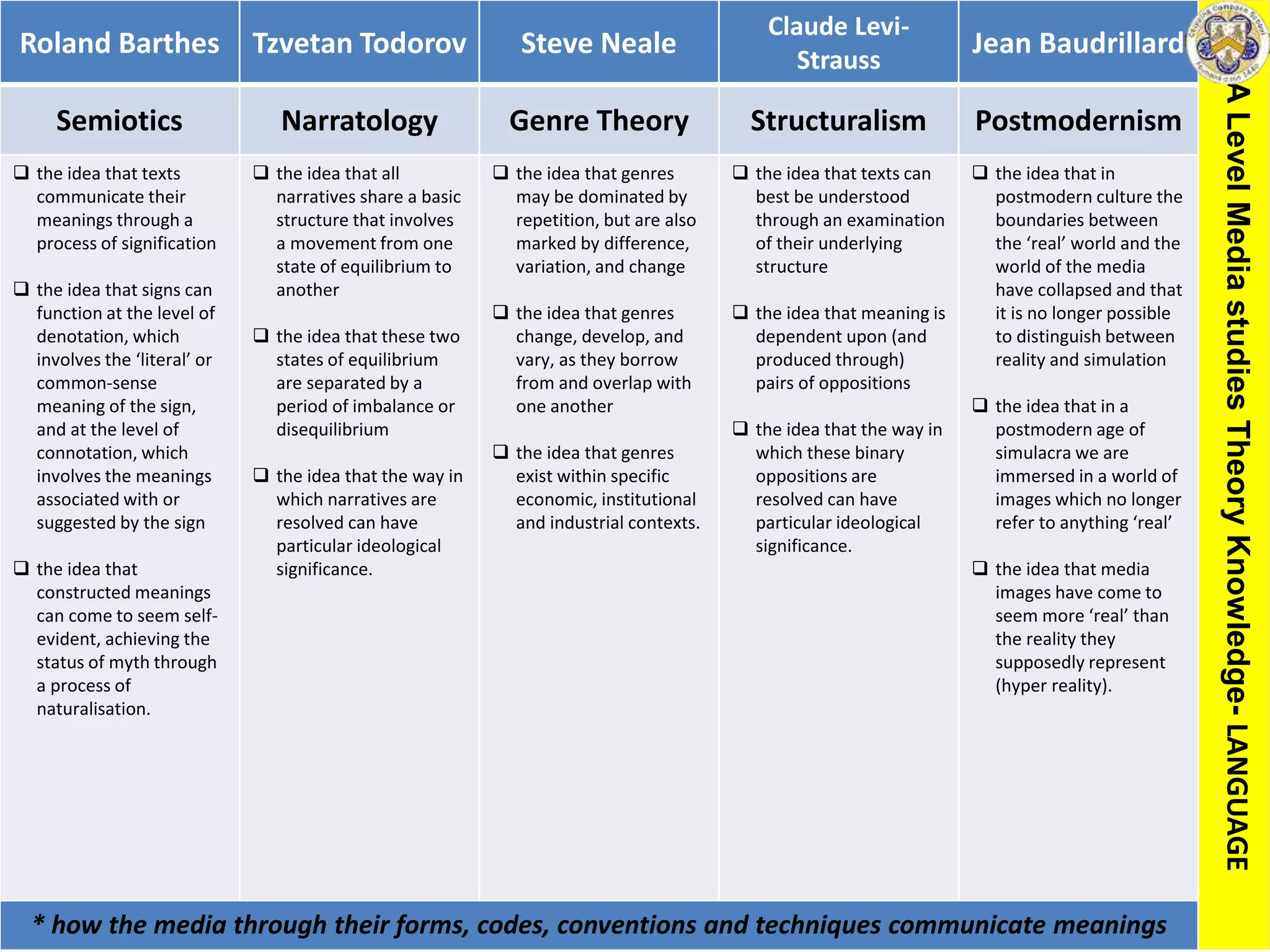
ALevelMediastudiesTheoryKnowledge-LANGUAGE
Roland Barthes Tzvetan Todorov Steve Neale
Claude Levi-
Strauss
Jean Baudrillard
Semiotics Narratology Genre Theory Structuralism Postmodernism
 the idea that texts
communicate their
meanings through a
process of signification
 the idea that signs can
function at the level of
denotation, which
involves the ‘literal’ or
common-sense
meaning of the sign,
and at the level of
connotation, which
involves the meanings
associated with or
suggested by the sign
 the idea that
constructed meanings
can come to seem self-
evident, achieving the
status of myth through
a process of
naturalisation.
 the idea that all
narratives share a basic
structure that involves
a movement from one
state of equilibrium to
another
 the idea that these two
states of equilibrium
are separated by a
period of imbalance or
disequilibrium
 the idea that the way in
which narratives are
resolved can have
particular ideological
significance.
 the idea that genres
may be dominated by
repetition, but are also
marked by difference,
variation, and change
 the idea that genres
change, develop, and
vary, as they borrow
from and overlap with
one another
 the idea that genres
exist within specific
economic, institutional
and industrial contexts.
 the idea that texts can
best be understood
through an examination
of their underlying
structure
 the idea that meaning is
dependent upon (and
produced through)
pairs of oppositions
 the idea that the way in
which these binary
oppositions are
resolved can have
particular ideological
significance.
 the idea that in
postmodern culture the
boundaries between
the ‘real’ world and the
world of the media
have collapsed and that
it is no longer possible
to distinguish between
reality and simulation
 the idea that in a
postmodern age of
simulacra we are
immersed in a world of
images which no longer
refer to anything ‘real’
 the idea that media
images have come to
seem more ‘real’ than
the reality they
supposedly represent
(hyper reality).
* how the media through their forms, codes, conventions and techniques communicate meanings
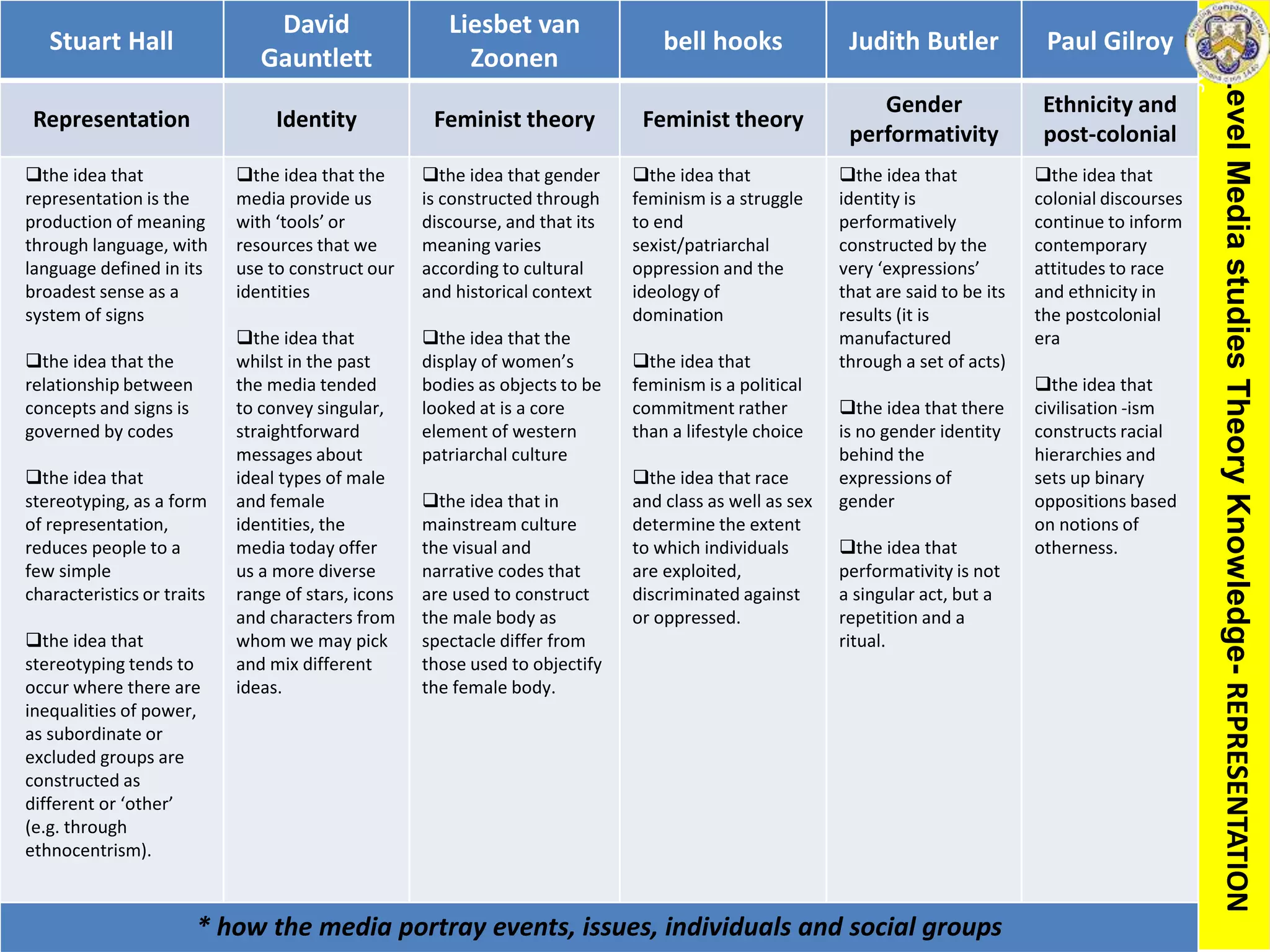
ALevelMediastudiesTheoryKnowledge-REPRESENTATION
groups
Stuart Hall
David
Gauntlett
Liesbet van
Zoonen
bell hooks Judith Butler Paul Gilroy
Representation Identity Feminist theory Feminist theory
Gender
performativity
Ethnicity and
post-colonial
the idea that
representation is the
production of meaning
through language, with
language defined in its
broadest sense as a
system of signs
the idea that the
relationship between
concepts and signs is
governed by codes
the idea that
stereotyping, as a form
of representation,
reduces people to a
few simple
characteristics or traits
the idea that
stereotyping tends to
occur where there are
inequalities of power,
as subordinate or
excluded groups are
constructed as
different or ‘other’
(e.g. through
ethnocentrism).
the idea that the
media provide us
with ‘tools’ or
resources that we
use to construct our
identities
the idea that
whilst in the past
the media tended
to convey singular,
straightforward
messages about
ideal types of male
and female
identities, the
media today offer
us a more diverse
range of stars, icons
and characters from
whom we may pick
and mix different
ideas.
the idea that gender
is constructed through
discourse, and that its
meaning varies
according to cultural
and historical context
the idea that the
display of women’s
bodies as objects to be
looked at is a core
element of western
patriarchal culture
the idea that in
mainstream culture
the visual and
narrative codes that
are used to construct
the male body as
spectacle differ from
those used to objectify
the female body.
the idea that
feminism is a struggle
to end
sexist/patriarchal
oppression and the
ideology of
domination
the idea that
feminism is a political
commitment rather
than a lifestyle choice
the idea that race
and class as well as sex
determine the extent
to which individuals
are exploited,
discriminated against
or oppressed.
the idea that
identity is
performatively
constructed by the
very ‘expressions’
that are said to be its
results (it is
manufactured
through a set of acts)
the idea that there
is no gender identity
behind the
expressions of
gender
the idea that
performativity is not
a singular act, but a
repetition and a
ritual.
the idea that
colonial discourses
continue to inform
contemporary
attitudes to race
and ethnicity in
the postcolonial
era
the idea that
civilisation -ism
constructs racial
hierarchies and
sets up binary
oppositions based
on notions of
otherness.
* how the media portray events, issues, individuals and social groups
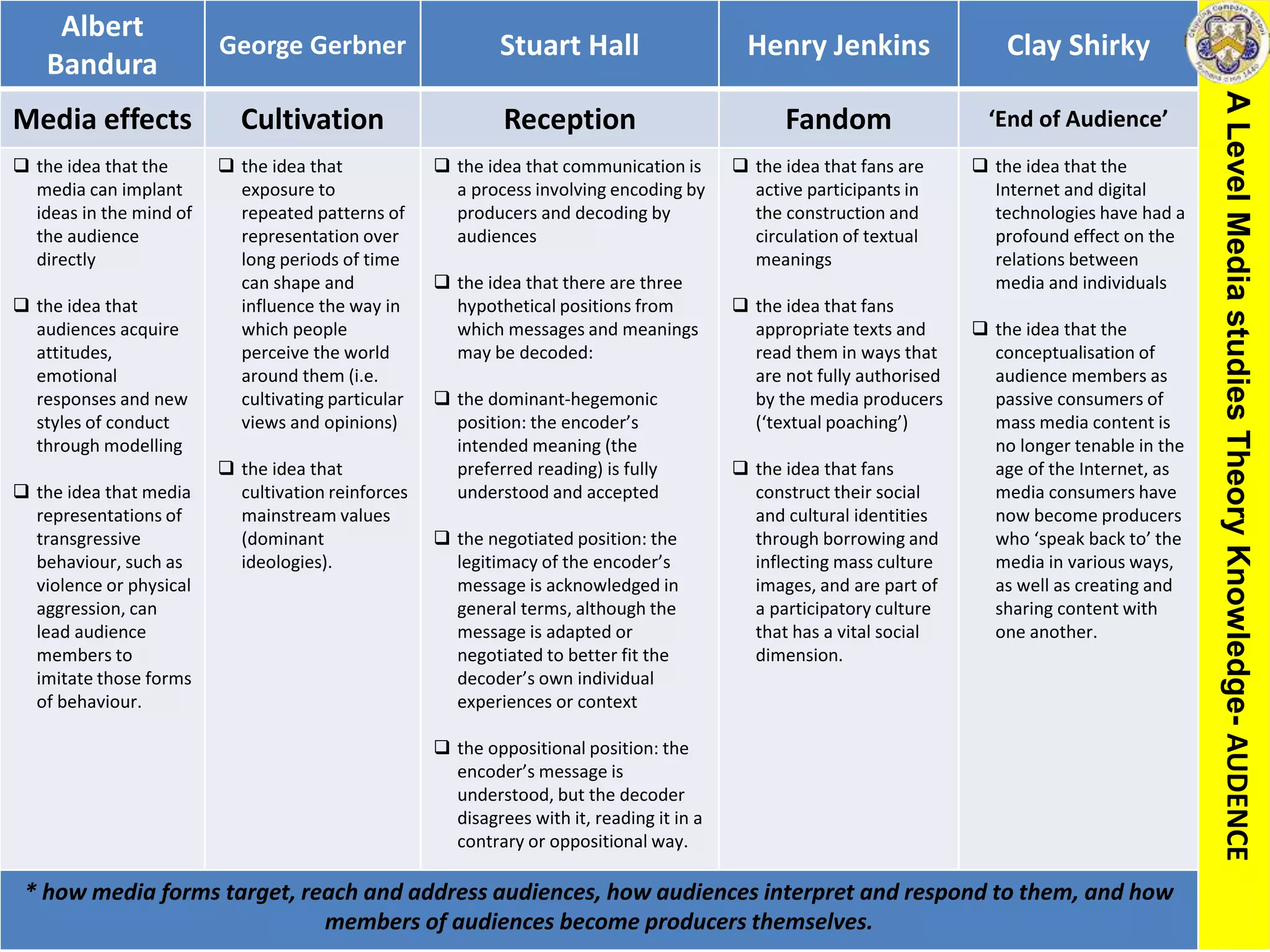
ALevelMediastudiesTheoryKnowledge-AUDENCE
Albert
Bandura
George Gerbner Stuart Hall Henry Jenkins Clay Shirky
Media effects Cultivation Reception Fandom ‘End of Audience’
 the idea that the
media can implant
ideas in the mind of
the audience
directly
 the idea that
audiences acquire
attitudes,
emotional
responses and new
styles of conduct
through modelling
 the idea that media
representations of
transgressive
behaviour, such as
violence or physical
aggression, can
lead audience
members to
imitate those forms
of behaviour.
 the idea that
exposure to
repeated patterns of
representation over
long periods of time
can shape and
influence the way in
which people
perceive the world
around them (i.e.
cultivating particular
views and opinions)
 the idea that
cultivation reinforces
mainstream values
(dominant
ideologies).
 the idea that communication is
a process involving encoding by
producers and decoding by
audiences
 the idea that there are three
hypothetical positions from
which messages and meanings
may be decoded:
 the dominant-hegemonic
position: the encoder’s
intended meaning (the
preferred reading) is fully
understood and accepted
 the negotiated position: the
legitimacy of the encoder’s
message is acknowledged in
general terms, although the
message is adapted or
negotiated to better fit the
decoder’s own individual
experiences or context
 the oppositional position: the
encoder’s message is
understood, but the decoder
disagrees with it, reading it in a
contrary or oppositional way.
 the idea that fans are
active participants in
the construction and
circulation of textual
meanings
 the idea that fans
appropriate texts and
read them in ways that
are not fully authorised
by the media producers
(‘textual poaching’)
 the idea that fans
construct their social
and cultural identities
through borrowing and
inflecting mass culture
images, and are part of
a participatory culture
that has a vital social
dimension.
 the idea that the
Internet and digital
technologies have had a
profound effect on the
relations between
media and individuals
 the idea that the
conceptualisation of
audience members as
passive consumers of
mass media content is
no longer tenable in the
age of the Internet, as
media consumers have
now become producers
who ‘speak back to’ the
media in various ways,
as well as creating and
sharing content with
one another.
* how media forms target, reach and address audiences, how audiences interpret and respond to them, and how
members of audiences become producers themselves.
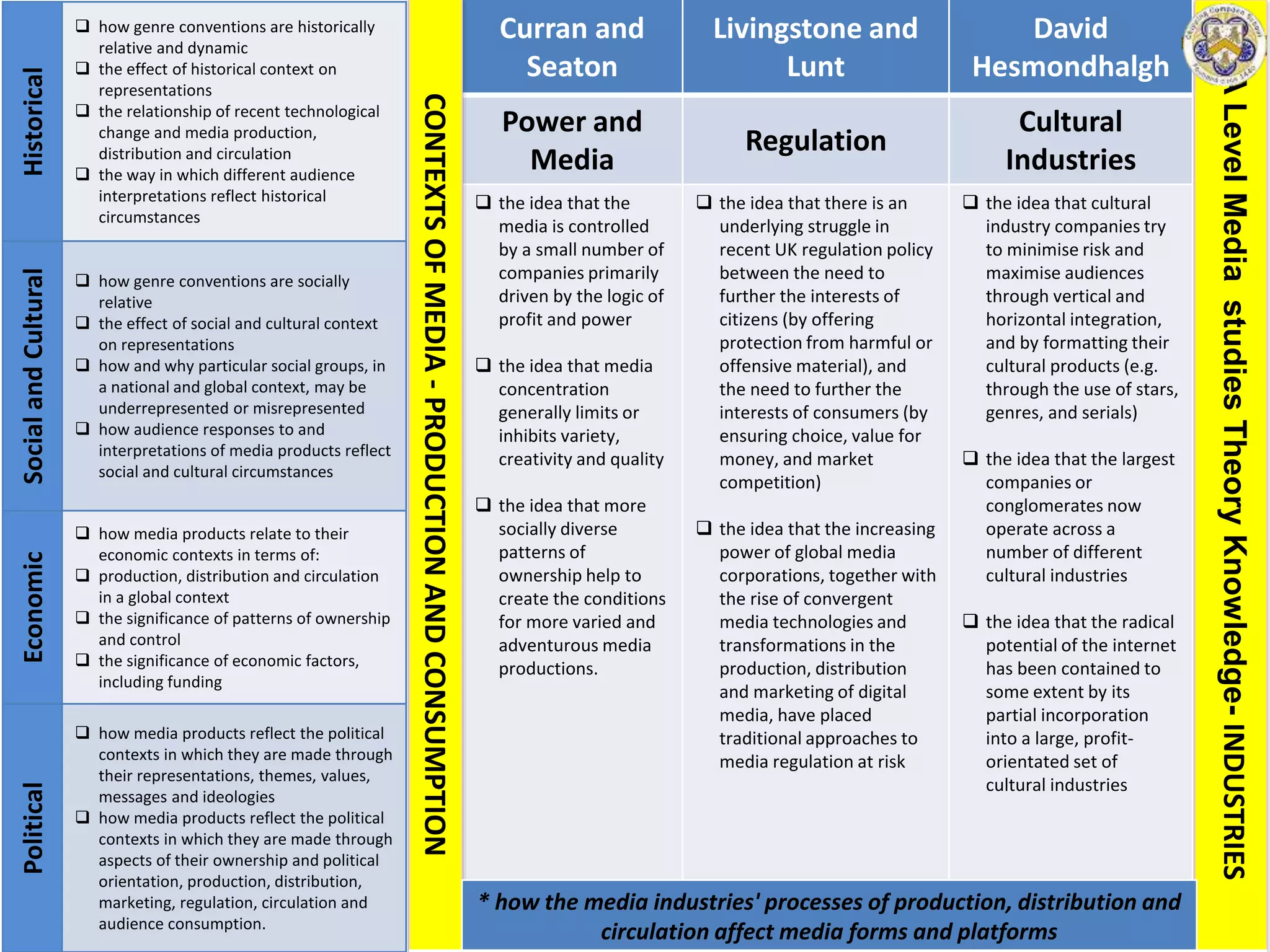
ALevelMediastudiesTheoryKnowledge-INDUSTRIES
Curran and
Seaton
Livingstone and
Lunt
David
Hesmondhalgh
Power and
Media
Regulation
Cultural
Industries
 the idea that the
media is controlled
by a small number of
companies primarily
driven by the logic of
profit and power
 the idea that media
concentration
generally limits or
inhibits variety,
creativity and quality
 the idea that more
socially diverse
patterns of
ownership help to
create the conditions
for more varied and
adventurous media
productions.
 the idea that there is an
underlying struggle in
recent UK regulation policy
between the need to
further the interests of
citizens (by offering
protection from harmful or
offensive material), and
the need to further the
interests of consumers (by
ensuring choice, value for
money, and market
competition)
 the idea that the increasing
power of global media
corporations, together with
the rise of convergent
media technologies and
transformations in the
production, distribution
and marketing of digital
media, have placed
traditional approaches to
media regulation at risk
 the idea that cultural
industry companies try
to minimise risk and
maximise audiences
through vertical and
horizontal integration,
and by formatting their
cultural products (e.g.
through the use of stars,
genres, and serials)
 the idea that the largest
companies or
conglomerates now
operate across a
number of different
cultural industries
 the idea that the radical
potential of the internet
has been contained to
some extent by its
partial incorporation
into a large, profit-
orientated set of
cultural industries
CONTEXTSOFMEDIA-PRODUCTIONANDCONSUMPTION
Historical  how genre conventions are historically
relative and dynamic
 the effect of historical context on
representations
 the relationship of recent technological
change and media production,
distribution and circulation
 the way in which different audience
interpretations reflect historical
circumstances
SocialandCultural
 how genre conventions are socially
relative
 the effect of social and cultural context
on representations
 how and why particular social groups, in
a national and global context, may be
underrepresented or misrepresented
 how audience responses to and
interpretations of media products reflect
social and cultural circumstances
Economic
 how media products relate to their
economic contexts in terms of:
 production, distribution and circulation
in a global context
 the significance of patterns of ownership
and control
 the significance of economic factors,
including funding
Political
 how media products reflect the political
contexts in which they are made through
their representations, themes, values,
messages and ideologies
 how media products reflect the political
contexts in which they are made through
aspects of their ownership and political
orientation, production, distribution,
marketing, regulation, circulation and
audience consumption.
* how the media industries' processes of production, distribution and
circulation affect media forms and platforms
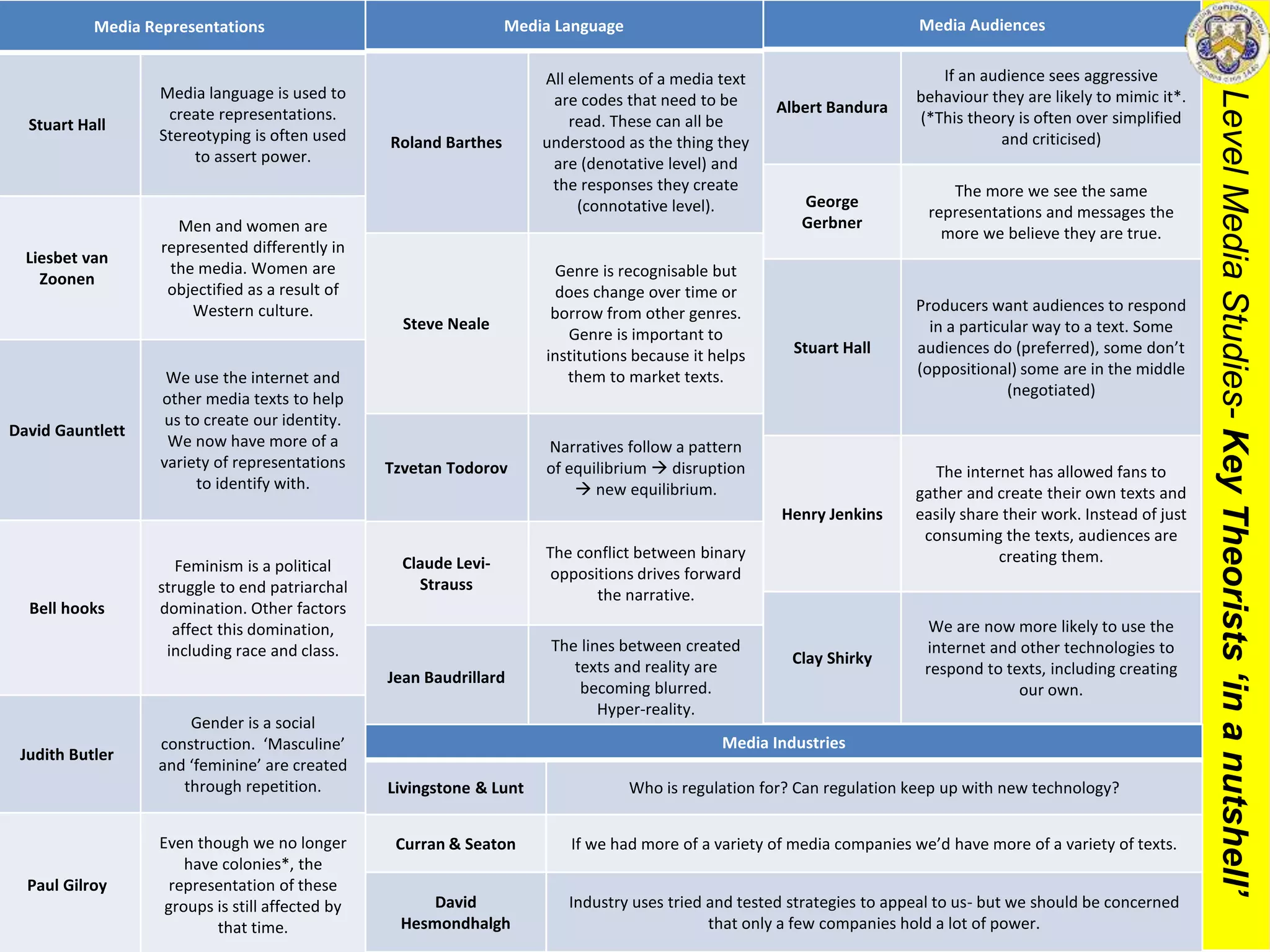
ALevelMediaStudies-KeyTheorists‘inanutshell’
Media Language
Roland Barthes
All elements of a media text
are codes that need to be
read. These can all be
understood as the thing they
are (denotative level) and
the responses they create
(connotative level).
Steve Neale
Genre is recognisable but
does change over time or
borrow from other genres.
Genre is important to
institutions because it helps
them to market texts.
Tzvetan Todorov
Narratives follow a pattern
of equilibrium  disruption
 new equilibrium.
Claude Levi-
Strauss
The conflict between binary
oppositions drives forward
the narrative.
Jean Baudrillard
The lines between created
texts and reality are
becoming blurred.
Hyper-reality.
Media Industries
Livingstone & Lunt Who is regulation for? Can regulation keep up with new technology?
Curran & Seaton If we had more of a variety of media companies we’d have more of a variety of texts.
David
Hesmondhalgh
Industry uses tried and tested strategies to appeal to us- but we should be concerned
that only a few companies hold a lot of power.
Media Audiences
Albert Bandura
If an audience sees aggressive
behaviour they are likely to mimic it*.
(*This theory is often over simplified
and criticised)
George
Gerbner
The more we see the same
representations and messages the
more we believe they are true.
Stuart Hall
Producers want audiences to respond
in a particular way to a text. Some
audiences do (preferred), some don’t
(oppositional) some are in the middle
(negotiated)
Henry Jenkins
The internet has allowed fans to
gather and create their own texts and
easily share their work. Instead of just
consuming the texts, audiences are
creating them.
Clay Shirky
We are now more likely to use the
internet and other technologies to
respond to texts, including creating
our own.
Media Representations
Stuart Hall
Media language is used to
create representations.
Stereotyping is often used
to assert power.
Liesbet van
Zoonen
Men and women are
represented differently in
the media. Women are
objectified as a result of
Western culture.
David Gauntlett
We use the internet and
other media texts to help
us to create our identity.
We now have more of a
variety of representations
to identify with.
Bell hooks
Feminism is a political
struggle to end patriarchal
domination. Other factors
affect this domination,
including race and class.
Judith Butler
Gender is a social
construction. ‘Masculine’
and ‘feminine’ are created
through repetition.
Paul Gilroy
Even though we no longer
have colonies*, the
representation of these
groups is still affected by
that time.

A level media theory knowledge organiser with exam

  • 1.
    ALevelMediastudiesTheoryKnowledge-LANGUAGE Roland Barthes TzvetanTodorov Steve Neale Claude Levi- Strauss Jean Baudrillard Semiotics Narratology Genre Theory Structuralism Postmodernism  the idea that texts communicate their meanings through a process of signification  the idea that signs can function at the level of denotation, which involves the ‘literal’ or common-sense meaning of the sign, and at the level of connotation, which involves the meanings associated with or suggested by the sign  the idea that constructed meanings can come to seem self- evident, achieving the status of myth through a process of naturalisation.  the idea that all narratives share a basic structure that involves a movement from one state of equilibrium to another  the idea that these two states of equilibrium are separated by a period of imbalance or disequilibrium  the idea that the way in which narratives are resolved can have particular ideological significance.  the idea that genres may be dominated by repetition, but are also marked by difference, variation, and change  the idea that genres change, develop, and vary, as they borrow from and overlap with one another  the idea that genres exist within specific economic, institutional and industrial contexts.  the idea that texts can best be understood through an examination of their underlying structure  the idea that meaning is dependent upon (and produced through) pairs of oppositions  the idea that the way in which these binary oppositions are resolved can have particular ideological significance.  the idea that in postmodern culture the boundaries between the ‘real’ world and the world of the media have collapsed and that it is no longer possible to distinguish between reality and simulation  the idea that in a postmodern age of simulacra we are immersed in a world of images which no longer refer to anything ‘real’  the idea that media images have come to seem more ‘real’ than the reality they supposedly represent (hyper reality). * how the media through their forms, codes, conventions and techniques communicate meanings
  • 2.
    ALevelMediastudiesTheoryKnowledge-REPRESENTATION groups Stuart Hall David Gauntlett Liesbet van Zoonen bellhooks Judith Butler Paul Gilroy Representation Identity Feminist theory Feminist theory Gender performativity Ethnicity and post-colonial the idea that representation is the production of meaning through language, with language defined in its broadest sense as a system of signs the idea that the relationship between concepts and signs is governed by codes the idea that stereotyping, as a form of representation, reduces people to a few simple characteristics or traits the idea that stereotyping tends to occur where there are inequalities of power, as subordinate or excluded groups are constructed as different or ‘other’ (e.g. through ethnocentrism). the idea that the media provide us with ‘tools’ or resources that we use to construct our identities the idea that whilst in the past the media tended to convey singular, straightforward messages about ideal types of male and female identities, the media today offer us a more diverse range of stars, icons and characters from whom we may pick and mix different ideas. the idea that gender is constructed through discourse, and that its meaning varies according to cultural and historical context the idea that the display of women’s bodies as objects to be looked at is a core element of western patriarchal culture the idea that in mainstream culture the visual and narrative codes that are used to construct the male body as spectacle differ from those used to objectify the female body. the idea that feminism is a struggle to end sexist/patriarchal oppression and the ideology of domination the idea that feminism is a political commitment rather than a lifestyle choice the idea that race and class as well as sex determine the extent to which individuals are exploited, discriminated against or oppressed. the idea that identity is performatively constructed by the very ‘expressions’ that are said to be its results (it is manufactured through a set of acts) the idea that there is no gender identity behind the expressions of gender the idea that performativity is not a singular act, but a repetition and a ritual. the idea that colonial discourses continue to inform contemporary attitudes to race and ethnicity in the postcolonial era the idea that civilisation -ism constructs racial hierarchies and sets up binary oppositions based on notions of otherness. * how the media portray events, issues, individuals and social groups
  • 3.
    ALevelMediastudiesTheoryKnowledge-AUDENCE Albert Bandura George Gerbner StuartHall Henry Jenkins Clay Shirky Media effects Cultivation Reception Fandom ‘End of Audience’  the idea that the media can implant ideas in the mind of the audience directly  the idea that audiences acquire attitudes, emotional responses and new styles of conduct through modelling  the idea that media representations of transgressive behaviour, such as violence or physical aggression, can lead audience members to imitate those forms of behaviour.  the idea that exposure to repeated patterns of representation over long periods of time can shape and influence the way in which people perceive the world around them (i.e. cultivating particular views and opinions)  the idea that cultivation reinforces mainstream values (dominant ideologies).  the idea that communication is a process involving encoding by producers and decoding by audiences  the idea that there are three hypothetical positions from which messages and meanings may be decoded:  the dominant-hegemonic position: the encoder’s intended meaning (the preferred reading) is fully understood and accepted  the negotiated position: the legitimacy of the encoder’s message is acknowledged in general terms, although the message is adapted or negotiated to better fit the decoder’s own individual experiences or context  the oppositional position: the encoder’s message is understood, but the decoder disagrees with it, reading it in a contrary or oppositional way.  the idea that fans are active participants in the construction and circulation of textual meanings  the idea that fans appropriate texts and read them in ways that are not fully authorised by the media producers (‘textual poaching’)  the idea that fans construct their social and cultural identities through borrowing and inflecting mass culture images, and are part of a participatory culture that has a vital social dimension.  the idea that the Internet and digital technologies have had a profound effect on the relations between media and individuals  the idea that the conceptualisation of audience members as passive consumers of mass media content is no longer tenable in the age of the Internet, as media consumers have now become producers who ‘speak back to’ the media in various ways, as well as creating and sharing content with one another. * how media forms target, reach and address audiences, how audiences interpret and respond to them, and how members of audiences become producers themselves.
  • 4.
    ALevelMediastudiesTheoryKnowledge-INDUSTRIES Curran and Seaton Livingstone and Lunt David Hesmondhalgh Powerand Media Regulation Cultural Industries  the idea that the media is controlled by a small number of companies primarily driven by the logic of profit and power  the idea that media concentration generally limits or inhibits variety, creativity and quality  the idea that more socially diverse patterns of ownership help to create the conditions for more varied and adventurous media productions.  the idea that there is an underlying struggle in recent UK regulation policy between the need to further the interests of citizens (by offering protection from harmful or offensive material), and the need to further the interests of consumers (by ensuring choice, value for money, and market competition)  the idea that the increasing power of global media corporations, together with the rise of convergent media technologies and transformations in the production, distribution and marketing of digital media, have placed traditional approaches to media regulation at risk  the idea that cultural industry companies try to minimise risk and maximise audiences through vertical and horizontal integration, and by formatting their cultural products (e.g. through the use of stars, genres, and serials)  the idea that the largest companies or conglomerates now operate across a number of different cultural industries  the idea that the radical potential of the internet has been contained to some extent by its partial incorporation into a large, profit- orientated set of cultural industries CONTEXTSOFMEDIA-PRODUCTIONANDCONSUMPTION Historical  how genre conventions are historically relative and dynamic  the effect of historical context on representations  the relationship of recent technological change and media production, distribution and circulation  the way in which different audience interpretations reflect historical circumstances SocialandCultural  how genre conventions are socially relative  the effect of social and cultural context on representations  how and why particular social groups, in a national and global context, may be underrepresented or misrepresented  how audience responses to and interpretations of media products reflect social and cultural circumstances Economic  how media products relate to their economic contexts in terms of:  production, distribution and circulation in a global context  the significance of patterns of ownership and control  the significance of economic factors, including funding Political  how media products reflect the political contexts in which they are made through their representations, themes, values, messages and ideologies  how media products reflect the political contexts in which they are made through aspects of their ownership and political orientation, production, distribution, marketing, regulation, circulation and audience consumption. * how the media industries' processes of production, distribution and circulation affect media forms and platforms
  • 5.
    ALevelMediaStudies-KeyTheorists‘inanutshell’ Media Language Roland Barthes Allelements of a media text are codes that need to be read. These can all be understood as the thing they are (denotative level) and the responses they create (connotative level). Steve Neale Genre is recognisable but does change over time or borrow from other genres. Genre is important to institutions because it helps them to market texts. Tzvetan Todorov Narratives follow a pattern of equilibrium  disruption  new equilibrium. Claude Levi- Strauss The conflict between binary oppositions drives forward the narrative. Jean Baudrillard The lines between created texts and reality are becoming blurred. Hyper-reality. Media Industries Livingstone & Lunt Who is regulation for? Can regulation keep up with new technology? Curran & Seaton If we had more of a variety of media companies we’d have more of a variety of texts. David Hesmondhalgh Industry uses tried and tested strategies to appeal to us- but we should be concerned that only a few companies hold a lot of power. Media Audiences Albert Bandura If an audience sees aggressive behaviour they are likely to mimic it*. (*This theory is often over simplified and criticised) George Gerbner The more we see the same representations and messages the more we believe they are true. Stuart Hall Producers want audiences to respond in a particular way to a text. Some audiences do (preferred), some don’t (oppositional) some are in the middle (negotiated) Henry Jenkins The internet has allowed fans to gather and create their own texts and easily share their work. Instead of just consuming the texts, audiences are creating them. Clay Shirky We are now more likely to use the internet and other technologies to respond to texts, including creating our own. Media Representations Stuart Hall Media language is used to create representations. Stereotyping is often used to assert power. Liesbet van Zoonen Men and women are represented differently in the media. Women are objectified as a result of Western culture. David Gauntlett We use the internet and other media texts to help us to create our identity. We now have more of a variety of representations to identify with. Bell hooks Feminism is a political struggle to end patriarchal domination. Other factors affect this domination, including race and class. Judith Butler Gender is a social construction. ‘Masculine’ and ‘feminine’ are created through repetition. Paul Gilroy Even though we no longer have colonies*, the representation of these groups is still affected by that time.