Fandom- henry Jenkins
A Level Media audience theory
Henry Jenkins
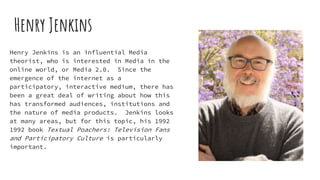
Henry Jenkins is an influential Media
theorist, who is interested in Media in the
online world, or Media 2.0. Since the
emergence of the internet as a
participatory, interactive medium, there has
been a great deal of writing about how this
has transformed audiences, institutions and
the nature of media products. Jenkins looks
at many areas, but for this topic, his 1992
1992 book Textual Poachers: Television Fans
and Participatory Culture is particularly
important.
WEB 2.0
http://whatis.techtarget.com/definition/Web-20-or-Web-2
Textual poachers
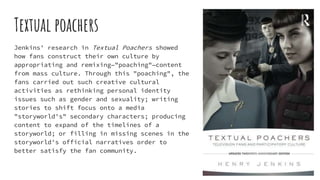
Jenkins' research in Textual Poachers showed
how fans construct their own culture by
appropriating and remixing—"poaching"—content
from mass culture. Through this "poaching", the
fans carried out such creative cultural
activities as rethinking personal identity
issues such as gender and sexuality; writing
stories to shift focus onto a media
"storyworld's" secondary characters; producing
content to expand of the timelines of a
storyworld; or filling in missing scenes in the
storyworld's official narratives order to
better satisfy the fan community.
Jenkins’ (inter)active audience approach
Jenkins belongs to a group of Media thinkers who are highly
optimistic about the Media. They view the Media, and Web 2.0 as
empowering to the audience, breaking down traditional boundaries of
class and status. The audience is interactive and powerful. They
can participate and create their own narratives, questioning
messages and generating their own ideas.
Jenkins, Shirky and others clearly contrast with the more
traditional media effects theory models, which see the media as
powerful and the audience as passive.
Participatory culture
Jenkins noted that the development of “new” Media (roughly
post 2000) has accelerated “participatory culture”, in which
audiences are active and creative participants rather than
passive consumers. They create online communities, produce
new creative forms, collaborate to solve problems, and shape
the flow of media. This generates what Jenkins describes as
“collective intelligence.”
Three key terms from Jenkins
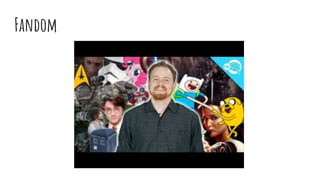
Fandom refers to the social structures and cultural practices
created by the most passionately engaged consumers of mass
media properties
Participatory culture refers more broadly to any kind of
cultural production which starts at the grassroots level and
which is open to broad participation
Web 2.0 is a business model that sustains many web-based
projects that rely on principles such as user-creation and
moderation, social networking, and "crowdsourcing."
Fandom
Discussion point:
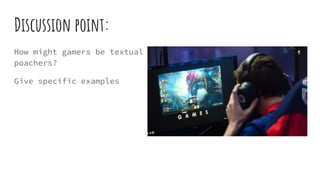
How might gamers be textual
poachers?
Give specific examples
Fandom and minecraft
Very poachy:
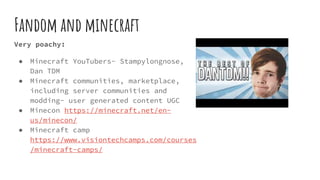
● Minecraft YouTubers- Stampylongnose,
Dan TDM
● Minecraft communities, marketplace,
including server communities and
modding- user generated content UGC
● Minecon https://minecraft.net/en-
us/minecon/
● Minecraft camp
https://www.visiontechcamps.com/courses
/minecraft-camps/
Fandom and minecraft
Still participatory but slightly less poachy / active:
● Merchandise: books, clothing, bags, toys,
● Synergy and the Minecraft film
Minecraft and trans-media learning
http://henryjenkins.org/blog/2015/04/minecraft-and-the-
future-of-transmedia-learning.html
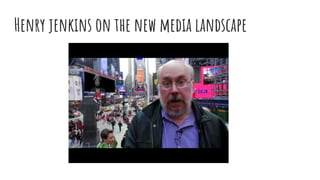
Henry jenkins on the new media landscape
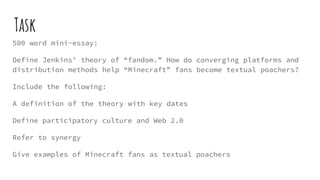
Task
500 word mini-essay:
Define Jenkins’ theory of “fandom.” How do converging platforms and
distribution methods help “Minecraft” fans become textual poachers?
Include the following:
A definition of the theory with key dates
Define participatory culture and Web 2.0
Refer to synergy
Give examples of Minecraft fans as textual poachers

Fandom Henry Jenkins

  • 1.
    Fandom- henry Jenkins ALevel Media audience theory
  • 2.
    Henry Jenkins Henry Jenkinsis an influential Media theorist, who is interested in Media in the online world, or Media 2.0. Since the emergence of the internet as a participatory, interactive medium, there has been a great deal of writing about how this has transformed audiences, institutions and the nature of media products. Jenkins looks at many areas, but for this topic, his 1992 1992 book Textual Poachers: Television Fans and Participatory Culture is particularly important.
  • 3.
  • 4.
    Textual poachers Jenkins' researchin Textual Poachers showed how fans construct their own culture by appropriating and remixing—"poaching"—content from mass culture. Through this "poaching", the fans carried out such creative cultural activities as rethinking personal identity issues such as gender and sexuality; writing stories to shift focus onto a media "storyworld's" secondary characters; producing content to expand of the timelines of a storyworld; or filling in missing scenes in the storyworld's official narratives order to better satisfy the fan community.
  • 5.
    Jenkins’ (inter)active audienceapproach Jenkins belongs to a group of Media thinkers who are highly optimistic about the Media. They view the Media, and Web 2.0 as empowering to the audience, breaking down traditional boundaries of class and status. The audience is interactive and powerful. They can participate and create their own narratives, questioning messages and generating their own ideas. Jenkins, Shirky and others clearly contrast with the more traditional media effects theory models, which see the media as powerful and the audience as passive.
  • 6.
    Participatory culture Jenkins notedthat the development of “new” Media (roughly post 2000) has accelerated “participatory culture”, in which audiences are active and creative participants rather than passive consumers. They create online communities, produce new creative forms, collaborate to solve problems, and shape the flow of media. This generates what Jenkins describes as “collective intelligence.”
  • 7.
    Three key termsfrom Jenkins Fandom refers to the social structures and cultural practices created by the most passionately engaged consumers of mass media properties Participatory culture refers more broadly to any kind of cultural production which starts at the grassroots level and which is open to broad participation Web 2.0 is a business model that sustains many web-based projects that rely on principles such as user-creation and moderation, social networking, and "crowdsourcing."
  • 8.
  • 9.
    Discussion point: How mightgamers be textual poachers? Give specific examples
  • 10.
    Fandom and minecraft Verypoachy: ● Minecraft YouTubers- Stampylongnose, Dan TDM ● Minecraft communities, marketplace, including server communities and modding- user generated content UGC ● Minecon https://minecraft.net/en- us/minecon/ ● Minecraft camp https://www.visiontechcamps.com/courses /minecraft-camps/
  • 11.
    Fandom and minecraft Stillparticipatory but slightly less poachy / active: ● Merchandise: books, clothing, bags, toys, ● Synergy and the Minecraft film
  • 12.
    Minecraft and trans-medialearning http://henryjenkins.org/blog/2015/04/minecraft-and-the- future-of-transmedia-learning.html
  • 13.
    Henry jenkins onthe new media landscape
  • 14.
    Task 500 word mini-essay: DefineJenkins’ theory of “fandom.” How do converging platforms and distribution methods help “Minecraft” fans become textual poachers? Include the following: A definition of the theory with key dates Define participatory culture and Web 2.0 Refer to synergy Give examples of Minecraft fans as textual poachers