Gaussian is capable of perdecting
many properties of the Atoms ,
molecules
 Molecular Energies
 Geometry optimisation
 Viberational frequencies
 NMR Properties
 Potential energy surface
 Reaction pathways
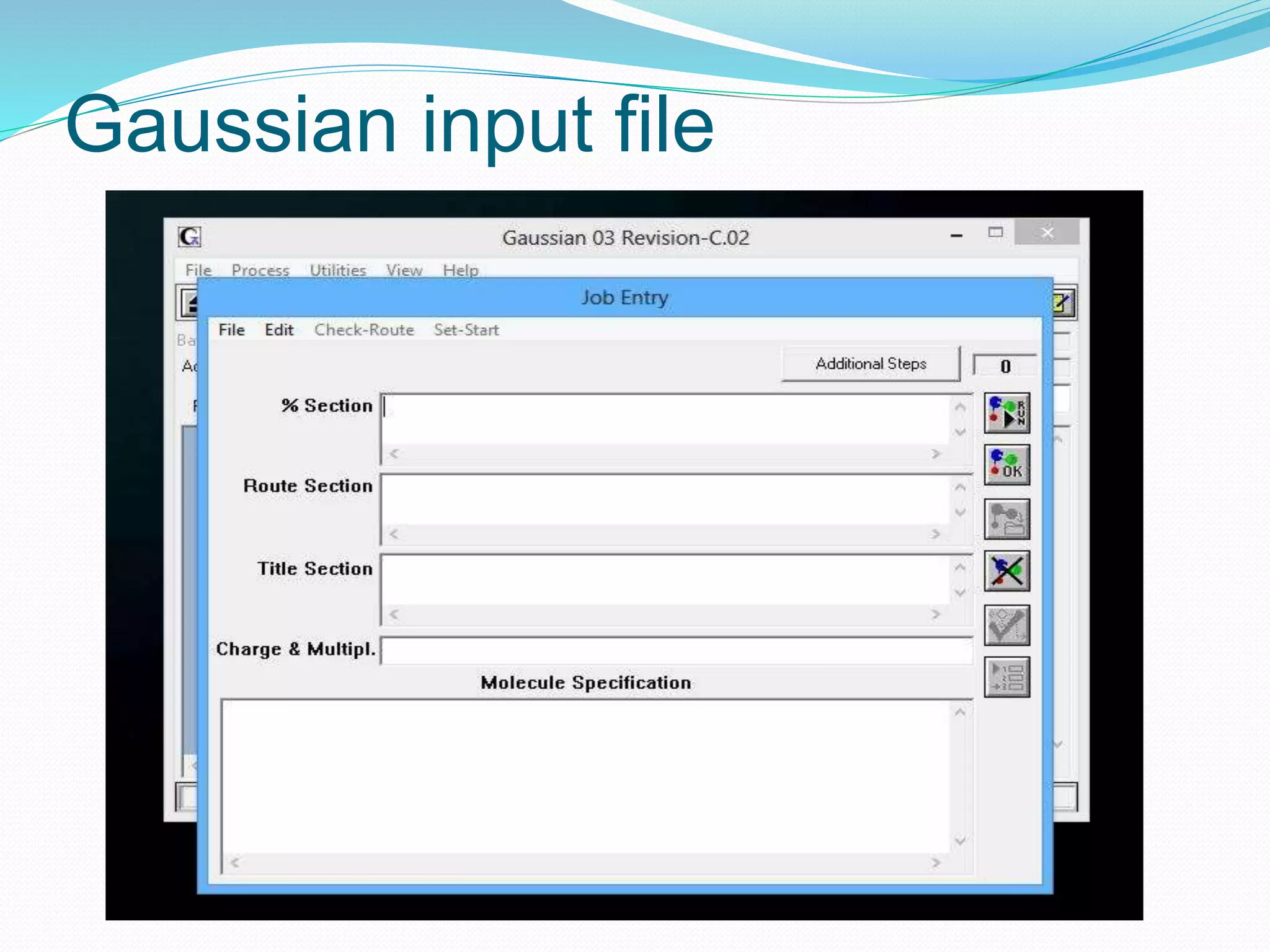
How to Create Input File
Gaussian input file
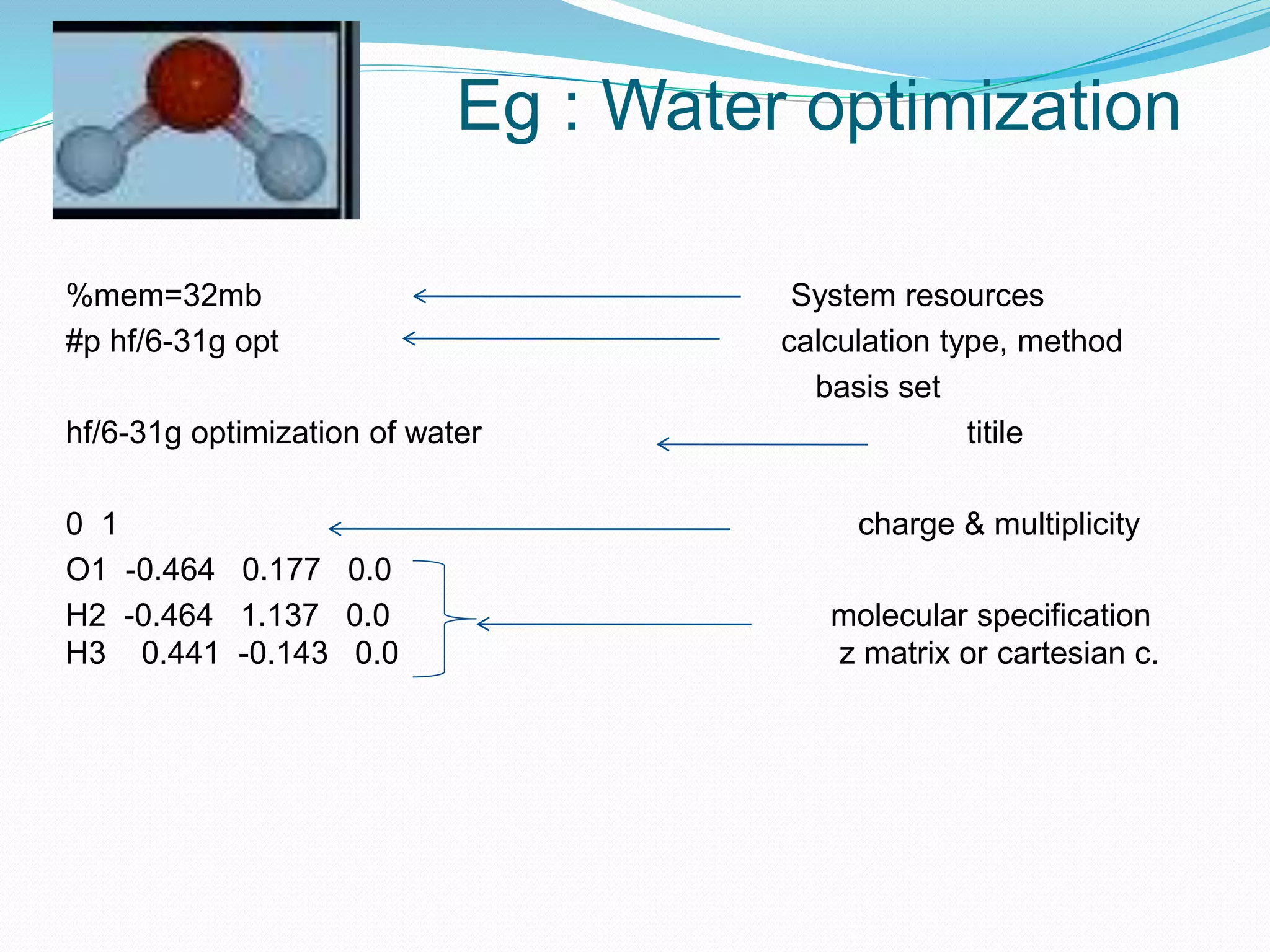
Eg : Water optimization
%mem=32mb System resources
#p hf/6-31g opt calculation type, method
basis set
hf/6-31g optimization of water titile
0 1 charge & multiplicity
O1 -0.464 0.177 0.0
H2 -0.464 1.137 0.0 molecular specification
H3 0.441 -0.143 0.0 z matrix or cartesian c.
Commands for Resource
Management(link 0)
%mem=n set the amount of dynamic meomory(n)
default is 32 mb
%chk=file location and name of checkpoint file
%nproc=n set the number of processors, n to use
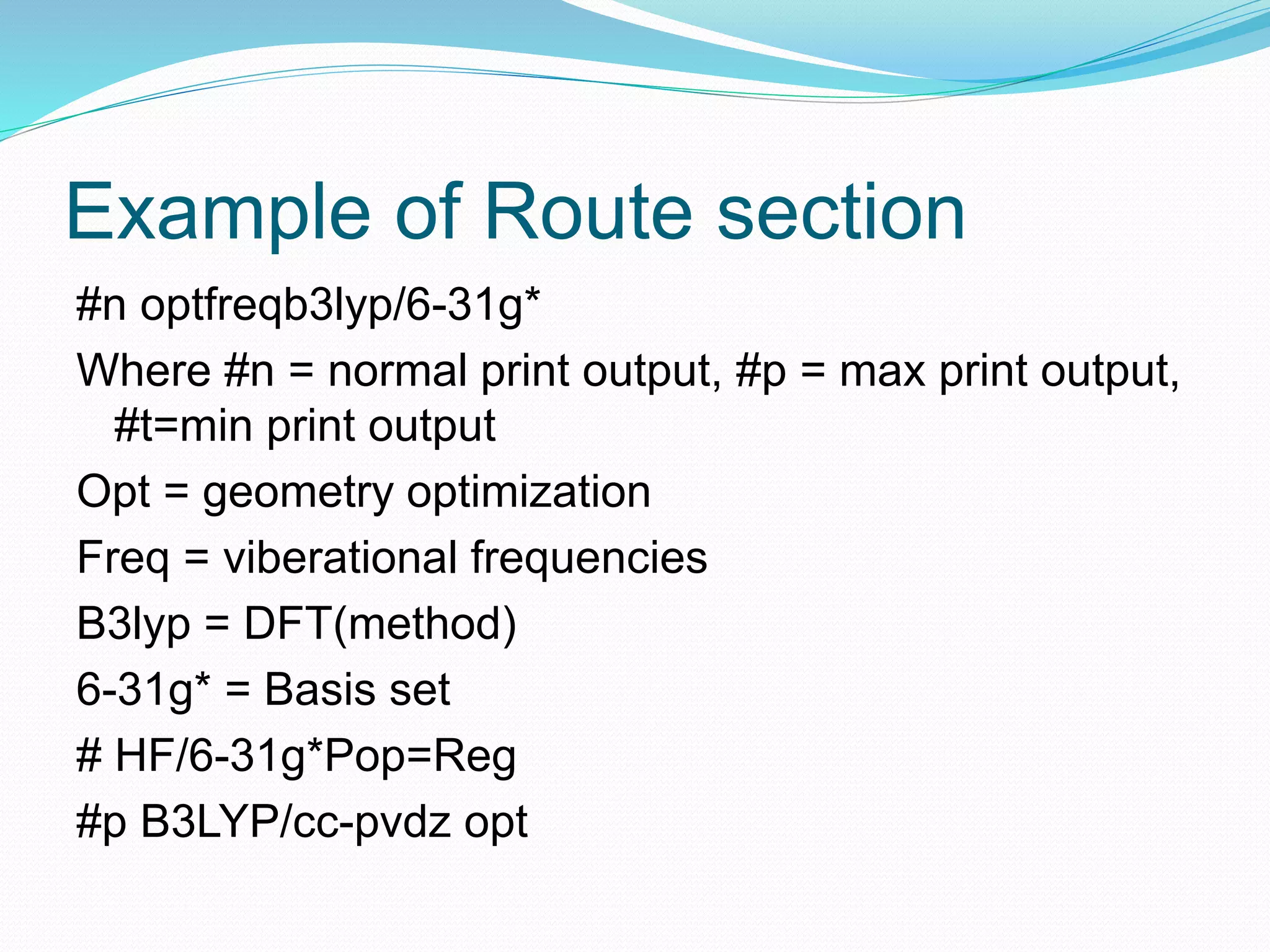
Example of Route section
#n optfreqb3lyp/6-31g*
Where #n = normal print output, #p = max print output,
#t=min print output
Opt = geometry optimization
Freq = viberational frequencies
B3lyp = DFT(method)
6-31g* = Basis set
# HF/6-31g*Pop=Reg
#p B3LYP/cc-pvdz opt
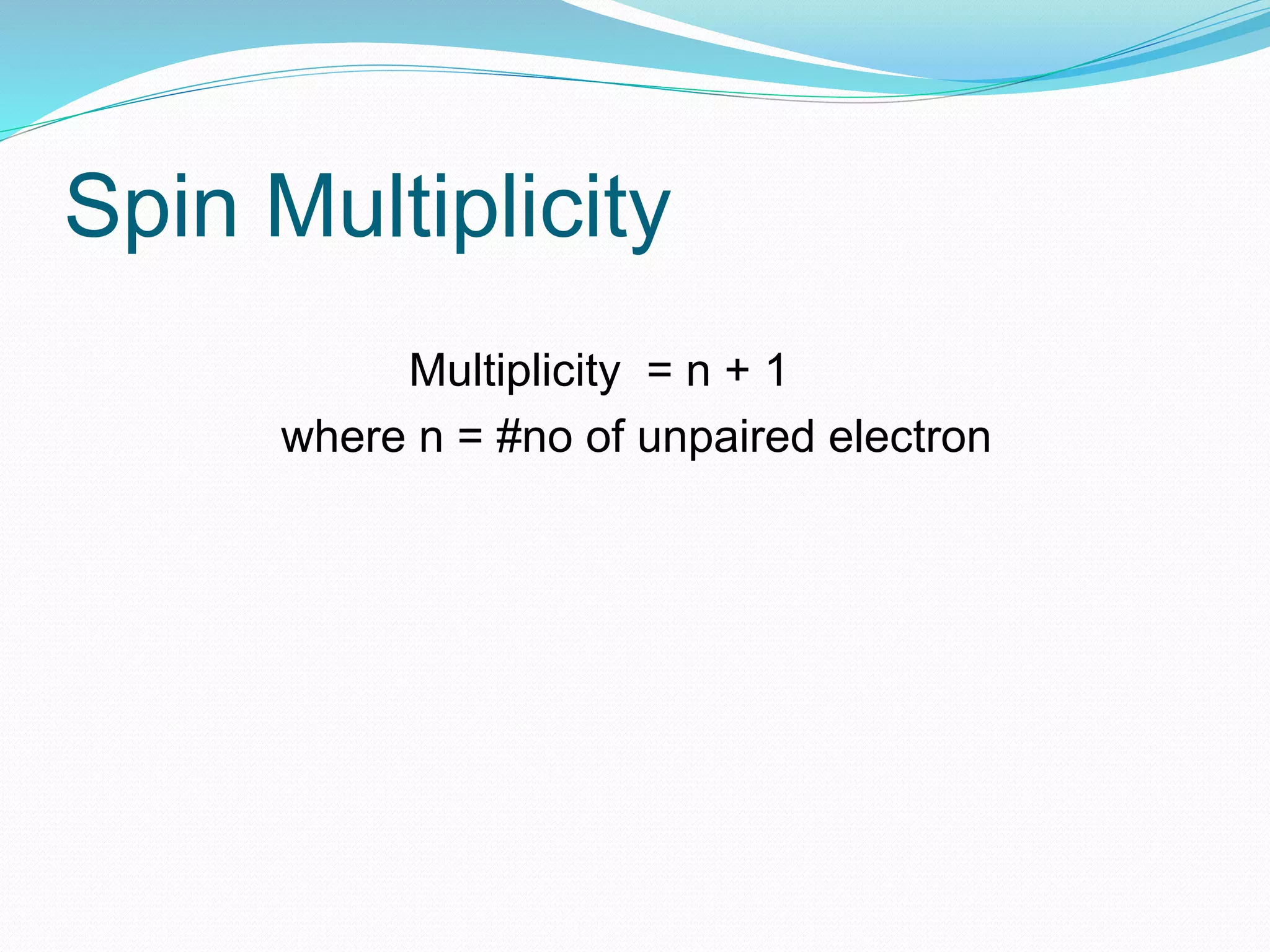
Spin Multiplicity
Multiplicity = n + 1
where n = #no of unpaired electron
Calculation types
 Single point energy
 Geometry Optimization
 Viberational Frequency
Single Point Energy
 Keyword Sp
 It simply calculates Energy ,wavefunction and other
requested properties at single fixed geometry.
 It is also frequently carried out after a geometry
optimization.
 If no keyword present in route section By default
calculation leads to HF/STO-3G Sp
 Information get out of this calculation
single point energy(hartree), orbital Symmetries,Mullkien
atomic charges,Dipole Moments
Geometry Optimization
 Keyword : Opt
 It is a procedure that attempts to find the configuration of
Minimum Energy of the Molecule.
 It also calculate the Force on each atom by evaluating
gradient(first derivative) of energy with respect to atomic
postion
 It stops when a stationary point found(point where force
on each atom is zero)
 Information get out of this calculation
Atomic coordinates of optimized molecule
Optimized Parameters: atomic distances and angles
HOMO/LUMO eigenvalues (Hartrees)
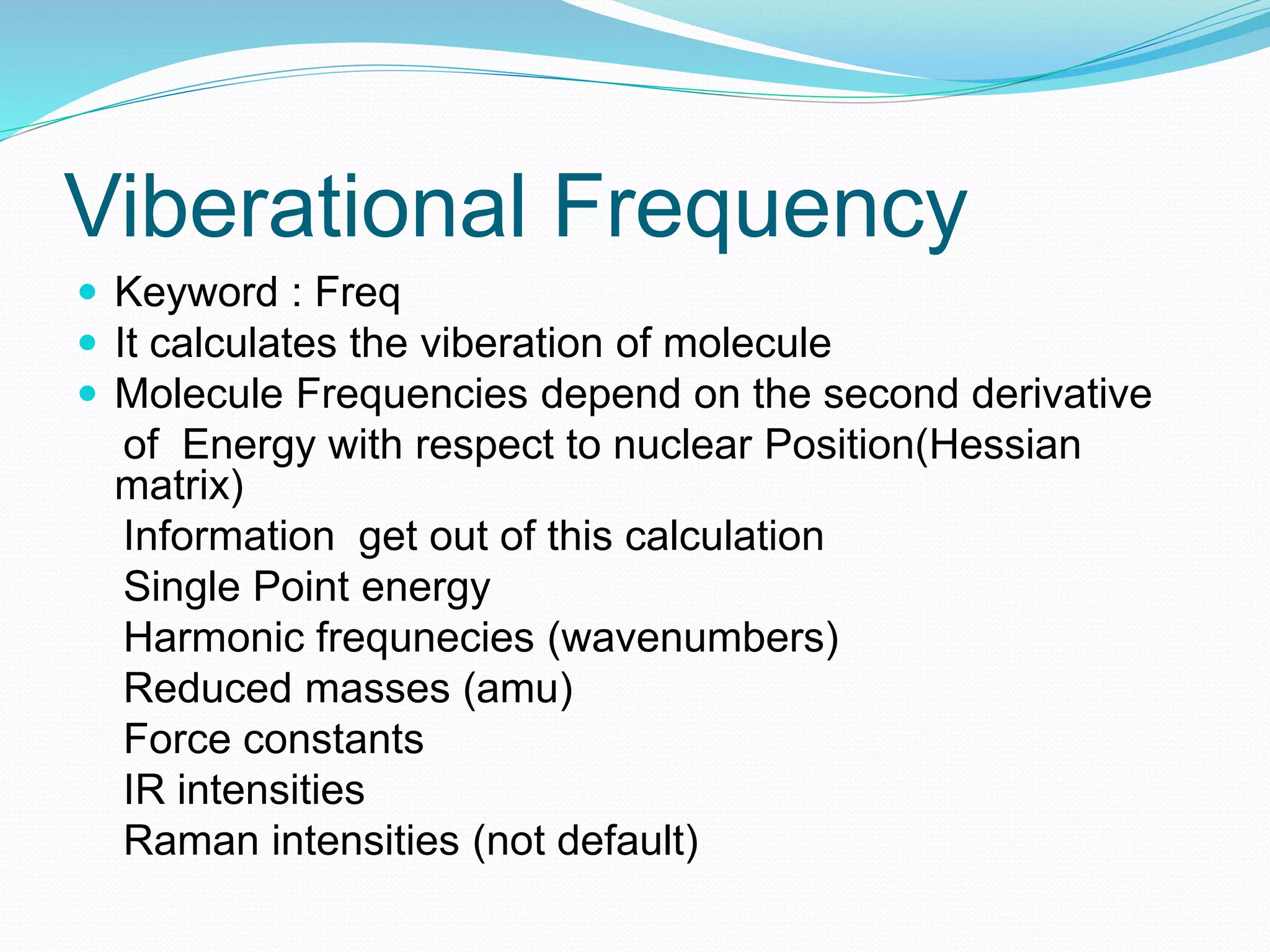
Viberational Frequency
 Keyword : Freq
 It calculates the viberation of molecule
 Molecule Frequencies depend on the second derivative
of Energy with respect to nuclear Position(Hessian
matrix)
Information get out of this calculation
Single Point energy
Harmonic frequnecies (wavenumbers)
Reduced masses (amu)
Force constants
IR intensities
Raman intensities (not default)
Theoretical model
 Ab initio Methods :
HF,MP2,CCSD,QCISD
 Semi-emperical Method
AM1,MNDO,PM3
 Density functional theory
B3LYP,VWN,PW91
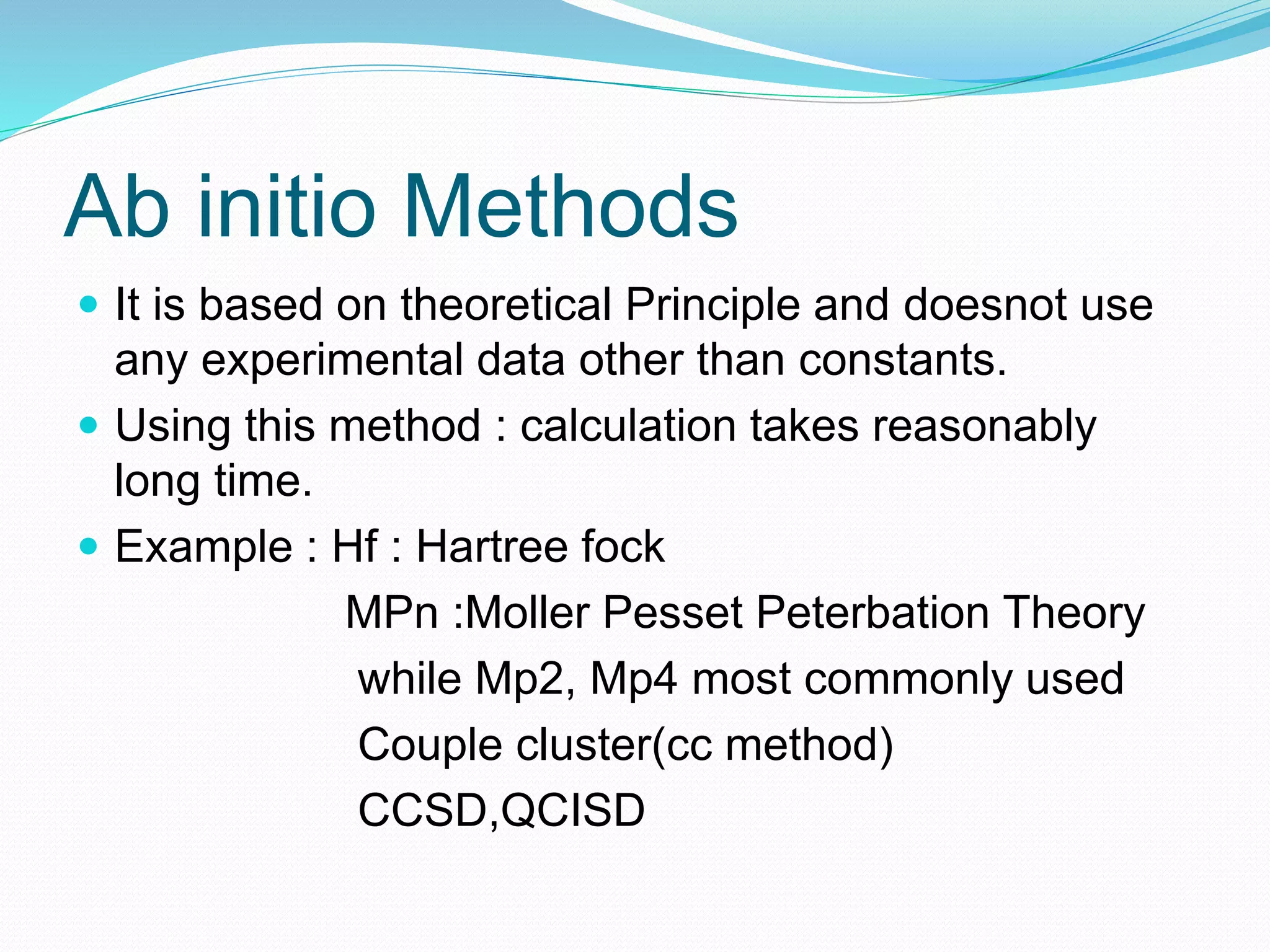
Ab initio Methods
 It is based on theoretical Principle and doesnot use
any experimental data other than constants.
 Using this method : calculation takes reasonably
long time.
 Example : Hf : Hartree fock
MPn :Moller Pesset Peterbation Theory
while Mp2, Mp4 most commonly used
Couple cluster(cc method)
CCSD,QCISD
Semi-emperical Methods
 Semi emperical methods are based hartree fock
formalism.
 It parmetrize or neglect the integrals based on
experimental data
 It can be applied to large molecules and give
accurate results
Methods : MNDO : modified neglect of diatomic
overlap
AM1 : austin model 1
PM3 : parmeterized model number 3
Density functional theory
 Dft methods are becoming more popular because
results obtained are comparable to ab intio methods
Dft differs from methods based on Hf calculation in
the way that it uses Electron density to compare
energy instead of wave function
eg: B3LYP : Becke3-parameter, Lee-Yang-Parr
VWN : Vosko Wilk Nusair Functional
PW91 : Perdew-Wang
Population analysis
 This keyword control the printing of molecular orbitals
and several types of population analysis and atomic
charges.
 Population are done once for Sp energy calculation and
at the first and last step of geometry optimisation.
 Keywords
Pop=minimal
Pop=none
Pop=full
Pop=regular
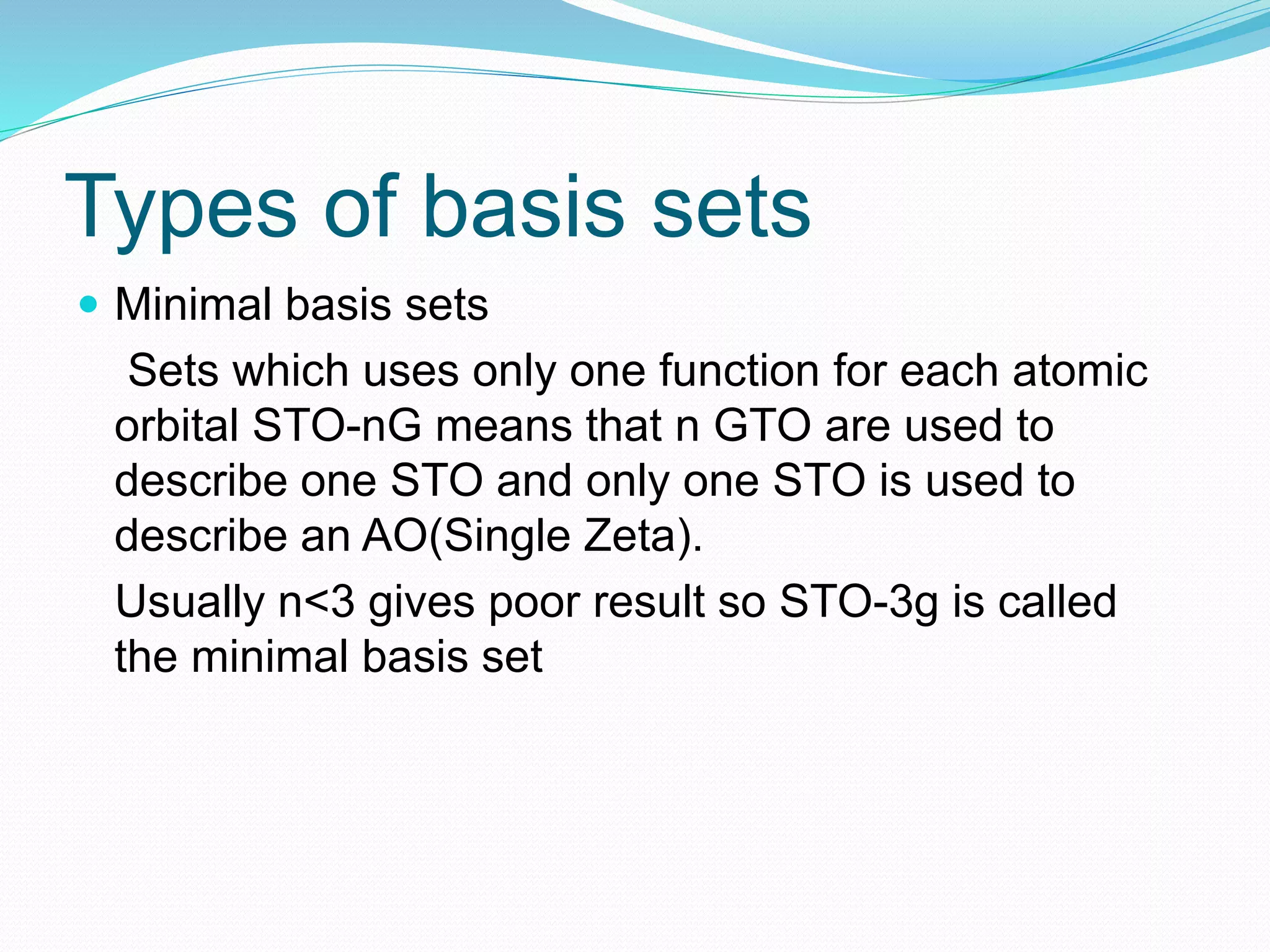
Types of basis sets
 Minimal basis sets
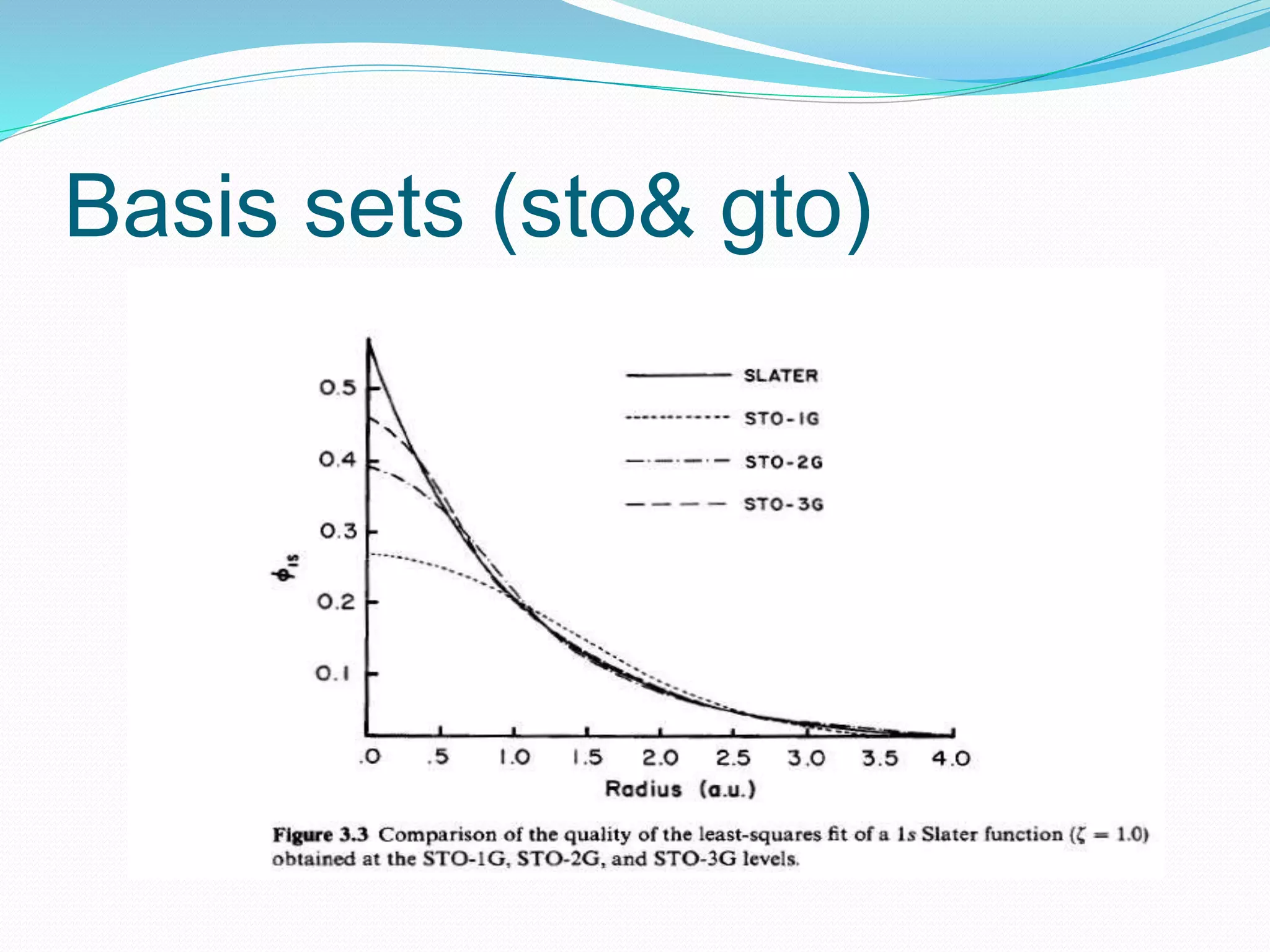
Sets which uses only one function for each atomic
orbital STO-nG means that n GTO are used to
describe one STO and only one STO is used to
describe an AO(Single Zeta).
Usually n<3 gives poor result so STO-3g is called
the minimal basis set
Basis sets (sto& gto)
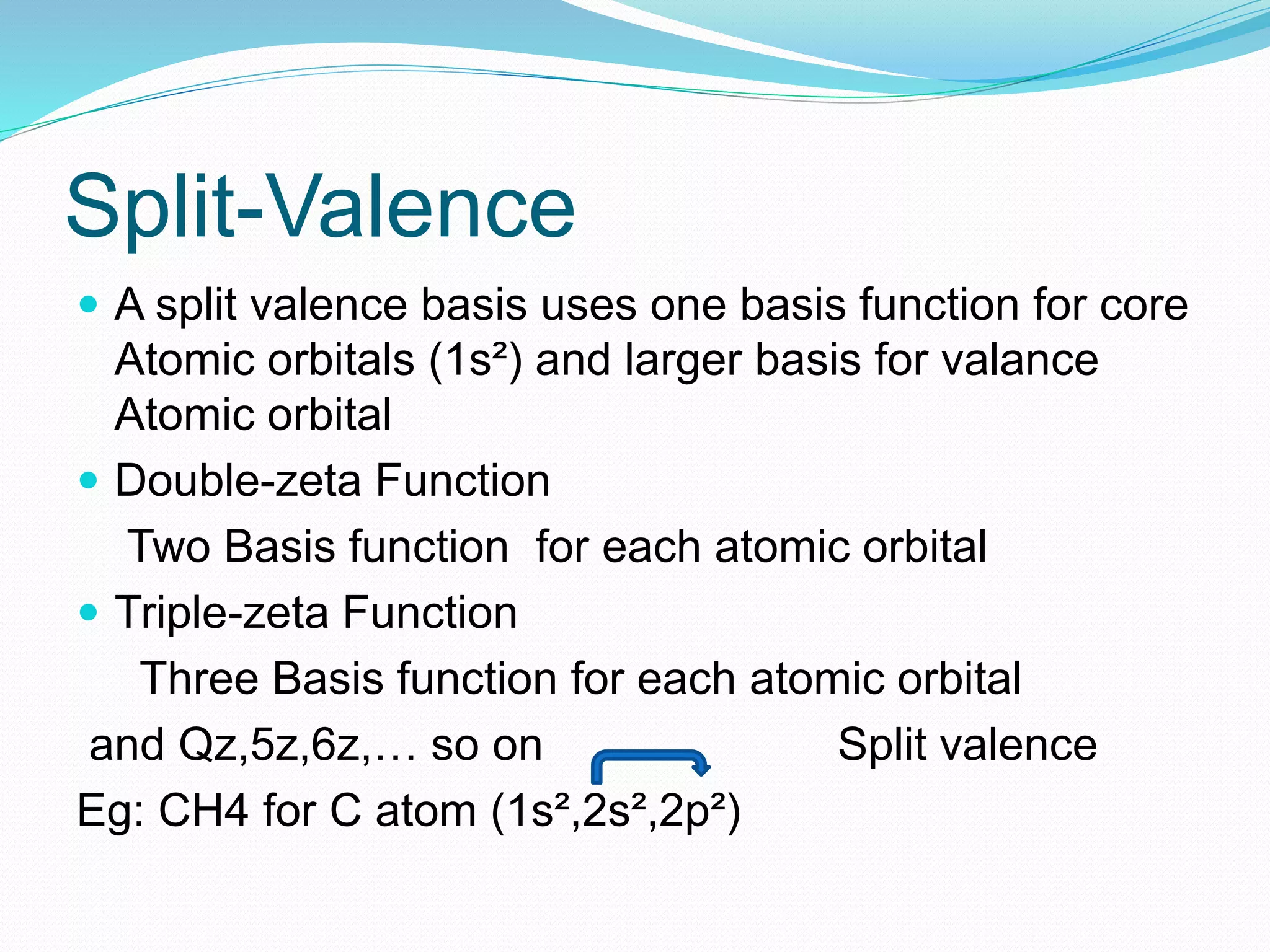
Split-Valence
 A split valence basis uses one basis function for core
Atomic orbitals (1s²) and larger basis for valance
Atomic orbital
 Double-zeta Function
Two Basis function for each atomic orbital
 Triple-zeta Function
Three Basis function for each atomic orbital
and Qz,5z,6z,… so on Split valence
Eg: CH4 for C atom (1s²,2s²,2p²)
Eg: CH4 with split valence
double zeta basis
 C atom (1s²,2s²,2p²)
 With double zeta basis function
 C atom (1s²,2s’²,2s², 2px’2px,2py’2py,2pz’2pz)
 We get value 9
 Similarly for H atom (1s¹)
 With double zeta basis function(1s¹’1s¹)
 So 4*2=8
 Total value is 9+8= 17
Pople basis sets
 3-21G
3 Gtos for inner shell(core) , 2 Gtos for inner
valence , 1 Gto for outer valence
 6-31G
 6-311G
Polarization function
 *type (6-31G*)
 D type function added other than hydrogen atom and
f type function added on the transition metals
 **type (6-31G**)
 P type function added on hydrogen atom and d type
function added on all other atom, f type function
added on transition metals
Diffused function
 To provide more accurate description of anion or
neutral molecules
 + : diffuse function added on to atoms other than
hydrogen
 ++: diffuse function added on to all atoms
 6-31G+
 6-31G++
Dunning basis sets
 Correlation consistent
 Dunning created basis sets that can optimized using
correlated (CISD) wavefunction
various types
cc-pVXZ
cc= indicates that it is a correlation-consistent basis
pV= indicates that it is a polarized valence basis
xz = indicates the zeta number (x = D for Double , T for
triple , Q for quadruple , 5,6,7)
The prefix aug- can be used to add diffuse function
eg : aug-cc-pVTZ , aug-cc-VDZ
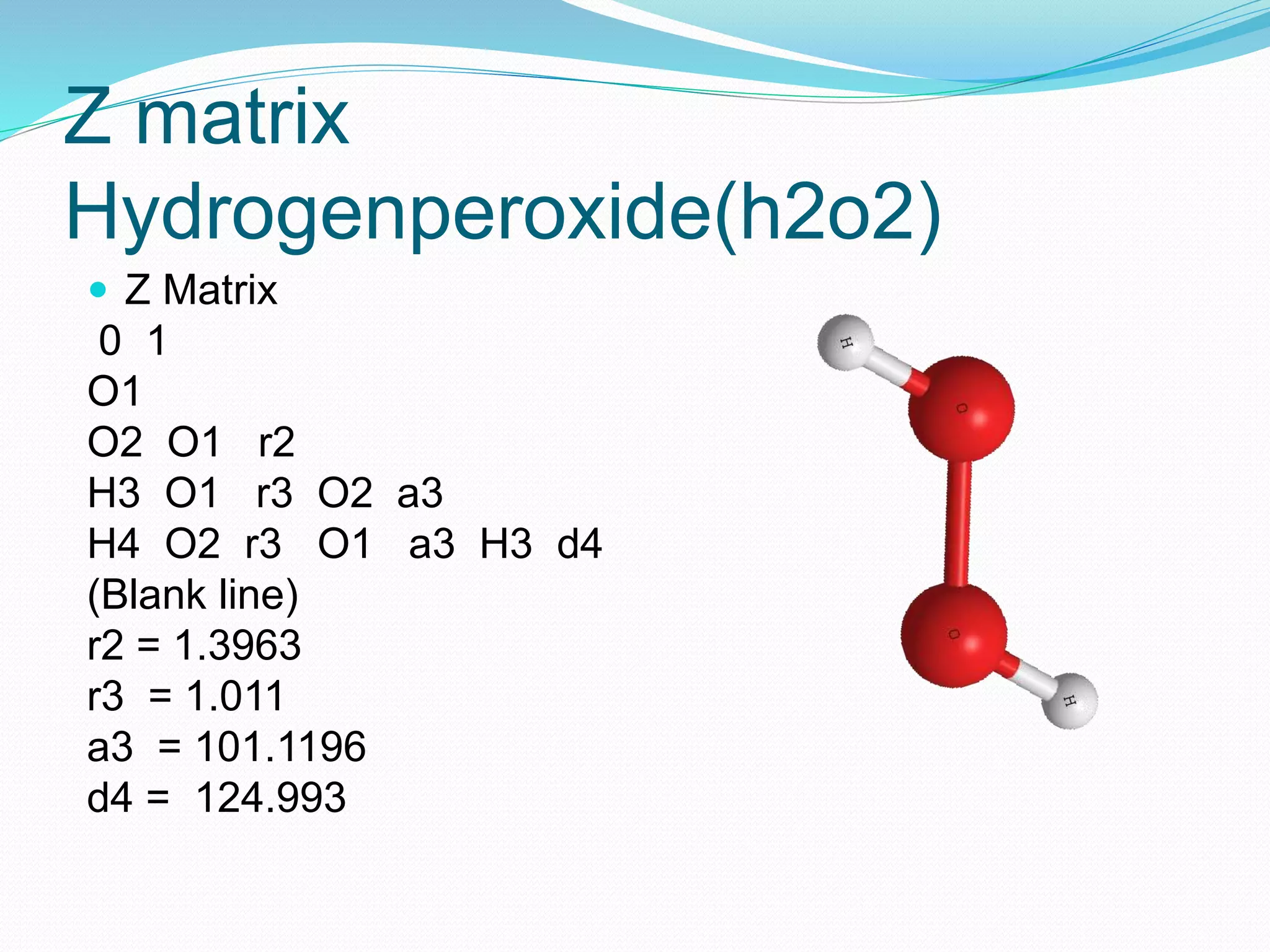
Z matrix
Hydrogenperoxide(h2o2)
 Z Matrix
0 1
O1
O2 O1 r2
H3 O1 r3 O2 a3
H4 O2 r3 O1 a3 H3 d4
(Blank line)
r2 = 1.3963
r3 = 1.011
a3 = 101.1196
d4 = 124.993
Building with Gauss View
 Instead of typing all the coordinates, theory, basis
set, etc., we can use GaussView.
 The calculation is specified by pointing and clicking
to build the molecule, and using pull-down menus to
select the calculation type, level of theory and basis
set.
 GaussView generates the Gaussian input file, and
can run Gaussian without ever returning to the Unix
prompt.
 GaussView can also be used to read Gaussian
output files and visualize the results
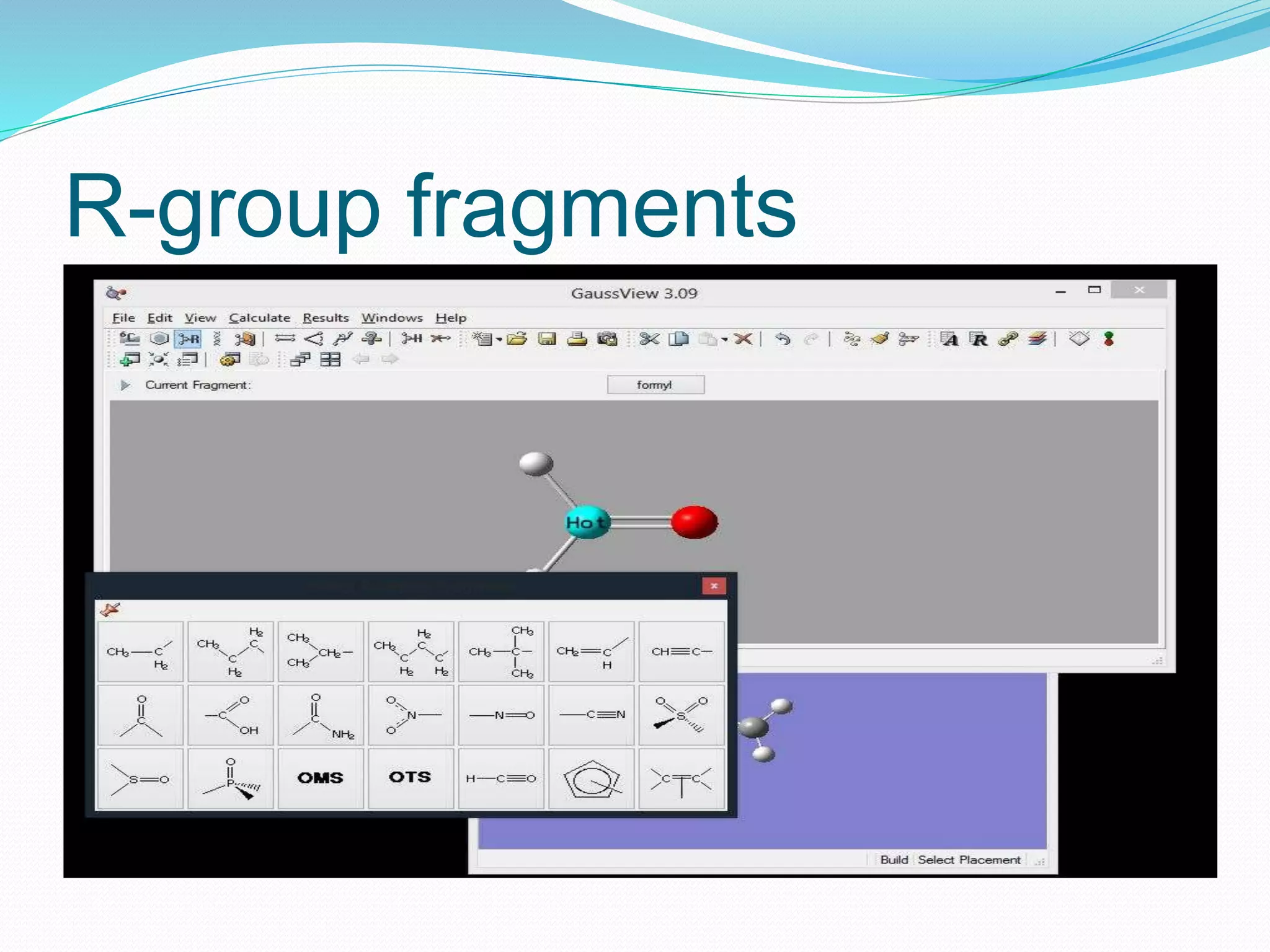
Gauss view
Builder viewer
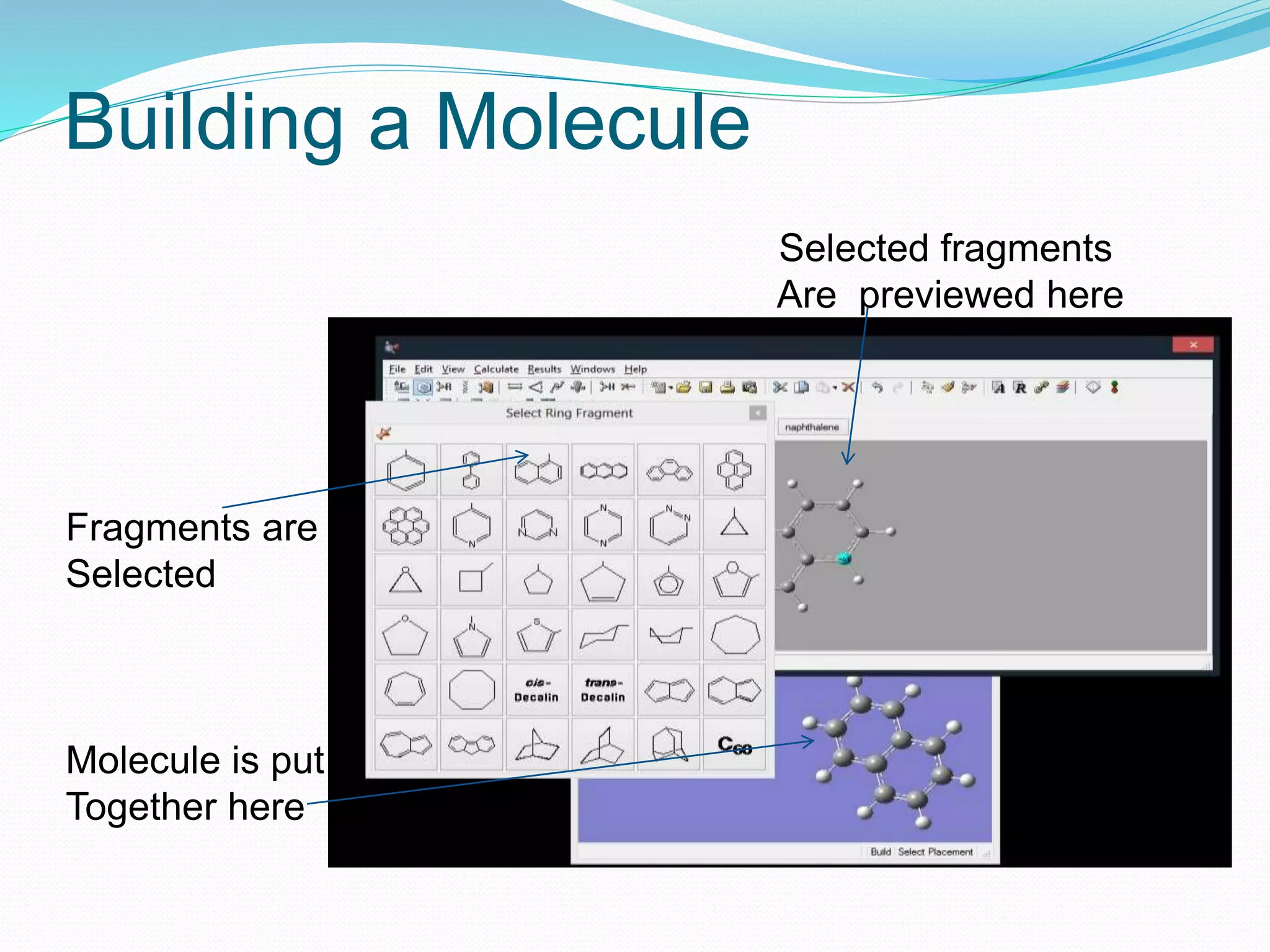
Building a Molecule
Selected fragments
Are previewed here
Fragments are
Selected
Molecule is put
Together here
Biological fragments
R-group fragments
Method & Basis sets
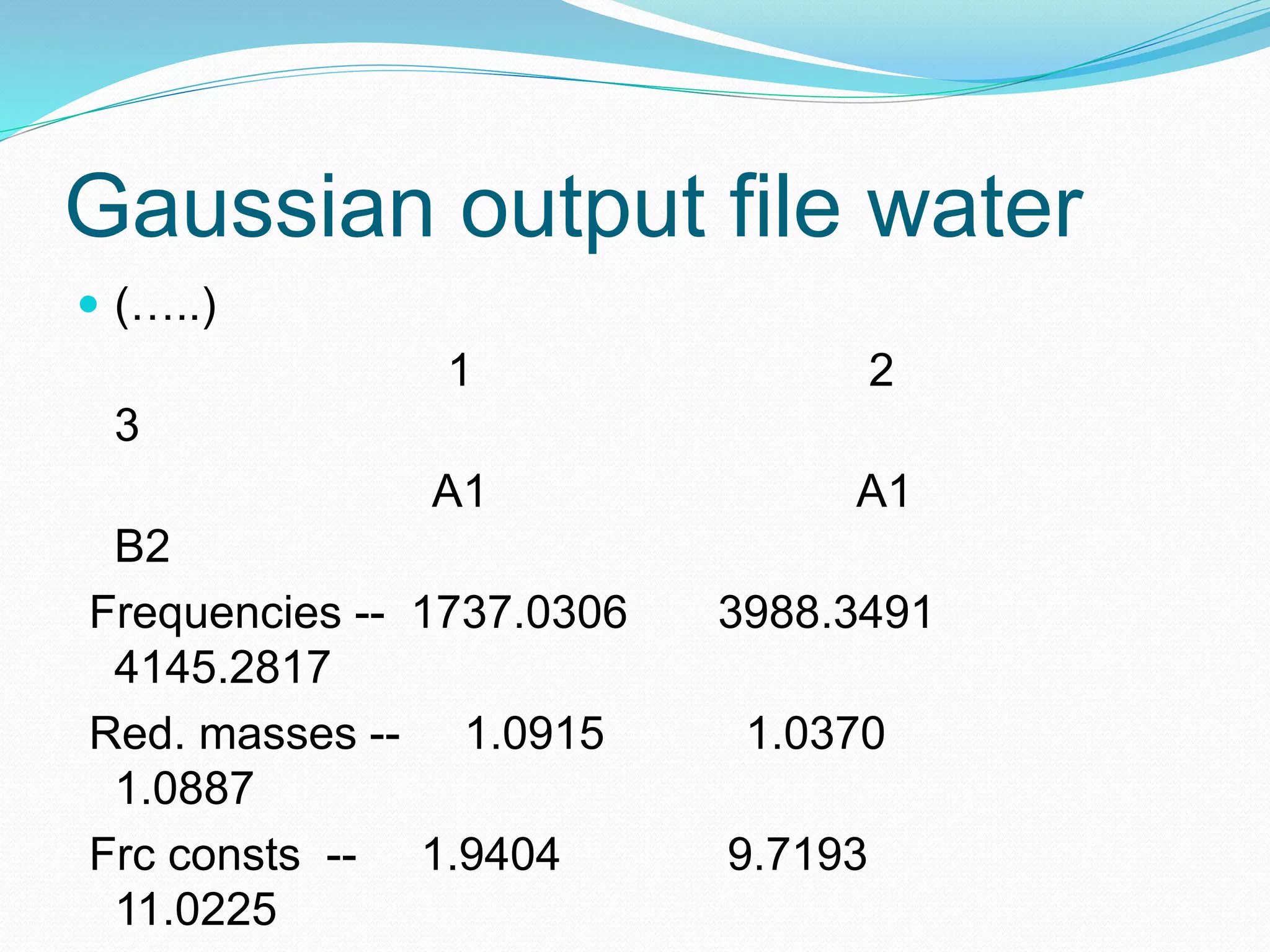
Gaussian output file water
 (…..)
1 2
3
A1 A1
B2
Frequencies -- 1737.0306 3988.3491
4145.2817
Red. masses -- 1.0915 1.0370
1.0887
Frc consts -- 1.9404 9.7193
11.0225
Gaussian output file water
………
This molecule is an asymmetric top.
Rotational symmetry number 2.
Rotational temperatures (Kelvin) 47.48924 19.51815 13.83283
Rotational constants (GHZ): 989.51639 406.69263 288.22978
Zero-point vibrational energy 59039.7 (Joules/Mol)14.11082
(Kcal/Mol)
Vibrational temperatures: 2499.20 5738.34 5964.13 (Kelvin)
Zero-point correction= 0.022487 (Hartree/Particle)
Thermal correction to Energy= 0.025321
Thermal correction to Enthalpy= 0.026266
Thermal correction to Gibbs Free Energy= 0.004914
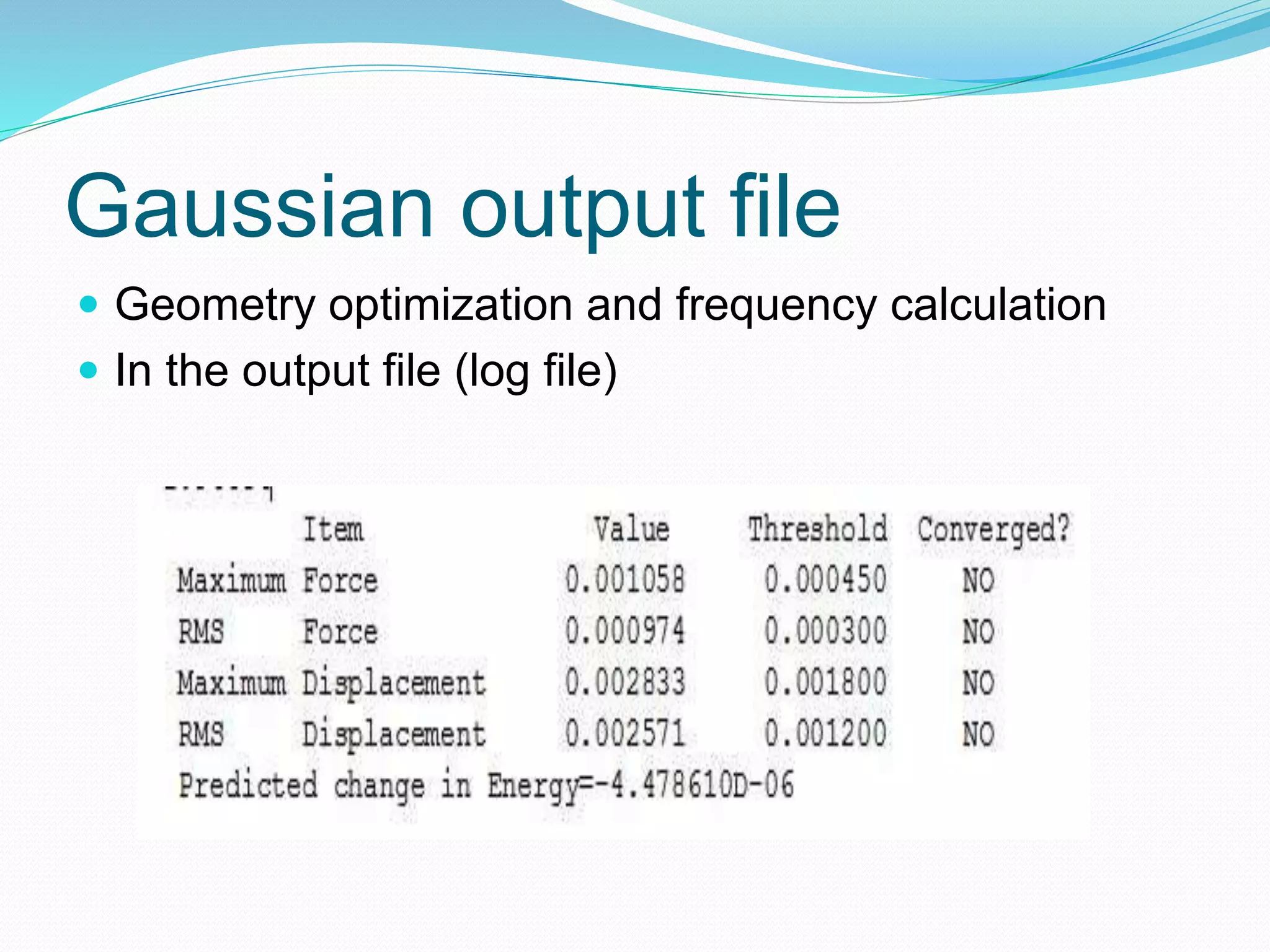
Gaussian output file
 Geometry optimization and frequency calculation
 In the output file (log file)
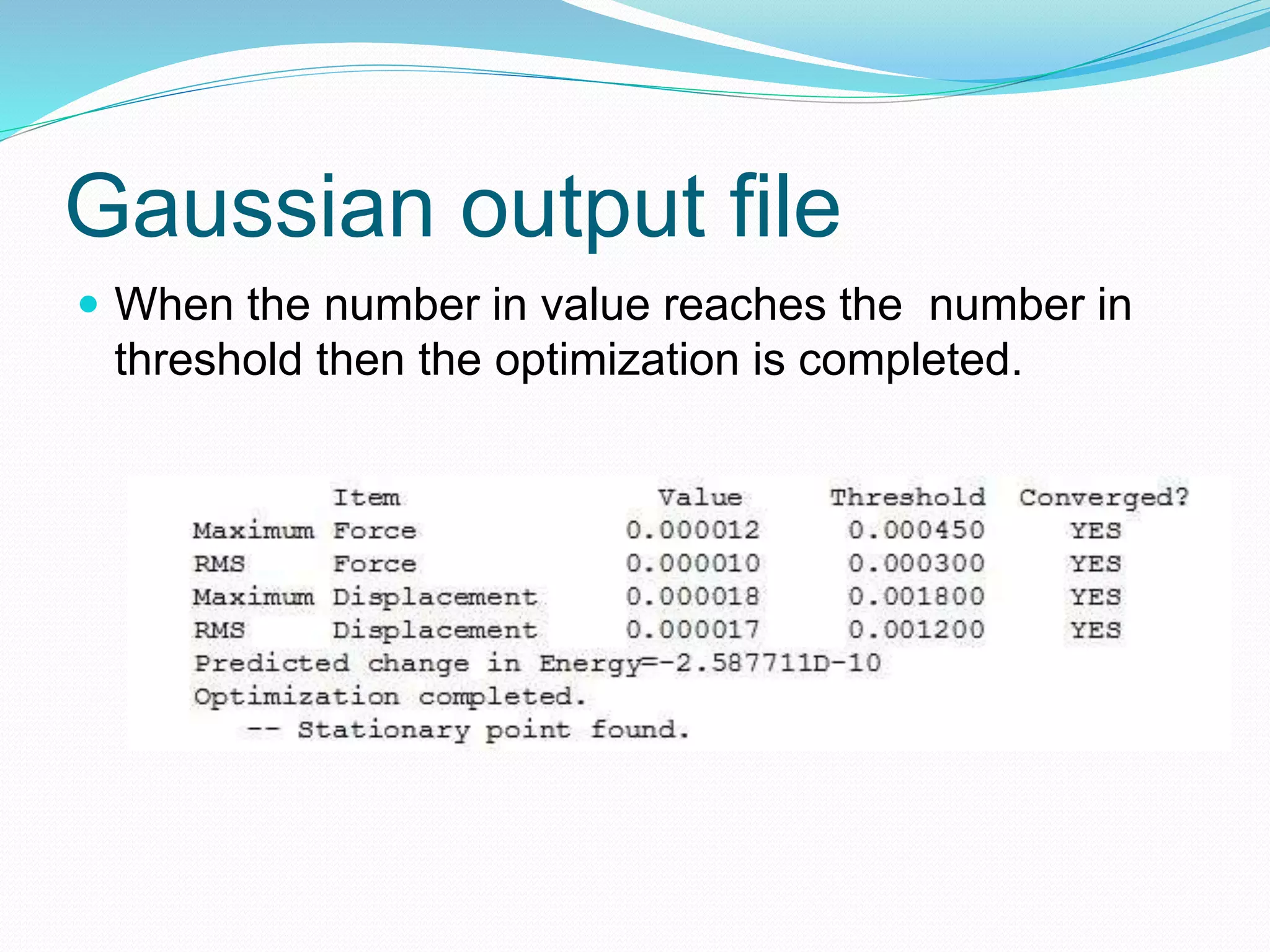
Gaussian output file
 When the number in value reaches the number in
threshold then the optimization is completed.
Gaussian

Gaussian

  • 2.
    Gaussian is capableof perdecting many properties of the Atoms , molecules  Molecular Energies  Geometry optimisation  Viberational frequencies  NMR Properties  Potential energy surface  Reaction pathways
  • 3.
    How to CreateInput File
  • 4.
  • 5.
    Eg : Wateroptimization %mem=32mb System resources #p hf/6-31g opt calculation type, method basis set hf/6-31g optimization of water titile 0 1 charge & multiplicity O1 -0.464 0.177 0.0 H2 -0.464 1.137 0.0 molecular specification H3 0.441 -0.143 0.0 z matrix or cartesian c.
  • 6.
    Commands for Resource Management(link0) %mem=n set the amount of dynamic meomory(n) default is 32 mb %chk=file location and name of checkpoint file %nproc=n set the number of processors, n to use
  • 7.
    Example of Routesection #n optfreqb3lyp/6-31g* Where #n = normal print output, #p = max print output, #t=min print output Opt = geometry optimization Freq = viberational frequencies B3lyp = DFT(method) 6-31g* = Basis set # HF/6-31g*Pop=Reg #p B3LYP/cc-pvdz opt
  • 8.
    Spin Multiplicity Multiplicity =n + 1 where n = #no of unpaired electron
  • 9.
    Calculation types  Singlepoint energy  Geometry Optimization  Viberational Frequency
  • 10.
    Single Point Energy Keyword Sp  It simply calculates Energy ,wavefunction and other requested properties at single fixed geometry.  It is also frequently carried out after a geometry optimization.  If no keyword present in route section By default calculation leads to HF/STO-3G Sp  Information get out of this calculation single point energy(hartree), orbital Symmetries,Mullkien atomic charges,Dipole Moments
  • 11.
    Geometry Optimization  Keyword: Opt  It is a procedure that attempts to find the configuration of Minimum Energy of the Molecule.  It also calculate the Force on each atom by evaluating gradient(first derivative) of energy with respect to atomic postion  It stops when a stationary point found(point where force on each atom is zero)  Information get out of this calculation Atomic coordinates of optimized molecule Optimized Parameters: atomic distances and angles HOMO/LUMO eigenvalues (Hartrees)
  • 12.
    Viberational Frequency  Keyword: Freq  It calculates the viberation of molecule  Molecule Frequencies depend on the second derivative of Energy with respect to nuclear Position(Hessian matrix) Information get out of this calculation Single Point energy Harmonic frequnecies (wavenumbers) Reduced masses (amu) Force constants IR intensities Raman intensities (not default)
  • 13.
    Theoretical model  Abinitio Methods : HF,MP2,CCSD,QCISD  Semi-emperical Method AM1,MNDO,PM3  Density functional theory B3LYP,VWN,PW91
  • 14.
    Ab initio Methods It is based on theoretical Principle and doesnot use any experimental data other than constants.  Using this method : calculation takes reasonably long time.  Example : Hf : Hartree fock MPn :Moller Pesset Peterbation Theory while Mp2, Mp4 most commonly used Couple cluster(cc method) CCSD,QCISD
  • 15.
    Semi-emperical Methods  Semiemperical methods are based hartree fock formalism.  It parmetrize or neglect the integrals based on experimental data  It can be applied to large molecules and give accurate results Methods : MNDO : modified neglect of diatomic overlap AM1 : austin model 1 PM3 : parmeterized model number 3
  • 16.
    Density functional theory Dft methods are becoming more popular because results obtained are comparable to ab intio methods Dft differs from methods based on Hf calculation in the way that it uses Electron density to compare energy instead of wave function eg: B3LYP : Becke3-parameter, Lee-Yang-Parr VWN : Vosko Wilk Nusair Functional PW91 : Perdew-Wang
  • 17.
    Population analysis  Thiskeyword control the printing of molecular orbitals and several types of population analysis and atomic charges.  Population are done once for Sp energy calculation and at the first and last step of geometry optimisation.  Keywords Pop=minimal Pop=none Pop=full Pop=regular
  • 18.
    Types of basissets  Minimal basis sets Sets which uses only one function for each atomic orbital STO-nG means that n GTO are used to describe one STO and only one STO is used to describe an AO(Single Zeta). Usually n<3 gives poor result so STO-3g is called the minimal basis set
  • 19.
  • 20.
    Split-Valence  A splitvalence basis uses one basis function for core Atomic orbitals (1s²) and larger basis for valance Atomic orbital  Double-zeta Function Two Basis function for each atomic orbital  Triple-zeta Function Three Basis function for each atomic orbital and Qz,5z,6z,… so on Split valence Eg: CH4 for C atom (1s²,2s²,2p²)
  • 21.
    Eg: CH4 withsplit valence double zeta basis  C atom (1s²,2s²,2p²)  With double zeta basis function  C atom (1s²,2s’²,2s², 2px’2px,2py’2py,2pz’2pz)  We get value 9  Similarly for H atom (1s¹)  With double zeta basis function(1s¹’1s¹)  So 4*2=8  Total value is 9+8= 17
  • 22.
    Pople basis sets 3-21G 3 Gtos for inner shell(core) , 2 Gtos for inner valence , 1 Gto for outer valence  6-31G  6-311G
  • 23.
    Polarization function  *type(6-31G*)  D type function added other than hydrogen atom and f type function added on the transition metals  **type (6-31G**)  P type function added on hydrogen atom and d type function added on all other atom, f type function added on transition metals
  • 24.
    Diffused function  Toprovide more accurate description of anion or neutral molecules  + : diffuse function added on to atoms other than hydrogen  ++: diffuse function added on to all atoms  6-31G+  6-31G++
  • 25.
    Dunning basis sets Correlation consistent  Dunning created basis sets that can optimized using correlated (CISD) wavefunction various types cc-pVXZ cc= indicates that it is a correlation-consistent basis pV= indicates that it is a polarized valence basis xz = indicates the zeta number (x = D for Double , T for triple , Q for quadruple , 5,6,7) The prefix aug- can be used to add diffuse function eg : aug-cc-pVTZ , aug-cc-VDZ
  • 26.
    Z matrix Hydrogenperoxide(h2o2)  ZMatrix 0 1 O1 O2 O1 r2 H3 O1 r3 O2 a3 H4 O2 r3 O1 a3 H3 d4 (Blank line) r2 = 1.3963 r3 = 1.011 a3 = 101.1196 d4 = 124.993
  • 27.
    Building with GaussView  Instead of typing all the coordinates, theory, basis set, etc., we can use GaussView.  The calculation is specified by pointing and clicking to build the molecule, and using pull-down menus to select the calculation type, level of theory and basis set.  GaussView generates the Gaussian input file, and can run Gaussian without ever returning to the Unix prompt.  GaussView can also be used to read Gaussian output files and visualize the results
  • 28.
  • 29.
    Building a Molecule Selectedfragments Are previewed here Fragments are Selected Molecule is put Together here
  • 30.
  • 31.
  • 32.
  • 33.
  • 34.
  • 35.
  • 36.
    Gaussian output filewater  (…..) 1 2 3 A1 A1 B2 Frequencies -- 1737.0306 3988.3491 4145.2817 Red. masses -- 1.0915 1.0370 1.0887 Frc consts -- 1.9404 9.7193 11.0225
  • 37.
    Gaussian output filewater ……… This molecule is an asymmetric top. Rotational symmetry number 2. Rotational temperatures (Kelvin) 47.48924 19.51815 13.83283 Rotational constants (GHZ): 989.51639 406.69263 288.22978 Zero-point vibrational energy 59039.7 (Joules/Mol)14.11082 (Kcal/Mol) Vibrational temperatures: 2499.20 5738.34 5964.13 (Kelvin) Zero-point correction= 0.022487 (Hartree/Particle) Thermal correction to Energy= 0.025321 Thermal correction to Enthalpy= 0.026266 Thermal correction to Gibbs Free Energy= 0.004914
  • 38.
    Gaussian output file Geometry optimization and frequency calculation  In the output file (log file)
  • 39.
    Gaussian output file When the number in value reaches the number in threshold then the optimization is completed.