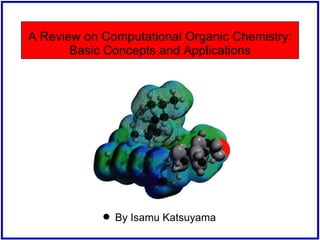
A Review on Computational Organic Chemistry: Basic Concepts and Applications By Isamu Katsuyama
Contents Introduction   Basic Guide to Computational Chemistry Applications to Investigation of Molecular Structure and Property Applications to Investigation of Chemical Reactivity and Selectivity Future Direction
Introduction Role of Calculations Calculations are much like experiments in that both may be employed in two different ways: Data collection. Looking for the unusual.
Calculations  can be performed on  unstable   molecules  and reaction  transition states ;  Experiments  are very  difficult  on such molecules and  can not be  performed on transition states. Calculations  are becoming less and  less   costly ;  Experiments  are becoming more and more  costly .   Advantages of Calculations
Advantages of Calculations (Cont.)‏ Calculations  are  safe ;  Experiments  are sometimes  dangerous . Calculations  are now  easy  to perform;  Experiments  are sometimes more  difficult . Calculations are now performed by not only  computational chemists but also experimental chemists.
Disadvantages of Calculations The cost of  calculations  increases rapidly with  molecular size ; The cost of  experiments  is generally  independent  of the molecular size. Calculations  sometimes yield  different results  depending on the employed model;  Experiments  usually provide  only one result .
Basic Guide to Computational Chemistry Molecular mechanics (MM)  methods Quantum mechanics (QM)  methods Semi-empirical Ab Initio  Hartree-Fock Ab Initio  correlated (Møller-Plesset)‏ Density functional
Differences Between   Molecular Mechanics and Quantum Methods Molecular mechanics   are restricted  to the description of  equilibrium  structure and conformation. Quantum methods   also provide  information about  non-equilibrium  forms,  e.g., transition states, and about electron charge distributions.
Differences Between   Molecular Mechanics and Quantum Methods (Cont.)‏ Molecular mechanics   are based on use of  experimental information (=parameters) , and thus  can not be applied outside the range of parameterization . Quantum methods   are  not  based on use of experimental information, and thus  can be applied to areas where there is little or no prior experience .
Differences Between   Molecular Mechanics and Quantum Methods (Cont.)‏ Molecular mechanics methods   are much  less costly  than even the simplest  quantum methods  such as semi-empirical methods.
Range of Molecular Mechanics and Quantum Methods Method  Range (heavy atoms)‏ Molecular Mechanics   > 1000 Semi-Empirical   < 200 Ab initio  Hartree-Fock(HF)   < 50 Ab initio  Correlated   < 20 Density Functional (DFT)   < 100
Relative Computation Times Methylcyclohexane (C 7 H 14 )‏ 14 2 pBP/DN* ( DFT )‏ .06 8 54 - f 1 7 100 AM1 ( Semi-Empirical )‏ HF/3-21G ( Ab initio )‏ HF/6-31G* ( Ab initio )‏ MP2/6-31G*  ( Ab   initio  Correlated )‏ f f MMFF94 ( MM )‏ Geometry Optimization Single-Point Energy Level of Calculation
Comparison of the Performance of Molecular Mechanics( MM ) and Quantum Methods( QM )   S= satisfactory; U= unsatisfactory   Task      MM   Semi-  Ab   initio   DFT     Empirical  HF  Correlated Geometry  S  S  S  S  S Transition-state  -    S  S  S  S Geometry Conformation  S  U  S  S  S Thermochemistry  -      U  S  S  S
References of  MM  and  QM   Review of  MM : U. Burkert and N. L. Allinger,  molecular mechanics , ACS monograph 177, American chemical society, Washington D.C., 1982. Reviews of basic  QM : I. N. Levine,  quantum chemistry , 4 th  ed., Prentice hall, Englewood cliffs, NJ, 1991; P.W. Atkins and R.S. Friedman,  molecular quantum mechanics , 3 rd  ed., Oxford Univ. Press, oxford, 1997.
Review of  semi-empirical  methods: T. Clark,  A handbook of computational chemistry , Wiley, new York 1986. Review of  Hartree-Fock and Møller-Plesset  models: W.J. Hehre, L. Radom, P.V.R. Schleyer and J.A. Pople,  Ab Initio  molecular orbital theory , Wiley, new York 1986. Reviews of  density functional  theory: R.G. Parr and W. Yang,  density functional theory of atoms and molecules , oxford Univ. Press, oxford, 1989; J.K. Labanowski and J.W. Andzelm, eds.,  Density functional methods in chemistry , Spriger-Verlag, new York, 1991.
Widely Used Software Packages for  MM ,  QM Chem3D (CambridgeSoft, Corp.  www.camsoft.com  : Mac, PC)‏ Gaussian (Gaussian, Inc.  www.gaussian.com  : Unix, PC)  MOPAC (Fujitsu CCS  www.winmopac.com  : Unix, PC)‏ Sybyl (Tripos, Inc.  www.tripos.com  : Unix)‏ SPARTAN  (Wavefunction, Inc.: Unix, Mac, PC)‏ Each software has  different user interface, operating feature, price, manual and so on .
Applications to Investigation of Molecular Structure and Property Investigation of Molecular Structure by use of  MM  and/or  QM Geometry Absolute Configuration Investigation of Molecular Property (Electron Charge Distributions) by use of  QM
Geometry (bond distance, angle, energy of molecules etc.)‏ Conformational Energy Differences in 1,3-Butadiene; Investigation of Order of Stability Investigation of Molecular Structure  by use of  MM  and/or  QM Dihedral angle  0  90  180 
Relation between Dihedral Angle and Relative Conformer Energy in 1,3-Butadiene s- trans s- cis twisted Order of stability: s- trans  > s- cis  > twisted
Absolute Configuration Physical Methods X-ray Crystallography CD Spectroscopy Chemical Methods Total Synthesis NMR Spectroscopy  (2D-NMR, 1D-NMR with Chiral Derivatizing Agents such as Mosher’s Method)‏ Computational Chemistry  ( MM  and/or  QM )‏
Advantage and Disadvantage of X-ray and CD Method Advantage These methods have  high reliability. Disadvantage These methods have  limitation of application. Preparation of single crystal (X-ray)‏ Molecules where   -electron chromophores exist or can be introduced  (CD method)‏
Advantages and Disadvantages of  Total Synthesis Advantage This method has  high reliability. Disadvantage Long Time Many Synthetic Organic Chemists
Advantages and Disadvantages of  NMR   (2D-NMR, 1D-NMR with Chiral Derivatizing Agents   )‏ Advantage NMR is widely used and easy to perform. Disadvantage Low Reliability  on Acyclic Systems as well as  Macro cyclic Systems ( 2D-NMR )‏ Preparation of Derivatives  by use of  Chiral Derivatizing Agents ( Mosher’s Method etc. )‏
Advantages and Disadvantages of Computational Chemistry Advantage This method does  not  require  preparation of specific samples  in contrast to X-ray and Mosher’s method etc. Disadvantage This method requires  combination with   another method  such as NMR. QM  has limitation of  molecular size .
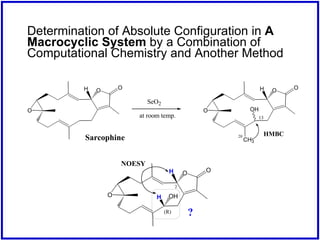
Determination of Absolute Configuration in  A Macrocyclic System  by a Combination of Computational Chemistry and Another Method
The distance between H-2 and H-13 is  4.0 Å  in 13( R )configuration . This is  not consistent with  information based on NOESY.
The distance between H-2 and H-13 is 2.4 Å  in   13( S )configuration. This is  consistent with  information based on NOESY.
CD Spectrum Negative  Cotton Effect - CD also supports 13( S )configuration.
Investigation of Molecular Property (Electron Charge Distributions) by  use of  QM Electrostatic Potential Atomic Charges Dipole Moment Enthalpy, Entropy, and Free Energy Salvation Energy etc. Investigation of  Basicity (Proton Affinity) ,  Acidity , and More…
4-Aminopyridine: Where is the Basic Site ? Quantitative Investigation  H(A) = 193.6,   H(B) = 169.1 kcal/mol  B  is more stable than  A , and thus the ring  N  is more basic.
Qualitative Investigation (Electrostatic Potential Map)‏ The ring  N  is more negatively charged , and thus is likely to be more basic. Colors near red represent more negative charge , while colors near blue represent more positive charge.
Imidazole: Where is the Basic Site ? The  N-3  is negatively charged , and thus is the basic site . Electrostatic Potential Map
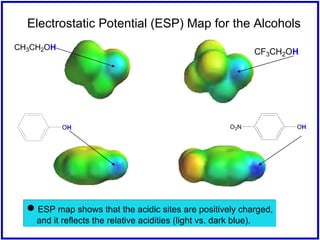
Acidities of Alcohols stronger stronger weaker weaker 15.5 Methanol 15.9 Ethanol 7.2 4-Nitrophenol 10.0 Phenol 12.4 2,2,2-Trifluoroethanol pKa’s (acidities)‏
Electrostatic Potential (ESP) Map for the Alcohols ESP map shows that the acidic sites are positively charged, and it reflects the relative acidities (light vs. dark blue).
Applications to Investigation of Chemical Reactivity and Selectivity   (Investigation of Molecular Orbital by use of  QM )‏ When there are more than one reagent, which reagent will react first ? When a molecule contains multiple reactive sites, which site will react first ? Examination of  frontier molecular orbital ( HOMO  and  LUMO )  is an important method because most chemical reactions involve  electron movement between them .
References of  Frontier Molecular Orbital   (FMO)  Theory and Reaction I. Fleming,  Frontier Orbitals and Organic Chemical Reactions , Wiley, New York, 1976. K. Fukui,  Theory of Orientation and Stereoselection , Springer, Berlin, 1975. T. L. Gilchrist and R. C. Storr,  Organic Reactions and Orbital Symmetry , 2 nd . Ed., Cambridge University Press, 1979. T. A. Albright, J. K. et al.,  Orbital Interactions in Chemistry , Wiley, New York, 1985.
Investigation of Chemical Reactivity   A reagent with the highest  HOMO   energy  will give its electrons most easily and thus be  the most reactive  donor . A reagent with the lowest  LUMO   energy  should be able to accept electrons most easily and thus be  the most reactive  accepter . Examination of  FMO  Energies
Acrolein/BF 3 : What is the role of Lewis Acids ? Lewis acids  are commonly used to accelerate chemical reactions;  the  BF 3  adduct of acrolein more rapidly undergoes nucleophilic attack than acrolein itself.
Lewis acid complexation  reduces   the energy of  LUMO  on acrolein, making it more accessible to the HOMO on nucleophile.
Investigation of Chemical Selectivity The regions where  LUMO   shape (value)  is large  will be  reactive sites  toward attack by a  nucleophile . The regions where  HOMO   shape (value)  is large  will be  reactive sites  toward attack by a  electrophile . Examination of  FMO  Shape (Value)‏
Ester Enolate: Where is the reactive site ? The site where  HOMO   shape (value) is larger  will be more reactive   toward attack by a  electrophile . The ester enolate has two possible sites,  which may react with  electrophiles ;  the anion  and  the terminal carbon .
HOMO of the Enolate HOMO Map of the Enolate The color near red indicates minimum value, and  the color near blue indicates maximum value of HOMO. The terminal carbon,where  HOMO shape (value) is   larger , generally reacts with  electrophile .
Electrophilic Substitution of Indole; What should be favorite position for electrophilic attack ? HOMO map reveals that 3-position is the  most likely site of  electrophilic  attack.
Stereochemistry of Nucleophilic Additions to Carbonyl Compounds Cyclohexanones has two possible faces, which may undergo  nucleophilic  attack;  the axial   and  the equatorial  face. The face where  LUMO shape (value) is larger  will be more reactive   toward attack by a  nucleophile.
Nucleophilic Additions to Dioxanone Ring LUMO   map for the axial face LUMO   map for the equatorial face Nucleophililes  preferentially attack from the  axial  face.
Nucleophilic Additions to Dithianone Ring LUMO   map for the axial face LUMO   map for the equatorial face Nucleophililes  preferentially attack from the  equatorial   face.
Future Direction Calculation in Solution Although calculation in gas phase usually provide s a reliable account, it in solution is still unsatisfactory for investigation of some tasks. The development of several methods  is  in progress   for the  calculation in solution.
References of Recently Developed Methods for Calculation in Solution Supramolecular method: A. Abotto  et al. ,  J. Am. Chem. Soc. ,  119 , 11255 (1997). MC and MD method: M. Aida  et al. ,  Chem. Phys. Lett. ,  292 , 474 (1998). QM/MM method: J. Gao  et al. ,  J. Am. Chem. Soc. ,  115 , 9667 (1993). RISM-SCF method: H. Sato  et al. ,  J. Chem. Phys. ,  105 , 1546 (1996).
Extension of Application Field of Computational Organic Chemistry MM and QM calculations  have been used mainly in the field of   investigation of molecular structure and chemical reaction so far.  They have recently begun to be widely applied  in not only organic chemistry but also biochemistry and closely related fields such as drug design . Explosive developments in computer hardware and software
References of Drug Design by use of  QM R. R. Squires  et al. ,  J. Phys. Chem. A ,  102 , 9072 (1998). J. Hoffner  et al. ,  J. Am. Chem. Soc. ,  120 , 376 (1998). P. R. Schreiner,  ibid. ,  120 , 4184 (1998). Quantum chemical calculations ( QM ) are expected to become an important method for drug design in the future.

Computational Organic Chemistry

  • 1.
    A Review onComputational Organic Chemistry: Basic Concepts and Applications By Isamu Katsuyama
  • 2.
    Contents Introduction Basic Guide to Computational Chemistry Applications to Investigation of Molecular Structure and Property Applications to Investigation of Chemical Reactivity and Selectivity Future Direction
  • 3.
    Introduction Role ofCalculations Calculations are much like experiments in that both may be employed in two different ways: Data collection. Looking for the unusual.
  • 4.
    Calculations canbe performed on unstable molecules and reaction transition states ; Experiments are very difficult on such molecules and can not be performed on transition states. Calculations are becoming less and less costly ; Experiments are becoming more and more costly .   Advantages of Calculations
  • 5.
    Advantages of Calculations(Cont.)‏ Calculations are safe ; Experiments are sometimes dangerous . Calculations are now easy to perform; Experiments are sometimes more difficult . Calculations are now performed by not only computational chemists but also experimental chemists.
  • 6.
    Disadvantages of CalculationsThe cost of calculations increases rapidly with molecular size ; The cost of experiments is generally independent of the molecular size. Calculations sometimes yield different results depending on the employed model; Experiments usually provide only one result .
  • 7.
    Basic Guide toComputational Chemistry Molecular mechanics (MM) methods Quantum mechanics (QM) methods Semi-empirical Ab Initio Hartree-Fock Ab Initio correlated (Møller-Plesset)‏ Density functional
  • 8.
    Differences Between Molecular Mechanics and Quantum Methods Molecular mechanics are restricted to the description of equilibrium structure and conformation. Quantum methods also provide information about non-equilibrium forms, e.g., transition states, and about electron charge distributions.
  • 9.
    Differences Between Molecular Mechanics and Quantum Methods (Cont.)‏ Molecular mechanics are based on use of experimental information (=parameters) , and thus can not be applied outside the range of parameterization . Quantum methods are not based on use of experimental information, and thus can be applied to areas where there is little or no prior experience .
  • 10.
    Differences Between Molecular Mechanics and Quantum Methods (Cont.)‏ Molecular mechanics methods are much less costly than even the simplest quantum methods such as semi-empirical methods.
  • 11.
    Range of MolecularMechanics and Quantum Methods Method Range (heavy atoms)‏ Molecular Mechanics > 1000 Semi-Empirical < 200 Ab initio Hartree-Fock(HF) < 50 Ab initio Correlated < 20 Density Functional (DFT) < 100
  • 12.
    Relative Computation TimesMethylcyclohexane (C 7 H 14 )‏ 14 2 pBP/DN* ( DFT )‏ .06 8 54 - f 1 7 100 AM1 ( Semi-Empirical )‏ HF/3-21G ( Ab initio )‏ HF/6-31G* ( Ab initio )‏ MP2/6-31G* ( Ab initio Correlated )‏ f f MMFF94 ( MM )‏ Geometry Optimization Single-Point Energy Level of Calculation
  • 13.
    Comparison of thePerformance of Molecular Mechanics( MM ) and Quantum Methods( QM ) S= satisfactory; U= unsatisfactory Task     MM Semi- Ab initio DFT     Empirical HF Correlated Geometry S S S S S Transition-state -   S S S S Geometry Conformation S U S S S Thermochemistry -    U S S S
  • 14.
    References of MM and QM Review of MM : U. Burkert and N. L. Allinger, molecular mechanics , ACS monograph 177, American chemical society, Washington D.C., 1982. Reviews of basic QM : I. N. Levine, quantum chemistry , 4 th ed., Prentice hall, Englewood cliffs, NJ, 1991; P.W. Atkins and R.S. Friedman, molecular quantum mechanics , 3 rd ed., Oxford Univ. Press, oxford, 1997.
  • 15.
    Review of semi-empirical methods: T. Clark, A handbook of computational chemistry , Wiley, new York 1986. Review of Hartree-Fock and Møller-Plesset models: W.J. Hehre, L. Radom, P.V.R. Schleyer and J.A. Pople, Ab Initio molecular orbital theory , Wiley, new York 1986. Reviews of density functional theory: R.G. Parr and W. Yang, density functional theory of atoms and molecules , oxford Univ. Press, oxford, 1989; J.K. Labanowski and J.W. Andzelm, eds., Density functional methods in chemistry , Spriger-Verlag, new York, 1991.
  • 16.
    Widely Used SoftwarePackages for MM , QM Chem3D (CambridgeSoft, Corp. www.camsoft.com : Mac, PC)‏ Gaussian (Gaussian, Inc. www.gaussian.com : Unix, PC) MOPAC (Fujitsu CCS www.winmopac.com : Unix, PC)‏ Sybyl (Tripos, Inc. www.tripos.com : Unix)‏ SPARTAN (Wavefunction, Inc.: Unix, Mac, PC)‏ Each software has different user interface, operating feature, price, manual and so on .
  • 17.
    Applications to Investigationof Molecular Structure and Property Investigation of Molecular Structure by use of MM and/or QM Geometry Absolute Configuration Investigation of Molecular Property (Electron Charge Distributions) by use of QM
  • 18.
    Geometry (bond distance,angle, energy of molecules etc.)‏ Conformational Energy Differences in 1,3-Butadiene; Investigation of Order of Stability Investigation of Molecular Structure by use of MM and/or QM Dihedral angle 0  90  180 
  • 19.
    Relation between DihedralAngle and Relative Conformer Energy in 1,3-Butadiene s- trans s- cis twisted Order of stability: s- trans > s- cis > twisted
  • 20.
    Absolute Configuration PhysicalMethods X-ray Crystallography CD Spectroscopy Chemical Methods Total Synthesis NMR Spectroscopy (2D-NMR, 1D-NMR with Chiral Derivatizing Agents such as Mosher’s Method)‏ Computational Chemistry ( MM and/or QM )‏
  • 21.
    Advantage and Disadvantageof X-ray and CD Method Advantage These methods have high reliability. Disadvantage These methods have limitation of application. Preparation of single crystal (X-ray)‏ Molecules where  -electron chromophores exist or can be introduced (CD method)‏
  • 22.
    Advantages and Disadvantagesof Total Synthesis Advantage This method has high reliability. Disadvantage Long Time Many Synthetic Organic Chemists
  • 23.
    Advantages and Disadvantagesof NMR (2D-NMR, 1D-NMR with Chiral Derivatizing Agents )‏ Advantage NMR is widely used and easy to perform. Disadvantage Low Reliability on Acyclic Systems as well as Macro cyclic Systems ( 2D-NMR )‏ Preparation of Derivatives by use of Chiral Derivatizing Agents ( Mosher’s Method etc. )‏
  • 24.
    Advantages and Disadvantagesof Computational Chemistry Advantage This method does not require preparation of specific samples in contrast to X-ray and Mosher’s method etc. Disadvantage This method requires combination with another method such as NMR. QM has limitation of molecular size .
  • 25.
    Determination of AbsoluteConfiguration in A Macrocyclic System by a Combination of Computational Chemistry and Another Method
  • 26.
    The distance betweenH-2 and H-13 is 4.0 Å in 13( R )configuration . This is not consistent with information based on NOESY.
  • 27.
    The distance betweenH-2 and H-13 is 2.4 Å in 13( S )configuration. This is consistent with information based on NOESY.
  • 28.
    CD Spectrum Negative Cotton Effect - CD also supports 13( S )configuration.
  • 29.
    Investigation of MolecularProperty (Electron Charge Distributions) by use of QM Electrostatic Potential Atomic Charges Dipole Moment Enthalpy, Entropy, and Free Energy Salvation Energy etc. Investigation of Basicity (Proton Affinity) , Acidity , and More…
  • 30.
    4-Aminopyridine: Where isthe Basic Site ? Quantitative Investigation  H(A) = 193.6,  H(B) = 169.1 kcal/mol B is more stable than A , and thus the ring N is more basic.
  • 31.
    Qualitative Investigation (ElectrostaticPotential Map)‏ The ring N is more negatively charged , and thus is likely to be more basic. Colors near red represent more negative charge , while colors near blue represent more positive charge.
  • 32.
    Imidazole: Where isthe Basic Site ? The N-3 is negatively charged , and thus is the basic site . Electrostatic Potential Map
  • 33.
    Acidities of Alcoholsstronger stronger weaker weaker 15.5 Methanol 15.9 Ethanol 7.2 4-Nitrophenol 10.0 Phenol 12.4 2,2,2-Trifluoroethanol pKa’s (acidities)‏
  • 34.
    Electrostatic Potential (ESP)Map for the Alcohols ESP map shows that the acidic sites are positively charged, and it reflects the relative acidities (light vs. dark blue).
  • 35.
    Applications to Investigationof Chemical Reactivity and Selectivity (Investigation of Molecular Orbital by use of QM )‏ When there are more than one reagent, which reagent will react first ? When a molecule contains multiple reactive sites, which site will react first ? Examination of frontier molecular orbital ( HOMO and LUMO ) is an important method because most chemical reactions involve electron movement between them .
  • 36.
    References of Frontier Molecular Orbital (FMO) Theory and Reaction I. Fleming, Frontier Orbitals and Organic Chemical Reactions , Wiley, New York, 1976. K. Fukui, Theory of Orientation and Stereoselection , Springer, Berlin, 1975. T. L. Gilchrist and R. C. Storr, Organic Reactions and Orbital Symmetry , 2 nd . Ed., Cambridge University Press, 1979. T. A. Albright, J. K. et al., Orbital Interactions in Chemistry , Wiley, New York, 1985.
  • 37.
    Investigation of ChemicalReactivity A reagent with the highest HOMO energy will give its electrons most easily and thus be the most reactive donor . A reagent with the lowest LUMO energy should be able to accept electrons most easily and thus be the most reactive accepter . Examination of FMO Energies
  • 38.
    Acrolein/BF 3 :What is the role of Lewis Acids ? Lewis acids are commonly used to accelerate chemical reactions; the BF 3 adduct of acrolein more rapidly undergoes nucleophilic attack than acrolein itself.
  • 39.
    Lewis acid complexation reduces the energy of LUMO on acrolein, making it more accessible to the HOMO on nucleophile.
  • 40.
    Investigation of ChemicalSelectivity The regions where LUMO shape (value) is large will be reactive sites toward attack by a nucleophile . The regions where HOMO shape (value) is large will be reactive sites toward attack by a electrophile . Examination of FMO Shape (Value)‏
  • 41.
    Ester Enolate: Whereis the reactive site ? The site where HOMO shape (value) is larger will be more reactive toward attack by a electrophile . The ester enolate has two possible sites, which may react with electrophiles ; the anion and the terminal carbon .
  • 42.
    HOMO of theEnolate HOMO Map of the Enolate The color near red indicates minimum value, and the color near blue indicates maximum value of HOMO. The terminal carbon,where HOMO shape (value) is larger , generally reacts with electrophile .
  • 43.
    Electrophilic Substitution ofIndole; What should be favorite position for electrophilic attack ? HOMO map reveals that 3-position is the most likely site of electrophilic attack.
  • 44.
    Stereochemistry of NucleophilicAdditions to Carbonyl Compounds Cyclohexanones has two possible faces, which may undergo nucleophilic attack; the axial and the equatorial face. The face where LUMO shape (value) is larger will be more reactive toward attack by a nucleophile.
  • 45.
    Nucleophilic Additions toDioxanone Ring LUMO map for the axial face LUMO map for the equatorial face Nucleophililes preferentially attack from the axial face.
  • 46.
    Nucleophilic Additions toDithianone Ring LUMO map for the axial face LUMO map for the equatorial face Nucleophililes preferentially attack from the equatorial face.
  • 47.
    Future Direction Calculationin Solution Although calculation in gas phase usually provide s a reliable account, it in solution is still unsatisfactory for investigation of some tasks. The development of several methods is in progress for the calculation in solution.
  • 48.
    References of RecentlyDeveloped Methods for Calculation in Solution Supramolecular method: A. Abotto et al. , J. Am. Chem. Soc. , 119 , 11255 (1997). MC and MD method: M. Aida et al. , Chem. Phys. Lett. , 292 , 474 (1998). QM/MM method: J. Gao et al. , J. Am. Chem. Soc. , 115 , 9667 (1993). RISM-SCF method: H. Sato et al. , J. Chem. Phys. , 105 , 1546 (1996).
  • 49.
    Extension of ApplicationField of Computational Organic Chemistry MM and QM calculations have been used mainly in the field of investigation of molecular structure and chemical reaction so far. They have recently begun to be widely applied in not only organic chemistry but also biochemistry and closely related fields such as drug design . Explosive developments in computer hardware and software
  • 50.
    References of DrugDesign by use of QM R. R. Squires et al. , J. Phys. Chem. A , 102 , 9072 (1998). J. Hoffner et al. , J. Am. Chem. Soc. , 120 , 376 (1998). P. R. Schreiner, ibid. , 120 , 4184 (1998). Quantum chemical calculations ( QM ) are expected to become an important method for drug design in the future.

Editor's Notes

  • #2 Thank you Dr. XYZ for your kind introduction. It is my pleasure to speak to you my seminar “A Review on Computational Organic Chemistry: Basic Concepts and Applications”. I am not computational chemist, but today I would like to introduce usefulness of computational chemistry.
  • #30 QM can calculate ……… These futures are applied for investigation of…..
  • #35 dark blue