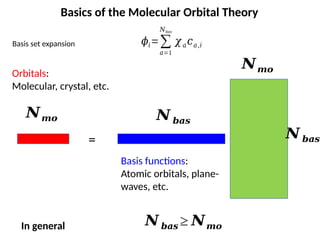
Basics of theMolecular Orbital Theory
𝜙𝑖=∑
𝑎=1
𝑁𝑏𝑎𝑠
𝜒𝑎𝑐𝑎,𝑖
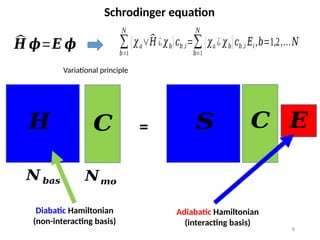
Basis set expansion
𝑵𝒎𝒐
𝑵 𝒃𝒂𝒔
𝑵𝒎𝒐 𝑵 𝒃𝒂𝒔
=
Basis functions:
Atomic orbitals, plane-
waves, etc.
Orbitals:
Molecular, crystal, etc.
𝑵 𝒃𝒂𝒔 ≥ 𝑵𝒎𝒐
In general
3.
Atomic orbitals
Slater-type orbitals(STO):
Gaussian-type orbitals (GTO):
where
STO-2G:
𝜓𝐺𝑇 𝑂1
=(2𝛼1
𝜋 )
3/4
𝑒
−𝛼1 𝑟
2
Just for the radial component of wavefunction
𝜓𝐺𝑇 𝑂2
=(2𝛼2
𝜋 )
3/ 4
𝑒
− 𝛼2 𝑟
2
STO-2G
1s (C) 0.151623 0.678914 0.851819 0.430129
2s (C) 0.0974545 0.963782 0.384244 0.0494718
2p (C) 0.0974545 0.61282 0.384244 0.511541
Energy of electron in H atom
Basis set
Energy
[hartree]
STO-3G -0.49491
STO-4G -0.49848
STO-5G -0.49951
STO-6G -0.49983
Exact -0.5
5
Plane waves (PW)
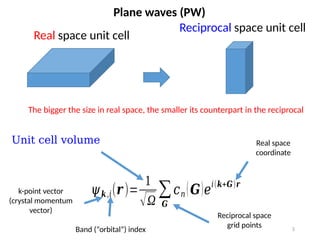
𝜓𝒌,𝑖(𝒓)=
1
√Ω
∑
𝑮
𝑐𝑛(𝑮)𝑒
𝑖(𝒌+𝑮)𝒓
Real space unit cell
Reciprocal space unit cell
Unit cell volume
k-point vector
(crystal momentum
vector)
Band (“orbital”) index
Reciprocal space
grid points
Real space
coordinate
The bigger the size in real space, the smaller its counterpart in the reciprocal
6.
6
Plane waves (PW)
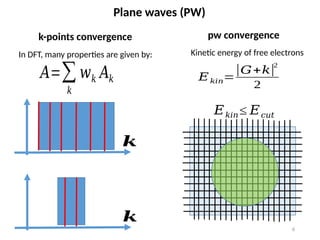
𝐴=∑
𝑘
𝑤𝑘𝐴𝑘
In DFT, many properties are given by:
k-points convergence
𝒌
𝒌
pw convergence
𝐸𝑘𝑖𝑛=
|𝐺+𝑘|
2
2
Kinetic energy of free electrons
𝐸𝑘𝑖𝑛≤ 𝐸𝑐𝑢𝑡
7.
7
Basis set comparisons
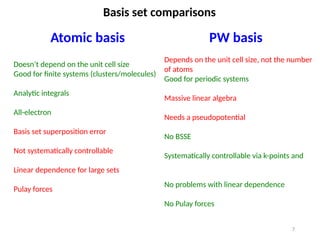
Atomicbasis PW basis
Doesn’t depend on the unit cell size
Good for finite systems (clusters/molecules)
Analytic integrals
All-electron
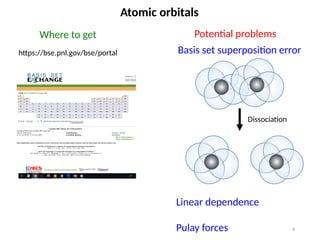
Basis set superposition error
Not systematically controllable
Linear dependence for large sets
Pulay forces
Depends on the unit cell size, not the number
of atoms
Good for periodic systems
Massive linear algebra
Needs a pseudopotential
No BSSE
Systematically controllable via k-points and
No problems with linear dependence
No Pulay forces
9
Hierarchy of wavefunctions
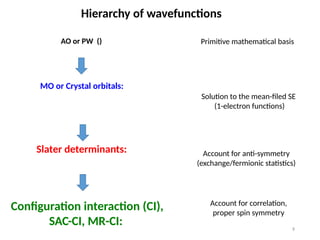
AOor PW () Primitive mathematical basis
MO or Crystal orbitals:
Solution to the mean-filed SE
(1-electron functions)
Slater determinants: Account for anti-symmetry
(exchange/fermionic statistics)
Configuration interaction (CI),
SAC-CI, MR-CI:
Account for correlation,
proper spin symmetry
10.
10
Constructing the Hamiltonian
(inthe AO basis)
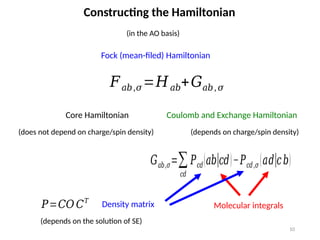
𝐹𝑎𝑏,𝜎=𝐻𝑎𝑏+𝐺𝑎𝑏, 𝜎
Fock (mean-filed) Hamiltonian
Core Hamiltonian Coulomb and Exchange Hamiltonian
(depends on charge/spin density)
(does not depend on charge/spin density)
𝐺𝑎𝑏,𝜎=∑
𝑐𝑑
𝑃𝑐𝑑(𝑎𝑏|𝑐𝑑)−𝑃𝑐𝑑,𝜎 (𝑎𝑑|𝑐𝑏)
Molecular integrals
𝑃=𝐶𝑂 𝐶𝑇
Density matrix
(depends on the solution of SE)
11.
11
Dealing with thecomplexity of SE
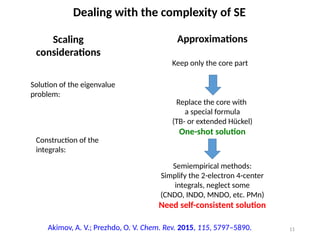
Scaling
considerations
Approximations
Solution of the eigenvalue
problem:
Construction of the
integrals:
Keep only the core part
Replace the core with
a special formula
(TB- or extended Hückel)
One-shot solution
Semiempirical methods:
Simplify the 2-electron 4-center
integrals, neglect some
(CNDO, INDO, MNDO, etc. PMn)
Need self-consistent solution
Akimov, A. V.; Prezhdo, O. V. Chem. Rev. 2015, 115, 5797–5890.
12.
12
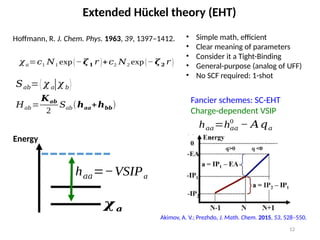
Extended Hückel theory(EHT)
Hoffmann, R. J. Chem. Phys. 1963, 39, 1397–1412. • Simple math, efficient
• Clear meaning of parameters
• Consider it a Tight-Binding
• General-purpose (analog of UFF)
• No SCF required: 1-shot
Akimov, A. V.; Prezhdo, J. Math. Chem. 2015, 53, 528–550.
𝐻𝑎𝑏=
𝑲𝒂𝒃
2
𝑆𝑎𝑏(𝒉𝒂𝒂+𝒉𝒃𝒃)
𝜒𝑎=𝑐1 𝑁1 exp(− 𝜻𝟏 𝑟 )+𝑐2 𝑁2 exp (− 𝜻𝟐 𝑟 )
𝑆𝑎𝑏=⟨ 𝜒 𝑎|𝜒 𝑏⟩
Energy
h𝑎𝑎=−VSIPa
𝝌𝒂
Fancier schemes: SC-EHT
Charge-dependent VSIP
h𝑎𝑎=h𝑎𝑎
0
− 𝐴𝑞𝑎
13.
13
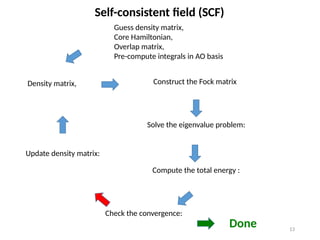
Guess density matrix,
CoreHamiltonian,
Overlap matrix,
Pre-compute integrals in AO basis
Density matrix, Construct the Fock matrix
Solve the eigenvalue problem:
Self-consistent field (SCF)
Check the convergence:
Compute the total energy :
Done
Update density matrix:

![Atomic orbitals
Slater-type orbitals (STO):
Gaussian-type orbitals (GTO):
where
STO-2G:
𝜓𝐺𝑇 𝑂1
=(2𝛼1
𝜋 )
3/4
𝑒
−𝛼1 𝑟
2
Just for the radial component of wavefunction
𝜓𝐺𝑇 𝑂2
=(2𝛼2
𝜋 )
3/ 4
𝑒
− 𝛼2 𝑟
2
STO-2G
1s (C) 0.151623 0.678914 0.851819 0.430129
2s (C) 0.0974545 0.963782 0.384244 0.0494718
2p (C) 0.0974545 0.61282 0.384244 0.511541
Energy of electron in H atom
Basis set
Energy
[hartree]
STO-3G -0.49491
STO-4G -0.49848
STO-5G -0.49951
STO-6G -0.49983
Exact -0.5](https://image.slidesharecdn.com/lecture3-250503061331-05c4d8a6/85/molecular-orbital-theory-quantum-mechanics-3-320.jpg)