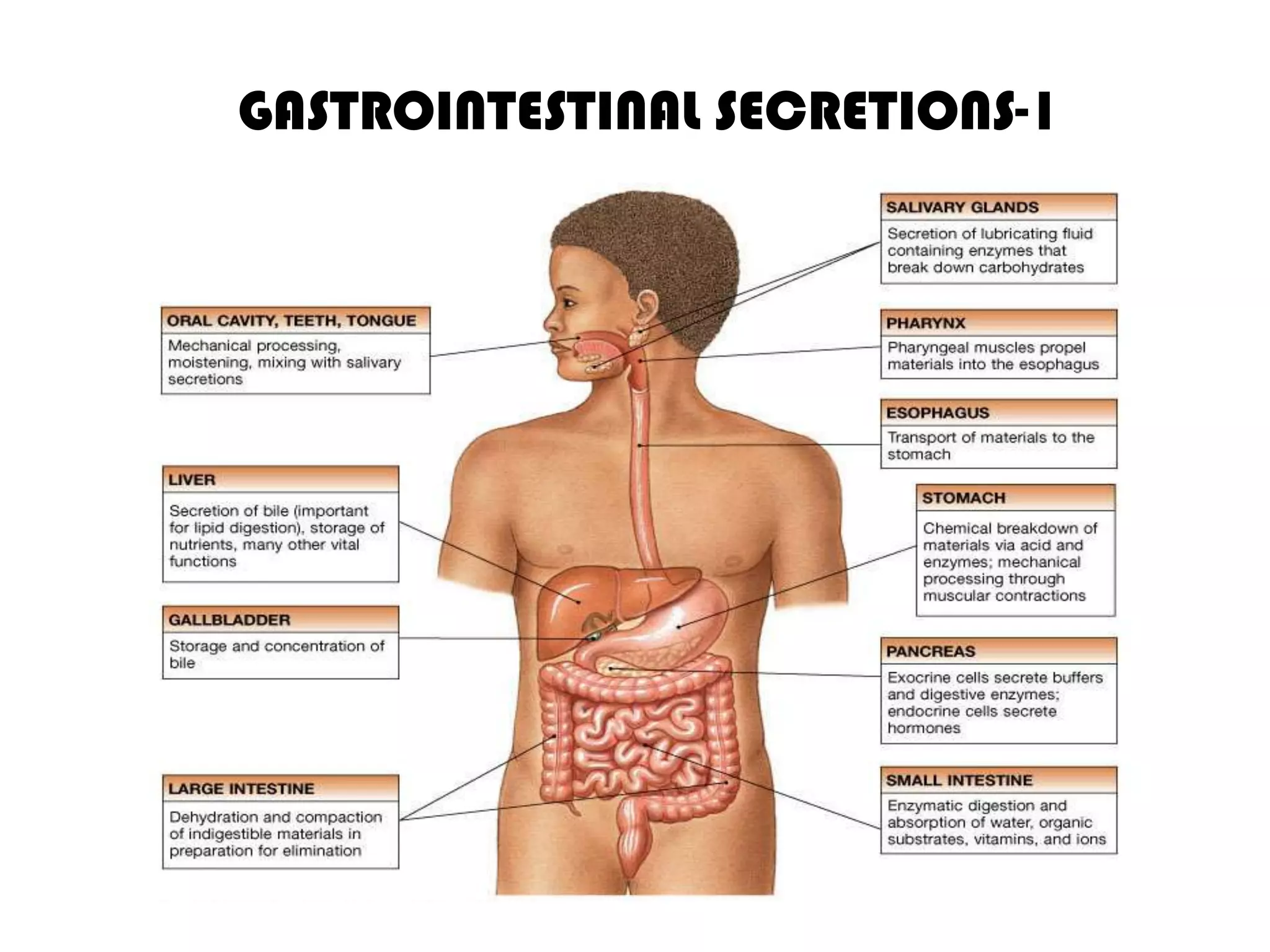
GASTROINTESTINAL SECRETIONS-1
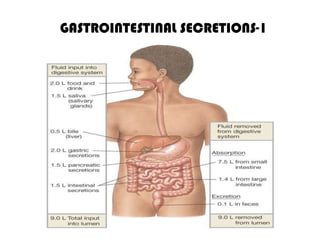
•About 9 liters of fluid pass through the GI system each
day, and only about 2 liters are ingested, the rest
represent secretions from the system itself.

•About half of the total secreted amount (3.5, liters) is
secreted from the exocrine glands, the salivary
glands, the pancreas and the liver,

•The other half is secreted by the epithelial cells of the
digestive tract itself.

•Nearly all this fluid is absorbed
GASTROINTESTINAL SECRETIONS-1

•To put this in perspective a 70 Kilogram man has about
42 liters of fluid, so the secretions represent about a sixth
of the body's volume.

•The circulation contains about 3.5 liters, so these
secretions represent twice the bodies circulating volume!

•Failures of absorption of the intestinal secretions can
thus lead to rapid dehydration and electrolyte imbalance.
GASTROINTESTINAL SECRETIONS-1

              Types of gastrointestinal glands
1.   Single cell mucous glands and goblet cells.
2.   Pit glands: Invaginations of the epithelia into the
     submucosa. In the small intestine these are called
     Crypts of Lieberkuhn.
3.   Deep tubular glands. These are found in the stomach
     - the gastric glands, and the upper duodenum -
     Brunners glands.
4.   Complex glands, the salivary glands, the pancreas,
     and the liver.
GASTROINTESTINAL SECRETIONS-1
         Components of gastrointestinal secretions
               1- Electrolytes and Fluids
A large portion of the 7 liters is composed of water and ions. The
ionic composition varies from region to region.
•The acini of the salivary glands secrete a sodium and chloride rich
secretion, this is then turned to a potassium, bicarbonate rich secretion as it
travels down the lumen and ducts of the glands

•The Oxyntic cells of the stomach secret Hydrochloric acid

•The mucous cells of the stomach secrete a mucous rich in bicarbonates

•The pancreatic ducts and ductules secrete a solution rich in bicarbonate

•The Crypts of Liberkuhn of the small intestine secrete a solution almost
indistinguishable from interstitial fluid.
GASTROINTESTINAL SECRETIONS-1
        Components of gastrointestinal secretions
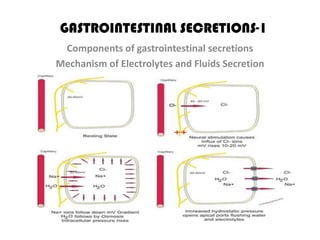
     Mechanism of Electrolytes and Fluids Secretion
•In its resting state the membrane resting potential is
about -30-40 mV
•Neural stimulation causes an influx of -ve chloride ions
decreasing resting potential by 10-20 mV
•Sodium ions follow down the electrical gradient.
•Cell contents become hyper osmotic.
•Water follows.
•Intracellular pressure increases
•Increased pressure opens pores on apical side of
glandular cell flushing water and electrolytes
GASTROINTESTINAL SECRETIONS-1
 Components of gastrointestinal secretions
Mechanism of Electrolytes and Fluids Secretion
GASTROINTESTINAL SECRETIONS-1
        Components of gastrointestinal secretions
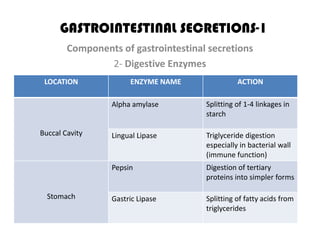
                2- Digestive Enzymes
 LOCATION             ENZYME NAME               ACTION

                 Alpha amylase        Splitting of 1-4 linkages in
                                      starch

Buccal Cavity    Lingual Lipase       Triglyceride digestion
                                      especially in bacterial wall
                                      (immune function)
                 Pepsin               Digestion of tertiary
                                      proteins into simpler forms

  Stomach        Gastric Lipase       Splitting of fatty acids from
                                      triglycerides
GASTROINTESTINAL SECRETIONS-1
     Components of gastrointestinal secretions
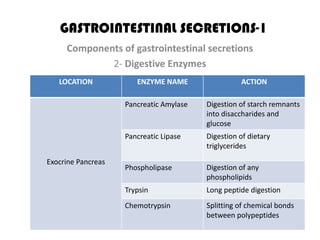
             2- Digestive Enzymes
   LOCATION            ENZYME NAME                 ACTION

                    Pancreatic Amylase   Digestion of starch remnants
                                         into disaccharides and
                                         glucose
                    Pancreatic Lipase    Digestion of dietary
                                         triglycerides
Exocrine Pancreas
                    Phospholipase        Digestion of any
                                         phospholipids
                    Trypsin              Long peptide digestion
                    Chemotrypsin         Splitting of chemical bonds
                                         between polypeptides
GASTROINTESTINAL SECRETIONS-1
        Components of gastrointestinal secretions
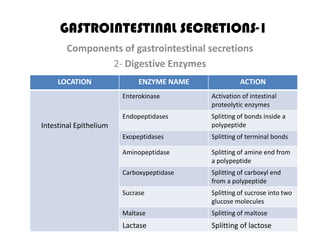
                2- Digestive Enzymes
     LOCATION                ENZYME NAME             ACTION
                        Enterokinase       Activation of intestinal
                                           proteolytic enzymes
                        Endopeptidases     Splitting of bonds inside a
Intestinal Epithelium                      polypeptide
                        Exopeptidases      Splitting of terminal bonds

                        Aminopeptidase     Splitting of amine end from
                                           a polypeptide
                        Carboxypeptidase   Splitting of carboxyl end
                                           from a polypeptide
                        Sucrase            Splitting of sucrose into two
                                           glucose molecules
                        Maltase            Splitting of maltose
                        Lactase            Splitting of lactose
GASTROINTESTINAL SECRETIONS-1
       Components of gastrointestinal secretions
  Mechanism of formation and secretion of Digestive Enzymes
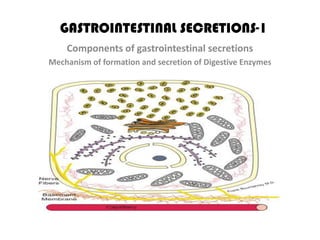
•Digestive enzymes are secreted by glandular cells which
will store the enzyme in secretory vesicles until they are
ready to be released.

•These cells are characterised by a robust rough
endoplastic reticulum and numerous mitochondria.

•Passage of materials from the ribosomes, through the
endoplasmic reticulum and Golgi body to the secretory
vesicles takes about 20 minutes.
GASTROINTESTINAL SECRETIONS-1
    Components of gastrointestinal secretions
Mechanism of formation and secretion of Digestive Enzymes
GASTROINTESTINAL SECRETIONS-1
        Components of gastrointestinal secretions
                 3- Mucous Secretions
•Mucous is a viscous secretion used for protection and
lubrication.
•It consists mainly of Glycoproteins.
•In the mouth about 70% of the mucous is secreted by
the minor salivary glands.
•Mucous cells in the stomach.
•Goblet cells in the small intestine. Up to 25% of the
intestinal epithelial cells are goblet cells.
GASTROINTESTINAL SECRETIONS-1
       Components of gastrointestinal secretions
                  3- Mucous Secretions
Mucous has the following properties:
1. Adherent properties, it sticks well to surfaces
2. Enough body to prevent contact of most food
   particles with tissue
3. Lubricates well - has a low resistance to slippage
4. Strongly resistant to digestive enzymes
5. Neutralizing properties. As well as a buffer like
   effect, mucous can also contain large quantities of
   bicarbonate.
GASTROINTESTINAL SECRETIONS-1
             Components of gastrointestinal secretions
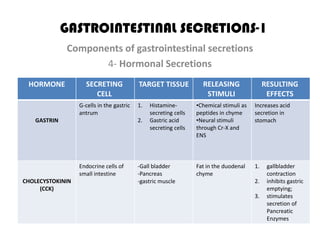
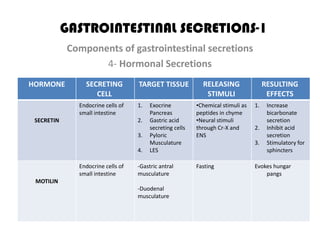
                    4- Hormonal Secretions
 HORMONE            SECRETING              TARGET TISSUE            RELEASING                 RESULTING
                       CELL                                          STIMULI                   EFFECTS
                  G-cells in the gastric   1.   Histamine-        •Chemical stimuli as   Increases acid
                  antrum                        secreting cells   peptides in chyme      secretion in
   GASTRIN                                 2.   Gastric acid      •Neural stimuli        stomach
                                                secreting cells   through Cr-X and
                                                                  ENS


                  Endocrine cells of       -Gall bladder          Fat in the duodenal    1.    gallbladder
                  small intestine          -Pancreas              chyme                        contraction
CHOLECYSTOKININ                            -gastric muscle                               2.    inhibits gastric
     (CCK)                                                                                     emptying;
                                                                                         3.    stimulates
                                                                                               secretion of
                                                                                               Pancreatic
                                                                                               Enzymes
GASTROINTESTINAL SECRETIONS-1
            Components of gastrointestinal secretions
                   4- Hormonal Secretions
HORMONE         SECRETING          TARGET TISSUE            RELEASING                 RESULTING
                   CELL                                      STIMULI                   EFFECTS
              Endocrine cells of   1.   Exocrine          •Chemical stimuli as   1.    Increase
              small intestine           Pancreas          peptides in chyme            bicarbonate
 SECRETIN                          2.   Gastric acid      •Neural stimuli              secretion
                                        secreting cells   through Cr-X and       2.    Inhibit acid
                                   3.   Pyloric           ENS                          secretion
                                        Musculature                              3.    Stimulatory for
                                   4.   LES                                            sphincters

              Endocrine cells of   -Gastric antral        Fasting                Evokes hungar
              small intestine      musculature                                       pangs
 MOTILIN
                                   -Duodenal
                                   musculature
GASTROINTESTINAL SECRETIONS-1
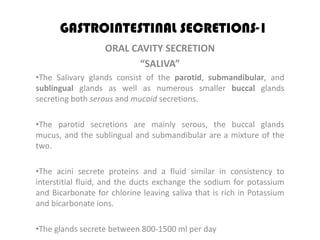
                   ORAL CAVITY SECRETION
                         “SALIVA”
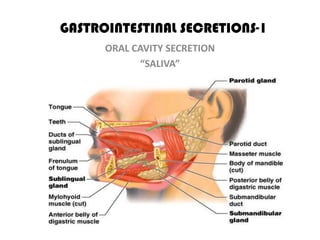
•The Salivary glands consist of the parotid, submandibular, and
sublingual glands as well as numerous smaller buccal glands
secreting both serous and mucoid secretions.

•The parotid secretions are mainly serous, the buccal glands
mucus, and the sublingual and submandibular are a mixture of the
two.

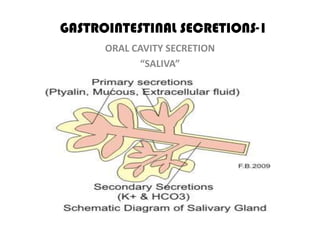
•The acini secrete proteins and a fluid similar in consistency to
interstitial fluid, and the ducts exchange the sodium for potassium
and Bicarbonate for chlorine leaving saliva that is rich in Potassium
and bicarbonate ions.

•The glands secrete between 800-1500 ml per day
GASTROINTESTINAL SECRETIONS-1
      ORAL CAVITY SECRETION
            “SALIVA”
GASTROINTESTINAL SECRETIONS-1
      ORAL CAVITY SECRETION
            “SALIVA”
GASTROINTESTINAL SECRETIONS-1
                 ORAL CAVITY SECRETION
                         “SALIVA”
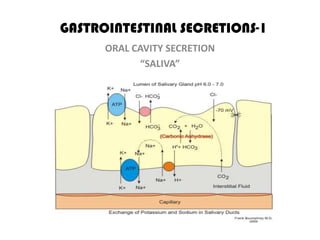
•The sodium ions are actively reabsorbed, and the
potassium ions are actively secreted at the luminal side
of the cell with an excess of sodium reabsorbtion causing
a -70mV gradient.

•This causes passive reabsorbtion of chlorine ions.

•Bicarbonate ions are both passively exchanged , and
actively secreted in exchange for chlorine.
GASTROINTESTINAL SECRETIONS-1
      ORAL CAVITY SECRETION
            “SALIVA”

Gastrointestinal secretions 1

  • 1.
  • 2.
    GASTROINTESTINAL SECRETIONS-1 •About 9liters of fluid pass through the GI system each day, and only about 2 liters are ingested, the rest represent secretions from the system itself. •About half of the total secreted amount (3.5, liters) is secreted from the exocrine glands, the salivary glands, the pancreas and the liver, •The other half is secreted by the epithelial cells of the digestive tract itself. •Nearly all this fluid is absorbed
  • 3.
    GASTROINTESTINAL SECRETIONS-1 •To putthis in perspective a 70 Kilogram man has about 42 liters of fluid, so the secretions represent about a sixth of the body's volume. •The circulation contains about 3.5 liters, so these secretions represent twice the bodies circulating volume! •Failures of absorption of the intestinal secretions can thus lead to rapid dehydration and electrolyte imbalance.
  • 4.
  • 5.
    GASTROINTESTINAL SECRETIONS-1 Types of gastrointestinal glands 1. Single cell mucous glands and goblet cells. 2. Pit glands: Invaginations of the epithelia into the submucosa. In the small intestine these are called Crypts of Lieberkuhn. 3. Deep tubular glands. These are found in the stomach - the gastric glands, and the upper duodenum - Brunners glands. 4. Complex glands, the salivary glands, the pancreas, and the liver.
  • 6.
    GASTROINTESTINAL SECRETIONS-1 Components of gastrointestinal secretions 1- Electrolytes and Fluids A large portion of the 7 liters is composed of water and ions. The ionic composition varies from region to region. •The acini of the salivary glands secrete a sodium and chloride rich secretion, this is then turned to a potassium, bicarbonate rich secretion as it travels down the lumen and ducts of the glands •The Oxyntic cells of the stomach secret Hydrochloric acid •The mucous cells of the stomach secrete a mucous rich in bicarbonates •The pancreatic ducts and ductules secrete a solution rich in bicarbonate •The Crypts of Liberkuhn of the small intestine secrete a solution almost indistinguishable from interstitial fluid.
  • 7.
    GASTROINTESTINAL SECRETIONS-1 Components of gastrointestinal secretions Mechanism of Electrolytes and Fluids Secretion •In its resting state the membrane resting potential is about -30-40 mV •Neural stimulation causes an influx of -ve chloride ions decreasing resting potential by 10-20 mV •Sodium ions follow down the electrical gradient. •Cell contents become hyper osmotic. •Water follows. •Intracellular pressure increases •Increased pressure opens pores on apical side of glandular cell flushing water and electrolytes
  • 8.
    GASTROINTESTINAL SECRETIONS-1 Componentsof gastrointestinal secretions Mechanism of Electrolytes and Fluids Secretion
  • 9.
    GASTROINTESTINAL SECRETIONS-1 Components of gastrointestinal secretions 2- Digestive Enzymes LOCATION ENZYME NAME ACTION Alpha amylase Splitting of 1-4 linkages in starch Buccal Cavity Lingual Lipase Triglyceride digestion especially in bacterial wall (immune function) Pepsin Digestion of tertiary proteins into simpler forms Stomach Gastric Lipase Splitting of fatty acids from triglycerides
  • 10.
    GASTROINTESTINAL SECRETIONS-1 Components of gastrointestinal secretions 2- Digestive Enzymes LOCATION ENZYME NAME ACTION Pancreatic Amylase Digestion of starch remnants into disaccharides and glucose Pancreatic Lipase Digestion of dietary triglycerides Exocrine Pancreas Phospholipase Digestion of any phospholipids Trypsin Long peptide digestion Chemotrypsin Splitting of chemical bonds between polypeptides
  • 11.
    GASTROINTESTINAL SECRETIONS-1 Components of gastrointestinal secretions 2- Digestive Enzymes LOCATION ENZYME NAME ACTION Enterokinase Activation of intestinal proteolytic enzymes Endopeptidases Splitting of bonds inside a Intestinal Epithelium polypeptide Exopeptidases Splitting of terminal bonds Aminopeptidase Splitting of amine end from a polypeptide Carboxypeptidase Splitting of carboxyl end from a polypeptide Sucrase Splitting of sucrose into two glucose molecules Maltase Splitting of maltose Lactase Splitting of lactose
  • 12.
    GASTROINTESTINAL SECRETIONS-1 Components of gastrointestinal secretions Mechanism of formation and secretion of Digestive Enzymes •Digestive enzymes are secreted by glandular cells which will store the enzyme in secretory vesicles until they are ready to be released. •These cells are characterised by a robust rough endoplastic reticulum and numerous mitochondria. •Passage of materials from the ribosomes, through the endoplasmic reticulum and Golgi body to the secretory vesicles takes about 20 minutes.
  • 13.
    GASTROINTESTINAL SECRETIONS-1 Components of gastrointestinal secretions Mechanism of formation and secretion of Digestive Enzymes
  • 14.
    GASTROINTESTINAL SECRETIONS-1 Components of gastrointestinal secretions 3- Mucous Secretions •Mucous is a viscous secretion used for protection and lubrication. •It consists mainly of Glycoproteins. •In the mouth about 70% of the mucous is secreted by the minor salivary glands. •Mucous cells in the stomach. •Goblet cells in the small intestine. Up to 25% of the intestinal epithelial cells are goblet cells.
  • 15.
    GASTROINTESTINAL SECRETIONS-1 Components of gastrointestinal secretions 3- Mucous Secretions Mucous has the following properties: 1. Adherent properties, it sticks well to surfaces 2. Enough body to prevent contact of most food particles with tissue 3. Lubricates well - has a low resistance to slippage 4. Strongly resistant to digestive enzymes 5. Neutralizing properties. As well as a buffer like effect, mucous can also contain large quantities of bicarbonate.
  • 16.
    GASTROINTESTINAL SECRETIONS-1 Components of gastrointestinal secretions 4- Hormonal Secretions HORMONE SECRETING TARGET TISSUE RELEASING RESULTING CELL STIMULI EFFECTS G-cells in the gastric 1. Histamine- •Chemical stimuli as Increases acid antrum secreting cells peptides in chyme secretion in GASTRIN 2. Gastric acid •Neural stimuli stomach secreting cells through Cr-X and ENS Endocrine cells of -Gall bladder Fat in the duodenal 1. gallbladder small intestine -Pancreas chyme contraction CHOLECYSTOKININ -gastric muscle 2. inhibits gastric (CCK) emptying; 3. stimulates secretion of Pancreatic Enzymes
  • 17.
    GASTROINTESTINAL SECRETIONS-1 Components of gastrointestinal secretions 4- Hormonal Secretions HORMONE SECRETING TARGET TISSUE RELEASING RESULTING CELL STIMULI EFFECTS Endocrine cells of 1. Exocrine •Chemical stimuli as 1. Increase small intestine Pancreas peptides in chyme bicarbonate SECRETIN 2. Gastric acid •Neural stimuli secretion secreting cells through Cr-X and 2. Inhibit acid 3. Pyloric ENS secretion Musculature 3. Stimulatory for 4. LES sphincters Endocrine cells of -Gastric antral Fasting Evokes hungar small intestine musculature pangs MOTILIN -Duodenal musculature
  • 18.
    GASTROINTESTINAL SECRETIONS-1 ORAL CAVITY SECRETION “SALIVA” •The Salivary glands consist of the parotid, submandibular, and sublingual glands as well as numerous smaller buccal glands secreting both serous and mucoid secretions. •The parotid secretions are mainly serous, the buccal glands mucus, and the sublingual and submandibular are a mixture of the two. •The acini secrete proteins and a fluid similar in consistency to interstitial fluid, and the ducts exchange the sodium for potassium and Bicarbonate for chlorine leaving saliva that is rich in Potassium and bicarbonate ions. •The glands secrete between 800-1500 ml per day
  • 19.
    GASTROINTESTINAL SECRETIONS-1 ORAL CAVITY SECRETION “SALIVA”
  • 20.
    GASTROINTESTINAL SECRETIONS-1 ORAL CAVITY SECRETION “SALIVA”
  • 21.
    GASTROINTESTINAL SECRETIONS-1 ORAL CAVITY SECRETION “SALIVA” •The sodium ions are actively reabsorbed, and the potassium ions are actively secreted at the luminal side of the cell with an excess of sodium reabsorbtion causing a -70mV gradient. •This causes passive reabsorbtion of chlorine ions. •Bicarbonate ions are both passively exchanged , and actively secreted in exchange for chlorine.
  • 22.
    GASTROINTESTINAL SECRETIONS-1 ORAL CAVITY SECRETION “SALIVA”