GASTRIC JUICE
Group members: Shafqat Mukhtar, Anum, Aiza
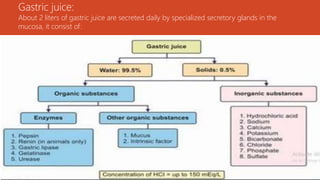
Gastric juice:
About 2 liters of gastric juice are secreted daily by specialized secretory glands in the
mucosa, it consist of:
FUNCTIONS OF GASTRIC JUICE
Water further liquefies the food
swallowed.
• Hydrochloric acid (hcl) -
(1)Acidifies the food and stops the
action of salivary amylase.
(2)Kills ingested microbes.
(3)Provide the acid environment
needed f or the action of pepsins.
• Pepsinogens are activated to pepsins
by HCL and by pepsin already
present in the
o Intrinsic factor (a protein) is
necessary for the absorption of
Vitamin 812 f rom the ileum.
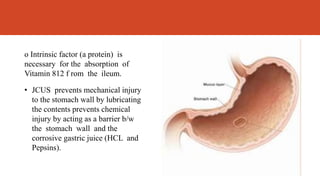
• JCUS prevents mechanical injury
to the stomach wall by lubricating
the contents prevents chemical
injury by acting as a barrier b/w
the stomach wall and the
corrosive gastric juice (HCL and
Pepsins).
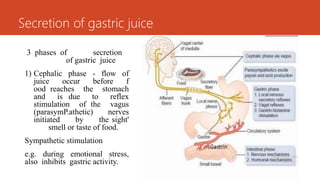
Secretion of gastric juice
® 3 phases of secretion
of gastric juice
1) Cephalic phase - flow of
juice occur before f
ood reaches the stomach
and is due to reflex
stimulation of the vagus
(parasymP.athetic) nerves
initiated by the sight'
smell or taste of food.
Sympathetic stimulation
e.g. during emotional stress,
also inhibits gastric activity.
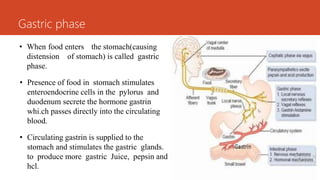
Gastric phase
• When food enters the stomach(causing
distension of stomach) is called gastric
phase.
• Presence of food in stomach stimulates
enteroendocrine cells in the pylorus and
duodenum secrete the hormone gastrin
whi.ch passes directly into the circulating
blood.
• Circulating gastrin is supplied to the
stomach and stimulates the gastric glands.
to produce more gastric Juice, pepsin and
hcl.
Functions of the stomach
• These includes:
 T
emporary storage allowing time for the digestive enzymes, pepsins,to act.
 Chemical digestion-pepsins break proteins into polypeptides.
 Mechanical breakdown.
 Limited absorption.
 Non specific defense against m icrobes.
 Preparation of iron for absorption.
 Production and secretion of intrinsic factors needed for absorption of vit.B12
 Regu lation of the passage of gastric contents into the duodenum .
REFERENCE
1. Lamers CB, Borgström B, Dockray GJ. Gastric juice: a barrier to microbes. Best Pract Res Clin
Gastroenterol. 2004 Feb;18(1):671-82. doi: 10.1016/j.bpg.2003.11.004. PMID: 15123084.
2. Hirschowitz BI, Worthington J, Mohnen J. Acid secretion in health and disease: assessment of gastric
acid secretion by ambulatory pH monitoring. Am J Med. 1997 Apr 28;102(4A):19S-27S. doi:
10.1016/s0002-9343(97)80004-4. PMID: 9217592.
3. Sjöqvist A, Nylander O, Franzén L, Lönroth H, Lundell L. Duodenogastric reflux in the pathogenesis of
Barrett's oesophagus. Best Pract Res Clin Gastroenterol. 2004 Feb;18(1):173-83. doi:
10.1016/j.bpg.2003.10.001. PMID: 15123068.
4. Furuta GT, Liacouras CA, Collins MH, Gupta SK, Justinich C, Putnam PE, Bonis P, Hassall E, Straumann
A, Rothenberg ME. Eosinophilic esophagitis in children and adults: a systematic review and consensus
recommendations for diagnosis and treatment. Gastroenterology. 2007 Oct;133(4):1342-63. doi:
10.1053/j.gastro.2007.08.017. PMID: 17919504.
5. Waugh A, Grant A. Ross and Wilson Anatomy and Physiology in Health and Illness. 13th ed.
Edinburgh: Elsevier; 2018.

GASTRIC JUICE.pptx

  • 1.
    GASTRIC JUICE Group members:Shafqat Mukhtar, Anum, Aiza
  • 2.
    Gastric juice: About 2liters of gastric juice are secreted daily by specialized secretory glands in the mucosa, it consist of:
  • 4.
    FUNCTIONS OF GASTRICJUICE Water further liquefies the food swallowed. • Hydrochloric acid (hcl) - (1)Acidifies the food and stops the action of salivary amylase. (2)Kills ingested microbes. (3)Provide the acid environment needed f or the action of pepsins. • Pepsinogens are activated to pepsins by HCL and by pepsin already present in the
  • 5.
    o Intrinsic factor(a protein) is necessary for the absorption of Vitamin 812 f rom the ileum. • JCUS prevents mechanical injury to the stomach wall by lubricating the contents prevents chemical injury by acting as a barrier b/w the stomach wall and the corrosive gastric juice (HCL and Pepsins).
  • 6.
    Secretion of gastricjuice ® 3 phases of secretion of gastric juice 1) Cephalic phase - flow of juice occur before f ood reaches the stomach and is due to reflex stimulation of the vagus (parasymP.athetic) nerves initiated by the sight' smell or taste of food. Sympathetic stimulation e.g. during emotional stress, also inhibits gastric activity.
  • 7.
    Gastric phase • Whenfood enters the stomach(causing distension of stomach) is called gastric phase. • Presence of food in stomach stimulates enteroendocrine cells in the pylorus and duodenum secrete the hormone gastrin whi.ch passes directly into the circulating blood. • Circulating gastrin is supplied to the stomach and stimulates the gastric glands. to produce more gastric Juice, pepsin and hcl.
  • 8.
    Functions of thestomach • These includes:  T emporary storage allowing time for the digestive enzymes, pepsins,to act.  Chemical digestion-pepsins break proteins into polypeptides.  Mechanical breakdown.  Limited absorption.  Non specific defense against m icrobes.  Preparation of iron for absorption.  Production and secretion of intrinsic factors needed for absorption of vit.B12  Regu lation of the passage of gastric contents into the duodenum .
  • 9.
    REFERENCE 1. Lamers CB,Borgström B, Dockray GJ. Gastric juice: a barrier to microbes. Best Pract Res Clin Gastroenterol. 2004 Feb;18(1):671-82. doi: 10.1016/j.bpg.2003.11.004. PMID: 15123084. 2. Hirschowitz BI, Worthington J, Mohnen J. Acid secretion in health and disease: assessment of gastric acid secretion by ambulatory pH monitoring. Am J Med. 1997 Apr 28;102(4A):19S-27S. doi: 10.1016/s0002-9343(97)80004-4. PMID: 9217592. 3. Sjöqvist A, Nylander O, Franzén L, Lönroth H, Lundell L. Duodenogastric reflux in the pathogenesis of Barrett's oesophagus. Best Pract Res Clin Gastroenterol. 2004 Feb;18(1):173-83. doi: 10.1016/j.bpg.2003.10.001. PMID: 15123068. 4. Furuta GT, Liacouras CA, Collins MH, Gupta SK, Justinich C, Putnam PE, Bonis P, Hassall E, Straumann A, Rothenberg ME. Eosinophilic esophagitis in children and adults: a systematic review and consensus recommendations for diagnosis and treatment. Gastroenterology. 2007 Oct;133(4):1342-63. doi: 10.1053/j.gastro.2007.08.017. PMID: 17919504. 5. Waugh A, Grant A. Ross and Wilson Anatomy and Physiology in Health and Illness. 13th ed. Edinburgh: Elsevier; 2018.