GAS LAWS
SIR JOHNEL V. ESPONILLA
G10 - SCIENCE
OBJECTIVES:
G A S
L AW S
1. Define atmospheric pressure
2. Explain why atmospheric pressure
decreases with increasing altitude
3. Describe how atmospheric pressure is
measured
THE EARTH’S ATMOSPHERE
G A S L A W S
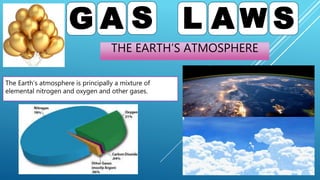
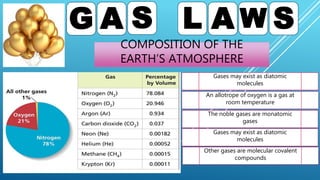
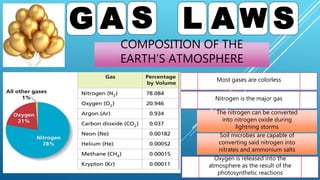
The Earth’s atmosphere is principally a mixture of
elemental nitrogen and oxygen and other gases.
THE EARTH’S ATMOSPHERE
G A S L A W S
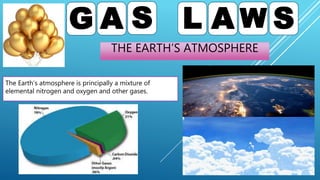
The Earth’s atmosphere is principally a mixture of
elemental nitrogen and oxygen and other gases.
COMPOSITION OF THE
EARTH’S ATMOSPHERE
G A S L A W S
Gases may exist as diatomic
molecules
An allotrope of oxygen is a gas at
room temperature
The noble gases are monatomic
gases
Gases may exist as diatomic
molecules
Other gases are molecular covalent
compounds
COMPOSITION OF THE
EARTH’S ATMOSPHERE
G A S L A W S
Most gases are colorless
Nitrogen is the major gas
The nitrogen can be converted
into nitrogen oxide during
lightning storms
Soil microbes are capable of
converting said nitrogen into
nitrates and ammonium salts
Oxygen is released into the
atmosphere as the result of the
photosynthetic reactions
ATMOSPHERIC PRESSURE
G A S L A W S
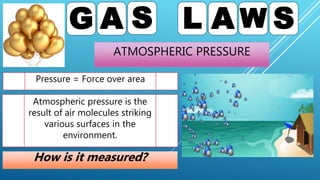
Pressure = Force over area
Atmospheric pressure is the
result of air molecules striking
various surfaces in the
environment.
How is it measured?
ATMOSPHERIC PRESSURE
G A S L A W S
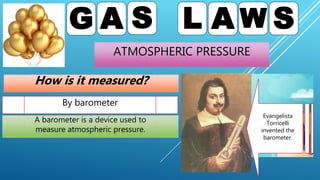
How is it measured?
By barometer
Evangelista
Torricelli
invented the
barometer.
A barometer is a device used to
measure atmospheric pressure.
ATMOSPHERIC PRESSURE
G A S L A W S
The atmosphere is denser near the
surface of the Earth than in higher
altitude.
Forcearea = weightair column
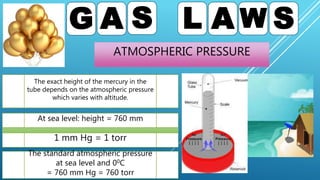
The exact height of the mercury in the
tube depends on the atmospheric pressure
which varies with altitude.
At sea level: height = 760 mm
1 mm Hg = 1 torr
The standard atmospheric pressure
at sea level and 00C
= 760 mm Hg = 760 torr
COMMON UNITS OF PRESSURE
G A S L A W S
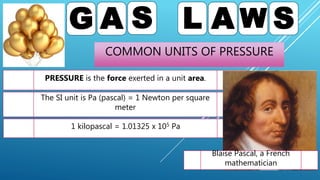
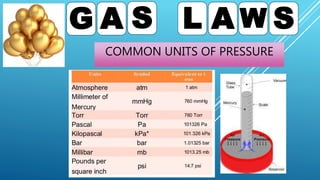
PRESSURE is the force exerted in a unit area.
The SI unit is Pa (pascal) = 1 Newton per square
meter
1 kilopascal = 1.01325 x 10⁵ Pa
Blaise Pascal, a French
mathematician
COMMON UNITS OF PRESSURE
G A S L A W S
CHECKPOINT!!!
G A S L A W S
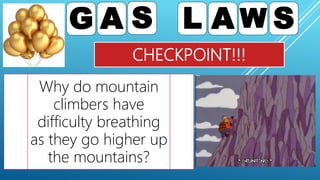
Why do mountain
climbers have
difficulty breathing
as they go higher up
the mountains?
OBJECTIVES:
B O Y L ‘ S
1. State Boyle’s law
2. Calculate changes in gas volume resulting
from pressure changes and vice versa
L
E
A W
B O Y L
A W
S
L
E ‘
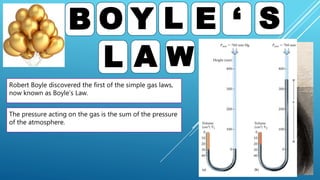
Robert Boyle discovered the first of the simple gas laws,
now known as Boyle’s Law.
The pressure acting on the gas is the sum of the pressure
of the atmosphere.
B O Y L
A W
S
L
E ‘
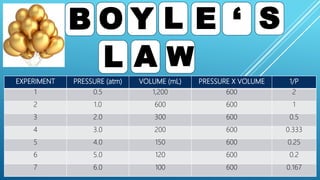
EXPERIMENT PRESSURE (atm) VOLUME (mL) PRESSURE X VOLUME 1/P
1 0.5 1,200 600 2
2 1.0 600 600 1
3 2.0 300 600 0.5
4 3.0 200 600 0.333
5 4.0 150 600 0.25
6 5.0 120 600 0.2
7 6.0 100 600 0.167
B O Y L
A W
S
L
E ‘
EXPERIMENT PRESSURE (atm) VOLUME (mL) PRESSURE X VOLUME 1/P
1 0.5 1,200 600 2
2 1.0 600 600 1
3 2.0 300 600 0.5
4 3.0 200 600 0.333
5 4.0 150 600 0.25
6 5.0 120 600 0.2
7 6.0 100 600 0.167
PRESSURE
AND
VOLUME
VOLUME AND
RECIPROCAL
PRESSURE
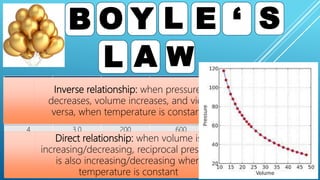
Inverse relationship: when pressure
decreases, volume increases, and vice
versa, when temperature is constant
Direct relationship: when volume is
increasing/decreasing, reciprocal pressure
is also increasing/decreasing when
temperature is constant
B O Y L
A W
S
L
E ‘
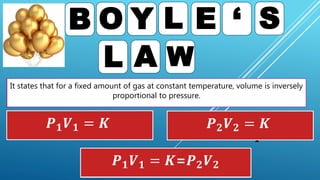
It states that for a fixed amount of gas at constant temperature, volume is inversely
proportional to pressure.
It states that for a fixed amount of gas at constant temperature, volume is inversely
proportional to pressure.
𝑽 ∝
𝟏
𝑷
(𝒗, 𝑻 𝒄𝒐𝒏𝒔𝒕𝒂𝒏𝒕) 𝑽 = 𝑲(
𝟏
𝑷
)
𝑷𝑽 = 𝑲
𝑷𝟏𝑽𝟏 = 𝑲 𝑷𝟐𝑽𝟐 = 𝑲
𝑷𝟏𝑽𝟏 = 𝑲=𝑷𝟐𝑽𝟐
B O Y L
A W
S
L
E ‘
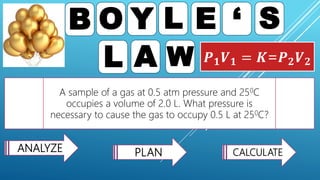
𝑷𝟏𝑽𝟏 = 𝑲=𝑷𝟐𝑽𝟐
A sample of a gas at 0.5 atm pressure and 250C
occupies a volume of 2.0 L. What pressure is
necessary to cause the gas to occupy 0.5 L at 250C?
ANALYZE PLAN CALCULATE
B O Y L
A W
S
L
E ‘
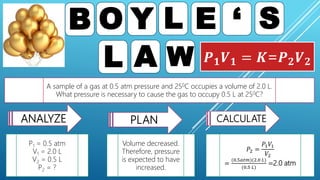
𝑷𝟏𝑽𝟏 = 𝑲=𝑷𝟐𝑽𝟐
A sample of a gas at 0.5 atm pressure and 250C occupies a volume of 2.0 L.
What pressure is necessary to cause the gas to occupy 0.5 L at 250C?
ANALYZE
P1 = 0.5 atm
V1 = 2.0 L
V2 = 0.5 L
P2 = ?
PLAN
Volume decreased.
Therefore, pressure
is expected to have
increased.
CALCULATE
𝑃2 =
𝑃1𝑉1
𝑉2
=
(0.5𝑎𝑡𝑚)(2.0 𝐿)
(0.5 𝐿)
=2.0 atm
B O Y L
A W
S
L
E ‘
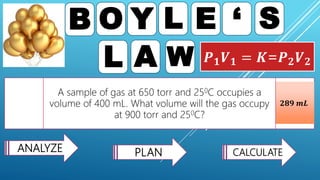
𝑷𝟏𝑽𝟏 = 𝑲=𝑷𝟐𝑽𝟐
A sample of gas at 650 torr and 250C occupies a
volume of 400 mL. What volume will the gas occupy
at 900 torr and 250C?
ANALYZE PLAN CALCULATE
𝟐𝟖𝟗 𝒎𝑳
B O Y L
A W
S
L
E ‘
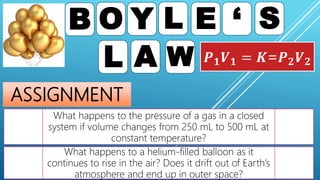
𝑷𝟏𝑽𝟏 = 𝑲=𝑷𝟐𝑽𝟐
What happens to the pressure of a gas in a closed
system if volume changes from 250 mL to 500 mL at
constant temperature?
ASSIGNMENT
What happens to a helium-filled balloon as it
continues to rise in the air? Does it drift out of Earth’s
atmosphere and end up in outer space?

Gas laws

  • 1.
    GAS LAWS SIR JOHNELV. ESPONILLA G10 - SCIENCE
  • 2.
    OBJECTIVES: G A S LAW S 1. Define atmospheric pressure 2. Explain why atmospheric pressure decreases with increasing altitude 3. Describe how atmospheric pressure is measured
  • 3.
    THE EARTH’S ATMOSPHERE GA S L A W S The Earth’s atmosphere is principally a mixture of elemental nitrogen and oxygen and other gases.
  • 4.
    THE EARTH’S ATMOSPHERE GA S L A W S The Earth’s atmosphere is principally a mixture of elemental nitrogen and oxygen and other gases.
  • 5.
    COMPOSITION OF THE EARTH’SATMOSPHERE G A S L A W S Gases may exist as diatomic molecules An allotrope of oxygen is a gas at room temperature The noble gases are monatomic gases Gases may exist as diatomic molecules Other gases are molecular covalent compounds
  • 6.
    COMPOSITION OF THE EARTH’SATMOSPHERE G A S L A W S Most gases are colorless Nitrogen is the major gas The nitrogen can be converted into nitrogen oxide during lightning storms Soil microbes are capable of converting said nitrogen into nitrates and ammonium salts Oxygen is released into the atmosphere as the result of the photosynthetic reactions
  • 7.
    ATMOSPHERIC PRESSURE G AS L A W S Pressure = Force over area Atmospheric pressure is the result of air molecules striking various surfaces in the environment. How is it measured?
  • 8.
    ATMOSPHERIC PRESSURE G AS L A W S How is it measured? By barometer Evangelista Torricelli invented the barometer. A barometer is a device used to measure atmospheric pressure.
  • 9.
    ATMOSPHERIC PRESSURE G AS L A W S The atmosphere is denser near the surface of the Earth than in higher altitude. Forcearea = weightair column The exact height of the mercury in the tube depends on the atmospheric pressure which varies with altitude. At sea level: height = 760 mm 1 mm Hg = 1 torr The standard atmospheric pressure at sea level and 00C = 760 mm Hg = 760 torr
  • 10.
    COMMON UNITS OFPRESSURE G A S L A W S PRESSURE is the force exerted in a unit area. The SI unit is Pa (pascal) = 1 Newton per square meter 1 kilopascal = 1.01325 x 10⁵ Pa Blaise Pascal, a French mathematician
  • 11.
    COMMON UNITS OFPRESSURE G A S L A W S
  • 12.
    CHECKPOINT!!! G A SL A W S Why do mountain climbers have difficulty breathing as they go higher up the mountains?
  • 13.
    OBJECTIVES: B O YL ‘ S 1. State Boyle’s law 2. Calculate changes in gas volume resulting from pressure changes and vice versa L E A W
  • 14.
    B O YL A W S L E ‘ Robert Boyle discovered the first of the simple gas laws, now known as Boyle’s Law. The pressure acting on the gas is the sum of the pressure of the atmosphere.
  • 15.
    B O YL A W S L E ‘ EXPERIMENT PRESSURE (atm) VOLUME (mL) PRESSURE X VOLUME 1/P 1 0.5 1,200 600 2 2 1.0 600 600 1 3 2.0 300 600 0.5 4 3.0 200 600 0.333 5 4.0 150 600 0.25 6 5.0 120 600 0.2 7 6.0 100 600 0.167
  • 16.
    B O YL A W S L E ‘ EXPERIMENT PRESSURE (atm) VOLUME (mL) PRESSURE X VOLUME 1/P 1 0.5 1,200 600 2 2 1.0 600 600 1 3 2.0 300 600 0.5 4 3.0 200 600 0.333 5 4.0 150 600 0.25 6 5.0 120 600 0.2 7 6.0 100 600 0.167 PRESSURE AND VOLUME VOLUME AND RECIPROCAL PRESSURE Inverse relationship: when pressure decreases, volume increases, and vice versa, when temperature is constant Direct relationship: when volume is increasing/decreasing, reciprocal pressure is also increasing/decreasing when temperature is constant
  • 17.
    B O YL A W S L E ‘ It states that for a fixed amount of gas at constant temperature, volume is inversely proportional to pressure. It states that for a fixed amount of gas at constant temperature, volume is inversely proportional to pressure. 𝑽 ∝ 𝟏 𝑷 (𝒗, 𝑻 𝒄𝒐𝒏𝒔𝒕𝒂𝒏𝒕) 𝑽 = 𝑲( 𝟏 𝑷 ) 𝑷𝑽 = 𝑲 𝑷𝟏𝑽𝟏 = 𝑲 𝑷𝟐𝑽𝟐 = 𝑲 𝑷𝟏𝑽𝟏 = 𝑲=𝑷𝟐𝑽𝟐
  • 18.
    B O YL A W S L E ‘ 𝑷𝟏𝑽𝟏 = 𝑲=𝑷𝟐𝑽𝟐 A sample of a gas at 0.5 atm pressure and 250C occupies a volume of 2.0 L. What pressure is necessary to cause the gas to occupy 0.5 L at 250C? ANALYZE PLAN CALCULATE
  • 19.
    B O YL A W S L E ‘ 𝑷𝟏𝑽𝟏 = 𝑲=𝑷𝟐𝑽𝟐 A sample of a gas at 0.5 atm pressure and 250C occupies a volume of 2.0 L. What pressure is necessary to cause the gas to occupy 0.5 L at 250C? ANALYZE P1 = 0.5 atm V1 = 2.0 L V2 = 0.5 L P2 = ? PLAN Volume decreased. Therefore, pressure is expected to have increased. CALCULATE 𝑃2 = 𝑃1𝑉1 𝑉2 = (0.5𝑎𝑡𝑚)(2.0 𝐿) (0.5 𝐿) =2.0 atm
  • 20.
    B O YL A W S L E ‘ 𝑷𝟏𝑽𝟏 = 𝑲=𝑷𝟐𝑽𝟐 A sample of gas at 650 torr and 250C occupies a volume of 400 mL. What volume will the gas occupy at 900 torr and 250C? ANALYZE PLAN CALCULATE 𝟐𝟖𝟗 𝒎𝑳
  • 21.
    B O YL A W S L E ‘ 𝑷𝟏𝑽𝟏 = 𝑲=𝑷𝟐𝑽𝟐 What happens to the pressure of a gas in a closed system if volume changes from 250 mL to 500 mL at constant temperature? ASSIGNMENT What happens to a helium-filled balloon as it continues to rise in the air? Does it drift out of Earth’s atmosphere and end up in outer space?