© 2014 Pearson Education, Inc.
Christian Madu, Ph.D.
Collin College
Lecture Presentation
Chapter 5
Gases
© 2014 Pearson Education, Inc.
Gas
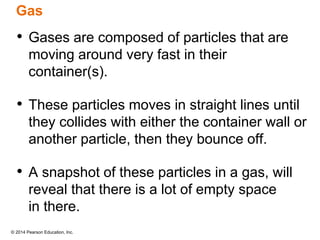
• Gases are composed of particles that are
moving around very fast in their
container(s).
• These particles moves in straight lines until
they collides with either the container wall or
another particle, then they bounce off.
• A snapshot of these particles in a gas, will
reveal that there is a lot of empty space
in there.
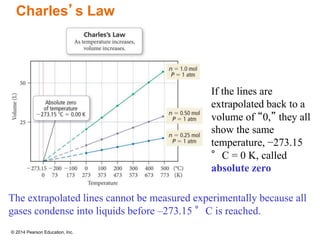
© 2014 Pearson Education, Inc.
Gas Pressure
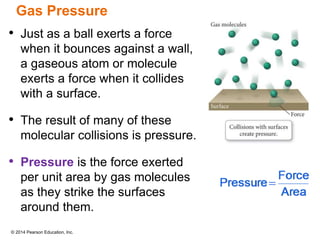
• Just as a ball exerts a force
when it bounces against a wall,
a gaseous atom or molecule
exerts a force when it collides
with a surface.
• The result of many of these
molecular collisions is pressure.
• Pressure is the force exerted
per unit area by gas molecules
as they strike the surfaces
around them.
© 2014 Pearson Education, Inc.
Gas Pressure
• Gas pressure is a result of the constant
movement of the gas molecules and their
collisions with the surfaces around them.
• The pressure of a gas depends on several
factors:
Number of gas particles in a given volume
Volume of the container
Average speed of the gas particles
© 2014 Pearson Education, Inc.
Gas Pressure
• The total pressure exerted by a gas depends
on several factors, including the
concentration of gas molecules in the
sample.
The higher the concentration, the greater the
pressure.
• As volume increases, concentration of gas
molecules decreases (number of molecules
does not change, but since the volume
increases, the concentration goes down).
This in turn results in fewer molecular collisions, which
results in lower pressure.
© 2014 Pearson Education, Inc.
Atmospheric Pressure Effects
• Variation in pressure in Earth’s
atmosphere creates wind, and
changes in pressure help us to
predict weather.
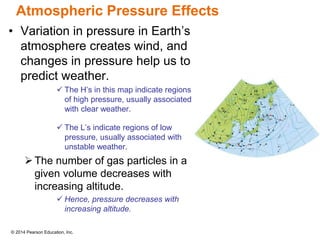
 The H’s in this map indicate regions
of high pressure, usually associated
with clear weather.
 The L’s indicate regions of low
pressure, usually associated with
unstable weather.
The number of gas particles in a
given volume decreases with
increasing altitude.
 Hence, pressure decreases with
increasing altitude.
© 2014 Pearson Education, Inc.
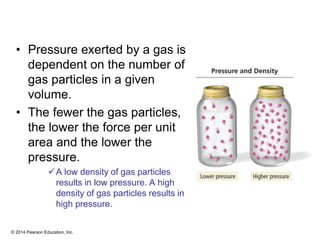
• Pressure exerted by a gas is
dependent on the number of
gas particles in a given
volume.
• The fewer the gas particles,
the lower the force per unit
area and the lower the
pressure.
A low density of gas particles
results in low pressure. A high
density of gas particles results in
high pressure.
© 2014 Pearson Education, Inc.
The Manometer
• The pressure of a gas trapped in a container can
be measured with an instrument called a
manometer.
• Manometers are U-shaped tubes partially filled
with a liquid that are connected to the gas
sample on one side and open to the air on
the other.
• A competition is established between the
pressures of the atmosphere and the gas.
• The difference in the liquid levels is a measure
of the difference in pressure between the gas
and the atmosphere.
© 2014 Pearson Education, Inc.
The Manometer
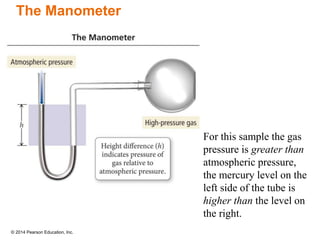
For this sample the gas
pressure is greater than
atmospheric pressure,
the mercury level on the
left side of the tube is
higher than the level on
the right.
© 2014 Pearson Education, Inc.
The Simple Gas Laws
• Boyle’s Law
• Charles’s Law
• Avogadro’s Law
• There are four basic properties of a gas:
pressure (P), volume (V), temperature (T),
and amount in moles (n).
These properties are interrelated—when one
changes, it affects the others.
The simple gas laws describe the
relationships between pairs of these
properties.
© 2014 Pearson Education, Inc.
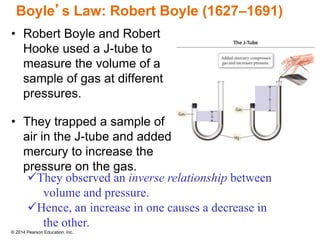
Boyle’s Law: Robert Boyle (1627–1691)
• Robert Boyle and Robert
Hooke used a J-tube to
measure the volume of a
sample of gas at different
pressures.
• They trapped a sample of
air in the J-tube and added
mercury to increase the
pressure on the gas.
They observed an inverse relationship between
volume and pressure.
Hence, an increase in one causes a decrease in
the other.
© 2014 Pearson Education, Inc.
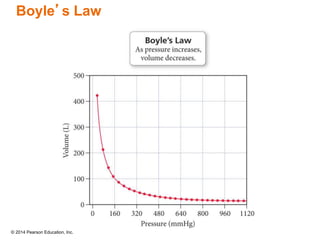
Boyle’s Law
© 2014 Pearson Education, Inc.
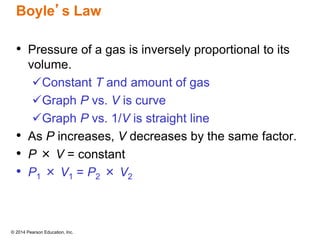
Boyle’s Law
• Pressure of a gas is inversely proportional to its
volume.
Constant T and amount of gas
Graph P vs. V is curve
Graph P vs. 1/V is straight line
• As P increases, V decreases by the same factor.
• P × V = constant
• P1 × V1 = P2 × V2
© 2014 Pearson Education, Inc.
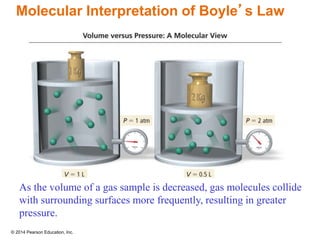
Molecular Interpretation of Boyle’s Law
As the volume of a gas sample is decreased, gas molecules collide
with surrounding surfaces more frequently, resulting in greater
pressure.
© 2014 Pearson Education, Inc.
Boyle’s Law and Diving
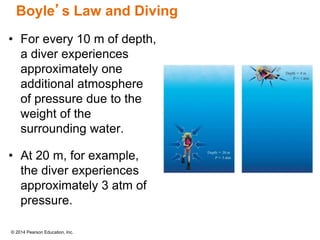
• For every 10 m of depth,
a diver experiences
approximately one
additional atmosphere
of pressure due to the
weight of the
surrounding water.
• At 20 m, for example,
the diver experiences
approximately 3 atm of
pressure.
© 2014 Pearson Education, Inc.
Boyle’s Law and Diving
• If a diver holds his or her breath and rises
to the surface quickly, the outside
pressure drops to 1 atm.
According to Boyle’s law, what should
happen to the volume of air in the lungs?
• Because the pressure is decreasing by a
factor of 3, the volume will expand by a
factor of 3, causing damage to internal
organs.
Always exhale when rising!
© 2014 Pearson Education, Inc.
Charles’s Law: Volume and Temperature
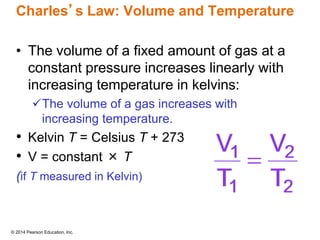
• The volume of a fixed amount of gas at a
constant pressure increases linearly with
increasing temperature in kelvins:
The volume of a gas increases with
increasing temperature.
• Kelvin T = Celsius T + 273
• V = constant × T
(if T measured in Kelvin)
© 2014 Pearson Education, Inc.
Charles’s Law
The extrapolated lines cannot be measured experimentally because all
gases condense into liquids before –273.15 °C is reached.
If the lines are
extrapolated back to a
volume of “0,” they all
show the same
temperature, −273.15
°C = 0 K, called
absolute zero
© 2014 Pearson Education, Inc.
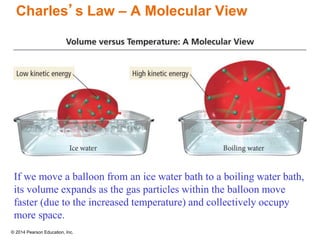
Charles’s Law – A Molecular View
If we move a balloon from an ice water bath to a boiling water bath,
its volume expands as the gas particles within the balloon move
faster (due to the increased temperature) and collectively occupy
more space.
© 2014 Pearson Education, Inc.
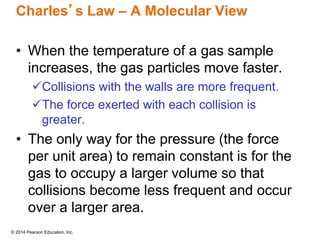
Charles’s Law – A Molecular View
• When the temperature of a gas sample
increases, the gas particles move faster.
Collisions with the walls are more frequent.
The force exerted with each collision is
greater.
• The only way for the pressure (the force
per unit area) to remain constant is for the
gas to occupy a larger volume so that
collisions become less frequent and occur
over a larger area.
© 2014 Pearson Education, Inc.
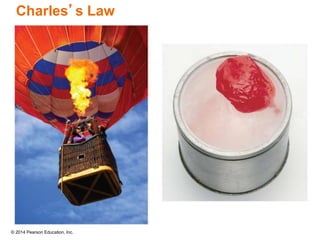
Charles’s Law
© 2014 Pearson Education, Inc.
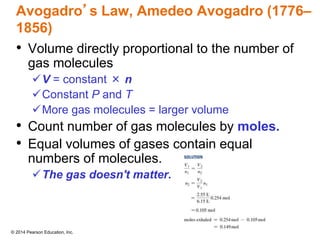
Avogadro’s Law, Amedeo Avogadro (1776–
1856)
• Volume directly proportional to the number of
gas molecules
V = constant × n
Constant P and T
More gas molecules = larger volume
• Count number of gas molecules by moles.
• Equal volumes of gases contain equal
numbers of molecules.
The gas doesn't matter.
© 2014 Pearson Education, Inc.
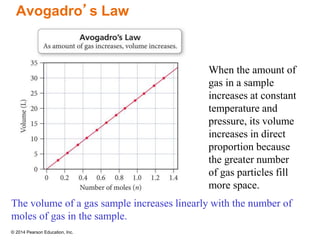
Avogadro’s Law
The volume of a gas sample increases linearly with the number of
moles of gas in the sample.
When the amount of
gas in a sample
increases at constant
temperature and
pressure, its volume
increases in direct
proportion because
the greater number
of gas particles fill
more space.
© 2014 Pearson Education, Inc.
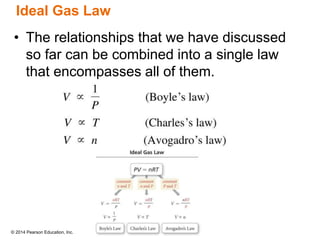
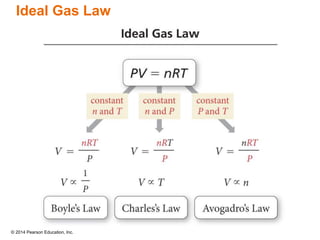
Ideal Gas Law
• The relationships that we have discussed
so far can be combined into a single law
that encompasses all of them.
© 2014 Pearson Education, Inc.
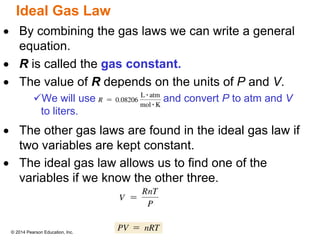
Ideal Gas Law
 By combining the gas laws we can write a general
equation.
 R is called the gas constant.
 The value of R depends on the units of P and V.
We will use and convert P to atm and V
to liters.
 The other gas laws are found in the ideal gas law if
two variables are kept constant.
 The ideal gas law allows us to find one of the
variables if we know the other three.
© 2014 Pearson Education, Inc.
Ideal Gas Law
© 2014 Pearson Education, Inc.
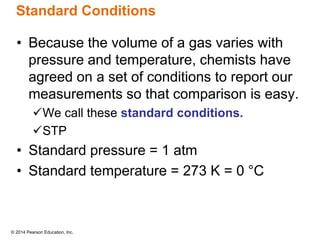
Standard Conditions
• Because the volume of a gas varies with
pressure and temperature, chemists have
agreed on a set of conditions to report our
measurements so that comparison is easy.
We call these standard conditions.
STP
• Standard pressure = 1 atm
• Standard temperature = 273 K = 0 °C
© 2014 Pearson Education, Inc.
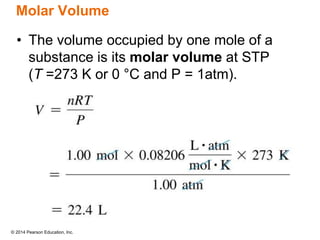
Molar Volume
• The volume occupied by one mole of a
substance is its molar volume at STP
(T =273 K or 0 °C and P = 1atm).
© 2014 Pearson Education, Inc.
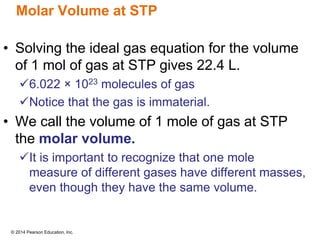
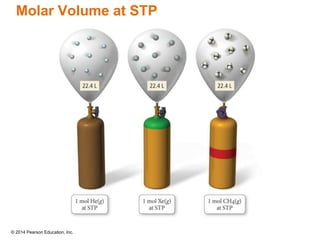
Molar Volume at STP
• Solving the ideal gas equation for the volume
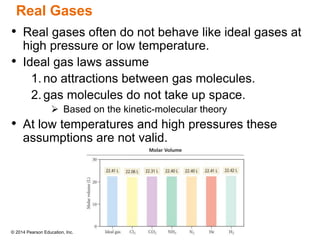
of 1 mol of gas at STP gives 22.4 L.
6.022 × 10²³ molecules of gas
Notice that the gas is immaterial.
• We call the volume of 1 mole of gas at STP
the molar volume.
It is important to recognize that one mole
measure of different gases have different masses,
even though they have the same volume.
© 2014 Pearson Education, Inc.
Molar Volume at STP
© 2014 Pearson Education, Inc.
Density of a Gas at STP
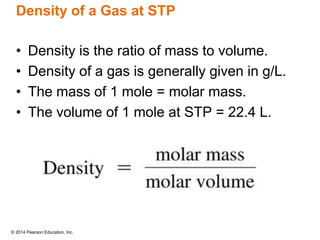
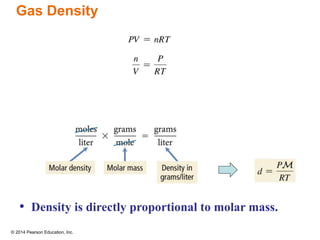
• Density is the ratio of mass to volume.
• Density of a gas is generally given in g/L.
• The mass of 1 mole = molar mass.
• The volume of 1 mole at STP = 22.4 L.
© 2014 Pearson Education, Inc.
Density of a Gas at STP
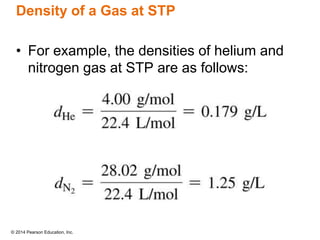
• For example, the densities of helium and
nitrogen gas at STP are as follows:
© 2014 Pearson Education, Inc.
Gas Density
• Density is directly proportional to molar mass.
© 2014 Pearson Education, Inc.
Molar Mass of a Gas
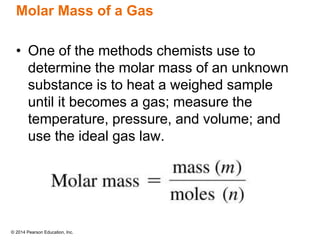
• One of the methods chemists use to
determine the molar mass of an unknown
substance is to heat a weighed sample
until it becomes a gas; measure the
temperature, pressure, and volume; and
use the ideal gas law.
© 2014 Pearson Education, Inc.
Mixtures of Gases
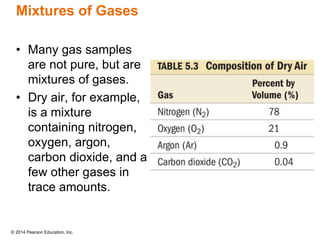
• Many gas samples
are not pure, but are
mixtures of gases.
• Dry air, for example,
is a mixture
containing nitrogen,
oxygen, argon,
carbon dioxide, and a
few other gases in
trace amounts.
© 2014 Pearson Education, Inc.
Mixtures of Gases
• Therefore, in certain applications, the
mixture can be thought of as one gas.
Even though air is a mixture, we can measure
the pressure, volume, and temperature of air
as if it were a pure substance.
We can calculate the total moles of molecules
in an air sample, knowing P, V, and T, even
though they are different molecules.
© 2014 Pearson Education, Inc.
Partial Pressure
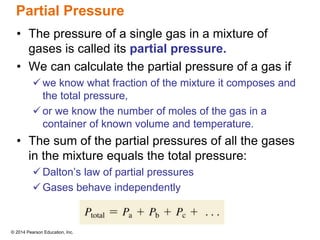
• The pressure of a single gas in a mixture of
gases is called its partial pressure.
• We can calculate the partial pressure of a gas if
 we know what fraction of the mixture it composes and
the total pressure,
 or we know the number of moles of the gas in a
container of known volume and temperature.
• The sum of the partial pressures of all the gases
in the mixture equals the total pressure:
 Dalton’s law of partial pressures
 Gases behave independently
© 2014 Pearson Education, Inc.
Partial Pressure
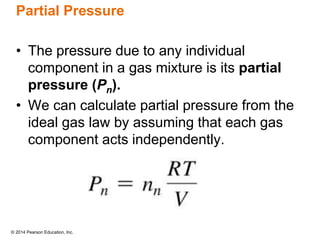
• The pressure due to any individual
component in a gas mixture is its partial
pressure (Pn).
• We can calculate partial pressure from the
ideal gas law by assuming that each gas
component acts independently.
© 2014 Pearson Education, Inc.
Dalton’s Law of Partial Pressures
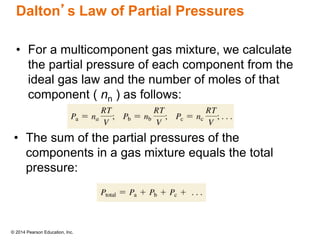
• For a multicomponent gas mixture, we calculate
the partial pressure of each component from the
ideal gas law and the number of moles of that
component ( nn ) as follows:
• The sum of the partial pressures of the
components in a gas mixture equals the total
pressure:
© 2014 Pearson Education, Inc.
Dalton’s Law of Partial Pressures
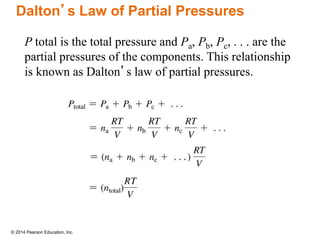
P total is the total pressure and Pa, Pb, Pc, . . . are the
partial pressures of the components. This relationship
is known as Dalton’s law of partial pressures.
© 2014 Pearson Education, Inc.
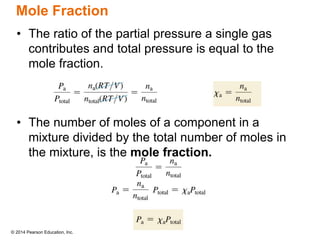
Mole Fraction
• The ratio of the partial pressure a single gas
contributes and total pressure is equal to the
mole fraction.
• The number of moles of a component in a
mixture divided by the total number of moles in
the mixture, is the mole fraction.
© 2014 Pearson Education, Inc.
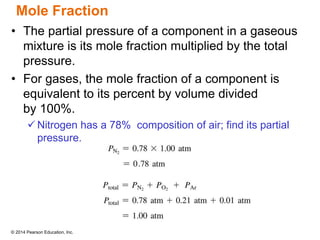
Mole Fraction
• The partial pressure of a component in a gaseous
mixture is its mole fraction multiplied by the total
pressure.
• For gases, the mole fraction of a component is
equivalent to its percent by volume divided
by 100%.
 Nitrogen has a 78% composition of air; find its partial
pressure.
© 2014 Pearson Education, Inc.
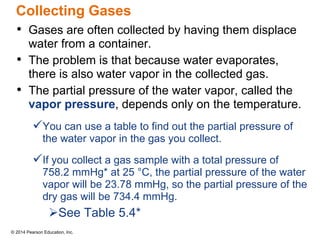
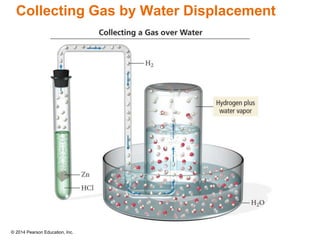
Collecting Gases
• Gases are often collected by having them displace
water from a container.
• The problem is that because water evaporates,
there is also water vapor in the collected gas.
• The partial pressure of the water vapor, called the
vapor pressure, depends only on the temperature.
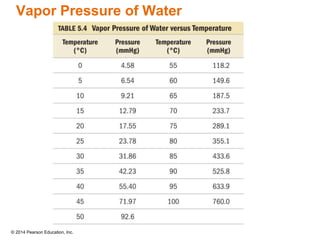
You can use a table to find out the partial pressure of
the water vapor in the gas you collect.
If you collect a gas sample with a total pressure of
758.2 mmHg* at 25 °C, the partial pressure of the water
vapor will be 23.78 mmHg, so the partial pressure of the
dry gas will be 734.4 mmHg.
See Table 5.4*
© 2014 Pearson Education, Inc.
Vapor Pressure of Water
© 2014 Pearson Education, Inc.
Collecting Gas by Water Displacement
© 2014 Pearson Education, Inc.
Reactions Involving Gases
• In reactions involving reactant or products, we
often specify the quantity of a gas in terms of its
volume at a given temperature and pressure.
 As we have seen, stoichiometry involves relationships
between amounts in moles.
 For stoichiometric calculations involving gases, we can use
the ideal gas law to determine the amounts in moles from
the volumes, or to determine the volumes from the amounts
in moles.
© 2014 Pearson Education, Inc.
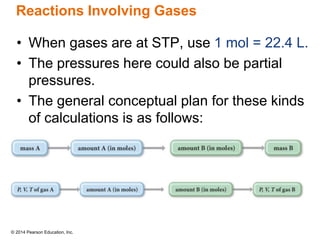
Reactions Involving Gases
• When gases are at STP, use 1 mol = 22.4 L.
• The pressures here could also be partial
pressures.
• The general conceptual plan for these kinds
of calculations is as follows:
© 2014 Pearson Education, Inc.
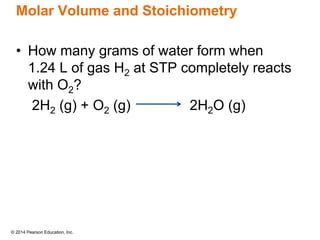
Molar Volume and Stoichiometry
• How many grams of water form when
1.24 L of gas H2 at STP completely reacts
with O2?
2H2 (g) + O2 (g) 2H2O (g)
© 2014 Pearson Education, Inc.
Properties of Gases
• Expand to completely fill their container
• Take the shape of their container
• Low density
Much less than solid or liquid state
• Compressible
• Mixtures of gases are always
homogeneous fluid
© 2014 Pearson Education, Inc.
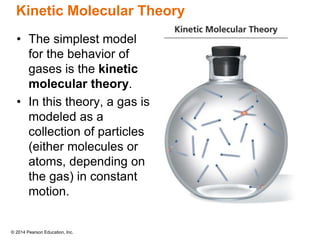
Kinetic Molecular Theory
• The simplest model
for the behavior of
gases is the kinetic
molecular theory.
• In this theory, a gas is
modeled as a
collection of particles
(either molecules or
atoms, depending on
the gas) in constant
motion.
© 2014 Pearson Education, Inc.
Kinetic Molecular Theory
• The particles of the gas (either atoms or
molecules) are constantly moving.
• The attraction between particles is negligible.
• When the moving gas particles hit another gas
particle or the container, they do not stick; but
they bounce off and continue moving in another
direction.
Like billiard balls
• There is a lot of empty space between the gas
particles compared to the size of the particles.
© 2014 Pearson Education, Inc.
Kinetic Molecular Theory
• The average kinetic energy of the gas particles
is directly proportional to the Kelvin temperature.
As you raise the temperature of the gas, the average
speed of the particles increases.
But not all the gas articles are moving at the
same speed!
• The collision of one particle with another (or with
the walls of its container) is completely elastic.
This means that when two particles collide, they
may exchange energy, but there is no overall
loss of energy.
Any kinetic energy lost by one particle is completely
gained by the other.
© 2014 Pearson Education, Inc.
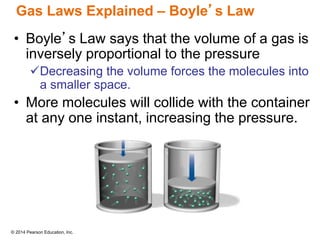
Gas Laws Explained – Boyle’s Law
• Boyle’s Law says that the volume of a gas is
inversely proportional to the pressure
Decreasing the volume forces the molecules into
a smaller space.
• More molecules will collide with the container
at any one instant, increasing the pressure.
© 2014 Pearson Education, Inc.
Gas Laws Explained – Charles’s Law
• Charles’s Law says that the volume of a gas
is directly proportional to the absolute
temperature.
According to kinetic molecular theory, when we
increase the temperature of a gas, the average
speed, and thus the average kinetic energy, of
the particles increases.
• The greater volume spreads the collisions
out over a greater surface area, so that the
pressure is unchanged.
© 2014 Pearson Education, Inc.
Gas Laws Explained – Avogadro’s Law
• Avogadro’s Law says that the volume of a
gas is directly proportional to the number
of gas molecules.
• Increasing the number of gas molecules
causes more of them to hit the wall at the
same time.
• To keep the pressure constant, the volume
must then increase.
© 2014 Pearson Education, Inc.
Gas Laws Explained – Dalton’s Law
• Dalton’s law: the total pressure of a gas
mixture is the sum of the partial pressures.
• According to kinetic molecular theory, the
particles have negligible size and they do
not interact.
Particles of different masses have the same
average kinetic energy at a given temperature.
• Because the average kinetic energy is the
same, the total pressure of the collisions is
the same.
© 2014 Pearson Education, Inc.
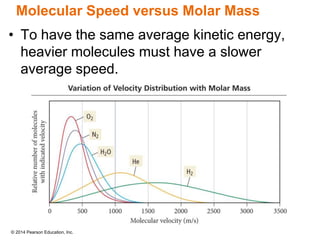
Molecular Speed versus Molar Mass
• To have the same average kinetic energy,
heavier molecules must have a slower
average speed.
© 2014 Pearson Education, Inc.
Diffusion and Effusion
• The process of a collection of molecules
spreading out from high concentration to low
concentration is called diffusion.
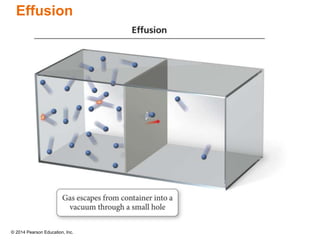
• The process by which a collection of
molecules escapes through a small hole into
a vacuum is called effusion.
The rates of diffusion and effusion of a gas are
both related to its rms average velocity.
For gases at the same temperature, this means
that the rate of gas movement is inversely
proportional to the square root of its molar mass.
© 2014 Pearson Education, Inc.
Effusion
© 2014 Pearson Education, Inc.
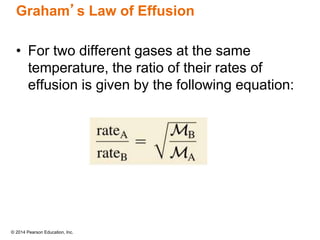
Graham’s Law of Effusion
• For two different gases at the same
temperature, the ratio of their rates of
effusion is given by the following equation:
© 2014 Pearson Education, Inc.
Real Gases
• Real gases often do not behave like ideal gases at
high pressure or low temperature.
• Ideal gas laws assume
1.no attractions between gas molecules.
2.gas molecules do not take up space.
 Based on the kinetic-molecular theory
• At low temperatures and high pressures these
assumptions are not valid.

AP TRO GAS LAWS.ppt

  • 1.
    © 2014 PearsonEducation, Inc. Christian Madu, Ph.D. Collin College Lecture Presentation Chapter 5 Gases
  • 2.
    © 2014 PearsonEducation, Inc. Gas • Gases are composed of particles that are moving around very fast in their container(s). • These particles moves in straight lines until they collides with either the container wall or another particle, then they bounce off. • A snapshot of these particles in a gas, will reveal that there is a lot of empty space in there.
  • 3.
    © 2014 PearsonEducation, Inc. Gas Pressure • Just as a ball exerts a force when it bounces against a wall, a gaseous atom or molecule exerts a force when it collides with a surface. • The result of many of these molecular collisions is pressure. • Pressure is the force exerted per unit area by gas molecules as they strike the surfaces around them.
  • 4.
    © 2014 PearsonEducation, Inc. Gas Pressure • Gas pressure is a result of the constant movement of the gas molecules and their collisions with the surfaces around them. • The pressure of a gas depends on several factors: Number of gas particles in a given volume Volume of the container Average speed of the gas particles
  • 5.
    © 2014 PearsonEducation, Inc. Gas Pressure • The total pressure exerted by a gas depends on several factors, including the concentration of gas molecules in the sample. The higher the concentration, the greater the pressure. • As volume increases, concentration of gas molecules decreases (number of molecules does not change, but since the volume increases, the concentration goes down). This in turn results in fewer molecular collisions, which results in lower pressure.
  • 6.
    © 2014 PearsonEducation, Inc. Atmospheric Pressure Effects • Variation in pressure in Earth’s atmosphere creates wind, and changes in pressure help us to predict weather.  The H’s in this map indicate regions of high pressure, usually associated with clear weather.  The L’s indicate regions of low pressure, usually associated with unstable weather. The number of gas particles in a given volume decreases with increasing altitude.  Hence, pressure decreases with increasing altitude.
  • 7.
    © 2014 PearsonEducation, Inc. • Pressure exerted by a gas is dependent on the number of gas particles in a given volume. • The fewer the gas particles, the lower the force per unit area and the lower the pressure. A low density of gas particles results in low pressure. A high density of gas particles results in high pressure.
  • 8.
    © 2014 PearsonEducation, Inc. The Manometer • The pressure of a gas trapped in a container can be measured with an instrument called a manometer. • Manometers are U-shaped tubes partially filled with a liquid that are connected to the gas sample on one side and open to the air on the other. • A competition is established between the pressures of the atmosphere and the gas. • The difference in the liquid levels is a measure of the difference in pressure between the gas and the atmosphere.
  • 9.
    © 2014 PearsonEducation, Inc. The Manometer For this sample the gas pressure is greater than atmospheric pressure, the mercury level on the left side of the tube is higher than the level on the right.
  • 10.
    © 2014 PearsonEducation, Inc. The Simple Gas Laws • Boyle’s Law • Charles’s Law • Avogadro’s Law • There are four basic properties of a gas: pressure (P), volume (V), temperature (T), and amount in moles (n). These properties are interrelated—when one changes, it affects the others. The simple gas laws describe the relationships between pairs of these properties.
  • 11.
    © 2014 PearsonEducation, Inc. Boyle’s Law: Robert Boyle (1627–1691) • Robert Boyle and Robert Hooke used a J-tube to measure the volume of a sample of gas at different pressures. • They trapped a sample of air in the J-tube and added mercury to increase the pressure on the gas. They observed an inverse relationship between volume and pressure. Hence, an increase in one causes a decrease in the other.
  • 12.
    © 2014 PearsonEducation, Inc. Boyle’s Law
  • 13.
    © 2014 PearsonEducation, Inc. Boyle’s Law • Pressure of a gas is inversely proportional to its volume. Constant T and amount of gas Graph P vs. V is curve Graph P vs. 1/V is straight line • As P increases, V decreases by the same factor. • P × V = constant • P1 × V1 = P2 × V2
  • 14.
    © 2014 PearsonEducation, Inc. Molecular Interpretation of Boyle’s Law As the volume of a gas sample is decreased, gas molecules collide with surrounding surfaces more frequently, resulting in greater pressure.
  • 15.
    © 2014 PearsonEducation, Inc. Boyle’s Law and Diving • For every 10 m of depth, a diver experiences approximately one additional atmosphere of pressure due to the weight of the surrounding water. • At 20 m, for example, the diver experiences approximately 3 atm of pressure.
  • 16.
    © 2014 PearsonEducation, Inc. Boyle’s Law and Diving • If a diver holds his or her breath and rises to the surface quickly, the outside pressure drops to 1 atm. According to Boyle’s law, what should happen to the volume of air in the lungs? • Because the pressure is decreasing by a factor of 3, the volume will expand by a factor of 3, causing damage to internal organs. Always exhale when rising!
  • 17.
    © 2014 PearsonEducation, Inc. Charles’s Law: Volume and Temperature • The volume of a fixed amount of gas at a constant pressure increases linearly with increasing temperature in kelvins: The volume of a gas increases with increasing temperature. • Kelvin T = Celsius T + 273 • V = constant × T (if T measured in Kelvin)
  • 18.
    © 2014 PearsonEducation, Inc. Charles’s Law The extrapolated lines cannot be measured experimentally because all gases condense into liquids before –273.15 °C is reached. If the lines are extrapolated back to a volume of “0,” they all show the same temperature, −273.15 °C = 0 K, called absolute zero
  • 19.
    © 2014 PearsonEducation, Inc. Charles’s Law – A Molecular View If we move a balloon from an ice water bath to a boiling water bath, its volume expands as the gas particles within the balloon move faster (due to the increased temperature) and collectively occupy more space.
  • 20.
    © 2014 PearsonEducation, Inc. Charles’s Law – A Molecular View • When the temperature of a gas sample increases, the gas particles move faster. Collisions with the walls are more frequent. The force exerted with each collision is greater. • The only way for the pressure (the force per unit area) to remain constant is for the gas to occupy a larger volume so that collisions become less frequent and occur over a larger area.
  • 21.
    © 2014 PearsonEducation, Inc. Charles’s Law
  • 22.
    © 2014 PearsonEducation, Inc. Avogadro’s Law, Amedeo Avogadro (1776– 1856) • Volume directly proportional to the number of gas molecules V = constant × n Constant P and T More gas molecules = larger volume • Count number of gas molecules by moles. • Equal volumes of gases contain equal numbers of molecules. The gas doesn't matter.
  • 23.
    © 2014 PearsonEducation, Inc. Avogadro’s Law The volume of a gas sample increases linearly with the number of moles of gas in the sample. When the amount of gas in a sample increases at constant temperature and pressure, its volume increases in direct proportion because the greater number of gas particles fill more space.
  • 24.
    © 2014 PearsonEducation, Inc. Ideal Gas Law • The relationships that we have discussed so far can be combined into a single law that encompasses all of them.
  • 25.
    © 2014 PearsonEducation, Inc. Ideal Gas Law  By combining the gas laws we can write a general equation.  R is called the gas constant.  The value of R depends on the units of P and V. We will use and convert P to atm and V to liters.  The other gas laws are found in the ideal gas law if two variables are kept constant.  The ideal gas law allows us to find one of the variables if we know the other three.
  • 26.
    © 2014 PearsonEducation, Inc. Ideal Gas Law
  • 27.
    © 2014 PearsonEducation, Inc. Standard Conditions • Because the volume of a gas varies with pressure and temperature, chemists have agreed on a set of conditions to report our measurements so that comparison is easy. We call these standard conditions. STP • Standard pressure = 1 atm • Standard temperature = 273 K = 0 °C
  • 28.
    © 2014 PearsonEducation, Inc. Molar Volume • The volume occupied by one mole of a substance is its molar volume at STP (T =273 K or 0 °C and P = 1atm).
  • 29.
    © 2014 PearsonEducation, Inc. Molar Volume at STP • Solving the ideal gas equation for the volume of 1 mol of gas at STP gives 22.4 L. 6.022 × 10²³ molecules of gas Notice that the gas is immaterial. • We call the volume of 1 mole of gas at STP the molar volume. It is important to recognize that one mole measure of different gases have different masses, even though they have the same volume.
  • 30.
    © 2014 PearsonEducation, Inc. Molar Volume at STP
  • 31.
    © 2014 PearsonEducation, Inc. Density of a Gas at STP • Density is the ratio of mass to volume. • Density of a gas is generally given in g/L. • The mass of 1 mole = molar mass. • The volume of 1 mole at STP = 22.4 L.
  • 32.
    © 2014 PearsonEducation, Inc. Density of a Gas at STP • For example, the densities of helium and nitrogen gas at STP are as follows:
  • 33.
    © 2014 PearsonEducation, Inc. Gas Density • Density is directly proportional to molar mass.
  • 34.
    © 2014 PearsonEducation, Inc. Molar Mass of a Gas • One of the methods chemists use to determine the molar mass of an unknown substance is to heat a weighed sample until it becomes a gas; measure the temperature, pressure, and volume; and use the ideal gas law.
  • 35.
    © 2014 PearsonEducation, Inc. Mixtures of Gases • Many gas samples are not pure, but are mixtures of gases. • Dry air, for example, is a mixture containing nitrogen, oxygen, argon, carbon dioxide, and a few other gases in trace amounts.
  • 36.
    © 2014 PearsonEducation, Inc. Mixtures of Gases • Therefore, in certain applications, the mixture can be thought of as one gas. Even though air is a mixture, we can measure the pressure, volume, and temperature of air as if it were a pure substance. We can calculate the total moles of molecules in an air sample, knowing P, V, and T, even though they are different molecules.
  • 37.
    © 2014 PearsonEducation, Inc. Partial Pressure • The pressure of a single gas in a mixture of gases is called its partial pressure. • We can calculate the partial pressure of a gas if  we know what fraction of the mixture it composes and the total pressure,  or we know the number of moles of the gas in a container of known volume and temperature. • The sum of the partial pressures of all the gases in the mixture equals the total pressure:  Dalton’s law of partial pressures  Gases behave independently
  • 38.
    © 2014 PearsonEducation, Inc. Partial Pressure • The pressure due to any individual component in a gas mixture is its partial pressure (Pn). • We can calculate partial pressure from the ideal gas law by assuming that each gas component acts independently.
  • 39.
    © 2014 PearsonEducation, Inc. Dalton’s Law of Partial Pressures • For a multicomponent gas mixture, we calculate the partial pressure of each component from the ideal gas law and the number of moles of that component ( nn ) as follows: • The sum of the partial pressures of the components in a gas mixture equals the total pressure:
  • 40.
    © 2014 PearsonEducation, Inc. Dalton’s Law of Partial Pressures P total is the total pressure and Pa, Pb, Pc, . . . are the partial pressures of the components. This relationship is known as Dalton’s law of partial pressures.
  • 41.
    © 2014 PearsonEducation, Inc. Mole Fraction • The ratio of the partial pressure a single gas contributes and total pressure is equal to the mole fraction. • The number of moles of a component in a mixture divided by the total number of moles in the mixture, is the mole fraction.
  • 42.
    © 2014 PearsonEducation, Inc. Mole Fraction • The partial pressure of a component in a gaseous mixture is its mole fraction multiplied by the total pressure. • For gases, the mole fraction of a component is equivalent to its percent by volume divided by 100%.  Nitrogen has a 78% composition of air; find its partial pressure.
  • 43.
    © 2014 PearsonEducation, Inc. Collecting Gases • Gases are often collected by having them displace water from a container. • The problem is that because water evaporates, there is also water vapor in the collected gas. • The partial pressure of the water vapor, called the vapor pressure, depends only on the temperature. You can use a table to find out the partial pressure of the water vapor in the gas you collect. If you collect a gas sample with a total pressure of 758.2 mmHg* at 25 °C, the partial pressure of the water vapor will be 23.78 mmHg, so the partial pressure of the dry gas will be 734.4 mmHg. See Table 5.4*
  • 44.
    © 2014 PearsonEducation, Inc. Vapor Pressure of Water
  • 45.
    © 2014 PearsonEducation, Inc. Collecting Gas by Water Displacement
  • 46.
    © 2014 PearsonEducation, Inc. Reactions Involving Gases • In reactions involving reactant or products, we often specify the quantity of a gas in terms of its volume at a given temperature and pressure.  As we have seen, stoichiometry involves relationships between amounts in moles.  For stoichiometric calculations involving gases, we can use the ideal gas law to determine the amounts in moles from the volumes, or to determine the volumes from the amounts in moles.
  • 47.
    © 2014 PearsonEducation, Inc. Reactions Involving Gases • When gases are at STP, use 1 mol = 22.4 L. • The pressures here could also be partial pressures. • The general conceptual plan for these kinds of calculations is as follows:
  • 48.
    © 2014 PearsonEducation, Inc. Molar Volume and Stoichiometry • How many grams of water form when 1.24 L of gas H2 at STP completely reacts with O2? 2H2 (g) + O2 (g) 2H2O (g)
  • 49.
    © 2014 PearsonEducation, Inc. Properties of Gases • Expand to completely fill their container • Take the shape of their container • Low density Much less than solid or liquid state • Compressible • Mixtures of gases are always homogeneous fluid
  • 50.
    © 2014 PearsonEducation, Inc. Kinetic Molecular Theory • The simplest model for the behavior of gases is the kinetic molecular theory. • In this theory, a gas is modeled as a collection of particles (either molecules or atoms, depending on the gas) in constant motion.
  • 51.
    © 2014 PearsonEducation, Inc. Kinetic Molecular Theory • The particles of the gas (either atoms or molecules) are constantly moving. • The attraction between particles is negligible. • When the moving gas particles hit another gas particle or the container, they do not stick; but they bounce off and continue moving in another direction. Like billiard balls • There is a lot of empty space between the gas particles compared to the size of the particles.
  • 52.
    © 2014 PearsonEducation, Inc. Kinetic Molecular Theory • The average kinetic energy of the gas particles is directly proportional to the Kelvin temperature. As you raise the temperature of the gas, the average speed of the particles increases. But not all the gas articles are moving at the same speed! • The collision of one particle with another (or with the walls of its container) is completely elastic. This means that when two particles collide, they may exchange energy, but there is no overall loss of energy. Any kinetic energy lost by one particle is completely gained by the other.
  • 53.
    © 2014 PearsonEducation, Inc. Gas Laws Explained – Boyle’s Law • Boyle’s Law says that the volume of a gas is inversely proportional to the pressure Decreasing the volume forces the molecules into a smaller space. • More molecules will collide with the container at any one instant, increasing the pressure.
  • 54.
    © 2014 PearsonEducation, Inc. Gas Laws Explained – Charles’s Law • Charles’s Law says that the volume of a gas is directly proportional to the absolute temperature. According to kinetic molecular theory, when we increase the temperature of a gas, the average speed, and thus the average kinetic energy, of the particles increases. • The greater volume spreads the collisions out over a greater surface area, so that the pressure is unchanged.
  • 55.
    © 2014 PearsonEducation, Inc. Gas Laws Explained – Avogadro’s Law • Avogadro’s Law says that the volume of a gas is directly proportional to the number of gas molecules. • Increasing the number of gas molecules causes more of them to hit the wall at the same time. • To keep the pressure constant, the volume must then increase.
  • 56.
    © 2014 PearsonEducation, Inc. Gas Laws Explained – Dalton’s Law • Dalton’s law: the total pressure of a gas mixture is the sum of the partial pressures. • According to kinetic molecular theory, the particles have negligible size and they do not interact. Particles of different masses have the same average kinetic energy at a given temperature. • Because the average kinetic energy is the same, the total pressure of the collisions is the same.
  • 57.
    © 2014 PearsonEducation, Inc. Molecular Speed versus Molar Mass • To have the same average kinetic energy, heavier molecules must have a slower average speed.
  • 58.
    © 2014 PearsonEducation, Inc. Diffusion and Effusion • The process of a collection of molecules spreading out from high concentration to low concentration is called diffusion. • The process by which a collection of molecules escapes through a small hole into a vacuum is called effusion. The rates of diffusion and effusion of a gas are both related to its rms average velocity. For gases at the same temperature, this means that the rate of gas movement is inversely proportional to the square root of its molar mass.
  • 59.
    © 2014 PearsonEducation, Inc. Effusion
  • 60.
    © 2014 PearsonEducation, Inc. Graham’s Law of Effusion • For two different gases at the same temperature, the ratio of their rates of effusion is given by the following equation:
  • 61.
    © 2014 PearsonEducation, Inc. Real Gases • Real gases often do not behave like ideal gases at high pressure or low temperature. • Ideal gas laws assume 1.no attractions between gas molecules. 2.gas molecules do not take up space.  Based on the kinetic-molecular theory • At low temperatures and high pressures these assumptions are not valid.