DECENTRALIZATION AND
THEORY OF MIGRATION

Presented by :- Urushali Shankar karale (111214015)
Rohan Ashok Pandit
(111214032)
DECENTRALISATION
A. Concept and City Evolution
a. Motor Age
b. Globalization
c. Ease of Administration
B. Nodes for Decentralization
a. Recreational
b. Educational
c. Technological
C. Bid-rent theory

MIGRATION
A .Theory of Migration (The Push-Pull factors)
B . Migration in western civilizations
Eastern Countries
C. Special Area Planning (intro and details)
D. Aerotropolis (with Case Studies)
Conclusion/Inferences
DECENTRALIZATION :
Decentralization :- The process of transferring and assigning
decision-making authority to lower level of an organization hierarchy.
In a decentralization, the decision making has
been moved to the lower levels or tiers of the organization, such as
division, branches,
departments or subsidiaries.
Knowledge, information and ideas are flowing
from the bottom to the top of the organization.
The span of the control to top managers is relatively small, and there
are relatively few tiers in the organization, because there because there is
more autonomy in the lower ranks.
Decentralization concept & City Evolution
As Jean Jacobs explained in her book- Life and Death of Great
American cities; the early migration to the outskirts took place due to the
unhealthy/low standards of living in the city after Industrial revolution
and the advent of Motor Age, which allowed people to travel large
distances.

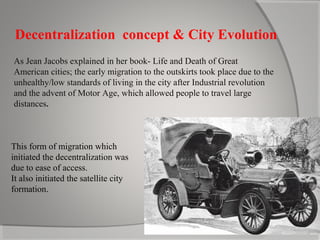
This form of migration which
initiated the decentralization was
due to ease of access.
It also initiated the satellite city
formation.
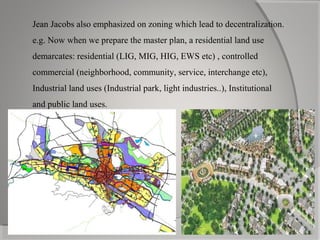
Jean Jacobs also emphasized on zoning which lead to decentralization.
e.g. Now when we prepare the master plan, a residential land use
demarcates: residential (LIG, MIG, HIG, EWS etc) , controlled
commercial (neighborhood, community, service, interchange etc),
Industrial land uses (Industrial park, light industries..), Institutional
and public land uses.
Globalization :
Globalization refers to processes that increase world-wide exchanges of national
and cultural resources. Advances in transportation and telecommunications
infrastructure and its posterity
Internet, are major factors in globalization, generating further interdependence of
economic and cultural activities.
This phenomenon brought world closer due to the advances in transportation. Air
travel, fast transit vehicles, cheap mass transport means helped in bringing the world
closer.
A person staying in the rural areas was thus able to enjoy Urban facilities.
Advancements in Telecommunication further helped the cause.
Now, people started migrating away from the city for peace of mind; to achieve an
abode away from the humdrum city life.
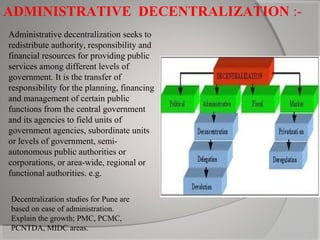
ADMINISTRATIVE DECENTRALIZATION :Administrative decentralization seeks to
redistribute authority, responsibility and
financial resources for providing public
services among different levels of
government. It is the transfer of
responsibility for the planning, financing
and management of certain public
functions from the central government
and its agencies to field units of
government agencies, subordinate units
or levels of government, semiautonomous public authorities or
corporations, or area-wide, regional or
functional authorities. e.g.
Decentralization studies for Pune are
based on ease of administration.
Explain the growth; PMC, PCMC,
PCNTDA, MIDC areas.
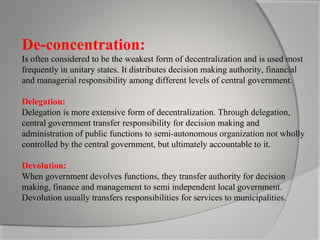
De-concentration:
Is often considered to be the weakest form of decentralization and is used most
frequently in unitary states. It distributes decision making authority, financial
and managerial responsibility among different levels of central government.
Delegation:
Delegation is more extensive form of decentralization. Through delegation,
central government transfer responsibility for decision making and
administration of public functions to semi-autonomous organization not wholly
controlled by the central government, but ultimately accountable to it.
Devolution:
When government devolves functions, they transfer authority for decision
making, finance and management to semi independent local government.
Devolution usually transfers responsibilities for services to municipalities.
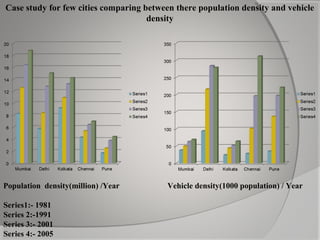
Case study for few cities comparing between there population density and vehicle
density

Population density(million) /Year
Series1:- 1981
Series 2:-1991
Series 3:- 2001
Series 4:- 2005

Vehicle density(1000 population) / Year
CONCLUSION :As seen from the case study above, we came to a conclusion
that
Population density and vehicle density are interlinked with
each other.
They are directly proportional to each other as the
population increases the vehicle density also increases.
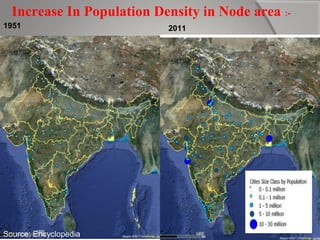
Increase In Population Density in Node area :1951

Source: Encyclopedia

2011
Nodes of Decentralization:
Recreational nodes:
Recreational factors attract population from longer area to them. recreational
factors like zoo, amusements parks ,theatres, malls, golf courses, boat clubs, gliding
centers attracts enthusiast .tot –lots, play grounds for children sitting spaces for elders
are some of the most common recreational spaces that favors decentralization e.g..
Katraj zoo, yerawada golf course, sambhaji garden, sarasbhag, pu.la. Udyan are some
of the pune’s recreational spaces that favors large decentralization.
Educational nodes:
Special training ,technical ,arts, management institutes attracts large amount of
population towards to them. Sinhagad institute, d.y.patil , MIT ,symbiosis , Fergusson ,
Wadia are some of the institutes which causes many students to travel to them.
e.g. symbiosis institute is a best institute that decentralize
students around the globe.
Technological nodes:
Upcoming IT sector in pune has attracted many IT workers from country to it,
new technological area brings the decentralization of engineers and supports staff
around the workplace.
e.g. hinjewadi, Kharadi, Baner, Pashan, Hadapsar are pune’s IT emerging
area, that brings the decentralization of skilled workers.
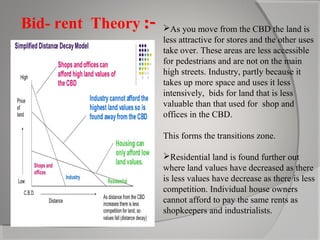
Bid- rent Theory :-

As you move from the CBD the land is
less attractive for stores and the other uses
take over. These areas are less accessible
for pedestrians and are not on the main
high streets. Industry, partly because it
takes up more space and uses it less
intensively, bids for land that is less
valuable than that used for shop and
offices in the CBD.
This forms the transitions zone.
Residential land is found further out
where land values have decreased as there
is less values have decrease as there is less
competition. Individual house owners
cannot afford to pay the same rents as
shopkeepers and industrialists.
MIGRATION:
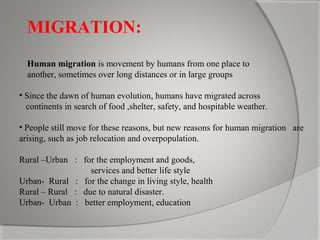
Human migration is movement by humans from one place to
another, sometimes over long distances or in large groups
• Since the dawn of human evolution, humans have migrated across
continents in search of food ,shelter, safety, and hospitable weather.
• People still move for these reasons, but new reasons for human migration are
arising, such as job relocation and overpopulation.
Rural –Urban : for the employment and goods,
services and better life style
Urban- Rural : for the change in living style, health
Rural – Rural : due to natural disaster.
Urban- Urban : better employment, education
Migration Theory :
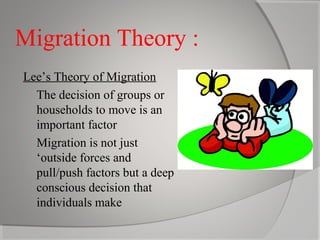
Lee’s Theory of Migration
 The decision of groups or
households to move is an
important factor
 Migration is not just
‘outside forces and
pull/push factors but a deep
conscious decision that
individuals make
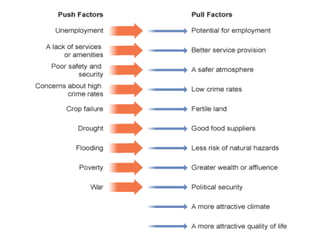
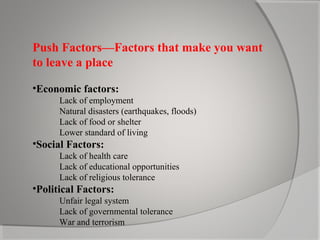
Push Factors—Factors that make you want
to leave a place
•Economic factors:
Lack of employment
Natural disasters (earthquakes, floods)
Lack of food or shelter
Lower standard of living

•Social Factors:
Lack of health care
Lack of educational opportunities
Lack of religious tolerance

•Political Factors:
Unfair legal system
Lack of governmental tolerance
War and terrorism
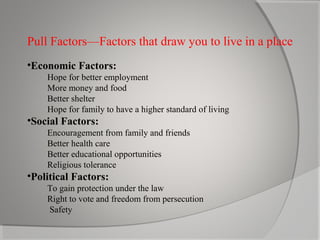
Pull Factors—Factors that draw you to live in a place
•Economic Factors:
Hope for better employment
More money and food
Better shelter
Hope for family to have a higher standard of living

•Social Factors:
Encouragement from family and friends
Better health care
Better educational opportunities
Religious tolerance

•Political Factors:
To gain protection under the law
Right to vote and freedom from persecution
Safety
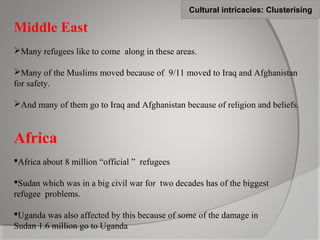
Cultural intricacies: Clusterising

Middle East
Many refugees like to come along in these areas.
Many of the Muslims moved because of 9/11 moved to Iraq and Afghanistan
for safety.
And many of them go to Iraq and Afghanistan because of religion and beliefs.

Africa
Africa about 8 million “official ” refugees
Sudan which was in a big civil war for two decades has of the biggest
refugee problems.
Uganda was also affected by this because of some of the damage in
Sudan 1.6 million go to Uganda
North Africa And Southwest Asia
Million of refugees came from the Gulf War of 1991
The current war has generated 2 million refugees
The Taliban enforced strict Islamic rules
All the countries of Southwest Asia have to deal with refugees
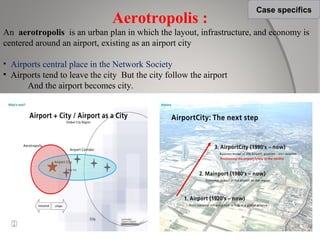
Aerotropolis :

Case specifics

An aerotropolis is an urban plan in which the layout, infrastructure, and economy is
centered around an airport, existing as an airport city
• Airports central place in the Network Society
• Airports tend to leave the city But the city follow the airport
And the airport becomes city.
Globalization lies at the Root of the Aerotropolis:
In the aerotropolis, the goods-based economy is built on a “physical Internet”
comprised of hubs and planes. Cities grow when they are able to effectively
utilize technology to expand their networks and reach, creating a grid that
shortens the distances between neighboring cities. This helps cities, and the
businesses within them, to become more competitive as supply chains and
networks become an increasingly vital part of how companies gain competitive
advantage
The aerotropolis has essentially evolved the role of a traditional airport, moving
it from an infrastructure provider to a service provider. The modern-day
aerotropolis focuses on megacities, urban development, vertical clusters with top
companies and free trade zones.
Special Economic Zone :
A Special Economic Zone (SEZ) is a geographical region that is
designed to export goods and provide employment.
SEZs are exempt from federal laws regarding taxes, quotas, FDI-bans,
labour laws and other restrictive laws in order to make the goods
manufactured in the SEZ at a globally competitive price.
The category SEZ includes
 free trade zones (FTZ),
export processing Zones (EPZ),
 free Zones (FZ),
 industrial parks or industrial estates (IE),
free ports, free economic zones, and urban enterprise zones.
Conclusion :
From the above study we learnt how the decentralization takes place in
settlements, how the pull -push factors affect the migration of people. We
even concluded that the population density is directly proportional to the
vehicle density from case study. From the report we saw migration is
caused due to various political, social, economical factors, and is a very
dynamic process.
In Indian context decentralisation mainly occurs due to economical factors
and for employment. Uttarpradesh, Bihar are well known for the labor
workers. In western and eastern countries the main reason for the
migration were wars and unemployment.
So from all the above conclusion we made out that people get migrate to
make there life save and to meet all basic requirements to live a better life.

Decentralization concept & city evolution

  • 1.
    DECENTRALIZATION AND THEORY OFMIGRATION Presented by :- Urushali Shankar karale (111214015) Rohan Ashok Pandit (111214032)
  • 2.
    DECENTRALISATION A. Concept andCity Evolution a. Motor Age b. Globalization c. Ease of Administration B. Nodes for Decentralization a. Recreational b. Educational c. Technological C. Bid-rent theory MIGRATION A .Theory of Migration (The Push-Pull factors) B . Migration in western civilizations Eastern Countries C. Special Area Planning (intro and details) D. Aerotropolis (with Case Studies) Conclusion/Inferences
  • 3.
    DECENTRALIZATION : Decentralization :-The process of transferring and assigning decision-making authority to lower level of an organization hierarchy. In a decentralization, the decision making has been moved to the lower levels or tiers of the organization, such as division, branches, departments or subsidiaries. Knowledge, information and ideas are flowing from the bottom to the top of the organization. The span of the control to top managers is relatively small, and there are relatively few tiers in the organization, because there because there is more autonomy in the lower ranks.
  • 4.
    Decentralization concept &City Evolution As Jean Jacobs explained in her book- Life and Death of Great American cities; the early migration to the outskirts took place due to the unhealthy/low standards of living in the city after Industrial revolution and the advent of Motor Age, which allowed people to travel large distances. This form of migration which initiated the decentralization was due to ease of access. It also initiated the satellite city formation.
  • 5.
    Jean Jacobs alsoemphasized on zoning which lead to decentralization. e.g. Now when we prepare the master plan, a residential land use demarcates: residential (LIG, MIG, HIG, EWS etc) , controlled commercial (neighborhood, community, service, interchange etc), Industrial land uses (Industrial park, light industries..), Institutional and public land uses.
  • 6.
    Globalization : Globalization refersto processes that increase world-wide exchanges of national and cultural resources. Advances in transportation and telecommunications infrastructure and its posterity Internet, are major factors in globalization, generating further interdependence of economic and cultural activities. This phenomenon brought world closer due to the advances in transportation. Air travel, fast transit vehicles, cheap mass transport means helped in bringing the world closer. A person staying in the rural areas was thus able to enjoy Urban facilities. Advancements in Telecommunication further helped the cause. Now, people started migrating away from the city for peace of mind; to achieve an abode away from the humdrum city life.
  • 7.
    ADMINISTRATIVE DECENTRALIZATION :Administrativedecentralization seeks to redistribute authority, responsibility and financial resources for providing public services among different levels of government. It is the transfer of responsibility for the planning, financing and management of certain public functions from the central government and its agencies to field units of government agencies, subordinate units or levels of government, semiautonomous public authorities or corporations, or area-wide, regional or functional authorities. e.g. Decentralization studies for Pune are based on ease of administration. Explain the growth; PMC, PCMC, PCNTDA, MIDC areas.
  • 8.
    De-concentration: Is often consideredto be the weakest form of decentralization and is used most frequently in unitary states. It distributes decision making authority, financial and managerial responsibility among different levels of central government. Delegation: Delegation is more extensive form of decentralization. Through delegation, central government transfer responsibility for decision making and administration of public functions to semi-autonomous organization not wholly controlled by the central government, but ultimately accountable to it. Devolution: When government devolves functions, they transfer authority for decision making, finance and management to semi independent local government. Devolution usually transfers responsibilities for services to municipalities.
  • 9.
    Case study forfew cities comparing between there population density and vehicle density Population density(million) /Year Series1:- 1981 Series 2:-1991 Series 3:- 2001 Series 4:- 2005 Vehicle density(1000 population) / Year
  • 10.
    CONCLUSION :As seenfrom the case study above, we came to a conclusion that Population density and vehicle density are interlinked with each other. They are directly proportional to each other as the population increases the vehicle density also increases.
  • 11.
    Increase In PopulationDensity in Node area :1951 Source: Encyclopedia 2011
  • 12.
    Nodes of Decentralization: Recreationalnodes: Recreational factors attract population from longer area to them. recreational factors like zoo, amusements parks ,theatres, malls, golf courses, boat clubs, gliding centers attracts enthusiast .tot –lots, play grounds for children sitting spaces for elders are some of the most common recreational spaces that favors decentralization e.g.. Katraj zoo, yerawada golf course, sambhaji garden, sarasbhag, pu.la. Udyan are some of the pune’s recreational spaces that favors large decentralization. Educational nodes: Special training ,technical ,arts, management institutes attracts large amount of population towards to them. Sinhagad institute, d.y.patil , MIT ,symbiosis , Fergusson , Wadia are some of the institutes which causes many students to travel to them. e.g. symbiosis institute is a best institute that decentralize students around the globe. Technological nodes: Upcoming IT sector in pune has attracted many IT workers from country to it, new technological area brings the decentralization of engineers and supports staff around the workplace. e.g. hinjewadi, Kharadi, Baner, Pashan, Hadapsar are pune’s IT emerging area, that brings the decentralization of skilled workers.
  • 13.
    Bid- rent Theory:- As you move from the CBD the land is less attractive for stores and the other uses take over. These areas are less accessible for pedestrians and are not on the main high streets. Industry, partly because it takes up more space and uses it less intensively, bids for land that is less valuable than that used for shop and offices in the CBD. This forms the transitions zone. Residential land is found further out where land values have decreased as there is less values have decrease as there is less competition. Individual house owners cannot afford to pay the same rents as shopkeepers and industrialists.
  • 14.
    MIGRATION: Human migration ismovement by humans from one place to another, sometimes over long distances or in large groups • Since the dawn of human evolution, humans have migrated across continents in search of food ,shelter, safety, and hospitable weather. • People still move for these reasons, but new reasons for human migration are arising, such as job relocation and overpopulation. Rural –Urban : for the employment and goods, services and better life style Urban- Rural : for the change in living style, health Rural – Rural : due to natural disaster. Urban- Urban : better employment, education
  • 15.
    Migration Theory : Lee’sTheory of Migration  The decision of groups or households to move is an important factor  Migration is not just ‘outside forces and pull/push factors but a deep conscious decision that individuals make
  • 17.
    Push Factors—Factors thatmake you want to leave a place •Economic factors: Lack of employment Natural disasters (earthquakes, floods) Lack of food or shelter Lower standard of living •Social Factors: Lack of health care Lack of educational opportunities Lack of religious tolerance •Political Factors: Unfair legal system Lack of governmental tolerance War and terrorism
  • 18.
    Pull Factors—Factors thatdraw you to live in a place •Economic Factors: Hope for better employment More money and food Better shelter Hope for family to have a higher standard of living •Social Factors: Encouragement from family and friends Better health care Better educational opportunities Religious tolerance •Political Factors: To gain protection under the law Right to vote and freedom from persecution Safety
  • 19.
    Cultural intricacies: Clusterising MiddleEast Many refugees like to come along in these areas. Many of the Muslims moved because of 9/11 moved to Iraq and Afghanistan for safety. And many of them go to Iraq and Afghanistan because of religion and beliefs. Africa Africa about 8 million “official ” refugees Sudan which was in a big civil war for two decades has of the biggest refugee problems. Uganda was also affected by this because of some of the damage in Sudan 1.6 million go to Uganda
  • 20.
    North Africa AndSouthwest Asia Million of refugees came from the Gulf War of 1991 The current war has generated 2 million refugees The Taliban enforced strict Islamic rules All the countries of Southwest Asia have to deal with refugees
  • 21.
    Aerotropolis : Case specifics Anaerotropolis is an urban plan in which the layout, infrastructure, and economy is centered around an airport, existing as an airport city • Airports central place in the Network Society • Airports tend to leave the city But the city follow the airport And the airport becomes city.
  • 22.
    Globalization lies atthe Root of the Aerotropolis: In the aerotropolis, the goods-based economy is built on a “physical Internet” comprised of hubs and planes. Cities grow when they are able to effectively utilize technology to expand their networks and reach, creating a grid that shortens the distances between neighboring cities. This helps cities, and the businesses within them, to become more competitive as supply chains and networks become an increasingly vital part of how companies gain competitive advantage The aerotropolis has essentially evolved the role of a traditional airport, moving it from an infrastructure provider to a service provider. The modern-day aerotropolis focuses on megacities, urban development, vertical clusters with top companies and free trade zones.
  • 23.
    Special Economic Zone: A Special Economic Zone (SEZ) is a geographical region that is designed to export goods and provide employment. SEZs are exempt from federal laws regarding taxes, quotas, FDI-bans, labour laws and other restrictive laws in order to make the goods manufactured in the SEZ at a globally competitive price. The category SEZ includes  free trade zones (FTZ), export processing Zones (EPZ),  free Zones (FZ),  industrial parks or industrial estates (IE), free ports, free economic zones, and urban enterprise zones.
  • 24.
    Conclusion : From theabove study we learnt how the decentralization takes place in settlements, how the pull -push factors affect the migration of people. We even concluded that the population density is directly proportional to the vehicle density from case study. From the report we saw migration is caused due to various political, social, economical factors, and is a very dynamic process. In Indian context decentralisation mainly occurs due to economical factors and for employment. Uttarpradesh, Bihar are well known for the labor workers. In western and eastern countries the main reason for the migration were wars and unemployment. So from all the above conclusion we made out that people get migrate to make there life save and to meet all basic requirements to live a better life.