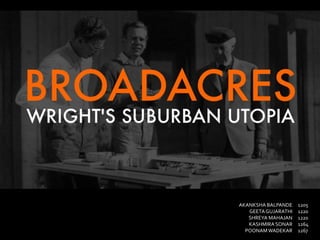
AKANKSHA BALPANDE
GEETAGUJARATHI
SHREYA MAHAJAN
KASHMIRA SONAR
POONAMWADEKAR
1205
1220
1220
1264
1267
FRANK LLOYD WRIGHT’S UTOPIAN DYSTOPIA
A TRULY
PROPHETIC
VISION OF
MODERN
AMERICA
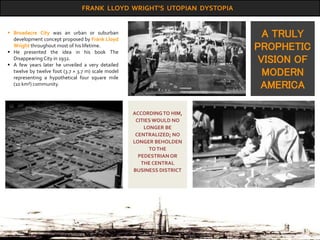
 Broadacre City was an urban or suburban
development concept proposed by Frank Lloyd
Wright throughout most of his lifetime.
 He presented the idea in his book The
Disappearing City in 1932.
 A few years later he unveiled a very detailed
twelve by twelve foot (3.7 × 3.7 m) scale model
representing a hypothetical four square mile
(10 km²) community.
ACCORDINGTO HIM,
CITIESWOULD NO
LONGER BE
CENTRALIZED; NO
LONGER BEHOLDEN
TOTHE
PEDESTRIAN OR
THE CENTRAL
BUSINESS DISTRICT
FRANK LLOYD WRIGHT’S UTOPIAN DYSTOPIA
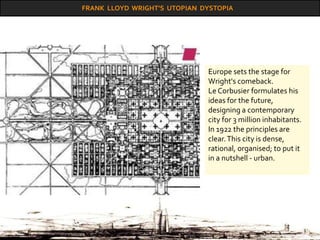
Europe sets the stage for
Wright's comeback.
Le Corbusier formulates his
ideas for the future,
designing a contemporary
city for 3 million inhabitants.
In 1922 the principles are
clear.This city is dense,
rational, organised; to put it
in a nutshell - urban.
FRANK LLOYD WRIGHT’S UTOPIAN DYSTOPIA
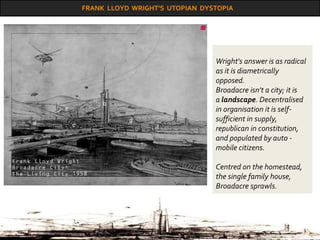
Wright's answer is as radical
as it is diametrically
opposed.
Broadacre isn't a city; it is
a landscape. Decentralised
in organisation it is self-
sufficient in supply,
republican in constitution,
and populated by auto -
mobile citizens.
Centred on the homestead,
the single family house,
Broadacre sprawls.
FRANK LLOYD WRIGHT’S UTOPIAN DYSTOPIA
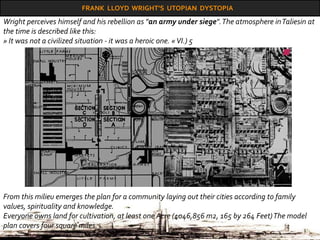
From this milieu emerges the plan for a community laying out their cities according to family
values, spirituality and knowledge.
Everyone owns land for cultivation, at least one Acre (4046,856 m2, 165 by 264 Feet)The model
plan covers four square miles.
Wright perceives himself and his rebellion as "an army under siege".The atmosphere inTaliesin at
the time is described like this:
» It was not a civilized situation - it was a heroic one. «VI.) 5
FRANK LLOYD WRIGHT’S UTOPIAN DYSTOPIA
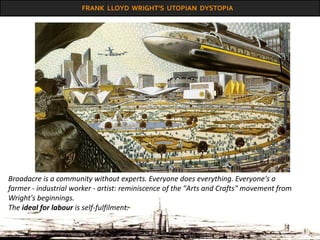
Broadacre is a community without experts. Everyone does everything. Everyone's a
farmer - industrial worker - artist: reminiscence of the "Arts and Crafts" movement from
Wright's beginnings.
The ideal for labour is self-fulfilment.
FRANK LLOYD WRIGHT’S UTOPIAN DYSTOPIA
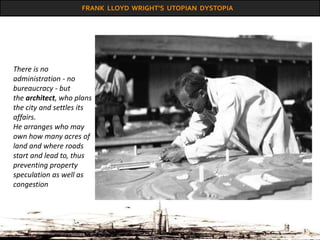
There is no
administration - no
bureaucracy - but
the architect, who plans
the city and settles its
affairs.
He arranges who may
own how many acres of
land and where roads
start and lead to, thus
preventing property
speculation as well as
congestion
FRANK LLOYD WRIGHT’S UTOPIAN DYSTOPIA
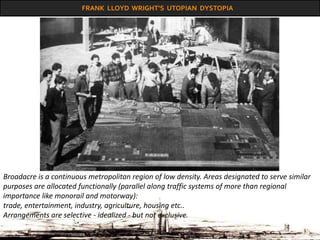
Broadacre is a continuous metropolitan region of low density. Areas designated to serve similar
purposes are allocated functionally (parallel along traffic systems of more than regional
importance like monorail and motorway):
trade, entertainment, industry, agriculture, housing etc..
Arrangements are selective - idealized - but not exclusive.
FRANK LLOYD WRIGHT’S UTOPIAN DYSTOPIA
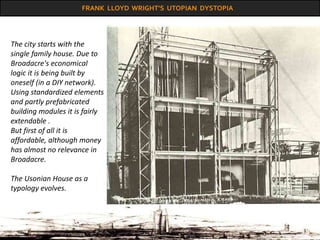
The city starts with the
single family house. Due to
Broadacre's economical
logic it is being built by
oneself (in a DIY network).
Using standardized elements
and partly prefabricated
building modules it is fairly
extendable .
But first of all it is
affordable, although money
has almost no relevance in
Broadacre.
The Usonian House as a
typology evolves.
FRANK LLOYD WRIGHT’S UTOPIAN DYSTOPIA
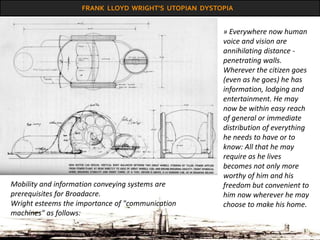
» Everywhere now human
voice and vision are
annihilating distance -
penetrating walls.
Wherever the citizen goes
(even as he goes) he has
information, lodging and
entertainment. He may
now be within easy reach
of general or immediate
distribution of everything
he needs to have or to
know: All that he may
require as he lives
becomes not only more
worthy of him and his
freedom but convenient to
him now wherever he may
choose to make his home.
Mobility and information conveying systems are
prerequisites for Broadacre.
Wright esteems the importance of "communication
machines" as follows:
FRANK LLOYD WRIGHT’S UTOPIAN DYSTOPIA
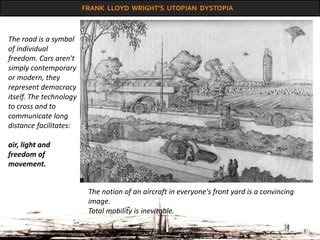
The notion of an aircraft in everyone's front yard is a convincing
image.
Total mobility is inevitable.
The road is a symbol
of individual
freedom. Cars aren't
simply contemporary
or modern, they
represent democracy
itself. The technology
to cross and to
communicate long
distance facilitates:
air, light and
freedom of
movement.
FRANK LLOYD WRIGHT’S UTOPIAN DYSTOPIA
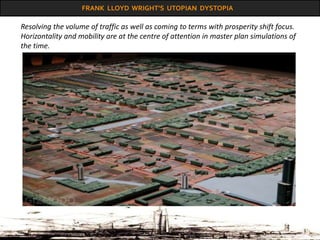
Resolving the volume of traffic as well as coming to terms with prosperity shift focus.
Horizontality and mobility are at the centre of attention in master plan simulations of
the time.
FRANK LLOYD WRIGHT’S UTOPIAN DYSTOPIA
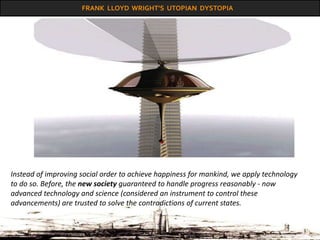
Instead of improving social order to achieve happiness for mankind, we apply technology
to do so. Before, the new society guaranteed to handle progress reasonably - now
advanced technology and science (considered an instrument to control these
advancements) are trusted to solve the contradictions of current states.
FRANK LLOYD WRIGHT’S UTOPIAN DYSTOPIA
By 1958 Broadacre remains true to its socioeconomic concept, but generates different images.
It sells via monuments, Frank Lloyd Wright's monuments. The 'air-rotor' [helicopter] becomes
a trademark.
FRANK LLOYD WRIGHT’S UTOPIAN DYSTOPIA
Still, the conclusive statement by Robert Fishman's 1977 analysis of Broadacre City
constitutes the keenest critique possible.
» […] The plan was democratic not because it had been debated in a legislature or
approved in an election but because it was representative of the nation's deepest
feelings […]
THE BALM FOR WHAT AILS AMERICA
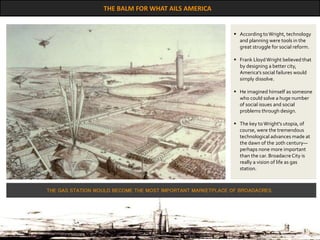
THE GAS STATION WOULD BECOME THE MOST IMPORTANT MARKETPLACE OF BROADACRES
 According toWright, technology
and planning were tools in the
great struggle for social reform.
 Frank LloydWright believed that
by designing a better city,
America's social failures would
simply dissolve.
 He imagined himself as someone
who could solve a huge number
of social issues and social
problems through design.
 The key toWright's utopia, of
course, were the tremendous
technological advances made at
the dawn of the 20th century—
perhaps none more important
than the car. BroadacreCity is
really a vision of life as gas
station.
VISION OFTHE GAS STATION AND THE ALT UNIVERSE PULP SCI- FI
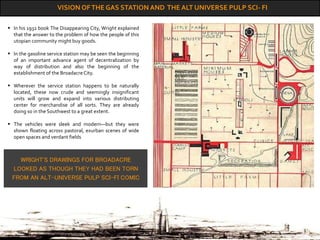
WRIGHT'S DRAWINGS FOR BROADACRE
LOOKED AS THOUGH THEY HAD BEEN TORN
FROM AN ALT-UNIVERSE PULP SCI-FI COMIC
 In his 1932 book The Disappearing City, Wright explained
that the answer to the problem of how the people of this
utopian community might buy goods.
 In the gasoline service station may be seen the beginning
of an important advance agent of decentralization by
way of distribution and also the beginning of the
establishment of the BroadacreCity.
 Wherever the service station happens to be naturally
located, these now crude and seemingly insignificant
units will grow and expand into various distributing
center for merchandise of all sorts. They are already
doing so in the Southwest to a great extent.
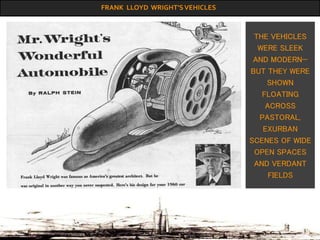
 The vehicles were sleek and modern—but they were
shown floating across pastoral, exurban scenes of wide
open spaces and verdant fields
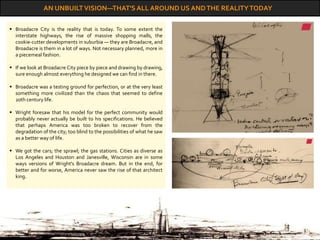
AN UNBUILTVISION—THAT'S ALL AROUND US ANDTHE REALITYTODAY
 Broadacre City is the reality that is today. To some extent the
interstate highways, the rise of massive shopping malls, the
cookie-cutter developments in suburbia — they are Broadacre, and
Broadacre is them in a lot of ways. Not necessary planned, more in
a piecemeal fashion.
 If we look at Broadacre City piece by piece and drawing by drawing,
sure enough almost everything he designed we can find in there.
 Broadacre was a testing ground for perfection, or at the very least
something more civilized than the chaos that seemed to define
20th century life.
 Wright foresaw that his model for the perfect community would
probably never actually be built to his specifications. He believed
that perhaps America was too broken to recover from the
degradation of the city; too blind to the possibilities of what he saw
as a better way of life.
 We got the cars; the sprawl; the gas stations. Cities as diverse as
Los Angeles and Houston and Janesville, Wisconsin are in some
ways versions of Wright's Broadacre dream. But in the end, for
better and for worse, America never saw the rise of that architect
king.
FRANK LLOYD WRIGHT’SVEHICLES
THE VEHICLES
WERE SLEEK
AND MODERN—
BUT THEY WERE
SHOWN
FLOATING
ACROSS
PASTORAL,
EXURBAN
SCENES OF WIDE
OPEN SPACES
AND VERDANT
FIELDS
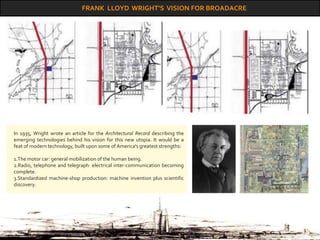
FRANK LLOYD WRIGHT’S VISION FOR BROADACRE
In 1935, Wright wrote an article for the Architectural Record describing the
emerging technologies behind his vision for this new utopia. It would be a
feat of modern technology, built upon some of America's greatest strengths:
1.The motor car: general mobilization of the human being.
2.Radio, telephone and telegraph: electrical inter-communication becoming
complete.
3.Standardized machine-shop production: machine invention plus scientific
discovery.
FRANK LLOYD WRIGHT’S UTOPIAN DYSTOPIA
Butterfly Wing Bridge, Spring Green, Wisconsin 1947
Rogers Lacy Hotel, Dallas 1946-47
Beth Sholom Synagogue, Pennsylvania 1953-59
Twin Suspension Bridges and Community Center, Pittsburgh 1947
Huntington Hartford Play Resort, Hollywood 1947
Self Service Garage, Pittsburgh 1949
(To the right of illustration 20; click image to enlarge)
Automobile Objective and Planetarium for Gordon Strong, Maryland 1925
Marin County Civic Centre, San Rafael, California, 1957 - 70

BROADACRE BY F.L. WRIGHT

  • 1.
    AKANKSHA BALPANDE GEETAGUJARATHI SHREYA MAHAJAN KASHMIRASONAR POONAMWADEKAR 1205 1220 1220 1264 1267
  • 2.
    FRANK LLOYD WRIGHT’SUTOPIAN DYSTOPIA A TRULY PROPHETIC VISION OF MODERN AMERICA  Broadacre City was an urban or suburban development concept proposed by Frank Lloyd Wright throughout most of his lifetime.  He presented the idea in his book The Disappearing City in 1932.  A few years later he unveiled a very detailed twelve by twelve foot (3.7 × 3.7 m) scale model representing a hypothetical four square mile (10 km²) community. ACCORDINGTO HIM, CITIESWOULD NO LONGER BE CENTRALIZED; NO LONGER BEHOLDEN TOTHE PEDESTRIAN OR THE CENTRAL BUSINESS DISTRICT
  • 3.
    FRANK LLOYD WRIGHT’SUTOPIAN DYSTOPIA Europe sets the stage for Wright's comeback. Le Corbusier formulates his ideas for the future, designing a contemporary city for 3 million inhabitants. In 1922 the principles are clear.This city is dense, rational, organised; to put it in a nutshell - urban.
  • 4.
    FRANK LLOYD WRIGHT’SUTOPIAN DYSTOPIA Wright's answer is as radical as it is diametrically opposed. Broadacre isn't a city; it is a landscape. Decentralised in organisation it is self- sufficient in supply, republican in constitution, and populated by auto - mobile citizens. Centred on the homestead, the single family house, Broadacre sprawls.
  • 5.
    FRANK LLOYD WRIGHT’SUTOPIAN DYSTOPIA From this milieu emerges the plan for a community laying out their cities according to family values, spirituality and knowledge. Everyone owns land for cultivation, at least one Acre (4046,856 m2, 165 by 264 Feet)The model plan covers four square miles. Wright perceives himself and his rebellion as "an army under siege".The atmosphere inTaliesin at the time is described like this: » It was not a civilized situation - it was a heroic one. «VI.) 5
  • 6.
    FRANK LLOYD WRIGHT’SUTOPIAN DYSTOPIA Broadacre is a community without experts. Everyone does everything. Everyone's a farmer - industrial worker - artist: reminiscence of the "Arts and Crafts" movement from Wright's beginnings. The ideal for labour is self-fulfilment.
  • 7.
    FRANK LLOYD WRIGHT’SUTOPIAN DYSTOPIA There is no administration - no bureaucracy - but the architect, who plans the city and settles its affairs. He arranges who may own how many acres of land and where roads start and lead to, thus preventing property speculation as well as congestion
  • 8.
    FRANK LLOYD WRIGHT’SUTOPIAN DYSTOPIA Broadacre is a continuous metropolitan region of low density. Areas designated to serve similar purposes are allocated functionally (parallel along traffic systems of more than regional importance like monorail and motorway): trade, entertainment, industry, agriculture, housing etc.. Arrangements are selective - idealized - but not exclusive.
  • 9.
    FRANK LLOYD WRIGHT’SUTOPIAN DYSTOPIA The city starts with the single family house. Due to Broadacre's economical logic it is being built by oneself (in a DIY network). Using standardized elements and partly prefabricated building modules it is fairly extendable . But first of all it is affordable, although money has almost no relevance in Broadacre. The Usonian House as a typology evolves.
  • 10.
    FRANK LLOYD WRIGHT’SUTOPIAN DYSTOPIA » Everywhere now human voice and vision are annihilating distance - penetrating walls. Wherever the citizen goes (even as he goes) he has information, lodging and entertainment. He may now be within easy reach of general or immediate distribution of everything he needs to have or to know: All that he may require as he lives becomes not only more worthy of him and his freedom but convenient to him now wherever he may choose to make his home. Mobility and information conveying systems are prerequisites for Broadacre. Wright esteems the importance of "communication machines" as follows:
  • 11.
    FRANK LLOYD WRIGHT’SUTOPIAN DYSTOPIA The notion of an aircraft in everyone's front yard is a convincing image. Total mobility is inevitable. The road is a symbol of individual freedom. Cars aren't simply contemporary or modern, they represent democracy itself. The technology to cross and to communicate long distance facilitates: air, light and freedom of movement.
  • 12.
    FRANK LLOYD WRIGHT’SUTOPIAN DYSTOPIA Resolving the volume of traffic as well as coming to terms with prosperity shift focus. Horizontality and mobility are at the centre of attention in master plan simulations of the time.
  • 13.
    FRANK LLOYD WRIGHT’SUTOPIAN DYSTOPIA Instead of improving social order to achieve happiness for mankind, we apply technology to do so. Before, the new society guaranteed to handle progress reasonably - now advanced technology and science (considered an instrument to control these advancements) are trusted to solve the contradictions of current states.
  • 14.
    FRANK LLOYD WRIGHT’SUTOPIAN DYSTOPIA By 1958 Broadacre remains true to its socioeconomic concept, but generates different images. It sells via monuments, Frank Lloyd Wright's monuments. The 'air-rotor' [helicopter] becomes a trademark.
  • 15.
    FRANK LLOYD WRIGHT’SUTOPIAN DYSTOPIA Still, the conclusive statement by Robert Fishman's 1977 analysis of Broadacre City constitutes the keenest critique possible. » […] The plan was democratic not because it had been debated in a legislature or approved in an election but because it was representative of the nation's deepest feelings […]
  • 16.
    THE BALM FORWHAT AILS AMERICA THE GAS STATION WOULD BECOME THE MOST IMPORTANT MARKETPLACE OF BROADACRES  According toWright, technology and planning were tools in the great struggle for social reform.  Frank LloydWright believed that by designing a better city, America's social failures would simply dissolve.  He imagined himself as someone who could solve a huge number of social issues and social problems through design.  The key toWright's utopia, of course, were the tremendous technological advances made at the dawn of the 20th century— perhaps none more important than the car. BroadacreCity is really a vision of life as gas station.
  • 17.
    VISION OFTHE GASSTATION AND THE ALT UNIVERSE PULP SCI- FI WRIGHT'S DRAWINGS FOR BROADACRE LOOKED AS THOUGH THEY HAD BEEN TORN FROM AN ALT-UNIVERSE PULP SCI-FI COMIC  In his 1932 book The Disappearing City, Wright explained that the answer to the problem of how the people of this utopian community might buy goods.  In the gasoline service station may be seen the beginning of an important advance agent of decentralization by way of distribution and also the beginning of the establishment of the BroadacreCity.  Wherever the service station happens to be naturally located, these now crude and seemingly insignificant units will grow and expand into various distributing center for merchandise of all sorts. They are already doing so in the Southwest to a great extent.  The vehicles were sleek and modern—but they were shown floating across pastoral, exurban scenes of wide open spaces and verdant fields
  • 18.
    AN UNBUILTVISION—THAT'S ALLAROUND US ANDTHE REALITYTODAY  Broadacre City is the reality that is today. To some extent the interstate highways, the rise of massive shopping malls, the cookie-cutter developments in suburbia — they are Broadacre, and Broadacre is them in a lot of ways. Not necessary planned, more in a piecemeal fashion.  If we look at Broadacre City piece by piece and drawing by drawing, sure enough almost everything he designed we can find in there.  Broadacre was a testing ground for perfection, or at the very least something more civilized than the chaos that seemed to define 20th century life.  Wright foresaw that his model for the perfect community would probably never actually be built to his specifications. He believed that perhaps America was too broken to recover from the degradation of the city; too blind to the possibilities of what he saw as a better way of life.  We got the cars; the sprawl; the gas stations. Cities as diverse as Los Angeles and Houston and Janesville, Wisconsin are in some ways versions of Wright's Broadacre dream. But in the end, for better and for worse, America never saw the rise of that architect king.
  • 19.
    FRANK LLOYD WRIGHT’SVEHICLES THEVEHICLES WERE SLEEK AND MODERN— BUT THEY WERE SHOWN FLOATING ACROSS PASTORAL, EXURBAN SCENES OF WIDE OPEN SPACES AND VERDANT FIELDS
  • 20.
    FRANK LLOYD WRIGHT’SVISION FOR BROADACRE In 1935, Wright wrote an article for the Architectural Record describing the emerging technologies behind his vision for this new utopia. It would be a feat of modern technology, built upon some of America's greatest strengths: 1.The motor car: general mobilization of the human being. 2.Radio, telephone and telegraph: electrical inter-communication becoming complete. 3.Standardized machine-shop production: machine invention plus scientific discovery.
  • 21.
    FRANK LLOYD WRIGHT’SUTOPIAN DYSTOPIA Butterfly Wing Bridge, Spring Green, Wisconsin 1947 Rogers Lacy Hotel, Dallas 1946-47 Beth Sholom Synagogue, Pennsylvania 1953-59 Twin Suspension Bridges and Community Center, Pittsburgh 1947 Huntington Hartford Play Resort, Hollywood 1947 Self Service Garage, Pittsburgh 1949 (To the right of illustration 20; click image to enlarge) Automobile Objective and Planetarium for Gordon Strong, Maryland 1925 Marin County Civic Centre, San Rafael, California, 1957 - 70