MANAGEMENT OF
CARCINOMA PROSTATE
Reference :
1) NCCN
2) Perez and Brady’s principles and practice of
Radiation Oncology 7th edition
CLINICAL FEATURES
• Lower urinary tract symptoms - nocturia, urinary
frequency, urgency, decreased flow, incomplete
voiding, intermittent flow, or hesitancy and
occasionally erectile dysfunction .
• Bulky primary disease - urinary tract obstruction
or difficulty in passing stool or even bloody stool.
• With increasing PSA and Gleason score, the risk of
metastases increases.
• Metastatic spread is generally sequential,
proceeding from the prostate to the
periprostatic pelvic lymph nodes, but some
appear to spread directly to the common iliac
nodes and then to bone.
• Rarely, patients may present with renal failure,
lymphedema of the lower extremities, and
bone pain.
INTERMEDIATE RISK
FAVOURABLE
• Has all of the following :-
• 1 IRF
• Grade Group 1 / 2
• < 50 % Biopsy cores positive
UNFAVOURABLE
• Has 1 or more of the
following :-
• 2 or 3 IRF’s
• Grade group-3
• >= 50% Biopsy cores
positive.
FAVOURABLE INTERMEDIATE
Expected Survival >= 10 Years
• Active Surveillance
• EBRT / BT alone
• RP +/- PLND (If nodal
metastasis >=2 %)
Expected Survival <10 Years
• EBRT / BT Alone
• Observation
ACTIVE SURVEILLANCE
• Based on ProtecT trial
• Multiparametric MRI &/ or Prostate Biopsy &/or
Molecular tumour analysis.
• PSA – 6 monthly once
• DRE – Annually
• Repeat Biopsy –Annually
• Repeat MRI – Annually
(Unless clinically indicated not repeated )
OBSERVATION
• Involves monitoring the course of disease with
the intention to deliver palliative therapy for
symptoms or change in examination or PSA that
suggests that symptom is imminent.
• Selection of patients with indolent disease or
comorbidities that would impact the expected
survival is crucial
UNFAVOURABLE INTERMEDIATE
RADICAL PROSTATECTOMY
• Based on SPCG-4 & PIVOT Trial  RP is a
recommended treatment option if life
expectance is >=10 years.
HIGH & VERY RISK GROUP
Clinical and Pathological Features
(HIGH)
• Has no very high risk features and has atleast
one high risk feature:
T3a
Grade group-4 / 5
PSA >20 ng/ml
VERY HIGH RISK
• Has at least one of the following
T3b- T4
Primary Gleason pattern 5
2 – 3 high risk features
>4 cores with Grade 4 or 5
INITIAL THERAPY
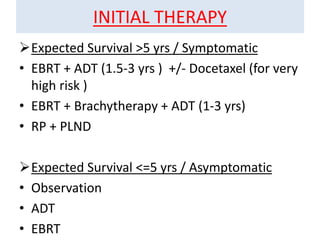
Expected Survival >5 yrs / Symptomatic
• EBRT + ADT (1.5-3 yrs ) +/- Docetaxel (for very
high risk )
• EBRT + Brachytherapy + ADT (1-3 yrs)
• RP + PLND
Expected Survival <=5 yrs / Asymptomatic
• Observation
• ADT
• EBRT
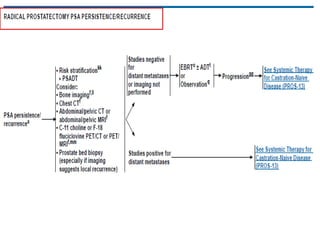
• Undetectable PSA After RP / PSA Nadir after RT
RADIATION TECHNIQUES
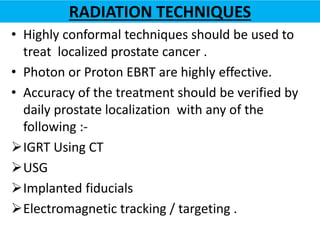
• Highly conformal techniques should be used to
treat localized prostate cancer .
• Photon or Proton EBRT are highly effective.
• Accuracy of the treatment should be verified by
daily prostate localization with any of the
following :-
IGRT Using CT
USG
Implanted fiducials
Electromagnetic tracking / targeting .
IGRT
• Image-guided RT (IGRT) allows for the adjustment
of patient daily set up as well as the positional
correction of the radiation beams during radiation
delivery .
• A consequence of modern, high-conformality RT,
however, is the risk of a “geographic miss”.
• Geometric uncertainty include target delineation
error, patient setup uncertainty and target position
variation (both day-to-day interfraction motion and
intrafraction movement during the course of
treatment delivery
• Additionally, the use of IGRT allows for the
reduction of planning margins .
• Imaging methods :-
Non-radiation-based -ultrasound,
electromagnetic tracking, and MRI systems
integrated into the treatment room or
treatment machine.
 Radiation-based - static as well as real time
tracking, using either kV, MV, or hybrid
methods .
• intraprostatic radiopaque markers with daily in-
room imaging as this technique is low cost, is
easy to use, and provides limited interobserver
variability .
• Three radiopaque markers, such as gold seeds
or coils, are implanted into the periphery of the
prostate via a transrectal or transperineal
approach.
• The FMs remain stable within the prostate with
an average displacement of 1.01–2.8 mm
• The markers are a surrogate for the prostate
position and thus ensure that the prostate and
rectal interface is reproducibly identified even
with prostate rotation and deformation
DEFINITIVE RT
Favorable Intermediate
Risk
• Prophylactic lymph node RT ,
ADT is not performed
routinely unless there is
aggressive tumour behaviour.
Unfavorable
Intermediate
• Prophylactic Pelvic RT can
be given after assesment.
• ADT must be given unless
contraindicated.
• Duration of ADT can be
reduced if EBRT & BT is
administered.
• SBRT + ADT can be
administered.
HIGH and VERY HIGH RISK
• Prophylactic nodal radiation –considered.
• ADT is given unless contraindicated.
• Brachytherapy + ADT / SBRT +ADT can be
used .
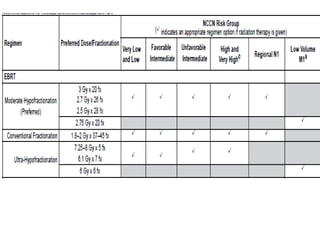
DOSE ESCALATION
Conclusion
• This suggests that dose escalation alone
cannot replace hormones as a strategy to
improve cure, and that both may be necessary
in patients with intermediate- and high-risk
disease.
HYPOFRACTIONATION
ADJUVANT RT
SWOG-8794 randomly assigned 425 node-negative patients initially
treated with radical prostatectomy but found to have either PSM or
pT3 (ECE and/or SVI) disease to ART or observation.
Central pathology review was performed in 73% of patients, and
there was a 95% concordance with the community pathologist.
Ninety percent of patients had ECE or PSM.
Two-thirds of patients had a postoperative PSA <0.2 ng/mL.
RT consisted of 60 to 64 Gy.
Median PSA relapse-free survival was significantly longer with
ART (10.3 vs. 3.1 years; P <.001).
Updated results were recently published with a median follow-up of
12.6 years.
The 10-year distant metastasis-free survival (71% vs. 61%; HR
0.71; P = .016) and overall survival (74% vs. 66%; HR 0.72; P =
.023) were significantly improved with ART.
The median distant metastasis-free survival was prolonged from 12.9
to 14.7 years with ART, and overall survival from 13.3 to 15.2 years.
• As it stands, we have only retrospective data
that suggest that early salvage radiotherapy is
more effective than later salvage radiotherapy,
and this is likely due to reduced tumor
burden.
• Whether early salvage radiotherapy is as good
as adjuvant radiotherapy is unknown.
NODE POSITIVE
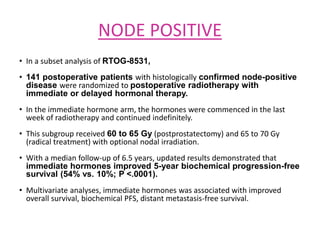
• In a subset analysis of RTOG-8531,
• 141 postoperative patients with histologically confirmed node-positive
disease were randomized to postoperative radiotherapy with
immediate or delayed hormonal therapy.
• In the immediate hormone arm, the hormones were commenced in the last
week of radiotherapy and continued indefinitely.
• This subgroup received 60 to 65 Gy (postprostatectomy) and 65 to 70 Gy
(radical treatment) with optional nodal irradiation.
• With a median follow-up of 6.5 years, updated results demonstrated that
immediate hormones improved 5-year biochemical progression-free
survival (54% vs. 10%; P <.0001).
• Multivariate analyses, immediate hormones was associated with improved
overall survival, biochemical PFS, distant metastasis-free survival.
• REGIONAL DISEASE
• Nodal irradiation must be given .
• Clinically Positive nodes must be dose escalated
as DVH parameters allow.
• ADT is required unless contraindicated .
• ABIRATERONE or fine particle Abiraterone can
be considered.
ADJUVANT RADIATION THERAPY
• Treatment is individualised based on age/ co-
morbidities /clinical and pathological information ,
PSA level and PSADT.
• Moloecular assay –if adverse features are present .
• Administered within 1 year of RP and after post-op
recovery is complete.
• Patients with positive margins may benefit the most
.
INDICATIONS
• Positive surgical margins
• Seminal vesicle invasion
• Extracapsular extension
• LN mets
• Poorly diffrentiated adenocarcinoma
• GS 8-10
• pT3 disease.
ADVANTAGES
• Increased local control
• Eradicating microscopic periprostatic disease
• Decreased distant mets
• Improved survival
SALVAGE RADIATION THERAPY
• Indications :- Undetectable PSA that becomes
subsequently detectable and increases on 2
measurements or a PSA that is persistantly
detectable after RP .
• Treatment is more effective when pre-treatment
PSA Is low and PSAdt is long .
RAVES TRIAL
SRT spares approximately half of men
from pelvic radiotherapy, and is
associated with significantly lower levels
of GU toxicity.
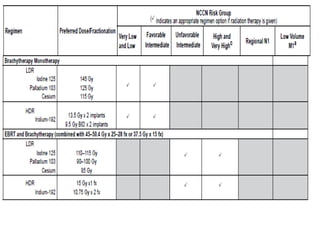
BRACHYTHERAPY
• As per NCCN –
• Recommended only in low-risk or favourable
intermediate risk( MONOTHERAPY)
• Unfavourable intermediate risk – EBRT + BT +/-
Androgen Deprivation therapy – Based on
ASCENDE-RT trial
• High risk – Dose Escalation – Highly beneficial.
• HDR Brachytherapy –Absolute and radiobiological
dose escalation – high tumour control and low
toxicity .
• Dose rate - >=12 Gy /h.
• Boost schedules vary from 9-15 Gy in a single
fraction to 26 Gy in 4 fractions .
• 5 year Biochemical disease control –
Low risk – 85-100 %
Intermediate – 83-98%
High risk – 51- 96%
• Patient Evaluation
• Sexual function assessment.
• Gastrointestinal / Rectal function assessment.
• Urinary function assessment .
• Serum PSA
• Biopsy and HPE report
• MRI / CT – With Endorectal coil is preferred for
extracapsular extension.
• Bone Scan
• PRIOR PROSTATE RADIATION
• HDR Monotherapy - Salvage treatment for local
failure after EBRT / Permanent Seed
Brachytherapy –Promising results in patients
who don’t fit the criteria for salvage
prostatectomy .
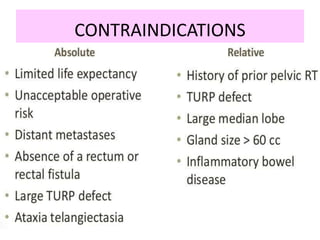
CONTRAINDICATIONS
SEEDS AND IMPLANTATION
 PERMANENT
• Iodine 125
• Palladium 103
• Cesium 131
 TEMPORARY
• Iridium 192
• Cesium 137
• APPROACHES :
Perineal approach-
• Needles are introduced above the anus and are
guided into the prostate with the index finger in
the rectum
 Suprapubic Cystotomy Approach-
• The needles are placed directly in the prostate
through the open bladder with a finger in rectum
guiding the placement
 Retropubic approach-
• This approach is used most extensively, though it’s
a more difficult procedure.
ANDROGEN DEPRIVATION THERAPY
• ADT acts by reducing the level of androgen
hormones, to prevent the prostate cancer cells from
growing
 INDICATIONS
• Intermediate unfavorable prostate cancer
• High risk and Very High Risk Prostate Cancer
• Metastatic Prostate Cancer
• In recurrence after RT or Surgery
• Most patients with T3 are, at the present time,
treated with NAHT followed by RT
• Prolongs survival in selected patients.
LHRH Agonist alone
Goserelin , Histrelin , Leuprolide or Triptorelin .
LHRH Agonist + First generation Antiandrogen
Nilutamide, Flutamide or Bicalutamide
LHRH Antagonist
Degarelix
TIMING OF ADT
• Intermediate Risk:
• NACT : 3 to 6 months + Concurrent +/- Adjuvant : 6
months
• High and Very High Risk :
NACT : 3 to 6 months + Concurrent +/- Adjuvant : 24
to 36 months
• Metastatic : Gold Standard for metastasis at time of
presentation
CASTRATION RESISTANT PROSTATE
CANCER
Defined by disease progression despite
androgen depletion therapy (ADT) and may
present as :
o Continuous rise in serum prostate-specific antigen
(PSA) levels
o Progression of pre-existing disease
o Appearance of new metastases
Second Line Hormonal Therapy
ABIRATERONE ACETATE:
• 1000MG DAILY(250 Mg 4 tabs daily)
• Taken with Prednisone 5mg BD
• FDA approved 1st line therapy in asymptomatic
CRPC
• 2nd line therapy after failure of docetaxel
ENZALUTAMIDE:
• Inhibits signaling of androgen receptor
• Poor PS
• Given with GNRH Agonists
FOLLOW UP SCHEDULE
• First follow-up : 3 months
• Years 0–1 : Every 3 –4 months
• Years 2–5 : Every 6 months
• Years 5+ : Annually
CA PROSTATE
CA PROSTATE
CA PROSTATE
CA PROSTATE

CA PROSTATE

  • 1.
    MANAGEMENT OF CARCINOMA PROSTATE Reference: 1) NCCN 2) Perez and Brady’s principles and practice of Radiation Oncology 7th edition
  • 4.
    CLINICAL FEATURES • Lowerurinary tract symptoms - nocturia, urinary frequency, urgency, decreased flow, incomplete voiding, intermittent flow, or hesitancy and occasionally erectile dysfunction . • Bulky primary disease - urinary tract obstruction or difficulty in passing stool or even bloody stool. • With increasing PSA and Gleason score, the risk of metastases increases.
  • 5.
    • Metastatic spreadis generally sequential, proceeding from the prostate to the periprostatic pelvic lymph nodes, but some appear to spread directly to the common iliac nodes and then to bone. • Rarely, patients may present with renal failure, lymphedema of the lower extremities, and bone pain.
  • 6.
  • 8.
    FAVOURABLE • Has allof the following :- • 1 IRF • Grade Group 1 / 2 • < 50 % Biopsy cores positive UNFAVOURABLE • Has 1 or more of the following :- • 2 or 3 IRF’s • Grade group-3 • >= 50% Biopsy cores positive.
  • 9.
    FAVOURABLE INTERMEDIATE Expected Survival>= 10 Years • Active Surveillance • EBRT / BT alone • RP +/- PLND (If nodal metastasis >=2 %) Expected Survival <10 Years • EBRT / BT Alone • Observation
  • 10.
    ACTIVE SURVEILLANCE • Basedon ProtecT trial • Multiparametric MRI &/ or Prostate Biopsy &/or Molecular tumour analysis. • PSA – 6 monthly once • DRE – Annually • Repeat Biopsy –Annually • Repeat MRI – Annually (Unless clinically indicated not repeated )
  • 11.
    OBSERVATION • Involves monitoringthe course of disease with the intention to deliver palliative therapy for symptoms or change in examination or PSA that suggests that symptom is imminent. • Selection of patients with indolent disease or comorbidities that would impact the expected survival is crucial
  • 13.
  • 14.
    RADICAL PROSTATECTOMY • Basedon SPCG-4 & PIVOT Trial  RP is a recommended treatment option if life expectance is >=10 years.
  • 17.
    HIGH & VERYRISK GROUP
  • 18.
    Clinical and PathologicalFeatures (HIGH) • Has no very high risk features and has atleast one high risk feature: T3a Grade group-4 / 5 PSA >20 ng/ml
  • 19.
    VERY HIGH RISK •Has at least one of the following T3b- T4 Primary Gleason pattern 5 2 – 3 high risk features >4 cores with Grade 4 or 5
  • 20.
    INITIAL THERAPY Expected Survival>5 yrs / Symptomatic • EBRT + ADT (1.5-3 yrs ) +/- Docetaxel (for very high risk ) • EBRT + Brachytherapy + ADT (1-3 yrs) • RP + PLND Expected Survival <=5 yrs / Asymptomatic • Observation • ADT • EBRT
  • 22.
    • Undetectable PSAAfter RP / PSA Nadir after RT
  • 25.
    RADIATION TECHNIQUES • Highlyconformal techniques should be used to treat localized prostate cancer . • Photon or Proton EBRT are highly effective. • Accuracy of the treatment should be verified by daily prostate localization with any of the following :- IGRT Using CT USG Implanted fiducials Electromagnetic tracking / targeting .
  • 26.
    IGRT • Image-guided RT(IGRT) allows for the adjustment of patient daily set up as well as the positional correction of the radiation beams during radiation delivery . • A consequence of modern, high-conformality RT, however, is the risk of a “geographic miss”. • Geometric uncertainty include target delineation error, patient setup uncertainty and target position variation (both day-to-day interfraction motion and intrafraction movement during the course of treatment delivery
  • 27.
    • Additionally, theuse of IGRT allows for the reduction of planning margins . • Imaging methods :- Non-radiation-based -ultrasound, electromagnetic tracking, and MRI systems integrated into the treatment room or treatment machine.  Radiation-based - static as well as real time tracking, using either kV, MV, or hybrid methods .
  • 28.
    • intraprostatic radiopaquemarkers with daily in- room imaging as this technique is low cost, is easy to use, and provides limited interobserver variability . • Three radiopaque markers, such as gold seeds or coils, are implanted into the periphery of the prostate via a transrectal or transperineal approach. • The FMs remain stable within the prostate with an average displacement of 1.01–2.8 mm
  • 29.
    • The markersare a surrogate for the prostate position and thus ensure that the prostate and rectal interface is reproducibly identified even with prostate rotation and deformation
  • 31.
    DEFINITIVE RT Favorable Intermediate Risk •Prophylactic lymph node RT , ADT is not performed routinely unless there is aggressive tumour behaviour. Unfavorable Intermediate • Prophylactic Pelvic RT can be given after assesment. • ADT must be given unless contraindicated. • Duration of ADT can be reduced if EBRT & BT is administered. • SBRT + ADT can be administered.
  • 32.
    HIGH and VERYHIGH RISK • Prophylactic nodal radiation –considered. • ADT is given unless contraindicated. • Brachytherapy + ADT / SBRT +ADT can be used .
  • 33.
  • 34.
    Conclusion • This suggeststhat dose escalation alone cannot replace hormones as a strategy to improve cure, and that both may be necessary in patients with intermediate- and high-risk disease.
  • 35.
  • 36.
    ADJUVANT RT SWOG-8794 randomlyassigned 425 node-negative patients initially treated with radical prostatectomy but found to have either PSM or pT3 (ECE and/or SVI) disease to ART or observation. Central pathology review was performed in 73% of patients, and there was a 95% concordance with the community pathologist. Ninety percent of patients had ECE or PSM. Two-thirds of patients had a postoperative PSA <0.2 ng/mL.
  • 37.
    RT consisted of60 to 64 Gy. Median PSA relapse-free survival was significantly longer with ART (10.3 vs. 3.1 years; P <.001). Updated results were recently published with a median follow-up of 12.6 years. The 10-year distant metastasis-free survival (71% vs. 61%; HR 0.71; P = .016) and overall survival (74% vs. 66%; HR 0.72; P = .023) were significantly improved with ART. The median distant metastasis-free survival was prolonged from 12.9 to 14.7 years with ART, and overall survival from 13.3 to 15.2 years.
  • 38.
    • As itstands, we have only retrospective data that suggest that early salvage radiotherapy is more effective than later salvage radiotherapy, and this is likely due to reduced tumor burden. • Whether early salvage radiotherapy is as good as adjuvant radiotherapy is unknown.
  • 39.
    NODE POSITIVE • Ina subset analysis of RTOG-8531, • 141 postoperative patients with histologically confirmed node-positive disease were randomized to postoperative radiotherapy with immediate or delayed hormonal therapy. • In the immediate hormone arm, the hormones were commenced in the last week of radiotherapy and continued indefinitely. • This subgroup received 60 to 65 Gy (postprostatectomy) and 65 to 70 Gy (radical treatment) with optional nodal irradiation. • With a median follow-up of 6.5 years, updated results demonstrated that immediate hormones improved 5-year biochemical progression-free survival (54% vs. 10%; P <.0001). • Multivariate analyses, immediate hormones was associated with improved overall survival, biochemical PFS, distant metastasis-free survival.
  • 40.
    • REGIONAL DISEASE •Nodal irradiation must be given . • Clinically Positive nodes must be dose escalated as DVH parameters allow. • ADT is required unless contraindicated . • ABIRATERONE or fine particle Abiraterone can be considered.
  • 41.
    ADJUVANT RADIATION THERAPY •Treatment is individualised based on age/ co- morbidities /clinical and pathological information , PSA level and PSADT. • Moloecular assay –if adverse features are present . • Administered within 1 year of RP and after post-op recovery is complete. • Patients with positive margins may benefit the most .
  • 42.
    INDICATIONS • Positive surgicalmargins • Seminal vesicle invasion • Extracapsular extension • LN mets • Poorly diffrentiated adenocarcinoma • GS 8-10 • pT3 disease.
  • 43.
    ADVANTAGES • Increased localcontrol • Eradicating microscopic periprostatic disease • Decreased distant mets • Improved survival
  • 44.
    SALVAGE RADIATION THERAPY •Indications :- Undetectable PSA that becomes subsequently detectable and increases on 2 measurements or a PSA that is persistantly detectable after RP . • Treatment is more effective when pre-treatment PSA Is low and PSAdt is long .
  • 45.
    RAVES TRIAL SRT sparesapproximately half of men from pelvic radiotherapy, and is associated with significantly lower levels of GU toxicity.
  • 48.
    BRACHYTHERAPY • As perNCCN – • Recommended only in low-risk or favourable intermediate risk( MONOTHERAPY) • Unfavourable intermediate risk – EBRT + BT +/- Androgen Deprivation therapy – Based on ASCENDE-RT trial • High risk – Dose Escalation – Highly beneficial.
  • 50.
    • HDR Brachytherapy–Absolute and radiobiological dose escalation – high tumour control and low toxicity . • Dose rate - >=12 Gy /h. • Boost schedules vary from 9-15 Gy in a single fraction to 26 Gy in 4 fractions . • 5 year Biochemical disease control – Low risk – 85-100 % Intermediate – 83-98% High risk – 51- 96%
  • 51.
    • Patient Evaluation •Sexual function assessment. • Gastrointestinal / Rectal function assessment. • Urinary function assessment . • Serum PSA • Biopsy and HPE report • MRI / CT – With Endorectal coil is preferred for extracapsular extension. • Bone Scan
  • 52.
    • PRIOR PROSTATERADIATION • HDR Monotherapy - Salvage treatment for local failure after EBRT / Permanent Seed Brachytherapy –Promising results in patients who don’t fit the criteria for salvage prostatectomy .
  • 55.
  • 56.
    SEEDS AND IMPLANTATION PERMANENT • Iodine 125 • Palladium 103 • Cesium 131  TEMPORARY • Iridium 192 • Cesium 137
  • 57.
    • APPROACHES : Perinealapproach- • Needles are introduced above the anus and are guided into the prostate with the index finger in the rectum  Suprapubic Cystotomy Approach- • The needles are placed directly in the prostate through the open bladder with a finger in rectum guiding the placement  Retropubic approach- • This approach is used most extensively, though it’s a more difficult procedure.
  • 58.
  • 59.
    • ADT actsby reducing the level of androgen hormones, to prevent the prostate cancer cells from growing  INDICATIONS • Intermediate unfavorable prostate cancer • High risk and Very High Risk Prostate Cancer • Metastatic Prostate Cancer • In recurrence after RT or Surgery • Most patients with T3 are, at the present time, treated with NAHT followed by RT
  • 60.
    • Prolongs survivalin selected patients. LHRH Agonist alone Goserelin , Histrelin , Leuprolide or Triptorelin . LHRH Agonist + First generation Antiandrogen Nilutamide, Flutamide or Bicalutamide LHRH Antagonist Degarelix
  • 62.
    TIMING OF ADT •Intermediate Risk: • NACT : 3 to 6 months + Concurrent +/- Adjuvant : 6 months • High and Very High Risk : NACT : 3 to 6 months + Concurrent +/- Adjuvant : 24 to 36 months • Metastatic : Gold Standard for metastasis at time of presentation
  • 63.
    CASTRATION RESISTANT PROSTATE CANCER Definedby disease progression despite androgen depletion therapy (ADT) and may present as : o Continuous rise in serum prostate-specific antigen (PSA) levels o Progression of pre-existing disease o Appearance of new metastases
  • 64.
    Second Line HormonalTherapy ABIRATERONE ACETATE: • 1000MG DAILY(250 Mg 4 tabs daily) • Taken with Prednisone 5mg BD • FDA approved 1st line therapy in asymptomatic CRPC • 2nd line therapy after failure of docetaxel ENZALUTAMIDE: • Inhibits signaling of androgen receptor • Poor PS • Given with GNRH Agonists
  • 66.
    FOLLOW UP SCHEDULE •First follow-up : 3 months • Years 0–1 : Every 3 –4 months • Years 2–5 : Every 6 months • Years 5+ : Annually