Pain management in cancer
Dr Kiran
DEFINITION OF PAIN
The definition of pain, as proposed by the International Association for the Study
of Pain, is as follows: “an unpleasant sensory and emotional experience
associated with actual or potential tissue damage or described in terms of such
damage.”
TYPES OF PAIN
(1) somatic,
(2) visceral, and
(3) neuropathic.
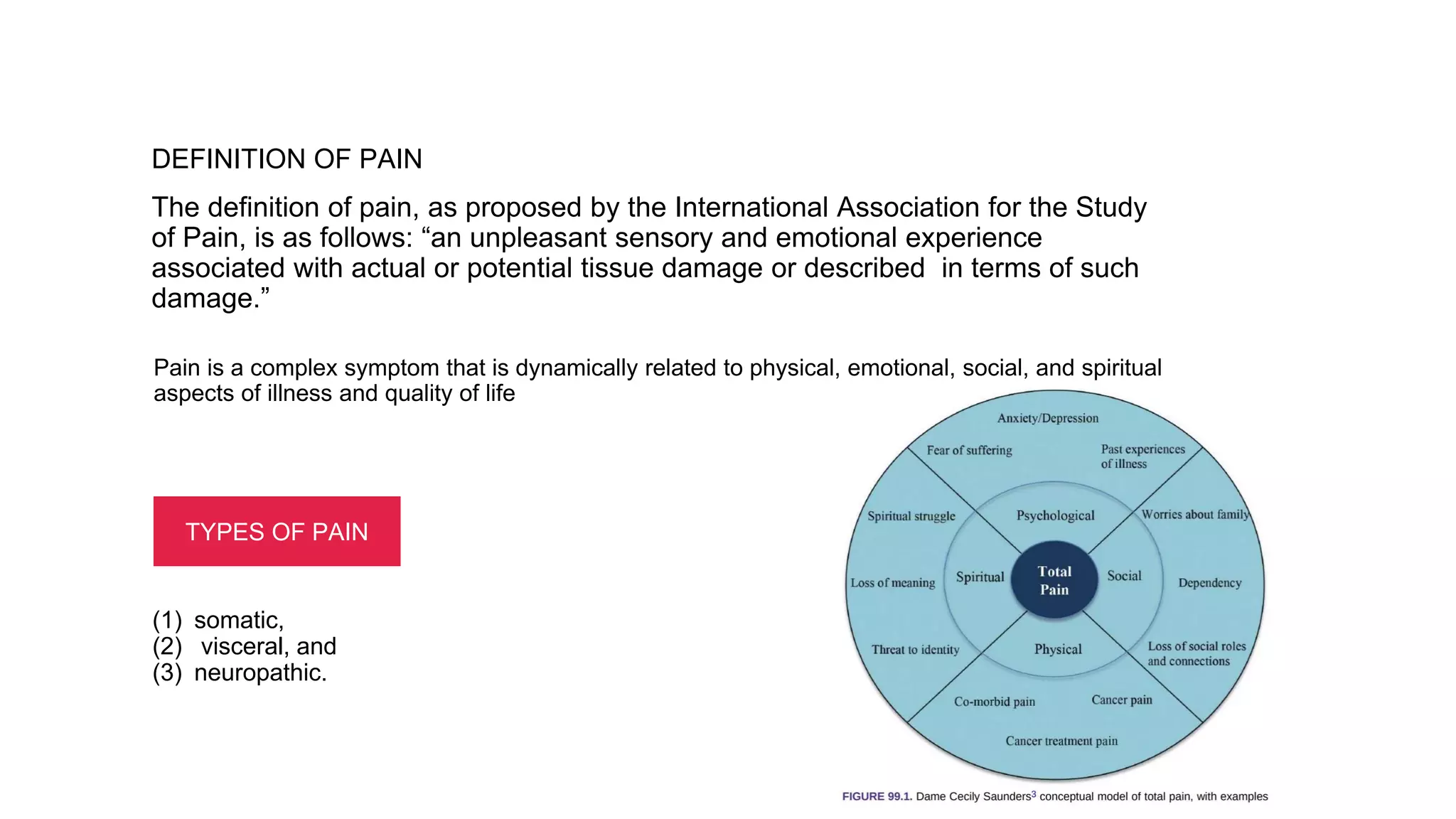
Pain is a complex symptom that is dynamically related to physical, emotional, social, and spiritual
aspects of illness and quality of life
PATHOPHYSIOLOGY: ORGANIZATION OF PAIN PATHWAYS
• Pain producing sensory stimuli in skin and viscera —->activates peripheral nerve
endings(primary afferent neutrons) ——-> synapse on second order neurons———->
Thalamus———>Project to the somatosensory cortex———> parallel ascending
neurons ——-> project to the limbic system——> pain transmission is regulated at the
dorsal horn level by descending Bulbospinal pathways.
Grading of pain
multifaceted, subjective experience
• Specific categorical scales of pain intensity are often used
• patients are asked to describe their pain as mild, moderate, or severe
• Visual analog scales (VASs) have also been applied
presented on a 10-cm line anchored at either end by two points, signifying no pain and worst possible pain
Brief Pain Inventory
self-administered, easily understood, brief method to assess pain. It addresses the relevant aspects of pain
(history, intensity, location, and quality) and the impact of pain on the patient’s activities and helps to provide an
understanding of its cause
Wong-Baker faces pain rating
scale
Verbal Pain Scale
McGill Pain Questionnaire
extensively used pain assessment instrument that produces scores on four empirically derived dimensions as well as several
summary scores
• consists of 78 adjectives that cluster in 20 categories. Within each category, the adjectives are arranged in order of
intensity from low to high.
• The categories are divided into four dimensions: sensory, affective, evaluative, and miscellaneous
• The patient is asked to choose one adjective from each applicable category that describes an aspect of his or her current
pain, and the score for each dimension is obtained by adding the rank values of the selected adjectives
PATIENT-REPORTED OUTCOME MEASURES
• MD Anderson Symptom Inventory (MDASI)
• the Patient Care Monitor (PCM)
• Assessing symptoms by direct patient self-report is an increasingly common and desirable method for collecting data on
important patient-centered outcomes such as pain
• Memorial Symptom Assessment Scale
• Functional Assessment of Cancer Therapy–General
• European Organisation for Research and Treatment of Cancer Quality of Life Questionnaire-C30
• Edmonton Symptom Assessment Scale
Barriers to Pain Management
1. Believe the patient’s complaint of pain.
2. Take a careful history of the pain complaint.
3. Evaluate the patient’s psychological state.
4. Perform careful medical and neurologic examinations.
5. Order the appropriate diagnostic studies and personally review the results.
6. Treat the pain to facilitate the appropriate workup.
7. Reassess the patient’s response to therapy.
8. Individualize the diagnostic and therapeutic approaches.
9. Discuss goals of care and consider specialist palliative care consultation when medications are
needed beyond front-line analgesics and opioids
CLINICAL ASSESSMENT OF PAIN
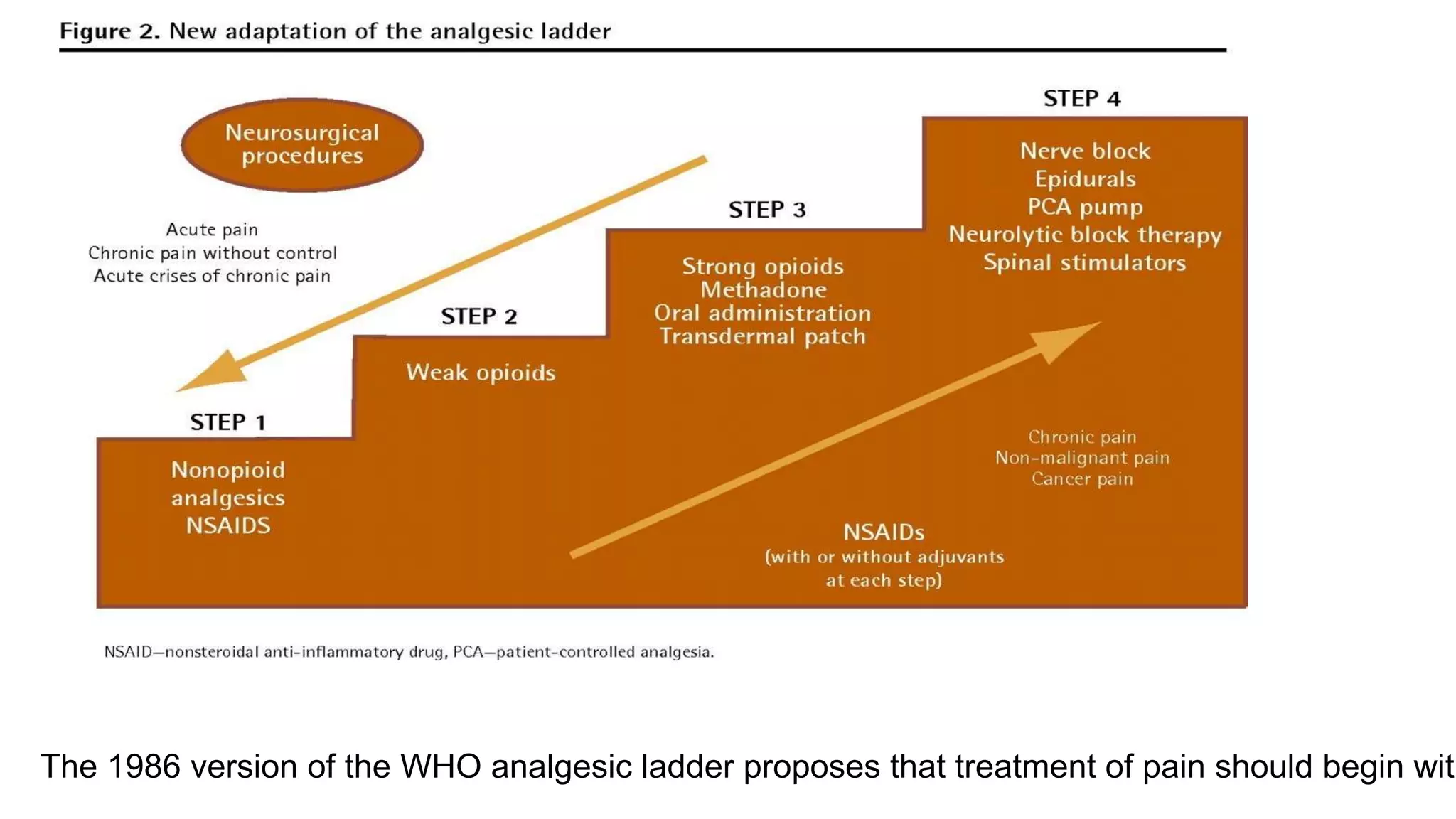
Adapted WHO pain ladder.
The 1986 version of the WHO analgesic ladder proposes that treatment of pain should begin with
• This new adaptation of the analgesic ladder adds new opioids. such as
tramadol, oxycodone, hydromorphone, and buprenorphine, and also new
ways of administering them, such as by transdermal patch, that did not
exist in 1986
• Since the 1990s, numerous medical articles have been published
promoting opioids as a safe treat- ment for patients with chronic
noncancer pain.
• Methadone, in step 3, is important because it is currently very useful
in the treatment of cancer pain, chronic noncancer pain, and
refractory neuropathic pain that does not respond to conventional
treatment
WHO document rests on 5 simple recommendations for the correct use of analgesics to
make the prescribed treatments effective.
1. Oral administration of analgesics.
2. Analgesics should be given at regular intervals
3. Analgesics should be prescribed according to pain intensity as evaluated by a scale of inten
4. Dosing of pain medication should be adapted to the individual
5. Analgesics should be prescribed with a constant concern for detail
Grisell Vargas-Schaffer MD
Paracetamol (Acetaminophen)
selective COX 3 inhibition in the brain.
metabolized to N-acetyl paraaminobenzo quinoneimine (NAPQ) by microsomal
enzymes
overdose- 90% of patients will develop severe liver damage, if plasma concentration is
greater than 300 µg/ml at 4 hours or 45 µg/ml at 15 hours after ingestion. Gastric lavage
(with activated charcoal) should be done to prevent further absorption but it is ineffective
after 4 hours of ingestion.
weak COX-1 and COX-2 inhibitor
Acute pain and fever may be effectively treated with 325–500 mg four times daily
• Route of administration: oral, Iv, suppository
N-acetylcysteine is antidote of choice for paracetamol poising.
• Diclofenac
• inhibit LOX and higher COX2 selectivity
• 100- 150 mg / day in divided doses
• Milder cases 75 -100 mg / day
• Max.dose 200 mg / day
inhibits PG synthesis.
• plasma t½ is -2 hours.
Ibuprofen
t 1/2 - 2-4 hr
Dosage 400-600 mg (5-10 mg/kg) TDS
Aceclofenac A moderately COX-2 selective congener of diclofenac having similar
properties. Enhancement of glycosaminoglycan synthesis may confer chondroprotective property
to aceclofenac. Dose: I00 mg BD
The appropriate dose is the dose that relieves the patient’s pain
throughout its dosing interval without causing unmanageable
side effects.
Pain 7-10 Consider increasing dose by 50%-100%
Pain 4-6 Consider increasing dose by 25%-50%
Pain 1-3 Consider increasing dose by 25%
Opioid Doses
• Step 2
• Weak opioids -Tramadol
• Synthetic codeine derivative, weak agonist at mu receptors.
• It inhibits reuptake of NA and 5HT
• Route of administration: oral, im,iv
• Indicated in mild to moderate pain in cancer
• Injected i. v. 100 mg tramadol is equianalgesic to 10 mg
i.m. morphine
t½ is 5-6 hours and effects last for. 4-6 hrs.
• Dose: 50---100 mg oral/ i.m./slow i.v. infusion (children 12mg/kg) 4-6
hourly.
• lt is generally well tolerated, but nausea and dizziness may be prominent
• Step 3
• Strong opioids- Morphine principal alkaloid in opium
CNS actions : Morphine has site specific depressant and stimulant actions in
the CNS by interacting primarily with the µ opioid receptor (for which it has
the highest affinity), as a full agonist
Analgesia
• dull, poorly localized visceral pain is relieved better than sharply defined somatic pain;
• higher doses can mitigate even severe pain; degree of analgesia increasing with the dose.
• Nociceptive pain arising from stimulation of peripheral pain receptors is relieved better than
neuretic pain (such as trigeminal neuralgia) produced by inflammation of or damage to neural
structures.
• The associated reactions to pain are also dampened. Suppression of pain perception is
selective, without affecting other sensations or producing proportionate generalized CNS
depression
• Analgesic action by both spinal and supraspinal components
• It acts in the substantia gelatinosa of dorsal horn to inhibit release of excitatory
transmitters from primary afferents carrying pain impulses
• Action at supraspinal sites in medulla, periaqueductal gray matter, limbic and
cortical areas may alter processing and interpretation of pain impulses.
• supraspinal action of morphine augments the inhibitory impulses through
descending pathways to the spinal cord.
• Several aminergic (5-HT, NA), GABAergic and other neuronal systems appear to be
involved in the action of morphine.
• Simultaneous action at spinal and supraspinal sites greatly amplifies the analgesia.
• Plasma t½ of morphine averages 2- 3 hours.
• Effect of a parenteral dose lasts 4- 6 hours.
• Elimination is almost complete in 24 hours
• Route of administration: po,iv,epidural,intrathecal
Common
Constipation
Dry Mouth
Nausea / Vomiting
Sedation Sweats
Opioid Side Effects
Uncommon
Bad Dreams / Hallucinations
Dysphoria / Delirium Myoclonus /
Seizures Pruritus /
Urticaria/Respiratory Depression
Urinary Retention
Fentanyl A pethidine congener, 80-100 times more potent than morphine, both
in analgesia and respiratory depression
Fentanyl
• highly lipid soluble, it enters brain rapidly and produces peak analgesia in 5 min after i.v.
injection.
• The duration of action is short: starts wearing off after 30-40 min due to redistribution.
• t½ is -4 hr.
• Transdermal form very frequently used opioid analgesic for cancer/terminal illness pain
• transdermal patch delivering 12 µg/hr, 25 µg/hr, 50 µg/hr, 75 µg/hr or 100 µg per hour: the
patch is changed every 3 days
Methadone
A synthetic opioid, chemically dissimilar but pharmacologically very
similar to morphine.
• µ receptor agonist, and has analgesic, respiratory depressant, emetic, antitussive,
constipating and biliary actions similar to morphine.
• plasma t½ on chronic use is 24-48 hours
• 2.5- 10 mg oral or i.m
• Step 4
Bone Pain
Opioids
NSAIDs/steroids/Cox-2 inhibitors
Bisphosphonates
• Pamidronate
Clodronate
Zoledronate
Radiation treatment
1. Single treatment (800 cGy)
2. Multiple fraction (200 cGy x 3-5)
3. Effective immediately
4. Maximal effect 4 - 6 weeks
5. 60-80% patients get relief
• Adjuvant analgesics for the treatment of neuropathic pain
• Cannabinoids can be added to this group of adjuvant medications
• used to offer a better quality of life to patients with chronic pain.
• They can also be used to treat chronic neuropathic pain
Alternative Therapies
Acupuncture
Cognitive
/behavioral therapy
Meditation/relaxation Guided
imagery
Herbal preparations
Magnets
Therapeutic massage
• Thank you

Cancer pain management.pptx

  • 1.
    Pain management incancer Dr Kiran
  • 2.
    DEFINITION OF PAIN Thedefinition of pain, as proposed by the International Association for the Study of Pain, is as follows: “an unpleasant sensory and emotional experience associated with actual or potential tissue damage or described in terms of such damage.” TYPES OF PAIN (1) somatic, (2) visceral, and (3) neuropathic. Pain is a complex symptom that is dynamically related to physical, emotional, social, and spiritual aspects of illness and quality of life
  • 3.
  • 4.
    • Pain producingsensory stimuli in skin and viscera —->activates peripheral nerve endings(primary afferent neutrons) ——-> synapse on second order neurons———-> Thalamus———>Project to the somatosensory cortex———> parallel ascending neurons ——-> project to the limbic system——> pain transmission is regulated at the dorsal horn level by descending Bulbospinal pathways. Grading of pain multifaceted, subjective experience • Specific categorical scales of pain intensity are often used • patients are asked to describe their pain as mild, moderate, or severe • Visual analog scales (VASs) have also been applied presented on a 10-cm line anchored at either end by two points, signifying no pain and worst possible pain
  • 5.
    Brief Pain Inventory self-administered,easily understood, brief method to assess pain. It addresses the relevant aspects of pain (history, intensity, location, and quality) and the impact of pain on the patient’s activities and helps to provide an understanding of its cause
  • 6.
    Wong-Baker faces painrating scale Verbal Pain Scale
  • 7.
    McGill Pain Questionnaire extensivelyused pain assessment instrument that produces scores on four empirically derived dimensions as well as several summary scores • consists of 78 adjectives that cluster in 20 categories. Within each category, the adjectives are arranged in order of intensity from low to high. • The categories are divided into four dimensions: sensory, affective, evaluative, and miscellaneous • The patient is asked to choose one adjective from each applicable category that describes an aspect of his or her current pain, and the score for each dimension is obtained by adding the rank values of the selected adjectives PATIENT-REPORTED OUTCOME MEASURES • MD Anderson Symptom Inventory (MDASI) • the Patient Care Monitor (PCM) • Assessing symptoms by direct patient self-report is an increasingly common and desirable method for collecting data on important patient-centered outcomes such as pain • Memorial Symptom Assessment Scale • Functional Assessment of Cancer Therapy–General • European Organisation for Research and Treatment of Cancer Quality of Life Questionnaire-C30 • Edmonton Symptom Assessment Scale
  • 8.
    Barriers to PainManagement
  • 9.
    1. Believe thepatient’s complaint of pain. 2. Take a careful history of the pain complaint. 3. Evaluate the patient’s psychological state. 4. Perform careful medical and neurologic examinations. 5. Order the appropriate diagnostic studies and personally review the results. 6. Treat the pain to facilitate the appropriate workup. 7. Reassess the patient’s response to therapy. 8. Individualize the diagnostic and therapeutic approaches. 9. Discuss goals of care and consider specialist palliative care consultation when medications are needed beyond front-line analgesics and opioids CLINICAL ASSESSMENT OF PAIN
  • 10.
    Adapted WHO painladder. The 1986 version of the WHO analgesic ladder proposes that treatment of pain should begin with
  • 11.
    • This newadaptation of the analgesic ladder adds new opioids. such as tramadol, oxycodone, hydromorphone, and buprenorphine, and also new ways of administering them, such as by transdermal patch, that did not exist in 1986 • Since the 1990s, numerous medical articles have been published promoting opioids as a safe treat- ment for patients with chronic noncancer pain. • Methadone, in step 3, is important because it is currently very useful in the treatment of cancer pain, chronic noncancer pain, and refractory neuropathic pain that does not respond to conventional treatment
  • 12.
    WHO document restson 5 simple recommendations for the correct use of analgesics to make the prescribed treatments effective. 1. Oral administration of analgesics. 2. Analgesics should be given at regular intervals 3. Analgesics should be prescribed according to pain intensity as evaluated by a scale of inten 4. Dosing of pain medication should be adapted to the individual 5. Analgesics should be prescribed with a constant concern for detail Grisell Vargas-Schaffer MD
  • 14.
    Paracetamol (Acetaminophen) selective COX3 inhibition in the brain. metabolized to N-acetyl paraaminobenzo quinoneimine (NAPQ) by microsomal enzymes overdose- 90% of patients will develop severe liver damage, if plasma concentration is greater than 300 µg/ml at 4 hours or 45 µg/ml at 15 hours after ingestion. Gastric lavage (with activated charcoal) should be done to prevent further absorption but it is ineffective after 4 hours of ingestion. weak COX-1 and COX-2 inhibitor Acute pain and fever may be effectively treated with 325–500 mg four times daily • Route of administration: oral, Iv, suppository N-acetylcysteine is antidote of choice for paracetamol poising.
  • 15.
    • Diclofenac • inhibitLOX and higher COX2 selectivity • 100- 150 mg / day in divided doses • Milder cases 75 -100 mg / day • Max.dose 200 mg / day inhibits PG synthesis. • plasma t½ is -2 hours. Ibuprofen t 1/2 - 2-4 hr Dosage 400-600 mg (5-10 mg/kg) TDS Aceclofenac A moderately COX-2 selective congener of diclofenac having similar properties. Enhancement of glycosaminoglycan synthesis may confer chondroprotective property to aceclofenac. Dose: I00 mg BD
  • 16.
    The appropriate doseis the dose that relieves the patient’s pain throughout its dosing interval without causing unmanageable side effects. Pain 7-10 Consider increasing dose by 50%-100% Pain 4-6 Consider increasing dose by 25%-50% Pain 1-3 Consider increasing dose by 25% Opioid Doses
  • 19.
    • Step 2 •Weak opioids -Tramadol • Synthetic codeine derivative, weak agonist at mu receptors. • It inhibits reuptake of NA and 5HT • Route of administration: oral, im,iv • Indicated in mild to moderate pain in cancer • Injected i. v. 100 mg tramadol is equianalgesic to 10 mg i.m. morphine t½ is 5-6 hours and effects last for. 4-6 hrs. • Dose: 50---100 mg oral/ i.m./slow i.v. infusion (children 12mg/kg) 4-6 hourly. • lt is generally well tolerated, but nausea and dizziness may be prominent
  • 20.
    • Step 3 •Strong opioids- Morphine principal alkaloid in opium CNS actions : Morphine has site specific depressant and stimulant actions in the CNS by interacting primarily with the µ opioid receptor (for which it has the highest affinity), as a full agonist Analgesia • dull, poorly localized visceral pain is relieved better than sharply defined somatic pain; • higher doses can mitigate even severe pain; degree of analgesia increasing with the dose. • Nociceptive pain arising from stimulation of peripheral pain receptors is relieved better than neuretic pain (such as trigeminal neuralgia) produced by inflammation of or damage to neural structures. • The associated reactions to pain are also dampened. Suppression of pain perception is selective, without affecting other sensations or producing proportionate generalized CNS depression
  • 21.
    • Analgesic actionby both spinal and supraspinal components • It acts in the substantia gelatinosa of dorsal horn to inhibit release of excitatory transmitters from primary afferents carrying pain impulses • Action at supraspinal sites in medulla, periaqueductal gray matter, limbic and cortical areas may alter processing and interpretation of pain impulses. • supraspinal action of morphine augments the inhibitory impulses through descending pathways to the spinal cord. • Several aminergic (5-HT, NA), GABAergic and other neuronal systems appear to be involved in the action of morphine. • Simultaneous action at spinal and supraspinal sites greatly amplifies the analgesia. • Plasma t½ of morphine averages 2- 3 hours. • Effect of a parenteral dose lasts 4- 6 hours. • Elimination is almost complete in 24 hours • Route of administration: po,iv,epidural,intrathecal
  • 22.
    Common Constipation Dry Mouth Nausea /Vomiting Sedation Sweats Opioid Side Effects Uncommon Bad Dreams / Hallucinations Dysphoria / Delirium Myoclonus / Seizures Pruritus / Urticaria/Respiratory Depression Urinary Retention
  • 23.
    Fentanyl A pethidinecongener, 80-100 times more potent than morphine, both in analgesia and respiratory depression Fentanyl • highly lipid soluble, it enters brain rapidly and produces peak analgesia in 5 min after i.v. injection. • The duration of action is short: starts wearing off after 30-40 min due to redistribution. • t½ is -4 hr. • Transdermal form very frequently used opioid analgesic for cancer/terminal illness pain • transdermal patch delivering 12 µg/hr, 25 µg/hr, 50 µg/hr, 75 µg/hr or 100 µg per hour: the patch is changed every 3 days
  • 24.
    Methadone A synthetic opioid,chemically dissimilar but pharmacologically very similar to morphine. • µ receptor agonist, and has analgesic, respiratory depressant, emetic, antitussive, constipating and biliary actions similar to morphine. • plasma t½ on chronic use is 24-48 hours • 2.5- 10 mg oral or i.m
  • 25.
  • 27.
    Bone Pain Opioids NSAIDs/steroids/Cox-2 inhibitors Bisphosphonates •Pamidronate Clodronate Zoledronate Radiation treatment 1. Single treatment (800 cGy) 2. Multiple fraction (200 cGy x 3-5) 3. Effective immediately 4. Maximal effect 4 - 6 weeks 5. 60-80% patients get relief
  • 28.
    • Adjuvant analgesicsfor the treatment of neuropathic pain
  • 29.
    • Cannabinoids canbe added to this group of adjuvant medications • used to offer a better quality of life to patients with chronic pain. • They can also be used to treat chronic neuropathic pain Alternative Therapies Acupuncture Cognitive /behavioral therapy Meditation/relaxation Guided imagery Herbal preparations Magnets Therapeutic massage
  • 30.