time , dose & fractionation
INTRODUCTION To deliver precisely measured dose of radiation to a defined tumor volume with minimal damage to surrounding normal tissue. Aims:  To eradicate tumor,  Improve quality of life &  Prolongation of survival.
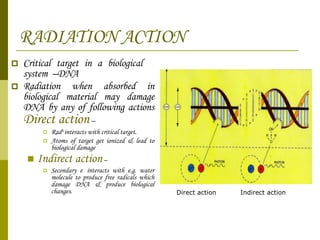
RADIATION ACTION Critical target in a biological  system  –DNA Radiation when absorbed in biological material may damage DNA by any of following actions  Direct action  –  Rad n  interacts with critical target. Atoms of target get ionized & lead to biological damage Indirect action  – Secondary e -  interacts with e.g. water molecule to produce free radicals which damage DNA & produce biological changes. Indirect action Direct action
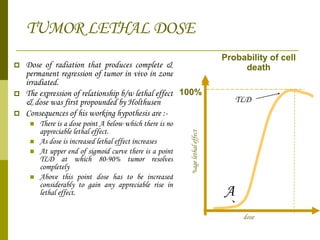
TUMOR LETHAL DOSE Dose of radiation that produces complete & permanent regression of tumor in vivo in zone irradiated. The expression of relationship b/w lethal effect & dose was first propounded by Holthusen Consequences of his working hypothesis are :- There is a dose point A below which there is no appreciable lethal effect. As dose is increased lethal effect increases At upper end of sigmoid curve there is a point TLD at which 80-90% tumor resolves completely Above this point dose has to be increased considerably to gain any appreciable rise in lethal effect. Probability of cell death 100% A TLD %age lethal effect dose
TUMOR LETHAL DOSE Tumor control is a probabilistic event i.e. for every increment of radiation dose certain # of cells will be killed Total no. of surviving cells will be proportional to initial no. of cells present & the # killed after each dose. Constant # of cells are killed by each dose #.
TISSUE TOLERANCE Radiation dose that will not produce any appreciable damage to normal tissue irradiated. usually <5% damage to normal tissue is acceptable. In RT the success of eradicating tumor depends on radio sensitivity of tumor as well as tolerance of surrounding normal tissue NTT limits the max. dose that can be delivered to tumor During early years of RT with orthovoltage skin was a limiting factor. This was overcome by use of Co - 60 & megavoltage X-rays
NTT: Factors Site of tissue – axilla, perineum less tolerant  Area or volume irradiated  Vascularity  Supporting tissues ( stroma and parenchymal cells)  Individual variation of tolerance.
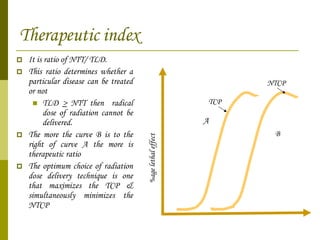
Therapeutic index   It is ratio of NTT/ TLD. This ratio determines whether a particular disease can be treated or not  TLD  >  NTT then  radical dose of radiation cannot be delivered. The more the curve B is to the right of curve A the more is therapeutic ratio The optimum choice of radiation dose delivery technique is one that maximizes the TCP & simultaneously minimizes the NTCP %age lethal effect A B TCP NTCP
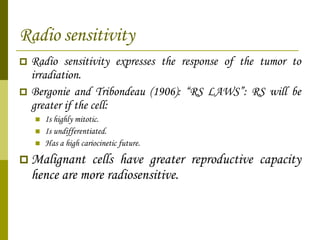
Radio sensitivity Radio sensitivity expresses the response of the tumor to irradiation. Bergonie and Tribondeau (1906): “RS LAWS”: RS will be greater if the cell: Is highly mitotic. Is undifferentiated. Has a high cariocinetic future. Malignant cells have greater reproductive capacity hence are more radiosensitive.
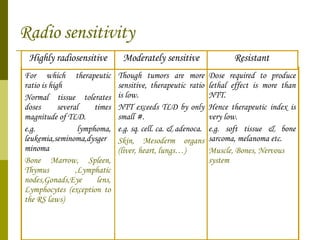
Radio sensitivity Dose required to produce lethal effect is more than NTT. Hence therapeutic index is very low.  e.g. soft tissue & bone sarcoma, melanoma etc. Muscle, Bones, Nervous system Though tumors are more sensitive, therapeutic ratio is low.  NTT exceeds TLD by only small #.  e.g. sq. cell. ca. & adenoca. Skin, Mesoderm organs (liver, heart, lungs…) For which therapeutic ratio is high  Normal tissue tolerates doses several times magnitude of TLD.  e.g. lymphoma, leukemia,seminoma,dysgerminoma Bone Marrow, Spleen, Thymus ,Lymphatic nodes,Gonads,Eye lens, Lymphocytes (exception to the RS laws) Resistant Moderately sensitive Highly radiosensitive
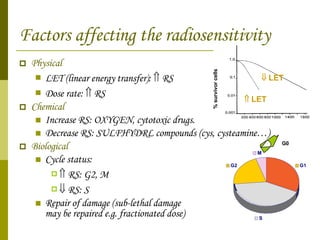
Factors affecting the radiosensitivity Physical LET (linear energy transfer):    RS Dose rate:    RS Chemical Increase RS: OXYGEN, cytotoxic drugs. Decrease RS: SULFHYDRL compounds (cys, cysteamine…) Biological Cycle status:     RS: G2, M    RS: S Repair of damage (sub-lethal damage  may be repaired e.g. fractionated dose) G1 S G2 M G0    LET    LET % survivor cells M M
RADIOCURABILITY Refers to eradication of tumor at primary or regional sites & reflects direct effect of irradiation. There is no significant relation b/w radio sensitivity & radio curability. A tumor may be radio sensitive yet incurable & vice versa. Examples Leukemia is radiosensitive but not radio curable. Seminoma is radiosensitive & radio curable. Sarcoma is not radiosensitive/ radio curable.
TREATMENT FACTORS To eradicate a tumor radiation is delivered & factors that play an important role in any treatment are Dose of radiation Time of dose delivery Fractionation of dose
DOSE Is a physical quantity Amount of energy absorbed from beam of radiation at a given point in medium. Dose can be measured by any of three methods Calorimetry Fricke dosimetry Ion chamber dosimetry – most practical & widely used dosimetry Old unit of dose is rad When 100ergs of energy is deposited in a gm. of material then absorbed dose is one rad 1rad= 100erg/gm SI unit of dose is Gray 1Gy = 1J/Kg 1Gy = 100rads
INTENTION OF TREATMENT Radical  –  To achieve tumor lethality  Dose as high as tolerance dose is used. Cure or local control is the aim. t/t  5-6 wks Palliative   –  Incurable disease. Aim is to relieve pt. from discomforting symptoms of cancer (e.g. pain , dysphagia, dyspnoea)  Side effects of treatment should be minor. t/t single # or 1-3wks Growth restraint  -
CHOICE OF DOSE In radical radiotherapy  choice of dose & fractionation regimen depends on following factors:- Radio sensitivity of tumor  –  e.g. radiosensitive tumor such as seminoma can be controlled by total dose of 30Gy/ 4wks While for moderately sensitive sq. cell ca. of head & neck higher doses of the order of 50-60Gy in 5-6wks is used.  Size of treatment volume  –  smaller the vol. the greater is the dose that can be delivered without exceeding NTT. Proximity of dose limiting structures  – presence of critical st. such as brain stem & spinal chord may limit dose that can be delivered to tumors e.g while treating head & neck cancer & esophagus spinal chord is the critical st.
To assess the effects of quantity of radiation following doses should be known for clinical purposes :- Given dose  – The dose being delivered by any one beam either to an area of skin for KV beam or to the level of max. buildup below the skin for MV beam. Tumor dose  – The dose (max. or min.) being delivered in selected treated zone containing tumor i.e. tumor & safety margins. Skin dose  – The actual dose received by any area of skin summating given dose contributions received through body from any beam.
Sub lethal dose   –  Dose which results in only temporary shrinkage of tumor having rarely palliative value if any and with no lethal effect . Supra lethal dose   - dose to tumor which  gives a slow response giving rise to an indurate mass with sloughing of tumour centre & ultimately frequent recurrences at a later date  Integral dose  – Total amt of  energy absorbed at each and every point inside T/T volume. It should be minimum provided adequacy of tumor irradiation & sparing of critical organs are not compromised.
TIME Time factor is overall time to deliver prescribed dose from beginning of course of radiation until its completion. Therapy effect varies enormously with time. General rule is longer the overall duration of treatment greater is the dose required to produce a particular effect. Hence dose should always be stated in relation to time.
TIME For curative purposes overall t/t is 5-6wks Better tumor control with minimal morbidity Tumor suppression can be monitored. Radiation reactions can be monitored. If treatment time is more than 6wks then dose has to be increased  Short duration treatment time is justified for Treatment of small lesions To treat aged persons Palliative treatments Tumors with high therapeutic ratio e.g. skin tumors
FRACTIONATION Refers to division of total dose into no. of separate fractions over  total t/t conventionally given on daily basis , usually 5days a wk. Size of each dose # whether for cure or palliation depends on tumor dose as well as normal tissue tolerance . e.g. if 40Gy is to be delivered in 20# in a time of 4wks then daily dose is 2Gy.
HISTORICAL REVIEW X-ray were used for radiotherapy just 1 month after its discovery in a fractionated course because of the primitive X-ray machines available at that time & their low output To deliver a single dose to destroy a tumor would require several hours or even days. Single fraction radiotherapy became feasible only in 1914 with the advent of Coolidge hot cathode tube, with high output, adjustable tube currents & reproducible exposures.
HISTORICAL REVIEW Earlier some radiotherapists believed that fractionated treatment was inferior & single dose was necessary to cure cancer. While radiobiological experiments conducted in France favored fractionated regimen for radiotherapy which allows cancerocidal dose to be delivered without exceeding normal tissue tolerance
RADIOBIOLOGICAL RATIONALE FOR FRACTIONATION Delivery of tumorocidal dose in small dose fractions in conventional multifraction regimen is based on 4R’s of radiobiology namely  Repair of SLD Repopulation Redistribution Reoxygenation Radio sensitivity is considered by some authors to be 5 th  R of radiobiology.
RADIATION DAMAGE CLASSIFICATION Radiation damage to mammalian cells are divided into three categories: Lethal damage :irreversible, irreparable & leads to cell death Sub lethal damage : can be repaired in hours unless additional sub lethal damage is added to it  Potentially lethal damage : can be manipulated by repair when cells are allowed to remain in non-dividing state.
REPAIR Most important rationale for fractionation Mammalian cells can repair radn damage in b/w dose fractions. This is a complex process involving repair of SLD by a variety of repair enzymes & pathways. Since tumerocidal doses are very high as compared to NTT there are two ways to deliver such high doses: One option is to deliver much higher dose to tumor than to normal tissue – basis of conformal radiotherapy Other option is to fractionate the dose. So that there is sufficient time b/w consecutive fractions for complete repair of all cell that suffered SLD during 1 st  # before 2 nd  #& so on.  So small dose /# spares late reactions preferentially & a reasonable schedule duration allows regeneration of early reacting tissues.
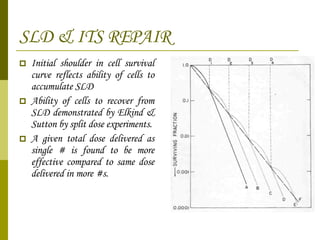
SLD & ITS REPAIR Initial shoulder in cell survival curve reflects ability of cells to accumulate SLD Ability of cells to recover from SLD demonstrated by Elkind & Sutton by split dose experiments. A given total dose delivered as single # is found to be more effective compared to same dose delivered in more #s.
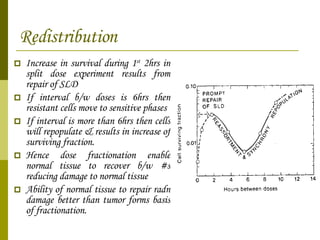
Redistribution Increase in survival during 1 st  2hrs in split dose experiment results from repair of SLD If interval b/w doses is 6hrs then resistant cells move to sensitive phases If interval is more than 6hrs then cells will repopulate & results in increase of surviving fraction. Hence dose fractionation enable normal tissue to recover b/w #s reducing damage to normal tissue Ability of normal tissue to repair radn damage better than tumor forms basis of fractionation.
Redistribution of proliferating cell populations throughout the cell cycle increases cell kill in fractionated treatment relative to a single session treatment. Cells are most sensitive during M & G 2  phase & are resistant during S phase of cell cycle . Redistribution can be a benefit in fractionated course of RT if cells are caught in sensitive phase after each fraction . Redistribution
Repopulation In b/w dose fractions normal cells as well as tumor cells repopulate. So longer a radiotherapy course lasts, more difficult it becomes to control tumor & may be detrimental But acutely responding normal tissue need to repopulate during course of radiotherapy .  Thus fractionation must be controlled so as not to allow too much time for excessive repopulation of tumor cells at the same time not treating so fast that acute tolerance is exceeded
ACCELERATED REPOPULATION Treatment with any cytotoxic agent , including rad n  , triggers surviving cells (clonogens) in a tumor to divide faster than before Dose escalation is needed to overcome this proliferation. e.g. it starts in head & neck cancer 4wks after initiation of fractionated RT Implication  Treatment should be completed as soon after it is started . It is better to delay a treatment than to introduce delay during treatment .
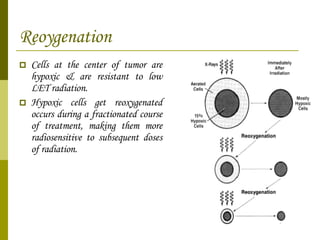
Reoygenation Cells at the center of tumor are hypoxic & are resistant to low LET radiation. Hypoxic cells get reoxygenated occurs during a fractionated course of treatment, making them more radiosensitive to subsequent doses of radiation.
ADV. OF FRACTIONATION Acute effects of single dose of radiation can be decreased  Pt.’s tolerance improves with fractionated RT Exploits diff. in recovery rate b/w normal tissues & tumors. Rad n  induced  redistribution & sensitization of rapidly proliferating cells. Reduction in hypoxic cells leads to – Reoxygenation Opening of compressed blood vessels Reduction in no. of tumor cells with each dose #
RADIATION RESPONSE Response of  all normal tissues to rad n  is not same Depending on their response tissues are either  Early responding – constitute fast proliferating cells such as skin, mucosa, intestinal epithelium, colon, testis etc. Late responding –  have large no. of cells in the resting phase e.g. spinal cord, bladder, lung, kidneys etc. Early responding tissues are triggered to proliferate within 2-3wks after start of fractionated RT. Prolonging overall treatment time can reduce acute reactions without sparing late damage
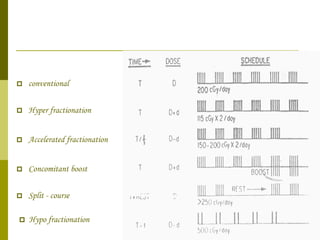
VARIOUS FRACTIONATION SCHEDULES Fractionated radiation exploits difference in 4R’s between tumors and normal tissue thereby improving therapeutic index  Types  Conventional  Altered  Hyper fractionation  Accelerated fractionation  Split course Hypofractionation
Conventional fractionation Division of dose into multiple # spares normal tissue through repair of SLD b/w dose #s & repopulation of cells. The former is greater for late reacting tissues & the later for early reacting tissues. Concurrently , fractionation increases tumor damage through reoxygenation & redistribution of tumor cells. Hence a balance is achieved b/w the response of tumor & early & late reacting normal tissue. Most common fractionation for curative radiotherapy is 1.8 to 2.2Gy/#
CONVENTIONAL FRACTIONATION Evolved as conventional regimen because it is Convenient  (no weekend treatment) Efficient (treatment every weekday) Effective (high doses can be delivered without exceeding either acute or chronic normal tissue tolerance) Allows upkeep of machines. Rationale for using conventional fractionation Most tried & trusted method Both tumorocidal & tolerance doses are well documented
HYPERFRACTIONATION Rationale  –  To take maximal adv. of diff. in repair capacity of late reacting normal tissue compared with tumors. Radio sensitization through redistribution. Pure hyper fractionation – total dose & over all t/t same as conventional regimen but delivering dose in twice as many #s i.e. treating twice daily. Impure hyper fractionation - Since dose/# decreases hence total dose need to be increased.
HYPERFRACTIONATION A hyper fractionated schedule of 80.5Gy/70#(1.15Gy twice/day)/7wks compared with 70Gy/35#/7wks in head & neck cancer. Implications – Increased local tumor control at 5yr from 40 to59% Reflected in improved survival No increase in side effects
ACCELERATED TREATMENT Alternative to hyper fractionation Rationale  – To reduce repopulation in rapidly proliferating tumors by reducing overall treatment time. Pure accelerated treatment – same total dose delivered in half the overall time by giving 2or more #s/day. but it is not possible to achieve as acute effects become limiting factor. Impure accelerated treatment – dose is reduced or rest period is interposed in the middle of treatment.
Types  of accelerated fraction Multiple std # / day  Comparison of head & neck cases accelerated regimen 72Gy/45# (1.6Gy,3#/day)/5wks with 70Gy/35#/7wks Implications – 15% increase in loco regional control No survival adv.  Increased acute effects Unexpected increase in late complications
ACCELERATED TREATMENT Concomitant boost  Developed at M.D. Anderson cancer centre  Boost dose to a reduced volume given concomitantly , with t/t of initial layer volume  Conv 54Gy in 30 # over 6 wks & boost dose of 1.5 Gy per # in last 12 # with Inter # interval of 6 hr in last 12#  large field gets 54 Gy  & boost field  72 Gy in 6 wks time E.g. Head and Neck cancer
CHART Regimen conceived at Mount Vernon Hospital, London With CHART treatments 6hrs apart delivered 3times a day,7daya a wk. with dose # of 1.5Gy, total dose of 54Gy can be delivered in 36# over 12  consecutive days including weekends. This schedule was chosen to complete treatment before acute reactions start appearing i.e. 2wks Characteristics  Low dose /# Short treatment time No gap in treatment, 3#/day at 6hr interval Implications- Better local tumor control Acute reactions are brisk but peak after treatment is completed Dose/# small hence late effects acceptable Promising clinical results achieved with considerable trauma to pt.
SPLIT-COURSE Total dose is delivered in two halves with a gap in b/w with interval of 4wks. Purpose of gap is  to allow elderly pts. to recover from acute reactions of treatment  to exclude pts. from further morbidity who have poorly tolerated 1 st  half or disease progressed despite treatment. Applied to elderly pts. in radical treatment of ca bladder & prostate & lung cancer. Disadv : impaired tumor control due to prolong T/T time that results in tumor cell repopulation
  HYPOFRACTIONATION High dose is delivered in 2-3# / wk Rationale  Treatment completed in a shorter period of time. Machine time well utilized for busy centers. Higher dose /# gives better control for larger tumors. Higher dose /# also useful for hypoxic fraction of  large tumor. Disadv. Higher potential for late normal tissue complications. E.g. 5oGy/10#/5wks treating 2 days a wk in head & neck cancer.
conventional Hyper fractionation Accelerated fractionation Concomitant boost Split - course Hypo fractionation
TIME DOSE MODELS With introduction of various fractionation schemes in radiotherapy need for quantitative comparisons of treatments was felt in order to optimize treatment for particular tumor. Strandquist was 1 st  to device scientific approach for correlating dose to overall t/t to produce an equivalent biological isoeffect.
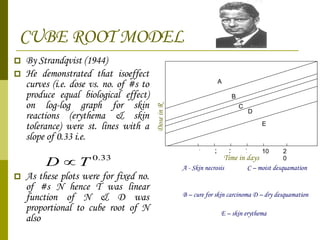
CUBE ROOT MODEL By Strandqvist (1944)  He demonstrated that isoeffect curves (i.e. dose vs. no. of #s to produce equal biological effect) on log-log graph for skin reactions (erythema & skin tolerance) were st. lines with a slope of 0.33 i.e. As these plots were for fixed no. of #s N hence T was linear function of N & D was proportional to cube root of N also Dose in R Time in days A - Skin necrosis  C – moist desquamation  B – cure for skin carcinoma D – dry desquamation E – skin erythema   A B C D E 1 3 7 10 20 2
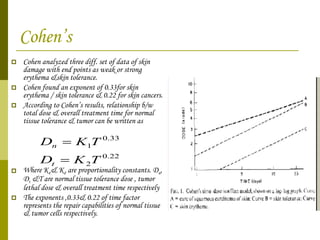
Cohen’s Cohen analyzed three diff. set of data of skin damage with end points as weak or strong erythema &skin tolerance. Cohen found an exponent of 0.33for skin erythema / skin tolerance & 0.22 for skin cancers. According to Cohen’s results, relationship b/w total dose & overall treatment time for normal tissue tolerance & tumor can be written as  Where K 1 & K 2  are proportionality constants. D n , D t  &T are normal tissue tolerance dose , tumor lethal dose & overall treatment time respectively The exponents ,0.33& 0.22 of time factor represents the repair capabilities of normal tissue & tumor cells respectively.
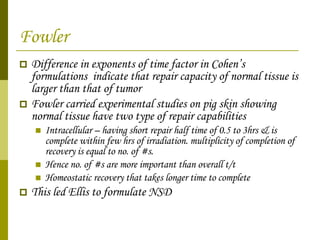
Fowler Difference in exponents of time factor in Cohen’s formulations  indicate that repair capacity of normal tissue is larger than that of tumor Fowler carried experimental studies on pig skin showing normal tissue have two type of repair capabilities Intracellular – having short repair half time of 0.5 to 3hrs & is complete within few hrs of irradiation. multiplicity of completion of recovery is equal to no. of #s. Hence no. of #s are more important than overall t/t Homeostatic recovery that takes longer time to complete This led Ellis to formulate NSD
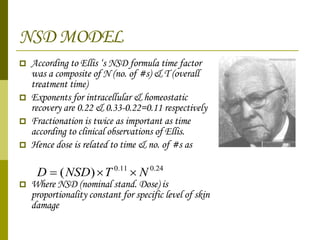
NSD MODEL According to Ellis ‘s NSD formula time factor  was a composite of N (no. of #s) & T (overall treatment time)  Exponents for intracellular & homeostatic recovery are 0.22 & 0.33-0.22=0.11 respectively Fractionation is twice as important as time according to clinical observations of Ellis. Hence dose is related to time & no. of #s as  Where NSD (nominal stand. Dose) is proportionality constant for specific level of skin damage
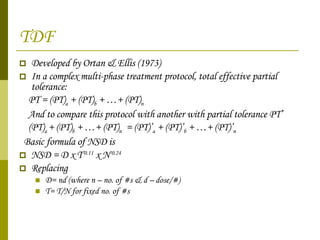
TDF Developed by Ortan & Ellis (1973) In a complex multi-phase treatment protocol, total effective partial tolerance: PT = (PT) a  + (PT) b  + …+ (PT) n And to compare this protocol with another with partial tolerance PT’ (PT) a  + (PT) b  + …+ (PT) n   = (PT)’ a  + (PT)’ b  + …+ (PT)’ n   Basic formula of NSD is  NSD = D x T -0.11  x N -0.24 Replacing D= nd (where n – no. of #s & d – dose/#)  T= T/N for fixed no. of #s
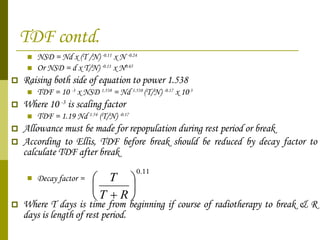
TDF contd. NSD = Nd x (T /N)  -0.11  x N  -0.24 Or NSD = d x T/N)  -0.11  x N 0.65 Raising both side of equation to power 1.538  TDF = 10  -3  x NSD  1.538  = Nd  1.538  (T/N)  -0.17  x 10 -3 Where 10  -3  is scaling factor TDF = 1.19 Nd  1.54  (T/N)  -0.17   Allowance must be made for repopulation during rest period or break According to Ellis, TDF before break should be reduced by decay factor to calculate TDF after break Decay factor   = Where T days is time from beginning if course of radiotherapy to break & R days is length of rest period.
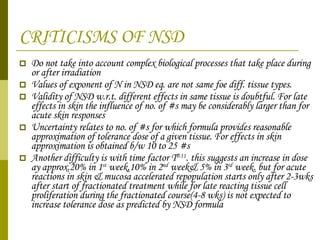
CRITICISMS   OF NSD Do not take into account complex biological processes that take place during or after irradiation Values of exponent of N in NSD eq. are not same foe diff. tissue types. Validity of NSD w.r.t. different effects in same tissue is doubtful. For late effects in skin the influence of no. of #s may be considerably larger than for acute skin responses Uncertainty relates to no. of #s for which formula provides reasonable approximation of tolerance dose of a given tissue. For effects in skin approximation is obtained b/w 10 to 25 #s Another difficulty is with time factor T 0.11 . this suggests an increase in dose ay approx.20% in 1 st  week,10% in 2 nd  week& 5% in 3 rd  week. but for acute reactions in skin & mucosa accelerated repopulation starts only after 2-3wks after start of fractionated treatment while for late reacting tissue cell proliferation during the fractionated course(4-8 wks) is not expected to increase tolerance dose as predicted by NSD formula
TARGET THEORY To express relationship b/w no. of cells killed & dose delivered in mathematical terms Target theory was proposed by Crowther & expended by Lea. Curve representing relation b/w dose & surviving # after radiation delivery is called survival curve.
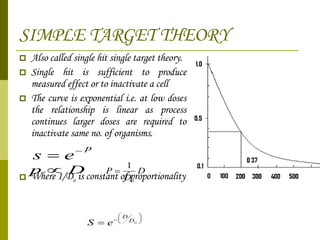
SIMPLE TARGET THEORY Also called single hit single target theory. Single hit is sufficient to produce measured effect or to inactivate a cell The curve is exponential i.e. at low doses the relationship is linear as process continues larger doses are required to inactivate same no. of organisms. Where 1/D o  is constant of proportionality
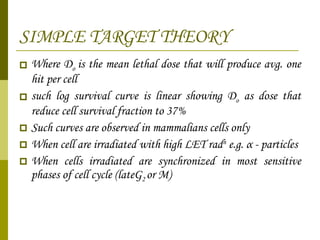
SIMPLE TARGET THEORY Where D o  is the mean lethal dose that will produce avg. one hit per cell  such log survival curve is linear showing D o  as dose that reduce cell survival fraction to 37% Such curves are observed in mammalians cells only When cell are irradiated with high LET rad n  e.g.  α   - particles When cells irradiated are synchronized in most sensitive phases of cell cycle (lateG 2  or M)
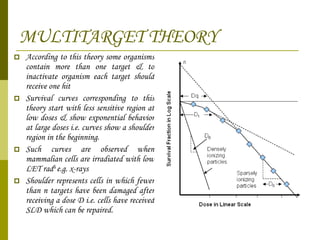
MULTITARGET THEORY According to this theory some organisms contain more than one target & to inactivate organism each target should receive one hit Survival curves corresponding to this theory start with less sensitive region at low doses & show exponential behavior at large doses i.e. curves show a shoulder region in the beginning. Such curves are observed when mammalian cells are irradiated with low LET rad n  e.g. x-rays Shoulder represents cells in which fewer than n targets have been damaged after receiving a dose D i.e. cells have received SLD which can be repaired.
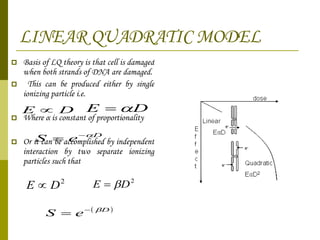
LINEAR QUADRATIC MODEL Basis of LQ theory is that cell is damaged when both strands of DNA are damaged. This can be produced either by single ionizing particle i.e. Where  α   is constant of proportionality Or it can be accomplished by independent interaction by two separate ionizing particles such that
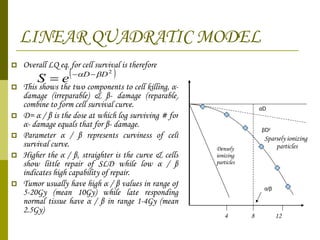
LINEAR QUADRATIC MODEL Overall LQ eq. for cell survival is therefore This shows the two components to cell killing,  α - damage (irreparable) &  β - damage (reparable) combine to form cell survival curve. D=  α  /  β  is the dose at which log surviving # for  α - damage equals that for  β - damage. Parameter  α  /  β  represents curviness of cell survival curve.  Higher the  α  /  β , straighter is the curve & cells show little repair of SLD while low  α  /  β  indicates high capability of repair. Tumor usually have high  α  /  β  values in range of 5-20Gy (mean 10Gy) while late responding normal tissue have  α  /  β  in range 1-4Gy (mean 2.5Gy) Sparsely ionizing  particles 4 8 12 Densely ionizing particles β D 2 α D α / β
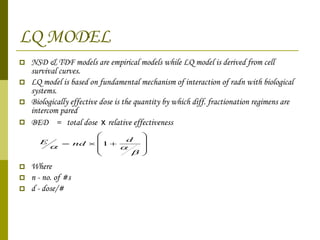
LQ MODEL NSD & TDF models are empirical models while LQ model is derived from cell survival curves. LQ model is based on fundamental mechanism of interaction of radn with biological systems. Biologically effective dose is the quantity by which diff. fractionation regimens are intercom pared  BED  =  total dose  x  relative effectiveness Where  n - no. of #s d - dose/#
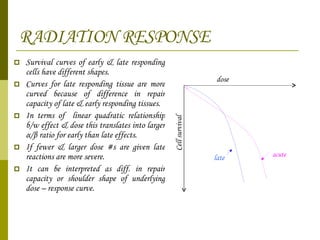
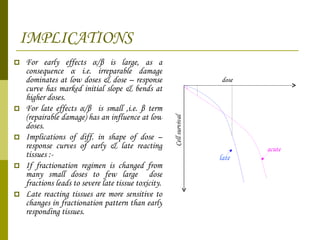
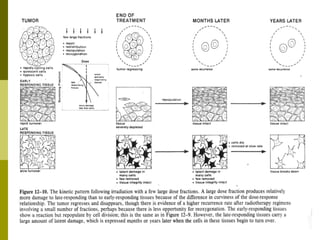
RADIATION RESPONSE Survival curves of early & late responding cells have different shapes. Curves for late responding tissue are more curved because of difference in repair capacity of late & early responding tissues. In terms of  linear quadratic relationship b/w effect & dose this translates into larger  α / β  ratio for early than late effects. If fewer & larger dose #s are given late reactions are more severe. It can be interpreted as diff. in repair capacity or shoulder shape of underlying dose – response curve. acute late Cell survival dose
EXPLANATION FOR DIFF. IN SHAPE OF EARLY & LATE RESPONDING TISSUES   The radio sensitivity of a population of cells varies with the distribution of cells through the cycle . Two different cell populations may be radio resistant :- Population proliferating so fast that S phase occupies a major portion of cycle . Population proliferating so slowly that many cells are in early G 1  or not proliferating at all so that cells are in resting (G 0 ) phase.
Population proliferating so fast that S phase occupies a major portion of cycle . Redistribution  occurs through all phases of cell cycle in such population & is referred to as self sensitizing activity. New cells produced by fast proliferating population offset cells killed by  dose #s & thus offers resistance to effect of radiation in acutely responding tissues & tumors. Thus proliferation occurring b/w dose #s help in repopulation of  normal tissue (i.e. spares normal tissue) at the risk of tumor repopulation
EXPLANATION FOR DIFF. IN SHAPE OF EARLY & LATE RESPONDING TISSUES   Population proliferating so slowly that many cells are in early G 1  or not proliferating at all so that cells are in resting (G 0 ) phase.  Hence late responding normal tissue are resistant due to presence of many resting cells. Such resistance disappears at high dose/#
IMPLICATIONS For early effects  α / β  is large, as a consequence  α  i.e. irreparable damage dominates at low doses & dose – response curve has marked initial slope & bends at higher doses. For late effects  α / β   is small ,i.e.  β  term (repairable damage) has an influence at low doses. Implications of diff. in shape of dose – response curves of early & late reacting tissues :- If fractionation regimen is changed from many small doses to few large  dose fractions leads to severe late tissue toxicity. Late reacting tissues are more sensitive to changes in fractionation pattern than early responding tissues. dose Cell survival late acute
To calculate new total dose required to keep biological effectiveness of course of therapy unchanged when a conventional fractionation schedule has been altered. To compare treatment technique that differ in dose/#, no. of #s, and/or overall t/t. To strive for optimal fractionation regimen.
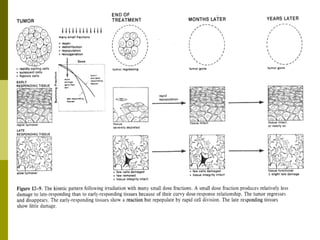
Response to multifraction radiation therapy is illustrated by three cell populations :- Tumor Early responding tissue Late responding tissue
 
 
THANK YOU

Time , Dose & Fractionationrevised

  • 1.
    time , dose& fractionation
  • 2.
    INTRODUCTION To deliverprecisely measured dose of radiation to a defined tumor volume with minimal damage to surrounding normal tissue. Aims: To eradicate tumor, Improve quality of life & Prolongation of survival.
  • 3.
    RADIATION ACTION Criticaltarget in a biological system –DNA Radiation when absorbed in biological material may damage DNA by any of following actions Direct action – Rad n interacts with critical target. Atoms of target get ionized & lead to biological damage Indirect action – Secondary e - interacts with e.g. water molecule to produce free radicals which damage DNA & produce biological changes. Indirect action Direct action
  • 4.
    TUMOR LETHAL DOSEDose of radiation that produces complete & permanent regression of tumor in vivo in zone irradiated. The expression of relationship b/w lethal effect & dose was first propounded by Holthusen Consequences of his working hypothesis are :- There is a dose point A below which there is no appreciable lethal effect. As dose is increased lethal effect increases At upper end of sigmoid curve there is a point TLD at which 80-90% tumor resolves completely Above this point dose has to be increased considerably to gain any appreciable rise in lethal effect. Probability of cell death 100% A TLD %age lethal effect dose
  • 5.
    TUMOR LETHAL DOSETumor control is a probabilistic event i.e. for every increment of radiation dose certain # of cells will be killed Total no. of surviving cells will be proportional to initial no. of cells present & the # killed after each dose. Constant # of cells are killed by each dose #.
  • 6.
    TISSUE TOLERANCE Radiationdose that will not produce any appreciable damage to normal tissue irradiated. usually <5% damage to normal tissue is acceptable. In RT the success of eradicating tumor depends on radio sensitivity of tumor as well as tolerance of surrounding normal tissue NTT limits the max. dose that can be delivered to tumor During early years of RT with orthovoltage skin was a limiting factor. This was overcome by use of Co - 60 & megavoltage X-rays
  • 7.
    NTT: Factors Siteof tissue – axilla, perineum less tolerant Area or volume irradiated Vascularity Supporting tissues ( stroma and parenchymal cells) Individual variation of tolerance.
  • 8.
    Therapeutic index It is ratio of NTT/ TLD. This ratio determines whether a particular disease can be treated or not TLD > NTT then radical dose of radiation cannot be delivered. The more the curve B is to the right of curve A the more is therapeutic ratio The optimum choice of radiation dose delivery technique is one that maximizes the TCP & simultaneously minimizes the NTCP %age lethal effect A B TCP NTCP
  • 9.
    Radio sensitivity Radiosensitivity expresses the response of the tumor to irradiation. Bergonie and Tribondeau (1906): “RS LAWS”: RS will be greater if the cell: Is highly mitotic. Is undifferentiated. Has a high cariocinetic future. Malignant cells have greater reproductive capacity hence are more radiosensitive.
  • 10.
    Radio sensitivity Doserequired to produce lethal effect is more than NTT. Hence therapeutic index is very low. e.g. soft tissue & bone sarcoma, melanoma etc. Muscle, Bones, Nervous system Though tumors are more sensitive, therapeutic ratio is low. NTT exceeds TLD by only small #. e.g. sq. cell. ca. & adenoca. Skin, Mesoderm organs (liver, heart, lungs…) For which therapeutic ratio is high Normal tissue tolerates doses several times magnitude of TLD. e.g. lymphoma, leukemia,seminoma,dysgerminoma Bone Marrow, Spleen, Thymus ,Lymphatic nodes,Gonads,Eye lens, Lymphocytes (exception to the RS laws) Resistant Moderately sensitive Highly radiosensitive
  • 11.
    Factors affecting theradiosensitivity Physical LET (linear energy transfer):  RS Dose rate:  RS Chemical Increase RS: OXYGEN, cytotoxic drugs. Decrease RS: SULFHYDRL compounds (cys, cysteamine…) Biological Cycle status:  RS: G2, M  RS: S Repair of damage (sub-lethal damage may be repaired e.g. fractionated dose) G1 S G2 M G0  LET  LET % survivor cells M M
  • 12.
    RADIOCURABILITY Refers toeradication of tumor at primary or regional sites & reflects direct effect of irradiation. There is no significant relation b/w radio sensitivity & radio curability. A tumor may be radio sensitive yet incurable & vice versa. Examples Leukemia is radiosensitive but not radio curable. Seminoma is radiosensitive & radio curable. Sarcoma is not radiosensitive/ radio curable.
  • 13.
    TREATMENT FACTORS Toeradicate a tumor radiation is delivered & factors that play an important role in any treatment are Dose of radiation Time of dose delivery Fractionation of dose
  • 14.
    DOSE Is aphysical quantity Amount of energy absorbed from beam of radiation at a given point in medium. Dose can be measured by any of three methods Calorimetry Fricke dosimetry Ion chamber dosimetry – most practical & widely used dosimetry Old unit of dose is rad When 100ergs of energy is deposited in a gm. of material then absorbed dose is one rad 1rad= 100erg/gm SI unit of dose is Gray 1Gy = 1J/Kg 1Gy = 100rads
  • 15.
    INTENTION OF TREATMENTRadical – To achieve tumor lethality Dose as high as tolerance dose is used. Cure or local control is the aim. t/t 5-6 wks Palliative – Incurable disease. Aim is to relieve pt. from discomforting symptoms of cancer (e.g. pain , dysphagia, dyspnoea) Side effects of treatment should be minor. t/t single # or 1-3wks Growth restraint -
  • 16.
    CHOICE OF DOSEIn radical radiotherapy choice of dose & fractionation regimen depends on following factors:- Radio sensitivity of tumor – e.g. radiosensitive tumor such as seminoma can be controlled by total dose of 30Gy/ 4wks While for moderately sensitive sq. cell ca. of head & neck higher doses of the order of 50-60Gy in 5-6wks is used. Size of treatment volume – smaller the vol. the greater is the dose that can be delivered without exceeding NTT. Proximity of dose limiting structures – presence of critical st. such as brain stem & spinal chord may limit dose that can be delivered to tumors e.g while treating head & neck cancer & esophagus spinal chord is the critical st.
  • 17.
    To assess theeffects of quantity of radiation following doses should be known for clinical purposes :- Given dose – The dose being delivered by any one beam either to an area of skin for KV beam or to the level of max. buildup below the skin for MV beam. Tumor dose – The dose (max. or min.) being delivered in selected treated zone containing tumor i.e. tumor & safety margins. Skin dose – The actual dose received by any area of skin summating given dose contributions received through body from any beam.
  • 18.
    Sub lethal dose – Dose which results in only temporary shrinkage of tumor having rarely palliative value if any and with no lethal effect . Supra lethal dose - dose to tumor which gives a slow response giving rise to an indurate mass with sloughing of tumour centre & ultimately frequent recurrences at a later date Integral dose – Total amt of energy absorbed at each and every point inside T/T volume. It should be minimum provided adequacy of tumor irradiation & sparing of critical organs are not compromised.
  • 19.
    TIME Time factoris overall time to deliver prescribed dose from beginning of course of radiation until its completion. Therapy effect varies enormously with time. General rule is longer the overall duration of treatment greater is the dose required to produce a particular effect. Hence dose should always be stated in relation to time.
  • 20.
    TIME For curativepurposes overall t/t is 5-6wks Better tumor control with minimal morbidity Tumor suppression can be monitored. Radiation reactions can be monitored. If treatment time is more than 6wks then dose has to be increased Short duration treatment time is justified for Treatment of small lesions To treat aged persons Palliative treatments Tumors with high therapeutic ratio e.g. skin tumors
  • 21.
    FRACTIONATION Refers todivision of total dose into no. of separate fractions over total t/t conventionally given on daily basis , usually 5days a wk. Size of each dose # whether for cure or palliation depends on tumor dose as well as normal tissue tolerance . e.g. if 40Gy is to be delivered in 20# in a time of 4wks then daily dose is 2Gy.
  • 22.
    HISTORICAL REVIEW X-raywere used for radiotherapy just 1 month after its discovery in a fractionated course because of the primitive X-ray machines available at that time & their low output To deliver a single dose to destroy a tumor would require several hours or even days. Single fraction radiotherapy became feasible only in 1914 with the advent of Coolidge hot cathode tube, with high output, adjustable tube currents & reproducible exposures.
  • 23.
    HISTORICAL REVIEW Earliersome radiotherapists believed that fractionated treatment was inferior & single dose was necessary to cure cancer. While radiobiological experiments conducted in France favored fractionated regimen for radiotherapy which allows cancerocidal dose to be delivered without exceeding normal tissue tolerance
  • 24.
    RADIOBIOLOGICAL RATIONALE FORFRACTIONATION Delivery of tumorocidal dose in small dose fractions in conventional multifraction regimen is based on 4R’s of radiobiology namely Repair of SLD Repopulation Redistribution Reoxygenation Radio sensitivity is considered by some authors to be 5 th R of radiobiology.
  • 25.
    RADIATION DAMAGE CLASSIFICATIONRadiation damage to mammalian cells are divided into three categories: Lethal damage :irreversible, irreparable & leads to cell death Sub lethal damage : can be repaired in hours unless additional sub lethal damage is added to it Potentially lethal damage : can be manipulated by repair when cells are allowed to remain in non-dividing state.
  • 26.
    REPAIR Most importantrationale for fractionation Mammalian cells can repair radn damage in b/w dose fractions. This is a complex process involving repair of SLD by a variety of repair enzymes & pathways. Since tumerocidal doses are very high as compared to NTT there are two ways to deliver such high doses: One option is to deliver much higher dose to tumor than to normal tissue – basis of conformal radiotherapy Other option is to fractionate the dose. So that there is sufficient time b/w consecutive fractions for complete repair of all cell that suffered SLD during 1 st # before 2 nd #& so on. So small dose /# spares late reactions preferentially & a reasonable schedule duration allows regeneration of early reacting tissues.
  • 27.
    SLD & ITSREPAIR Initial shoulder in cell survival curve reflects ability of cells to accumulate SLD Ability of cells to recover from SLD demonstrated by Elkind & Sutton by split dose experiments. A given total dose delivered as single # is found to be more effective compared to same dose delivered in more #s.
  • 28.
    Redistribution Increase insurvival during 1 st 2hrs in split dose experiment results from repair of SLD If interval b/w doses is 6hrs then resistant cells move to sensitive phases If interval is more than 6hrs then cells will repopulate & results in increase of surviving fraction. Hence dose fractionation enable normal tissue to recover b/w #s reducing damage to normal tissue Ability of normal tissue to repair radn damage better than tumor forms basis of fractionation.
  • 29.
    Redistribution of proliferatingcell populations throughout the cell cycle increases cell kill in fractionated treatment relative to a single session treatment. Cells are most sensitive during M & G 2 phase & are resistant during S phase of cell cycle . Redistribution can be a benefit in fractionated course of RT if cells are caught in sensitive phase after each fraction . Redistribution
  • 30.
    Repopulation In b/wdose fractions normal cells as well as tumor cells repopulate. So longer a radiotherapy course lasts, more difficult it becomes to control tumor & may be detrimental But acutely responding normal tissue need to repopulate during course of radiotherapy . Thus fractionation must be controlled so as not to allow too much time for excessive repopulation of tumor cells at the same time not treating so fast that acute tolerance is exceeded
  • 31.
    ACCELERATED REPOPULATION Treatmentwith any cytotoxic agent , including rad n , triggers surviving cells (clonogens) in a tumor to divide faster than before Dose escalation is needed to overcome this proliferation. e.g. it starts in head & neck cancer 4wks after initiation of fractionated RT Implication Treatment should be completed as soon after it is started . It is better to delay a treatment than to introduce delay during treatment .
  • 32.
    Reoygenation Cells atthe center of tumor are hypoxic & are resistant to low LET radiation. Hypoxic cells get reoxygenated occurs during a fractionated course of treatment, making them more radiosensitive to subsequent doses of radiation.
  • 33.
    ADV. OF FRACTIONATIONAcute effects of single dose of radiation can be decreased Pt.’s tolerance improves with fractionated RT Exploits diff. in recovery rate b/w normal tissues & tumors. Rad n induced redistribution & sensitization of rapidly proliferating cells. Reduction in hypoxic cells leads to – Reoxygenation Opening of compressed blood vessels Reduction in no. of tumor cells with each dose #
  • 34.
    RADIATION RESPONSE Responseof all normal tissues to rad n is not same Depending on their response tissues are either Early responding – constitute fast proliferating cells such as skin, mucosa, intestinal epithelium, colon, testis etc. Late responding – have large no. of cells in the resting phase e.g. spinal cord, bladder, lung, kidneys etc. Early responding tissues are triggered to proliferate within 2-3wks after start of fractionated RT. Prolonging overall treatment time can reduce acute reactions without sparing late damage
  • 35.
    VARIOUS FRACTIONATION SCHEDULESFractionated radiation exploits difference in 4R’s between tumors and normal tissue thereby improving therapeutic index Types Conventional Altered Hyper fractionation Accelerated fractionation Split course Hypofractionation
  • 36.
    Conventional fractionation Divisionof dose into multiple # spares normal tissue through repair of SLD b/w dose #s & repopulation of cells. The former is greater for late reacting tissues & the later for early reacting tissues. Concurrently , fractionation increases tumor damage through reoxygenation & redistribution of tumor cells. Hence a balance is achieved b/w the response of tumor & early & late reacting normal tissue. Most common fractionation for curative radiotherapy is 1.8 to 2.2Gy/#
  • 37.
    CONVENTIONAL FRACTIONATION Evolvedas conventional regimen because it is Convenient (no weekend treatment) Efficient (treatment every weekday) Effective (high doses can be delivered without exceeding either acute or chronic normal tissue tolerance) Allows upkeep of machines. Rationale for using conventional fractionation Most tried & trusted method Both tumorocidal & tolerance doses are well documented
  • 38.
    HYPERFRACTIONATION Rationale – To take maximal adv. of diff. in repair capacity of late reacting normal tissue compared with tumors. Radio sensitization through redistribution. Pure hyper fractionation – total dose & over all t/t same as conventional regimen but delivering dose in twice as many #s i.e. treating twice daily. Impure hyper fractionation - Since dose/# decreases hence total dose need to be increased.
  • 39.
    HYPERFRACTIONATION A hyperfractionated schedule of 80.5Gy/70#(1.15Gy twice/day)/7wks compared with 70Gy/35#/7wks in head & neck cancer. Implications – Increased local tumor control at 5yr from 40 to59% Reflected in improved survival No increase in side effects
  • 40.
    ACCELERATED TREATMENT Alternativeto hyper fractionation Rationale – To reduce repopulation in rapidly proliferating tumors by reducing overall treatment time. Pure accelerated treatment – same total dose delivered in half the overall time by giving 2or more #s/day. but it is not possible to achieve as acute effects become limiting factor. Impure accelerated treatment – dose is reduced or rest period is interposed in the middle of treatment.
  • 41.
    Types ofaccelerated fraction Multiple std # / day Comparison of head & neck cases accelerated regimen 72Gy/45# (1.6Gy,3#/day)/5wks with 70Gy/35#/7wks Implications – 15% increase in loco regional control No survival adv. Increased acute effects Unexpected increase in late complications
  • 42.
    ACCELERATED TREATMENT Concomitantboost Developed at M.D. Anderson cancer centre Boost dose to a reduced volume given concomitantly , with t/t of initial layer volume Conv 54Gy in 30 # over 6 wks & boost dose of 1.5 Gy per # in last 12 # with Inter # interval of 6 hr in last 12# large field gets 54 Gy & boost field 72 Gy in 6 wks time E.g. Head and Neck cancer
  • 43.
    CHART Regimen conceivedat Mount Vernon Hospital, London With CHART treatments 6hrs apart delivered 3times a day,7daya a wk. with dose # of 1.5Gy, total dose of 54Gy can be delivered in 36# over 12 consecutive days including weekends. This schedule was chosen to complete treatment before acute reactions start appearing i.e. 2wks Characteristics Low dose /# Short treatment time No gap in treatment, 3#/day at 6hr interval Implications- Better local tumor control Acute reactions are brisk but peak after treatment is completed Dose/# small hence late effects acceptable Promising clinical results achieved with considerable trauma to pt.
  • 44.
    SPLIT-COURSE Total doseis delivered in two halves with a gap in b/w with interval of 4wks. Purpose of gap is to allow elderly pts. to recover from acute reactions of treatment to exclude pts. from further morbidity who have poorly tolerated 1 st half or disease progressed despite treatment. Applied to elderly pts. in radical treatment of ca bladder & prostate & lung cancer. Disadv : impaired tumor control due to prolong T/T time that results in tumor cell repopulation
  • 45.
    HYPOFRACTIONATIONHigh dose is delivered in 2-3# / wk Rationale Treatment completed in a shorter period of time. Machine time well utilized for busy centers. Higher dose /# gives better control for larger tumors. Higher dose /# also useful for hypoxic fraction of large tumor. Disadv. Higher potential for late normal tissue complications. E.g. 5oGy/10#/5wks treating 2 days a wk in head & neck cancer.
  • 46.
    conventional Hyper fractionationAccelerated fractionation Concomitant boost Split - course Hypo fractionation
  • 47.
    TIME DOSE MODELSWith introduction of various fractionation schemes in radiotherapy need for quantitative comparisons of treatments was felt in order to optimize treatment for particular tumor. Strandquist was 1 st to device scientific approach for correlating dose to overall t/t to produce an equivalent biological isoeffect.
  • 48.
    CUBE ROOT MODELBy Strandqvist (1944) He demonstrated that isoeffect curves (i.e. dose vs. no. of #s to produce equal biological effect) on log-log graph for skin reactions (erythema & skin tolerance) were st. lines with a slope of 0.33 i.e. As these plots were for fixed no. of #s N hence T was linear function of N & D was proportional to cube root of N also Dose in R Time in days A - Skin necrosis C – moist desquamation B – cure for skin carcinoma D – dry desquamation E – skin erythema A B C D E 1 3 7 10 20 2
  • 49.
    Cohen’s Cohen analyzedthree diff. set of data of skin damage with end points as weak or strong erythema &skin tolerance. Cohen found an exponent of 0.33for skin erythema / skin tolerance & 0.22 for skin cancers. According to Cohen’s results, relationship b/w total dose & overall treatment time for normal tissue tolerance & tumor can be written as Where K 1 & K 2 are proportionality constants. D n , D t &T are normal tissue tolerance dose , tumor lethal dose & overall treatment time respectively The exponents ,0.33& 0.22 of time factor represents the repair capabilities of normal tissue & tumor cells respectively.
  • 50.
    Fowler Difference inexponents of time factor in Cohen’s formulations indicate that repair capacity of normal tissue is larger than that of tumor Fowler carried experimental studies on pig skin showing normal tissue have two type of repair capabilities Intracellular – having short repair half time of 0.5 to 3hrs & is complete within few hrs of irradiation. multiplicity of completion of recovery is equal to no. of #s. Hence no. of #s are more important than overall t/t Homeostatic recovery that takes longer time to complete This led Ellis to formulate NSD
  • 51.
    NSD MODEL Accordingto Ellis ‘s NSD formula time factor was a composite of N (no. of #s) & T (overall treatment time) Exponents for intracellular & homeostatic recovery are 0.22 & 0.33-0.22=0.11 respectively Fractionation is twice as important as time according to clinical observations of Ellis. Hence dose is related to time & no. of #s as Where NSD (nominal stand. Dose) is proportionality constant for specific level of skin damage
  • 52.
    TDF Developed byOrtan & Ellis (1973) In a complex multi-phase treatment protocol, total effective partial tolerance: PT = (PT) a + (PT) b + …+ (PT) n And to compare this protocol with another with partial tolerance PT’ (PT) a + (PT) b + …+ (PT) n = (PT)’ a + (PT)’ b + …+ (PT)’ n Basic formula of NSD is NSD = D x T -0.11 x N -0.24 Replacing D= nd (where n – no. of #s & d – dose/#) T= T/N for fixed no. of #s
  • 53.
    TDF contd. NSD= Nd x (T /N) -0.11 x N -0.24 Or NSD = d x T/N) -0.11 x N 0.65 Raising both side of equation to power 1.538 TDF = 10 -3 x NSD 1.538 = Nd 1.538 (T/N) -0.17 x 10 -3 Where 10 -3 is scaling factor TDF = 1.19 Nd 1.54 (T/N) -0.17 Allowance must be made for repopulation during rest period or break According to Ellis, TDF before break should be reduced by decay factor to calculate TDF after break Decay factor = Where T days is time from beginning if course of radiotherapy to break & R days is length of rest period.
  • 54.
    CRITICISMS OF NSD Do not take into account complex biological processes that take place during or after irradiation Values of exponent of N in NSD eq. are not same foe diff. tissue types. Validity of NSD w.r.t. different effects in same tissue is doubtful. For late effects in skin the influence of no. of #s may be considerably larger than for acute skin responses Uncertainty relates to no. of #s for which formula provides reasonable approximation of tolerance dose of a given tissue. For effects in skin approximation is obtained b/w 10 to 25 #s Another difficulty is with time factor T 0.11 . this suggests an increase in dose ay approx.20% in 1 st week,10% in 2 nd week& 5% in 3 rd week. but for acute reactions in skin & mucosa accelerated repopulation starts only after 2-3wks after start of fractionated treatment while for late reacting tissue cell proliferation during the fractionated course(4-8 wks) is not expected to increase tolerance dose as predicted by NSD formula
  • 55.
    TARGET THEORY Toexpress relationship b/w no. of cells killed & dose delivered in mathematical terms Target theory was proposed by Crowther & expended by Lea. Curve representing relation b/w dose & surviving # after radiation delivery is called survival curve.
  • 56.
    SIMPLE TARGET THEORYAlso called single hit single target theory. Single hit is sufficient to produce measured effect or to inactivate a cell The curve is exponential i.e. at low doses the relationship is linear as process continues larger doses are required to inactivate same no. of organisms. Where 1/D o is constant of proportionality
  • 57.
    SIMPLE TARGET THEORYWhere D o is the mean lethal dose that will produce avg. one hit per cell such log survival curve is linear showing D o as dose that reduce cell survival fraction to 37% Such curves are observed in mammalians cells only When cell are irradiated with high LET rad n e.g. α - particles When cells irradiated are synchronized in most sensitive phases of cell cycle (lateG 2 or M)
  • 58.
    MULTITARGET THEORY Accordingto this theory some organisms contain more than one target & to inactivate organism each target should receive one hit Survival curves corresponding to this theory start with less sensitive region at low doses & show exponential behavior at large doses i.e. curves show a shoulder region in the beginning. Such curves are observed when mammalian cells are irradiated with low LET rad n e.g. x-rays Shoulder represents cells in which fewer than n targets have been damaged after receiving a dose D i.e. cells have received SLD which can be repaired.
  • 59.
    LINEAR QUADRATIC MODELBasis of LQ theory is that cell is damaged when both strands of DNA are damaged. This can be produced either by single ionizing particle i.e. Where α is constant of proportionality Or it can be accomplished by independent interaction by two separate ionizing particles such that
  • 60.
    LINEAR QUADRATIC MODELOverall LQ eq. for cell survival is therefore This shows the two components to cell killing, α - damage (irreparable) & β - damage (reparable) combine to form cell survival curve. D= α / β is the dose at which log surviving # for α - damage equals that for β - damage. Parameter α / β represents curviness of cell survival curve. Higher the α / β , straighter is the curve & cells show little repair of SLD while low α / β indicates high capability of repair. Tumor usually have high α / β values in range of 5-20Gy (mean 10Gy) while late responding normal tissue have α / β in range 1-4Gy (mean 2.5Gy) Sparsely ionizing particles 4 8 12 Densely ionizing particles β D 2 α D α / β
  • 61.
    LQ MODEL NSD& TDF models are empirical models while LQ model is derived from cell survival curves. LQ model is based on fundamental mechanism of interaction of radn with biological systems. Biologically effective dose is the quantity by which diff. fractionation regimens are intercom pared BED = total dose x relative effectiveness Where n - no. of #s d - dose/#
  • 62.
    RADIATION RESPONSE Survivalcurves of early & late responding cells have different shapes. Curves for late responding tissue are more curved because of difference in repair capacity of late & early responding tissues. In terms of linear quadratic relationship b/w effect & dose this translates into larger α / β ratio for early than late effects. If fewer & larger dose #s are given late reactions are more severe. It can be interpreted as diff. in repair capacity or shoulder shape of underlying dose – response curve. acute late Cell survival dose
  • 63.
    EXPLANATION FOR DIFF.IN SHAPE OF EARLY & LATE RESPONDING TISSUES The radio sensitivity of a population of cells varies with the distribution of cells through the cycle . Two different cell populations may be radio resistant :- Population proliferating so fast that S phase occupies a major portion of cycle . Population proliferating so slowly that many cells are in early G 1 or not proliferating at all so that cells are in resting (G 0 ) phase.
  • 64.
    Population proliferating sofast that S phase occupies a major portion of cycle . Redistribution occurs through all phases of cell cycle in such population & is referred to as self sensitizing activity. New cells produced by fast proliferating population offset cells killed by dose #s & thus offers resistance to effect of radiation in acutely responding tissues & tumors. Thus proliferation occurring b/w dose #s help in repopulation of normal tissue (i.e. spares normal tissue) at the risk of tumor repopulation
  • 65.
    EXPLANATION FOR DIFF.IN SHAPE OF EARLY & LATE RESPONDING TISSUES Population proliferating so slowly that many cells are in early G 1 or not proliferating at all so that cells are in resting (G 0 ) phase. Hence late responding normal tissue are resistant due to presence of many resting cells. Such resistance disappears at high dose/#
  • 66.
    IMPLICATIONS For earlyeffects α / β is large, as a consequence α i.e. irreparable damage dominates at low doses & dose – response curve has marked initial slope & bends at higher doses. For late effects α / β is small ,i.e. β term (repairable damage) has an influence at low doses. Implications of diff. in shape of dose – response curves of early & late reacting tissues :- If fractionation regimen is changed from many small doses to few large dose fractions leads to severe late tissue toxicity. Late reacting tissues are more sensitive to changes in fractionation pattern than early responding tissues. dose Cell survival late acute
  • 67.
    To calculate newtotal dose required to keep biological effectiveness of course of therapy unchanged when a conventional fractionation schedule has been altered. To compare treatment technique that differ in dose/#, no. of #s, and/or overall t/t. To strive for optimal fractionation regimen.
  • 68.
    Response to multifractionradiation therapy is illustrated by three cell populations :- Tumor Early responding tissue Late responding tissue
  • 69.
  • 70.
  • 71.