Fractionation
& its types…
Fractionation:
• Refers to division of total dose into no. of
separate fractions over total treatment
conventionally given on daily basis , usually
5days a wk.
• Size of each dose fraction whether for cure or
palliation depends on tumor dose as well as
normal tissue tolerance .
• e.g. if 40Gy is to be delivered in 20# in a time
of 4wks then daily dose is 2Gy.
RADIOBIOLOGICAL RATIONALE FOR
FRACTIONATION
• Delivery of tumorocidal dose in small dose
fractions in conventional multifraction regimen is
based on 4R’s of radiobiology namely
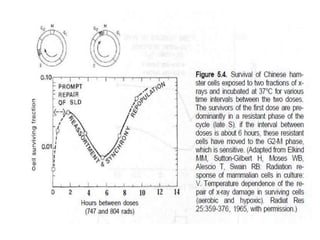
– Repair of SLD
– Redistribution
– Repopulation
– Reoxygenation
• Radio sensitivity is considered by some authors to
be 5th R of radiobiology.
VARIOUS FRACTIONATION SCHEDULES
• Fractionated radiation exploits difference in
4R’s between tumors and normal tissue
thereby improving therapeutic index
• Types
– Conventional
– Altered
• Hyper fractionation
• Accelerated fractionation
• Hypofractionation
1. Conventional fractionation:
• Fractional doses of 1.8 to 2 Gy given once
daily, Monday through Friday, to total doses
determined by the tumor feature and the
tolerance of critical normal tissues.
• Evolved as conventional regimen because it is
– Convenient (no weekend treatment)
– Efficient (treatment every weekday)
– Effective (high doses can be delivered without
exceeding either acute or chronic normal tissue
tolerance
Rationale for using conventional fractionation
– Most tried & trusted method
– Both tumorocidal & tolerance doses are well
documented
ALTERED FRACTIONATION
• HYPERFRACTIONATION
• ACCELERATED FRACTIONATION
1.CHART
2.CHARTWEL
3.ARCON
4.CONCOMITANT BOOST
5.SPLIT-COURSE
• HYPOFRACTIONATION
• Perhaps the most important consequence of
altering a fractionation schedule is that late
effects are more sensitive to changes in size of
dose per fraction, and acute reactions are
more sensitive to changes in the rate of dose
accumulation
Hyperfractionation
• Hyperfractionation, the total dose is
increased, the size of dose per fraction is
significantly reduced, the number of dose
fractions is increased, and overall time is
relatively unchanged.
The basic rationale of hyperfractionation is that
the use of small dose fractions allows higher
total doses to be administered within the
tolerance of late-responding normal tissues,
and this translates into a higher biologically
effective dose to the tumor
• A hyper fractionated schedule of
80.5Gy/70#(1.15Gy twice/day)/7wks compared
with 70Gy/35#/7wks(2Gy/day) in head & neck
cancer.
• Implications –
– Increased local tumor control at 5yr from 40 to59%
– Reflected in improved survival
– No increase in side effects
Accelerated fractionation
• Accelerated fractionation, overall time is
significantly reduced, and the number of dose
fractions, total dose, and size of dose per
fraction are either unchanged or somewhat
reduced, depending on the extent of overall
time reduction.
• The rationale for accelerated fractionation is that
reduction in overall treatment time decreases the
opportunity for tumor
cell regeneration during treatment and therefore
increases the probability of tumor control for a give
• Because overall treatment time has little influence
on the probability of late normal tissue injury, a
therapeutic gain should be realized, provided the size
of dose per fraction is not increased and the interval
between dose fractions is sufficient for complete
repair to take place. n total dose
• Comparison of head & neck cases accelerated
regimen 72Gy/45# (1.6Gy,3#/day)/5wks with
70Gy/35#/7wks
• Implications –
– 15% increase in loco regional control
– No survival adv.
– Increased acute effects
CHART(Continuous Hyperfractionated Accelerated
Radiation Therapy) & CHARTWEL
• Regimen conceived at Mount Vernon Hospital, London
• With CHART treatments 6hrs apart delivered 3times a day,7days a wk.
with dose # of 1.5Gy, total dose of 54Gy can be delivered in 36# over 12
consecutive days including weekends.
• This schedule was chosen to complete treatment before acute reactions
start appearing i.e. 2wks
• Characteristics
– Low dose /#
– Short treatment time
– No gap in treatment, 3#/day at 6hr interval
• Implications-
– Better local tumor control
– Acute reactions are brisk but peak after treatment is completed
– Dose/# small hence late effects acceptable
– Promising clinical results achieved with considerable trauma to pt.
• Accelerated Hyper fractionated radiotherapy with
addition of breathing carbogen and nicotinamide.
• Characteristics of ARCON-
1. Accelerated treatment to overcome tumor
proliferation.
2. Hyperfractionated to spare normal tissue.
3. Carbogen breathing to overcome chronic
hypoxia.
4. Nicotinamide to overcome acute hypoxia.
17
ARCON (Accelerated Hyperfractionated Radiation
Therapy while Breathing Carbogen and with the
Addition of Nicotinamide)
• Concomitant boost
– Developed at M.D. Anderson cancer centre
– Boost dose to a reduced volume given
concomitantly , with t/t of initial layer volume
– Conv 54Gy in 30 # over 6 wks & boost dose of 1.5
Gy per # in last 12 # with Inter # interval of 6 hr in
last 12#
– large field gets 54 Gy & boost field 72 Gy in 6
wks time
– E.g. Head and Neck cancer
SPLIT-COURSE
• Total dose is delivered in two halves with a gap in
b/w with interval of 4wks.
• Purpose of gap is
– to allow elderly pts. to recover from acute reactions of
treatment
– to exclude pts. from further morbidity who have
poorly tolerated 1st half or disease progressed despite
treatment.
• Applied to elderly pts. in radical treatment of ca
bladder & prostate & lung cancer.
• Disadv : impaired tumor control due to prolong
T/T time that results in tumor cell repopulation
HYPOFRACTIONATION
• High dose is delivered in 2-3# / wk
• Rationale
– Treatment completed in a shorter period of time.
– Higher dose /# gives better control for larger tumors.
– Higher dose /# also useful for hypoxic fraction of large
tumor.
• Disadv.
• Higher potential for late normal tissue
complications.
• E.g. 5oGy/10#/5wks treating 2 days a wk in head
& neck cancer.
The Advantages Of Dose Fractionation
Include
• Reduction in the number of hypoxic cells through
cell killing and re oxygenation.
• Reduction in the absolute number of clonogenic
tumor cells by the preceding fractions with the
killing of the better oxygenated cells.
• Blood vessels compressed by a growing cancer are
decompressed secondary to tumor regression.
Cont…..
• Fractionation exploits the difference in recovery
rate between normal, acute, and late-reacting
tissues and tumors.
• Radiation-induced redistribution of cell within
the cell cycle tends to sensitize rapidly
proliferating cells as they move into the more
sensitive phases of the cell cycle.
• The acute normal tissue toxicity of single
radiation doses can be decreased with
fractionation.
• Thus, patients' tolerance of radiotherapy will
improve with fractionated irradiation.

Fractionation.pptx

  • 1.
  • 2.
    Fractionation: • Refers todivision of total dose into no. of separate fractions over total treatment conventionally given on daily basis , usually 5days a wk. • Size of each dose fraction whether for cure or palliation depends on tumor dose as well as normal tissue tolerance . • e.g. if 40Gy is to be delivered in 20# in a time of 4wks then daily dose is 2Gy.
  • 3.
    RADIOBIOLOGICAL RATIONALE FOR FRACTIONATION •Delivery of tumorocidal dose in small dose fractions in conventional multifraction regimen is based on 4R’s of radiobiology namely – Repair of SLD – Redistribution – Repopulation – Reoxygenation • Radio sensitivity is considered by some authors to be 5th R of radiobiology.
  • 5.
    VARIOUS FRACTIONATION SCHEDULES •Fractionated radiation exploits difference in 4R’s between tumors and normal tissue thereby improving therapeutic index • Types – Conventional – Altered • Hyper fractionation • Accelerated fractionation • Hypofractionation
  • 6.
    1. Conventional fractionation: •Fractional doses of 1.8 to 2 Gy given once daily, Monday through Friday, to total doses determined by the tumor feature and the tolerance of critical normal tissues.
  • 7.
    • Evolved asconventional regimen because it is – Convenient (no weekend treatment) – Efficient (treatment every weekday) – Effective (high doses can be delivered without exceeding either acute or chronic normal tissue tolerance Rationale for using conventional fractionation – Most tried & trusted method – Both tumorocidal & tolerance doses are well documented
  • 8.
    ALTERED FRACTIONATION • HYPERFRACTIONATION •ACCELERATED FRACTIONATION 1.CHART 2.CHARTWEL 3.ARCON 4.CONCOMITANT BOOST 5.SPLIT-COURSE • HYPOFRACTIONATION
  • 9.
    • Perhaps themost important consequence of altering a fractionation schedule is that late effects are more sensitive to changes in size of dose per fraction, and acute reactions are more sensitive to changes in the rate of dose accumulation
  • 10.
    Hyperfractionation • Hyperfractionation, thetotal dose is increased, the size of dose per fraction is significantly reduced, the number of dose fractions is increased, and overall time is relatively unchanged.
  • 11.
    The basic rationaleof hyperfractionation is that the use of small dose fractions allows higher total doses to be administered within the tolerance of late-responding normal tissues, and this translates into a higher biologically effective dose to the tumor
  • 12.
    • A hyperfractionated schedule of 80.5Gy/70#(1.15Gy twice/day)/7wks compared with 70Gy/35#/7wks(2Gy/day) in head & neck cancer. • Implications – – Increased local tumor control at 5yr from 40 to59% – Reflected in improved survival – No increase in side effects
  • 13.
    Accelerated fractionation • Acceleratedfractionation, overall time is significantly reduced, and the number of dose fractions, total dose, and size of dose per fraction are either unchanged or somewhat reduced, depending on the extent of overall time reduction.
  • 14.
    • The rationalefor accelerated fractionation is that reduction in overall treatment time decreases the opportunity for tumor cell regeneration during treatment and therefore increases the probability of tumor control for a give • Because overall treatment time has little influence on the probability of late normal tissue injury, a therapeutic gain should be realized, provided the size of dose per fraction is not increased and the interval between dose fractions is sufficient for complete repair to take place. n total dose
  • 15.
    • Comparison ofhead & neck cases accelerated regimen 72Gy/45# (1.6Gy,3#/day)/5wks with 70Gy/35#/7wks • Implications – – 15% increase in loco regional control – No survival adv. – Increased acute effects
  • 16.
    CHART(Continuous Hyperfractionated Accelerated RadiationTherapy) & CHARTWEL • Regimen conceived at Mount Vernon Hospital, London • With CHART treatments 6hrs apart delivered 3times a day,7days a wk. with dose # of 1.5Gy, total dose of 54Gy can be delivered in 36# over 12 consecutive days including weekends. • This schedule was chosen to complete treatment before acute reactions start appearing i.e. 2wks • Characteristics – Low dose /# – Short treatment time – No gap in treatment, 3#/day at 6hr interval • Implications- – Better local tumor control – Acute reactions are brisk but peak after treatment is completed – Dose/# small hence late effects acceptable – Promising clinical results achieved with considerable trauma to pt.
  • 17.
    • Accelerated Hyperfractionated radiotherapy with addition of breathing carbogen and nicotinamide. • Characteristics of ARCON- 1. Accelerated treatment to overcome tumor proliferation. 2. Hyperfractionated to spare normal tissue. 3. Carbogen breathing to overcome chronic hypoxia. 4. Nicotinamide to overcome acute hypoxia. 17 ARCON (Accelerated Hyperfractionated Radiation Therapy while Breathing Carbogen and with the Addition of Nicotinamide)
  • 18.
    • Concomitant boost –Developed at M.D. Anderson cancer centre – Boost dose to a reduced volume given concomitantly , with t/t of initial layer volume – Conv 54Gy in 30 # over 6 wks & boost dose of 1.5 Gy per # in last 12 # with Inter # interval of 6 hr in last 12# – large field gets 54 Gy & boost field 72 Gy in 6 wks time – E.g. Head and Neck cancer
  • 19.
    SPLIT-COURSE • Total doseis delivered in two halves with a gap in b/w with interval of 4wks. • Purpose of gap is – to allow elderly pts. to recover from acute reactions of treatment – to exclude pts. from further morbidity who have poorly tolerated 1st half or disease progressed despite treatment. • Applied to elderly pts. in radical treatment of ca bladder & prostate & lung cancer. • Disadv : impaired tumor control due to prolong T/T time that results in tumor cell repopulation
  • 20.
    HYPOFRACTIONATION • High doseis delivered in 2-3# / wk • Rationale – Treatment completed in a shorter period of time. – Higher dose /# gives better control for larger tumors. – Higher dose /# also useful for hypoxic fraction of large tumor. • Disadv. • Higher potential for late normal tissue complications. • E.g. 5oGy/10#/5wks treating 2 days a wk in head & neck cancer.
  • 22.
    The Advantages OfDose Fractionation Include • Reduction in the number of hypoxic cells through cell killing and re oxygenation. • Reduction in the absolute number of clonogenic tumor cells by the preceding fractions with the killing of the better oxygenated cells. • Blood vessels compressed by a growing cancer are decompressed secondary to tumor regression. Cont…..
  • 23.
    • Fractionation exploitsthe difference in recovery rate between normal, acute, and late-reacting tissues and tumors. • Radiation-induced redistribution of cell within the cell cycle tends to sensitize rapidly proliferating cells as they move into the more sensitive phases of the cell cycle. • The acute normal tissue toxicity of single radiation doses can be decreased with fractionation. • Thus, patients' tolerance of radiotherapy will improve with fractionated irradiation.