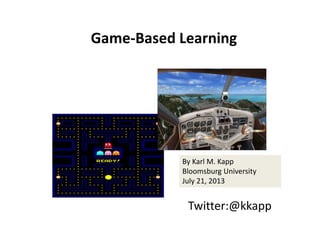
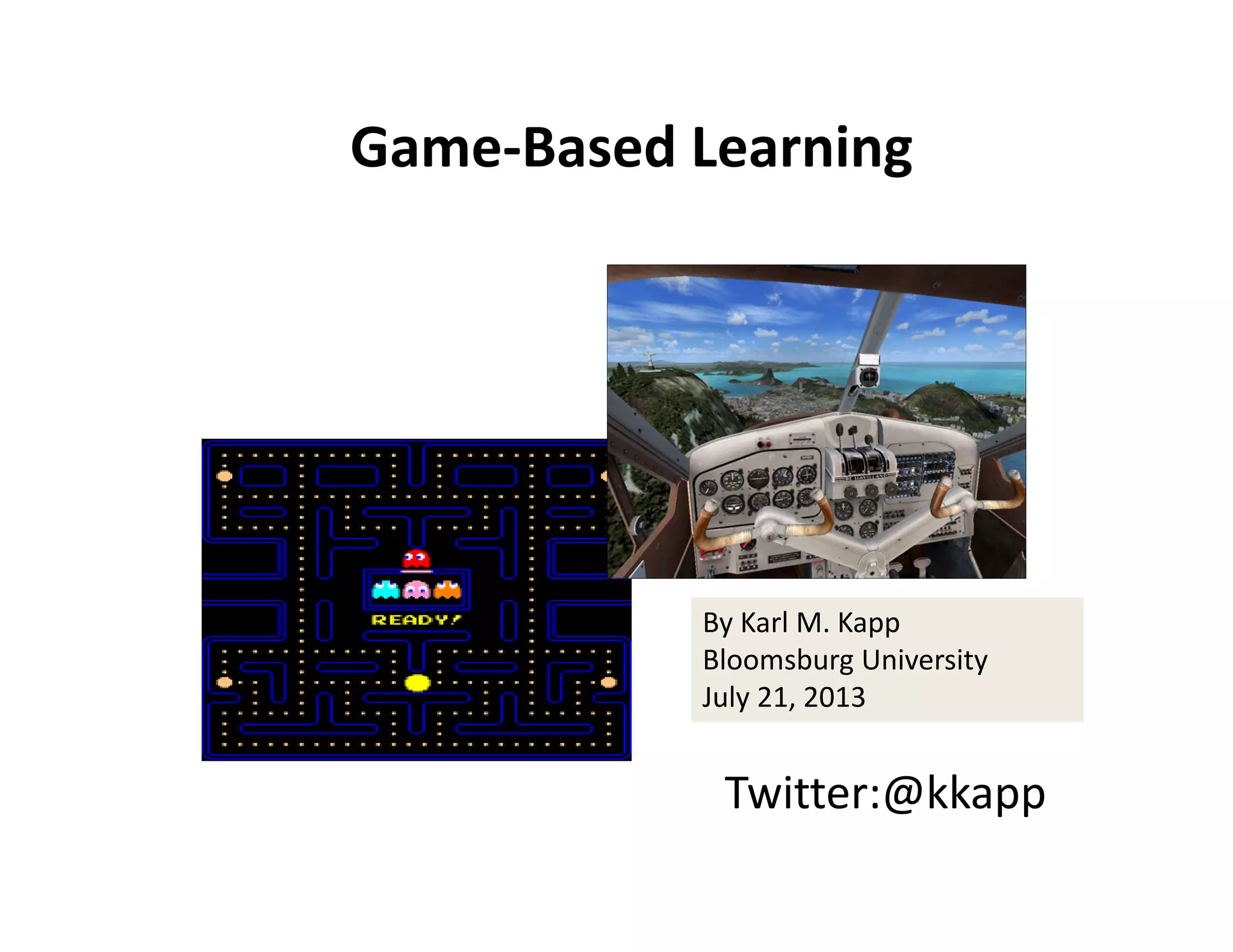
Game‐Based Learning
Twitter:@kkapp
By Karl M. Kapp
Bloomsburg University 
July 21, 2013
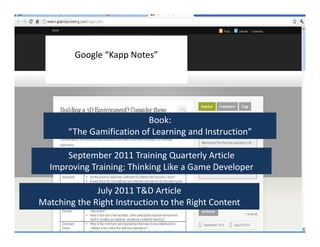
Google “Kapp Notes”Google “Kapp Notes”
Book:
“The Gamification of Learning and Instruction”
Book:
“The Gamification of Learning and Instruction”
September 2011 Training Quarterly Article
Improving Training: Thinking Like a Game Developer
September 2011 Training Quarterly Article
Improving Training: Thinking Like a Game Developer
July 2011 T&D Article
Matching the Right Instruction to the Right Content
July 2011 T&D Article
Matching the Right Instruction to the Right Content
1
Agenda
How do I use game-based
learning in the classroom?
How do you apply game-based strategies
to the presentation of learning content?
2
3
What are 3 principles for adding
serious games to learning curriculums?
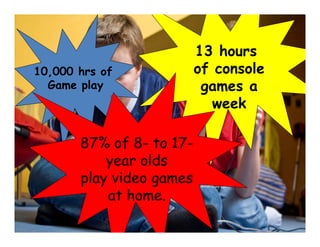
10,000 hrs of
Game play
13 hours
of console
games a
week
Digital divisions. Report by the Pew /Internet: Pew Internet & American Life. 
US Department of Commerce
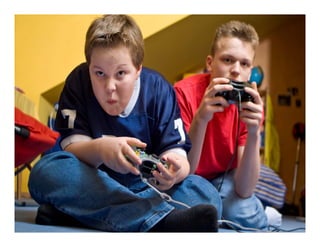
87% of 8- to 17-
year olds
play video games
at home.
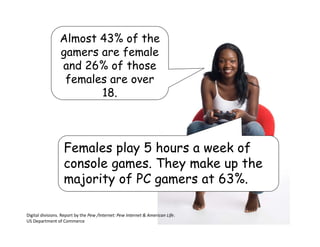
Females play 5 hours a week of
console games. They make up the
majority of PC gamers at 63%.
Almost 43% of the
gamers are female
and 26% of those
females are over
18.
Digital divisions. Report by the Pew /Internet: Pew Internet & American Life. 
US Department of Commerce
What Research Says
about
Games for Learning
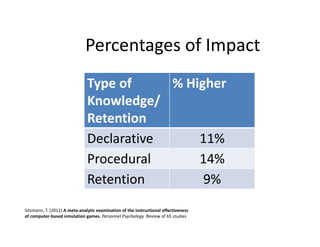
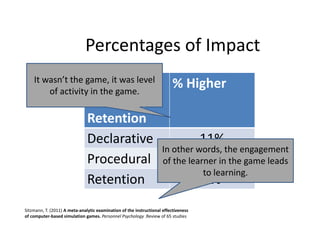
Type of 
Knowledge/
Retention
% Higher
Declarative 11%
Procedural 14%
Retention 9%
Percentages of Impact
Sitzmann, T. (2011) A meta‐analytic examination of the instructional effectiveness 
of computer‐based simulation games. Personnel Psychology .Review of 65 studies
Type of 
Knowledge/
Retention
% Higher
Declarative 11%
Procedural 14%
Retention 9%
Percentages of Impact
Sitzmann, T. (2011) A meta‐analytic examination of the instructional effectiveness 
of computer‐based simulation games. Personnel Psychology .Review of 65 studies
It wasn’t the game, it was level 
of activity in the game.
In other words, the engagement 
of the learner in the game leads 
to learning.
Sitzmann, T. (2011) A meta‐analytic examination of the instructional effectiveness 
of computer‐based simulation games. Personnel Psychology .
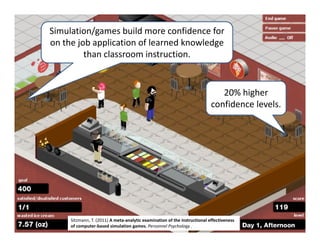
20% higher 
confidence levels.
Simulation/games build more confidence for 
on the job application of learned knowledge 
than classroom instruction.
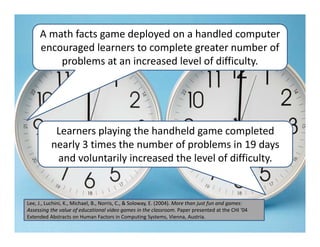
A math facts game deployed on a handled computer 
encouraged learners to complete greater number of 
problems at an increased level of difficulty. 
Learners playing the handheld game completed 
nearly 3 times the number of problems in 19 days 
and voluntarily increased the level of difficulty. 
Lee, J., Luchini, K., Michael, B., Norris, C., & Soloway, E. (2004). More than just fun and games: 
Assessing the value of educational video games in the classroom. Paper presented at the CHI '04 
Extended Abstracts on Human Factors in Computing Systems, Vienna, Austria.
..it’s the instructional methods and 
not the delivery system that 
provides the active ingredients for 
learning…in a game/simulation.
‐‐Jeanne Farrington
Recommendations 
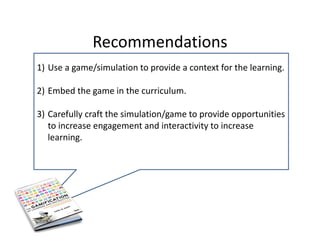
1) Use a game/simulation to provide a context for the learning. 
2) Embed the game in the curriculum. 
3) Carefully craft the simulation/game to provide opportunities 
to increase engagement and interactivity to increase 
learning.
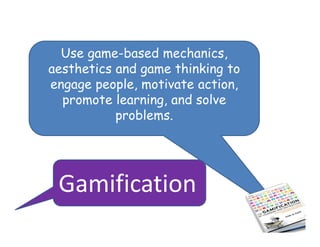
Use game-based mechanics,
aesthetics and game thinking to
engage people, motivate action,
promote learning, and solve
problems.
Gamification
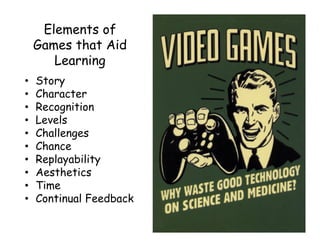
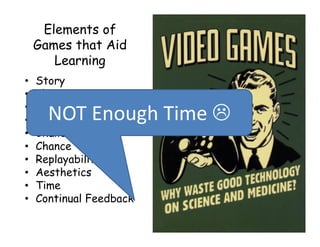
Elements of
Games that Aid
Learning
• Story
• Character
• Recognition
• Levels
• Challenges
• Chance
• Replayability
• Aesthetics
• Time
• Continual Feedback
Elements of
Games that Aid
Learning
• Story
• Character
• Recognition
• Levels
• Challenges
• Chance
• Replayability
• Aesthetics
• Time
• Continual Feedback
NOT Enough Time 
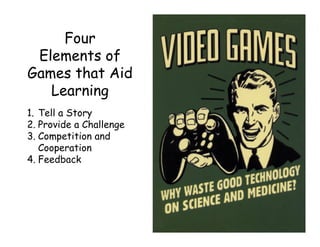
Four
Elements of
Games that Aid
Learning
1. Tell a Story
2. Provide a Challenge
3. Competition and
Cooperation
4. Feedback
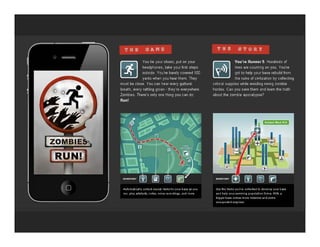
Tell a Story
Researchers have found that the 
human brain has a natural affinity for 
narrative construction.
Yep, People tend to remember facts 
more accurately if they encounter 
them in a story rather than in a list.
And they rate legal arguments as more 
convincing when built into narrative 
tales rather than on legal precedent.
Carey, B. (2007) this is Your Life (and How You Tell it). The New York Times. Melanie 
Green http://www.unc.edu/~mcgreen/research.html
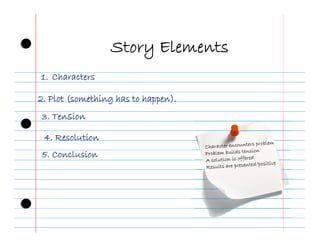
1. Characters
Story Elements
5. Conclusion
2. Plot (something has to happen).
3. Tension
4. Resolution
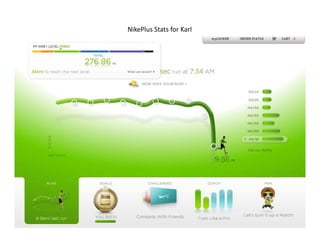
NikePlus Stats for Karl
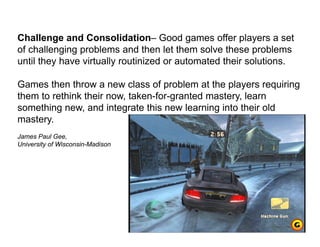
Challenge and Consolidation– Good games offer players a set
of challenging problems and then let them solve these problems
until they have virtually routinized or automated their solutions.
Games then throw a new class of problem at the players requiring
them to rethink their now, taken-for-granted mastery, learn
something new, and integrate this new learning into their old
mastery.
James Paul Gee,
University of Wisconsin-Madison
Provide a challenge
Jones, B., Valdez, G., Norakowski, J., & Rasmussen, C. (1994). Designing learning and technology 
for educational reform. North Central Regional  Educational Laboratory. [Online]. Available: 
http://www.ncrtec.org/capacity/profile/profwww.htm and Schlechty, P. C. (1997). Inventing 
better schools: An action plan for educational reform. San Francisco, CA: Jossey‐Bass
Re‐design the Instruction to 
Start with a Challenge
Recommendations 
• Embed facts to be learned in the context of stories.
• Start the learning process by providing a challenge to 
the learner.
• Use stories that are related to the context of the 
desired learning outcome. 
Competition and Cooperation
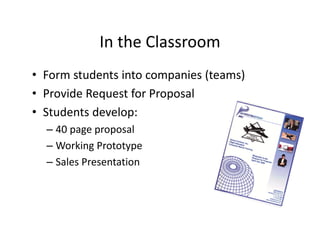
In the Classroom
• Form students into companies (teams)
• Provide Request for Proposal
• Students develop:
– 40 page proposal
– Working Prototype
– Sales Presentation
Feedback
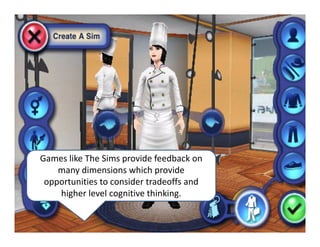
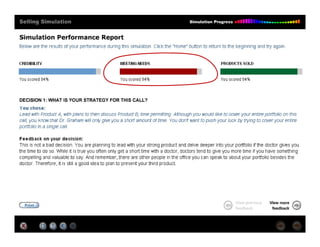
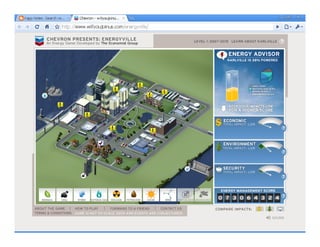
Games like The Sims provide feedback on 
many dimensions which provide 
opportunities to consider tradeoffs and 
higher level cognitive thinking. 
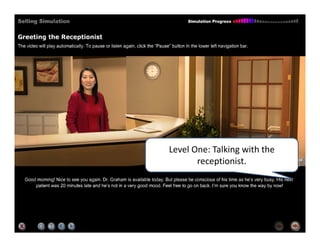
Level One: Talking with the 
receptionist.
Level Two: Talking with the nurse 
gatekeeper.
Level Three: Talking with the 
physician.
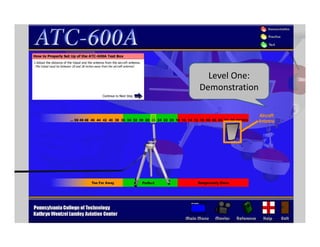
Level One: 
Demonstration
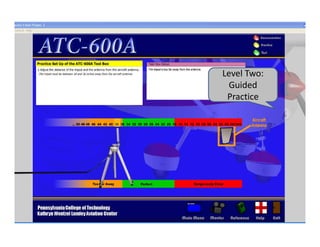
Practice
Level Two: 
Guided 
Practice
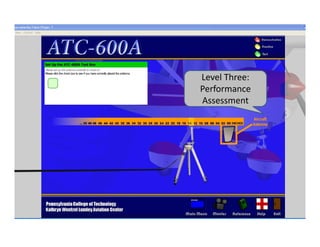
Level Three: 
Performance 
Assessment
Recommendations 
• Provide feedback on several dimensions. 
• Use feedback to help change behavior. 
• Discussion of feedback aids the learning 
process.
• Feedback should be continuous throughout 
the learning process. 
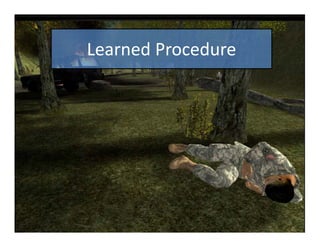
Learned Procedure
1
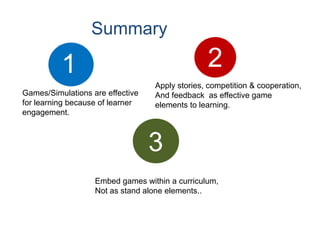
Summary
Games/Simulations are effective
for learning because of learner
engagement.
Apply stories, competition & cooperation,
And feedback as effective game
elements to learning.
2
3
Embed games within a curriculum,
Not as stand alone elements..
Go ahead…jump in!
Questions/More Information
• Google Kapp Notes
– Recommended books
– Samples and Examples
• Email: kkapp@bloomu.edu
• Email: karlkapp@gmail.com
• Twitter: @kkapp
• Pinterest: Gamification Happenings
• Facebook: http://www.facebook.com/gamificationLI
“The Gamification of Learning 
and Instruction”

Game based learning