See discussions, stats, and author profiles for this publication at: https://www.researchgate.net/publication/280733004
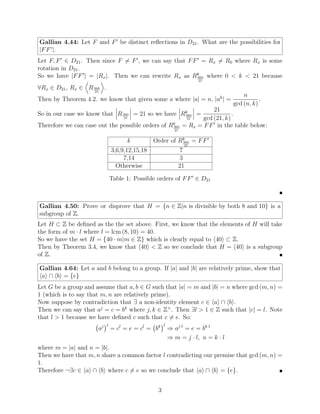
Abstract Algebra Solutions
Research · August 2015
DOI: 10.13140/RG.2.1.2799.6004
CITATIONS
0
READS
20,471
1 author:
Evan Oman
Black River Systems Co.
4 PUBLICATIONS   0 CITATIONS   
SEE PROFILE
All content following this page was uploaded by Evan Oman on 06 August 2015.
The user has requested enhancement of the downloaded file.
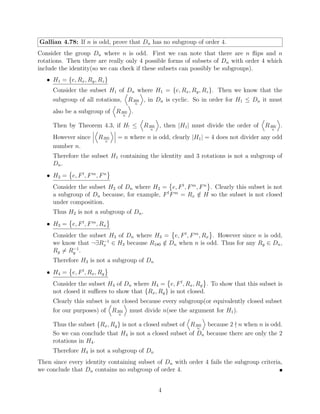
Evan Oman
MATH 5371
Joe Gallian
September 16, 2013
Homework 1
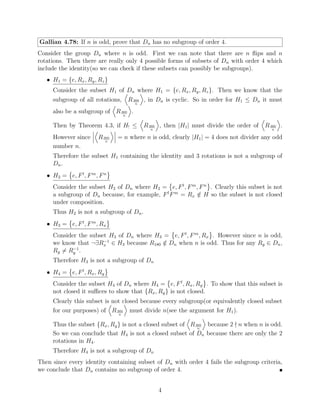
Gallian 2.6: In each case, perform the indicated operation:
a) In C∗
, (7 + 5i) (−3 + 2i)
(7 + 5i) (−3 + 2i) = −21 + 14i − 15i + 10i2
= −21 − i + 10 (−1)
= − (i + 31) ∈ C∗
b) In GL (2, Z13), det

7 4
1 5

First recall the definition of the determinant of a 2 × 2 matrix:
det

a b
c d

= a · d − b · c
So in our case we would have:
det

7 4
1 5

= 7 · 5 − 4 · 1
= 31
≡13 5 ∈ Z13
c) In GL (2, R),

6 3
8 2
−1
Recall the definition of the inverse of a 2 × 2 matrix:
A−1
=

a b
c d
−1
=
1
det A

d −b
−c a

So if we let B =

6 3
8 2

, we find that
det[B] = 6 · 2 − 8 · 3
= 12 − 24
= −12 ∈ R
1
Therefore
B−1
=
−1
12

2 −3
−8 6

=

−1
6
1
4
2
3
−1
2

∈ GL(2, R)
d) In GL (2, Z13),

6 3
8 2
−1
Here we use the same formula but since the entries are elements of Z13, we must adjust
the values according to this new modulus. So from part c): det[B] = −12 ≡13 1.
So our inverse becomes:
B−1
=
1
1

2 −3
−8 6

≡13

2 10
5 6

∈ GL(2, Z13)

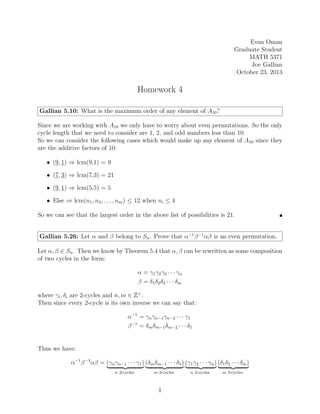
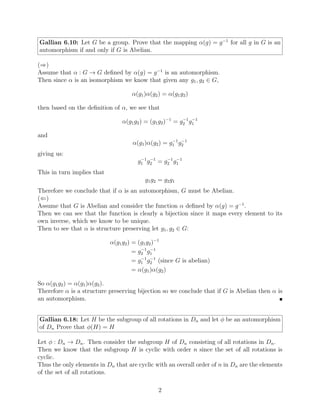
Gallian 2.20: For any integer n  2, show that there are at least 2 elements in U(n) that
satisfy x2
= 1.
Let n ∈ Z such that n  2. Then we know that that U(n), the group of integers modulo n
under multiplication, contains only the elements which are relatively prime to n. So we can
write
U(n) = {x mod n| gcd(n, x) = 1}
So clearly 1 ∈ U(n) because the gcd(n, 1) = 1(which is true for any number) and because
1 = e under multiplication which must be an element of U(n) by U(n) being a group.
Then since 1 is the identity it follows that (1)2
= 1 giving one element satisfying x2
= 1.
The next element we will consider is n − 1. By Lemma 0.1 we know that n and (n − 1) are
relatively prime so n − 1 ∈ U(n).
Then squaring (n − 1)2
yields:
(n − 1)2
= n2
− 2n + 1
= n2
− 2n + 1
≡n 1
Therefore we have found two elements that satisfy x2
= 1, guaranteeing at least 2 elements
∀U(n).
Lemma 0.1
Let n ∈ Z such that n  2. Assume by contradiction that n, n − 1 are not relatively prime.
2
Then ∃a ∈ N{1} such that a|n and a|(n − 1) which is to say that ∃l, m ∈ N{1} such that
m · a = n and l · a = (n − 1).
Rearranging we have ma = la + 1 ⇒ a =
1
m − l
.
However since a, l, m ∈ N{1}, we arrive at a contradiction. Therefore we conclude that
n, n − 1 must be relatively prime for n  2.

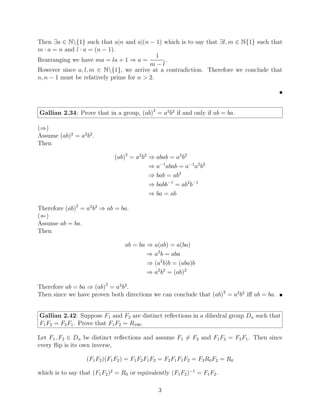
Gallian 2.34: Prove that in a group, (ab)2
= a2
b2
if and only if ab = ba.
(⇒)
Assume (ab)2
= a2
b2
.
Then
(ab)2
= a2
b2
⇒ abab = a2
b2
⇒ a−1
abab = a−1
a2
b2
⇒ bab = ab2
⇒ babb−1
= ab2
b−1
⇒ ba = ab
Therefore (ab)2
= a2
b2
⇒ ab = ba.
(⇐)
Assume ab = ba.
Then
ab = ba ⇒ a(ab) = a(ba)
⇒ a2
b = aba
⇒ (a2
b)b = (aba)b
⇒ a2
b2
= (ab)2
Therefore ab = ba ⇒ (ab)2
= a2
b2
.
Then since we have proven both directions we can conclude that (ab)2
= a2
b2
iff ab = ba. 
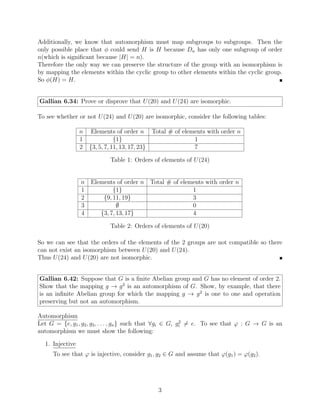
Gallian 2.42: Suppose F1 and F2 are distinct reflections in a dihedral group Dn such that
F1F2 = F2F1. Prove that F1F2 = R180.
Let F1, F2 ∈ Dn be distinct reflections and assume F1 6= F2 and F1F2 = F2F1. Then since
every flip is its own inverse,
(F1F2)(F1F2) = F1F2F1F2 = F2F1F1F2 = F2R0F2 = R0
which is to say that (F1F2)2
= R0 or equivalently (F1F2)−1
= F1F2.
3
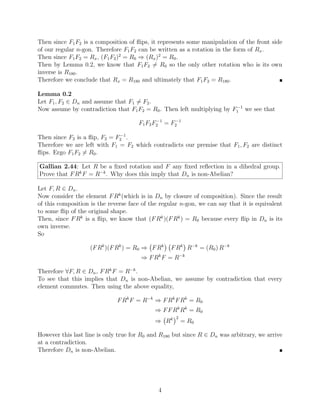
Then since F1F2 is a composition of flips, it represents some manipulation of the front side
of our regular n-gon. Therefore F1F2 can be written as a rotation in the form of Rx.
Then since F1F2 = Rx, (F1F2)2
= R0 ⇒ (Rx)2
= R0.
Then by Lemma 0.2, we know that F1F2 6= R0 so the only other rotation who is its own
inverse is R180.
Therefore we conclude that Rx = R180 and ultimately that F1F2 = R180. 
Lemma 0.2
Let F1, F2 ∈ Dn and assume that F1 6= F2.
Now assume by contradiction that F1F2 = R0. Then left multiplying by F−1
1 we see that
F1F2F−1
2 = F−1
2
Then since F2 is a flip, F2 = F−1
2 .
Therefore we are left with F1 = F2 which contradicts our premise that F1, F2 are distinct
flips. Ergo F1F2 6= R0.
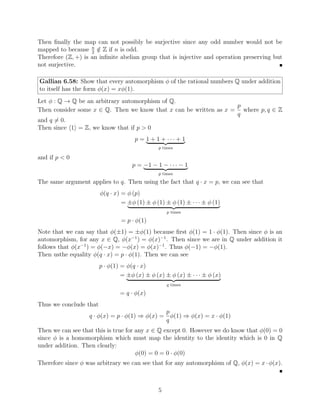
Gallian 2.44: Let R be a fixed rotation and F any fixed reflection in a dihedral group.
Prove that FRk
F = R−k
. Why does this imply that Dn is non-Abelian?
Let F, R ∈ Dn.
Now consider the element FRk
(which is in Dn by closure of composition). Since the result
of this composition is the reverse face of the regular n-gon, we can say that it is equivalent
to some flip of the original shape.
Then, since FRk
is a flip, we know that (FRk
)(FRk
) = R0 because every flip in Dn is its
own inverse.
So
(FRk
)(FRk
) = R0 ⇒ FRk

FRk

R−k
= (R0) R−k
⇒ FRk
F = R−k
Therefore ∀F, R ∈ Dn, FRk
F = R−k
.
To see that this implies that Dn is non-Abelian, we assume by contradiction that every
element commutes. Then using the above equality,
FRk
F = R−k
⇒ FRk
FRk
= R0
⇒ FFRk
Rk
= R0
⇒ Rk
2
= R0
However this last line is only true for R0 and R180 but since R ∈ Dn was arbitrary, we arrive
at a contradiction.
Therefore Dn is non-Abelian. 
4
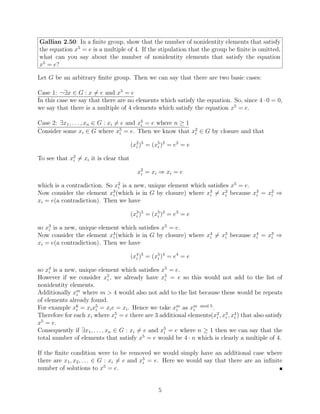
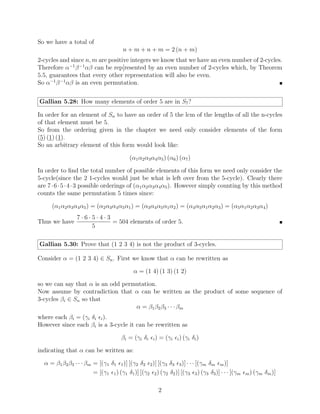
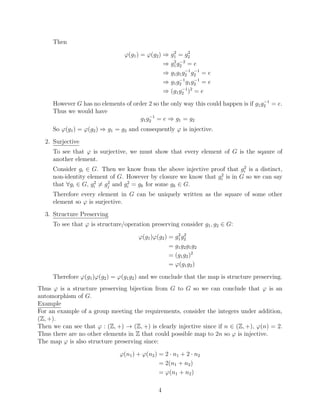
Gallian 2.50: In a finite group, show that the number of nonidentity elements that satisfy
the equation x5
= e is a multiple of 4. If the stipulation that the group be finite is omitted,
what can you say about the number of nonidentity elements that satisfy the equation
x5
= e?
Let G be an arbitrary finite group. Then we can say that there are two basic cases:
Case 1: ¬∃x ∈ G : x 6= e and x5
= e
In this case we say that there are no elements which satisfy the equation. So, since 4 · 0 = 0,
we say that there is a multiple of 4 elements which satisfy the equation x5
= e.
Case 2: ∃x1, . . . , xn ∈ G : xi 6= e and x5
i = e where n ≥ 1
Consider some xi ∈ G where x5
i = e. Then we know that x2
i ∈ G by closure and that
(x2
i )5
= (x5
i )2
= e2
= e
To see that x2
i 6= xi it is clear that
x2
i = xi ⇒ xi = e
which is a contradiction. So x2
i is a new, unique element which satisfies x5
= e.
Now consider the element x3
i (which is in G by closure) where x3
i 6= x2
i because x3
i = x2
i ⇒
xi = e(a contradiction). Then we have
(x3
i )5
= (x5
i )3
= e3
= e
so x3
i is a new, unique element which satisfies x5
= e.
Now consider the element x4
i (which is in G by closure) where x4
i 6= x3
i because x4
i = x3
i ⇒
xi = e(a contradiction). Then we have
(x4
i )5
= (x5
i )4
= e4
= e
so x4
i is a new, unique element which satisfies x5
= e.
However if we consider x5
i , we already have x5
i = e so this would not add to the list of
nonidentity elements.
Additionally xm
i where m  4 would also not add to the list because these would be repeats
of elements already found.
For example x6
i = xix5
i = xie = xi. Hence we take xm
i as xm mod 5
i .
Therefore for each xi where x5
i = e there are 3 additional elements(x2
i , x3
i , x4
i ) that also satisfy
x5
= e.
Consequently if ∃x1, . . . , xn ∈ G : xi 6= e and x5
i = e where n ≥ 1 then we can say that the
total number of elements that satisfy x5
= e would be 4 · n which is clearly a multiple of 4.
If the finite condition were to be removed we would simply have an additional case where
there are x1, x2, . . . ∈ G : xi 6= e and x5
i = e. Here we would say that there are an infinite
number of solutions to x5
= e. 
5
Evan Oman
MATH 5371
Joe Gallian
September 25, 2013
Homework 2
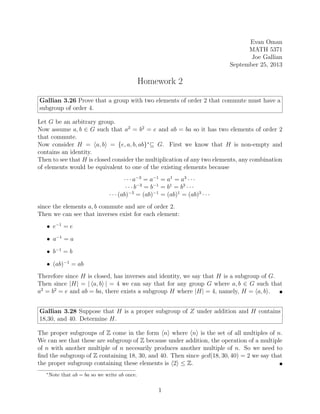
Gallian 3.26 Prove that a group with two elements of order 2 that commute must have a
subgroup of order 4.
Let G be an arbitrary group.
Now assume a, b ∈ G such that a2
= b2
= e and ab = ba so it has two elements of order 2
that commute.
Now consider H = ha, bi = {e, a, b, ab}∗
⊆ G. First we know that H is non-empty and
contains an identity.
Then to see that H is closed consider the multiplication of any two elements, any combination
of elements would be equivalent to one of the existing elements because
· · · a−3
= a−1
= a1
= a3
· · ·
· · · b−3
= b−1
= b1
= b3
· · ·
· · · (ab)−3
= (ab)−1
= (ab)1
= (ab)3
· · ·
since the elements a, b commute and are of order 2.
Then we can see that inverses exist for each element:
• e−1
= e
• a−1
= a
• b−1
= b
• (ab)−1
= ab
Therefore since H is closed, has inverses and identity, we say that H is a subgroup of G.
Then since |H| = | ha, bi | = 4 we can say that for any group G where a, b ∈ G such that
a2
= b2
= e and ab = ba, there exists a subgroup H where |H| = 4, namely, H = ha, bi. 
Gallian 3.28 Suppose that H is a proper subgroup of Z under addition and H contains
18,30, and 40. Determine H.
The proper subgroups of Z come in the form hni where hni is the set of all multiples of n.
We can see that these are subgroup of Z because under addition, the operation of a multiple
of n with another multiple of n necesarily produces another multiple of n. So we need to
find the subgroup of Z containing 18, 30, and 40. Then since gcd(18, 30, 40) = 2 we say that
the proper subgroup containing these elements is h2i ≤ Z. 
∗
Note that ab = ba so we write ab once.
1
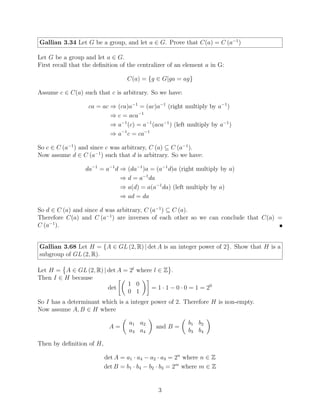
Gallian 3.30 Prove that the dihedral group of order 6 does not have a subgroup of order
4.

Consider some subset H of the group D3 where |H| = 4 andf R0 ∈ H. Then H the only
possibilities for H would be one of the following cases:
• Case 1: H1 = {R0, F1, F2, F3}
Since F1F2 = R120 /
∈ H, we know that H is not closed under the operation of compo-
sition so we know that it can not be a subgroup of G.
• Case 2: H2 = {R0, R120, R240, Fn}
Because FnR120 = Fm where Fm 6= Fn, Fm /
∈ H which implies that H is not closed.
Therefore it can not be a subgroup of G.
• Case 2: H3 = {R0, Rx, Fn, Fm}
If we consider the element Rx ∈ H we know that R2
x = R2·x 6= Rx
†
so clearly R2
x /
∈ H
so again H is not closed and consequently not a group.
So every possible subset of D3 with order 4 is not closed and fails to satisfy the subgroup
criteria. Therefore D3 has no subgroups of order 4. 
Gallian 3.32 If H and K are subgroups of G, show that H ∩ K is a subgroup of G. Can
you see that the same proof shows that the intersection of any number of subgroups of G,
finite or infinite, is again a subgroup of G?
Let G be a group and assume H, K ≤ G. Then we can see that there are two possibilities
for H ∩ K:
• Case 1: H ∩ K = {e}
Assume H ∩K = {e}. Then H ∩K would be the trivial subgroup which is by definition
a subgroup of G. So H ∩ K ≤ G.
• Case 2: H ∩ K is nontrivial.
Assume H ∩K is a nontrivial set. Then since H, K are subgroups we know that e ∈ H
and e ∈ K so e ∈ H ∩ K which implies that H ∩ K is non-empty.
Now assume a, b ∈ H ∩ K. Then since H ∩ K is defined as all elements that are in
H and K we know that a, b ∈ H and a, b ∈ K. Then since H and K are subgroups,
ab−1
∈ H and ab−1
∈ K. Therefore ab−1
∈ H ∩ K.
Therefore H ∩ K passes the one-step subgroup test and consequently H ∩ K ≤ G.
So we conclude that for all H, K ≤ G, H ∩ K ≤ G. 
†
Since we are working in D3 the possibilities here for x are 120 and 240 which when doubled do not
equal themselves modulo 360
2
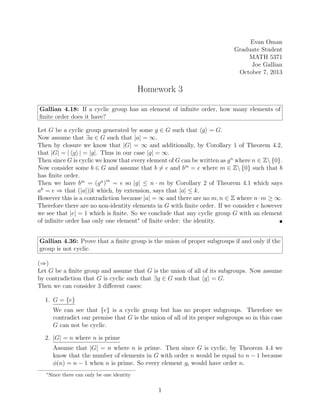
Gallian 3.34 Let G be a group, and let a ∈ G. Prove that C(a) = C (a−1
)
Let G be a group and let a ∈ G.
First recall that the definition of the centralizer of an element a in G:
C(a) = {g ∈ G|ga = ag}
Assume c ∈ C(a) such that c is arbitrary. So we have:
ca = ac ⇒ (ca)a−1
= (ac)a−1
(right multiply by a−1
)
⇒ c = aca−1
⇒ a−1
(c) = a−1
(aca−1
) (left multiply by a−1
)
⇒ a−1
c = ca−1
So c ∈ C (a−1
) and since c was arbitrary, C (a) ⊆ C (a−1
).
Now assume d ∈ C (a−1
) such that d is arbitrary. So we have:
da−1
= a−1
d ⇒ (da−1
)a = (a−1
d)a (right multiply by a)
⇒ d = a−1
da
⇒ a(d) = a(a−1
da) (left multiply by a)
⇒ ad = da
So d ∈ C (a) and since d was arbitrary, C (a−1
) ⊆ C (a).
Therefore C(a) and C (a−1
) are inverses of each other so we can conclude that C(a) =
C (a−1
). 
Gallian 3.68 Let H = {A ∈ GL (2, R) | det A is an integer power of 2}. Show that H is a
subgroup of GL (2, R).
Let H =

A ∈ GL (2, R) | det A = 2l
where l ∈ Z
	
.
Then I ∈ H because
det

1 0
0 1

= 1 · 1 − 0 · 0 = 1 = 20
So I has a determinant which is a integer power of 2. Therefore H is non-empty.
Now assume A, B ∈ H where
A =

a1 a2
a3 a4

and B =

b1 b2
b3 b4

Then by definition of H,
det A = a1 · a4 − a2 · a3 = 2n
where n ∈ Z
det B = b1 · b4 − b2 · b3 = 2m
where m ∈ Z
3
Then to see that AB−1
∈ H, we first find B−1
which is defined as:
B−1
=
1
det B

b4 −b2
−b3 b1

Then calculating AB−1
we find that:
AB−1
= C =

a1 a2
a3 a4

·

1
det B

b4 −b2
−b3 b1

=
1
det B

a1 a2
a3 a4

·

b4 −b2
−b3 b1

=
1
det B

b4a1 − b3a2 a2b1 − a1b2
a3b4 − a4b3 a4b1 − a3b2

Then to see that AB−1
= C ∈ H we must calculate the determinant of C:
det C = det

1
det B

b4a1 − b3a2 a2b1 − a1b2
a3b4 − a4b3 a4b1 − a3b2

=

1
det B
2
· det

b4a1 − b3a2 a2b1 − a1b2
a3b4 − a4b3 a4b1 − a3b2

(since we have a 2 × 2 matrix)
=

1
det B
2
· [(b4a1 − b3a2) · (a4b1 − a3b2) − (a2b1 − a1b2) · (a3b4 − a4b3)]
=

1
det B
2
· [b4a1a4b1 − b4a1a3b2 − b3a2a4b1 + b3a2a3b2 − (a2b1a3b4 − a2b1a4b3 − a1b2a3b4 + a1b2a4b3)]
=

1
det B
2
· [a1a4b1b4 + a2a3b2b3 − a2a3b1b4 − a1a4b2b3]
=

1
det B
2
· [a1a4 (b1b4 − b2b3) − a2a3 (b1b4 − b2b3)]
=

1
det B
2
· (a1a4 − a2a3) · (b1b4 − b2b3)
=

1
det B
2
· (det A) · (det B)
=
det A
det B
=
2n
2m
= 2n−m
Then since n − m ∈ Z we can say that det [C] = det [AB−1
] is equal to an integer power of
2 and consequently AB−1
∈ H.
Therefore we have satisfied the conditions of the one-step subgroup test and consequently
H is a subgroup of G. 
4
Evan Oman
Graduate Student
MATH 5371
Joe Gallian
October 7, 2013
Homework 3
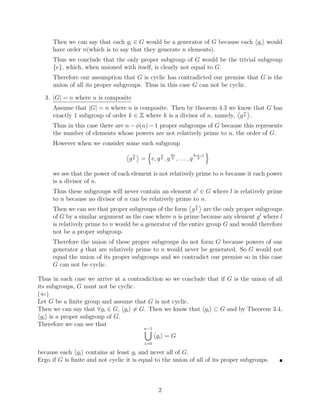
Gallian 4.18: If a cyclic group has an element of infinite order, how many elements of
finite order does it have?
Let G be a cyclic group generated by some g ∈ G such that hgi = G.
Now assume that ∃a ∈ G such that |a| = ∞.
Then by closure we know that |G| = ∞ and additionally, by Corollary 1 of Theorem 4.2,
that |G| = | hgi | = |g|. Thus in our case |g| = ∞.
Then since G is cyclic we know that every element of G can be written as gn
where n ∈ Z {0}.
Now consider some b ∈ G and assume that b 6= e and bm
= e where m ∈ Z {0} such that b
has finite order.
Then we have bm
= (gn
)m
= e so |g| ≤ n · m by Corollary 2 of Theorem 4.1 which says
ak
= e ⇒ that (|a|)|k which, by extension, says that |a| ≤ k.
However this is a contradiction because |a| = ∞ and there are no m, n ∈ Z where n·m ≥ ∞.
Therefore there are no non-identity elements in G with finite order. If we consider e however
we see that |e| = 1 which is finite. So we conclude that any cyclic group G with an element
of infinite order has only one element∗
of finite order: the identity. 
Gallian 4.36: Prove that a finite group is the union of proper subgroups if and only if the
group is not cyclic.
(⇒)
Let G be a finite group and assume that G is the union of all of its subgroups. Now assume
by contradiction that G is cyclic such that ∃g ∈ G such that hgi = G.
Then we can consider 3 different cases:
1. G = {e}
We can see that {e} is a cyclic group but has no proper subgroups. Therefore we
contradict our premise that G is the union of all of its proper subgroups so in this case
G can not be cyclic.
2. |G| = n where n is prime
Assume that |G| = n where n is prime. Then since G is cyclic, by Theorem 4.4 we
know that the number of elements in G with order n would be equal to n − 1 because
φ(n) = n − 1 when n is prime. So every element gi would have order n.
∗
Since there can only be one identity
1
Then we can say that each gi ∈ G would be a generator of G because each hgii would
have order n(which is to say that they generate n elements).
Thus we conclude that the only proper subgroup of G would be the trivial subgroup
{e}, which, when unioned with itself, is clearly not equal to G.
Therefore our assumption that G is cyclic has contradicted our premise that G is the
union of all its proper subgroups. Thus in this case G can not be cyclic.
3. |G| = n where n is composite
Assume that |G| = n where n is composite. Then by theorem 4.3 we know that G has
exactly 1 subgroup of order k ∈ Z where k is a divisor of n, namely,


g
n
k

.
Thus in this case there are n − φ(n) − 1 proper subgroups of G because this represents
the number of elements whose powers are not relatively prime to n, the order of G.
However when we consider some such subgroup


g
n
k

=
n
e, g
n
k , g
2n
k , . . . , g
k·n−1
k
o
we see that the power of each element is not relatively prime to n because it each power
is a divisor of n.
Thus these subgroups will never contain an element al
∈ G where l is relatively prime
to n because no divisor of n can be relatively prime to n.
Then we can see that proper subgroups of the form


g
n
k

are the only proper subgroups
of G by a similar argument as the case where n is prime because any element gl
where l
is relatively prime to n would be a generator of the entire group G and would therefore
not be a proper subgroup.
Therefore the union of these proper subgroups do not form G because powers of our
generator g that are relatively prime to n would never be generated. So G would not
equal the union of its proper subgroups and we contradict our premise so in this case
G can not be cyclic.
Thus in each case we arrive at a contradiction so we conclude that if G is the union of all
its subgroups, G must not be cyclic.
(⇐)
Let G be a finite group and assume that G is not cyclic.
Then we can say that ∀gi ∈ G, hgii 6= G. Then we know that hgii ⊂ G and by Theorem 3.4,
hgii is a proper subgroup of G.
Therefore we can see that
n−1
[
i=0
hgii = G
because each hgii contains at least gi and never all of G.
Ergo if G is finite and not cyclic it is equal to the union of all of its proper subgroups. 
2
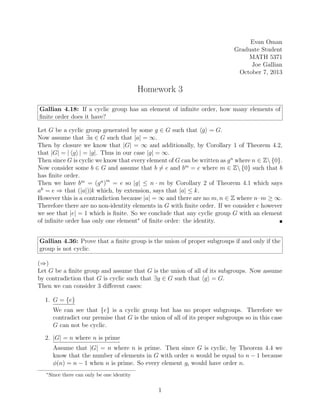
Gallian 4.44: Let F and F0
be distinct reflections in D21. What are the possibilities for
|FF0
|.
Let F, F0
∈ D21. Then since F 6= F0
, we can say that FF0
= Rx 6= R0 where Rx is some
rotation in D21.
So we have |FF0
| = |Rx|. Then we can rewrite Rx as Rk
360
21
where 0  k  21 because
∀Rx ∈ D21, Rx ∈
D
R360
21
E
.
Then by Theorem 4.2. we know that given some a where |a| = n, |ak
| =
n
gcd (n, k)
.
So in our case we know that
R360
21
= 21 so we have
Rk
360
21
=
21
gcd (21, k)
.
Therefore we can case out the possible orders of Rk
360
21
= Rx = FF0
in the table below:
k Order of Rk
360
21
= FF0
3,6,9,12,15,18 7
7,14 3
Otherwise 21
Table 1: Possible orders of FF0
∈ D21

Gallian 4.50: Prove or disprove that H = {n ∈ Z|n is divisible by both 8 and 10} is a
subgroup of Z.
Let H ⊂ Z be defined as the the set above. First, we know that the elements of H will take
the form of m · l where l = lcm (8, 10) = 40.
So we have the set H = {40 · m|m ∈ Z} which is clearly equal to h40i ⊂ Z.
Then by Theorem 3.4, we know that h40i  Z so we conclude that H = h40i is a subgroup
of Z. 
Gallian 4.64: Let a and b belong to a group. If |a| and |b| are relatively prime, show that
hai ∩ hbi = {e}
Let G be a group and assume that a, b ∈ G such that |a| = m and |b| = n where gcd (m, n) =
1 (which is to say that m, n are relatively prime).
Now suppose by contradiction that ∃ a non-identity element c ∈ hai ∩ hbi.
Then we can say that aj
= c = bk
where j, k ∈ Z+
. Then ∃l  1 ∈ Z such that |c| = l. Note
that l  1 because we have defined c such that c 6= e. So:
aj
l
= cl
= e = cl
= bk
l
⇒ aj·l
= e = bk·l
⇒ m = j · l, n = k · l
where m = |a| and n = |b|.
Then we have that m, n share a common factor l contradicting our premise that gcd (m, n) =
1.
Therefore ¬∃c ∈ hai ∩ hbi where c 6= e so we conclude that hai ∩ hbi = {e}. 
3
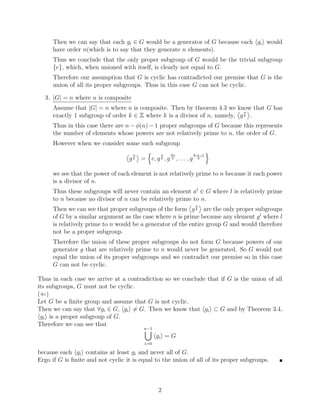
Gallian 4.78: If n is odd, prove that Dn has no subgroup of order 4.
Consider the group Dn where n is odd. First we can note that there are n flips and n
rotations. Then there are really only 4 possible forms of subsets of Dn with order 4 which
include the identity(so we can check if these subsets can possibly be subgroups).
• H1 = {e, Rx, Ry, Rz}
Consider the subset H1 of Dn where H1 = {e, Rx, Ry, Rz}. Then we know that the
subgroup of all rotations,
D
R360
n
E
, in Dn is cyclic. So in order for H1 ≤ Dn it must
also be a subgroup of
D
R360
n
E
.
Then by Theorem 4.3, if H! ≤
D
R360
n
E
, then |H1| must divide the order of
D
R360
n
E
.
However since
D
R360
n
E
= n where n is odd, clearly |H1| = 4 does not divider any odd
number n.
Therefore the subset H1 containing the identity and 3 rotations is not a subgroup of
Dn.
• H2 =

e, Fl
, Fm
, Fn
	
Consider the subset H2 of Dn where H2 =

e, Fl
, Fm
, Fn
	
. Clearly this subset is not
a subgroup of Dn because, for example, Fl
Fm
= Rx /
∈ H so the subset is not closed
under composition.
Thus H2 is not a subgroup of Dn.
• H3 =

e, Fl
, Fm
, Rx
	
Consider the subset H3 of Dn where H3 =

e, Fl
, Fm
, Rx
	
. However since n is odd,
we know that ¬∃R−1
x ∈ H3 because R180 /
∈ Dn when n is odd. Thus for any Ry ∈ Dn,
Ry 6= R−1
y .
Therefore H3 is not a subgroup of Dn
• H4 =

e, Fl
, Rx, Ry
	
Consider the subset H4 of Dn where H4 =

e, Fl
, Rx, Ry
	
. To show that this subset is
not closed it suffices to show that {Rx, Ry} is not closed.
Clearly this subset is not closed because every subgroup(or equivalently closed subset
for our purposes) of
D
R360
n
E
must divide n(see the argument for H1).
Thus the subset {Rx, Ry} is not a closed subset of
D
R360
n
E
because 2 - n when n is odd.
So we can conclude that H4 is not a closed subset of Dn because there are only the 2
rotations in H4.
Therefore H4 is not a subgroup of Dn
Then since every identity containing subset of Dn with order 4 fails the subgroup criteria,
we conclude that Dn contains no subgroup of order 4. 
4
Evan Oman
Graduate Student
MATH 5371
Joe Gallian
October 7, 2013
Homework 3
Gallian 4.18: If a cyclic group has an element of infinite order, how many elements of
finite order does it have?
Let G be a cyclic group generated by some g ∈ G such that hgi = G.
Now assume that ∃a ∈ G such that |a| = ∞.
Then by closure we know that |G| = ∞ and additionally, by Corollary 1 of Theorem 4.2,
that |G| = | hgi | = |g|. Thus in our case |g| = ∞.
Then since G is cyclic we know that every element of G can be written as gn
where n ∈ Z {0}.
Now consider some b ∈ G and assume that b 6= e and bm
= e where m ∈ Z {0} such that b
has finite order.
Then we have bm
= (gn
)m
= e so |g| ≤ n · m by Corollary 2 of Theorem 4.1 which says
ak
= e ⇒ that (|a|)|k which, by extension, says that |a| ≤ k.
However this is a contradiction because |a| = ∞ and there are no m, n ∈ Z where n·m ≥ ∞.
Therefore there are no non-identity elements in G with finite order. If we consider e however
we see that |e| = 1 which is finite. So we conclude that any cyclic group G with an element
of infinite order has only one element∗
of finite order: the identity. 
Gallian 4.36: Prove that a finite group is the union of proper subgroups if and only if the
group is not cyclic.
(⇒)
Let G be a finite group and assume that G is the union of all of its subgroups. Now assume
by contradiction that G is cyclic such that ∃g ∈ G such that hgi = G.
Then we can consider 3 different cases:
1. G = {e}
We can see that {e} is a cyclic group but has no proper subgroups. Therefore we
contradict our premise that G is the union of all of its proper subgroups so in this case
G can not be cyclic.
2. |G| = n where n is prime
Assume that |G| = n where n is prime. Then since G is cyclic, by Theorem 4.4 we
know that the number of elements in G with order n would be equal to n − 1 because
φ(n) = n − 1 when n is prime. So every element gi would have order n.
∗
Since there can only be one identity
1
Then we can say that each gi ∈ G would be a generator of G because each hgii would
have order n(which is to say that they generate n elements).
Thus we conclude that the only proper subgroup of G would be the trivial subgroup
{e}, which, when unioned with itself, is clearly not equal to G.
Therefore our assumption that G is cyclic has contradicted our premise that G is the
union of all its proper subgroups. Thus in this case G can not be cyclic.
3. |G| = n where n is composite
Assume that |G| = n where n is composite. Then by theorem 4.3 we know that G has
exactly 1 subgroup of order k ∈ Z where k is a divisor of n, namely,


g
n
k

.
Thus in this case there are n − φ(n) − 1 proper subgroups of G because this represents
the number of elements whose powers are not relatively prime to n, the order of G.
However when we consider some such subgroup


g
n
k

=
n
e, g
n
k , g
2n
k , . . . , g
k·n−1
k
o
we see that the power of each element is not relatively prime to n because it each power
is a divisor of n.
Thus these subgroups will never contain an element al
∈ G where l is relatively prime
to n because no divisor of n can be relatively prime to n.
Then we can see that proper subgroups of the form


g
n
k

are the only proper subgroups
of G by a similar argument as the case where n is prime because any element gl
where l
is relatively prime to n would be a generator of the entire group G and would therefore
not be a proper subgroup.
Therefore the union of these proper subgroups do not form G because powers of our
generator g that are relatively prime to n would never be generated. So G would not
equal the union of its proper subgroups and we contradict our premise so in this case
G can not be cyclic.
Thus in each case we arrive at a contradiction so we conclude that if G is the union of all
its subgroups, G must not be cyclic.
(⇐)
Let G be a finite group and assume that G is not cyclic.
Then we can say that ∀gi ∈ G, hgii 6= G. Then we know that hgii ⊂ G and by Theorem 3.4,
hgii is a proper subgroup of G.
Therefore we can see that
n−1
[
i=0
hgii = G
because each hgii contains at least gi and never all of G.
Ergo if G is finite and not cyclic it is equal to the union of all of its proper subgroups. 
2
Gallian 4.44: Let F and F0
be distinct reflections in D21. What are the possibilities for
|FF0
|.
Let F, F0
∈ D21. Then since F 6= F0
, we can say that FF0
= Rx 6= R0 where Rx is some
rotation in D21.
So we have |FF0
| = |Rx|. Then we can rewrite Rx as Rk
360
21
where 0  k  21 because
∀Rx ∈ D21, Rx ∈
D
R360
21
E
.
Then by Theorem 4.2. we know that given some a where |a| = n, |ak
| =
n
gcd (n, k)
.
So in our case we know that

Gallians solution

  • 1.
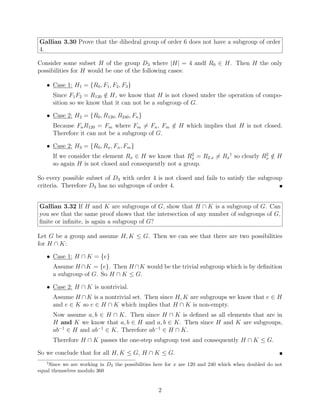
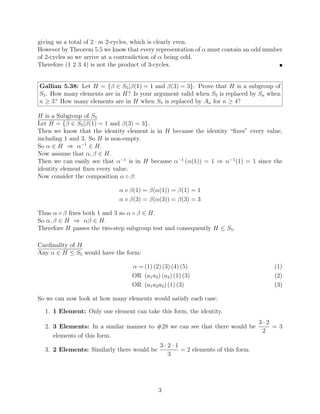
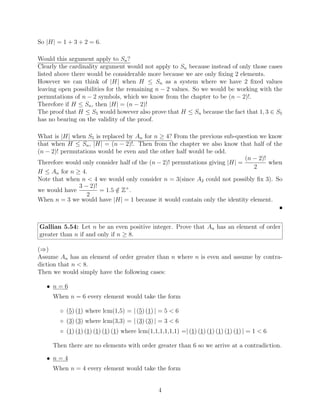
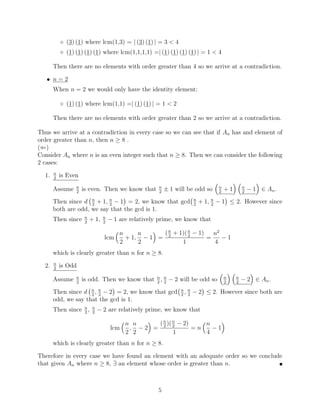
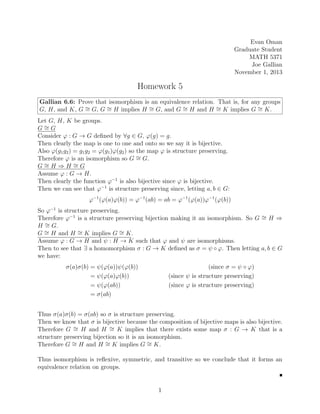
    See discussions, stats,and author profiles for this publication at: https://www.researchgate.net/publication/280733004 Abstract Algebra Solutions Research · August 2015 DOI: 10.13140/RG.2.1.2799.6004 CITATIONS 0 READS 20,471 1 author: Evan Oman Black River Systems Co. 4 PUBLICATIONS   0 CITATIONS    SEE PROFILE All content following this page was uploaded by Evan Oman on 06 August 2015. The user has requested enhancement of the downloaded file.
  • 2.
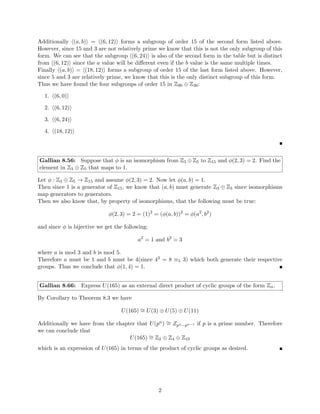
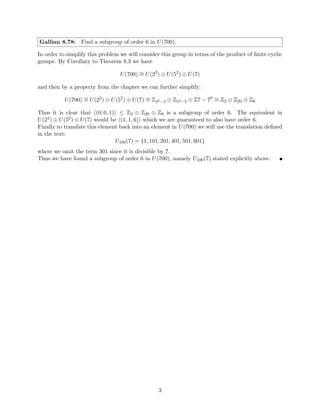
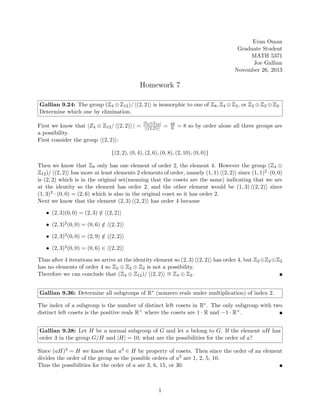
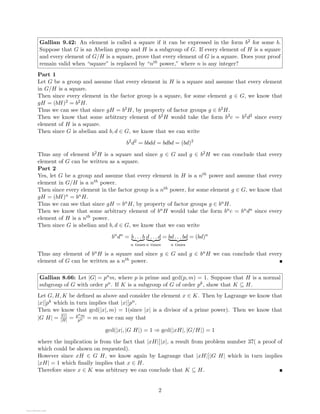
    Evan Oman MATH 5371 JoeGallian September 16, 2013 Homework 1 Gallian 2.6: In each case, perform the indicated operation: a) In C∗ , (7 + 5i) (−3 + 2i) (7 + 5i) (−3 + 2i) = −21 + 14i − 15i + 10i2 = −21 − i + 10 (−1) = − (i + 31) ∈ C∗ b) In GL (2, Z13), det 7 4 1 5 First recall the definition of the determinant of a 2 × 2 matrix: det a b c d = a · d − b · c So in our case we would have: det 7 4 1 5 = 7 · 5 − 4 · 1 = 31 ≡13 5 ∈ Z13 c) In GL (2, R), 6 3 8 2 −1 Recall the definition of the inverse of a 2 × 2 matrix: A−1 = a b c d −1 = 1 det A d −b −c a So if we let B = 6 3 8 2 , we find that det[B] = 6 · 2 − 8 · 3 = 12 − 24 = −12 ∈ R 1
  • 3.
    Therefore B−1 = −1 12 2 −3 −8 6 = −1 6 1 4 2 3 −1 2 ∈GL(2, R) d) In GL (2, Z13), 6 3 8 2 −1 Here we use the same formula but since the entries are elements of Z13, we must adjust the values according to this new modulus. So from part c): det[B] = −12 ≡13 1. So our inverse becomes: B−1 = 1 1 2 −3 −8 6 ≡13 2 10 5 6 ∈ GL(2, Z13) Gallian 2.20: For any integer n 2, show that there are at least 2 elements in U(n) that satisfy x2 = 1. Let n ∈ Z such that n 2. Then we know that that U(n), the group of integers modulo n under multiplication, contains only the elements which are relatively prime to n. So we can write U(n) = {x mod n| gcd(n, x) = 1} So clearly 1 ∈ U(n) because the gcd(n, 1) = 1(which is true for any number) and because 1 = e under multiplication which must be an element of U(n) by U(n) being a group. Then since 1 is the identity it follows that (1)2 = 1 giving one element satisfying x2 = 1. The next element we will consider is n − 1. By Lemma 0.1 we know that n and (n − 1) are relatively prime so n − 1 ∈ U(n). Then squaring (n − 1)2 yields: (n − 1)2 = n2 − 2n + 1 = n2 − 2n + 1 ≡n 1 Therefore we have found two elements that satisfy x2 = 1, guaranteeing at least 2 elements ∀U(n). Lemma 0.1 Let n ∈ Z such that n 2. Assume by contradiction that n, n − 1 are not relatively prime. 2
  • 4.
    Then ∃a ∈N{1} such that a|n and a|(n − 1) which is to say that ∃l, m ∈ N{1} such that m · a = n and l · a = (n − 1). Rearranging we have ma = la + 1 ⇒ a = 1 m − l . However since a, l, m ∈ N{1}, we arrive at a contradiction. Therefore we conclude that n, n − 1 must be relatively prime for n 2. Gallian 2.34: Prove that in a group, (ab)2 = a2 b2 if and only if ab = ba. (⇒) Assume (ab)2 = a2 b2 . Then (ab)2 = a2 b2 ⇒ abab = a2 b2 ⇒ a−1 abab = a−1 a2 b2 ⇒ bab = ab2 ⇒ babb−1 = ab2 b−1 ⇒ ba = ab Therefore (ab)2 = a2 b2 ⇒ ab = ba. (⇐) Assume ab = ba. Then ab = ba ⇒ a(ab) = a(ba) ⇒ a2 b = aba ⇒ (a2 b)b = (aba)b ⇒ a2 b2 = (ab)2 Therefore ab = ba ⇒ (ab)2 = a2 b2 . Then since we have proven both directions we can conclude that (ab)2 = a2 b2 iff ab = ba. Gallian 2.42: Suppose F1 and F2 are distinct reflections in a dihedral group Dn such that F1F2 = F2F1. Prove that F1F2 = R180. Let F1, F2 ∈ Dn be distinct reflections and assume F1 6= F2 and F1F2 = F2F1. Then since every flip is its own inverse, (F1F2)(F1F2) = F1F2F1F2 = F2F1F1F2 = F2R0F2 = R0 which is to say that (F1F2)2 = R0 or equivalently (F1F2)−1 = F1F2. 3
  • 5.
    Then since F1F2is a composition of flips, it represents some manipulation of the front side of our regular n-gon. Therefore F1F2 can be written as a rotation in the form of Rx. Then since F1F2 = Rx, (F1F2)2 = R0 ⇒ (Rx)2 = R0. Then by Lemma 0.2, we know that F1F2 6= R0 so the only other rotation who is its own inverse is R180. Therefore we conclude that Rx = R180 and ultimately that F1F2 = R180. Lemma 0.2 Let F1, F2 ∈ Dn and assume that F1 6= F2. Now assume by contradiction that F1F2 = R0. Then left multiplying by F−1 1 we see that F1F2F−1 2 = F−1 2 Then since F2 is a flip, F2 = F−1 2 . Therefore we are left with F1 = F2 which contradicts our premise that F1, F2 are distinct flips. Ergo F1F2 6= R0. Gallian 2.44: Let R be a fixed rotation and F any fixed reflection in a dihedral group. Prove that FRk F = R−k . Why does this imply that Dn is non-Abelian? Let F, R ∈ Dn. Now consider the element FRk (which is in Dn by closure of composition). Since the result of this composition is the reverse face of the regular n-gon, we can say that it is equivalent to some flip of the original shape. Then, since FRk is a flip, we know that (FRk )(FRk ) = R0 because every flip in Dn is its own inverse. So (FRk )(FRk ) = R0 ⇒ FRk FRk R−k = (R0) R−k ⇒ FRk F = R−k Therefore ∀F, R ∈ Dn, FRk F = R−k . To see that this implies that Dn is non-Abelian, we assume by contradiction that every element commutes. Then using the above equality, FRk F = R−k ⇒ FRk FRk = R0 ⇒ FFRk Rk = R0 ⇒ Rk 2 = R0 However this last line is only true for R0 and R180 but since R ∈ Dn was arbitrary, we arrive at a contradiction. Therefore Dn is non-Abelian. 4
  • 6.
    Gallian 2.50: Ina finite group, show that the number of nonidentity elements that satisfy the equation x5 = e is a multiple of 4. If the stipulation that the group be finite is omitted, what can you say about the number of nonidentity elements that satisfy the equation x5 = e? Let G be an arbitrary finite group. Then we can say that there are two basic cases: Case 1: ¬∃x ∈ G : x 6= e and x5 = e In this case we say that there are no elements which satisfy the equation. So, since 4 · 0 = 0, we say that there is a multiple of 4 elements which satisfy the equation x5 = e. Case 2: ∃x1, . . . , xn ∈ G : xi 6= e and x5 i = e where n ≥ 1 Consider some xi ∈ G where x5 i = e. Then we know that x2 i ∈ G by closure and that (x2 i )5 = (x5 i )2 = e2 = e To see that x2 i 6= xi it is clear that x2 i = xi ⇒ xi = e which is a contradiction. So x2 i is a new, unique element which satisfies x5 = e. Now consider the element x3 i (which is in G by closure) where x3 i 6= x2 i because x3 i = x2 i ⇒ xi = e(a contradiction). Then we have (x3 i )5 = (x5 i )3 = e3 = e so x3 i is a new, unique element which satisfies x5 = e. Now consider the element x4 i (which is in G by closure) where x4 i 6= x3 i because x4 i = x3 i ⇒ xi = e(a contradiction). Then we have (x4 i )5 = (x5 i )4 = e4 = e so x4 i is a new, unique element which satisfies x5 = e. However if we consider x5 i , we already have x5 i = e so this would not add to the list of nonidentity elements. Additionally xm i where m 4 would also not add to the list because these would be repeats of elements already found. For example x6 i = xix5 i = xie = xi. Hence we take xm i as xm mod 5 i . Therefore for each xi where x5 i = e there are 3 additional elements(x2 i , x3 i , x4 i ) that also satisfy x5 = e. Consequently if ∃x1, . . . , xn ∈ G : xi 6= e and x5 i = e where n ≥ 1 then we can say that the total number of elements that satisfy x5 = e would be 4 · n which is clearly a multiple of 4. If the finite condition were to be removed we would simply have an additional case where there are x1, x2, . . . ∈ G : xi 6= e and x5 i = e. Here we would say that there are an infinite number of solutions to x5 = e. 5
  • 7.
    Evan Oman MATH 5371 JoeGallian September 25, 2013 Homework 2 Gallian 3.26 Prove that a group with two elements of order 2 that commute must have a subgroup of order 4. Let G be an arbitrary group. Now assume a, b ∈ G such that a2 = b2 = e and ab = ba so it has two elements of order 2 that commute. Now consider H = ha, bi = {e, a, b, ab}∗ ⊆ G. First we know that H is non-empty and contains an identity. Then to see that H is closed consider the multiplication of any two elements, any combination of elements would be equivalent to one of the existing elements because · · · a−3 = a−1 = a1 = a3 · · · · · · b−3 = b−1 = b1 = b3 · · · · · · (ab)−3 = (ab)−1 = (ab)1 = (ab)3 · · · since the elements a, b commute and are of order 2. Then we can see that inverses exist for each element: • e−1 = e • a−1 = a • b−1 = b • (ab)−1 = ab Therefore since H is closed, has inverses and identity, we say that H is a subgroup of G. Then since |H| = | ha, bi | = 4 we can say that for any group G where a, b ∈ G such that a2 = b2 = e and ab = ba, there exists a subgroup H where |H| = 4, namely, H = ha, bi. Gallian 3.28 Suppose that H is a proper subgroup of Z under addition and H contains 18,30, and 40. Determine H. The proper subgroups of Z come in the form hni where hni is the set of all multiples of n. We can see that these are subgroup of Z because under addition, the operation of a multiple of n with another multiple of n necesarily produces another multiple of n. So we need to find the subgroup of Z containing 18, 30, and 40. Then since gcd(18, 30, 40) = 2 we say that the proper subgroup containing these elements is h2i ≤ Z. ∗ Note that ab = ba so we write ab once. 1
  • 8.
    Gallian 3.30 Provethat the dihedral group of order 6 does not have a subgroup of order 4. Consider some subset H of the group D3 where |H| = 4 andf R0 ∈ H. Then H the only possibilities for H would be one of the following cases: • Case 1: H1 = {R0, F1, F2, F3} Since F1F2 = R120 / ∈ H, we know that H is not closed under the operation of compo- sition so we know that it can not be a subgroup of G. • Case 2: H2 = {R0, R120, R240, Fn} Because FnR120 = Fm where Fm 6= Fn, Fm / ∈ H which implies that H is not closed. Therefore it can not be a subgroup of G. • Case 2: H3 = {R0, Rx, Fn, Fm} If we consider the element Rx ∈ H we know that R2 x = R2·x 6= Rx † so clearly R2 x / ∈ H so again H is not closed and consequently not a group. So every possible subset of D3 with order 4 is not closed and fails to satisfy the subgroup criteria. Therefore D3 has no subgroups of order 4. Gallian 3.32 If H and K are subgroups of G, show that H ∩ K is a subgroup of G. Can you see that the same proof shows that the intersection of any number of subgroups of G, finite or infinite, is again a subgroup of G? Let G be a group and assume H, K ≤ G. Then we can see that there are two possibilities for H ∩ K: • Case 1: H ∩ K = {e} Assume H ∩K = {e}. Then H ∩K would be the trivial subgroup which is by definition a subgroup of G. So H ∩ K ≤ G. • Case 2: H ∩ K is nontrivial. Assume H ∩K is a nontrivial set. Then since H, K are subgroups we know that e ∈ H and e ∈ K so e ∈ H ∩ K which implies that H ∩ K is non-empty. Now assume a, b ∈ H ∩ K. Then since H ∩ K is defined as all elements that are in H and K we know that a, b ∈ H and a, b ∈ K. Then since H and K are subgroups, ab−1 ∈ H and ab−1 ∈ K. Therefore ab−1 ∈ H ∩ K. Therefore H ∩ K passes the one-step subgroup test and consequently H ∩ K ≤ G. So we conclude that for all H, K ≤ G, H ∩ K ≤ G. † Since we are working in D3 the possibilities here for x are 120 and 240 which when doubled do not equal themselves modulo 360 2

  • 9.
    Gallian 3.34 LetG be a group, and let a ∈ G. Prove that C(a) = C (a−1 ) Let G be a group and let a ∈ G. First recall that the definition of the centralizer of an element a in G: C(a) = {g ∈ G|ga = ag} Assume c ∈ C(a) such that c is arbitrary. So we have: ca = ac ⇒ (ca)a−1 = (ac)a−1 (right multiply by a−1 ) ⇒ c = aca−1 ⇒ a−1 (c) = a−1 (aca−1 ) (left multiply by a−1 ) ⇒ a−1 c = ca−1 So c ∈ C (a−1 ) and since c was arbitrary, C (a) ⊆ C (a−1 ). Now assume d ∈ C (a−1 ) such that d is arbitrary. So we have: da−1 = a−1 d ⇒ (da−1 )a = (a−1 d)a (right multiply by a) ⇒ d = a−1 da ⇒ a(d) = a(a−1 da) (left multiply by a) ⇒ ad = da So d ∈ C (a) and since d was arbitrary, C (a−1 ) ⊆ C (a). Therefore C(a) and C (a−1 ) are inverses of each other so we can conclude that C(a) = C (a−1 ). Gallian 3.68 Let H = {A ∈ GL (2, R) | det A is an integer power of 2}. Show that H is a subgroup of GL (2, R). Let H = A ∈ GL (2, R) | det A = 2l where l ∈ Z . Then I ∈ H because det 1 0 0 1 = 1 · 1 − 0 · 0 = 1 = 20 So I has a determinant which is a integer power of 2. Therefore H is non-empty. Now assume A, B ∈ H where A = a1 a2 a3 a4 and B = b1 b2 b3 b4 Then by definition of H, det A = a1 · a4 − a2 · a3 = 2n where n ∈ Z det B = b1 · b4 − b2 · b3 = 2m where m ∈ Z 3
  • 10.
    Then to seethat AB−1 ∈ H, we first find B−1 which is defined as: B−1 = 1 det B b4 −b2 −b3 b1 Then calculating AB−1 we find that: AB−1 = C = a1 a2 a3 a4 · 1 det B b4 −b2 −b3 b1 = 1 det B a1 a2 a3 a4 · b4 −b2 −b3 b1 = 1 det B b4a1 − b3a2 a2b1 − a1b2 a3b4 − a4b3 a4b1 − a3b2 Then to see that AB−1 = C ∈ H we must calculate the determinant of C: det C = det 1 det B b4a1 − b3a2 a2b1 − a1b2 a3b4 − a4b3 a4b1 − a3b2 = 1 det B 2 · det b4a1 − b3a2 a2b1 − a1b2 a3b4 − a4b3 a4b1 − a3b2 (since we have a 2 × 2 matrix) = 1 det B 2 · [(b4a1 − b3a2) · (a4b1 − a3b2) − (a2b1 − a1b2) · (a3b4 − a4b3)] = 1 det B 2 · [b4a1a4b1 − b4a1a3b2 − b3a2a4b1 + b3a2a3b2 − (a2b1a3b4 − a2b1a4b3 − a1b2a3b4 + a1b2a4b3)] = 1 det B 2 · [a1a4b1b4 + a2a3b2b3 − a2a3b1b4 − a1a4b2b3] = 1 det B 2 · [a1a4 (b1b4 − b2b3) − a2a3 (b1b4 − b2b3)] = 1 det B 2 · (a1a4 − a2a3) · (b1b4 − b2b3) = 1 det B 2 · (det A) · (det B) = det A det B = 2n 2m = 2n−m Then since n − m ∈ Z we can say that det [C] = det [AB−1 ] is equal to an integer power of 2 and consequently AB−1 ∈ H. Therefore we have satisfied the conditions of the one-step subgroup test and consequently H is a subgroup of G. 4
  • 11.
    Evan Oman Graduate Student MATH5371 Joe Gallian October 7, 2013 Homework 3 Gallian 4.18: If a cyclic group has an element of infinite order, how many elements of finite order does it have? Let G be a cyclic group generated by some g ∈ G such that hgi = G. Now assume that ∃a ∈ G such that |a| = ∞. Then by closure we know that |G| = ∞ and additionally, by Corollary 1 of Theorem 4.2, that |G| = | hgi | = |g|. Thus in our case |g| = ∞. Then since G is cyclic we know that every element of G can be written as gn where n ∈ Z {0}. Now consider some b ∈ G and assume that b 6= e and bm = e where m ∈ Z {0} such that b has finite order. Then we have bm = (gn )m = e so |g| ≤ n · m by Corollary 2 of Theorem 4.1 which says ak = e ⇒ that (|a|)|k which, by extension, says that |a| ≤ k. However this is a contradiction because |a| = ∞ and there are no m, n ∈ Z where n·m ≥ ∞. Therefore there are no non-identity elements in G with finite order. If we consider e however we see that |e| = 1 which is finite. So we conclude that any cyclic group G with an element of infinite order has only one element∗ of finite order: the identity. Gallian 4.36: Prove that a finite group is the union of proper subgroups if and only if the group is not cyclic. (⇒) Let G be a finite group and assume that G is the union of all of its subgroups. Now assume by contradiction that G is cyclic such that ∃g ∈ G such that hgi = G. Then we can consider 3 different cases: 1. G = {e} We can see that {e} is a cyclic group but has no proper subgroups. Therefore we contradict our premise that G is the union of all of its proper subgroups so in this case G can not be cyclic. 2. |G| = n where n is prime Assume that |G| = n where n is prime. Then since G is cyclic, by Theorem 4.4 we know that the number of elements in G with order n would be equal to n − 1 because φ(n) = n − 1 when n is prime. So every element gi would have order n. ∗ Since there can only be one identity 1
  • 12.
    Then we cansay that each gi ∈ G would be a generator of G because each hgii would have order n(which is to say that they generate n elements). Thus we conclude that the only proper subgroup of G would be the trivial subgroup {e}, which, when unioned with itself, is clearly not equal to G. Therefore our assumption that G is cyclic has contradicted our premise that G is the union of all its proper subgroups. Thus in this case G can not be cyclic. 3. |G| = n where n is composite Assume that |G| = n where n is composite. Then by theorem 4.3 we know that G has exactly 1 subgroup of order k ∈ Z where k is a divisor of n, namely, g n k . Thus in this case there are n − φ(n) − 1 proper subgroups of G because this represents the number of elements whose powers are not relatively prime to n, the order of G. However when we consider some such subgroup g n k = n e, g n k , g 2n k , . . . , g k·n−1 k o we see that the power of each element is not relatively prime to n because it each power is a divisor of n. Thus these subgroups will never contain an element al ∈ G where l is relatively prime to n because no divisor of n can be relatively prime to n. Then we can see that proper subgroups of the form g n k are the only proper subgroups of G by a similar argument as the case where n is prime because any element gl where l is relatively prime to n would be a generator of the entire group G and would therefore not be a proper subgroup. Therefore the union of these proper subgroups do not form G because powers of our generator g that are relatively prime to n would never be generated. So G would not equal the union of its proper subgroups and we contradict our premise so in this case G can not be cyclic. Thus in each case we arrive at a contradiction so we conclude that if G is the union of all its subgroups, G must not be cyclic. (⇐) Let G be a finite group and assume that G is not cyclic. Then we can say that ∀gi ∈ G, hgii 6= G. Then we know that hgii ⊂ G and by Theorem 3.4, hgii is a proper subgroup of G. Therefore we can see that n−1 [ i=0 hgii = G because each hgii contains at least gi and never all of G. Ergo if G is finite and not cyclic it is equal to the union of all of its proper subgroups. 2
  • 13.
    Gallian 4.44: LetF and F0 be distinct reflections in D21. What are the possibilities for |FF0 |. Let F, F0 ∈ D21. Then since F 6= F0 , we can say that FF0 = Rx 6= R0 where Rx is some rotation in D21. So we have |FF0 | = |Rx|. Then we can rewrite Rx as Rk 360 21 where 0 k 21 because ∀Rx ∈ D21, Rx ∈ D R360 21 E . Then by Theorem 4.2. we know that given some a where |a| = n, |ak | = n gcd (n, k) . So in our case we know that
  • 16.
  • 19.
    = 21 sowe have
  • 22.
  • 25.
    = 21 gcd (21, k) . Thereforewe can case out the possible orders of Rk 360 21 = Rx = FF0 in the table below: k Order of Rk 360 21 = FF0 3,6,9,12,15,18 7 7,14 3 Otherwise 21 Table 1: Possible orders of FF0 ∈ D21 Gallian 4.50: Prove or disprove that H = {n ∈ Z|n is divisible by both 8 and 10} is a subgroup of Z. Let H ⊂ Z be defined as the the set above. First, we know that the elements of H will take the form of m · l where l = lcm (8, 10) = 40. So we have the set H = {40 · m|m ∈ Z} which is clearly equal to h40i ⊂ Z. Then by Theorem 3.4, we know that h40i Z so we conclude that H = h40i is a subgroup of Z. Gallian 4.64: Let a and b belong to a group. If |a| and |b| are relatively prime, show that hai ∩ hbi = {e} Let G be a group and assume that a, b ∈ G such that |a| = m and |b| = n where gcd (m, n) = 1 (which is to say that m, n are relatively prime). Now suppose by contradiction that ∃ a non-identity element c ∈ hai ∩ hbi. Then we can say that aj = c = bk where j, k ∈ Z+ . Then ∃l 1 ∈ Z such that |c| = l. Note that l 1 because we have defined c such that c 6= e. So: aj l = cl = e = cl = bk l ⇒ aj·l = e = bk·l ⇒ m = j · l, n = k · l where m = |a| and n = |b|. Then we have that m, n share a common factor l contradicting our premise that gcd (m, n) = 1. Therefore ¬∃c ∈ hai ∩ hbi where c 6= e so we conclude that hai ∩ hbi = {e}. 3
  • 26.
    Gallian 4.78: Ifn is odd, prove that Dn has no subgroup of order 4. Consider the group Dn where n is odd. First we can note that there are n flips and n rotations. Then there are really only 4 possible forms of subsets of Dn with order 4 which include the identity(so we can check if these subsets can possibly be subgroups). • H1 = {e, Rx, Ry, Rz} Consider the subset H1 of Dn where H1 = {e, Rx, Ry, Rz}. Then we know that the subgroup of all rotations, D R360 n E , in Dn is cyclic. So in order for H1 ≤ Dn it must also be a subgroup of D R360 n E . Then by Theorem 4.3, if H! ≤ D R360 n E , then |H1| must divide the order of D R360 n E . However since
  • 29.
  • 32.
    = n wheren is odd, clearly |H1| = 4 does not divider any odd number n. Therefore the subset H1 containing the identity and 3 rotations is not a subgroup of Dn. • H2 = e, Fl , Fm , Fn Consider the subset H2 of Dn where H2 = e, Fl , Fm , Fn . Clearly this subset is not a subgroup of Dn because, for example, Fl Fm = Rx / ∈ H so the subset is not closed under composition. Thus H2 is not a subgroup of Dn. • H3 = e, Fl , Fm , Rx Consider the subset H3 of Dn where H3 = e, Fl , Fm , Rx . However since n is odd, we know that ¬∃R−1 x ∈ H3 because R180 / ∈ Dn when n is odd. Thus for any Ry ∈ Dn, Ry 6= R−1 y . Therefore H3 is not a subgroup of Dn • H4 = e, Fl , Rx, Ry Consider the subset H4 of Dn where H4 = e, Fl , Rx, Ry . To show that this subset is not closed it suffices to show that {Rx, Ry} is not closed. Clearly this subset is not closed because every subgroup(or equivalently closed subset for our purposes) of D R360 n E must divide n(see the argument for H1). Thus the subset {Rx, Ry} is not a closed subset of D R360 n E because 2 - n when n is odd. So we can conclude that H4 is not a closed subset of Dn because there are only the 2 rotations in H4. Therefore H4 is not a subgroup of Dn Then since every identity containing subset of Dn with order 4 fails the subgroup criteria, we conclude that Dn contains no subgroup of order 4. 4
  • 33.
    Evan Oman Graduate Student MATH5371 Joe Gallian October 7, 2013 Homework 3 Gallian 4.18: If a cyclic group has an element of infinite order, how many elements of finite order does it have? Let G be a cyclic group generated by some g ∈ G such that hgi = G. Now assume that ∃a ∈ G such that |a| = ∞. Then by closure we know that |G| = ∞ and additionally, by Corollary 1 of Theorem 4.2, that |G| = | hgi | = |g|. Thus in our case |g| = ∞. Then since G is cyclic we know that every element of G can be written as gn where n ∈ Z {0}. Now consider some b ∈ G and assume that b 6= e and bm = e where m ∈ Z {0} such that b has finite order. Then we have bm = (gn )m = e so |g| ≤ n · m by Corollary 2 of Theorem 4.1 which says ak = e ⇒ that (|a|)|k which, by extension, says that |a| ≤ k. However this is a contradiction because |a| = ∞ and there are no m, n ∈ Z where n·m ≥ ∞. Therefore there are no non-identity elements in G with finite order. If we consider e however we see that |e| = 1 which is finite. So we conclude that any cyclic group G with an element of infinite order has only one element∗ of finite order: the identity. Gallian 4.36: Prove that a finite group is the union of proper subgroups if and only if the group is not cyclic. (⇒) Let G be a finite group and assume that G is the union of all of its subgroups. Now assume by contradiction that G is cyclic such that ∃g ∈ G such that hgi = G. Then we can consider 3 different cases: 1. G = {e} We can see that {e} is a cyclic group but has no proper subgroups. Therefore we contradict our premise that G is the union of all of its proper subgroups so in this case G can not be cyclic. 2. |G| = n where n is prime Assume that |G| = n where n is prime. Then since G is cyclic, by Theorem 4.4 we know that the number of elements in G with order n would be equal to n − 1 because φ(n) = n − 1 when n is prime. So every element gi would have order n. ∗ Since there can only be one identity 1
  • 34.
    Then we cansay that each gi ∈ G would be a generator of G because each hgii would have order n(which is to say that they generate n elements). Thus we conclude that the only proper subgroup of G would be the trivial subgroup {e}, which, when unioned with itself, is clearly not equal to G. Therefore our assumption that G is cyclic has contradicted our premise that G is the union of all its proper subgroups. Thus in this case G can not be cyclic. 3. |G| = n where n is composite Assume that |G| = n where n is composite. Then by theorem 4.3 we know that G has exactly 1 subgroup of order k ∈ Z where k is a divisor of n, namely, g n k . Thus in this case there are n − φ(n) − 1 proper subgroups of G because this represents the number of elements whose powers are not relatively prime to n, the order of G. However when we consider some such subgroup g n k = n e, g n k , g 2n k , . . . , g k·n−1 k o we see that the power of each element is not relatively prime to n because it each power is a divisor of n. Thus these subgroups will never contain an element al ∈ G where l is relatively prime to n because no divisor of n can be relatively prime to n. Then we can see that proper subgroups of the form g n k are the only proper subgroups of G by a similar argument as the case where n is prime because any element gl where l is relatively prime to n would be a generator of the entire group G and would therefore not be a proper subgroup. Therefore the union of these proper subgroups do not form G because powers of our generator g that are relatively prime to n would never be generated. So G would not equal the union of its proper subgroups and we contradict our premise so in this case G can not be cyclic. Thus in each case we arrive at a contradiction so we conclude that if G is the union of all its subgroups, G must not be cyclic. (⇐) Let G be a finite group and assume that G is not cyclic. Then we can say that ∀gi ∈ G, hgii 6= G. Then we know that hgii ⊂ G and by Theorem 3.4, hgii is a proper subgroup of G. Therefore we can see that n−1 [ i=0 hgii = G because each hgii contains at least gi and never all of G. Ergo if G is finite and not cyclic it is equal to the union of all of its proper subgroups. 2
  • 35.
    Gallian 4.44: LetF and F0 be distinct reflections in D21. What are the possibilities for |FF0 |. Let F, F0 ∈ D21. Then since F 6= F0 , we can say that FF0 = Rx 6= R0 where Rx is some rotation in D21. So we have |FF0 | = |Rx|. Then we can rewrite Rx as Rk 360 21 where 0 k 21 because ∀Rx ∈ D21, Rx ∈ D R360 21 E . Then by Theorem 4.2. we know that given some a where |a| = n, |ak | = n gcd (n, k) . So in our case we know that