Abstract Algebra, Saracino
Second Edition
Midterm Exam 2
(Review)
“A person who never made a
mistake never tried anything new.“
– Albert Einstein -
Lehman College, Department of Mathematics
Midterm Exam 2 Review (1 of 10)
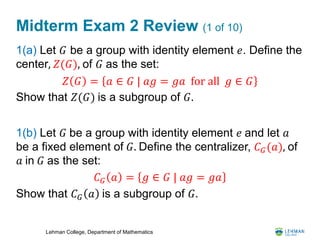
1(a) Let 𝐺 be a group with identity element 𝑒. Define the
center, 𝑍(𝐺), of 𝐺 as the set:
Show that 𝑍(𝐺) is a subgroup of 𝐺.
1(b) Let 𝐺 be a group with identity element 𝑒 and let 𝑎
be a fixed element of 𝐺. Define the centralizer, 𝐶 𝐺(𝑎), of
𝑎 in 𝐺 as the set:
Show that 𝐶 𝐺 𝑎 is a subgroup of 𝐺.
𝑍 𝐺 = 𝑎 ∈ 𝐺 | 𝑎𝑔 = 𝑔𝑎 for all 𝑔 ∈ 𝐺
𝐶 𝐺 𝑎 = 𝑔 ∈ 𝐺 | 𝑎𝑔 = 𝑔𝑎
Lehman College, Department of Mathematics
Midterm Exam 2 Review (1 of 10)
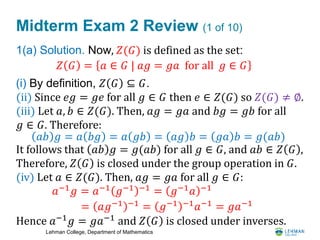
1(a) Solution. Now, 𝑍(𝐺) is defined as the set:
(i) By definition, 𝑍 𝐺 ⊆ 𝐺.
(ii) Since 𝑒𝑔 = 𝑔𝑒 for all 𝑔 ∈ 𝐺 then 𝑒 ∈ 𝑍(𝐺) so 𝑍(𝐺) ≠ ∅.
(iii) Let 𝑎, 𝑏 ∈ 𝑍(𝐺). Then, 𝑎𝑔 = 𝑔𝑎 and 𝑏𝑔 = 𝑔𝑏 for all
𝑔 ∈ 𝐺. Therefore:
It follows that 𝑎𝑏 𝑔 = 𝑔(𝑎𝑏) for all 𝑔 ∈ 𝐺, and 𝑎𝑏 ∈ 𝑍 𝐺 ,
Therefore, 𝑍 𝐺 is closed under the group operation in 𝐺.
(iv) Let 𝑎 ∈ 𝑍(𝐺). Then, 𝑎𝑔 = 𝑔𝑎 for all 𝑔 ∈ 𝐺:
Hence 𝑎−1
𝑔 = 𝑔𝑎−1
and 𝑍 𝐺 is closed under inverses.
𝑍 𝐺 = 𝑎 ∈ 𝐺 | 𝑎𝑔 = 𝑔𝑎 for all 𝑔 ∈ 𝐺
𝑎𝑏 𝑔 = 𝑎 𝑏𝑔 = 𝑎 𝑔𝑏 = 𝑎𝑔 𝑏 = 𝑔𝑎 𝑏 = 𝑔(𝑎𝑏)
𝑎−1
𝑔 = 𝑎−1
𝑔−1 −1
= 𝑔−1
𝑎 −1
= 𝑎𝑔−1 −1
= 𝑔−1 −1
𝑎−1
= 𝑔𝑎−1
Lehman College, Department of Mathematics
Midterm Exam 2 Review (1 of 10)
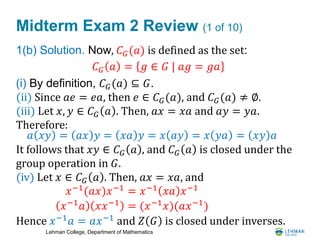
1(b) Solution. Now, 𝐶 𝐺(𝑎) is defined as the set:
(i) By definition, 𝐶 𝐺(𝑎) ⊆ 𝐺.
(ii) Since 𝑎𝑒 = 𝑒𝑎, then 𝑒 ∈ 𝐶 𝐺(𝑎), and 𝐶 𝐺(𝑎) ≠ ∅.
(iii) Let 𝑥, 𝑦 ∈ 𝐶 𝐺 𝑎 . Then, 𝑎𝑥 = 𝑥𝑎 and 𝑎𝑦 = 𝑦𝑎.
Therefore:
It follows that 𝑥𝑦 ∈ 𝐶 𝐺 𝑎 , and 𝐶 𝐺 𝑎 is closed under the
group operation in 𝐺.
(iv) Let 𝑥 ∈ 𝐶 𝐺 𝑎 . Then, 𝑎𝑥 = 𝑥𝑎, and
Hence 𝑥−1
𝑎 = 𝑎𝑥−1
and 𝑍 𝐺 is closed under inverses.
𝑎 𝑥𝑦 = 𝑎𝑥 𝑦 = 𝑥𝑎 𝑦 = 𝑥 𝑎𝑦 = 𝑥 𝑦𝑎 = 𝑥𝑦 𝑎
𝑥−1
(𝑎𝑥)𝑥−1
= 𝑥−1
𝑥𝑎 𝑥−1
𝑥−1
𝑎 𝑥𝑥−1
= (𝑥−1
𝑥)(𝑎𝑥−1
)
𝐶 𝐺 𝑎 = 𝑔 ∈ 𝐺 | 𝑎𝑔 = 𝑔𝑎
Lehman College, Department of Mathematics
Midterm Exam 2 Review (2 of 10)
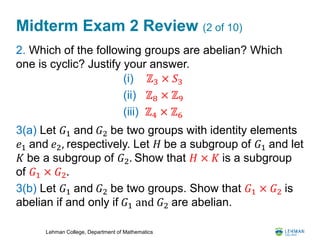
2. Which of the following groups are abelian? Which
one is cyclic? Justify your answer.
3(a) Let 𝐺1 and 𝐺2 be two groups with identity elements
𝑒1 and 𝑒2, respectively. Let 𝐻 be a subgroup of 𝐺1 and let
𝐾 be a subgroup of 𝐺2. Show that 𝐻 × 𝐾 is a subgroup
of 𝐺1 × 𝐺2.
3(b) Let 𝐺1 and 𝐺2 be two groups. Show that 𝐺1 × 𝐺2 is
abelian if and only if 𝐺1 and 𝐺2 are abelian.
(i) ℤ3 × 𝑆3
(ii) ℤ8 × ℤ9
(iii) ℤ4 × ℤ6
Lehman College, Department of Mathematics
Midterm Exam 2 Review (2 of 10)
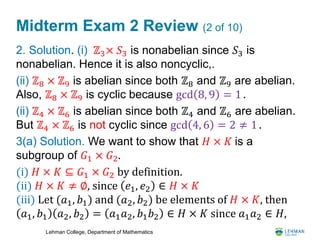
2. Solution. (i) ℤ3× 𝑆3 is nonabelian since 𝑆3 is
nonabelian. Hence it is also noncyclic,.
(ii) ℤ8 × ℤ9 is abelian since both ℤ8 and ℤ9 are abelian.
Also, ℤ8 × ℤ9 is cyclic because gcd 8, 9 = 1 .
(ii) ℤ4 × ℤ6 is abelian since both ℤ4 and ℤ6 are abelian.
But ℤ4 × ℤ6 is not cyclic since gcd 4, 6 = 2 ≠ 1 .
3(a) Solution. We want to show that 𝐻 × 𝐾 is a
subgroup of 𝐺1 × 𝐺2.
(i) 𝐻 × 𝐾 ⊆ 𝐺1 × 𝐺2 by definition.
(ii) 𝐻 × 𝐾 ≠ ∅, since 𝑒1, 𝑒2 ∈ 𝐻 × 𝐾
(iii) Let (𝑎1, 𝑏1) and (𝑎2, 𝑏2) be elements of 𝐻 × 𝐾, then
𝑎1, 𝑏1 𝑎2, 𝑏2 = 𝑎1 𝑎2, 𝑏1 𝑏2 ∈ 𝐻 × 𝐾 since 𝑎1 𝑎2 ∈ 𝐻,
Lehman College, Department of Mathematics
Midterm Exam 2 Review (2 of 10)
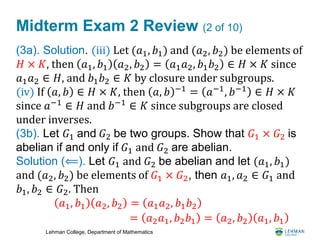
(3a). Solution. (iii) Let (𝑎1, 𝑏1) and (𝑎2, 𝑏2) be elements of
𝐻 × 𝐾, then 𝑎1, 𝑏1 𝑎2, 𝑏2 = 𝑎1 𝑎2, 𝑏1 𝑏2 ∈ 𝐻 × 𝐾 since
𝑎1 𝑎2 ∈ 𝐻, and 𝑏1 𝑏2 ∈ 𝐾 by closure under subgroups.
(iv) If 𝑎, 𝑏 ∈ 𝐻 × 𝐾, then 𝑎, 𝑏 −1
= 𝑎−1
, 𝑏−1
∈ 𝐻 × 𝐾
since 𝑎−1
∈ 𝐻 and 𝑏−1
∈ 𝐾 since subgroups are closed
under inverses.
(3b). Let 𝐺1 and 𝐺2 be two groups. Show that 𝐺1 × 𝐺2 is
abelian if and only if 𝐺1 and 𝐺2 are abelian.
Solution (⟸). Let 𝐺1 and 𝐺2 be abelian and let (𝑎1, 𝑏1)
and (𝑎2, 𝑏2) be elements of 𝐺1 × 𝐺2, then 𝑎1, 𝑎2 ∈ 𝐺1 and
𝑏1, 𝑏2 ∈ 𝐺2. Then
𝑎1, 𝑏1 𝑎2, 𝑏2 = 𝑎1 𝑎2, 𝑏1 𝑏2
= 𝑎2 𝑎1, 𝑏2 𝑏1 = 𝑎2, 𝑏2 𝑎1, 𝑏1
Lehman College, Department of Mathematics
Midterm Exam 2 Review (2 of 10)
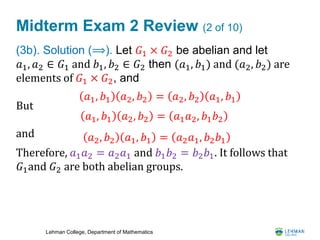
(3b). Solution (⟹). Let 𝐺1 × 𝐺2 be abelian and let
𝑎1, 𝑎2 ∈ 𝐺1 and 𝑏1, 𝑏2 ∈ 𝐺2 then (𝑎1, 𝑏1) and (𝑎2, 𝑏2) are
elements of 𝐺1 × 𝐺2, and
But
and
Therefore, 𝑎1 𝑎2 = 𝑎2 𝑎1 and 𝑏1 𝑏2 = 𝑏2 𝑏1. It follows that
𝐺1and 𝐺2 are both abelian groups.
𝑎1, 𝑏1 𝑎2, 𝑏2 = 𝑎1 𝑎2, 𝑏1 𝑏2
𝑎2, 𝑏2 𝑎1, 𝑏1 = 𝑎2 𝑎1, 𝑏2 𝑏1
𝑎1, 𝑏1 𝑎2, 𝑏2 = 𝑎2, 𝑏2 𝑎1, 𝑏1
Lehman College, Department of Mathematics
Midterm Exam 2 Review (2 of 10)
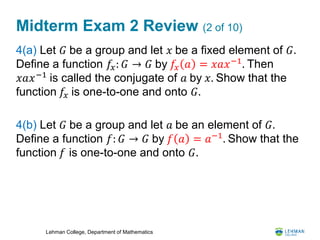
4(a) Let 𝐺 be a group and let 𝑥 be a fixed element of 𝐺.
Define a function 𝑓𝑥: 𝐺 → 𝐺 by 𝑓𝑥 𝑎 = 𝑥𝑎𝑥−1
. Then
𝑥𝑎𝑥−1
is called the conjugate of 𝑎 by 𝑥. Show that the
function 𝑓𝑥 is one-to-one and onto 𝐺.
4(b) Let 𝐺 be a group and let 𝑎 be an element of 𝐺.
Define a function 𝑓: 𝐺 → 𝐺 by 𝑓 𝑎 = 𝑎−1
. Show that the
function 𝑓 is one-to-one and onto 𝐺.
Lehman College, Department of Mathematics
Midterm Exam 2 Review (2 of 10)
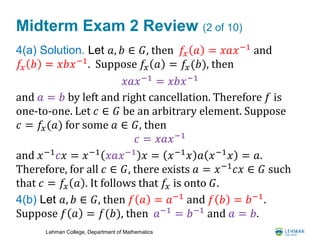
4(a) Solution. Let 𝑎, 𝑏 ∈ 𝐺, then 𝑓𝑥 𝑎 = 𝑥𝑎𝑥−1
and
𝑓𝑥 𝑏 = 𝑥𝑏𝑥−1
. Suppose 𝑓𝑥 𝑎 = 𝑓𝑥(𝑏), then
and 𝑎 = 𝑏 by left and right cancellation. Therefore 𝑓 is
one-to-one. Let 𝑐 ∈ 𝐺 be an arbitrary element. Suppose
𝑐 = 𝑓𝑥(𝑎) for some 𝑎 ∈ 𝐺, then
and 𝑥−1
𝑐𝑥 = 𝑥−1
𝑥𝑎𝑥−1
𝑥 = 𝑥−1
𝑥 𝑎 𝑥−1
𝑥 = 𝑎.
Therefore, for all 𝑐 ∈ 𝐺, there exists 𝑎 = 𝑥−1
𝑐𝑥 ∈ 𝐺 such
that 𝑐 = 𝑓𝑥 𝑎 . It follows that 𝑓𝑥 is onto 𝐺.
4(b) Let 𝑎, 𝑏 ∈ 𝐺, then 𝑓 𝑎 = 𝑎−1
and 𝑓 𝑏 = 𝑏−1
.
Suppose 𝑓 𝑎 = 𝑓(𝑏), then 𝑎−1 = 𝑏−1 and 𝑎 = 𝑏.
𝑥𝑎𝑥−1
= 𝑥𝑏𝑥−1
𝑐 = 𝑥𝑎𝑥−1
Lehman College, Department of Mathematics
Midterm Exam 2 Review (2 of 10)
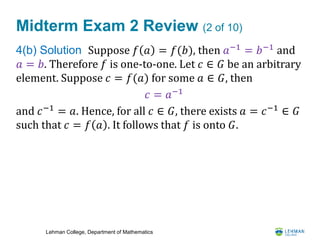
4(b) Solution Suppose 𝑓 𝑎 = 𝑓(𝑏), then 𝑎−1
= 𝑏−1
and
𝑎 = 𝑏. Therefore 𝑓 is one-to-one. Let 𝑐 ∈ 𝐺 be an arbitrary
element. Suppose 𝑐 = 𝑓(𝑎) for some 𝑎 ∈ 𝐺, then
and 𝑐−1
= 𝑎. Hence, for all 𝑐 ∈ 𝐺, there exists 𝑎 = 𝑐−1
∈ 𝐺
such that 𝑐 = 𝑓 𝑎 . It follows that 𝑓 is onto 𝐺.
𝑐 = 𝑎−1
Lehman College, Department of Mathematics
Midterm Exam 2 Review (2 of 10)
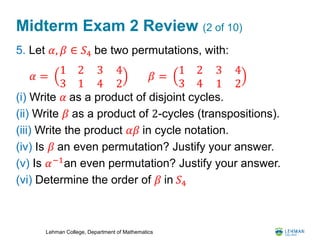
5. Let 𝛼, 𝛽 ∈ 𝑆4 be two permutations, with:
(i) Write 𝛼 as a product of disjoint cycles.
(ii) Write 𝛽 as a product of 2-cycles (transpositions).
(iii) Write the product 𝛼𝛽 in cycle notation.
(iv) Is 𝛽 an even permutation? Justify your answer.
(v) Is 𝛼−1
an even permutation? Justify your answer.
(vi) Determine the order of 𝛽 in 𝑆4
𝛼 =
1 2
3 1
3
4
4
2
𝛽 =
1 2
3 4
3
1
4
2
Lehman College, Department of Mathematics
Midterm Exam 2 Review (2 of 10)
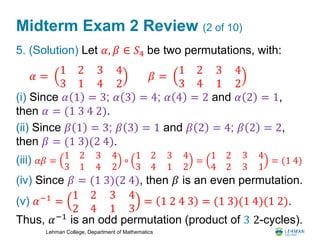
5. (Solution) Let 𝛼, 𝛽 ∈ 𝑆4 be two permutations, with:
(i) Since 𝛼 1 = 3; 𝛼 3 = 4; 𝛼 4 = 2 and 𝛼 2 = 1,
then 𝛼 = (1 3 4 2).
(ii) Since 𝛽 1 = 3; 𝛽 3 = 1 and 𝛽 2 = 4; 𝛽 2 = 2,
then 𝛽 = (1 3)(2 4).
(iii) 𝛼𝛽 =
1 2
3 1
3
4
4
2
∘
1 2
3 4
3
1
4
2
=
1 2
4 2
3
3
4
1
= (1 4)
(iv) Since 𝛽 = (1 3)(2 4), then 𝛽 is an even permutation.
(v) 𝛼−1 =
1 2
2 4
3
1
4
3
= 1 2 4 3 = (1 3)(1 4)(1 2).
Thus, 𝛼−1
is an odd permutation (product of 3 2-cycles).
𝛼 =
1 2
3 1
3
4
4
2
𝛽 =
1 2
3 4
3
1
4
2
Lehman College, Department of Mathematics
Midterm Exam 2 Review (2 of 10)
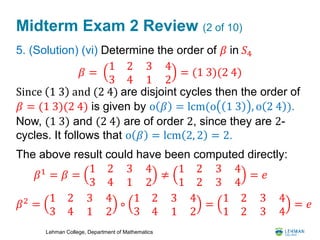
5. (Solution) (vi) Determine the order of 𝛽 in 𝑆4
Since 1 3 and (2 4) are disjoint cycles then the order of
𝛽 = (1 3)(2 4) is given by o 𝛽 = lcm(o 1 3 , o 2 4 ).
Now, (1 3) and (2 4) are of order 2, since they are 2-
cycles. It follows that o 𝛽 = lcm 2, 2 = 2.
The above result could have been computed directly:
𝛽 =
1 2
3 4
3
1
4
2
= (1 3)(2 4)
𝛽1
= 𝛽 =
1 2
3 4
3
1
4
2
≠
1 2
1 2
3
3
4
4
= 𝑒
𝛽2
=
1 2
3 4
3
1
4
2
∘
1 2
3 4
3
1
4
2
=
1 2
1 2
3
3
4
4
= 𝑒
Lehman College, Department of Mathematics
Midterm Exam 2 Review (2 of 10)
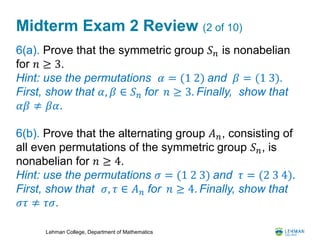
6(a). Prove that the symmetric group 𝑆 𝑛 is nonabelian
for 𝑛 ≥ 3.
Hint: use the permutations 𝛼 = (1 2) and 𝛽 = (1 3).
First, show that 𝛼, 𝛽 ∈ 𝑆 𝑛 for 𝑛 ≥ 3. Finally, show that
𝛼𝛽 ≠ 𝛽𝛼.
6(b). Prove that the alternating group 𝐴 𝑛, consisting of
all even permutations of the symmetric group 𝑆 𝑛, is
nonabelian for 𝑛 ≥ 4.
Hint: use the permutations 𝜎 = (1 2 3) and 𝜏 = (2 3 4).
First, show that 𝜎, 𝜏 ∈ 𝐴 𝑛 for 𝑛 ≥ 4. Finally, show that
𝜎𝜏 ≠ 𝜏𝜎.
Lehman College, Department of Mathematics
Midterm Exam 2 Review (2 of 10)
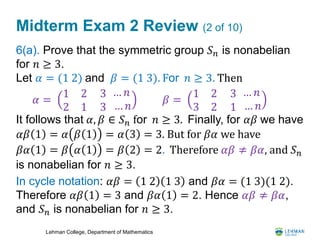
6(a). Prove that the symmetric group 𝑆 𝑛 is nonabelian
for 𝑛 ≥ 3.
Let 𝛼 = (1 2) and 𝛽 = (1 3). For 𝑛 ≥ 3. Then
It follows that 𝛼, 𝛽 ∈ 𝑆 𝑛 for 𝑛 ≥ 3. Finally, for 𝛼𝛽 we have
𝛼𝛽 1 = 𝛼 𝛽 1 = 𝛼 3 = 3. But for 𝛽𝛼 we have
𝛽𝛼 1 = 𝛽 𝛼 1 = 𝛽 2 = 2. Therefore 𝛼𝛽 ≠ 𝛽𝛼, and 𝑆 𝑛
is nonabelian for 𝑛 ≥ 3.
In cycle notation: 𝛼𝛽 = 1 2 1 3 and 𝛽𝛼 = (1 3)(1 2).
Therefore 𝛼𝛽 1 = 3 and 𝛽𝛼 1 = 2. Hence 𝛼𝛽 ≠ 𝛽𝛼,
and 𝑆 𝑛 is nonabelian for 𝑛 ≥ 3.
𝛽 =
1 2
3 2
3
1
… 𝑛
… 𝑛
𝛼 =
1 2
2 1
3
3
… 𝑛
… 𝑛
Lehman College, Department of Mathematics
Midterm Exam 2 Review (2 of 10)
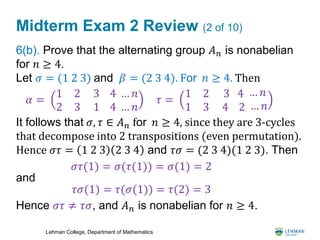
6(b). Prove that the alternating group 𝐴 𝑛 is nonabelian
for 𝑛 ≥ 4.
Let 𝜎 = (1 2 3) and 𝛽 = (2 3 4). For 𝑛 ≥ 4. Then
It follows that 𝜎, 𝜏 ∈ 𝐴 𝑛 for 𝑛 ≥ 4, since they are 3-cycles
that decompose into 2 transpositions (even permutation).
Hence 𝜎𝜏 = 1 2 3 2 3 4 and 𝜏𝜎 = (2 3 4)(1 2 3). Then
and
Hence 𝜎𝜏 ≠ 𝜏𝜎, and 𝐴 𝑛 is nonabelian for 𝑛 ≥ 4.
𝜏 =
1 2
1 3
3 4
4 2
… 𝑛
… 𝑛
𝛼 =
1 2
2 3
3
1
4 … 𝑛
4 … 𝑛
𝜎𝜏(1) = 𝜎(𝜏(1)) = 𝜎(1) = 2
𝜏𝜎(1) = 𝜏(𝜎(1)) = 𝜏(2) = 3
Lehman College, Department of Mathematics
Midterm Exam 2 Review (2 of 10)
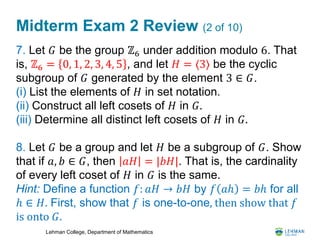
7. Let 𝐺 be the group ℤ6 under addition modulo 6. That
is, ℤ6 = 0, 1, 2, 3, 4, 5 , and let 𝐻 = ⟨3⟩ be the cyclic
subgroup of 𝐺 generated by the element 3 ∈ 𝐺.
(i) List the elements of 𝐻 in set notation.
(ii) Construct all left cosets of 𝐻 in 𝐺.
(iii) Determine all distinct left cosets of 𝐻 in 𝐺.
8. Let 𝐺 be a group and let 𝐻 be a subgroup of 𝐺. Show
that if 𝑎, 𝑏 ∈ 𝐺, then 𝑎𝐻 = |𝑏𝐻|. That is, the cardinality
of every left coset of 𝐻 in 𝐺 is the same.
Hint: Define a function 𝑓: 𝑎𝐻 → 𝑏𝐻 by 𝑓 𝑎ℎ = 𝑏ℎ for all
ℎ ∈ 𝐻. First, show that 𝑓 is one-to-one, then show that 𝑓
is onto 𝐺.
Lehman College, Department of Mathematics
Midterm Exam 2 Review (2 of 10)
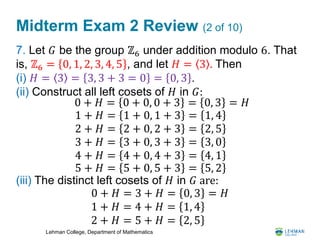
7. Let 𝐺 be the group ℤ6 under addition modulo 6. That
is, ℤ6 = 0, 1, 2, 3, 4, 5 , and let 𝐻 = 3 . Then
(i) 𝐻 = 3 = 3, 3 + 3 = 0 = 0, 3 .
(ii) Construct all left cosets of 𝐻 in 𝐺:
(iii) The distinct left cosets of 𝐻 in 𝐺 are:
0 + 𝐻 = 0 + 0, 0 + 3 = 0, 3 = 𝐻
1 + 𝐻 = 1 + 0, 1 + 3 = 1, 4
2 + 𝐻 = 2 + 0, 2 + 3 = 2, 5
3 + 𝐻 = 3 + 0, 3 + 3 = 3, 0
4 + 𝐻 = 4 + 0, 4 + 3 = 4, 1
5 + 𝐻 = 5 + 0, 5 + 3 = 5, 2
0 + 𝐻 = 3 + 𝐻 = 0, 3 = 𝐻
1 + 𝐻 = 4 + 𝐻 = 1, 4
2 + 𝐻 = 5 + 𝐻 = 2, 5
Lehman College, Department of Mathematics
Right Cosets (6 of 8)
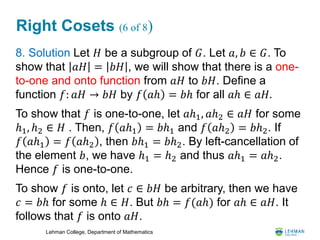
8. Solution Let 𝐻 be a subgroup of 𝐺. Let 𝑎, 𝑏 ∈ 𝐺. To
show that 𝑎𝐻 = 𝑏𝐻 , we will show that there is a one-
to-one and onto function from 𝑎𝐻 to 𝑏𝐻. Define a
function 𝑓: 𝑎𝐻 → 𝑏𝐻 by 𝑓 𝑎ℎ = 𝑏ℎ for all 𝑎ℎ ∈ 𝑎𝐻.
To show that 𝑓 is one-to-one, let 𝑎ℎ1, 𝑎ℎ2 ∈ 𝑎𝐻 for some
ℎ1, ℎ2 ∈ 𝐻 . Then, 𝑓 𝑎ℎ1 = 𝑏ℎ1 and 𝑓 𝑎ℎ2 = 𝑏ℎ2. If
𝑓 𝑎ℎ1 = 𝑓 𝑎ℎ2 , then 𝑏ℎ1 = 𝑏ℎ2. By left-cancellation of
the element 𝑏, we have ℎ1 = ℎ2 and thus 𝑎ℎ1 = 𝑎ℎ2.
Hence 𝑓 is one-to-one.
To show 𝑓 is onto, let 𝑐 ∈ 𝑏𝐻 be arbitrary, then we have
𝑐 = 𝑏ℎ for some ℎ ∈ 𝐻. But 𝑏ℎ = 𝑓(𝑎ℎ) for 𝑎ℎ ∈ 𝑎𝐻. It
follows that 𝑓 is onto 𝑎𝐻.
Lehman College, Department of Mathematics
Midterm Exam 2 Review (2 of 10)
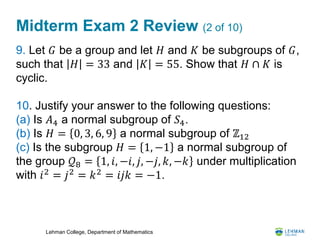
9. Let 𝐺 be a group and let 𝐻 and 𝐾 be subgroups of 𝐺,
such that 𝐻 = 33 and 𝐾 = 55. Show that 𝐻 ∩ 𝐾 is
cyclic.
10. Justify your answer to the following questions:
(a) Is 𝐴4 a normal subgroup of 𝑆4.
(b) Is 𝐻 = 0, 3, 6, 9 a normal subgroup of ℤ12
(c) Is the subgroup 𝐻 = 1, −1 a normal subgroup of
the group 𝒬8 = 1, 𝑖, −𝑖, 𝑗, −𝑗, 𝑘, −𝑘 under multiplication
with 𝑖2 = 𝑗2 = 𝑘2 = 𝑖𝑗𝑘 = −1.
Lehman College, Department of Mathematics
Midterm Exam 2 Review (2 of 10)
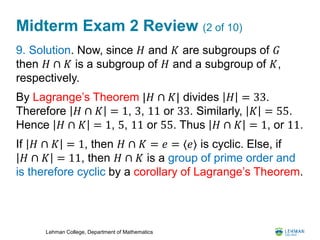
9. Solution. Now, since 𝐻 and 𝐾 are subgroups of 𝐺
then 𝐻 ∩ 𝐾 is a subgroup of 𝐻 and a subgroup of 𝐾,
respectively.
By Lagrange’s Theorem |𝐻 ∩ 𝐾| divides 𝐻 = 33.
Therefore 𝐻 ∩ 𝐾 = 1, 3, 11 or 33. Similarly, 𝐾 = 55.
Hence 𝐻 ∩ 𝐾 = 1, 5, 11 or 55. Thus 𝐻 ∩ 𝐾 = 1, or 11.
If 𝐻 ∩ 𝐾 = 1, then 𝐻 ∩ 𝐾 = 𝑒 = ⟨𝑒⟩ is cyclic. Else, if
𝐻 ∩ 𝐾 = 11, then 𝐻 ∩ 𝐾 is a group of prime order and
is therefore cyclic by a corollary of Lagrange’s Theorem.
Lehman College, Department of Mathematics
Midterm Exam 2 Review (2 of 10)
10. Solutions.
(a) 𝐴4 a normal subgroup of 𝑆4 because 𝑆4 = 4! = 24
and 𝐴4 = 4!/2 = 12. By Lagrange’s Theorem, the
index [𝑆3: 𝐴4] of 𝐴4 in 𝑆3 is given by:
It follows that 𝐴4 is an index 2 subgroup of 𝑆4 and is
therefore normal.
(b) ℤ12 is an abelian group. Therefore any subgroup of
ℤ12 is normal, including 𝐻 = 0, 3, 6, 9 .
(c) 𝐻 = 1, −1 is a subgroup of the center of 𝒬8, since
both 1 and −1 commute with every element of 𝒬8. It
follows that 𝐻 is a normal subgroup of 𝒬8.
[𝑆3: 𝐴4] =
𝑆4
𝐴4
=
24
12
= 2

MAT-314 Midterm Exam 2 Review

  • 1.
    Abstract Algebra, Saracino SecondEdition Midterm Exam 2 (Review) “A person who never made a mistake never tried anything new.“ – Albert Einstein -
  • 2.
    Lehman College, Departmentof Mathematics Midterm Exam 2 Review (1 of 10) 1(a) Let 𝐺 be a group with identity element 𝑒. Define the center, 𝑍(𝐺), of 𝐺 as the set: Show that 𝑍(𝐺) is a subgroup of 𝐺. 1(b) Let 𝐺 be a group with identity element 𝑒 and let 𝑎 be a fixed element of 𝐺. Define the centralizer, 𝐶 𝐺(𝑎), of 𝑎 in 𝐺 as the set: Show that 𝐶 𝐺 𝑎 is a subgroup of 𝐺. 𝑍 𝐺 = 𝑎 ∈ 𝐺 | 𝑎𝑔 = 𝑔𝑎 for all 𝑔 ∈ 𝐺 𝐶 𝐺 𝑎 = 𝑔 ∈ 𝐺 | 𝑎𝑔 = 𝑔𝑎
  • 3.
    Lehman College, Departmentof Mathematics Midterm Exam 2 Review (1 of 10) 1(a) Solution. Now, 𝑍(𝐺) is defined as the set: (i) By definition, 𝑍 𝐺 ⊆ 𝐺. (ii) Since 𝑒𝑔 = 𝑔𝑒 for all 𝑔 ∈ 𝐺 then 𝑒 ∈ 𝑍(𝐺) so 𝑍(𝐺) ≠ ∅. (iii) Let 𝑎, 𝑏 ∈ 𝑍(𝐺). Then, 𝑎𝑔 = 𝑔𝑎 and 𝑏𝑔 = 𝑔𝑏 for all 𝑔 ∈ 𝐺. Therefore: It follows that 𝑎𝑏 𝑔 = 𝑔(𝑎𝑏) for all 𝑔 ∈ 𝐺, and 𝑎𝑏 ∈ 𝑍 𝐺 , Therefore, 𝑍 𝐺 is closed under the group operation in 𝐺. (iv) Let 𝑎 ∈ 𝑍(𝐺). Then, 𝑎𝑔 = 𝑔𝑎 for all 𝑔 ∈ 𝐺: Hence 𝑎−1 𝑔 = 𝑔𝑎−1 and 𝑍 𝐺 is closed under inverses. 𝑍 𝐺 = 𝑎 ∈ 𝐺 | 𝑎𝑔 = 𝑔𝑎 for all 𝑔 ∈ 𝐺 𝑎𝑏 𝑔 = 𝑎 𝑏𝑔 = 𝑎 𝑔𝑏 = 𝑎𝑔 𝑏 = 𝑔𝑎 𝑏 = 𝑔(𝑎𝑏) 𝑎−1 𝑔 = 𝑎−1 𝑔−1 −1 = 𝑔−1 𝑎 −1 = 𝑎𝑔−1 −1 = 𝑔−1 −1 𝑎−1 = 𝑔𝑎−1
  • 4.
    Lehman College, Departmentof Mathematics Midterm Exam 2 Review (1 of 10) 1(b) Solution. Now, 𝐶 𝐺(𝑎) is defined as the set: (i) By definition, 𝐶 𝐺(𝑎) ⊆ 𝐺. (ii) Since 𝑎𝑒 = 𝑒𝑎, then 𝑒 ∈ 𝐶 𝐺(𝑎), and 𝐶 𝐺(𝑎) ≠ ∅. (iii) Let 𝑥, 𝑦 ∈ 𝐶 𝐺 𝑎 . Then, 𝑎𝑥 = 𝑥𝑎 and 𝑎𝑦 = 𝑦𝑎. Therefore: It follows that 𝑥𝑦 ∈ 𝐶 𝐺 𝑎 , and 𝐶 𝐺 𝑎 is closed under the group operation in 𝐺. (iv) Let 𝑥 ∈ 𝐶 𝐺 𝑎 . Then, 𝑎𝑥 = 𝑥𝑎, and Hence 𝑥−1 𝑎 = 𝑎𝑥−1 and 𝑍 𝐺 is closed under inverses. 𝑎 𝑥𝑦 = 𝑎𝑥 𝑦 = 𝑥𝑎 𝑦 = 𝑥 𝑎𝑦 = 𝑥 𝑦𝑎 = 𝑥𝑦 𝑎 𝑥−1 (𝑎𝑥)𝑥−1 = 𝑥−1 𝑥𝑎 𝑥−1 𝑥−1 𝑎 𝑥𝑥−1 = (𝑥−1 𝑥)(𝑎𝑥−1 ) 𝐶 𝐺 𝑎 = 𝑔 ∈ 𝐺 | 𝑎𝑔 = 𝑔𝑎
  • 5.
    Lehman College, Departmentof Mathematics Midterm Exam 2 Review (2 of 10) 2. Which of the following groups are abelian? Which one is cyclic? Justify your answer. 3(a) Let 𝐺1 and 𝐺2 be two groups with identity elements 𝑒1 and 𝑒2, respectively. Let 𝐻 be a subgroup of 𝐺1 and let 𝐾 be a subgroup of 𝐺2. Show that 𝐻 × 𝐾 is a subgroup of 𝐺1 × 𝐺2. 3(b) Let 𝐺1 and 𝐺2 be two groups. Show that 𝐺1 × 𝐺2 is abelian if and only if 𝐺1 and 𝐺2 are abelian. (i) ℤ3 × 𝑆3 (ii) ℤ8 × ℤ9 (iii) ℤ4 × ℤ6
  • 6.
    Lehman College, Departmentof Mathematics Midterm Exam 2 Review (2 of 10) 2. Solution. (i) ℤ3× 𝑆3 is nonabelian since 𝑆3 is nonabelian. Hence it is also noncyclic,. (ii) ℤ8 × ℤ9 is abelian since both ℤ8 and ℤ9 are abelian. Also, ℤ8 × ℤ9 is cyclic because gcd 8, 9 = 1 . (ii) ℤ4 × ℤ6 is abelian since both ℤ4 and ℤ6 are abelian. But ℤ4 × ℤ6 is not cyclic since gcd 4, 6 = 2 ≠ 1 . 3(a) Solution. We want to show that 𝐻 × 𝐾 is a subgroup of 𝐺1 × 𝐺2. (i) 𝐻 × 𝐾 ⊆ 𝐺1 × 𝐺2 by definition. (ii) 𝐻 × 𝐾 ≠ ∅, since 𝑒1, 𝑒2 ∈ 𝐻 × 𝐾 (iii) Let (𝑎1, 𝑏1) and (𝑎2, 𝑏2) be elements of 𝐻 × 𝐾, then 𝑎1, 𝑏1 𝑎2, 𝑏2 = 𝑎1 𝑎2, 𝑏1 𝑏2 ∈ 𝐻 × 𝐾 since 𝑎1 𝑎2 ∈ 𝐻,
  • 7.
    Lehman College, Departmentof Mathematics Midterm Exam 2 Review (2 of 10) (3a). Solution. (iii) Let (𝑎1, 𝑏1) and (𝑎2, 𝑏2) be elements of 𝐻 × 𝐾, then 𝑎1, 𝑏1 𝑎2, 𝑏2 = 𝑎1 𝑎2, 𝑏1 𝑏2 ∈ 𝐻 × 𝐾 since 𝑎1 𝑎2 ∈ 𝐻, and 𝑏1 𝑏2 ∈ 𝐾 by closure under subgroups. (iv) If 𝑎, 𝑏 ∈ 𝐻 × 𝐾, then 𝑎, 𝑏 −1 = 𝑎−1 , 𝑏−1 ∈ 𝐻 × 𝐾 since 𝑎−1 ∈ 𝐻 and 𝑏−1 ∈ 𝐾 since subgroups are closed under inverses. (3b). Let 𝐺1 and 𝐺2 be two groups. Show that 𝐺1 × 𝐺2 is abelian if and only if 𝐺1 and 𝐺2 are abelian. Solution (⟸). Let 𝐺1 and 𝐺2 be abelian and let (𝑎1, 𝑏1) and (𝑎2, 𝑏2) be elements of 𝐺1 × 𝐺2, then 𝑎1, 𝑎2 ∈ 𝐺1 and 𝑏1, 𝑏2 ∈ 𝐺2. Then 𝑎1, 𝑏1 𝑎2, 𝑏2 = 𝑎1 𝑎2, 𝑏1 𝑏2 = 𝑎2 𝑎1, 𝑏2 𝑏1 = 𝑎2, 𝑏2 𝑎1, 𝑏1
  • 8.
    Lehman College, Departmentof Mathematics Midterm Exam 2 Review (2 of 10) (3b). Solution (⟹). Let 𝐺1 × 𝐺2 be abelian and let 𝑎1, 𝑎2 ∈ 𝐺1 and 𝑏1, 𝑏2 ∈ 𝐺2 then (𝑎1, 𝑏1) and (𝑎2, 𝑏2) are elements of 𝐺1 × 𝐺2, and But and Therefore, 𝑎1 𝑎2 = 𝑎2 𝑎1 and 𝑏1 𝑏2 = 𝑏2 𝑏1. It follows that 𝐺1and 𝐺2 are both abelian groups. 𝑎1, 𝑏1 𝑎2, 𝑏2 = 𝑎1 𝑎2, 𝑏1 𝑏2 𝑎2, 𝑏2 𝑎1, 𝑏1 = 𝑎2 𝑎1, 𝑏2 𝑏1 𝑎1, 𝑏1 𝑎2, 𝑏2 = 𝑎2, 𝑏2 𝑎1, 𝑏1
  • 9.
    Lehman College, Departmentof Mathematics Midterm Exam 2 Review (2 of 10) 4(a) Let 𝐺 be a group and let 𝑥 be a fixed element of 𝐺. Define a function 𝑓𝑥: 𝐺 → 𝐺 by 𝑓𝑥 𝑎 = 𝑥𝑎𝑥−1 . Then 𝑥𝑎𝑥−1 is called the conjugate of 𝑎 by 𝑥. Show that the function 𝑓𝑥 is one-to-one and onto 𝐺. 4(b) Let 𝐺 be a group and let 𝑎 be an element of 𝐺. Define a function 𝑓: 𝐺 → 𝐺 by 𝑓 𝑎 = 𝑎−1 . Show that the function 𝑓 is one-to-one and onto 𝐺.
  • 10.
    Lehman College, Departmentof Mathematics Midterm Exam 2 Review (2 of 10) 4(a) Solution. Let 𝑎, 𝑏 ∈ 𝐺, then 𝑓𝑥 𝑎 = 𝑥𝑎𝑥−1 and 𝑓𝑥 𝑏 = 𝑥𝑏𝑥−1 . Suppose 𝑓𝑥 𝑎 = 𝑓𝑥(𝑏), then and 𝑎 = 𝑏 by left and right cancellation. Therefore 𝑓 is one-to-one. Let 𝑐 ∈ 𝐺 be an arbitrary element. Suppose 𝑐 = 𝑓𝑥(𝑎) for some 𝑎 ∈ 𝐺, then and 𝑥−1 𝑐𝑥 = 𝑥−1 𝑥𝑎𝑥−1 𝑥 = 𝑥−1 𝑥 𝑎 𝑥−1 𝑥 = 𝑎. Therefore, for all 𝑐 ∈ 𝐺, there exists 𝑎 = 𝑥−1 𝑐𝑥 ∈ 𝐺 such that 𝑐 = 𝑓𝑥 𝑎 . It follows that 𝑓𝑥 is onto 𝐺. 4(b) Let 𝑎, 𝑏 ∈ 𝐺, then 𝑓 𝑎 = 𝑎−1 and 𝑓 𝑏 = 𝑏−1 . Suppose 𝑓 𝑎 = 𝑓(𝑏), then 𝑎−1 = 𝑏−1 and 𝑎 = 𝑏. 𝑥𝑎𝑥−1 = 𝑥𝑏𝑥−1 𝑐 = 𝑥𝑎𝑥−1
  • 11.
    Lehman College, Departmentof Mathematics Midterm Exam 2 Review (2 of 10) 4(b) Solution Suppose 𝑓 𝑎 = 𝑓(𝑏), then 𝑎−1 = 𝑏−1 and 𝑎 = 𝑏. Therefore 𝑓 is one-to-one. Let 𝑐 ∈ 𝐺 be an arbitrary element. Suppose 𝑐 = 𝑓(𝑎) for some 𝑎 ∈ 𝐺, then and 𝑐−1 = 𝑎. Hence, for all 𝑐 ∈ 𝐺, there exists 𝑎 = 𝑐−1 ∈ 𝐺 such that 𝑐 = 𝑓 𝑎 . It follows that 𝑓 is onto 𝐺. 𝑐 = 𝑎−1
  • 12.
    Lehman College, Departmentof Mathematics Midterm Exam 2 Review (2 of 10) 5. Let 𝛼, 𝛽 ∈ 𝑆4 be two permutations, with: (i) Write 𝛼 as a product of disjoint cycles. (ii) Write 𝛽 as a product of 2-cycles (transpositions). (iii) Write the product 𝛼𝛽 in cycle notation. (iv) Is 𝛽 an even permutation? Justify your answer. (v) Is 𝛼−1 an even permutation? Justify your answer. (vi) Determine the order of 𝛽 in 𝑆4 𝛼 = 1 2 3 1 3 4 4 2 𝛽 = 1 2 3 4 3 1 4 2
  • 13.
    Lehman College, Departmentof Mathematics Midterm Exam 2 Review (2 of 10) 5. (Solution) Let 𝛼, 𝛽 ∈ 𝑆4 be two permutations, with: (i) Since 𝛼 1 = 3; 𝛼 3 = 4; 𝛼 4 = 2 and 𝛼 2 = 1, then 𝛼 = (1 3 4 2). (ii) Since 𝛽 1 = 3; 𝛽 3 = 1 and 𝛽 2 = 4; 𝛽 2 = 2, then 𝛽 = (1 3)(2 4). (iii) 𝛼𝛽 = 1 2 3 1 3 4 4 2 ∘ 1 2 3 4 3 1 4 2 = 1 2 4 2 3 3 4 1 = (1 4) (iv) Since 𝛽 = (1 3)(2 4), then 𝛽 is an even permutation. (v) 𝛼−1 = 1 2 2 4 3 1 4 3 = 1 2 4 3 = (1 3)(1 4)(1 2). Thus, 𝛼−1 is an odd permutation (product of 3 2-cycles). 𝛼 = 1 2 3 1 3 4 4 2 𝛽 = 1 2 3 4 3 1 4 2
  • 14.
    Lehman College, Departmentof Mathematics Midterm Exam 2 Review (2 of 10) 5. (Solution) (vi) Determine the order of 𝛽 in 𝑆4 Since 1 3 and (2 4) are disjoint cycles then the order of 𝛽 = (1 3)(2 4) is given by o 𝛽 = lcm(o 1 3 , o 2 4 ). Now, (1 3) and (2 4) are of order 2, since they are 2- cycles. It follows that o 𝛽 = lcm 2, 2 = 2. The above result could have been computed directly: 𝛽 = 1 2 3 4 3 1 4 2 = (1 3)(2 4) 𝛽1 = 𝛽 = 1 2 3 4 3 1 4 2 ≠ 1 2 1 2 3 3 4 4 = 𝑒 𝛽2 = 1 2 3 4 3 1 4 2 ∘ 1 2 3 4 3 1 4 2 = 1 2 1 2 3 3 4 4 = 𝑒
  • 15.
    Lehman College, Departmentof Mathematics Midterm Exam 2 Review (2 of 10) 6(a). Prove that the symmetric group 𝑆 𝑛 is nonabelian for 𝑛 ≥ 3. Hint: use the permutations 𝛼 = (1 2) and 𝛽 = (1 3). First, show that 𝛼, 𝛽 ∈ 𝑆 𝑛 for 𝑛 ≥ 3. Finally, show that 𝛼𝛽 ≠ 𝛽𝛼. 6(b). Prove that the alternating group 𝐴 𝑛, consisting of all even permutations of the symmetric group 𝑆 𝑛, is nonabelian for 𝑛 ≥ 4. Hint: use the permutations 𝜎 = (1 2 3) and 𝜏 = (2 3 4). First, show that 𝜎, 𝜏 ∈ 𝐴 𝑛 for 𝑛 ≥ 4. Finally, show that 𝜎𝜏 ≠ 𝜏𝜎.
  • 16.
    Lehman College, Departmentof Mathematics Midterm Exam 2 Review (2 of 10) 6(a). Prove that the symmetric group 𝑆 𝑛 is nonabelian for 𝑛 ≥ 3. Let 𝛼 = (1 2) and 𝛽 = (1 3). For 𝑛 ≥ 3. Then It follows that 𝛼, 𝛽 ∈ 𝑆 𝑛 for 𝑛 ≥ 3. Finally, for 𝛼𝛽 we have 𝛼𝛽 1 = 𝛼 𝛽 1 = 𝛼 3 = 3. But for 𝛽𝛼 we have 𝛽𝛼 1 = 𝛽 𝛼 1 = 𝛽 2 = 2. Therefore 𝛼𝛽 ≠ 𝛽𝛼, and 𝑆 𝑛 is nonabelian for 𝑛 ≥ 3. In cycle notation: 𝛼𝛽 = 1 2 1 3 and 𝛽𝛼 = (1 3)(1 2). Therefore 𝛼𝛽 1 = 3 and 𝛽𝛼 1 = 2. Hence 𝛼𝛽 ≠ 𝛽𝛼, and 𝑆 𝑛 is nonabelian for 𝑛 ≥ 3. 𝛽 = 1 2 3 2 3 1 … 𝑛 … 𝑛 𝛼 = 1 2 2 1 3 3 … 𝑛 … 𝑛
  • 17.
    Lehman College, Departmentof Mathematics Midterm Exam 2 Review (2 of 10) 6(b). Prove that the alternating group 𝐴 𝑛 is nonabelian for 𝑛 ≥ 4. Let 𝜎 = (1 2 3) and 𝛽 = (2 3 4). For 𝑛 ≥ 4. Then It follows that 𝜎, 𝜏 ∈ 𝐴 𝑛 for 𝑛 ≥ 4, since they are 3-cycles that decompose into 2 transpositions (even permutation). Hence 𝜎𝜏 = 1 2 3 2 3 4 and 𝜏𝜎 = (2 3 4)(1 2 3). Then and Hence 𝜎𝜏 ≠ 𝜏𝜎, and 𝐴 𝑛 is nonabelian for 𝑛 ≥ 4. 𝜏 = 1 2 1 3 3 4 4 2 … 𝑛 … 𝑛 𝛼 = 1 2 2 3 3 1 4 … 𝑛 4 … 𝑛 𝜎𝜏(1) = 𝜎(𝜏(1)) = 𝜎(1) = 2 𝜏𝜎(1) = 𝜏(𝜎(1)) = 𝜏(2) = 3
  • 18.
    Lehman College, Departmentof Mathematics Midterm Exam 2 Review (2 of 10) 7. Let 𝐺 be the group ℤ6 under addition modulo 6. That is, ℤ6 = 0, 1, 2, 3, 4, 5 , and let 𝐻 = ⟨3⟩ be the cyclic subgroup of 𝐺 generated by the element 3 ∈ 𝐺. (i) List the elements of 𝐻 in set notation. (ii) Construct all left cosets of 𝐻 in 𝐺. (iii) Determine all distinct left cosets of 𝐻 in 𝐺. 8. Let 𝐺 be a group and let 𝐻 be a subgroup of 𝐺. Show that if 𝑎, 𝑏 ∈ 𝐺, then 𝑎𝐻 = |𝑏𝐻|. That is, the cardinality of every left coset of 𝐻 in 𝐺 is the same. Hint: Define a function 𝑓: 𝑎𝐻 → 𝑏𝐻 by 𝑓 𝑎ℎ = 𝑏ℎ for all ℎ ∈ 𝐻. First, show that 𝑓 is one-to-one, then show that 𝑓 is onto 𝐺.
  • 19.
    Lehman College, Departmentof Mathematics Midterm Exam 2 Review (2 of 10) 7. Let 𝐺 be the group ℤ6 under addition modulo 6. That is, ℤ6 = 0, 1, 2, 3, 4, 5 , and let 𝐻 = 3 . Then (i) 𝐻 = 3 = 3, 3 + 3 = 0 = 0, 3 . (ii) Construct all left cosets of 𝐻 in 𝐺: (iii) The distinct left cosets of 𝐻 in 𝐺 are: 0 + 𝐻 = 0 + 0, 0 + 3 = 0, 3 = 𝐻 1 + 𝐻 = 1 + 0, 1 + 3 = 1, 4 2 + 𝐻 = 2 + 0, 2 + 3 = 2, 5 3 + 𝐻 = 3 + 0, 3 + 3 = 3, 0 4 + 𝐻 = 4 + 0, 4 + 3 = 4, 1 5 + 𝐻 = 5 + 0, 5 + 3 = 5, 2 0 + 𝐻 = 3 + 𝐻 = 0, 3 = 𝐻 1 + 𝐻 = 4 + 𝐻 = 1, 4 2 + 𝐻 = 5 + 𝐻 = 2, 5
  • 20.
    Lehman College, Departmentof Mathematics Right Cosets (6 of 8) 8. Solution Let 𝐻 be a subgroup of 𝐺. Let 𝑎, 𝑏 ∈ 𝐺. To show that 𝑎𝐻 = 𝑏𝐻 , we will show that there is a one- to-one and onto function from 𝑎𝐻 to 𝑏𝐻. Define a function 𝑓: 𝑎𝐻 → 𝑏𝐻 by 𝑓 𝑎ℎ = 𝑏ℎ for all 𝑎ℎ ∈ 𝑎𝐻. To show that 𝑓 is one-to-one, let 𝑎ℎ1, 𝑎ℎ2 ∈ 𝑎𝐻 for some ℎ1, ℎ2 ∈ 𝐻 . Then, 𝑓 𝑎ℎ1 = 𝑏ℎ1 and 𝑓 𝑎ℎ2 = 𝑏ℎ2. If 𝑓 𝑎ℎ1 = 𝑓 𝑎ℎ2 , then 𝑏ℎ1 = 𝑏ℎ2. By left-cancellation of the element 𝑏, we have ℎ1 = ℎ2 and thus 𝑎ℎ1 = 𝑎ℎ2. Hence 𝑓 is one-to-one. To show 𝑓 is onto, let 𝑐 ∈ 𝑏𝐻 be arbitrary, then we have 𝑐 = 𝑏ℎ for some ℎ ∈ 𝐻. But 𝑏ℎ = 𝑓(𝑎ℎ) for 𝑎ℎ ∈ 𝑎𝐻. It follows that 𝑓 is onto 𝑎𝐻.
  • 21.
    Lehman College, Departmentof Mathematics Midterm Exam 2 Review (2 of 10) 9. Let 𝐺 be a group and let 𝐻 and 𝐾 be subgroups of 𝐺, such that 𝐻 = 33 and 𝐾 = 55. Show that 𝐻 ∩ 𝐾 is cyclic. 10. Justify your answer to the following questions: (a) Is 𝐴4 a normal subgroup of 𝑆4. (b) Is 𝐻 = 0, 3, 6, 9 a normal subgroup of ℤ12 (c) Is the subgroup 𝐻 = 1, −1 a normal subgroup of the group 𝒬8 = 1, 𝑖, −𝑖, 𝑗, −𝑗, 𝑘, −𝑘 under multiplication with 𝑖2 = 𝑗2 = 𝑘2 = 𝑖𝑗𝑘 = −1.
  • 22.
    Lehman College, Departmentof Mathematics Midterm Exam 2 Review (2 of 10) 9. Solution. Now, since 𝐻 and 𝐾 are subgroups of 𝐺 then 𝐻 ∩ 𝐾 is a subgroup of 𝐻 and a subgroup of 𝐾, respectively. By Lagrange’s Theorem |𝐻 ∩ 𝐾| divides 𝐻 = 33. Therefore 𝐻 ∩ 𝐾 = 1, 3, 11 or 33. Similarly, 𝐾 = 55. Hence 𝐻 ∩ 𝐾 = 1, 5, 11 or 55. Thus 𝐻 ∩ 𝐾 = 1, or 11. If 𝐻 ∩ 𝐾 = 1, then 𝐻 ∩ 𝐾 = 𝑒 = ⟨𝑒⟩ is cyclic. Else, if 𝐻 ∩ 𝐾 = 11, then 𝐻 ∩ 𝐾 is a group of prime order and is therefore cyclic by a corollary of Lagrange’s Theorem.
  • 23.
    Lehman College, Departmentof Mathematics Midterm Exam 2 Review (2 of 10) 10. Solutions. (a) 𝐴4 a normal subgroup of 𝑆4 because 𝑆4 = 4! = 24 and 𝐴4 = 4!/2 = 12. By Lagrange’s Theorem, the index [𝑆3: 𝐴4] of 𝐴4 in 𝑆3 is given by: It follows that 𝐴4 is an index 2 subgroup of 𝑆4 and is therefore normal. (b) ℤ12 is an abelian group. Therefore any subgroup of ℤ12 is normal, including 𝐻 = 0, 3, 6, 9 . (c) 𝐻 = 1, −1 is a subgroup of the center of 𝒬8, since both 1 and −1 commute with every element of 𝒬8. It follows that 𝐻 is a normal subgroup of 𝒬8. [𝑆3: 𝐴4] = 𝑆4 𝐴4 = 24 12 = 2