

TRAIN THE TRAINER Best Training Is Always A Lead And Not A Lag Factor
Ground Rules: Pl. do not work on laptops while attending the workshop Pl. do not use mobile phones  We shall respect the break times  No one leaves except for extreme  emergency viz. bio-break et al…. We must be honest in our answers   Any one  amongst us who breaks any of the above…???....
Introduction Your   name with an adjective Organization Briefly about your work and in what  way  you are involved in management training? Expectation from workshop
Workshop objectives: Understand stages of Learning  Understand the importance of adult learning principles in corporate training Understand the behavioral  competencies of trainer
Stages of Learning & Role of Facilitator
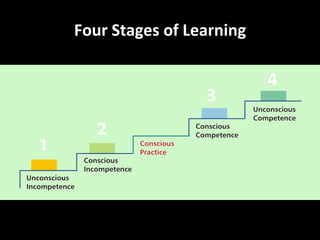
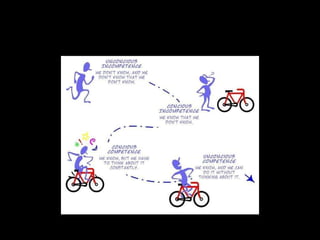
Four Stages of Learning 1 2 3 4
 
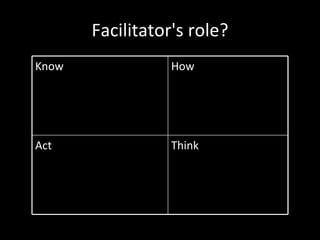
Facilitator's role? Think Act How Know
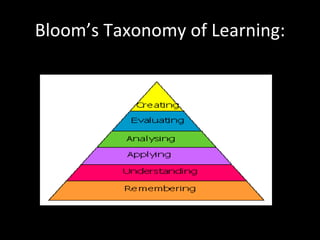
Bloom’s Taxonomy of Learning:
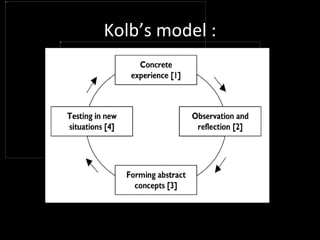
Kolb’s model :    
Honey -Mumford Activist –Reflector- Theorist -Pragmatist
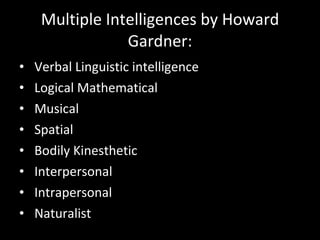
Multiple Intelligences by Howard Gardner: Verbal Linguistic intelligence Logical Mathematical Musical Spatial Bodily Kinesthetic Interpersonal Intrapersonal Naturalist
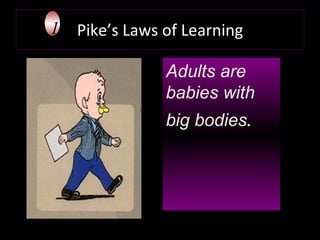
Pike’s Laws of Learning Adults are babies with big bodies . 1
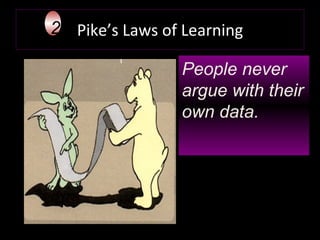
Pike’s Laws of Learning People never  argue with their own data. 2
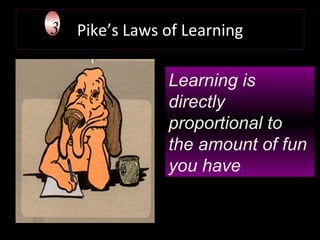
Pike’s Laws of Learning Learning is directly proportional to the amount of fun you have . 3
Pike’s Laws of Learning Learning has not taken place until behavior / work has improved.   4 The purpose of training is to  produce results back on the job.  It is not to cover content.  It is not to teach skills.  It is not to entertain.
Pike’s Laws of Learning It doesn't matter what I can teach you.  What ultimately matters is  what I can teach you to teach others. 5
How do the adults learn? If they see a value (WIIFM) When the price becomes unaffordable By linking learning to experience By practicing what they have been taught In an informal & non threatening environment
What are the behavioral competencies of a trainer?
Behavioral competencies of a trainer: Sets a Learning Environment Uses Adult Learning Principles Knows  the art of Facilitation Conducts Demonstration Uses appropriate training methodology Provides relevant feedback Handles different types of participants Administers test and evaluates skill
Sets a learning environment Sees climate setting activity as an important aspect to begin discussion Defines a  mutually  productive climate  with an appropriate ice-breaker Collaboratively sets ground rules
Uses Adult learning Principles Applies various learning styles and various media to ensure that learning takes shapes (Kolb’s learning) Provides a learning experience through practical insights to cause an experiential impact  Acknowledges &   invites participants experiences for facilitating & discussion
Knows the art of Facilitation Recognizes  the importance of questioning that promotes reflection and learning  Understands how to refocus groups that becomes lost or distracted during an exercise or activity Conducts debriefing of the activity by asking participants to share and interpret their reaction to the activity Handles unexpected learning through facilitative role and not to be directive or controlling
Conducts Demonstration  Understands how much practice and time is required to learn a new skills based on task difficulty  Supervises participants practice demonstrations and  gives feedback,
Uses appropriate training methodology Understands how to put learning concepts in place through role plays, case studies, management games and quizzes
Providing Relevant Feedback  Is specific to the point as to what was said or done rather than being generic or judgmental  Shows a flair for paraphrasing to ensure learner understanding and clear  communication
Administers Tests and Evaluates Skills  To understand the appropriateness of content for testing   Understand the importance and timing of administer the test   Shows deep understanding of making performance observation very objective
Handles Difficult Participants  Understand the various kinds of difficult participants Understand the risk associated with various strategies for handling different participants (Reflect/ Deflect technique)
TRAINING DELIVERY
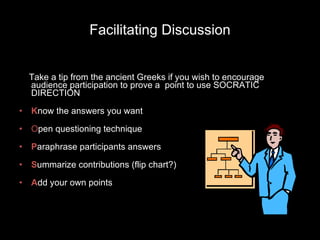
Facilitating Discussion Take a tip from the ancient Greeks if you wish to encourage audience participation to prove a  point to use SOCRATIC DIRECTION K now the answers you want O pen questioning technique P araphrase participants answers S ummarize contributions (flip chart?) A dd your own points
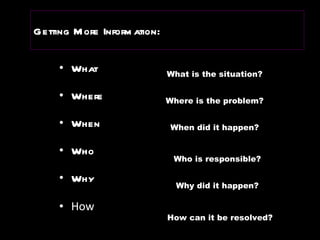
Getting More   Information: What  Where When Who Why How What is the situation? Where is the problem? When did it happen? Who is responsible? Why did it happen? How can it be resolved?
What are the personal attributes of a Facilitator?
Personal Attributes: Communication Skill Questioning Skills ( Funnel technique) Listening Skills Body Language Ability to gauge and adapt as per the learning style Perceptive Energy, Enthusiasm & Passion
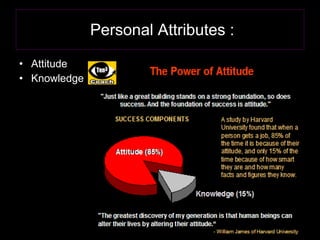
Personal Attributes : Attitude Knowledge
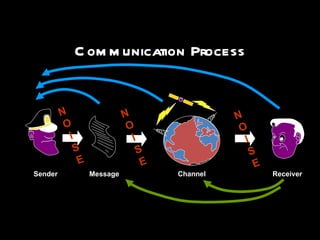
Communication Process NOISE NOISE NOISE Sender Message Channel Receiver
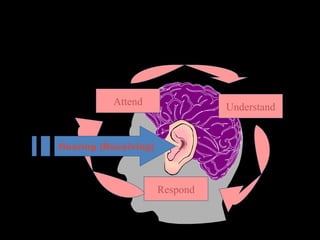
Listening Attend Understand Respond Hearing (Receiving)
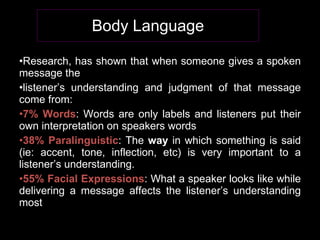
Body Language Research, has shown that when someone gives a spoken message the listener’s understanding and judgment of that message come from: 7% Words : Words are only labels and listeners put their own interpretation on speakers words 38% Paralinguistic : The  way  in which something is said (ie: accent, tone, inflection, etc) is very important to a listener’s understanding. 55% Facial Expressions : What a speaker looks like while delivering a message affects the listener’s understanding most
HOW DOES A PARTICIPANT LEARN??
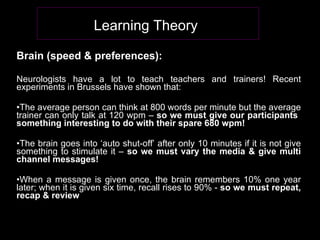
Brain (speed & preferences): Neurologists have a lot to teach teachers and trainers! Recent experiments in Brussels have shown that: The average person can think at 800 words per minute but the average trainer can only talk at 120 wpm –  so we must give our participants  something interesting to do with their spare 680 wpm! The brain goes into ‘auto shut-off’ after only 10 minutes if it is not give something to stimulate it –  so we must vary the media & give multi channel messages! When a message is given once, the brain remembers 10% one year later; when it is given six time, recall rises to 90% -  so   we must repeat, recap & review Learning Theory
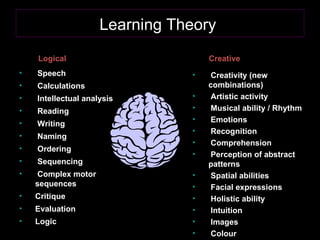
Learning Theory   Logical Speech Calculations Intellectual analysis Reading Writing Naming Ordering Sequencing Complex motor sequences Critique Evaluation Logic Creative Creativity (new combinations) Artistic activity Musical ability / Rhythm Emotions  Recognition Comprehension Perception of abstract patterns Spatial abilities Facial expressions Holistic ability  Intuition Images Colour
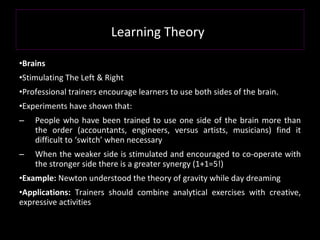
Learning Theory   Brains Stimulating The Left & Right Professional trainers encourage learners to use both sides of the brain. Experiments have shown that: People who have been trained to use one side of the brain more than the order (accountants, engineers, versus artists, musicians) find it difficult to ‘switch’ when necessary When the weaker side is stimulated and encouraged to co-operate with the stronger side there is a greater synergy (1+1=5!) Example:  Newton understood the theory of gravity while day dreaming Applications:  Trainers should combine analytical exercises with creative, expressive activities
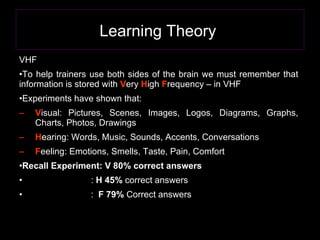
Learning Theory   VHF To help trainers use both sides of the brain we must remember that information is stored with  V ery  H igh  F requency – in VHF Experiments have shown that: V isual: Pictures, Scenes, Images, Logos, Diagrams, Graphs, Charts, Photos, Drawings H earing: Words, Music, Sounds, Accents, Conversations F eeling: Emotions, Smells, Taste, Pain, Comfort  Recall Experiment: V 80% correct answers  :  H 45%  correct answers  :  F 79%  Correct answers
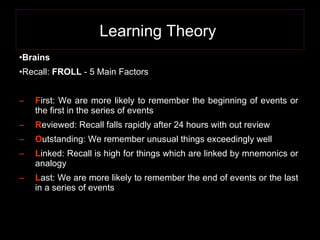
Learning Theory   Brains Recall:  FROLL  - 5 Main Factors  F irst: We are more likely to remember the beginning of events or the first in the series of events  R eviewed: Recall falls rapidly after 24 hours with out review O utstanding: We remember unusual things exceedingly well L inked: Recall is high for things which are linked by mnemonics or analogy L ast: We are more likely to remember the end of events or the last in a series of events
Thanks

Nhrd pune nov.-ppt

  • 1.
    TRAIN THE TRAINERBest Training Is Always A Lead And Not A Lag Factor
  • 2.
    Ground Rules: Pl.do not work on laptops while attending the workshop Pl. do not use mobile phones We shall respect the break times No one leaves except for extreme emergency viz. bio-break et al…. We must be honest in our answers  Any one amongst us who breaks any of the above…???....
  • 3.
    Introduction Your name with an adjective Organization Briefly about your work and in what way you are involved in management training? Expectation from workshop
  • 4.
    Workshop objectives: Understandstages of Learning Understand the importance of adult learning principles in corporate training Understand the behavioral competencies of trainer
  • 5.
    Stages of Learning& Role of Facilitator
  • 6.
    Four Stages ofLearning 1 2 3 4
  • 7.
  • 8.
  • 9.
  • 10.
  • 11.
    Honey -Mumford Activist–Reflector- Theorist -Pragmatist
  • 12.
    Multiple Intelligences byHoward Gardner: Verbal Linguistic intelligence Logical Mathematical Musical Spatial Bodily Kinesthetic Interpersonal Intrapersonal Naturalist
  • 13.
    Pike’s Laws ofLearning Adults are babies with big bodies . 1
  • 14.
    Pike’s Laws ofLearning People never argue with their own data. 2
  • 15.
    Pike’s Laws ofLearning Learning is directly proportional to the amount of fun you have . 3
  • 16.
    Pike’s Laws ofLearning Learning has not taken place until behavior / work has improved. 4 The purpose of training is to produce results back on the job. It is not to cover content. It is not to teach skills. It is not to entertain.
  • 17.
    Pike’s Laws ofLearning It doesn't matter what I can teach you. What ultimately matters is what I can teach you to teach others. 5
  • 18.
    How do theadults learn? If they see a value (WIIFM) When the price becomes unaffordable By linking learning to experience By practicing what they have been taught In an informal & non threatening environment
  • 19.
    What are thebehavioral competencies of a trainer?
  • 20.
    Behavioral competencies ofa trainer: Sets a Learning Environment Uses Adult Learning Principles Knows the art of Facilitation Conducts Demonstration Uses appropriate training methodology Provides relevant feedback Handles different types of participants Administers test and evaluates skill
  • 21.
    Sets a learningenvironment Sees climate setting activity as an important aspect to begin discussion Defines a mutually productive climate with an appropriate ice-breaker Collaboratively sets ground rules
  • 22.
    Uses Adult learningPrinciples Applies various learning styles and various media to ensure that learning takes shapes (Kolb’s learning) Provides a learning experience through practical insights to cause an experiential impact Acknowledges & invites participants experiences for facilitating & discussion
  • 23.
    Knows the artof Facilitation Recognizes the importance of questioning that promotes reflection and learning Understands how to refocus groups that becomes lost or distracted during an exercise or activity Conducts debriefing of the activity by asking participants to share and interpret their reaction to the activity Handles unexpected learning through facilitative role and not to be directive or controlling
  • 24.
    Conducts Demonstration Understands how much practice and time is required to learn a new skills based on task difficulty Supervises participants practice demonstrations and gives feedback,
  • 25.
    Uses appropriate trainingmethodology Understands how to put learning concepts in place through role plays, case studies, management games and quizzes
  • 26.
    Providing Relevant Feedback Is specific to the point as to what was said or done rather than being generic or judgmental Shows a flair for paraphrasing to ensure learner understanding and clear communication
  • 27.
    Administers Tests andEvaluates Skills To understand the appropriateness of content for testing Understand the importance and timing of administer the test Shows deep understanding of making performance observation very objective
  • 28.
    Handles Difficult Participants Understand the various kinds of difficult participants Understand the risk associated with various strategies for handling different participants (Reflect/ Deflect technique)
  • 29.
  • 30.
    Facilitating Discussion Takea tip from the ancient Greeks if you wish to encourage audience participation to prove a point to use SOCRATIC DIRECTION K now the answers you want O pen questioning technique P araphrase participants answers S ummarize contributions (flip chart?) A dd your own points
  • 31.
    Getting More Information: What Where When Who Why How What is the situation? Where is the problem? When did it happen? Who is responsible? Why did it happen? How can it be resolved?
  • 32.
    What are thepersonal attributes of a Facilitator?
  • 33.
    Personal Attributes: CommunicationSkill Questioning Skills ( Funnel technique) Listening Skills Body Language Ability to gauge and adapt as per the learning style Perceptive Energy, Enthusiasm & Passion
  • 34.
    Personal Attributes :Attitude Knowledge
  • 35.
    Communication Process NOISENOISE NOISE Sender Message Channel Receiver
  • 36.
    Listening Attend UnderstandRespond Hearing (Receiving)
  • 37.
    Body Language Research,has shown that when someone gives a spoken message the listener’s understanding and judgment of that message come from: 7% Words : Words are only labels and listeners put their own interpretation on speakers words 38% Paralinguistic : The way in which something is said (ie: accent, tone, inflection, etc) is very important to a listener’s understanding. 55% Facial Expressions : What a speaker looks like while delivering a message affects the listener’s understanding most
  • 38.
    HOW DOES APARTICIPANT LEARN??
  • 39.
    Brain (speed &preferences): Neurologists have a lot to teach teachers and trainers! Recent experiments in Brussels have shown that: The average person can think at 800 words per minute but the average trainer can only talk at 120 wpm – so we must give our participants something interesting to do with their spare 680 wpm! The brain goes into ‘auto shut-off’ after only 10 minutes if it is not give something to stimulate it – so we must vary the media & give multi channel messages! When a message is given once, the brain remembers 10% one year later; when it is given six time, recall rises to 90% - so we must repeat, recap & review Learning Theory
  • 40.
    Learning Theory Logical Speech Calculations Intellectual analysis Reading Writing Naming Ordering Sequencing Complex motor sequences Critique Evaluation Logic Creative Creativity (new combinations) Artistic activity Musical ability / Rhythm Emotions Recognition Comprehension Perception of abstract patterns Spatial abilities Facial expressions Holistic ability Intuition Images Colour
  • 41.
    Learning Theory Brains Stimulating The Left & Right Professional trainers encourage learners to use both sides of the brain. Experiments have shown that: People who have been trained to use one side of the brain more than the order (accountants, engineers, versus artists, musicians) find it difficult to ‘switch’ when necessary When the weaker side is stimulated and encouraged to co-operate with the stronger side there is a greater synergy (1+1=5!) Example: Newton understood the theory of gravity while day dreaming Applications: Trainers should combine analytical exercises with creative, expressive activities
  • 42.
    Learning Theory VHF To help trainers use both sides of the brain we must remember that information is stored with V ery H igh F requency – in VHF Experiments have shown that: V isual: Pictures, Scenes, Images, Logos, Diagrams, Graphs, Charts, Photos, Drawings H earing: Words, Music, Sounds, Accents, Conversations F eeling: Emotions, Smells, Taste, Pain, Comfort Recall Experiment: V 80% correct answers : H 45% correct answers : F 79% Correct answers
  • 43.
    Learning Theory Brains Recall: FROLL - 5 Main Factors F irst: We are more likely to remember the beginning of events or the first in the series of events R eviewed: Recall falls rapidly after 24 hours with out review O utstanding: We remember unusual things exceedingly well L inked: Recall is high for things which are linked by mnemonics or analogy L ast: We are more likely to remember the end of events or the last in a series of events
  • 44.

Editor's Notes

  • #7 THE FACILITOTOR MUST EMPHASIS ON CONSCIOUS PRACTICE STEP.
  • #13 According to multiple intelligences theory, not only do all individuals possess numerous mental representations and intellectual languages, but individuals also differ from one another in the forms of these representations, their relative strengths, and the ways in which (and ease with which) these representations can be changed .